Summarize this article with AI
In Brief
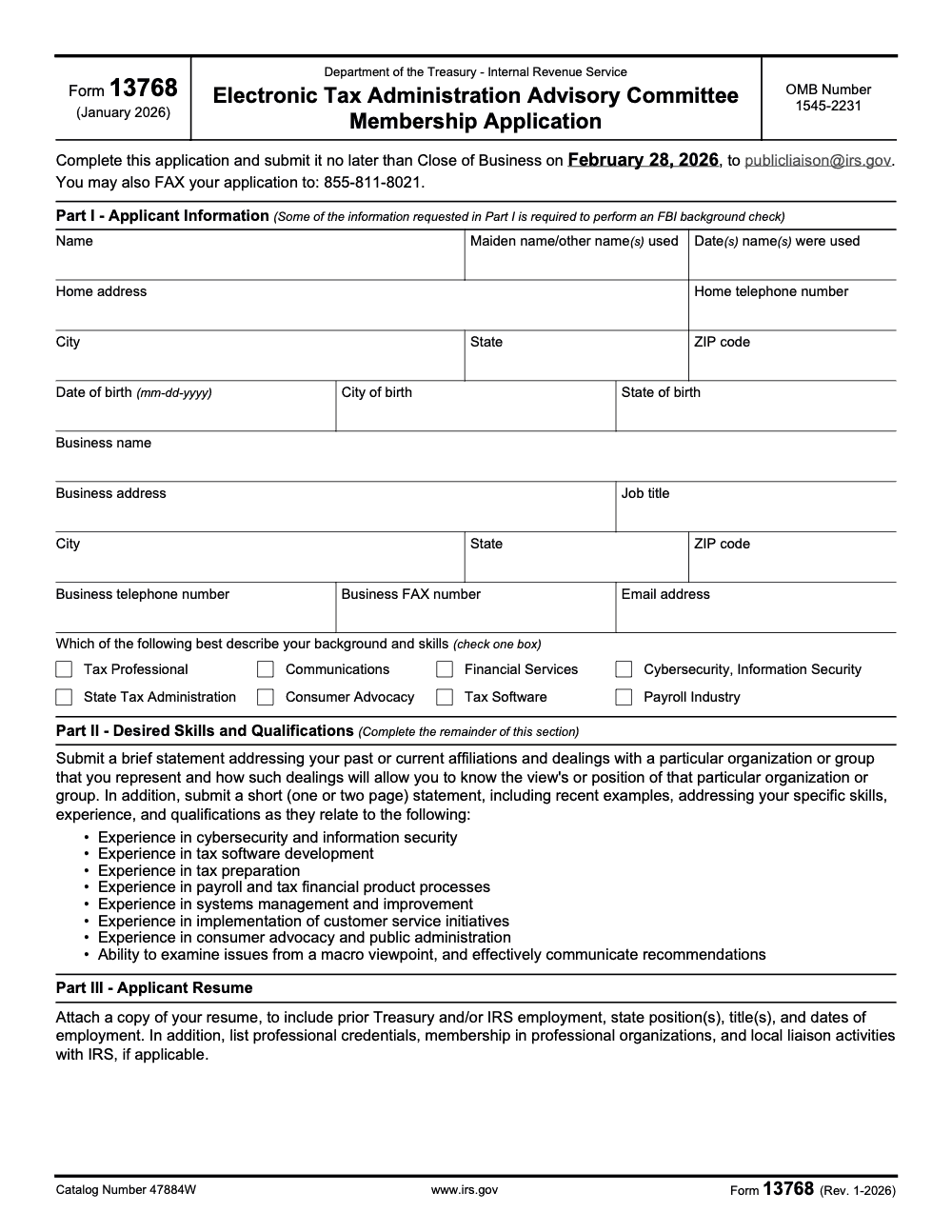
Form 13768 is the IRS Electronic Tax Administration Advisory Committee (ETAAC) membership application, a six-part form (Parts I through VI) used to apply for a seat on the committee that advises the IRS on electronic tax administration. It is not a tax return and has no effect on tax owed. For the 2026 cycle the completed application is due by Close of Business on February 28, 2026, and must be submitted by email to publicliaison@irs.gov or by fax to 855-811-8021 (per Form 13768, Rev. 1-2026); mailing it in is not accepted. After you file, the IRS emails the companion Form 14767 (Consent to Disclose Tax Compliance Check), which you must also return to complete the application.
People read Form 13768 like a tax form and then wonder why it feels like a board candidate bio. It is the membership application for the IRS Electronic Tax Administration Advisory Committee, the group that advises the IRS on electronic tax administration. It is not a tax return and has no effect on tax owed.
The application runs across six parts, and the part that decides outcomes is the statement of interest, because seats are competitive and the selection committee looks for a specific, articulated perspective rather than a generic resume. For the 2026 cycle the completed application is due by Close of Business on February 28, 2026, submitted by email to the public liaison address or by fax to 855-811-8021.
Key Takeaways
- Form 13768 is a membership application for the IRS Electronic Tax Administration Advisory Committee (ETAAC), a federal advisory committee that provides independent input on IRS electronic tax administration strategy and policy.
- Who applies: Tax practitioners, software developers, payroll professionals, financial institutions, tax-exempt organizations, state tax administrators, and consumer advocates with relevant expertise in electronic tax administration.
- Application window: The IRS publishes an annual Federal Register notice announcing the application period, typically in early spring; check the IRS website for the current year’s deadline.
- Main pitfall: Submitting a generic application that doesn’t clearly articulate your specific expertise in electronic tax administration – ETAAC seats are competitive and the selection committee looks for targeted perspective, not broad credentials.
- SOP tip: Draft your “statement of interest” section before filling in credentials; knowing what you want to contribute shapes how you present your background.
What Form 13768 Is and When to Use It
Form 13768 is the official application to serve on the Electronic Tax Administration Advisory Committee, a federal advisory body established under the Federal Advisory Committee Act (FACA) and the Internal Revenue Code. ETAAC was created to provide an organized public forum for discussion of IRS e-file issues and to make recommendations on matters relating to electronic tax administration.
The committee typically has around 14–16 members serving three-year terms. Members are selected to represent a cross-section of stakeholders in the electronic tax system: software developers, EROs (Electronic Return Originators), large and small tax preparation companies, payroll processors, financial institutions, state tax agencies, and consumer advocates. Members serve without compensation but receive reimbursement for travel to meetings.
Why ETAAC Matters to Practitioners
ETAAC produces an annual public report to the IRS that includes recommendations on electronic filing, taxpayer service improvements, and administration of the e-file program. From my side of the desk, ETAAC recommendations have historically influenced IRS decisions on e-file mandates, software certification standards, and identity theft safeguards. Serving on ETAAC gives practitioners a direct voice in shaping the regulatory and technological environment they operate in every day.
Who Should Apply
ETAAC applications are competitive. The IRS looks for applicants who can contribute informed perspectives on specific aspects of electronic tax administration – not just general tax knowledge. Strong applicants typically have deep experience in areas like tax software development, large-volume e-file operations, cybersecurity in the tax context, taxpayer identity verification, or state/federal e-file coordination.
How to Complete Form 13768
Form 13768 is a narrative application form. Unlike most IRS forms, it does not have numbered lines for numerical data – it asks for qualitative information about your background, expertise, and perspective. Approach it as you would a board application or professional fellowship submission.
| Section | What to Provide | Application Tip |
|---|---|---|
| Personal Information | Full name, title, organization name and type, address, phone, email | Use your professional title and affiliation; include a direct phone number where the IRS selection team can reach you |
| Sector / Stakeholder Category | Identify which stakeholder category you represent (software developer, ERO, payroll processor, financial institution, state tax agency, etc.) | Choose the category that best matches your primary role; if you fit multiple categories, pick the one most relevant to your intended contribution |
| Professional Background | Current position, years of experience, relevant credentials (CPA, EA, JD, etc.), employer size and type | Quantify your e-file or electronic tax administration volume where possible – “our firm processes 15,000 e-filed returns annually” is more compelling than “we do a lot of e-filing” |
| Statement of Interest and Relevant Experience | Narrative description of your expertise in electronic tax administration and why you want to serve on ETAAC | Be specific – name the ETAAC priority areas (cybersecurity, taxpayer experience, e-file adoption) where your perspective adds value; generic interest statements are weak applications. Keep the statement short as well – the form limits it to one or two pages, so structure it tightly around the listed experience areas rather than an open-ended multi-page essay |
| Conflict of Interest Disclosure | Disclosure of any financial interests, positions, or relationships that could create an appearance of conflict in ETAAC deliberations | ETAAC members are subject to federal ethics rules; be comprehensive here – undisclosed conflicts discovered later can disqualify an otherwise strong applicant |
| Availability Certification | Confirm that you can attend the required number of ETAAC meetings annually (typically 4–6 per year, primarily in Washington, D.C.) | Review your calendar before committing; missing meetings is a basis for removal from the committee |
Supporting Documents
Attach a current resume or curriculum vitae with your Form 13768. The IRS selection committee reviews resumes alongside the application form. Your resume should emphasize electronic tax administration experience, leadership roles in tax or technology organizations, and any prior federal advisory committee service. The form specifically requires you to list any prior Treasury and/or IRS employment, state positions and titles with dates, professional credentials, professional memberships, and any local liaison activities with the IRS – leaving those out when they apply weakens an otherwise strong application.
Deadlines, Penalties, and Filing Requirements
Form 13768 is not a tax filing – it carries no penalties for non-submission. However, application deadlines are firm, and late applications are not considered.
| Action | Timing | Notes |
|---|---|---|
| Federal Register notice of open application period | Typically published January–March each year | Subscribe to Federal Register notices or check IRS.gov/etaac for current announcements |
| Application submission deadline | Per Federal Register notice (typically 30–60 days after publication) | Deadlines are firm; submit at least one week early in case of technical issues |
| IRS selection process | Several months after deadline | The IRS reviews applications, conducts background checks, and obtains Treasury Department approval for appointments |
| New member term begins | Typically September–October of the application year | Members serve three-year terms; reappointment requires a new application |
Background Check and Ethics Requirements
All ETAAC applicants undergo a federal background check – in fact three separate checks: a Federal income tax compliance check, an FBI background check, and a practitioner check, not the FBI check alone. Members must comply with federal ethics rules applicable to Special Government Employees (SGEs), including financial disclosure and conflict of interest requirements. Applicants with significant financial interests in IRS contracting or regulatory matters affecting their employer may face recusal requirements.
What ETAAC Does and Why It Matters
ETAAC meets regularly throughout the year and produces a comprehensive annual report submitted to the IRS Commissioner and the Senate Finance and House Ways and Means Committees. The report includes recommendations on electronic filing, taxpayer authentication, cybersecurity, accessibility, and the overall health of the electronic tax ecosystem.
Recent ETAAC Priority Areas
In recent years, ETAAC has focused on identity verification and fraud prevention (including recommendations on IRS online account security), expanding e-file to business returns, improving taxpayer experience on IRS digital platforms, and coordinating federal and state e-file standards. If your expertise aligns with any of these areas, emphasize that alignment explicitly in your Form 13768 statement of interest.
What Members Actually Do
Members attend 4–6 full committee meetings per year and participate in working groups between meetings. Working group assignments depend on expertise and interest. Members review IRS proposals, hear from IRS subject matter experts, and draft recommendation language for the annual report. The time commitment is meaningful – typically 10–15 hours per month during active periods.
Common Mistakes That Slow Things Down
Form 13768 is short, but the same handful of avoidable errors stalls or sinks applications every cycle. Most are process problems, not knowledge gaps.
Practical Checklists You Can Reuse
These checklists are copy-paste ready for your firm’s SOP library or a personal application folder. Work them top to bottom before you submit.
Form 13768 part-by-part packet
- Part I: enter applicant and business information, with date of birth in mm-dd-yyyy format.
- Part I: list any maiden or other names used, along with the dates each name was used.
- Part I: select exactly one of the eight background and skill categories.
- Part II: draft the one-to-two-page skills statement around the eight listed experience areas.
- Part II: add the affiliation statement describing any group you represent.
- Part III: attach a resume with prior Treasury/IRS employment, state positions and dates, credentials, and memberships.
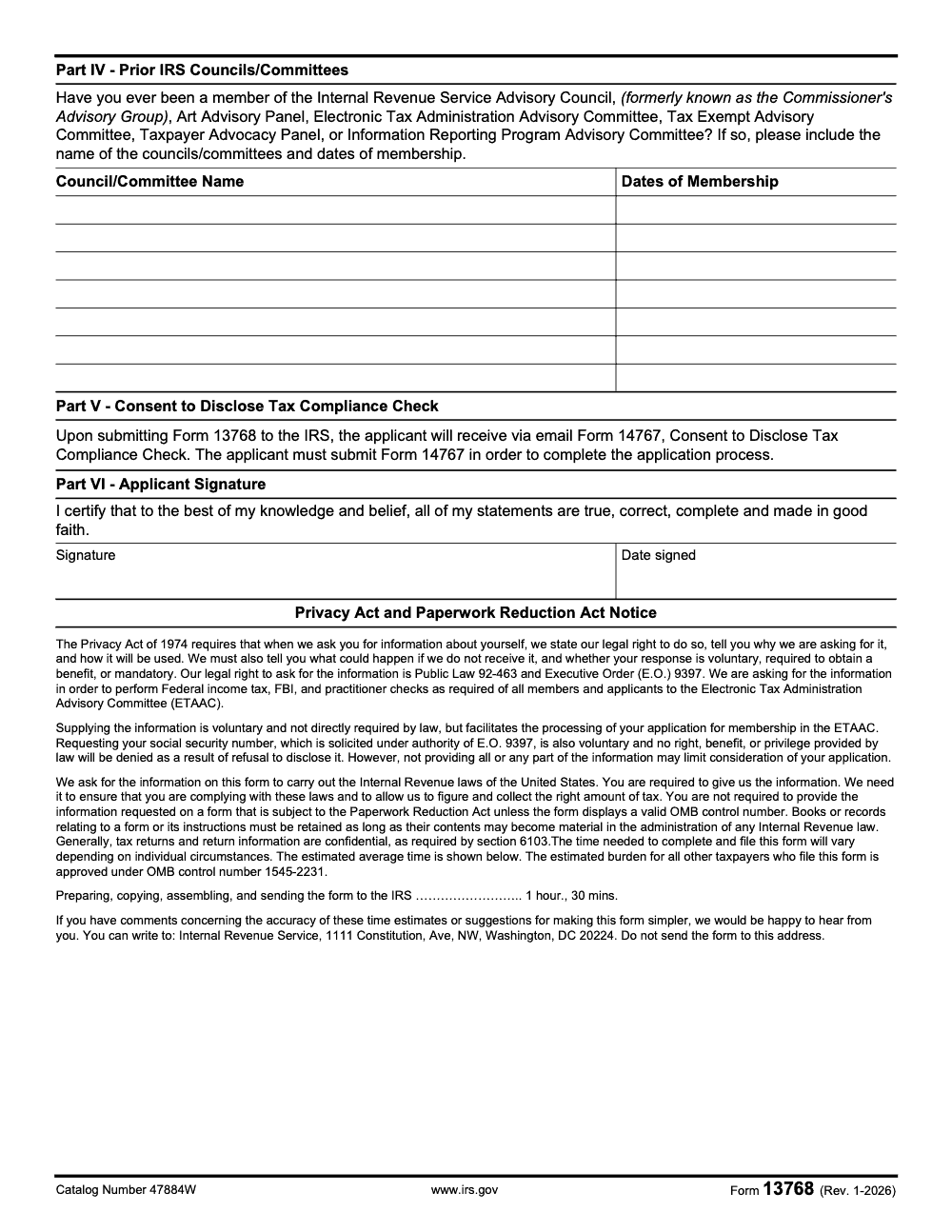
- Part IV: note prior service on any of the six listed IRS councils or committees, with dates.
- Parts V and VI: complete the tax-compliance consent, then sign and date the application.
Background-check and eligibility readiness
- Confirm you can clear all three checks: Federal income tax check, FBI check, and practitioner check.
- Resolve any open federal income tax compliance issues before you apply.
- Verify Part I birth city and state are accurate, since they support the FBI check.
- Decide on SSN disclosure: it is voluntary under Executive Order 9397, but it underpins the background checks.
- Confirm your business contact details are current so the selection team can reach you.
Submission and follow-through
- Submit by email to publicliaison@irs.gov or by fax to 855-811-8021, never by mail.
- Send before Close of Business on the cycle deadline, not 11:59 PM.
- Save a complete copy of the application packet for your records.
- Watch your email for the companion Form 14767 (Consent to Disclose Tax Compliance Check).
- Complete and return Form 14767 to finish the application.
Keep 13768 Season From Stalling
The ETAAC application window is short and it lands in the middle of filing season. For the 2026 cycle the completed Form 13768 is due by Close of Business on February 28, 2026, and unlike a tax return it is a narrative packet: six parts, a one-to-two-page skills statement, and a full resume. The IRS estimates the form itself at 1 hour and 30 minutes (per the Paperwork Reduction Act notice on Form 13768), but the writing and the two-step Form 14767 follow-up are where applications actually stall.
The fix is to treat the application like any other dated deliverable, with an owner and a documented sequence, instead of squeezing it between client work in the final week.
- Draft the Part II statement first – one or two pages, mapped to the eight experience areas – so the rest of the form has a clear point of view.
- Pre-build the Part III resume block: prior Treasury/IRS employment, state positions with dates, credentials, memberships, and local IRS liaison activity.
- Calendar the Close of Business deadline as a hard internal due date, then submit by email or fax a day early.
- Assign one owner to watch for the emailed Form 14767 and return it, so the file does not stall after Part VI is signed.
- Keep a short clearing log for the three checks – Federal income tax, FBI, and practitioner – so any compliance issue surfaces before you apply.
When the application window collides with filing deadlines, the disciplined-delivery habits that keep returns moving keep an ETAAC packet moving too. Accountably brings that same structured, U.S.-led execution to tax and accounting delivery, so routine production work stays handled while you focus on the narrative and relationships that win a committee seat.
FAQs
ETAAC is a federal advisory committee that provides independent recommendations to the IRS on matters related to electronic tax administration – including e-file programs, taxpayer authentication, cybersecurity, and digital service improvements. It is authorized under the IRS Restructuring and Reform Act of 1998 and operates under FACA. The committee’s annual report is publicly available and submitted to Congress.
Any individual with relevant expertise in electronic tax administration may apply. The IRS seeks representation from tax software developers, EROs, payroll companies, financial institutions, state tax agencies, tax-exempt organizations, and consumer advocates. Members serve as Special Government Employees and must meet federal eligibility requirements including a background check.
ETAAC typically receives significantly more applications than there are open seats in any given year. Selection is based on the IRS’s goal of maintaining diverse stakeholder representation, the relevance of an applicant’s expertise to current committee priorities, and the quality of the application. A specific, well-articulated statement of interest significantly improves selection odds.
ETAAC members serve three-year terms. Members may reapply at the end of their term; reappointment requires a new Form 13768 application and goes through the same selection process as initial appointments. There is no automatic renewal.
Submit the completed Form 13768 by email to publicliaison@irs.gov or by fax to 855-811-8021. Mailing the form is not an accepted method – the Washington, DC address printed in the Paperwork Reduction Act notice is for written comments only. For the 2026 cycle the application is due by Close of Business on February 28, 2026.
About this guide
Accountably helps US CPA, EA, and accounting firms hire trained accountants and tax preparers in India.
About us Reviewed byJugal Thacker, CPAFounder and CEO at Accountably
A Washington-licensed CPA with 7+ years inside US firms – PwC, a real-estate tax practice, then a full-service firm, rising from reviewer to manager to advisory. This article was reviewed against current IRS guidance for the 2025 tax year and updated for filers preparing late returns, amendments, and 2026 estimates.
View profile →How we research, review, and update this guide
Every Accountably guide is researched against primary IRS sources, reviewed by a U.S. CPA, and refreshed as guidance evolves. Read our Editorial Guidelines to see how we source, fact-check, and update our content.