Summarize this article with AI
In Brief
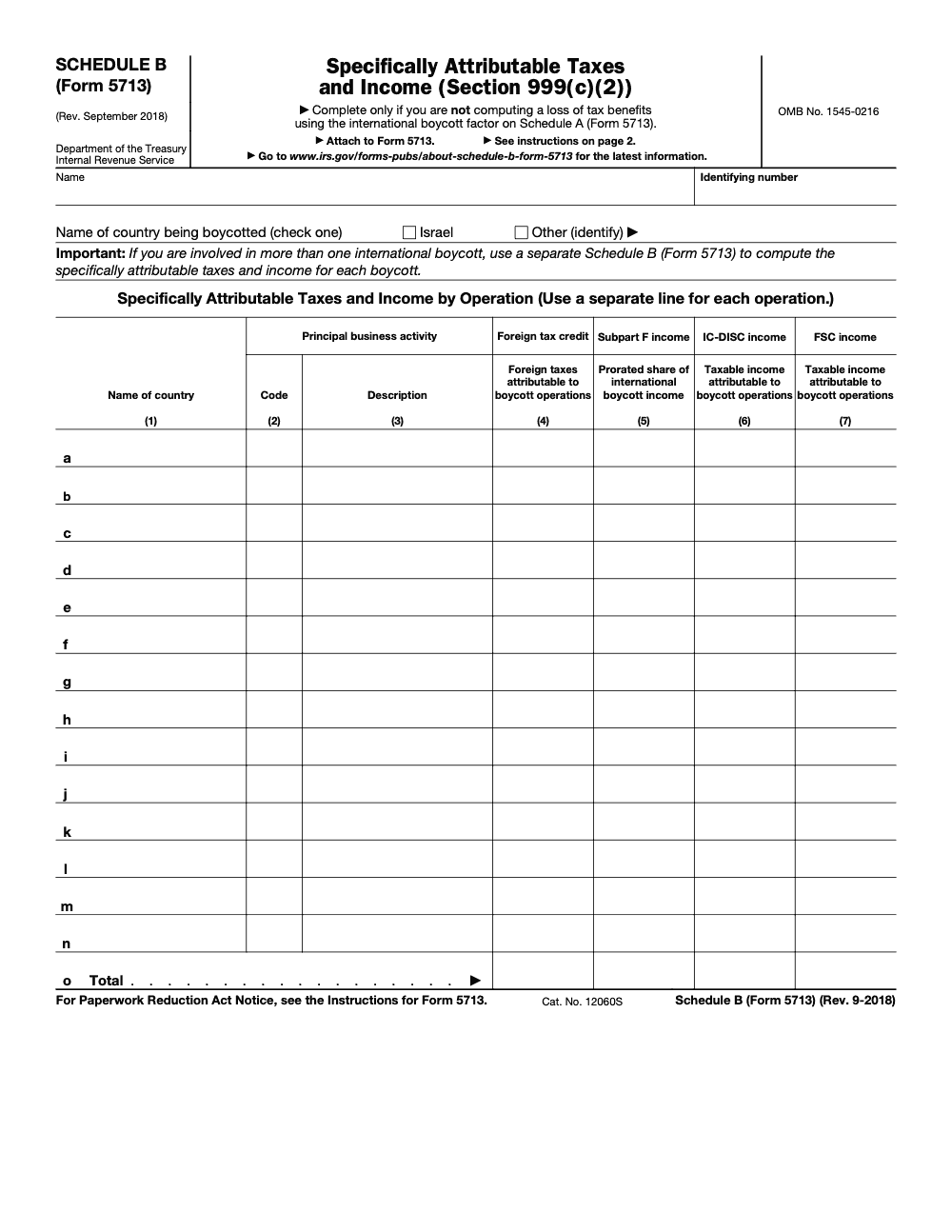
Schedule B (Form 5713) reports foreign taxes and income specifically attributable to international boycott operations under IRC §999(c)(2), with the column (4), (5), (6), and (7) totals on line o carrying to Schedule C lines 2b, 3b, 4b, and 5b (per the Instructions for Schedule B (Form 5713), Rev. September 2018). The September 2018 revision (OMB 1545-0216) is still the current form for tax year 2025; file Schedule B only when you elect specific attribution instead of the Schedule A boycott factor, attach it to Form 5713, and align it with the period of your U.S. income tax return.
The year a manufacturing client opened a sales office in a country on the Treasury boycott list, nobody on the engagement noticed until the tax provision was closing. The clean fix was Schedule B. Schedule B (Form 5713) reports foreign taxes and income specifically attributable to international boycott operations under IRC §999(c)(2), and you file it only when you elect specific attribution instead of the Schedule A factor method.
The schedule looks small, a handful of columns and a totals row on line o, but it sits on top of subpart F, the foreign tax credit rules, IC-DISC, and the former FSC regime at once. The column (4), (5), (6), and (7) totals on line o carry to Schedule C lines 2b, 3b, 4b, and 5b. Watch the interactions the September 2018 instructions flag, including the §952(a)(3) inclusion that stays in column (5) and the §911 and §6038 rules touching column (4).
Key Takeaways
- You file Schedule B when you elect the specifically attributable method under IRC §999(c)(2), then you flow the totals to Schedule C to compute the loss of benefits, such as the foreign tax credit.
- The IRS confirms that Schedules A, B, and C are part of the Form 5713 package, and Schedule C is where you compute the final reduction. The About Form 5713 page was reviewed on January 23, 2026.
- The Treasury list of boycotting countries is updated in the Federal Register. As of multiple 2025 notices, the list included Iraq, Kuwait, Lebanon, Libya, Qatar, Saudi Arabia, Syria, and Yemen. Always check the current quarterly notice before filing.
- Schedule B shows OMB No. 1545‑0216 on the face of the form, and the Paperwork Reduction Act notice appears in the Instructions for Form 5713. Keep records long enough for tax administration needs.
What is Schedule B, in plain English
Schedule B, Specifically Attributable Taxes and Income, is the trackable way to compute the loss of tax benefits when an operation involves an international boycott. Instead of using a single percentage factor, you tie specific foreign taxes and related income to boycott‑linked operations, then carry those amounts to Schedule C. Think of it as itemized proof for what the law will disallow.
If you choose specific attribution, Schedule B is your evidence log, and Schedule C is the calculator that applies the reduction.
The IRS provides the Schedule B PDF inside the Form 5713 package, and the instructions make it clear that you either use Schedule A with the international boycott factor, or you use Schedule B for specific attribution, then complete Schedule C either way.
Who must file Schedule B
You must complete Schedule B if you participated in or cooperated with an international boycott and you are figuring the loss of tax benefits by specifically attributing taxes and income under IRC §999(c)(2). Covered filers include U.S. persons such as individuals, corporations, partnerships, certain trusts where the owner is treated under §671, controlled group members under §993(a)(3), and U.S. shareholders under §951(b) when the related foreign corporation has reportable operations.
The instructions also explain when you attach Schedules to the return, how partnerships and partners split the work, and how certain regimes like IC‑DISC and the now‑repealed FSC are handled in the computation framework. Even with those legacy regimes, the computation still runs through Schedules A or B feeding Schedule C.
Schedule A vs Schedule B, which fits your facts
- Use Schedule A when your boycott involvement is broad, and a percentage reduction, the International Boycott Factor, is the practical choice.
- Use Schedule B when you can point to specific taxes and income items that connect to boycott‑related operations. This is common when the activity is confined to identifiable contracts, customers, or shipments. Do not use Schedule B to compute the reduction to foreign trade income qualifying for the extraterritorial income (ETI) exclusion – that calculation belongs on Schedule A, not Schedule B.
In every case, you finish on Schedule C. That is where the disallowance hits the foreign tax credit, and, where applicable, other benefits defined in the instructions.
A quick comparison you can skim
- Schedule A, percentage method, faster, less precise, best for widespread participation.
- Schedule B, specific method, more work up front, higher accuracy, best for discrete items.
- Schedule C, always required, the single place the reductions are computed and carried to Forms 1116 or 1118 as appropriate.
What data Schedule B expects from you
You will list each country, the tax type and amount paid or accrued, the income items tied to those taxes, and a short description of the transaction or operation. Your worksheet should show the math that ties the tax to the related income, and it should reconcile to your books. That documentation is what keeps reviewers efficient and keeps your file ready for questions. The Schedule B PDF itself directs you to bring totals to Schedule C lines for taxes and income, so structure your workpapers to mirror those columns.
I recommend you build a standing template for each filing season, then update it with the current boycotting‑country list before you open your first file. The list is published quarterly in the Federal Register, and the IRS Form 5713 page links the schedules you need.
Step by step, completing Schedule B without chaos
Here is a process you can follow. It is the same flow I use to keep reviewers out of second and third passes.
- Confirm your method, specific attribution under §999(c)(2), and that you will complete Schedule C after Schedule B.
- Pull the current Treasury list of boycotting countries from the latest Federal Register notice. Do not rely on memory, the list changes over time. As of multiple 2025 notices, the list included eight countries, but you must verify the quarter that covers your tax year.
- Identify every reportable operation tied to a listed country or another country you know, or have reason to know, requires cooperation with a boycott. Tie each item to a specific contract, shipment, or invoice where possible.
- For each operation, capture the foreign tax by type and amount, then link it to the related gross receipts or taxable income. Keep the description short and specific, for example, Withholding tax on invoice 2025‑0447 for parts shipped to customer X, tied to Country Y requirement.
- Enter items in Schedule B columns, then push the column totals to Schedule C lines as the form instructs. This is where your template earns its keep.
- Reconcile totals to your GL and to any foreign returns or withholding statements. Save scans or downloads in the same folder as your worksheet to make review painless. The IRS instructions emphasize retention and tie‑out to source books and records.
A simple worksheet you can copy
| Country | Tax type | Amount | Linked income item | Brief description | Schedule C line |
| Country A | Withholding | 12,500 | Sales order 2387 | Service fees subject to WHT | Line 2b |
| Country B | Income tax | 35,000 | Local branch profit | Annual assessment, boycott‑linked | Line 2b |
| Country C | Other | 8,400 | Commission income | Contract clause required cooperation | Line 2b |
Totals from this table should tie to Schedule B, then roll to Schedule C. The face of Schedule B tells you exactly which totals move to which Schedule C lines, for example, column 4 to Schedule C line 2b.
How Schedule B affects your foreign tax credit
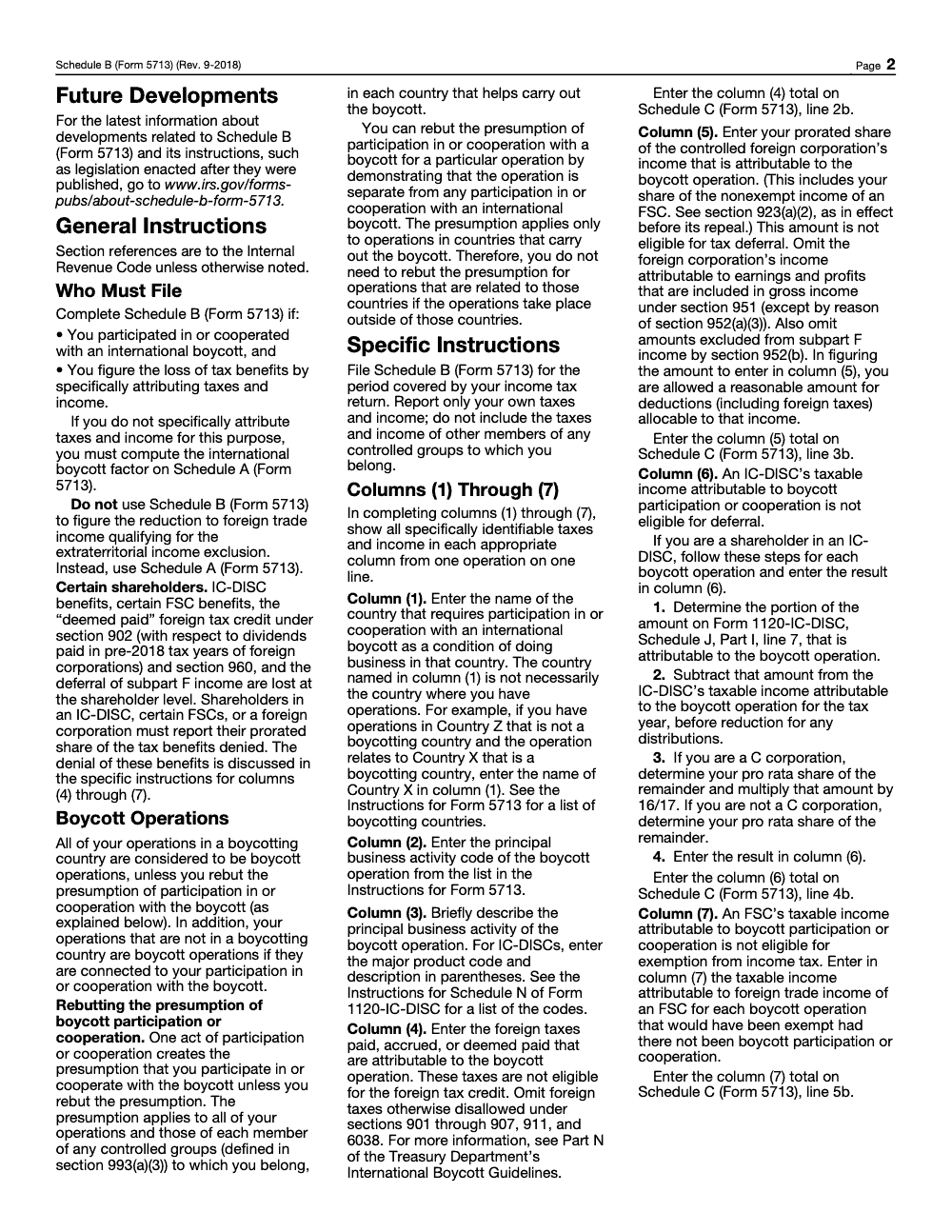
Your Schedule B totals are the roadmap for disallowed credits. Taxes in column 4 are not eligible for the foreign tax credit and must be carried to Schedule C (omit any foreign taxes already disallowed under sections 901 through 907, 911, or 6038 – the boycott rules do not double‑count those disallowances). From there, the reduction hits your Form 1116 or 1118, depending on the filer. This is why accuracy on Schedule B matters, an overstated credit can trigger adjustments, while clean support lowers the chance of back‑and‑forth.
Clean attribution saves you twice, first on review time, then on examination questions.
The instructions also outline how partnerships and partners handle the computation. Partnerships generally complete parts of Schedules A or B, not Schedule C. Partners then use Schedule C to compute the loss of their benefits and carry results to the correct forms. If your structure includes controlled groups, U.S. shareholders, or grantor trusts, align the allocations before you start keying forms.
Deadlines, filing, and penalties you should not ignore
Attach Form 5713 with the applicable Schedules to your timely filed income tax return, including extensions. If you e‑file the return, you can attach Form 5713 electronically as well. Willful failure to file can bring a fine up to $25,000, up to one year in prison, or both. Keep this in your internal calendar, and put a check box for 5713 in your workpaper kick‑off list for any client with potential exposure.
Keep your list current
The boycotting‑country list is published at least quarterly. You may see changes year over year, and older instruction examples still mention countries that have dropped off. Always cite the current Federal Register notice in your file, with the date and page number, so a reviewer can confirm it in seconds.
How Schedule B feeds Schedule C, the flow you will use every time
Think of Schedule B as line‑by‑line support, and Schedule C as the summary that applies the law’s reduction. On Schedule B you total the specifically attributable foreign taxes and related income. On Schedule C you compute the loss of tax benefits tied to those amounts. The IRS confirms this structure across the Form 5713 materials, and the Schedule B PDF points you to the exact Schedule C lines.
For example, you enter foreign taxes attributable to boycott operations in column 4 of Schedule B, then you carry that total to Schedule C line 2b. You do the same for prorated CFC income, IC‑DISC taxable income, and FSC foreign trade income where relevant under the instructions. Once Schedule C is complete, you carry the results to Form 1116 or 1118.
Partnerships, trusts, controlled groups, and U.S. shareholders
- Partnerships usually complete the relevant parts of Schedules A or B to provide detail to partners, not Schedule C. Each partner then completes Schedule C to compute their own loss of benefits.
- Trusts where §671 applies follow the owner‑level filing rule, with Schedule B completed when the trust has reportable operations and the owner is computing a loss by specific attribution.
- Controlled groups under §993(a)(3) and U.S. shareholders under §951(b) have their own allocation considerations. Confirm group member operations and shareholder‑level inclusions before you finalize the numbers, and remember each member reports only its own taxes and income on its own Schedule B – do not aggregate other controlled‑group members' amounts onto a single schedule, even though the boycott presumption sweeps the whole group.
Recordkeeping that stands up in review
The Paperwork Reduction Act notice in the instructions reminds you to keep books and records as long as they may be material to tax administration. In practice, that means you retain contracts, invoices, withholding statements, foreign returns, and your attribution computations that tie taxes to income. Make it easy for a reviewer to understand your data trail, and note the current OMB number and revision dates on the form in your file header.
Two quick points to lock down:
- The Schedule B PDF displays OMB No. 1545‑0216 at the top right. Capture a copy in your workpapers for the year you file.
- The IRS instructions page for Form 5713 contains the PRA language, including approved burden estimates and the rule that you are not required to respond unless a valid OMB control number is displayed.
Practical retention checklist
- Save the current Federal Register notice that covers your tax year, with date and citation.
- Keep a signed PDF of Schedule B as filed, and the final Schedule C, with cross‑references to Forms 1116 or 1118.
- Maintain the source ledger tie‑outs that show the totals reconcile to your books.
- Store any controlled group or shareholder allocation memos with the workpapers, so you do not need to hunt them down when someone asks six months later.
A quick note on E‑file and duplicate copies
If you e‑file your return, attach Form 5713 and the applicable schedules electronically. When you successfully attach the original electronically, the IRS instructions say there is no need to file a duplicate Form 5713. This saves you an extra mailing and keeps your file clean.
Common Schedule B mistakes and how to avoid them
- Aggregating instead of attributing. Schedule B is a specific method, so tie each tax to a clear income item, and keep narrative support short and plain. This prevents overstated credits and broken ties on Schedule C.
- Missing partner or shareholder shares. Pull controlled group, partner, and U.S. shareholder data early. Late allocations drive rework and risk mismatches with Forms 1116 or 1118.
- Using an outdated country list. Old checklists still cite countries that dropped off years ago. Add the current Federal Register notice to the top of your file.
- Skipping Schedule C. Even if you use Schedule B, you must finish on Schedule C. Build this into your closeout checklist for every case.
- Weak documentation. The instructions expect retention that allows tax administration. Save the withholding certificates, foreign returns, and reconciliations in one folder per case.
Schedule A vs Schedule B, a side by side look
| Feature | Schedule A, International Boycott Factor | Schedule B, Specifically Attributable |
| Method | Percentage factor across affected items | Itemized taxes and income tied to operations |
| Best when | Participation is broad and uniform | Impact is confined to identifiable items |
| Speed | Faster to prepare | Slower, more accurate |
| Review | Easier overview, less detail | Heavier review up front, fewer questions later |
| Always finish on | Schedule C | Schedule C |
The IRS materials back this structure. You choose the method that fits your facts, then complete Schedule C to compute the loss of benefits.
Workflow tips from the review chair
- Start with the list. Paste the current Federal Register list of countries at the top of your worksheet with the date and citation.
- Mirror the form. Build your columns to match Schedule B, then use formulas to roll totals to the matching Schedule C lines.
- Tag sources. Every line has a source file name or link, so a reviewer can open it in one click.
- Reconcile first. Prove the totals to the GL before you request the first review.
Where Accountably fits, only if you need extra hands
If you are short on in‑house capacity during peak season, strict workpaper structure protects you from review bottlenecks. Accountably’s offshore delivery teams work inside your systems and templates, keep file naming and version control tight, and prepare line‑by‑line support that ties to Schedule C without extra back‑and‑forth. That is helpful when you are juggling Schedule B, country lists, and Form 1116 or 1118 timelines. Use us if you need disciplined execution, skip us if your team already has the process humming. (You can read more on our delivery approach elsewhere on this site.)
Conclusion, make Schedule B calm and review‑ready
If you have struggled with Schedule B, it is rarely because you lack clients, it is because the delivery model breaks under pressure. When you build a simple checklist, keep the current country list, mirror the form’s columns, and reconcile before review, the work stops feeling heavy. Your totals land cleanly on Schedule C, your foreign tax credit is right the first time, and your reviewers spend their time on strategy rather than chasing missing support. The IRS keeps the Form 5713 page and schedules current, and it was reviewed on January 23, 2026, so use that page as your anchor each season.
Common Mistakes We See Every Season
Schedule B errors compound fast because the columns funnel straight into Schedule C without a second pass. Most are simple to prevent if you catch them at the operations-log stage rather than at form prep.
Reusable Checklists
These checklists are written to paste into a firm SOP or engagement file. Each item is one decision or one piece of documentation, not a paragraph.
Per-operation working paper
- Confirm the boycotting country for column (1) against the current Treasury Department International Boycott Guidelines.
- Pull the principal business activity code for column (2) from the Instructions for Form 5713 list – not NAICS or SIC.
- For IC-DISC operations, include the major product code from the Instructions for Schedule N of Form 1120-IC-DISC in column (3) along with the description.
- Identify each member of the controlled group (per §993(a)(3)) with operations in the boycotting country and tag whether a per-operation rebuttal applies.
- Mark operations physically located outside boycotting countries – no rebuttal is required for those rows.
- Check exactly one country box at the top of Schedule B: Israel or Other (identify).
Column-by-column reconciliation
- Column (4): strip foreign taxes already disallowed under §§901–907, §911, or §6038 before entering any amount.
- Column (5): include §952(a)(3) boycott income; omit other §951 inclusions and amounts excluded under §952(b).
- Column (5): allocate reasonable deductions, including foreign taxes, to the boycott-attributable income.
- Column (5): include the filer's share of FSC nonexempt income under former §923(a)(2).
- Column (6): run the four steps explicitly – Schedule J, Part I, line 7 portion; subtraction from IC-DISC boycott income; pro rata share; 16/17 only for C-corporation shareholders.
- Column (7): enter the FSC's foreign-trade income that would have been exempt absent boycott participation.
Schedule C handoff and sign-off
- File one Schedule B per international boycott – multiple boycotts get separate schedules.
- Carry the line o column (4) total to Schedule C, line 2b.
- Carry the line o column (5) total to Schedule C, line 3b.
- Carry the line o column (6) total to Schedule C, line 4b.
- Carry the line o column (7) total to Schedule C, line 5b.
- Attach Schedule B to Form 5713 and file it for the same period as the income tax return.
- Confirm no taxes or income of other controlled-group members appear on this filer's Schedule B.
Keep Schedule B (Form 5713) Season From Stalling
International boycott reporting has a thin practitioner bench and a heavy review burden. The September 2018 Schedule B (Form 5713) revision (OMB 1545-0216) is still the current form for tax year 2025 (per the Instructions for Schedule B (Form 5713), Rev. September 2018), and the column logic pulls from subpart F, the foreign tax credit rules, IC-DISC, and the former FSC regime at once. When clients with IC-DISC, FSC, or controlled-foreign-corporation operations show up in late winter, the seven columns are not the bottleneck – tracing each operation back to the right source line on Form 1120-IC-DISC, Schedule J, Part I, line 7 or the right §952(a)(3) inclusion under subpart F is what eats review hours.
The fix is to standardize the inputs before you ever open Schedule B. Treat the schedule as a downstream worksheet feeding off a clean, controlled-group-aware operations log, not as the place where the analysis happens. Teams that lock the inputs at the working-paper stage clear review the first time.
- Build a per-operation working paper that maps each row to the boycotting country (column 1), the Form 5713 business activity code (column 2), and, for IC-DISC operations, the major product code from Schedule N of Form 1120-IC-DISC.
- Strip foreign taxes already disallowed under §§901–907, §911, or §6038 before any amount lands in column (4) – per the Instructions for Schedule B (Form 5713), those amounts do not enter the boycott calculation.
- Document the column (6) four-step IC-DISC procedure explicitly and reserve the 16/17 multiplier for C-corporation shareholders only.
- Tag §951 inclusions in two buckets – amounts to exclude from column (5), and §952(a)(3) boycott income that stays in column (5) – so the reviewer can confirm the cut without re-reading the statute.
- Reconcile every line o column total to its Schedule C destination (lines 2b, 3b, 4b, and 5b) before sign-off, with a tickmark on each row.
When boycott reporting collides with foreign tax credit work and year-end provision, our U.S. tax delivery teams run the operations log, schedule prep, and Schedule C reconciliation inside your engagement templates – so review notes shrink instead of stack.
FAQs
Schedule B documents foreign taxes and related income that are specifically attributable to boycott‑linked operations. It replaces the percentage approach of Schedule A, then feeds totals to Schedule C where the loss of benefits is computed. You still attach the schedules to your income tax return.
U.S. persons with operations in or related to a boycotting country, or with its government, companies, or nationals, must file when they participate or cooperate and choose specific attribution under §999(c)(2). This includes individuals, corporations, partnerships, certain trusts, controlled group members, and U.S. shareholders when a foreign corporation has reportable operations.
Schedule B captures the itemized taxes and income that are disallowed. Schedule C applies the loss of benefits to the foreign tax credit and other items defined in the instructions, then the results flow to Form 1116 or 1118.
The Department of the Treasury publishes the list in the Federal Register, at least quarterly. In 2025 notices, the list included eight countries, but you must cite the notice that covers your period. Keep a copy in your file.
Willful failure to file can lead to a fine up to $25,000, up to one year in prison, or both. Put Form 5713 in your standard compliance checklist and track it like any other required attachment.
Other forms this guide names
- Form 1116: Foreign Tax Credit Guide 2025, How to Claim
- Form 1118: Corporate FTC Filing, Baskets, Limits, Carryovers
- Form 952: Consent to Extend the Time to Assess Tax Under Section 332(b)
- Form 1120‑IC‑DISC: Filing Guide, Schedules, Deadlines
About this guide
Accountably helps US CPA, EA, and accounting firms hire trained accountants and tax preparers in India.
About us Reviewed byJugal Thacker, CPAFounder and CEO at Accountably
A Washington-licensed CPA with 7+ years inside US firms – PwC, a real-estate tax practice, then a full-service firm, rising from reviewer to manager to advisory. This article was reviewed against current IRS guidance for the 2025 tax year and updated for filers preparing late returns, amendments, and 2026 estimates.
View profile →How we research, review, and update this guide
Every Accountably guide is researched against primary IRS sources, reviewed by a U.S. CPA, and refreshed as guidance evolves. Read our Editorial Guidelines to see how we source, fact-check, and update our content.