Summarize this article with AI
In Brief
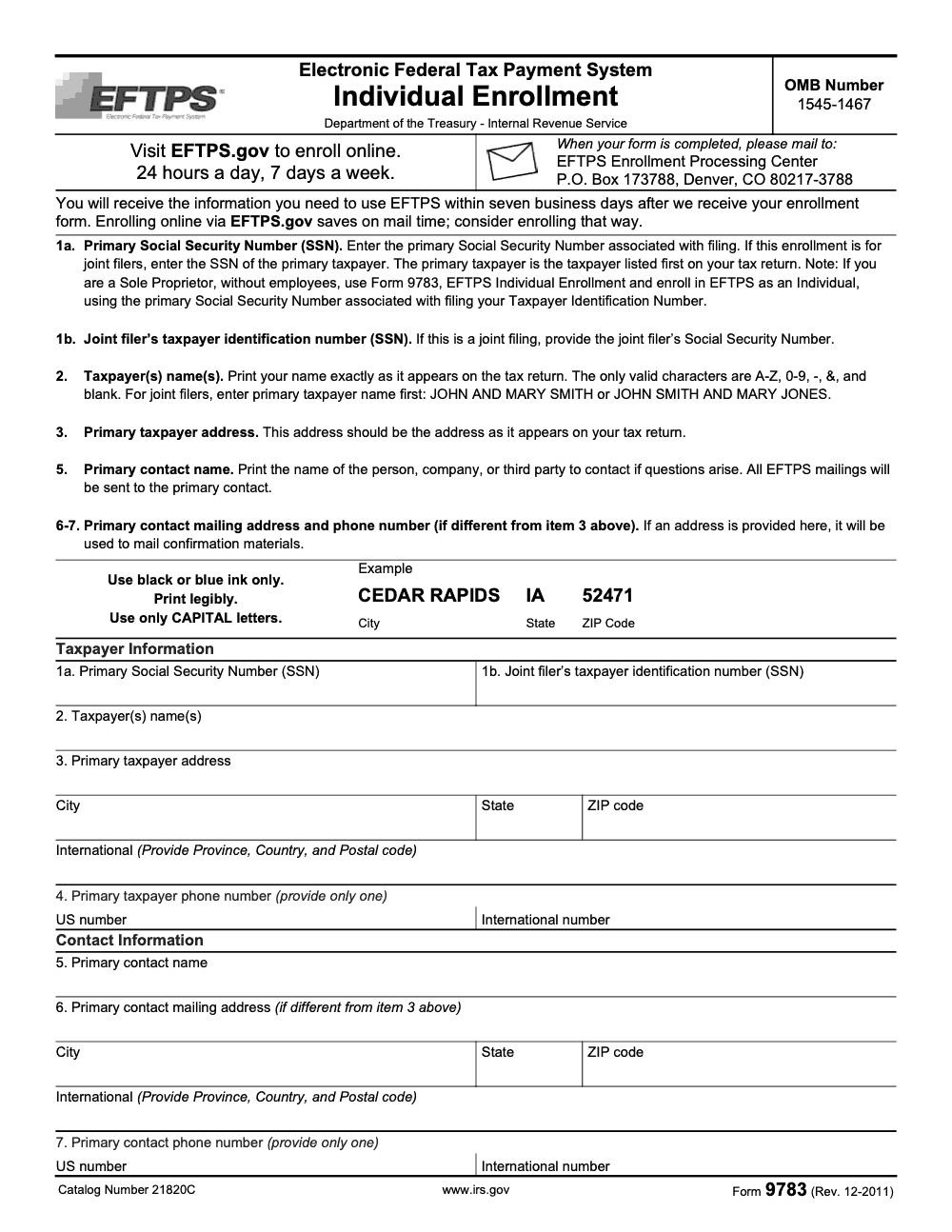
Form 9783 is the IRS paper form for EFTPS Individual Enrollment – it lets an individual sign up for the Electronic Federal Tax Payment System so federal taxes can be paid by direct debit from a checking or savings account. The form (Rev. 12-2011, Catalog Number 21820C) has 13 numbered items, including the nine-digit Routing Transit Number on line 9, the account number on line 10, and the Checking or Savings selection on line 11. Mail the completed form to the EFTPS Enrollment Processing Center in Denver, Colorado, and you will receive the information you need to use EFTPS within seven business days after the IRS receives it. You can also enroll online at EFTPS.gov, 24 hours a day, 7 days a week.
An EFTPS enrollment that bounces almost never fails on anything complicated. It fails on a bank field, a Routing Transit Number off by a digit or the wrong box checked between checking and savings. Form 9783 is the paper way an individual signs up for the Electronic Federal Tax Payment System, and three lines carry the whole thing, the nine-digit routing number on line 9, the account number on line 10, and the checking-or-savings choice on line 11.
The form runs 13 numbered items and takes about ten minutes, and the address matters as much as the bank fields. It goes to the EFTPS Enrollment Processing Center at P.O. Box 173788 in Denver, not the address printed in the privacy notice. Once the IRS has it, you should have what you need to start paying within seven business days, though most people skip the paper and enroll online at EFTPS.gov instead.
Key Takeaways
- Form 9783 is the IRS paper form for EFTPS Individual Enrollment, the way an individual signs up to pay federal taxes electronically by direct debit. It is revision 12-2011, Catalog Number 21820C, OMB Number 1545-1467.
- The form has 13 numbered items. The bank fields are line 9 (the nine-digit Routing Transit Number), line 10 (your account number), and line 11 (Checking or Savings).
- Mail the completed form to the EFTPS Enrollment Processing Center, P.O. Box 173788, Denver, CO 80217-3788. Do not send it to the IRS Tax Products Coordinating Committee address in the privacy notice.
- You will receive the information you need to use EFTPS within seven business days after the IRS receives your enrollment form. The form takes about ten minutes to complete.
- You can skip the paper form and enroll online at EFTPS.gov, 24 hours a day, 7 days a week. EFTPS Customer Service is 1-800-316-6541.
What Form 9783 Is (Plain-English Explanation)
Form 9783 is the IRS form titled Electronic Federal Tax Payment System (EFTPS) Individual Enrollment. It exists for one reason: to enroll an individual in EFTPS so they can pay federal taxes electronically.
EFTPS moves a tax payment straight from your bank account to the U.S. Treasury on a date you schedule. Form 9783 is the paper on-ramp. It tells the system who you are, which account to debit, and that you authorize a Financial Agent of the U.S. Department of the Treasury to initiate the payments you schedule.
The form is short. It carries revision date December 2011, Catalog Number 21820C, and OMB Number 1545-1467, and the IRS estimates it takes about ten minutes to complete. The brevity is the trap. With only 13 items, a single transposed routing digit or a mismatched Social Security Number stands out and stalls the whole enrollment.
Who this form is really for
You will usually use Form 9783 if:
- You are an individual who wants to make federal tax payments electronically instead of by check or money order.
- You prefer to enroll by mail rather than online at EFTPS.gov.
- You want estimated payments, balance-due payments, or installment-agreement payments pulled automatically from a checking or savings account.
- You have your bank routing and account numbers ready, because those drive the whole enrollment.
If you would rather not mail anything, you can enroll online at EFTPS.gov, 24 hours a day, 7 days a week, and skip the paper form entirely.
Who Uses Form 9783 (And Who Should Enroll Online Instead)
Form 9783 is the individual enrollment path. The form provides for a primary taxpayer and, where applicable, a joint filer, so it fits both single and joint filers who pay federal taxes.
Here is what you are setting up when you complete it.
1) You are an individual paying federal taxes
Line 1a asks for the primary Social Security Number, line 1b for a joint filer's taxpayer identification number, and line 2 for the taxpayer name or names. This is an individual enrollment, not a business one, so the identifiers are SSNs rather than an EIN.
Practical takeaway. If you file jointly and both spouses want to be on the enrollment, capture both SSNs accurately. A mismatch on the reenter field at line 8 is one of the most common reasons an enrollment bounces.
2) You want payments pulled from a bank account
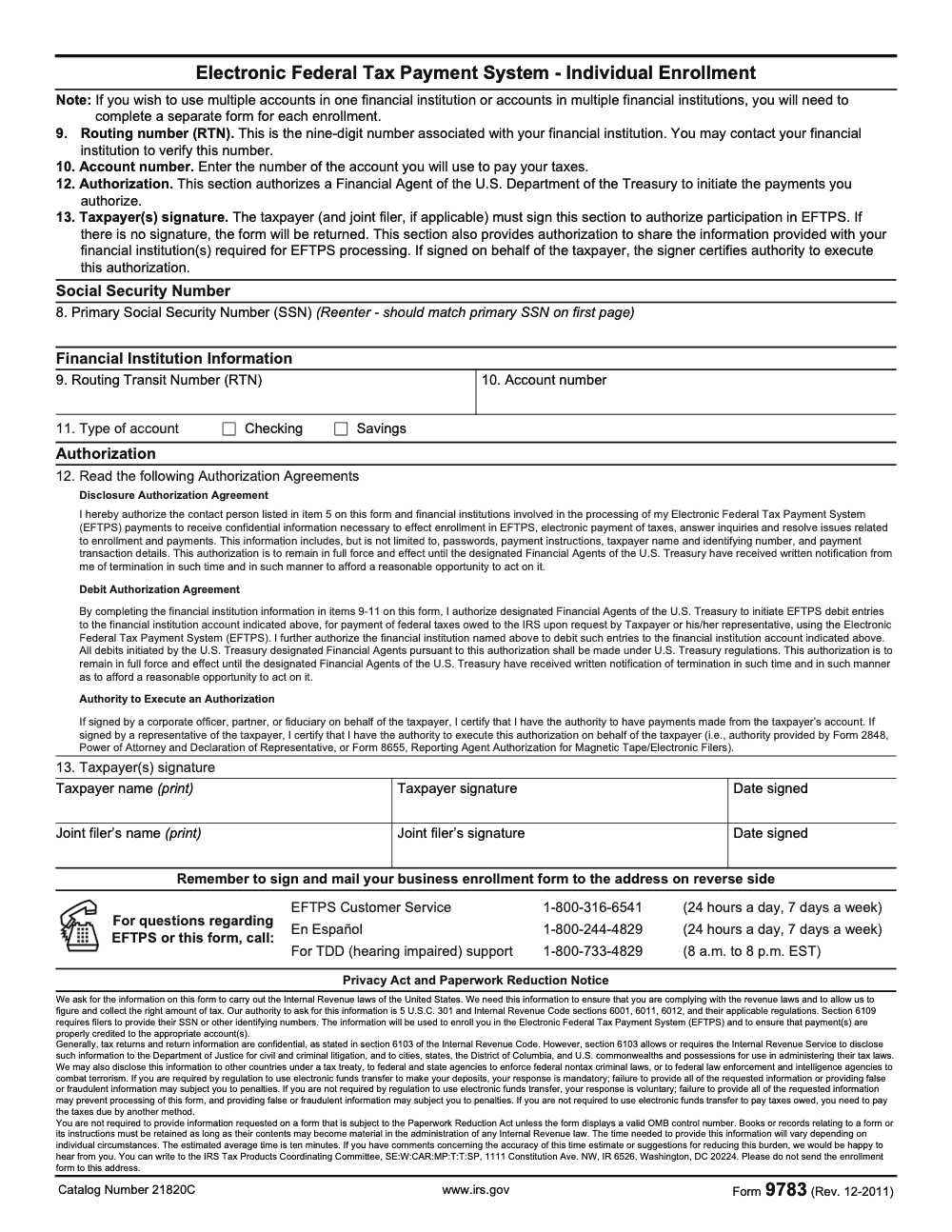
EFTPS debits the account you list. Form 9783 collects the Routing Transit Number on line 9, the account number on line 10, and whether the account is Checking or Savings on line 11. Have a check or a bank statement in front of you so the numbers are exact.
This is not the same as a one-time online card payment. You are authorizing a recurring channel, so the account information needs to be the account you actually intend to use for tax payments.
3) You are comfortable mailing the form and waiting a few days
The form says you will receive the information you need to use EFTPS within seven business days after the IRS receives your enrollment. Build that window into your plan. If a payment deadline is closer than that, the paper route may be too slow.
Real-world meaning. Do not wait until two days before an estimated-tax due date to mail Form 9783 and expect to pay through EFTPS in time.
4) You would rather not enroll online
Online enrollment at EFTPS.gov is available 24 hours a day, 7 days a week and is faster than mail. Form 9783 is for filers who prefer or need the paper path. Either way, the underlying enrollment is the same EFTPS system.
In plain terms, the paper form is a convenience for people who want a mailed, signed document rather than a web form, not a different program.
Paper Enrollment vs. Enrolling Online at EFTPS.gov
The IRS offers two doors into EFTPS for individuals. Form 9783 is the mailed paper door. EFTPS.gov is the online door, open 24 hours a day, 7 days a week.
The online path is generally quicker because there is no mail transit and no manual data entry on the IRS side. The paper path suits filers who want a physical signed record, who are helping someone who is not comfortable online, or who simply prefer mail. If speed matters and a deadline is near, choose online. If you want a paper trail you control, Form 9783 does the job.
What You Need Before You Start
Before you fill in a single field, gather:
- The primary taxpayer's Social Security Number, and the joint filer's SSN if you file jointly (lines 1a and 1b).
- The taxpayer name or names exactly as they appear on your return (line 2), using only the valid characters A-Z, 0-9, hyphen, ampersand, and blank.
- The primary taxpayer address (line 3) and a phone number (line 4).
- The nine-digit Routing Transit Number and the account number for the bank account you will use to pay taxes (lines 9 and 10), plus whether it is checking or savings (line 11).
Having the bank details verified up front is the single biggest time saver. The routing number is the nine-digit number associated with your financial institution, and getting it from a check or directly from the bank beats guessing.
Where people accidentally trip up
- They transpose digits in the nine-digit routing number on line 9.
- They enter a primary SSN on the first page that does not match the reenter field on line 8.
- They use punctuation or symbols in the name field that are not among the valid characters (A-Z, 0-9, hyphen, ampersand, blank).
- They forget to sign at line 13, which is the authorization the form needs to be processed.
How to Fill Out Form 9783 (Line by Line)
The form has 13 numbered items. It is short, which is both good news and bad news. It is quick to complete, but errors stand out because there are so few fields.
Items 1a through 2: Identify the taxpayer
Line 1a is the primary Social Security Number. Line 1b is the joint filer's taxpayer identification number, used only when you file jointly. Line 2 is the taxpayer name or names. Use only the valid characters: A-Z, 0-9, hyphen, ampersand, and blank.
Items 3 and 4: Address and phone
Line 3 is the primary taxpayer address. Line 4 is the primary taxpayer phone number, and the form asks you to provide only one. Format the city, state, and ZIP the way the form's own example shows, such as CEDAR RAPIDS IA 52471.
Items 5 through 7: Primary contact
Line 5 is the primary contact name, line 6 is the primary contact mailing address if it is different from item 3, and line 7 is the primary contact phone number (again, provide only one). For most individual filers, the contact is the same person as the taxpayer.
Items 8 through 11: Bank account details
- Line 8 reenters the primary SSN, and it should match the primary SSN on the first page.
- Line 9 is the Routing Transit Number (RTN), the nine-digit number associated with your financial institution.
- Line 10 is the account number you will use to pay your taxes.
- Line 11 is the type of account: Checking or Savings.
Pull these straight from a check or bank statement. A single wrong digit on line 9 or 10 is the fastest way to derail the enrollment.
Items 12 and 13: Authorization and signature
Line 12 is the authorization. It authorizes a Financial Agent of the U.S. Department of the Treasury to initiate the payments you authorize. Line 13 is the taxpayer signature, and the taxpayer (and joint filer, if applicable) must sign to authorize participation in EFTPS. An unsigned form will not be processed.
Where to Mail Form 9783 and What Happens Next
When the form is completed, mail it to the EFTPS Enrollment Processing Center, P.O. Box 173788, Denver, CO 80217-3788. That is the only address that processes enrollments.
You will receive the information you need to use EFTPS within seven business days after the IRS receives your enrollment form. Plan around that window so a payment deadline does not sneak up before your enrollment is active.
Do not mail it to the wrong address
The form's Paperwork Reduction Act notice lists a separate address for comments about the form: the IRS Tax Products Coordinating Committee, SE:W:CAR:MP:T:T:SP, 1111 Constitution Ave. NW, IR 6526, Washington, DC 20224. The form explicitly says not to send the enrollment form there. Enrollments go to Denver; comments go to Washington.
A Quick Note for Preparers and Reporting Agents
If you are completing or submitting Form 9783 on behalf of a client, your job is to get the identifiers and bank details exactly right and keep a clean copy. A few points worth keeping in your SOP:
- Verify the routing number and account number against a source document, not from memory.
- Confirm the line 8 reentry matches the primary SSN before mailing.
- Keep authority documentation on file. The form references Form 2848, Power of Attorney and Declaration of Representative, and Form 8655, Reporting Agent Authorization, for the relevant authorities.
For account questions during the process, EFTPS Customer Service is available at 1-800-316-6541, 24 hours a day, 7 days a week.
Common Form 9783 Mistakes (And How to Avoid Them)
Most Form 9783 problems are not dramatic. They are small, preventable data-entry slips.
Here are the big ones we see, with the fix.
Mistake 1: A wrong digit in the routing or account number
Line 9 is a nine-digit Routing Transit Number and line 10 is your account number. One transposed digit and the debit fails or never sets up.
Fix: Copy both numbers from a check or bank statement and read them back digit by digit before mailing.
Mistake 2: The line 8 reentry does not match the primary SSN
Line 8 is a reenter field that should match the primary SSN on the first page. A mismatch stalls the enrollment.
Fix: Enter the SSN once, then check the reentry against the original character by character.
Mistake 3: Invalid characters in the name field
The only valid characters are A-Z, 0-9, hyphen, ampersand, and blank. Periods, commas, and other symbols are not accepted.
Fix: Strip punctuation from the name and use only the allowed characters.
Mistake 4: Forgetting to sign at line 13
Line 13 is the taxpayer signature that authorizes participation in EFTPS. An unsigned form cannot be processed, and joint filers both need to sign.
Fix: Make signing the last step on your checklist, and confirm both signatures when filing jointly.
Getting Help With EFTPS Enrollment
If you get stuck, you do not have to guess. EFTPS has live support around the clock.
- EFTPS Customer Service: 1-800-316-6541, available 24 hours a day, 7 days a week.
- Spanish-language support (En Español): 1-800-244-4829, 24 hours a day, 7 days a week.
- TDD (hearing impaired) support: 1-800-733-4829, from 8 a.m. to 8 p.m. EST.
- Online enrollment and account access: EFTPS.gov, 24 hours a day, 7 days a week.
Calling before you mail can save a round trip, especially if you are unsure which account number to use or whether to enroll online instead.
Form 9783 vs. Other Federal Payment Channels
Form 9783 is one way to set up electronic federal tax payments, but it is not the only channel. Here is how it fits next to the alternatives.
| Channel | What it does | How you start |
| Form 9783 (paper) | Enrolls an individual in EFTPS for direct-debit federal tax payments | Mail to the EFTPS Enrollment Processing Center, Denver, CO |
| EFTPS.gov (online) | Same EFTPS enrollment, completed on the web | Enroll at EFTPS.gov, 24/7 |
If a payment deadline is close, the online route at EFTPS.gov is faster because there is no mail transit. If you prefer a signed paper document, Form 9783 is the form to use, and you will be ready to pay within seven business days after the IRS receives it.
Conclusion
Form 9783 is simple, but it is not casual. The bank details and identifiers have to be exact, and the form has to be signed, or the enrollment stalls.
If you take nothing else from this guide, take this. Copy the routing and account numbers from a source document, confirm the line 8 reentry matches your primary SSN, sign at line 13, and mail it to the Denver processing center, then expect to be ready to pay through EFTPS within seven business days.
Common Mistakes We See Every Season
Across the EFTPS Individual Enrollment forms we help clients complete, the same handful of slips show up every cycle. Each one is cheap to catch before mailing and annoying to fix after the form has gone to Denver.
Reusable Checklists
These checklists drop into a personal or preparer SOP and are written so a taxpayer, a front-desk coordinator, or an outsourced support team can run the same play. Each item is one decision a reviewer can sign off on without going back to source rules.
Before you start Form 9783
- Have the primary SSN, and the joint filer's SSN if filing jointly.
- Have the bank routing number (nine digits) and account number from a check or statement.
- Confirm whether the account is checking or savings.
- Confirm the taxpayer name uses only A-Z, 0-9, hyphen, ampersand, and blank.
- Decide whether paper (Form 9783) or online (EFTPS.gov) fits your timeline.
Line-by-line completion
- Lines 1a/1b: primary SSN, and joint filer's TIN if applicable.
- Line 2: taxpayer name(s), valid characters only.
- Lines 3 and 4: primary taxpayer address and one phone number.
- Lines 5 through 7: primary contact name, mailing address, and one phone number.
- Line 8: reenter primary SSN; confirm it matches the first page.
- Lines 9 through 11: routing number, account number, and Checking or Savings.
- Lines 12 and 13: authorization read, then sign (both spouses sign if joint).
Mailing and follow-up
- Mail to the EFTPS Enrollment Processing Center, P.O. Box 173788, Denver, CO 80217-3788.
- Do not mail it to the IRS Tax Products Coordinating Committee comments address.
- Keep a copy of the completed, signed form for your records.
- Expect EFTPS access information within seven business days of IRS receipt.
- If you do not receive it, call EFTPS Customer Service at 1-800-316-6541.
Keep Form 9783 Season From Stalling
EFTPS enrollments cluster around the same moments every year: a new client onboarding, the first estimated-tax cycle, or a balance due that someone wants paid by direct debit. Across the filers we support, the recurring failure pattern is not the form itself, it is the data trail around it: a routing number copied wrong, a primary SSN that does not match the reenter field, or a form mailed to the wrong address. A clean enrollment depends on the bank details, the identifiers, and the signature all lining up before the form leaves your desk.
The fix is to stop treating Form 9783 as a one-off scrap of paper and start treating it as a small, repeatable workflow with a verification step. A short SOP keeps the enrollment defensible without adding meaningful overhead.
- Pull the routing number (nine digits) and account number from a source document and read them back before entering them on lines 9 and 10.
- Confirm the line 8 reentry matches the primary SSN on the first page.
- Use only the valid name characters (A-Z, 0-9, hyphen, ampersand, blank) on line 2.
- Mail the signed form only to the EFTPS Enrollment Processing Center in Denver, never to the comments address in the privacy notice.
- Build in the seven-business-day processing window so an enrollment is active before any payment deadline, and use EFTPS.gov when time is short.
Data discipline is not EFTPS specific, it is the same muscle that protects payroll filings, tax workpapers, and audit support trails. Our trained offshore delivery teams embed this kind of verification step into client SOPs, so the enrollment form, the payroll register, and the engagement workpaper all sit on the same shelf when someone comes asking.
FAQs
Form 9783, Electronic Federal Tax Payment System (EFTPS) Individual Enrollment, is the paper enrollment form an individual uses to sign up for EFTPS so they can pay federal taxes electronically by direct debit from a checking or savings account. The form is revision 12-2011 and carries Catalog Number 21820C.
Mail the completed form to the EFTPS Enrollment Processing Center, P.O. Box 173788, Denver, CO 80217-3788. Do not send it to the IRS Tax Products Coordinating Committee address printed in the Paperwork Reduction Act notice.
The form states you will receive the information you need to use EFTPS within seven business days after the IRS receives your enrollment form. The estimated average time to complete the form itself is about ten minutes.
You can enroll online at EFTPS.gov, 24 hours a day, 7 days a week, instead of mailing Form 9783. The paper form exists for individuals who prefer or need to enroll by mail.
Line 9 asks for the nine-digit Routing Transit Number (RTN) of your financial institution, line 10 asks for the account number you will use to pay your taxes, and line 11 asks whether that account is Checking or Savings. Line 12 authorizes a Financial Agent of the U.S. Department of the Treasury to initiate the payments you authorize.
EFTPS Customer Service is 1-800-316-6541, available 24 hours a day, 7 days a week. Spanish-language support is 1-800-244-4829, and TDD (hearing impaired) support is 1-800-733-4829 from 8 a.m. to 8 p.m. EST.
About this guide
Accountably helps US CPA, EA, and accounting firms hire trained accountants and tax preparers in India.
About us Reviewed byJugal Thacker, CPAFounder and CEO at Accountably
A Washington-licensed CPA with 7+ years inside US firms – PwC, a real-estate tax practice, then a full-service firm, rising from reviewer to manager to advisory. This article was reviewed against current IRS guidance for the 2025 tax year and updated for filers preparing late returns, amendments, and 2026 estimates.
View profile →How we research, review, and update this guide
Every Accountably guide is researched against primary IRS sources, reviewed by a U.S. CPA, and refreshed as guidance evolves. Read our Editorial Guidelines to see how we source, fact-check, and update our content.