Summarize this article with AI
In Brief
Form 1098-F is the IRC §6050X information return a government or governmental entity files to report fines, penalties, and other amounts when the aggregate required to be paid under a suit, order, or agreement equals or exceeds $50,000 (per the April 2025 revision of Form 1098-F, OMB 1545-2284). Box 1 carries the aggregate; Box 3 (restitution or remediation) and Box 4 (compliance) may still be deductible by the payer under IRC §162(f)(2) if the order identifies those amounts and the statutory conditions are met.
A Form 1098-F is not a bill and it does not decide whether anything is deductible. A government agency files it to tell the IRS that a suit, order, or agreement requires payments tied to a legal matter once the total to be paid reaches at least $50,000, for orders that became binding on or after January 1, 2022. What it means for your own return depends on what the order says the money is for.
Box 1 carries the aggregate, and where the order identifies them, Box 3 restitution or remediation and Box 4 compliance amounts may still be deductible by the payer even though fines and penalties generally are not. When the agreement names no specific amounts, the filer can simply enter $50,000 with code E, which is why so many of these forms, EEOC matters especially, show that same round figure.
Key Takeaways
- Form 1098-F reports government ordered amounts when the total required to be paid for a matter is at least $50,000, for orders or agreements that become binding on or after January 1, 2022. It is informational, not a bill.
- The form lists totals in Box 1 and, where identified, amounts for violation, restitution or remediation, and coming into compliance. If the agreement does not identify amounts, the filer can enter $50,000 with code E.
- Government agencies must file the form with the IRS and furnish you a copy. Due dates are generally January 31 to you, February 28 if paper filed with the IRS, or March 31 if e-filed.
- Deductibility is a separate question under IRC §162(f). The IRS decides it, not the agency that sent the form. You must meet identification and establishment requirements for any deduction.
- EEOC forms often show a uniform $50,000 because the trigger is the threshold, not a precise estimate. The EEOC is not giving tax advice and lists a dedicated email for reporting questions.
What Form 1098-F Is
Form 1098-F, Fines, Penalties, and Other Amounts, is the IRS information return governments use when a suit, order, or agreement requires payments tied to a law violation, investigation, or coming into compliance, and the total hits $50,000 or more. The rule applies to matters that become binding on or after January 1, 2022. Agencies complete the form, file it with the IRS, and send you a copy. It is not an IRS assessment and does not decide any deduction.
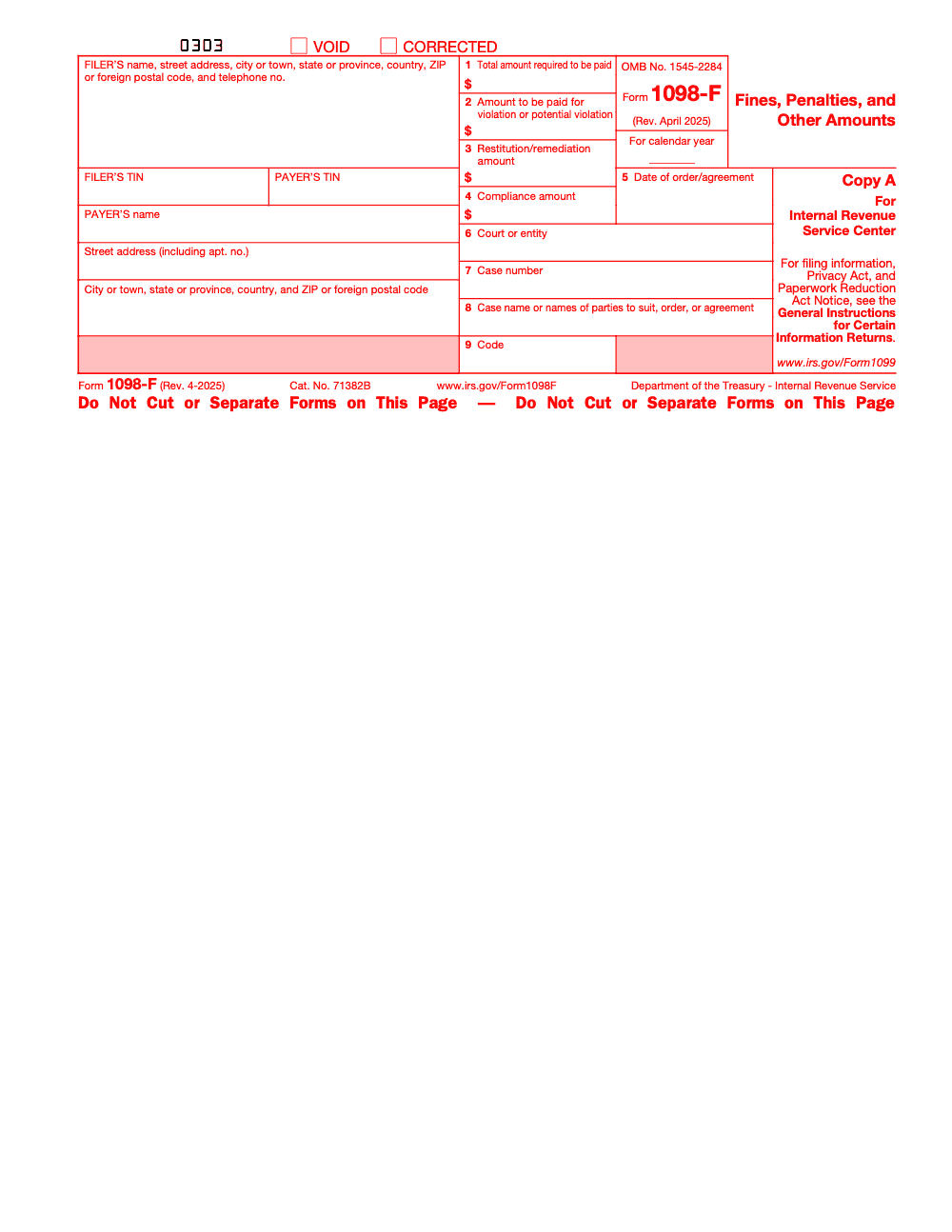
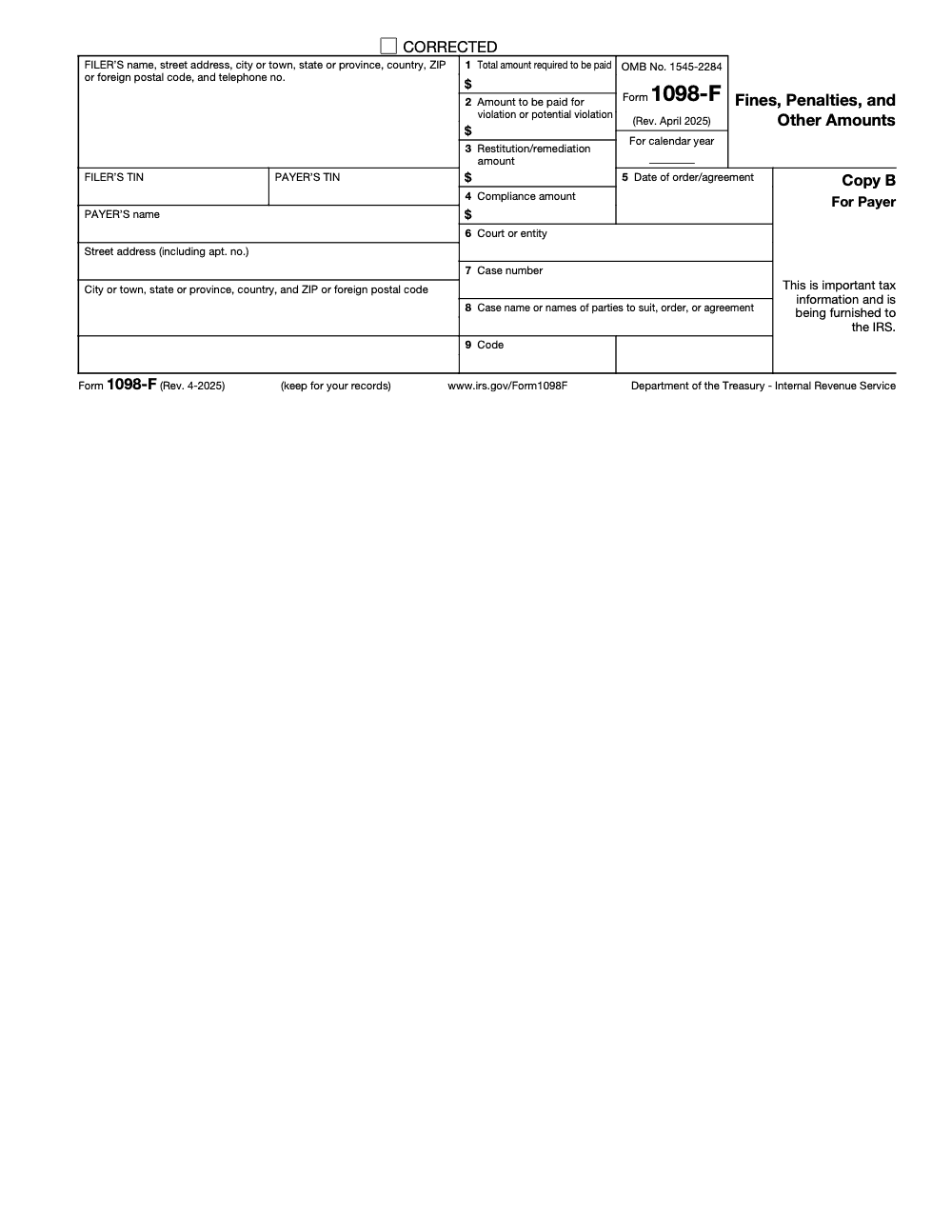
You may see separate boxes for the amount tied to a violation, the portion that is restitution or remediation, and the portion to come into compliance. When the order or agreement does not identify all amounts, the filer can enter 50,000 in Box 1 and use code E in Box 9 to signal “payment amount not identified.”
Who Receives Form 1098-F
You will get Form 1098-F if a government entity is a party to a binding order or agreement and reasonably expects your total required payments for that matter will reach at least 50,000. The government must both file with the IRS and furnish you a statement. This includes federal agencies, state revenue departments, and entities treated as governmental for these purposes.
If several parties are jointly or individually liable, each liable party may receive a form, even if one party’s individual share is under $50,000, because the aggregate for the matter meets the threshold. In joint and several situations, the form for each payor can show the total required to be paid by all jointly liable parties, as the rules require.
First reactions we often see
- Shock at the threshold, because 50,000 is a big round number.
- Urgency to verify facts, dates, and who is liable for what.
- A push to correct any obvious errors early.
- Determination to meet deadlines without creating tax problems later.
Why an EEOC Form 1098-F shows up
If your matter involved the EEOC, you might receive a Form 1098-F from the agency. The reason is simple. When the EEOC is a signatory to a court order or settlement, and it reasonably expects costs for restitution, remediation, or compliance will reach the threshold, it must report. The EEOC often uses a uniform 50,000 entry to indicate the threshold is met. That form does not grant, deny, or opine on your deductions. The IRS makes that call.
Quick checklist if the sender is the EEOC
- Confirm the binding date of the agreement and that the EEOC signed it.
- Match the parties and case name to your records.
- Note any Box 9 code, especially E, which signals that specific amounts were not identified in the agreement.
- Keep the form with the order or settlement and your cost support because the IRS will look for both if you claim a deduction.
EEOC reporting vs IRS deductibility, know the line
It helps to separate two different tracks. The EEOC files Form 1098-F because section 6050X requires it when the agency expects the matter to meet the $50,000 threshold. That is reporting. Deductibility lives on a different track under section 162(f), which the IRS administers through final regulations. Reporting does not equal a deduction, and a deduction does not depend on receiving the form.
EEOC’s reporting obligation
- The EEOC files Form 1098-F for orders or agreements that become binding on or after January 1, 2022 when the agency reasonably expects the threshold to be met.
- The agency commonly reports $50,000 on the form as a threshold marker, not a precise total.
- For 1098-F questions about what the EEOC filed, the agency lists a dedicated mailbox: IRC162FREQUEST@eeoc.gov.
- The EEOC does not provide tax advice and does not decide deductibility.
IRS decides deductibility under §162(f)
The IRS controls the deductibility analysis. Section 162(f) generally disallows deductions for amounts paid to, or at the direction of, a government in relation to a law violation or an investigation. There is a narrow doorway for amounts that qualify as restitution or remediation, or amounts to come into compliance, but only if the order or agreement identifies them and you can establish the nature and purpose with documentation. These are called the identification and establishment requirements in the final regulations.
| Item | Who controls | What it means |
| Filing Form 1098-F | Government agency | Reports that the matter meets the 50,000 threshold and provides basic matter details. |
| Deductibility under §162(f) | IRS | Applies the identification and establishment rules to decide if any amount is deductible. |
| Threshold expectation | Government agency | Can use 50,000 as Box 1 when amounts are not identified, with code E. |
| Effective framework | IRS, Treasury | Final regs adopted in 2021 and published in the Federal Register. |
A simple story to make it concrete
You sign an order on March 15, 2025 that requires training, back pay, and some internal monitoring. The EEOC files Form 1098-F because it expects your total costs will clear the threshold. It lists 50,000 in Box 1 with code E because the agreement does not nail down exact amounts. You later claim a deduction for back pay and training costs. The IRS will check whether the order identified those categories and whether your records prove amounts were actually paid for restitution, remediation, or coming into compliance. The form itself does not settle that question.
Why so many forms show “$50,000”
Many filers enter $50,000 in Box 1 when the order or agreement does not identify all amounts, then add code E in Box 9. That approach satisfies the reporting rule because the trigger is the expected aggregate meeting or exceeding $50,000. It is a threshold signal, not a full bill. You still need to keep your own schedule of actual cash payments and any costs to provide property or services.
What Box 1, 2, 3, and 4 try to tell you
- Box 1, total required to be paid for the matter.
- Box 2, amount for violation or potential violation, if identified.
- Box 3, amount for restitution or remediation, if identified.
- Box 4, amount to come into compliance, if identified (this is the narrower portion specifically identified in the order or agreement as required to bring the payer into compliance, not the full settlement). If some or all of those amounts are not identified in the agreement, the filer leaves the box blank and uses code E.
Binding dates and timing
Reporting under 6050X applies to suits, orders, or agreements that become binding on or after January 1, 2022. The agency must furnish the payer statement by January 31 of the year after the agreement becomes binding, and it must file with the IRS by February 28 if paper, or March 31 if e-filed. If multiple orders relate to the same violation and the aggregate equals or exceeds $50,000, the agency files only one Form 1098-F for that aggregate.
Mark one date in your calendar, the date the order or agreement became binding. That date drives whether the form is required and when it is due.
How agencies compute the numbers you see
When the threshold is met, filers enter the total amount required to be paid for the matter in Box 1. They may also enter identified amounts for the violation, for restitution or remediation, and for coming into compliance. If separate amounts are not identified in the order or agreement, the filer is permitted to enter $50,000 in Box 1 and code E in Box 9. The amounts are not required to equal each other, and Box 1 does not have to match the sum of Boxes 2, 3, and 4.
If a payor must make multiple payments over time, the government still files a single Form 1098-F for the matter and uses code A to indicate multiple payments. If several payors are jointly and severally liable, each may receive a form reflecting the total required for all payors, not just their slice.
What the threshold excludes
One common confusion is whether late payment penalties or interest on late penalties can push you over the line. The IRS explains that the threshold is measured on the date the suit or agreement becomes binding and does not include later late-payment penalties or interest on those penalties.
What to do the week you receive Form 1098-F
Here is the process I recommend to clients so you stay calm, accurate, and in control.
- Confirm the binding date. Pull the signed order or agreement and note when it became binding. This confirms that the reporting rule actually applies.
- Reconcile names and case details. Match the party names, case number, and court or agency to your documents.
- Read Box 9 codes. Codes A, B, C, D, or E provide important context, especially E for “payment amount not identified.”
- Build your own schedule. Create a simple ledger that tracks each payment and each cost to provide services or property, with date, amount, and purpose. This becomes critical if you later seek a deduction under §162(f)(2).
- Separate two folders. One for reporting questions with the agency, another for tax analysis with your advisor. Keep emails and supporting schedules in both.
Documentation checklist for §162(f)
If you plan to evaluate deductions for restitution, remediation, or coming into compliance, assemble:
- The signed order or agreement, with clear identification of qualifying amounts.
- Proof you were legally obligated to pay those amounts.
- Proof of payment, including dates and amounts.
- Evidence that the spending served the identified purpose, for example, invoices for training or remediation, payroll records for back pay, or reports showing compliance upgrades. These go to the “establishment” requirement.
Common mistakes that waste time
Two checklists you can drop straight into a firm SOP. Each step maps to a specific Form 1098-F box, instruction line, or §162(f) requirement so a senior reviewer can audit the file at a glance.
Post-Receipt Triage (Payer Side)
- Confirm the payer name and TIN on Copy B against your records; if only the last four digits show, that is the permitted truncation, and the IRS still receives the full TIN on Copy A per the Form 1098-F instructions.
- Pull the underlying suit, order, or settlement agreement and locate the §6050X identification language for restitution, remediation, or compliance.
- Read Box 5 as the date the order or agreement became binding under applicable law, not the date a check was written.
- Compare Box 1 (aggregate) to Boxes 2, 3, and 4 in the source order for context; the Form 1098-F instructions do not require Box 1 to equal the sum of Boxes 2, 3, and 4, so document the relationship without treating variance as an error.
- Decode the single Box 9 letter (A, B, C, D, or E) and document why that situation applies to your matter.
- Open a §162(f)(2) deductibility file for any amount in Box 3 or Box 4 before the return cycle touches the matter.
§162(f) Deductibility Workpaper
- Quote the exact identification language from the order or agreement for each restitution or compliance amount.
- Confirm the payment is made to, or at the direction of, a government or governmental entity, not a private third party.
- Document the establishment evidence: invoices, payroll records, training logs, or remediation reports tied to the identified purpose.
- Separate pure penalty amounts (non-deductible under §162(f)(1)) from restitution and compliance amounts that may qualify under §162(f)(2).
- Cross-reference the Form 1098-F box totals against the §162(f) workpaper; any difference needs a written reconciliation note.
- Route the file to senior review before the deduction is claimed; per the Form 1098-F instructions, the form itself does not decide deductibility.
Filer Pre-Submit Review (Government or Agency Side)
- Confirm the aggregate in Box 1 equals or exceeds $50,000; below that threshold, no §6050X reporting is required.
- Verify Box 5 reflects the binding date of the underlying order or agreement, not the date of payment.
- Apply TIN truncation only on Copy B furnished to the payer; transmit the complete TIN on Copy A to the IRS.
- Use only Box 9 codes A through E; reject any free-text entry per the General Instructions for Certain Information Returns.
- If aggregate information returns reach 10 or more under Treasury Decision 9972, transmit through FIRE for tax year 2025 (IRIS becomes the sole intake starting filing season 2027).
- Order the official scannable Copy A from IRS.gov/EmployerForms; never file Copy A printed from the IRS PDF, which is not scannable.
Deadlines, corrections, and multi-party situations
Agencies must furnish payor statements by January 31 of the year following the binding date, and they must file the return with the IRS by February 28 on paper or March 31 electronically. If the matter involves multiple suits or agreements about the same violation and the combined total meets the threshold, the agency files only one Form 1098-F for the aggregate. Corrections are handled using the standard information return correction process (corrected returns must be filed electronically if the original was electronic, but per Pub 1220 they do not count toward the 10-return e-file threshold).
If there are multiple payors who are individually liable, each liable payor should receive a separate form for the amount that payor is required to pay, even if that individual amount is under 50,000. For jointly and severally liable payors, each can receive a form showing the total amount required to be paid by all the jointly liable parties.
E-filing and administrative notes
Most agencies now e-file information returns. The IRS lowered the e-file threshold to 10 combined information returns beginning with filings due on or after January 1, 2024, and made IRIS available for e-filing (FIRE remains operational for tax year 2025 filings; IRIS becomes the sole intake system beginning filing season 2027). These are filer notes, but they explain why you are getting forms more consistently than a few years ago.
Deductibility, simplified
Here is the core rule of §162(f) in plain English. Amounts paid to, or at the direction of, a government for a legal violation or an investigation are not deductible. Some amounts can still be deducted if both conditions are met. The order or agreement must identify them as restitution or remediation, or as paid to come into compliance, and you must prove that is what you actually paid for. No identification plus weak proof usually equals no deduction.
For context, Treasury finalized this framework in early 2021. That final rule, known as T.D. 9946, sets the modern playbook for both deductibility under §162(f) and reporting under §6050X.
Practical moves that help the tax analysis
- Ask counsel to include clear identification language in the agreement while you are still negotiating.
- Keep vendor quotes and internal budgets that show the purpose and cost of coming into compliance.
- Track restitution and remediation separately from penalties.
- Avoid vague descriptions in your ledger. “Training to comply with order paragraph 12” is better than “consulting.”
Quick reference, Box 9 codes you might see
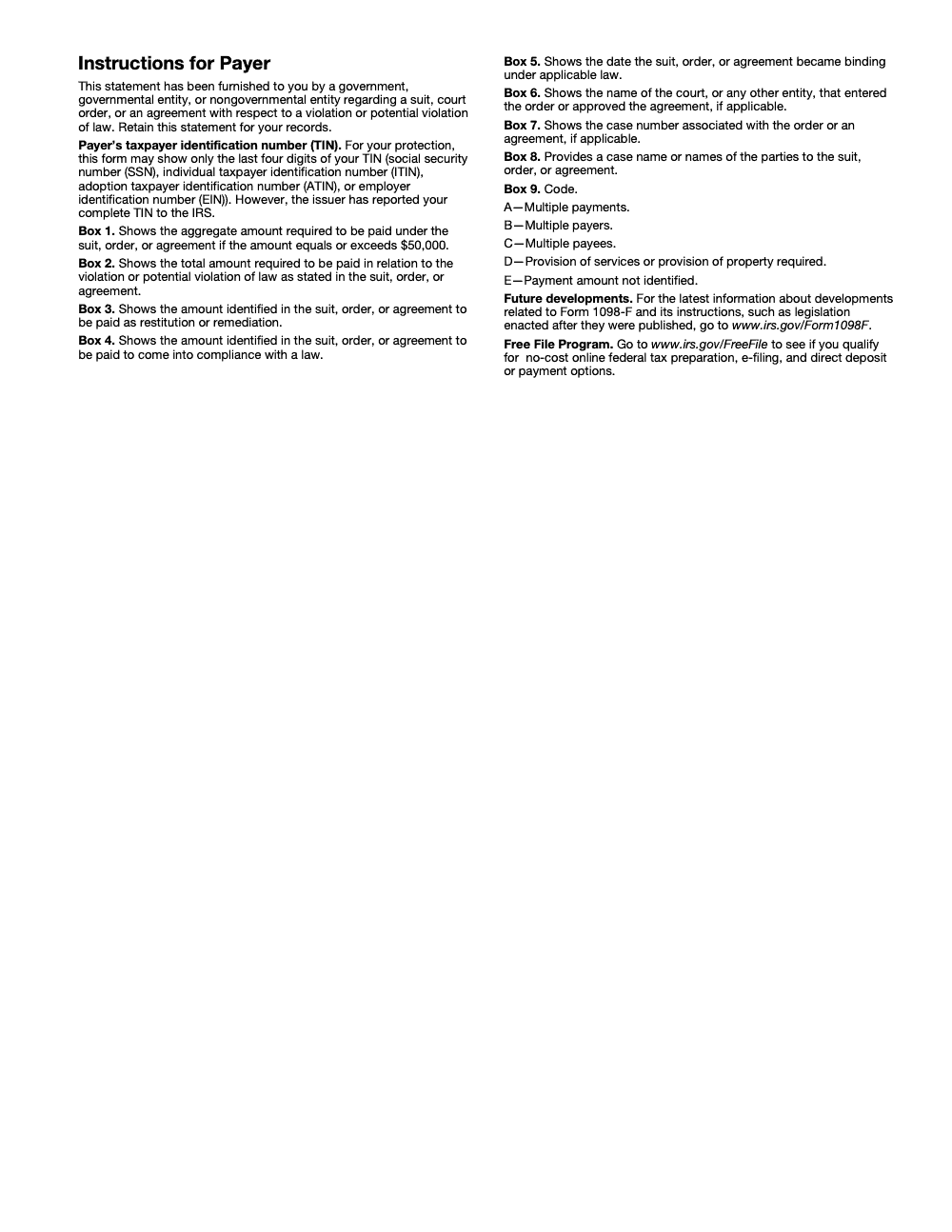
- A, multiple payments.
- B, multiple payors.
- C, multiple payees.
- D, provision of services or property is required.
- E, payment amount not identified. Only the defined codes A through E are accepted in Box 9, free text or other characters are not allowed. These codes do not decide tax treatment, but they give your team context for timing, parties, and whether the agreement lacked specific dollar allocations.
When to call the sender vs the IRS vs your advisor
- Sender, if names, dates, or case details look wrong, or if you need a duplicate copy. For EEOC matters, the agency lists a dedicated mailbox, IRC162FREQUEST@eeoc.gov, for questions about what it filed.
- IRS, for instructions on the form and due dates.
- Your advisor, for deductibility and documentation questions under §162(f).
If you plan to claim deductions tied to a Form 1098-F matter, write down the “who, what, when, and why” for every dollar. Your future self will thank you at exam time.
Where Accountably fits, only when you need hands-on help
If your team is buried in production work and struggling to keep documentation clean on matters that trigger Form 1098-F, we can help. Accountably embeds disciplined offshore teams into your workflow so you have standard workpapers, naming, and version control, which makes §162(f) support easier to pull on short notice. We work in your systems and templates, so you keep control while raising review quality. Use us for heavy seasons or to build durable capacity without the chaos.
Sources and quick references
- IRS, Instructions for Form 1098-F, revised April 2025. Threshold rules, boxes, and codes.
- IRS, Q&A on 6050X reporting. Due dates, multi-party rules, and placeholder entries.
- Treasury, Final regulations under §162(f) and §6050X, T.D. 9946, effective January 14, 2021.
- IRS, Internal Revenue Bulletin 2021-06, discussion of identification and establishment requirements.
- EEOC, What you should know about IRS Form 1098-F, including contact mailbox and threshold practice.
Final word and short disclaimer
If you received Form 1098-F, you are not alone. Treat it like a signal to get organized. Confirm the binding date, read the codes, line up your documentation, and separate reporting from tax treatment. For tax advice, work with a qualified professional. This article is general information based on IRS and EEOC guidance available as of November 4, 2025, and it is not a substitute for legal or tax counsel.
Reusable Checklists
Form 1098-F never produces a clean filing cycle. Settlements close on their own calendar, and any matter with an aggregate at or above $50,000 forces the payer's tax team to drop everything: the §6050X recipient copy lands, the §162(f) deductibility file has to be opened, and the underlying order or agreement gets re-read for the exact identification language on restitution and compliance. Per Treasury Decision 9972, filers transmitting 10 or more information returns in aggregate must e-file, so 1098-F volume now routes through FIRE for tax year 2025 and shifts to IRIS as the sole intake system beginning filing season 2027.
The fix is not faster turnaround on a single form. It is treating every 1098-F as a §162(f) workpaper trigger and routing it through a documented review path before the deduction question reaches the return.
- Build a 1098-F intake SOP keyed to Box 5, the binding date of the order or agreement, not the payment date; the binding date controls the year the §6050X workpaper opens.
- Map Box 9 codes A through E to a standard set of file-naming and routing conventions so multiple-payment, multiple-payer, and multiple-payee matters reach the right reviewer the first time.
- Maintain a separate §162(f)(2) deductibility memo for every Box 3 and Box 4 amount, quoting the identification language from the order verbatim, with the establishment evidence indexed alongside.
- Compare Box 1 to Boxes 2, 3, and 4 in the source document on intake for context; the Form 1098-F instructions do not require Box 1 to equal the sum of Boxes 2, 3, and 4, so note any difference without treating it as an automatic exception.
- Track TIN handling separately for Copy A (full TIN to the IRS) and Copy B (last four digits permitted on the payer copy), so an internal audit can verify the masking rule was applied correctly.
This is the workflow Accountably builds into client engagements. Our U.S. accounting and tax outsourcing teams run §6050X intake, §162(f) deductibility workpapers, and Box-by-Box reconciliation inside a multi-layer review structure, so a 1098-F that lands in February gets the same documentation discipline as one that arrives in October.
Keep 1098-F Season From Stalling
Form 1098-F does not arrive on a predictable calendar the way 941 lands quarterly or 1040 lands in March. Settlements close on the court's schedule, and any matter at or above the $50,000 aggregate threshold under IRC §6050X drops a §162(f) deductibility question onto a team that was already booked solid. Per Treasury Decision 9972, any filer issuing 10 or more information returns in aggregate must transmit electronically, so 1098-F routes through FIRE for tax year 2025 and shifts to IRIS as the sole intake system starting filing season 2027 (per the IRS Form 1098-F instructions, Rev. April 2025, and IRS Publication 1220).
The way to keep 1098-F volume from stalling the rest of the close is to stop treating it as one-off correspondence and start treating it as a recurring e-file program with its own SOP, its own credentials, and its own review path.
- Apply for the Transmitter Control Code by the November 1 deadline of the year prior to filing season and budget the 45 business days IRS asks for processing; firms that wait until January cannot e-file in time and end up exposed to information-return penalties for paper Copy A submissions printed from IRS.gov (prohibited per the Form 1098-F instructions).
- Build FIRE submissions to the Publication 1220 record layout, not PDF, Excel, Word, or image files; FIRE rejects those formats outright, and a rejection during the January production window has nowhere to go.
- Hold separate FIRE Production and FIRE Test accounts from day one, and reserve a portion of the 125-test-file annual cap for hardware and software validation when onboarding new filers or new vendor software.
- Run a §162(f)(2) identification review for every Box 3 (restitution or remediation) and Box 4 (compliance) amount before the deduction is set on the return, with the identification language from the order or agreement quoted verbatim into the workpaper; identification is the threshold question, not the existence of the 1098-F itself.
- Route corrected returns through a separate queue from originals; per Publication 1220, corrected returns do not count toward the 10-return threshold but must still be filed electronically when the original return was electronic.
Accountably runs this layer for the firms and tax teams that prefer to keep §6050X intake, FIRE and IRIS submissions, and §162(f) identification memos out of the senior reviewer's queue. The tax execution team holds the Transmitter Control Code, formats files to Publication 1220 specifications, and indexes every order's identification language inside a documented review path, so unpredictable 1098-F volume stops competing with quarterly and year-end deadlines.
FAQs
It reports government ordered payments when the expected aggregate for a matter is at least $50,000, for orders or agreements that become binding on or after January 1, 2022. Agencies file it with the IRS and furnish you a copy. It is not a tax bill and does not decide deductions.
The EEOC often uses 50,000 as a uniform entry when the agreement does not identify exact amounts. The form indicates the threshold is met, not your precise total. The EEOC does not decide deductibility.
Not directly. It is an information return. Any tax impact comes from how you treat payments under §162(f), which the IRS evaluates under the final regulations.
An agency can file one Form 1098-F for multiple suits about the same violation if the aggregate meets the threshold. Separately, each liable payor can receive a form. Joint and several payors may each receive a form showing the total for all.
No. The threshold is measured on the date the agreement becomes binding. Later late-payment penalties or interest on those penalties do not count toward the 50,000 trigger.
No. The IRS decides deductibility under §162(f). You must rely on the language in the order or agreement and your documentation to meet the identification and establishment requirements.
Summarize this article with AI
About this guide
Accountably helps US CPA, EA, and accounting firms hire trained accountants and tax preparers in India.
About us Reviewed byJugal Thacker, CPAFounder and CEO at Accountably
A US-licensed CPA with 7+ years inside US firms – PwC, a real-estate tax practice, then a full-service firm, rising from reviewer to manager to advisory. This article was reviewed against current IRS guidance for the 2025 tax year and updated for filers preparing late returns, amendments, and 2026 estimates.
View profile →How we research, review, and update this guide
Every Accountably guide is researched against primary IRS sources, reviewed by a U.S. CPA, and refreshed as guidance evolves. Read our Editorial Guidelines to see how we source, fact-check, and update our content.