Summarize this article with AI
In Brief
Form 1099-C reports canceled or forgiven debt of $600 or more, filed by financial institutions and federal government agencies under IRC §6050P (per the Instructions for Form 1099-C, Rev. April 2025); the discharged amount in Box 2 is generally taxable as other income on Form 1040, Schedule 1, line 8c, unless an IRC §108 exclusion is claimed on Form 982. For tax year 2025, creditors furnish Copy B to the debtor by January 31, 2026, with Copy A due to the IRS by March 2, 2026 on paper or March 31, 2026 electronically.
Most people meet Form 1099-C in the worst possible way: an envelope in February saying they owe tax on a credit card balance a bank charged off two or three years earlier. The amount in Box 2 can run well into five figures, and the form does nothing to explain that you might not owe tax on a dime of it.
Whether it is taxable usually comes down to one question the 1099-C never asks: were you insolvent when the debt was forgiven, meaning your debts were larger than everything you owned that day? If so, Form 982 can bring the taxable amount down, often to zero. The rest of this is about telling the taxable cases from the excluded ones, and the few situations, like a forgiven mortgage on a main home, that play by their own rules.
Key Takeaways
- Canceled debt of $600 or more is usually taxable, though the $600 figure governs only the creditor’s duty to file Form 1099‑C; you must include any canceled debt in your income even if it is less than $600, unless an exclusion such as bankruptcy or insolvency applies. Lenders must send Form 1099‑C to you and to the IRS after an identifiable event such as bankruptcy, settlement, or a foreclosure‑related action.
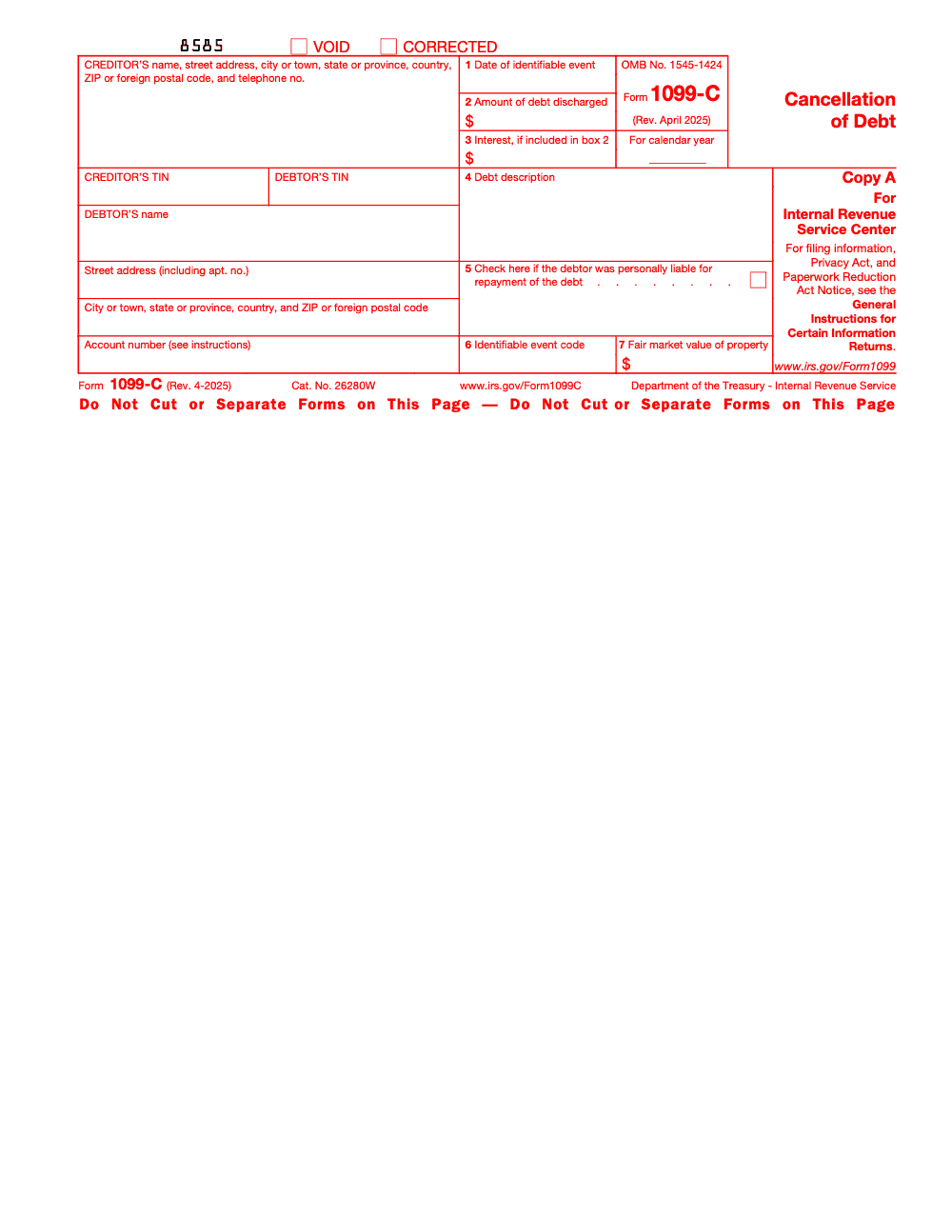
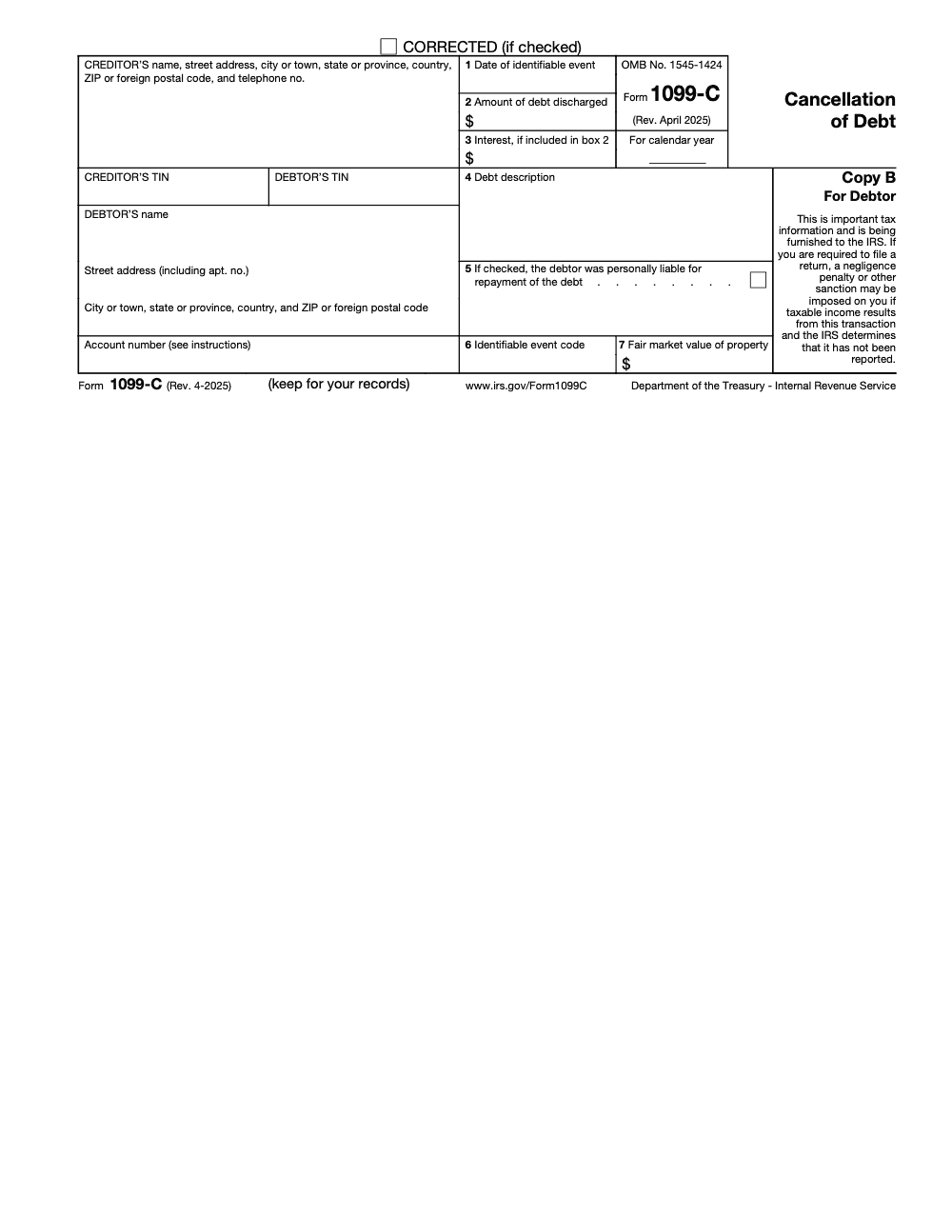
- Read four boxes first, Box 1 event date, Box 2 amount discharged, Box 3 interest included, Box 6 identifiable event code A through H.
- If the debt involved property and the creditor filed only 1099‑C, Boxes 4, 5, and 7 on the 1099‑C carry the property details, personal liability flag, and the property’s fair market value. This can replace a separate 1099‑A for that year.
- Most people report nonbusiness canceled debt on Schedule 1 of Form 1040. For tax year 2025, the line labeled Cancellation of debt is line 8c. Use Form 982 if you qualify for an exclusion such as bankruptcy, insolvency, or qualified principal residence debt.
- Mortgage forgiveness for your main home can be excluded if the discharge happens before January 1, 2026, or is under a written agreement in place before that date, subject to the $750,000, $375,000 MFS, cap.
What is Form 1099‑C
Form 1099‑C, Cancellation of Debt, is an information return that applicable financial entities and federal government agencies file when they cancel $600 or more of a debt you owed (a private individual who simply forgives a personal loan generally is not required to file one). You receive a copy so you can mirror what the IRS sees. The creditor must file the form when an identifiable event occurs, for example a bankruptcy discharge, a court order that wipes out collection rights, a foreclosure election that ends collection rights under local law, a negotiated settlement for less than full balance, or a policy decision to stop collection. These are coded A through H in Box 6.
How to read the boxes that matter
- Box 1, Date of identifiable event. This generally sets the tax year you consider the income or the exclusion, but if the debt was not actually discharged in that year, you include the income in the later year it is actually discharged, unless an exception or exclusion applies.
- Box 2, Amount of debt discharged. This is the canceled amount. It cannot exceed the total debt net of any amounts the creditor recovered through a sale or settlement.
- Box 3, Interest, if included in Box 2. If the creditor included forgiven interest in Box 2, they should also list it in Box 3.
- Box 4, Debt description. Tells you what the debt was, for example credit card, auto, student loan, mortgage.
- Box 5, Debtor personally liable, checkbox. If checked, you were personally liable when the debt was created or, if it was later modified, at the time of that last modification, not necessarily at the date of discharge. That matters for foreclosure tax math.
- Box 6, Identifiable event code. One letter, A through H, matching the event list in the instructions.
- Box 7, Fair market value of property. Completed if the 1099‑C is being used to cover the 1099‑A role for a property event.
The Box 6 codes, in plain words
- A, bankruptcy under Title 11.
- B, debt wiped out by a court process such as receivership or foreclosure action.
- C, statute of limitations or similar deadline expired with a final court decision.
- D, lender used foreclosure remedies that end further collection under local law.
- E, probate or similar proceeding made the debt unenforceable.
- F, agreement to settle for less than full amount, for example a short sale.
- G, creditor’s policy decision to stop collection and cancel the debt.
- H, an actual discharge before the above identifiable events.
Is canceled debt taxable
Generally yes, canceled debt is income. The IRS treats debt you no longer have to pay as a benefit, so it often increases taxable income. Most nonbusiness canceled debt belongs on Schedule 1, and for 2025 the IRS labels cancellation of debt on line 8c. If this is business debt, it usually shows on your business schedule instead. For sole proprietors that is typically Schedule C.
Important, exclusions exist
You may qualify to exclude some or all of the canceled amount if you were in a Title 11 bankruptcy, were insolvent immediately before the cancellation, or if the forgiven amount was qualified principal residence indebtedness within the current law window through December 31, 2025, including agreements in place by that date, capped at $750,000, $375,000 MFS. You claim exclusions on Form 982 and you reduce tax attributes as required.
You will not guess your way through this. Check the boxes, test the exclusions with real numbers, then file Form 982 if you qualify. Keep the paper trail.
How to decide what to report, a simple workflow that works
Step 1, confirm the facts on the 1099‑C
- Match your name and TIN to what the creditor reported.
- Confirm Box 1 date and Box 6 code reflect what actually happened, bankruptcy, settlement, foreclosure election, policy charge‑off.
- Tie Box 2 to the creditor ledger, principal plus any included interest or fees, net of payments or sale proceeds.
- If property is involved and there is no separate 1099‑A, confirm that Boxes 4, 5, and 7 on the 1099‑C capture property description, personal liability status, and fair market value. Ask for a correction if anything is off.
Step 2, decide if any exclusion applies
- Bankruptcy. If your discharge happened in a Title 11 case, the canceled amount is excluded. You still complete Form 982 to show the exclusion and the required attribute reductions.
- Insolvency. If your total liabilities exceeded your total asset fair market value immediately before the event, you can exclude up to that shortfall. Use the insolvency worksheet in Publication 4681 and keep the worksheet with your files. You still complete Form 982.
- Qualified principal residence indebtedness. For main home debt used to buy, build, or substantially improve the home, you may exclude forgiven amounts if the discharge occurs before January 1, 2026, or is under a written agreement in place before that date. The cap is $750,000, $375,000 MFS. This exclusion requires basis adjustments and Form 982.
- Other specific categories. Qualified farm indebtedness and qualified real property business indebtedness have narrow rules and sequencing with other exclusions. See Publication 4681 and Form 982 instructions.
Step 3, report it in the right place
For nonbusiness canceled debt that remains taxable after exclusions, use Schedule 1. For 2025, the IRS labels cancellation of debt on line 8c. Business debt usually belongs on the business schedule, for example Schedule C for sole proprietors, or Schedule F for farmers.
If there was a property foreclosure or abandonment, you may also need to compute gain or loss from the property disposition. Publication 4681 explains when you have ordinary income from cancellation and when you have a separate gain or loss from the property.
1099‑C, 1099‑A, and property math, what changes if a home or car was involved
When a lender forecloses, repossesses, or you do a deed in lieu, there are two possible tax pieces. First, there can be cancellation of debt income if the lender forgives an unpaid balance. Second, there can be gain or loss from giving up the property. For secured nonrecourse loans, the amount of the debt satisfied is generally treated as the amount realized, while for recourse loans the split between cancellation income and sale gain or loss depends on the fair market value and the personal liability flag. Publication 4681 walks through examples and how to report each piece.
If your creditor uses Form 1099‑C to meet both filings in the same year, they complete Boxes 4, 5, and 7 on 1099‑C and are not required to send a separate 1099‑A. If they send both forms, Boxes 4, 5, and 7 on the 1099‑C should not be completed. This coordination rule helps you avoid double counting.
Reading Box 6 codes during property cases
- D often shows up when the lender uses a foreclosure remedy that, under local law, ends further collection, common in certain nonjudicial states.
- F is common in short sales and negotiated settlements for less than the full balance. Use the code to anchor your reporting year and to choose the right worksheet in Publication 4681.
Real‑world checklist I use before I file
- Gather lender statements, the payoff history, and any settlement agreement.
- If property was involved, collect the foreclosure bid or appraisal used to set fair market value.
- Complete the insolvency worksheet if you suspect you were insolvent. Save dated screenshots of bank and brokerage balances, loan statements, and valuation printouts for that day.
- Fill out Form 982 when you claim an exclusion. Mark the box that matches your exclusion, enter the excluded amount on line 2, then complete the Part II attribute reductions.
- If any details on the 1099‑C are wrong, request a corrected form in writing and keep the correspondence. The IRS sees what the creditor filed.
The major exclusions, explained with practical tips
Bankruptcy exclusion
If your discharge happened in a Title 11 bankruptcy case, the canceled amount is not income. You still file Form 982, check line 1a, enter the excluded amount on line 2, and complete Part II to reduce tax attributes in the required order. Keep the court order with your tax records. The instructions detail the attribute reduction sequence and the option to elect basis reduction of depreciable property first.
Insolvency exclusion
You were insolvent if your total liabilities exceeded the fair market value of your total assets immediately before the cancellation. You can exclude canceled debt up to that shortfall. Use the Publication 4681 insolvency worksheet, document each figure, and remember that values are as of the moment before the event. File Form 982, check line 1b, enter the excluded amount on line 2, and reduce tax attributes in Part II. If only part is excluded, the remainder is taxable income.
Qualified principal residence indebtedness
If the canceled amount relates to your main home and the loan proceeds were used to buy, build, or substantially improve that home, you may be able to exclude it. Current guidance allows exclusion for discharges before January 1, 2026, or for discharges under a written agreement in place before January 1, 2026. The maximum treated as qualified principal residence debt is $750,000, $375,000 MFS. Form 982 is required, and if you keep the home, you must reduce your home’s basis by the excluded amount, line 10b. Pub. 523 and Pub. 4681 explain basis and home‑sale rules.
Other specialized categories
- Qualified farm indebtedness. Available if at least half of your prior three years of gross receipts were from farming and other limits apply. Sequence with insolvency rules as shown in Publication 4681 examples.
- Qualified real property business indebtedness. Available in limited business real estate cases. Review Form 982 instructions and consider the basis reduction election.
- Purchase price adjustment with the seller. Not income, usually a basis reduction. See Publication 334 for small business, general rule and exceptions.
- Certain student loans forgiven for service or death or disability under specific statutes. Check Publication 4681 for current treatment.
Reporting, line by line clarity you can trust
For individuals, nonbusiness debt
Use Schedule 1, Form 1040. For tax year 2025, cancellation of debt is line 8c. If a portion is excluded on Form 982, only include the taxable remainder. Keep the 1099‑C and your Form 982 with documentation.
For business owners
If the debt ties to your sole proprietorship, it generally goes on Schedule C. Farmers use Schedule F. Partnerships and S corporations report at the entity level and pass through to owners. Review the business schedule instructions and consider basis and attribute interactions.
Property foreclosures and repossessions
You may have both cancellation income and a gain or loss from the property disposition. Publication 4681 explains when the amount realized equals the debt and when you split the calculation between fair market value and canceled balance based on whether you were personally liable.
If the creditor filed only a 1099‑C for the foreclosure year and completed Boxes 4, 5, and 7, do not expect a separate 1099‑A for that same debt. The 1099‑C is doing double duty.
Accuracy checks that prevent IRS mismatch letters
- Compare creditor name, EIN, and account number to your statements. If you had multiple loans or a servicer change, make sure the right loan is tied to the right TIN. Ask for a corrected 1099‑C if needed.
- Verify Box 2 against the payoff ledger, and confirm whether forgiven interest was included and shown in Box 3 as required if included.
- Confirm Box 1 date and Box 6 code. The year and code drive your filing period and which exclusion you can claim.
- If property is involved, double check Box 7 fair market value against the foreclosure bid or appraisal used.
State conformity, timing, and practical housekeeping
- Some states do not follow every federal exclusion. After you finish the federal return and Form 982, check your state instructions for cancellation of debt and mortgage forgiveness rules for the year in question. Use your state’s Schedule 1 equivalent if required. For mortgage forgiveness, federal law allows exclusions for discharges before January 1, 2026, or under agreements in place by that date. States may differ.
- Keep a clean file. Save the 1099‑C, settlement letters, foreclosure records, insolvency worksheet, bank and brokerage balances for the event date, and a copy of your filed Form 982. Publication 4681 is your anchor reference.
Step‑by‑step, how to report a 1099‑C
- Confirm the form’s details and request corrections if needed.
- Test bankruptcy, insolvency, and principal residence rules. If any apply, complete Form 982 and compute attribute reductions.
- Report any remaining taxable amount, for 2025, Schedule 1 line 8c for nonbusiness debt, business debt on the business schedule.
- If there was a foreclosure or repossession, compute gain or loss from the property disposition using Publication 4681’s guidance.
Common questions, fast answers
What is Form 1099‑C used for?
It reports that a creditor canceled $600 or more of your debt after a specific event. You use it to decide whether the amount is taxable, to claim any exclusion on Form 982, and to file your return with the same facts the IRS has on file.
How does a 1099‑C affect my refund?
Canceled debt usually increases taxable income, which can reduce a refund or increase tax due. If you qualify for bankruptcy, insolvency, or main home mortgage exclusions, you can remove some or all of it by filing Form 982. Document everything so your return matches the IRS data.
Do I have to pay tax on canceled debt?
Usually yes, unless you qualify for an exclusion. The most common are bankruptcy, insolvency, and qualified principal residence indebtedness for discharges before January 1, 2026, within the $750,000 cap, $375,000 MFS. You claim the exclusion on Form 982.
Where do I report a 1099‑C on my return?
For 2025 individual returns, use Schedule 1 line 8c for nonbusiness amounts, business debt on your business schedule. If property was taken, compute gain or loss from the property disposition as explained in Publication 4681. Attach Form 982 if you claim an exclusion.
What if the creditor sent only a 1099‑C for my foreclosure?
That is allowed. If they canceled the debt and foreclosed in the same year, they can file only 1099‑C and complete Boxes 4, 5, and 7 to satisfy the 1099‑A requirement. Use those boxes for your property calculations.
Tools and sources you can trust
- IRS Instructions for Forms 1099‑A and 1099‑C, updated April 2025, give the official box definitions, codes, and the one‑form coordination rule.
- Publication 4681 explains canceled debts, insolvency, foreclosures, and how to report. It includes the insolvency worksheet.
- Form 982 and its instructions spell out the exclusions, limits for principal residence debt through 2025, and how to reduce tax attributes.
- Publication 17 and the 2025 Schedule 1 instructions show where cancellation of debt appears on individual returns.
Common Mistakes We See Every Season
The 1099-C trips up debtors and creditors in predictable ways every season. These are the ones my team flags most often, with the fix we paste into the workpaper.
Reusable Checklists
These checklists are copy-paste ready for your firm SOPs, one for the debtor side of a return and one for the creditor side of the filing.
Debtor reporting packet
- Confirm the actual discharge year, not just the Box 1 identifiable-event date, before recognizing income.
- Pull the discharged amount from Box 2 and note any interest broken out in Box 3.
- Check Box 5 to confirm whether the debt was recourse or nonrecourse.
- If property was involved, reconcile Box 7 fair market value against any companion Form 1099-A.
- Run the insolvency worksheet in Publication 4681 before assuming the full amount is taxable.
- Report taxable canceled debt on Schedule 1, line 8c of Form 1040.
- File Form 982 for any bankruptcy, insolvency, or qualified principal residence exclusion claimed.
Creditor filing packet
- Confirm you are an applicable financial entity required to file under IRC §6050P.
- Verify the discharged amount is $600 or more before issuing the form.
- Select the correct Box 6 identifiable-event code, A through H, for the discharge.
- Truncate the debtor TIN on Copy B while reporting the full TIN to the IRS.
- Furnish Copy B to the debtor by January 31, 2026.
- File Copy A by March 2, 2026 on paper or March 31, 2026 electronically.
- E-file if you are submitting 10 or more information returns across all types.
- Check the CORRECTED box on both copies for any reissue.
Keep 1099-C Season From Stalling
The 1099-C cycle is a January-to-March compression. Copy B is due to debtors by January 31, then Copy A reaches the IRS by March 2, 2026 on paper or March 31, 2026 electronically (per the Instructions for Form 1099-C, Rev. April 2025). For preparers, the same forms reappear in the spring return crunch, where a single mis-read Box 5 or a skipped insolvency worksheet turns into rework that no one has hours for.
The fix is not more nights in March, it is a documented sequence that pins down every box before the return or the filing is touched. Once that sequence is standardized, the 1099-C stops being a surprise and becomes a checklist. Since the e-file threshold dropped to 10 or more information returns across all types (General Instructions for Certain Information Returns, 2025), the whole 1099 batch now moves electronically anyway, so the discipline pays off twice.
- Lock the discharge year off Box 1 before recognizing income, so identifiable-event dates do not push income into the wrong year.
- Standardize the Box 5 recourse check so foreclosure files route to the right cancellation-of-debt-plus-disposition calculation.
- Build the Publication 4681 insolvency worksheet into the prep step, not the review step.
- Track Copy B (January 31) and Copy A (March 2 paper, March 31 e-file) on one calendar, with the $60, $130, and $340 penalty tiers noted next to the dates.
Accountably builds that sequence into structured, U.S.-led tax preparation and review workflows, so canceled-debt reporting clears on time behind documented SOPs and a multi-layer review on every return.
FAQs
It is the information return an applicable financial entity or federal government agency files under IRC §6050P when it cancels or forgives $600 or more of a debt you owed. You receive a copy so you can mirror what the IRS already sees, and the creditor files Copy A with the IRS. The form is tied to an identifiable event, coded A through H in Box 6.
No, and that is the most common trap I see. The $600 figure only governs whether the creditor must file a 1099-C. Your duty to include canceled debt in income applies regardless of amount, so you report any forgiven debt on the Other income line of your Form 1040 or 1040-SR unless an IRC §108 exclusion such as bankruptcy or insolvency applies.
Most nonbusiness canceled debt goes on Schedule 1, line 8c (Cancellation of debt), which flows to the Other income line of Form 1040. If part of the amount is excluded, you file Form 982 and report only the taxable remainder. Sole-proprietor business debt usually goes on Schedule C instead.
Contact the creditor first, not the IRS. The IRS will not adjust the reported figure on your say-so alone. If the creditor agrees it is wrong, they can issue a corrected 1099-C with the CORRECTED box checked. Tie Box 2 to the payoff ledger, including any forgiven interest broken out in Box 3, before you file.
Often, yes. If your total liabilities exceeded the fair market value of your total assets immediately before the cancellation, you can exclude the canceled debt up to the amount of that insolvency under IRC §108. It is a specific balance-sheet test, not a feeling of being broke. Work the numbers using Publication 4681 and claim the exclusion on Form 982.
Not anymore. The 36-month nonpayment testing period was removed as an identifiable event for events occurring after November 9, 2016. A 1099-C now has to be tied to one of the eight current Box 6 events, codes A through H, so a creditor simply not collecting for years is no longer enough on its own.
Three separate clocks apply for tax year 2025. Copy B is due to the debtor by January 31, 2026. Copy A is due to the IRS by February 28 on paper, which rolls to March 2, 2026 because February 28, 2026 is a Saturday, or by March 31, 2026 if you file electronically. Filers submitting 10 or more information returns across all types must e-file.
Other forms this guide names
- Form 982: How to Exclude 1099‑C Debt and Reduce Basis
- Form 1099-A: Boxes Explained, Reporting Steps, 1099-C
- Form 1040: Filing Guide for 2025 Returns (AGI, Deductions, Deadlines)
Summarize this article with AI
About this guide
Accountably helps US CPA, EA, and accounting firms hire trained accountants and tax preparers in India.
About us Reviewed byJugal Thacker, CPAFounder and CEO at Accountably
A Washington-licensed CPA with 7+ years inside US firms – PwC, a real-estate tax practice, then a full-service firm, rising from reviewer to manager to advisory. This article was reviewed against current IRS guidance for the 2025 tax year and updated for filers preparing late returns, amendments, and 2026 estimates.
View profile →How we research, review, and update this guide
Every Accountably guide is researched against primary IRS sources, reviewed by a U.S. CPA, and refreshed as guidance evolves. Read our Editorial Guidelines to see how we source, fact-check, and update our content.