Key dates
Summarize this article with AI
In Brief
Form 1040 is the U.S. individual income tax return – the IRS processes roughly 161 million individual returns each year (according to IRS Publication 1304, SOI TY2022). AGI sits on line 11a; total tax on line 24. Tax year 2025 returns were due April 15, 2026, and Form 4868 extends the filing deadline to October 15, 2026.
Form 1040 itself rarely causes the trouble. Its two pages mostly carry totals up from the schedules underneath, so a return can look finished long before it actually is. Where it goes wrong is a level down, the kind of thing that surfaces on review: an itemized total that did not quite clear the 2025 standard deduction, or a freelance 1099 that needed a Schedule C and a self-employment calculation nobody ran.
The headline lines, adjusted gross income and total tax on line 24, are only as good as the schedules feeding them. When a notice turns up months after filing, the cause is usually in one of those attachments, not on the two pages of the 1040 itself.
Key Takeaways
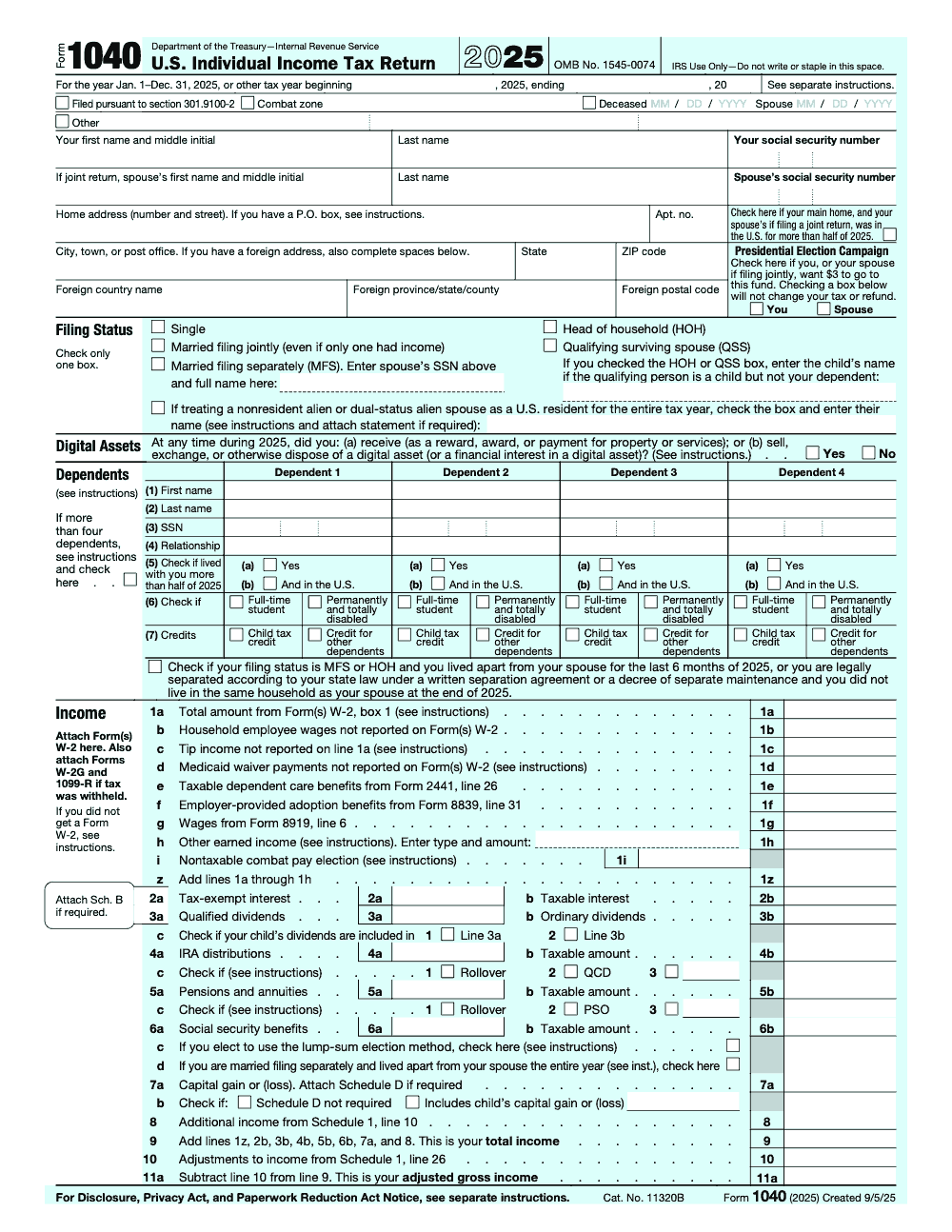
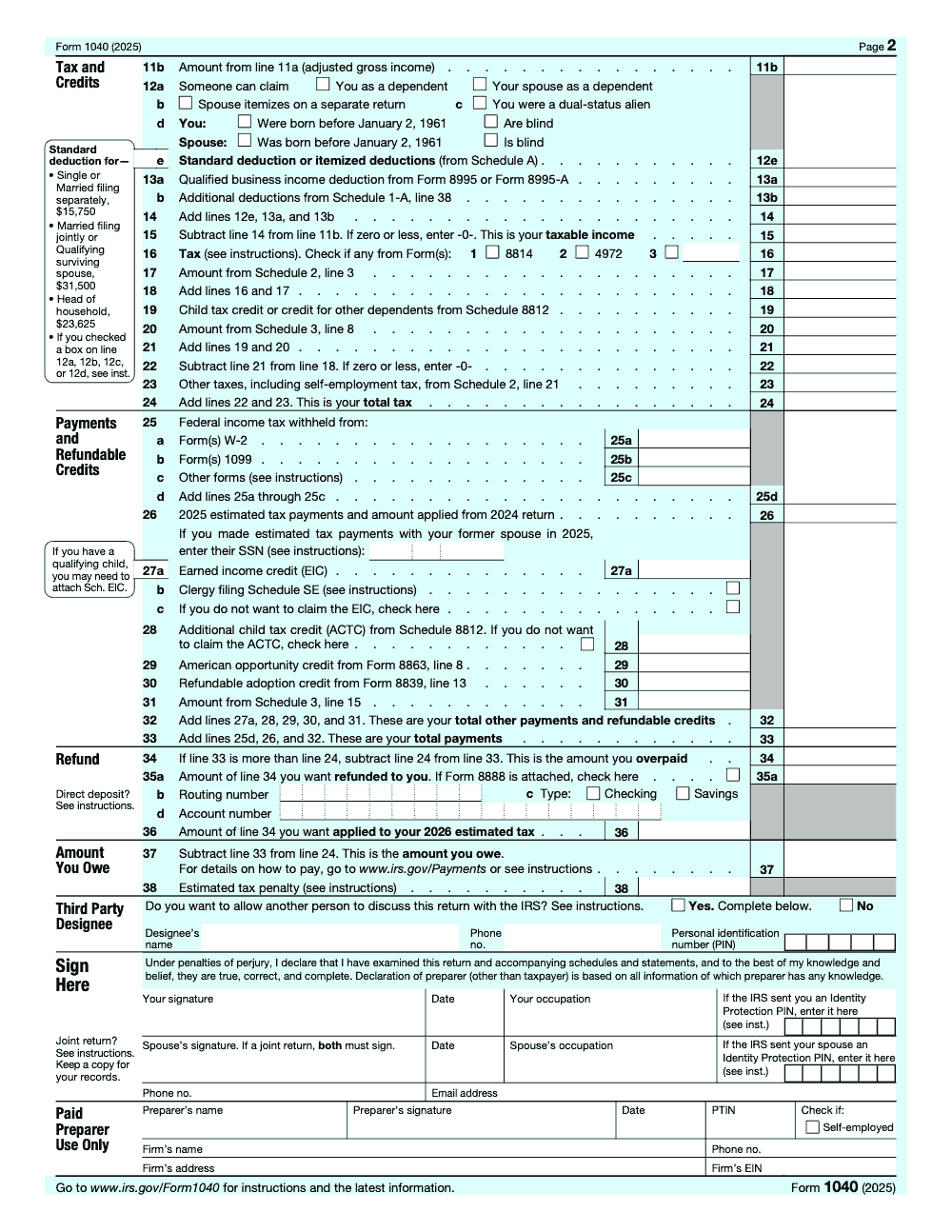
- Form 1040 is the U.S. individual income tax return. It reports your income, deductions, credits, total tax, and payments to determine your refund or balance due. The lines that move the most: wages on line 1a, total income on line 9, AGI on line 11a, deductions on line 12e, total tax on line 24, and payments on lines 25a–25c.
- Your 2025 return was due Wednesday, April 15, 2026. If you filed Form 4868 on time, your filing deadline runs to October 15, 2026. An extension extends the paperwork, not the payment.
- 2025 standard deduction: Single or MFS $15,750, MFJ or Qualifying surviving spouse $31,500, Head of household $23,625. Itemize on Schedule A only if your totals beat those amounts.
- Most e-filed refunds with direct deposit arrive in less than 21 days. Refunds with the Earned Income Tax Credit or Additional Child Tax Credit cannot be issued before mid-February by law.
- If you are self-employed with net earnings of $400 or more, you must file Schedule SE and pay self-employment tax.
- Use Form 1040-SR if you are 65 or older, Form 1040-NR if you are a nonresident with U.S. source income, and Form 1040-X to amend a return you already filed.
What Form 1040 Is and Why It Matters
Form 1040 is the annual U.S. individual income tax return. Everyone can file Form 1040, and filers age 65 or older can choose Form 1040-SR, which uses the same schedules and instructions as the standard 1040. The form centralizes totals and pushes detail to attached schedules. You enter filing status and dependents, summarize your income, apply adjustments, take either the standard deduction or Schedule A itemized deductions, then compute total tax, credits, and payments.
Line 11a, Adjusted Gross Income, is the control knob for your return. It is total income minus "above-the-line" adjustments from Schedule 1, Part II, such as student loan interest, deductible half of self-employment tax, and certain retirement or HSA contributions. Many credits and deductions rise or phase out based on AGI, so small adjustments can change your eligibility.
Remember, AGI drives eligibility. If you want to qualify for a credit or keep itemized deductions meaningful, focus on the adjustments that lower AGI first.
You will rely on Schedules 1–3 to move data to the main form: Schedule 1 for additional income and adjustments, Schedule 2 for additional taxes, and Schedule 3 for credits and other payments. These totals flow to Form 1040 and determine your bottom line.
Who Needs to File Form 1040
You must file Form 1040 when your gross income meets or exceeds the IRS filing threshold for your status and age for the year. The threshold roughly tracks the standard deduction, so it moves up each year with inflation. If you have net earnings from self-employment of $400 or more, you must file and complete Schedule SE to figure self-employment tax. You also must file if you owe additional taxes, for example AMT, household employment tax, or excess Advance Premium Tax Credit repayment.
Many people who fall below filing thresholds still file to claim refunds or refundable credits, like the EITC, Additional Child Tax Credit, or American Opportunity Credit. Always check the current instructions to confirm your status and any special rules.
If you are age 65 or older, you can file Form 1040-SR instead of Form 1040. It is the same return with larger print and an embedded standard deduction chart for easy reference. If you are a nonresident alien with U.S. source income, you must use Form 1040-NR, which has different rules, including limited access to the standard deduction. If you need to correct a previously filed return, use Form 1040-X within the time limits described later in this guide.
Deadlines and Filing Options for 2025 Returns
Your 2025 Form 1040 was due on April 15, 2026. If you missed the deadline and did not file Form 4868, file as soon as possible to limit failure-to-file and failure-to-pay penalties, which compound monthly. If you filed an extension on time, your filing deadline runs to October 15, 2026. The extension extends the paperwork, not the payment, so any tax due was still owed by April 15, 2026.
If you live and work outside the United States on the regular due date, you generally receive an automatic 2-month extension to file, typically to mid-June, although interest still accrues on any unpaid tax after April 15. Disaster-area taxpayers may have different automatic deadlines based on FEMA designations, always confirm your county's current date on IRS.gov.
Filing modalities: e-file, paper, IRS Direct File, and Free File
You have four mainstream ways to send a 1040 to the IRS, and the right choice depends on your income, complexity, and comfort with software.
- E-file with paid software. Fastest, most accurate, and the default for most preparers. Pair with direct deposit for the quickest refund.
- IRS Direct File. The IRS's own free e-file pilot, expanded for the 2025 filing year to more states and a wider range of returns. Best for straightforward W-2 returns with limited credits.
- IRS Free File. A partnership with private software providers for taxpayers under an income threshold (verify the current-year cap on IRS.gov). Free federal filing, with state filing sometimes free as well.
- Paper filing. Still allowed, still slow. Pull the current-year Form 1040, schedules, and instructions from IRS.gov, follow the assembly order in the instructions, and mail to the "Where to File" address that matches your state and whether a payment is enclosed. Use a trackable service and keep a complete copy.
Extensions: Form 4868 to October 15, 2026
Need more time to file? Submit Form 4868 by April 15 for an automatic six-month extension to October 15. The extension gives you more time to file, not more time to pay. Estimate your tax and pay what you owe with the extension to reduce penalties and interest. The IRS confirms the extension deadline every year near Tax Day.
Choosing Between the Standard Deduction and Itemizing
The standard deduction simplifies your return. For tax year 2025, the standard deduction amounts are:
| Filing status | 2025 standard deduction |
|---|---|
| Single or Married filing separately | $15,750 |
| Married filing jointly or Qualifying surviving spouse | $31,500 |
| Head of household | $23,625 |
Add-on amounts apply if you are 65 or older or blind. Use the standard deduction unless your allowable itemized deductions on Schedule A are higher.
When itemizing wins: the four buckets that move the needle
Most taxpayers who itemize do so because of one of these four categories. Track them in your folder all year, not just at filing.
- Medical and dental expenses. Only the amount over 7.5% of AGI is deductible. Keep receipts for unreimbursed prescriptions, dental work, vision, mental health care, and long-term care premiums.
- State and local taxes (SALT). Capped at $40,000 per return ($20,000 if MFS) for 2025 under OBBBA. The cap phases down for MAGI above $500,000 ($250,000 MFS) but cannot drop below $10,000 ($5,000 MFS). Includes state income or general sales tax, real estate tax, and personal property tax.
- Home mortgage interest. Generally deductible on acquisition debt up to $750,000 total ($375,000 if MFS), with a higher $1,000,000 limit for older debt taken out before December 16, 2017. Pull the figure from Form 1098.
- Charitable contributions. Keep proper receipts and acknowledgments for gifts of $250 or more, and Form 8283 for non-cash gifts over $500.
Practical tip, if you bought a home, made significant charitable gifts, or had large out-of-pocket medical bills, run both options in software. If itemized totals do not exceed the standard deduction, take the standard deduction and keep your records on file.
AGI and Modified AGI (MAGI)
AGI lives on line 11a of Form 1040. You reach it by adding up all income on lines 1–8, then subtracting allowable above-the-line adjustments from Schedule 1, Part II. Adjustments include student loan interest, deductible half of self-employment tax, HSA and IRA contributions, and certain educator expenses. Many credits and deductions start or phase out based on AGI, not taxable income, so AGI planning matters.
How AGI is built on line 11a
Here is a simple workflow you can use before you finalize:
- Gather W-2s, 1099s, K-1s, and brokerage statements to compute total income on line 9.
- Enter Schedule 1 adjustments on line 10, then confirm AGI on line 11a.
- Compare the standard deduction to itemized totals on Schedule A.
- If self-employed, complete Schedule C and Schedule SE, then revisit AGI and credits.
MAGI add-backs by credit
If a rule refers to Modified AGI, MAGI, it means your AGI plus specific add-backs that vary by credit or deduction. Different rules use different MAGI definitions, so always check the instructions for the specific credit you claim. Common patterns:
| Credit or deduction | Common MAGI add-backs |
|---|---|
| Roth IRA contribution limits | AGI plus traditional IRA deduction add-back, foreign earned income exclusion, and a few less common items. |
| Traditional IRA deduction (when covered by a plan) | AGI plus student loan interest deduction, foreign earned income exclusion, and savings bond interest exclusion. |
| Premium Tax Credit (ACA) | AGI plus tax-exempt interest, non-taxable Social Security, and foreign earned income. |
| Education credits (American Opportunity, Lifetime Learning) | AGI plus foreign earned income exclusion and Puerto Rico/possessions income. |
| Net Investment Income Tax (NIIT) | AGI plus foreign earned income exclusion (and adjustments for partnerships and S corps). |
The takeaway, never assume MAGI equals AGI. Run the specific add-backs for the credit you are testing.
Key Lines You Will Actually Use
Here are the lines most filers should verify before submission:
- Line 1a, Wages. Confirm against Form W-2 box 1.
- Line 9, Total income. Baseline before adjustments. Sum of lines 1z through 8.
- Line 11a, AGI. After Schedule 1 adjustments on line 10.
- Line 12, Standard deduction or itemized deductions. Pulls from the table above or from Schedule A.
- Line 13, QBI deduction. If eligible, computed on Form 8995 or Form 8995-A.
- Line 16, Tax. Computed using the tax tables, tax computation worksheet, or qualified dividend/capital gains worksheet.
- Line 24, Total tax. After credits from Schedule 3 and additional taxes from Schedule 2.
- Lines 25a–25c, Withholding and other payments. Determines refund or balance due.
If you track these eight spots and the schedules that feed them, you will catch most issues before filing.
Estimated Tax Safe Harbor
To reduce or avoid underpayment penalties, aim for one of these safe harbors through withholding and estimated tax for 2026:
- Pay at least 90% of the current-year total tax, or
- Pay 100% of last year's total tax,
- Or, if last year's AGI was over $150,000, pay 110% of last year's tax.
Farmers and fishers follow different percentages. These rules are spelled out each year in IRS Publication 505, which also lists the quarterly due dates for Form 1040-ES.
Many of us sleep better using the prior-year tax safe harbor, especially when income is lumpy. Update estimates each quarter if your year changes materially.
Schedules You May Need to Attach
You do not attach every schedule, only the ones your facts require. Think of Schedules 1–3 as the bridge between your details and the 1040 totals.
- Schedule 1. Additional income such as unemployment, prizes, gambling, business or rental, and adjustments like educator expenses, student loan interest, deductible half of SE tax, IRA or HSA contributions.
- Schedule 2. Additional taxes such as self-employment tax, AMT, household employment tax, and excess APTC repayment.
- Schedule 3. Credits and other payments, for example foreign tax credit, education credits, residential energy credits, clean vehicle credits, and any amount you paid with an extension.
If you itemize, attach Schedule A. If you run a business as a sole proprietor or single-member LLC, attach Schedule C, and if your net self-employment earnings are $400 or more, attach Schedule SE.
Self-Employment Basics: Schedule C, Schedule SE, and QBI
- Schedule C. Report revenue and ordinary and necessary business expenses. Use one Schedule C per business activity.
- Schedule SE. Compute self-employment tax at 15.3% on net earnings (12.4% Social Security plus 2.9% Medicare), then claim the deduction for one-half of SE tax on Schedule 1.
- Estimated tax. If your SE tax and income tax together create a balance at filing, set up quarterly estimates on Form 1040-ES to protect yourself from penalties. The SE filing trigger is $400 of net earnings.
If your business qualifies, consider whether the Qualified Business Income (QBI) deduction applies. Use Form 8995 or 8995-A depending on your taxable income and facts, and attach the form to your return. The 1040 instructions explain the thresholds and forms to use.
Investment Sales: Schedule D and Form 8949
Investment sales flow through Schedule D, with Form 8949 backing up the line items if your broker did not report basis or if any adjustments are needed. Long-term gains (held more than one year) get preferential rates, short-term gains are taxed as ordinary income. Wash sale rules and reporting category codes (A, B, D, E) matter, do not skip them.
Form 1040-V: The Payment Voucher
If you owe a balance and pay by check, attach Form 1040-V as the payment voucher. Make the check payable to "United States Treasury", include your SSN, daytime phone, the tax year, and "Form 1040" on the memo line. Do not staple the check to the return. If you pay electronically with Direct Pay, EFTPS, or a card, you do not need 1040-V at all, the electronic payment carries the identifying information.
IRS Post-Release Corrections
The IRS occasionally publishes corrections to the 1040 instructions after release, for typos, math errors in worksheets, or rate-schedule fixes. Before you compute tax or additional taxes, do two things: confirm your software has pulled the latest instructions, and check the IRS "About Form 1040" page for the current list of post-release changes for the year you are filing.
Keep a note in your workpapers with the exact IRS revision dates you used. It saves time if a notice arrives later, and it gives reviewers a clean trail. If you used original instructions for a prior-year filing and a correction was later published, evaluate whether the change affects your return materially before deciding to amend on Form 1040-X.
Refunds, Payments, and Extensions
Getting Your Refund
Most e-filed returns with direct deposit are paid in less than 21 days. The IRS updates Where's My Refund once per day, usually overnight. By law, refunds that include the Earned Income Tax Credit or Additional Child Tax Credit cannot be issued before mid-February, and for early EITC or ACTC filers, status typically updates by late February with funds often available by early March if there are no issues.
Best practice, e-file, choose direct deposit, triple-check routing and account numbers, and use Where's My Refund for status instead of calling. Paper checks add weeks.
Making Tax Payments
If you owe a balance, pay by April 15 to limit penalties and interest. Your payment options, ranked by convenience and cost:
- IRS Direct Pay. No fee, pulls from your bank account. The fastest no-fee option for most filers.
- IRS Online Account. View balance, payment history, and pay directly from a single login.
- EFTPS (Electronic Federal Tax Payment System). Free, requires advance enrollment. Good for taxpayers and businesses making frequent payments.
- Card payment. Allowed through approved processors, with a service fee. Useful if you need rewards or float, but compare the fee to your card's earn rate.
- Electronic funds withdrawal. Set up at the time you e-file, no separate transaction.
- Check or money order. Mail with Form 1040-V to the "Where to File" address for your state and payment status.
If you expect to owe this year, set up or adjust quarterly estimated payments. To avoid penalties, meet the safe harbor: pay at least 90% of current-year tax, 100% of last year's tax, or 110% if your prior-year AGI was over $150,000. Publication 505 explains the rules and lists the quarterly due dates, including the mid-June shift when the 15th lands on a weekend.
Filing an Extension
Need more time to file? Submit Form 4868 by April 15 for an automatic extension to October 15. This extends the paperwork, not the payment, so estimate and pay what you owe with the extension to reduce penalties and interest. The IRS confirms the extension deadline every year near Tax Day.
Variations of the Form: 1040, 1040-SR, 1040-NR, 1040-X
Pick the right variant up front, switching mid-stream creates rework.
| Form | Who uses it | Notes |
|---|---|---|
| Form 1040 | Most U.S. residents | Standard form, all schedules attach to this. |
| Form 1040-SR | Filers age 65 or older | Same lines, larger print, embedded standard deduction chart. |
| Form 1040-NR | Nonresident aliens with U.S. source income | Different rules, including limited access to the standard deduction and different filing dates for many filers. |
| Form 1040-X | Anyone amending a previously filed return | Often e-filed now. Typical processing window is several weeks. You generally have three years from the filing date or two years from the date you paid the tax to claim a refund, whichever is later. |
How Form 1040 Connects to Your State Return
Your federal AGI from line 11a is the starting point for most state income tax returns. States either accept federal AGI as is or apply a list of state-specific add-backs and subtractions before arriving at state taxable income. This means an error on your 1040 typically cascades into your state return, fix the federal first, then re-run state.
States diverge meaningfully on a few items that bite filers every year:
- Some states do not conform to the full 2025 SALT $40,000 cap or to current federal depreciation rules.
- A handful of states tax retirement income, others fully exempt it.
- Several states require you to add back the federal QBI deduction.
- Resident credits for tax paid to other states need both returns side by side.
If you moved during the year, expect part-year resident filings in two states, with apportionment based on residency dates and where the income was earned. This is one of the most common cleanup engagements we see, plan for it before year-end if you can.
Common Mistakes We See Every Season
Same five mistakes, every year, in every firm. Catch them in the workpaper review before they reach the partner.
Reusable Checklists
Print these or paste them into your workpaper template. They are written to be copied verbatim into a firm-wide SOP.
Pre-file checklist (every 1040)
- All W-2s collected and matched to line 1a.
- All 1099s collected: 1099-NEC, 1099-MISC, 1099-K, 1099-INT, 1099-DIV, 1099-B, 1099-R, SSA-1099.
- K-1s for partnerships, S corps, and trusts received.
- Schedule 1 adjustments reviewed line by line.
- AGI on line 11a confirmed.
- Standard vs itemized decision documented in the workpaper.
- Total tax on line 24 reconciled against payments on lines 25a–25c.
- Direct deposit routing and account numbers double-checked.
- Signature, date, and preparer info present.
- Workpaper note with IRS instruction revision date used.
Standard-vs-itemize decision checklist
- Compute total medical and dental expenses, subtract 7.5% of AGI.
- Compute SALT, capped at $40,000 ($20,000 MFS) for 2025 (phase-down above $500,000 MAGI / $250,000 MFS, floored at $10,000 / $5,000).
- Pull mortgage interest from Form 1098, confirm acquisition-debt limit.
- Total cash and non-cash charitable contributions, with proper documentation.
- Add miscellaneous deductions if any apply for your situation.
- Compare itemized total to the 2025 standard deduction for filing status.
- Take the larger amount, document the comparison.
Self-employment readiness checklist
- Schedule C revenue and expenses tied to bookkeeping detail.
- Net earnings ≥ $400 triggers Schedule SE.
- SE tax computed at 15.3% on net earnings.
- One-half of SE tax deduction added to Schedule 1.
- QBI deduction tested on Form 8995 or 8995-A.
- Quarterly estimates set up for the new year using safe harbor.
- Retirement plan options reviewed, SEP IRA, Solo 401(k), or SIMPLE IRA contribution windows confirmed.
- Vehicle, home office, and depreciation positions documented.
Real-World Examples
Five situations we see every season, and the lines and schedules each one touches.
- You bought a home in 2025. Check Form 1098 for mortgage interest, then confirm your loan date and balances against Publication 936's limits. If you have post-2017 acquisition debt, the total limit is generally $750,000 across your main and second home.
- Your medical bills were high. Add all unreimbursed qualified expenses, subtract 7.5% of AGI, and see if itemizing now beats the standard deduction.
- You changed jobs and received unemployment plus a 1099 from contracting. You will likely use Schedule 1 for unemployment, Schedule C and SE for your contracting income, then revisit AGI and the safe harbor for estimates.
- You drove for rideshare or made deliveries. Treat it as a sole proprietorship, file Schedule C with your gross from 1099-K and 1099-NEC, deduct mileage or actual expenses, complete Schedule SE if net earnings are $400 or more, and review whether QBI applies.
- You retired and want the simpler form. File Form 1040-SR if you are 65 or older, the calculation is identical to 1040 but the print is larger and the standard deduction chart is on the form. Watch for taxable Social Security on line 6b and retirement income on Schedule 1.
Tip for checklists, write the line number next to each document in your folder. It speeds review and helps you catch a missing 1099 or W-2 before filing.
Keep 1040 Season From Stalling
Individual 1040 work hits like a wall every March and April. The IRS processes roughly 161 million individual returns a year (according to IRS Publication 1304, SOI TY2022), and the bulk of that volume lands inside a six-week window before the April 15, 2026 deadline. Reviewers burn out, K-1s arrive late, and last-minute Schedule A reclassifications pile up.
The fix is not more late nights, it is trained capacity and a review structure built around the actual 1040 cycle. When the workpaper layout, review queue, and line-level checks are standardized before March hits, the season spike stops looking like a crisis and starts behaving like predictable throughput.
- Standardize a Schedule A and Schedule 1 intake checklist so SALT (now capped at $40,000 for 2025), charitable, and above-the-line adjustments stop sitting in email threads.
- Lock the line 11a (AGI) to line 15 (taxable income) walk into a single review sheet so reviewers stop reopening the return to verify deduction logic.
- Route Schedule C and Schedule SE returns through a preparer with self-employment-tax expertise so the $400 net earnings filing trigger and the half-SE-tax adjustment on Schedule 1 land cleanly the first time.
- Pre-stage Form 4868 templates for clients running late, with a 90 percent payment estimate built in so the failure-to-pay penalty stays suppressed during the extension window.
- Run a 1040 status board that compares line 24 (total tax) against line 33 (total payments) so refund returns and balance-due returns get triaged by risk, not arrival order.
Accountably places trained offshore preparers inside your firm and builds this 1040 review structure before the season starts, not during it. Proof before your name is on the line. See how our offshore tax delivery model handles the March-April spike if your team is heading into 2026 without one.
FAQs
You use it to report income, claim deductions and credits, and reconcile your total tax with payments and withholding to determine your refund or amount due. The lines that move the most: wages on line 1a, total income on line 9, AGI on line 11a, deductions on line 12e, total tax on line 24, and payments on lines 25a–25c.
No. Your employer issues a W-2 that reports wages and withholding. You use those figures to complete your Form 1040. The W-2 feeds the return, it is not the return.
Download the current Form 1040, schedules, and instructions from IRS.gov. The instructions include assembly order, signature rules, and mailing addresses if you file on paper. Software providers also embed the current form for e-filers.
If your net earnings from self-employment are $400 or more, you must file Form 1040 and complete Schedule SE to calculate self-employment tax. You will likely make or adjust quarterly estimated payments using Form 1040-ES.
Most e-filed refunds with direct deposit arrive in less than 21 days. Refunds with the Earned Income Credit or Additional Child Tax Credit cannot be released before mid-February by law. Use Where's My Refund for status updates.
File Form 1040-X with the corrected forms and schedules. Many amended returns can be e-filed now, and you generally have three years from the filing date or two years from the date you paid the tax, whichever is later, to claim a refund.
It depends on residency status, not citizenship. Nonresident aliens with U.S. source income generally file Form 1040-NR, not Form 1040. Asylum seekers, refugees, and others with pending or granted status may qualify as U.S. tax residents under the substantial presence test, which would put them on Form 1040 like any other resident. If you have an ITIN instead of an SSN, you can still file. The right form follows your residency determination, work through Publication 519 or talk to a preparer who handles nonresident and dual-status returns.
Form 1040 family
- Form 1040 (Schedule D): Capital Gains Reporting Guide
- Form 1040 Schedule 1: Additional Income & Adjustments
- Form 1040 Schedule 2: Parts I & II Explained (2024-2025)
- Form 1040 Schedule 8812: Child Tax Credit & ACTC Guide
- Form 1040 Schedule A: Medical, SALT, Mortgage, Charity
- Form 1040 Schedule B: Interest, Dividends, Foreign Accounts Guide
- Form 1040 Schedule C: Profit or Loss From Business Guide 2025
- Form 1040 Schedule E: Rentals, K‑1s, Loss Limits Guide
- Form 1040 Schedule EIC: step by step guide to the Earned Income Credit
- Form 1040 Schedule F: Farmer’s Guide to Income and Deductions
Other forms this guide names
- Form W‑2: Deadlines, E‑File Rules, Boxes, and W‑2c Corrections
- Form 1040-SR: Standard Deduction, Schedules, E-file Tips
- Form 1040‑X: How to Amend Your Tax Return in 2025
- Form 4868: IRS Tax Extension 2025 Guide to Filing
- Form 1040‑NR: Filing 2025, Nonresident Taxes Made Simple
- Form 1040‑V: IRS Payment Voucher & Mailed Check Guide
Summarize this article with AI
About this guide
Accountably helps US CPA, EA, and accounting firms hire trained accountants and tax preparers in India.
About us Reviewed byJugal Thacker, CPAFounder and CEO at Accountably
A Washington-licensed CPA with 7+ years inside US firms – PwC, a real-estate tax practice, then a full-service firm, rising from reviewer to manager to advisory. This article was reviewed against current IRS guidance for the 2025 tax year and updated for filers preparing late returns, amendments, and 2026 estimates.
View profile →How we research, review, and update this guide
Every Accountably guide is researched against primary IRS sources, reviewed by a U.S. CPA, and refreshed as guidance evolves. Read our Editorial Guidelines to see how we source, fact-check, and update our content.