Summarize this article with AI
In Brief
Form 1099-CAP reports the aggregate amount a shareholder received in a change of control or substantial change in capital structure – Box 2 carries cash plus the fair market value of any stock or other property received in the exchange (per Treas. Reg. §1.6043-4 and the April 2025 form revision, OMB No. 1545-1814). A corporation files for each shareholder whose reasonably-determined gain reaches $1,000; Copy B is due to shareholders by January 31, paper Copy A by February 28, and e-file by March 31 (per the General Instructions for Certain Information Returns). Shareholders carry any gain to Form 8949 and Schedule D – a loss based on Box 2 is not allowed.
The call usually comes in late January from a shareholder who just opened a strange statement after the company they owned was acquired. Box 2 shows a large number, nothing was withheld, and the footnote says they cannot claim a loss even when Box 2 sits below their basis. That reads backwards to anyone who treated the stock as an ordinary brokerage holding for years.
Form 1099-CAP comes from the acquired or restructured corporation, not the broker, and it only gets filed for shareholders whose reasonably-determined gain reaches $1,000 under Treas. Reg. §1.6043-4. Box 2 carries the cash plus the fair market value of any stock or property received, you use it as proceeds on Form 8949 and Schedule D, and the shareholder copy is due by January 31. The figures here track the April 2025 revision and OMB number 1545-1814 so the line references match the form in front of you.

Key Takeaways
- Form 1099-CAP reports what you received, cash, stock, or other property, when a corporation you own stock in is acquired, merges, reorganizes, or goes through a qualifying bankruptcy transfer. You use it to determine taxable gain and report on Form 8949 and Schedule D.
- Corporations issue it when there is an acquisition of control or a substantial change in capital structure. For these events, the law ties reporting to Form 8806 rules and thresholds, including the $100 million transaction value test for acquisitions of control or substantial changes.
- You usually use Box 2 as your proceeds on Form 8949, then compute gain using your own cost basis and dates acquired (the form footnote disallows claiming a loss based on Box 2, even if Box 2 is below your basis).
- Many investors and entities never receive it. The corporation only files 1099-CAP for shareholders with reasonably-determined gain of $1,000 or more under Treas. Reg. §1.6043-4. You may also be outside scope if you are a C corporation, a tax‑exempt entity, an IRA, a financial institution, or you have a valid Form W‑8BEN on file, among others.
- Due dates matter. Shareholder copies are generally due by January 31, IRS paper filing by February 28, and IRS e‑filing by March 31. Clearing organizations have an earlier date in January.
- If you must file 10 or more information returns in a year, e‑filing is required. The free IRS IRIS system supports Form 1099‑CAP and most 1099s.
What Form 1099-CAP Actually Is
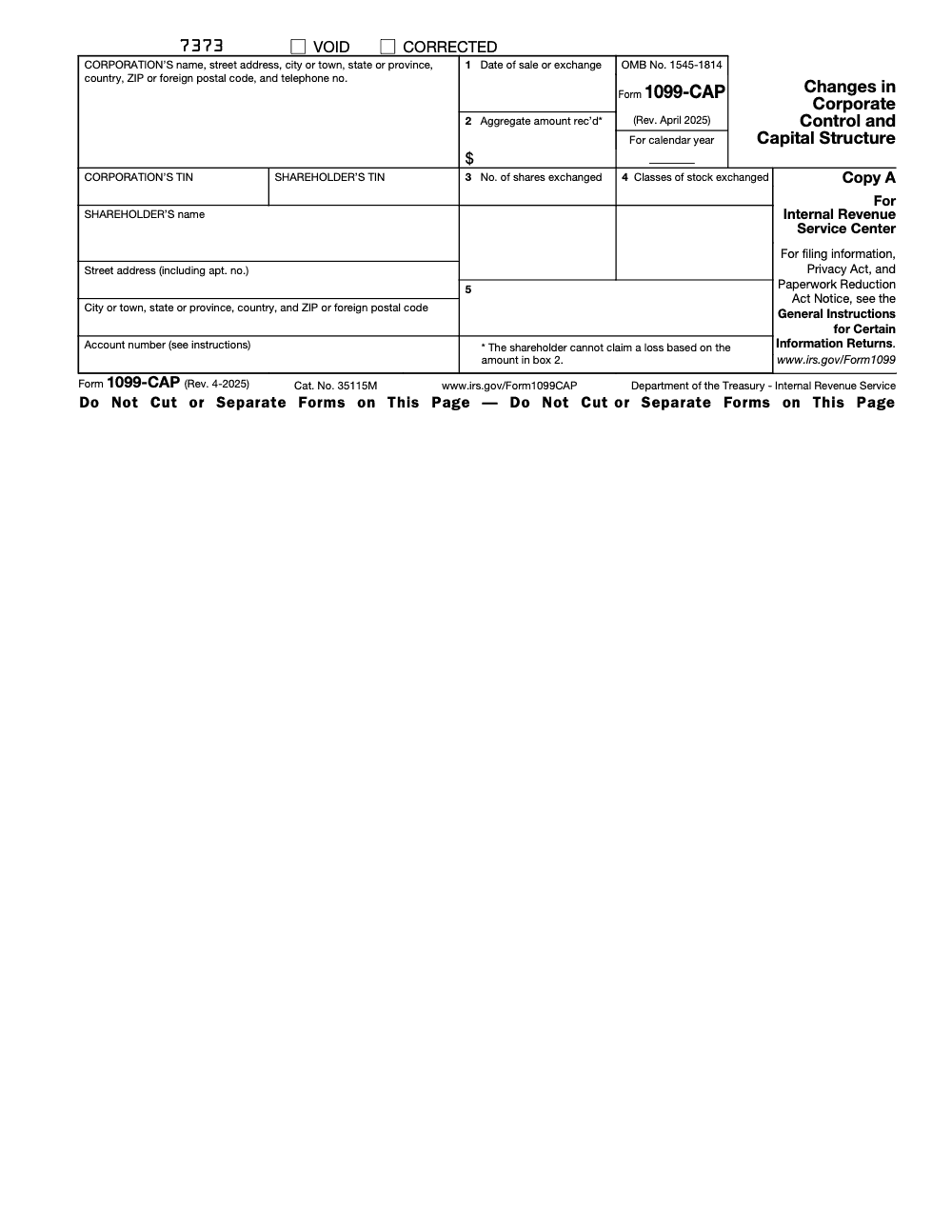
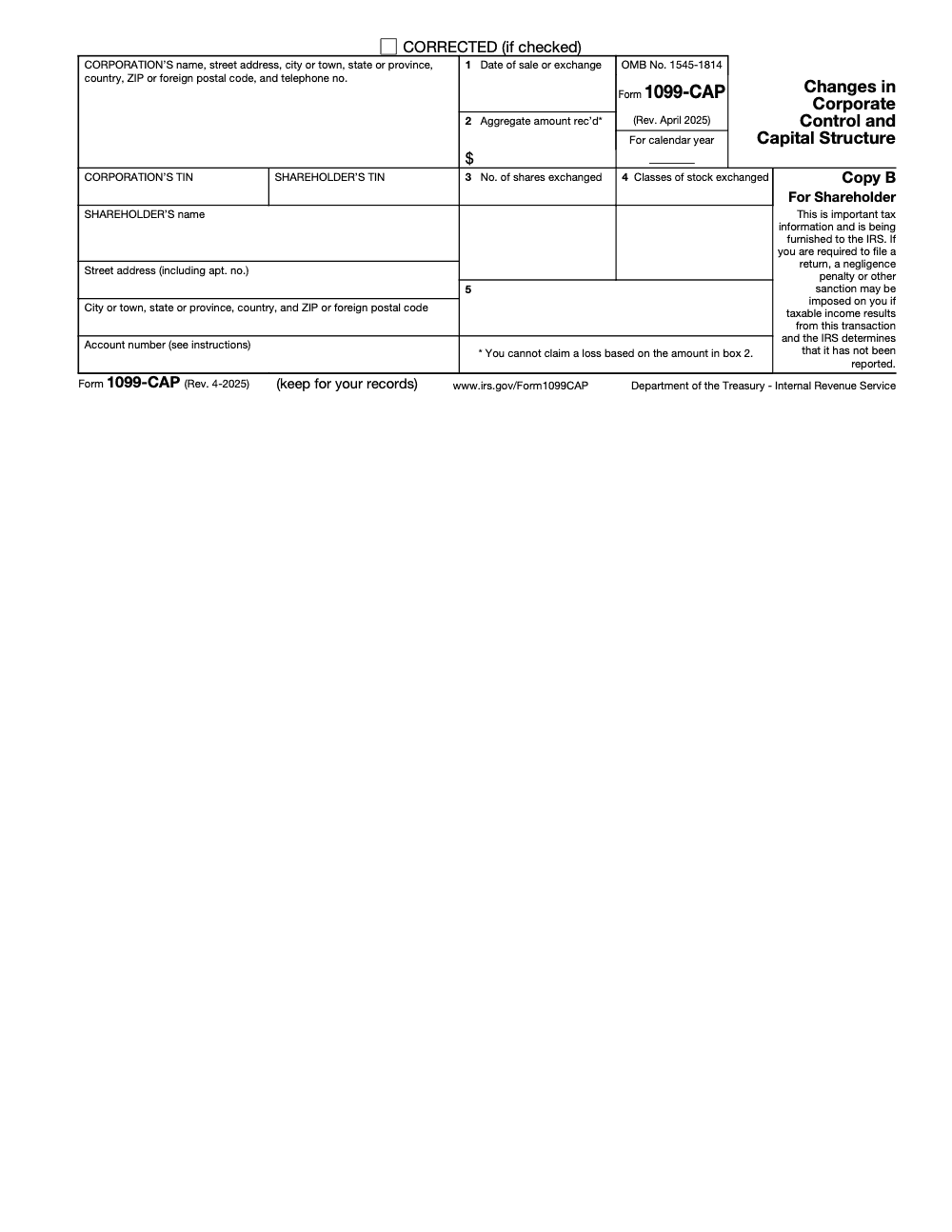
Form 1099‑CAP, Changes in Corporate Control and Capital Structure, is an information return a corporation uses to tell you, and the IRS, what you received when control of the company changed or its capital structure changed in a significant way. Think mergers, acquisitions, consolidations, transfers of substantially all assets, or certain bankruptcy restructurings. The form lists the transaction date, your aggregate amount received, and the shares and class you exchanged. You do not send the form with your tax return. You use the numbers on it to compute capital gain and report it.
Why the IRS cares
When your old shares are exchanged for cash or property, you may have a taxable gain. The IRS asks corporations to furnish Form 1099‑CAP so you can see the amounts and so the IRS can match reporting on your return. The corporation’s duty to issue 1099‑CAP is tied to Form 8806 rules about acquisitions of control and substantial changes. Those rules include a $100 million test and conditions around section 367(a) gain recognition.
A Fast, Real-World Example
- You hold 1,000 common shares of Company A.
- Company B acquires control, the deal closes July 10.
- You receive $8 per share in cash plus a small amount of stock in the new parent.
- In January, you receive Form 1099‑CAP:
- Box 1, July 10 date of exchange.
- Box 2, the total of your cash plus the fair market value of any stock or property you received.
- Box 3, 1,000 shares exchanged.
- Box 4, class of stock, likely C for common.
You then report Box 2 as proceeds on Form 8949, subtract your cost basis, and carry any gain to Schedule D.
Who This Guide Helps
- Individual investors who suddenly get Form 1099‑CAP after a deal closes.
- Controllers and in‑house tax teams who must confirm whether they, or their shareholders, should receive the form.
- CPA firms and EAs who need a clean workflow for high‑volume corporate actions during peak season.
Small note for firms, if you manage many of these events and struggle with reviews or seasonal spikes, trained offshore staff behind a layered review can protect review time and quality. At Accountably, we place offshore accountants and tax preparers inside your tools and templates so your firm processes corporate actions with structured workpapers and multi-layer QC, proof before your name is on the line. We mention this briefly here because it solves a capacity bottleneck many firms hit when merger season collides with deadlines.
When You Might Receive Form 1099-CAP
You may receive Form 1099‑CAP if your corporation has an acquisition of control or a substantial change in capital structure and you, as a shareholder, received cash, stock, or other property. Common triggers include:
- Mergers, acquisitions, consolidations.
- Transfers of substantially all assets.
- Restructurings in bankruptcy that swap or distribute stock or other property to shareholders.
- Certain cross‑border situations where section 367(a) requires gain recognition.
For these reportable events, the corporation furnishes Form 1099‑CAP to affected shareholders unless you are exempt.
Mergers and acquisitions
In qualifying acquisitions of control, shareholders who receive cash, stock, or other property will see a 1099‑CAP if the transaction meets the IRS criteria and reporting applies. Box 1 shows the deal date. Box 2 shows the aggregate amount you received, not just cash. If the corporation does not reasonably determine you have $1,000 or more of gain on the exchange under Treas. Reg. §1.6043-4, or you are otherwise exempt, you typically will not receive the form.
Bankruptcy restructurings
Bankruptcy‑driven transfers can also count as substantial changes. If the event provides stock or property to shareholders and hits the statutory thresholds, 1099‑CAP reporting can apply, with the same boxes and rules.
Reorganizations that trigger gain
Many reorganizations are tax‑free, but not all. When you receive consideration that requires gain recognition, 1099‑CAP is common, particularly when the transaction satisfies the $100 million condition for an acquisition of control or substantial change and the section 367(a) gain recognition test.
What Counts As a “Substantial Change” or “Acquisition of Control”
Here is the plain‑English version anchored to the IRS definitions:
- Acquisition of control means a second corporation goes from below control to control of the first corporation, generally at least 50 percent of vote or value, and the fair market value of stock acquired in the transaction and related transactions is $100 million or more, and gain recognition under section 367(a) is required for the corporation or any shareholder.
- Substantial change in capital structure happens when there is a merger, consolidation, transfer of all or substantially all assets, certain bankruptcy transfers, or a change in identity, form, or place of organization, and cash or property provided to shareholders is $100 million or more, and section 367(a) gain recognition applies.
Who Must File Form 1099-CAP
A domestic corporation that must file Form 8806 for an acquisition of control or a substantial change must also file Form 1099‑CAP with the IRS and furnish copies to each non‑exempt shareholder who received cash, stock, or other property. There are exceptions for affiliated‑group transactions, transactions under $100 million, cases where the corporation makes the consent election on Form 8806 so the IRS can publish data for brokers, and situations reported under other sections like 6042 or 6045.
Brokers and 1099-B
Brokers have their own rules. If a broker knows, or should know based on readily available information such as DTC notices, that a covered transaction occurred, the broker may have to file Form 1099‑B for their customers. The IRS ties this to information the agency publishes from 8806 consent elections.
Exempt Shareholders and Entities
You generally will not receive Form 1099‑CAP if:
- The corporation does not reasonably determine you have $1,000 or more of gain on the exchange under Treas. Reg. §1.6043-4.
- You received only stock in a nonrecognition exchange under section 367(a).
- You are a documented exempt recipient, for example, a C corporation, a tax‑exempt organization, an IRA, a government, a REIT, a RIC, a securities or commodities dealer, a common trust fund, a financial institution, or a foreign person with a valid Form W‑8BEN.
Small tip, if you believe you are exempt but get a form anyway, ask the issuer for a corrected statement and keep the correspondence with your tax records.
Understanding Each Box On Form 1099‑CAP
If the form looks cryptic, this quick map will help you tie it to your return and your records.
Box-by-Box Guide
| Box | What it shows | Why it matters | What you do with it |
| 1 | Date of sale or exchange | This is the day your shares were actually swapped for cash, stock, or other property | Use it as the sale date on Form 8949 |
| 2 | Aggregate amount received | Includes all cash plus the fair market value of stock and any other property you received | Treat it as your proceeds on Form 8949, then subtract your basis to compute gain |
| 3 | Number of shares exchanged | Confirms how many shares you gave up | Match to your brokerage lots and statements for basis and holding period |
| 4 | Class of stock exchanged | Common, preferred, or other class abbreviations | Helps you tie the right lots and basis to the correct security |
These box descriptions, including the definition of “aggregate amount received,” come directly from the IRS instructions for Form 1099‑CAP revised April 2025.
The $1,000 de minimis and exempt recipients
Many shareholders never see this form. You generally will not receive it if the corporation does not reasonably determine you have $1,000 or more of gain on the exchange under Treas. Reg. §1.6043-4, if you received only nonrecognition stock under section 367(a), or if you are an exempt recipient such as a C corporation, a tax‑exempt organization, an IRA, certain financial institutions, or a foreign person with a valid Form W‑8BEN on file.
Tip, if you believe you are exempt and still received a 1099‑CAP, ask the issuer to correct the statement and keep the correspondence with your tax file.
Special date for clearing organizations
Issuers have an earlier furnishing date for clearing organizations such as DTC, generally January 5 of the year after the transaction. This early date helps brokers meet their own reporting rules.
What Form 1099‑CAP Means For Your Taxes
At a practical level, Form 1099‑CAP tells you the proceeds to report when a corporate action requires you to recognize gain. You will usually enter Box 2 as proceeds on Form 8949, list the Box 1 date as the sale date, and use your own cost basis and acquisition dates to determine short‑term versus long‑term. Your subtotals then flow to Schedule D.
Some reorganizations are nonrecognition events for stock received, other parts of the same deal can be taxable. If guidance for your specific transaction says loss is not recognized, you do not report a loss. Publication 550 and the Form 8949 instructions explain how capital transactions flow, including when you report without a 1099‑B.
A simple walkthrough
- Check Box 3 and Box 4 against your brokerage statement to confirm the right security and share count.
- Confirm Box 2 includes both cash and the fair market value of any stock or property you received.
- On Form 8949, enter Box 2 as proceeds, use Box 1 for the sale date, and enter your lot‑level basis and dates acquired.
- Carry the totals to Schedule D and classify short‑term or long‑term based on your holding periods.
A quick micro‑example
You held 600 common shares with a total basis of 6,000. The merger closes on August 15. You receive 3,000 cash plus stock in the new parent worth 1,800 on the close date. Your Form 1099‑CAP shows Box 1, Aug 15, Box 2, 4,800, Box 3, 600, and Box 4, C. On Form 8949 you enter 4,800 as proceeds, subtract basis for the lots you sold or exchanged, and compute your gain.
Small note for firms, when basis lives across multiple custodians and spreadsheets, a standardized workpaper that ties Box 3 share counts to lot‑level basis can cut review time and corrections. If you manage many of these, building that checklist once will pay for itself every busy season.
When You Will Receive It, And What To Report
You typically receive Form 1099‑CAP in January for a transaction that closed the prior calendar year, unless you are exempt. The issuer follows the furnishing deadlines in the General Instructions for Certain Information Returns, and, for shares held at DTC, issues earlier to the clearing organization.
What you must report
- Treat Box 2, the aggregate amount received, as your proceeds on Form 8949.
- Use your own cost basis and acquisition date per lot to determine gain and short‑term or long‑term status, then carry results to Schedule D (no loss is allowed on a 1099‑CAP exchange even if Box 2 is below basis; treat a below‑basis result as no recognition, not a deductible loss).
- Follow any transaction‑specific guidance that disallows loss recognition. If loss is not recognized, do not report the loss.
If the numbers look off
The most common mistake is Box 2 that reflects only cash, not cash plus the fair market value of stock and other property. Ask the issuer for the deal valuation they used, compare it to your broker’s reorg notice, and request a corrected statement if needed. The IRS instructions confirm Box 2 must include both cash and FMV.
How To File Correctly, Step By Step
- Gather forms and records
- Form 1099‑CAP, your brokerage statement, deal documents, and any gain‑or‑loss notices from the issuer.
- If you did not receive a 1099‑CAP but know you received cash or property, you still report the taxable piece using your records. Publication 550 makes it clear you report capital sales and exchanges even if no 1099‑B is issued.
- Complete Form 8949
- Use Box 2 as proceeds, enter Box 1 date, and describe the security with Box 3 share count and Box 4 class.
- Enter lot‑level basis and acquisition dates, then total the page.
- Finish Schedule D
- Move subtotals from Form 8949 to Schedule D, Part I or II, based on holding period.
- Keep your proof
- Save copies of your 1099‑CAP, corrected statements, and any written responses from investor relations or the transfer agent.
Real‑world tip, if you handle multiple accounts, add a short cover sheet that lists each account, the box amounts, lot summaries, and any adjustments. Your future self will thank you at extension time.
A Quick Decision Table
| Situation | Do you report? | Where to look |
| You received cash or property and guidance shows gain is recognized | Yes | Form 8949 then Schedule D |
| You received only stock in a nonrecognition exchange under section 367(a) | No gain recognized | 1099‑CAP exempt rules |
| Your reasonably-determined gain is less than $1,000 | Likely no 1099‑CAP, keep records | Exempt recipients list |
| You are a C corporation, tax‑exempt, IRA, or valid W‑8BEN on file | Exempt | Exempt recipients list |
Basis, Holding Period, And Multiple Purchase Dates
If you bought shares over time, you need to match lot‑level basis and dates acquired to the shares shown in Box 3. Start with your broker’s lot report. If you used specific identification earlier, keep using it. If you never specified lots, many brokers default to FIFO. Then compute your gain per lot and total the results for Form 8949. Publication 550 and the 8949 instructions explain basis, holding periods, and lot reporting.
Short‑term vs long‑term
- Short‑term means held one year or less.
- Long‑term means held more than one year. Your holding period usually starts the day after you bought each lot and ends on the date in Box 1. You will split totals on Schedule D by term.
A worked example with mixed lots
- Lot A, 200 shares bought Jan 5 last year, basis 2,000.
- Lot B, 400 shares bought three years ago, basis 3,600.
- 1099‑CAP shows Box 2, proceeds 5,400, Box 3, 600 shares.
- Allocate proceeds across all exchanged shares, then compute gain per lot and split between short‑term and long‑term. Attach an explanation if you need to summarize many lines. The 8949 instructions allow summaries in certain cases, but individuals generally list each sale unless an exception applies.
When a loss is not recognized
Some corporate reorganizations allow gain recognition but disallow loss recognition on certain exchanges. If your deal materials or issuer guidance say loss is not recognized, do not report the loss on Form 8949. Keep your calculations and evidence with your return. Use Publication 550 and the issuer’s notice as your primary references.
If You Did Not Receive Form 1099‑CAP
Start with a quick eligibility check.
- Was there an acquisition of control or substantial change in capital structure, tied to Form 8806 rules and the $100 million threshold, and did you receive cash, stock, or other property.
- Are you below the $1,000 de minimis amount or otherwise exempt.
If you still think you should have a form, contact the issuer’s investor relations or transfer agent. Ask for the Box 1 date, Box 2 aggregate amount, Box 3 share count, and Box 4 class so you can complete Form 8949 accurately while waiting for a corrected or duplicate statement.
If a form never arrives, you still report taxable gain with your own records. The IRS reminds filers to report sales and exchanges even without an information return in certain situations.
Filing Deadlines, E‑Filing Rules, And 2025 Penalties
Here are the dates you care about for statements issued in early 2026 for 2025 transactions, and for forms issued in early 2025 for 2024 transactions.
- Furnish recipient copies by January 31.
- File paper returns by February 28.
- File electronically by March 31. The General Instructions for Certain Information Returns set these dates each year, and they note the special earlier date for clearing organizations.
E‑file threshold
If you file 10 or more information returns in a year, you must file electronically. This aggregate rule applies across most return types and includes W‑2s filed with SSA.
Use the free IRIS system
You can file 1099‑CAP for free through the IRS Information Returns Intake System, either in the browser portal or via Application‑to‑Application. IRIS supports 1099‑CAP for processing year 2025 and later, handles corrections, and provides acknowledgments.
2025 Penalty Amounts At A Glance
Penalties adjust with inflation. For returns due in calendar year 2025, the IRS shows these amounts for each incorrect or late information return or payee statement.
| Year due | Up to 30 days late | 31 days late through Aug 1 | After Aug 1 or not filed | Intentional disregard |
| 2025 | $60 | $130 | $330 | $660 |
The annual caps vary for small and large filers, and there is no maximum for intentional disregard. For the detailed cap amounts, see the 2025 General Instructions and the IRS penalty page that presents the annual table by year.
Important, the 2026 amounts already step up again to $340 and $680 at the highest tiers. If you are reading this after November 4, 2025, check the latest General Instructions or the IRS penalty page for updates.
A Quick Compliance Checklist For Issuers
- Confirm if Form 8806 applies and whether consent election will be made for broker reporting.
- Identify exempt recipients and apply the $1,000 reasonably-determined gain threshold per shareholder under Treas. Reg. §1.6043-4.
- Populate Box 2 with cash plus FMV of stock and property.
- Furnish DTC by January 5 when applicable, then furnish recipients by January 31.
- E‑file through IRIS if you are at or above 10 total information returns.
- Document TIN and name matches, retain audit logs, and plan for corrections.
Small note for firms, if you are juggling hundreds of payee statements, standard operating procedures and a correction log reduce penalty exposure. A brief QC step that rechecks Box 2 and the date in Box 1 against deal documents catches the biggest errors before they go out.
Using Tax Software And E‑File Providers
If you are an investor reporting your own return, most consumer tax products handle Form 8949 entries. You will enter the proceeds from Box 2, the sale date from Box 1, your basis per lot, and a short description that includes the share count and class. That will flow to Schedule D. The IRS Schedule D and Form 8949 pages are your best references if you want to confirm how the math carries through.
If you are an issuer or a service bureau, you have options.
- File at no cost in the IRIS Taxpayer Portal for smaller volumes or corrections.
- Use IRIS A2A for high volume and API integrations.
- Keep an eye on system status near year end maintenance windows and plan around them.
Note, IRS news and tax tips show how to get a TCC, upload CSVs, and receive acknowledgments, and they restate the 10‑return e‑file rule. Use Publication 5717 for screenshots and step‑by‑step help.
Common Errors And How To Fix Them
Misstating Box 2
Box 2 must include cash plus the fair market value of any stock and other property. Issuers sometimes include only cash or only stock value. Recalculate based on the deal’s closing price and the actual consideration received, then issue a corrected form.
Incorrect exemptions
Before furnishing, filter out exempt recipients. Apply the $1,000 reasonably-determined gain threshold per shareholder under Treas. Reg. §1.6043-4, confirm entity type, and honor valid W‑8BEN or exemption certificates. If a form was sent in error, void and reissue as needed.
Dates and share counts that do not match
Box 1 should be the exchange date, not the announcement date. Box 3 and Box 4 must match the shares and class you actually exchanged. Correcting these details avoids downstream basis and holding period errors on investors’ returns.
Missing e‑file when required
Sending paper when you have 10 or more total information returns can trigger penalties. If you missed the threshold, move to IRIS and file corrections electronically.
Helpful Source List
- Instructions for Form 1099‑CAP, revised April 2025, including exempt recipients, $1,000 de minimis, box definitions, and special clearing organization dates.
- General Instructions for Certain Information Returns, 2025 edition, including due dates and penalty caps.
- About Form 8949 and Schedule D pages for how proceeds and subtotals flow.
- IRS Information Return Penalties page, with annual tables for 2021 through 2026 and the 10‑return e‑file rule.
- IRIS filing pages with supported forms and TCC details.
For CPA And EA Firms Managing Volume
If you process many corporate actions, the bottleneck is rarely tax law, it is review time. Tighten your SOPs, use a standard basis tie‑out, and add a second‑level QC that scans Box 2 math, Box 1 dates, and exemptions before furnishing. If you choose to scale with offshore capacity, make sure your partner works inside your templates and provides layered review, not just resumes.
Accountably helps firms that want disciplined offshore delivery, not short‑term staffing. Our teams work inside QuickBooks, Xero, CCH Axcess, Thomson Reuters, and your workpaper tools, using SOPs, structured files, and turnaround SLAs that protect reviewer time. If you are running into seasonal spikes around corporate actions, this kind of structure can help you ship on time without quality drift.
Final Thoughts And A Plain‑English Disclaimer
You now have a clean process, confirm whether you should receive a 1099‑CAP, check Box 2 includes cash plus fair market value, report proceeds on Form 8949, and carry totals to Schedule D. Keep your basis proof and the issuer’s guidance in your file.
This guide is educational, not tax or legal advice. IRS rules cited here are current as of November 4, 2025. If you are reading this later, confirm the latest IRS instructions for Form 1099‑CAP, the 2025 General Instructions, the penalty table that applies to your filing year, and the IRIS e‑file rules before you file.
If you want a quick review checklist or a basis workbook template tailored to 1099‑CAP events, say the word. I am happy to share a version that has worked well for teams during busy season.
Common Mistakes We See Every Season
Five 1099-CAP mistakes show up almost every busy season, and most stem from treating the form like a regular brokerage 1099. The fixes below are the SOP language my team uses inside corporate reorg engagements.
Reusable Checklists
Two checklists below cover the issuer side and the shareholder side. Both are written so a senior can lift them straight into a firm SOP without rewording.
1099-CAP issuer pre-filing review
- Confirm the transaction qualifies as an acquisition of control or substantial change in capital structure under IRC §6043(c) or §6043A and Treas. Reg. §1.6043-4.
- Apply the 5 percent shareholder or $100 million aggregate-reportable threshold from Reg. §1.6043-4 before scoping the recipient list.
- For each candidate shareholder, confirm reasonably determined gain reaches the $1,000 issuance threshold; exclude those below it and document why.
- Capture each shareholder's TIN (SSN, ITIN, ATIN, or EIN); plan TIN truncation for Copy B and the full TIN for Copy A.
- Verify Box 1 (date of exchange), Box 2 (aggregate amount received), Box 3 (shares exchanged), and Box 4 (classes of stock) against the closing schedule.
- Confirm OMB No. 1545-1814, Cat. No. 35115M, and Form ID 7373 on the order-printed Copy A; never use the IRS.gov PDF for paper submission.
- Calendar the January 31 shareholder-furnishing date and the February 28 paper or March 31 e-file IRS deadlines separately.
- Aggregate all information returns the entity will issue for the year; if total reaches 10 or more, route through IRIS or FIRE.
Shareholder gain computation and reporting
- Pull the surrendered stock's cost basis and acquisition date(s) from brokerage or custodian records.
- Treat Box 2 (aggregate amount received) as proceeds; do not net against basis on the form itself.
- On Form 8949, enter the surrendered stock, original acquisition date, exchange date from Box 1, basis, and Box 2 as proceeds.
- Determine holding-period character (long-term if held more than one year before the exchange date, otherwise short-term).
- If Box 2 is less than basis, do not enter a loss – the transaction is not a recognition event under the form footnote.
- Carry Form 8949 totals to Schedule D; confirm the 2025 capital-gains brackets if total taxable income approaches the 0%, 15%, or 20% breakpoints.
- Review IRS Publication 550 chapter 4 for nonrecognition, basis carryover, and stock-for-stock rules before finalizing.
Keep 1099-CAP Season From Stalling
Corporate-control transactions move on tight closing calendars, and Form 1099-CAP usually surfaces after the deal is already announced. Once the closing date is set, the issuer has roughly six to ten weeks to identify every reportable shareholder, gather TINs, run the $1,000 gain test from Treas. Reg. §1.6043-4, and prepare Copy B for the January 31 furnishing deadline. The §6721 General Rule penalty for a missed or incorrect Copy A in 2026 is $340 per return with calendar-year caps up to $4,098,500 for larger filers, and §6722 mirrors that on the shareholder copy.
The teams that move through 1099-CAP cycles cleanly treat it as an information-return engagement, not a one-off transaction memo. They standardize the data capture before the closing memo is even drafted, and they hand the IRS copy off to whoever runs the rest of the 1099 batch for the year.
- Build a shareholder-data template at closing that captures TIN, address, basis allocation, share class, and Box 1 through Box 4 inputs so January production work is just review.
- Apply the §1.6043-4 $1,000 gain test per shareholder and document the exclusion rationale for anyone below it; reviewers look here first.
- Run a 10-return aggregate count across W-2s, 1099-NECs, 1099-DIVs, and 1099-CAPs before the first paper print job; if the count reaches 10 or more, switch the whole batch to IRIS or FIRE per T.D. 9972.
- Calendar the January 31 furnishing date, the February 28 or March 31 IRS deadlines, and the 30-day and August 1 correction-window cutoffs so any error caught after the fact lands in the $60 or $130 tier rather than the full $340.
- Keep an IRS Publication 550 chapter 4 reference in the engagement folder; basis-carryover and nonrecognition questions show up the moment the shareholder calls about Box 2.
That is the workflow our U.S.-led tax delivery teams run inside reorg engagements: a documented data-capture step at closing, a separate IRS-filing track, and correction-window discipline so penalty exposure stays in the lowest tier.
FAQs
It is a statement you get when a corporation you own has a qualifying acquisition of control or substantial change in capital structure and you received cash, stock, or other property. You use it to compute and report any taxable gain.
No. Thresholds vary by form. For 1099‑CAP, the issuer rules hinge on acquisitions of control or substantial changes and apply when the corporation reasonably determines a shareholder has $1,000 or more of gain under Treas. Reg. §1.6043-4, plus exempt entity categories.
You generally report Box 2 as proceeds on Form 8949 and carry totals to Schedule D. If the specific transaction guidance says loss is not recognized, do not report a loss.
You still report the taxable piece using your records. The IRS tells filers to report sales and exchanges even without an information return in certain situations.
Recipient copies are due January 31, paper filing is due February 28, and e‑filing is due March 31. For DTC, issuers generally furnish by January 5.
Other forms this guide names
- Form 8949: How to Report Capital Gains & Losses
- Form 8806: Filing & 1099-CAP Reporting Guide
- Form W-8BEN: Foreign Status Certificate Guide 2025
- Form 1099-B: Report Broker & Barter Proceeds
About this guide
Accountably helps US CPA, EA, and accounting firms hire trained accountants and tax preparers in India.
About us Reviewed byJugal Thacker, CPAFounder and CEO at Accountably
A Washington-licensed CPA with 7+ years inside US firms – PwC, a real-estate tax practice, then a full-service firm, rising from reviewer to manager to advisory. This article was reviewed against current IRS guidance for the 2025 tax year and updated for filers preparing late returns, amendments, and 2026 estimates.
View profile →How we research, review, and update this guide
Every Accountably guide is researched against primary IRS sources, reviewed by a U.S. CPA, and refreshed as guidance evolves. Read our Editorial Guidelines to see how we source, fact-check, and update our content.