Summarize this article with AI
In Brief
Form 8806 is the information return a domestic reporting corporation files to report an acquisition of control or a substantial change in capital structure, required only when the fair market value reaches $100 million and the corporation or a shareholder must recognize gain under section 367(a) (Form 8806, Rev. October 2016). File by the earlier of 45 days after the transaction or January 5 of the following year, send it by fax to 844-249-6232 because mailing is no longer accepted (IRS notice, July 25, 2022), and pair it with Form 1099-CAP for affected shareholders.
A company crosses the $100 million mark on an acquisition of control and assumes the reporting return can wait until the next filing season. It cannot. Form 8806 is due by the earlier of 45 days after the transaction or January 5 of the following year, and the penalty for missing it runs $500 per day under IRC §6652(l), up to $100,000 per form.
Form 8806 is the information return a domestic reporting corporation files when it gains control, defined as acquiring stock representing at least 50% of voting power or at least 50% of total value, or sees a substantial change in capital structure. Mailing is no longer accepted; it goes by fax to 844-249-6232, and a corporation that files it generally must also furnish Form 1099-CAP to affected shareholders.
Key Takeaways
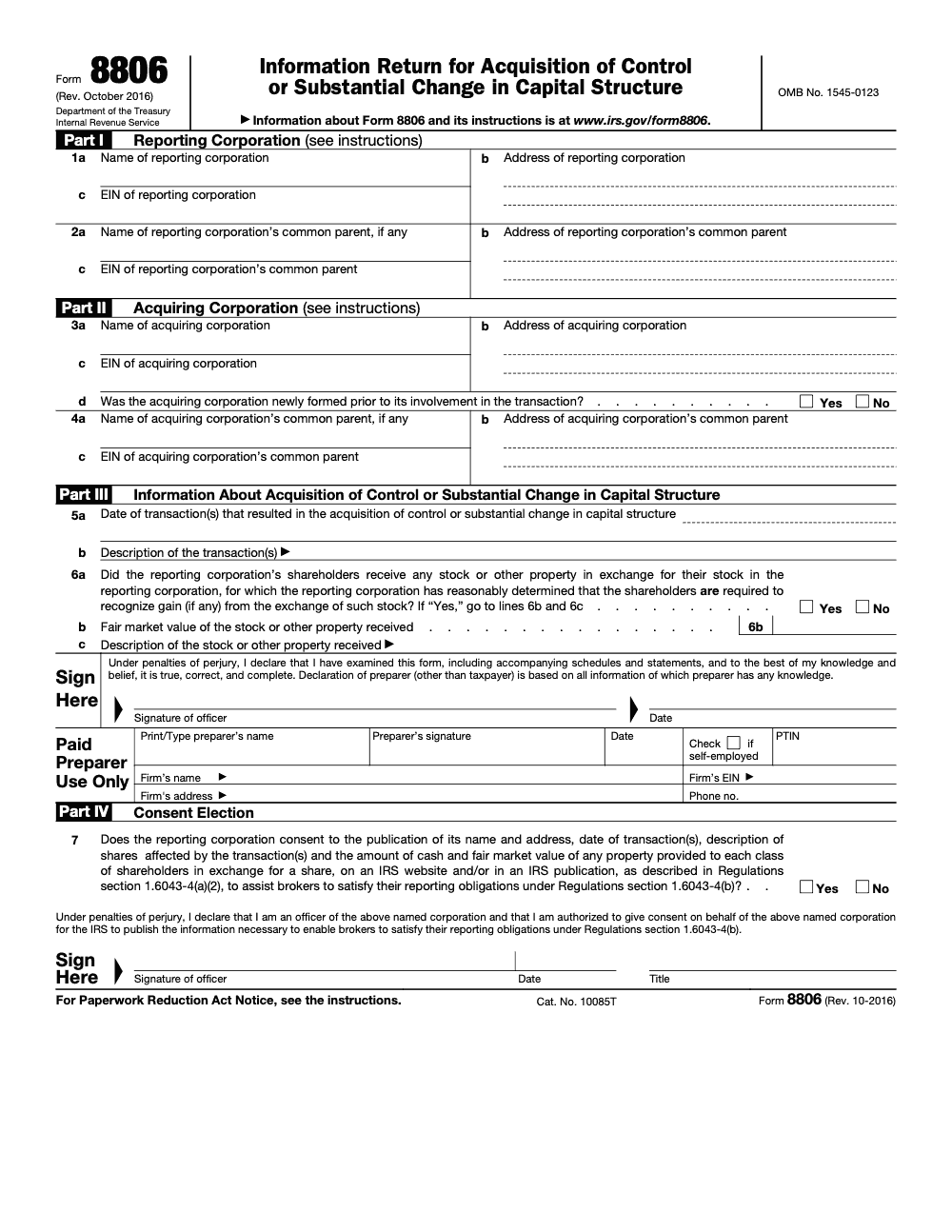
- Form 8806 is the Information Return for Acquisition of Control or Substantial Change in Capital Structure (Rev. October 2016, OMB No. 1545-0123, Cat. No. 10085T).
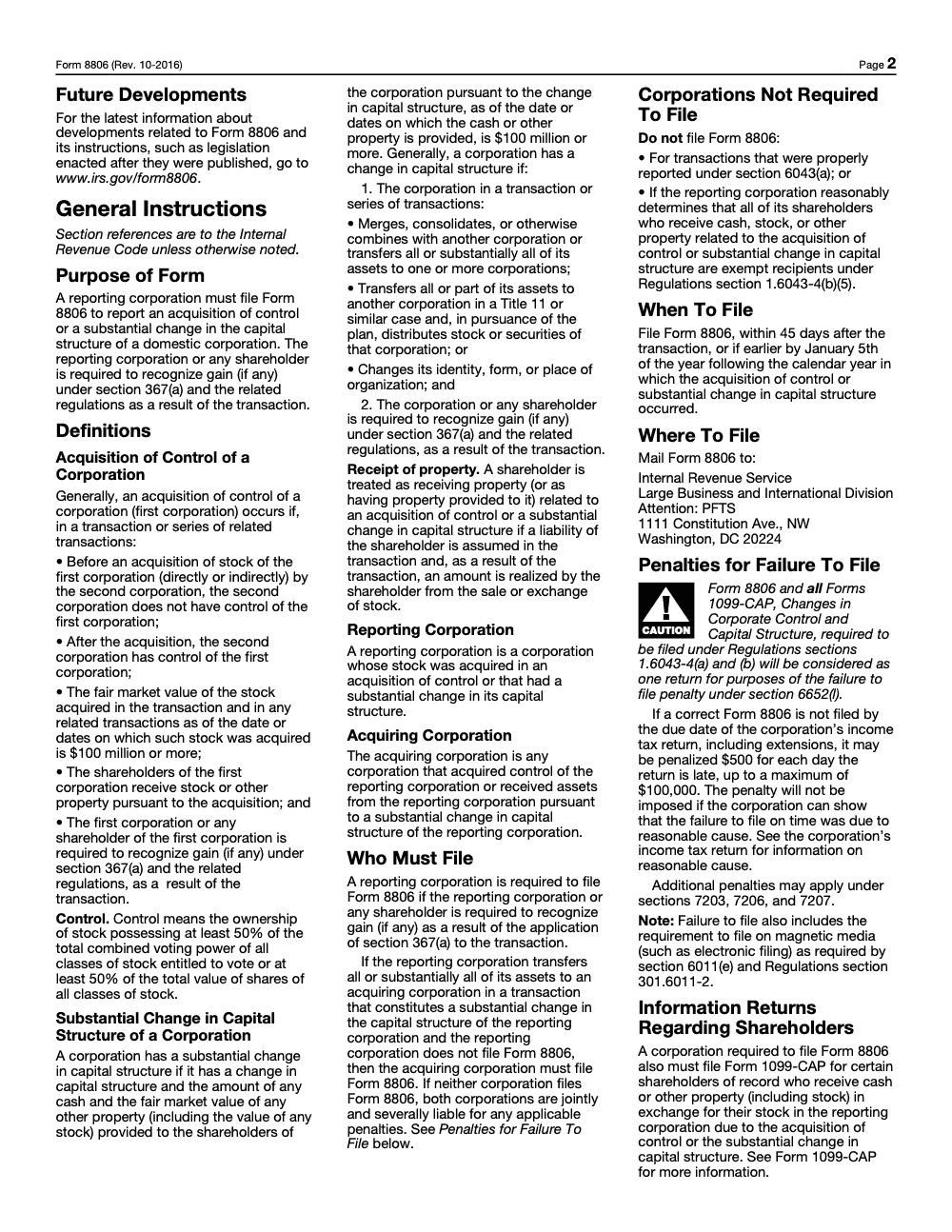
- An acquiring corporation is treated as gaining control when it acquires stock representing at least 50% of the voting power or at least 50% of the total value of the reporting corporation.
- Filing is triggered when stock with a fair market value of $100 million or more is acquired, or when cash and other property of $100 million or more is provided to shareholders in a substantial change in capital structure.
- File within 45 days after the transaction, or by January 5 of the year following the calendar year of the transaction if that date is earlier.
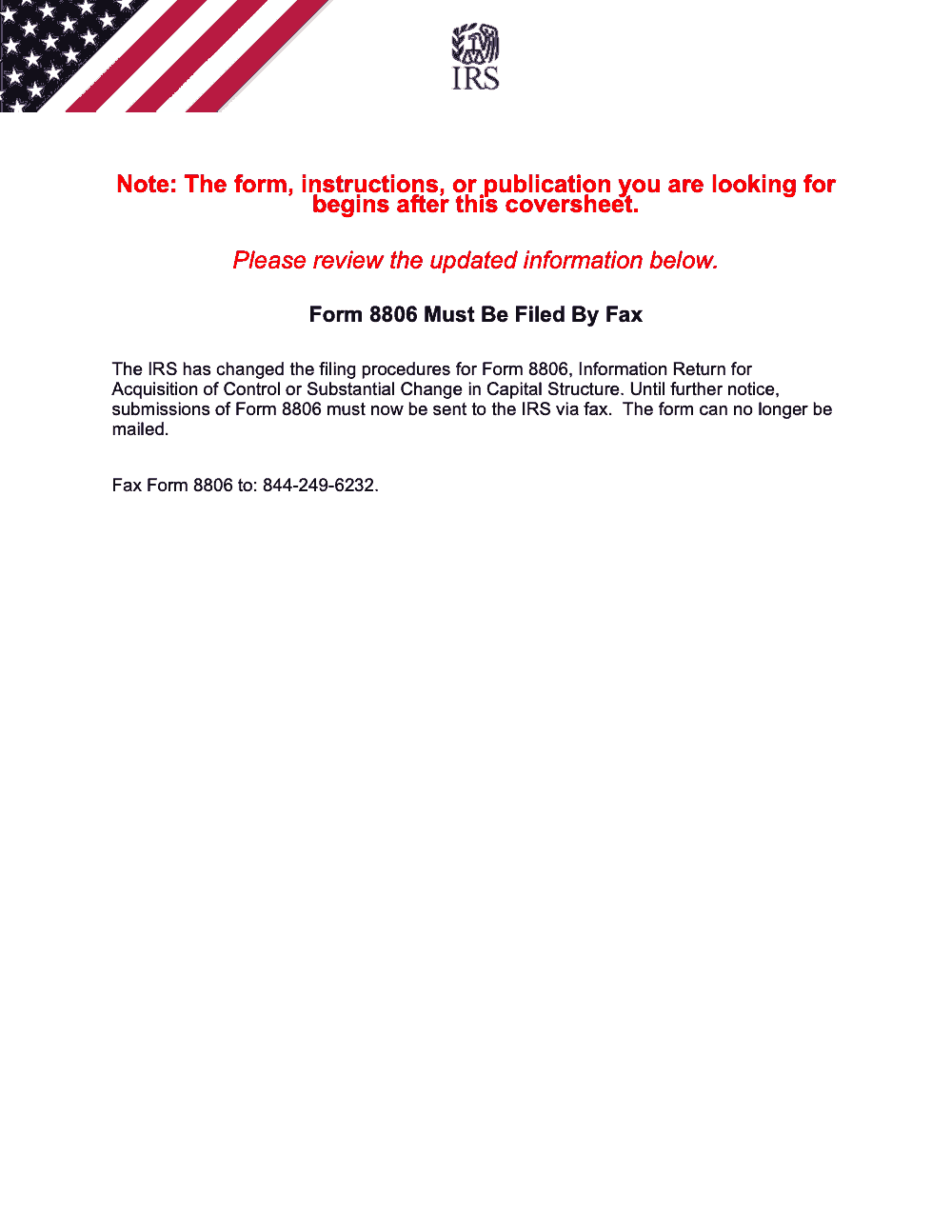
- Form 8806 must be filed by fax to 844-249-6232; the older mailing address is superseded by the fax-only requirement effective July 25, 2022.
- Failure to file carries a penalty under IRC §6652(l) of $500 per day, up to a maximum of $100,000 per Form 8806. A corporation that files Form 8806 generally must also furnish Form 1099-CAP to affected shareholders.
What Form 8806 Covers
Form 8806 is the information return that alerts the IRS to major corporate events that change who controls the corporation or reshape its capital structure. In practice, it turns on two questions. First, did an acquisition of control occur under the control test that looks through constructive ownership. Second, did shareholders receive cash or other property with an aggregate fair market value of $100 million or more. Answer yes to either trigger, and you move into a 45‑day, earlier‑of timing regime, provided the corporation or a shareholder is also required to recognize gain under section 367(a) as a result of the transaction.
The form itself asks for the reporting corporation’s legal name, address, EIN, any common parent details, each acquirer’s identifiers, a clear description of the transaction, key dates, and the fair market value and type of consideration provided to shareholders, class by class. If you choose the publication consent election, the IRS will publicly post only the limited items brokers need. That publication does not include shareholder identities.
Why delivery breaks, and how Accountably fixes it
If your team is already stretched by peak season, review loops, documentation gaps, and turnover, adding a large‑deal reporting stack will strain everything. We see the same patterns across firms, and we built our service to address them.
- Capacity without chaos, predictable turnaround so Form 8806, 1099‑CAP, and supporting schedules move on a timetable.
- Workflow discipline, SOP‑driven execution with standardized workpapers, naming, and version control.
- Review protection, layered QC that cuts partner time.
- Security and continuity, SOC 2 aligned controls, role‑based access, zero local storage, and continuity plans that prevent disruption.
Our trained offshore teams plug into your tech stack, including QuickBooks, Xero, UltraTax, CCH Axcess, ProConnect, Lacerte, Drake, Thomson Reuters, Canopy, Karbon, TaxDome, Suralink, and JetPack. You stay in control of templates, expectations, and approvals, while we absorb the production load.
How to Test Filing Necessity
Acquisition of control
Control for Form 8806 tracks the first sentence of §304(c)(1) and applies §318 attribution rules, with §958(b) where relevant. This means options, entities, and related parties can pull you over the control line even if no single certificate shows it. You file if a second corporation that did not previously control your corporation obtains control, and the acquired stock has a fair market value of at least $100 million, and the corporation or any shareholder is required to recognize gain under section 367(a) as a result of the transaction.
Practical example. Parent P forms Newco, acquires 100 percent of Target T in a cash‑and‑stock deal. If the stock acquired has FMV of $100 million or more, and T’s shareholders receive cash, stock, or other property, the 8806 control test is met. Layer in attribution, then confirm whether section 367(a) gain recognition applies for any outbound element.
Substantial change in capital structure
A substantial change exists when your corporation changes its capital structure, shareholders receive $100 million or more in cash or other property, and there is section 367(a) gain recognition by the corporation or any shareholder because of the transaction. Mergers, consolidations, transfers of all or substantially all assets, and changes in identity, form, or place of organization can qualify. Measure what shareholders actually receive on the transaction date, across all affected classes.
Practical example. A domestic C‑corp merges into another domestic C‑corp, and all shareholders receive a mix of cash and stock worth $175 million in total. If section 367(a) gain applies to any shareholder or the corporation, you have a substantial change, and Form 8806 is required under the earlier‑of deadline.
Recipient rules and de minimis
You still have investor‑level obligations through Form 1099‑CAP for each shareholder who is not an exempt recipient, but there is a practical screen. You do not furnish 1099‑CAP to any shareholder whose total cash plus FMV of stock and other property does not exceed $1,000. Exempt recipients include corporations, tax‑exempt organizations, IRAs, governments, financial institutions, and certain regulated entities. Keep exemption certificates on file.
Common pitfalls we prevent
- Counting only the cash, and missing property or deemed amounts from liability assumptions that push you past $100 million.
- Misjudging control because attribution rules were not applied across entities and families.
- Waiting on final shareholder rolls, then bumping into the January 5 cutoff.
- Treating clearing organizations like exempt recipients when the publication consent election was not made.
Our teams pressure test facts early, reconcile deal documents to cap tables, and stage workpapers so you can make clean, quick calls and keep the timeline intact.
Deadline Rules, Filing Sequence, and Broker Coordination
Core timing
- File Form 8806 by the earlier of 45 days after the triggering event or January 5 of the following calendar year.
- File Forms 1096/1099‑CAP with the IRS by February 28, or March 31 if electronic. Furnish 1099‑CAP statements to shareholders by January 31.
- If a clearing organization is the record holder, furnish 1099‑CAP to the clearing organization by January 5 unless you made the publication consent election on Form 8806.
Quick reference table
| Deadline item | What to do | Key date |
| Form 8806 filing | File by earlier of 45 days or January 5 | 45 days or January 5 |
| 1099‑CAP furnish to shareholders | Send recipient statements | January 31 |
| 1096/1099‑CAP file with IRS | Paper or e‑file | February 28, or March 31 if e‑file |
| Clearing organization furnish | Unless consent election made | January 5 |
| E‑file threshold | Aggregate information returns | 10 or more |
Sources, see 26 CFR §1.6043‑4 and 2025 1099‑CAP instructions including e‑file changes under T.D. 9972.
Completing Form 8806 Accurately
Reporting corporation details
Start with the exact legal name, address, and EIN as they appear in IRS records. Add any common parent information. Enter the date or dates that gave rise to the acquisition of control or capital‑structure change. If you intend to reduce clearing‑organization friction, consider the publication consent election, which allows limited IRS publication that brokers can use for §1.6043-4(b) reporting.
Checklist you can follow:
- Match entity name and EIN to IRS records to prevent rejects.
- List each transaction date that contributes to the reportable event.
- Keep narrative labels short and precise, then tie them to deal documents.
- Stage support for per‑class cash, stock, and other property at fair market value.
Acquiring corporation information
For each acquirer, provide legal name, address, EIN, whether it was newly formed, and any common parent data. Where multiple acquirers exist, list each and align the date fields to your closing mechanics. If stock is part of consideration, note class and quantity. If section 367(a) gain applies, state that clearly to support the substantial‑change analysis.
Transaction description and values
Use concise descriptions that mirror the agreements. For example, “Merger of T into A, 100 percent of T acquired,” then provide the closing date and the aggregate cash and FMV of stock or other property by class. For mixes of cash and stock, prepare a per‑class bridge that ties to your shareholder lists and transfer agent statements. This is the workpaper that accelerates review and reduces back‑and‑forth later.
Publication consent election
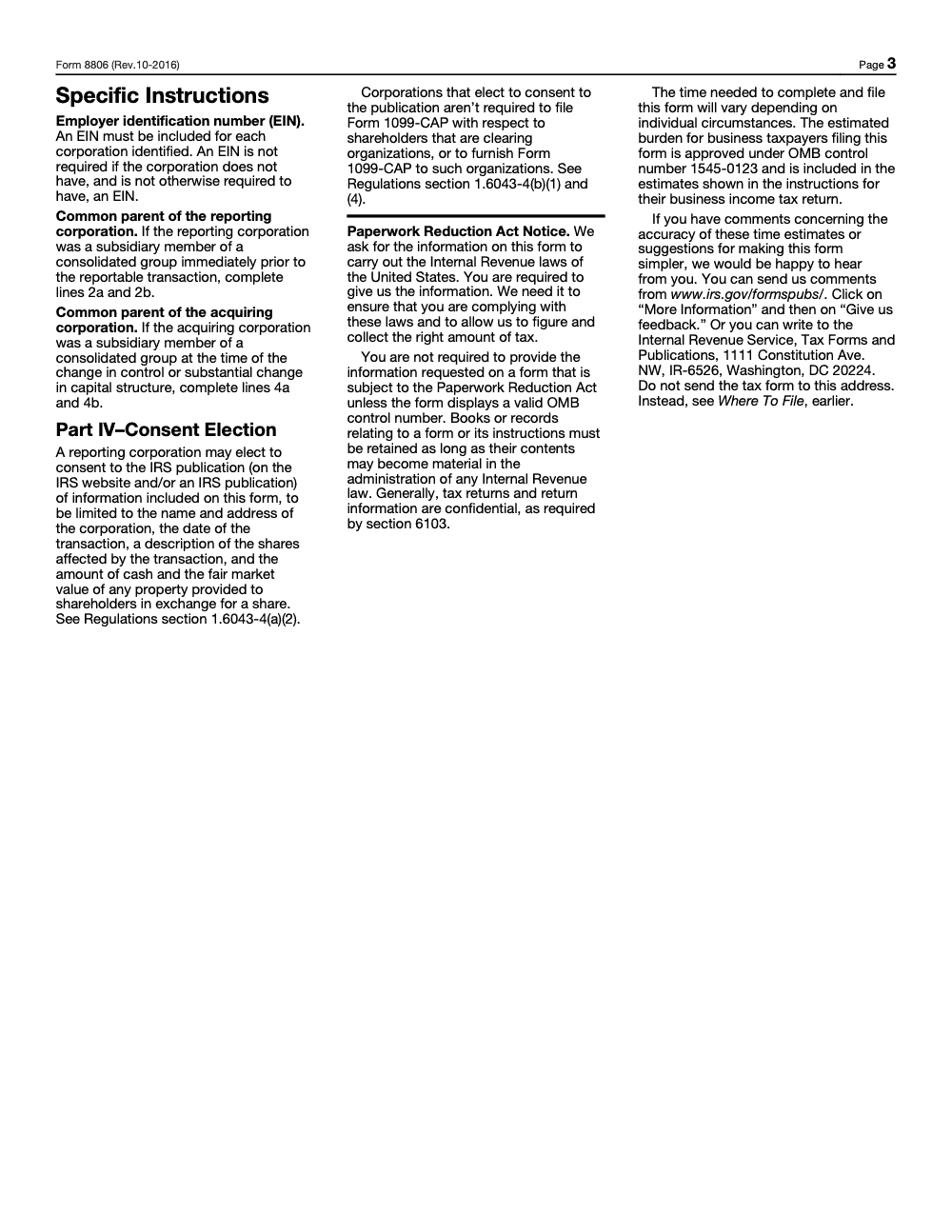
If you check the consent box on Form 8806, the IRS may publish your corporation’s name and address, the date of the transaction, a brief description of affected shares, and per‑share amounts of cash and FMV of stock or other property. That limited notice is designed to help brokers satisfy §1.6043-4(b). It does not publish shareholder identities or TINs.
Filing Mechanics You Must Get Right
As of July 25, 2022, the IRS notes that Form 8806 filings must be submitted by fax until further notice. The IRS’s update points you to fax submission rather than mail, and the historical notice lists the fax number as 844‑249‑6232. We advise documenting your fax confirmation and retaining a complete copy set with deal support.
For 1099‑CAP, remember the modern e‑file rule. The electronic filing threshold for information returns is now 10, calculated by aggregating all information returns you file, effective for returns due on or after January 1, 2024. If you are at or above that threshold, e‑file 1099‑CAP, since paper filing when electronic filing is required under section 6011(e) is itself treated as a failure to file.
A truncation reminder. You may truncate a recipient’s TIN on payee statements, but you may not truncate the filer’s TIN, and you may not truncate any TIN on forms filed with the IRS. Be extra careful when furnishing to a clearing organization.
Reviewer‑ready workpapers
To keep partner time focused on strategy, we build a reviewer‑ready pack:
- A control memo that applies §318 attribution and, where relevant, §958(b).
- Threshold worksheet that proves the $100 million test with ties to source data.
- 1099‑CAP recipient list with de minimis and exemption screens, plus contact data.
- Evidence of the consent election decision and the reasoning for or against it.
- A calendar with the earlier‑of deadline, shareholder furnish date, IRS filing date, and any clearing‑organization date.
Accountably’s Delivery Model for 8806, 1099‑CAP, Advisory, and Audit Support
You want filings on time, at quality, every time, without burning out your team. That requires structure. Accountably is an offshore and outsourced accounting and tax staffing partner built for CPA, EA, and accounting firms, by a CPA. We focus on controlled delivery for teams that cannot risk compliance misses.
How we integrate with your firm
- SOP‑driven execution across bookkeeping, tax, and month‑end, so Form 8806 tasks run in a repeatable pattern.
- Structured workpapers with standardized naming and version control, which shortens review cycles.
- Multi‑layer review, preparer, senior, quality, final, which protects partner time.
- Turnaround SLAs that set expectations and stabilize workload.
- Live workflow visibility, so you always see status and blockers.
- Escalation control that surfaces issues early, not at the deadline.
Security, confidentiality, and continuity
We align to SOC 2 controls, use role‑based data access, secure VPNs, enforced zero local storage, encrypted file exchange, and logged activity. All staff are background verified. We plan for continuity so there is no disruption if a team member is unavailable. This is offshore built for teams that care about U.S. client data integrity.
Engagement models that scale with you
| Model | Best for | Value |
| Dedicated offshore talent | Teams needing stable production capacity | Full‑time accountants and tax staff working in your workflow |
| White‑label delivery teams | Teams scaling seasonal or compliance workload | End‑to‑end pods with manager and reviewers |
| Build–Operate–Transfer (BOT) unit | Teams committed to long‑term offshore control | Your own offshore center with exclusive team and management |
No résumé farming, no short‑term band‑aids. You get disciplined offshore execution that meets U.S. standards.
Broader U.S. Taxation, Advisory, and Audit‑Support Coverage
We do more than file a form. Our teams help you free capacity to grow advisory and audit. That means better workpapers for auditors, tighter CAS cycles, fewer review bottlenecks, and more time for client strategy.
- U.S. taxation, corporate and shareholder‑level reporting support around reorganizations, mergers, and capital changes.
- 1099‑CAP production, recipient cleansing, exemption tracking, and e‑file packaging.
- Accounting execution, month‑end close, reconciliations, multi‑entity consolidation, fixed assets, and controller support.
- CAS and payroll support, onboarding, cleanup, and year‑end processing.
- Advisory enablement, freeing partners for tax planning, transaction modeling, and board‑level guidance.
- Audit‑support readiness, organized workpapers, schedules, and documentation that cut PBC cycles.
When you pair our capacity with your expertise, you get production stability, faster reviews, stronger margins, and client trust that sticks.
Delivery is the ceiling for growth, not demand. Build the right delivery system, and you unlock advisory time and durable margins.
Work With Accountably
If you want predictable execution without sacrificing control, we are ready. We slot disciplined offshore teams into your systems, your templates, and your client expectations, then run the process with SOPs, SLAs, and layered QC.
- Production stability, no more capacity panic at year‑end.
- Delivery efficiency, faster reviews and fewer revisions.
- Operational maturity, structure that outlasts turnover.
- Client trust, deadlines met, promises kept.
- Margin durability, cost‑effective scale without quality loss.
Ready to standardize Form 8806 and 1099‑CAP delivery, and free partners for strategy and growth, including taxation, financial advisory, and audit‑support work. Let’s build your offshore execution system with Accountably, and make delivery your advantage.
Common Mistakes We See Every Season
Form 8806 is rare enough that few teams build muscle memory for it, so the same errors resurface on almost every deal we review. These are the ones that cost the most when a tight clock is already running.
Reusable Checklists
These are copy-paste ready for your engagement SOP. Lift them into your deal workflow so the trigger test, the form itself, and the 1099-CAP handoff all stay on the same clock.
Form 8806 filing-trigger test
- Confirm the reporting corporation is a domestic corporation.
- Test control both ways: at least 50% of total voting power, or at least 50% of total stock value across all classes.
- Aggregate the triggering transaction and all related transactions when measuring the $100 million fair market value threshold.
- Confirm the corporation or a shareholder must recognize gain under section 367(a).
- Treat any assumed shareholder liability as property received when you test the threshold.
- Check whether the transaction was already reported under section 6043(a), which removes the Form 8806 requirement.
- Check whether every relevant shareholder is an exempt recipient under Regulations section 1.6043-4(b)(5), which also removes the requirement.
Form 8806 completion packet
- Complete Part I, lines 1a through 1c, with the reporting corporation's name, address, and EIN.
- Complete lines 2a through 2c if the reporting corporation was a consolidated group subsidiary before the transaction.
- Complete Part II, lines 3a through 3d, for the acquiring corporation, including the line 3d new-formation question.
- Complete lines 4a through 4c if the acquiring corporation was a consolidated group subsidiary at the time of the change.
- Enter the transaction date on line 5a and the description on line 5b.
- Answer line 6a on shareholder gain recognition, and complete lines 6b and 6c if 6a is Yes.
- Decide the Part IV consent election on line 7 and obtain an officer signature under penalties of perjury.
Deadline and 1099-CAP handoff
- Calendar the due date as the earlier of 45 days after the transaction or January 5 of the following year.
- Fax the completed form to 844-249-6232 and save the fax confirmation.
- Note the section 6652(l) penalty clock, which runs from the income tax return due date including extensions, and record any reasonable-cause facts.
- Build the Form 1099-CAP recipient list for non-exempt shareholders of record who received consideration.
- If the Part IV consent election was made, drop 1099-CAP for clearing-organization shareholders.
- Keep evidence of exemption for any shareholder excluded from 1099-CAP.
Keep 8806 Season From Stalling
Form 8806 lands at the worst possible moment in a deal, right after closing, when the team is already drained from negotiation and integration. The clock is short and unforgiving: the return is due by the earlier of 45 days after the transaction or January 5 of the following year, so a deal that closes in late November can be due in five or six weeks rather than a full 45 days (Form 8806, Rev. October 2016). Miss it and the section 6652(l) penalty runs $500 per day up to $100,000, with Form 8806 and every related Form 1099-CAP treated as one return.
The problem is rarely the form, which is a single page. It is the coordination around it: testing the trigger, running the control math, building the 1099-CAP list, and getting an officer signature while everyone is focused on the next deal. Structure beats heroics here.
- Lock the trigger test first: domestic corporation, 50% voting or value control, the aggregated $100 million threshold, and section 367(a) gain recognition, all documented before drafting.
- Calendar the due date as the earlier of 45 days or January 5 the moment closing is confirmed, and flag fourth-quarter deals that accelerate it.
- Prepare Parts I through IV in parallel, including lines 2a-2c and 4a-4c for consolidated-group members and the line 7 consent election.
- Build the Form 1099-CAP recipient list alongside the 8806 so shareholder reporting is not an afterthought.
- File by fax to 844-249-6232 and archive the confirmation as proof of timely filing.
This is exactly the kind of low-frequency, high-stakes filing where a documented process protects you. Our U.S. tax delivery teams run the trigger test, prepare the form and the related 1099-CAP, and track the fax-filing deadline against a checklist, so a rare return does not turn into a $100,000 exposure.
FAQs
File when there is an acquisition of control or a substantial change in capital structure, and shareholders receive cash or other property totaling $100 million or more in FMV. Substantial change also requires section 367(a) gain recognition by the corporation or any shareholder. An acquisition of control likewise requires that the corporation or a shareholder recognize gain under section 367(a).
You must file by the earlier of 45 days after the event or January 5 of the next year. Build your calendar from the actual closing date, then test whether January 5 lands sooner.
You must file 1099‑CAP for each non‑exempt shareholder who received consideration, but you do not furnish to any shareholder whose total is $1,000 or less. Exempt categories include corporations, certain funds, and governments. Keep evidence of exemption or certificates.
If you elect publication consent, the IRS publishes limited deal details that brokers can use to meet §1.6043-4(b) obligations. This can reduce your need to furnish to clearing organizations. The publication omits shareholder identities.
No. As of July 25, 2022, the IRS instructs that Form 8806 must be filed by fax until further notice, and the historical notice lists 844‑249‑6232 as the fax number. Retain fax proof.
Furnish 1099‑CAP statements to shareholders by January 31. File 1096 and 1099‑CAP with the IRS by February 28, or March 31 if you e‑file, and remember the 10‑return aggregated e‑file threshold. For clearing organizations, furnish by January 5 unless you made the consent election.
Use the control test tied to §304(c)(1) and apply §318 attribution rules, with §958(b) where relevant for certain foreign ownership. Consider options, related parties, and indirect holdings.
You may truncate a recipient’s TIN on payee statements, but do not truncate the filer’s TIN, and do not truncate any TIN on copies filed with the IRS.
Penalties apply under section 6652(l), with a per‑day cap and an overall cap tied to the acquisition or capital change, and additional penalties under sections 7203, 7206, and 7207 may apply for willful failure to file or fraudulent filing. The rules also treat Form 8806 and all 1099‑CAP for that event as one return for penalty purposes. Act quickly to correct and document reasonable cause if applicable.
Other forms this guide names
- Form 1099-CAP: Guide 2025: Box 2 Proceeds, Exemptions, Deadlines
- Form 1096: You Need It, Deadlines, and Instructions
About this guide
Accountably helps US CPA, EA, and accounting firms hire trained accountants and tax preparers in India.
About us Reviewed byJugal Thacker, CPAFounder and CEO at Accountably
A Washington-licensed CPA with 7+ years inside US firms – PwC, a real-estate tax practice, then a full-service firm, rising from reviewer to manager to advisory. This article was reviewed against current IRS guidance for the 2025 tax year and updated for filers preparing late returns, amendments, and 2026 estimates.
View profile →How we research, review, and update this guide
Every Accountably guide is researched against primary IRS sources, reviewed by a U.S. CPA, and refreshed as guidance evolves. Read our Editorial Guidelines to see how we source, fact-check, and update our content.