Summarize this article with AI
In Brief
Form 1099-K reports the gross amount of payments for goods or services processed through payment card networks and third-party platforms under IRC §6050W. For tax year 2025, the One Big Beautiful Bill Act restored the pre-ARPA TPSO threshold (more than $20,000 AND more than 200 transactions), confirmed by IRS guidance issued October 23, 2025; payment card transactions remain reportable with no minimum. Per IRS Publication 1220, recipient Copy B is due January 31, 2026 and IRS e-filing of Copy A is due March 31, 2026.
The 1099-K threshold question changed mid-stream, so a number you quoted a client last spring may already be wrong. For tax year 2025, the One Big Beautiful Bill Act restored the older third-party platform rule, confirmed by IRS guidance issued October 23, 2025: a platform files only when payments top $20,000 and there are more than 200 transactions for the year.
Card processors play by a different book entirely. They have no minimum, so a single card swipe of even 1 cent for reportable goods or services puts you on a 1099-K. States can also undercut the federal floor, with some triggering at $600 and others at $1,000, which means a client can owe nothing federally and still surface on a state filing. Recipient Copy B is due January 31, 2026.
Key Takeaways
- The 2025 federal TPSO rule restored the prior standard, a Form 1099‑K is required only when total goods or services payments on a platform are more than $20,000 and there are more than 200 transactions for the year. This change was confirmed by the IRS on October 23, 2025.
- Payment card processors have no de minimis threshold, if you process even 1 cent on a card network for reportable goods or services, the processor files a 1099‑K.
- You may receive multiple 1099‑Ks from different apps, marketplaces, or card processors. Aggregate for the return, do not double count. Always reconcile to your books, since 1099‑K shows gross, before fees, refunds, or chargebacks.
- Personal transfers, gifts, reimbursements, and true friends‑and‑family payments should not be on a 1099‑K. Ask for a correction if they appear.
- Several states apply lower TPSO thresholds, for example, Massachusetts and Maryland at $600, and New Jersey at $1,000. These can trigger state filings even when no federal 1099‑K is due.
What Form 1099‑K Reports
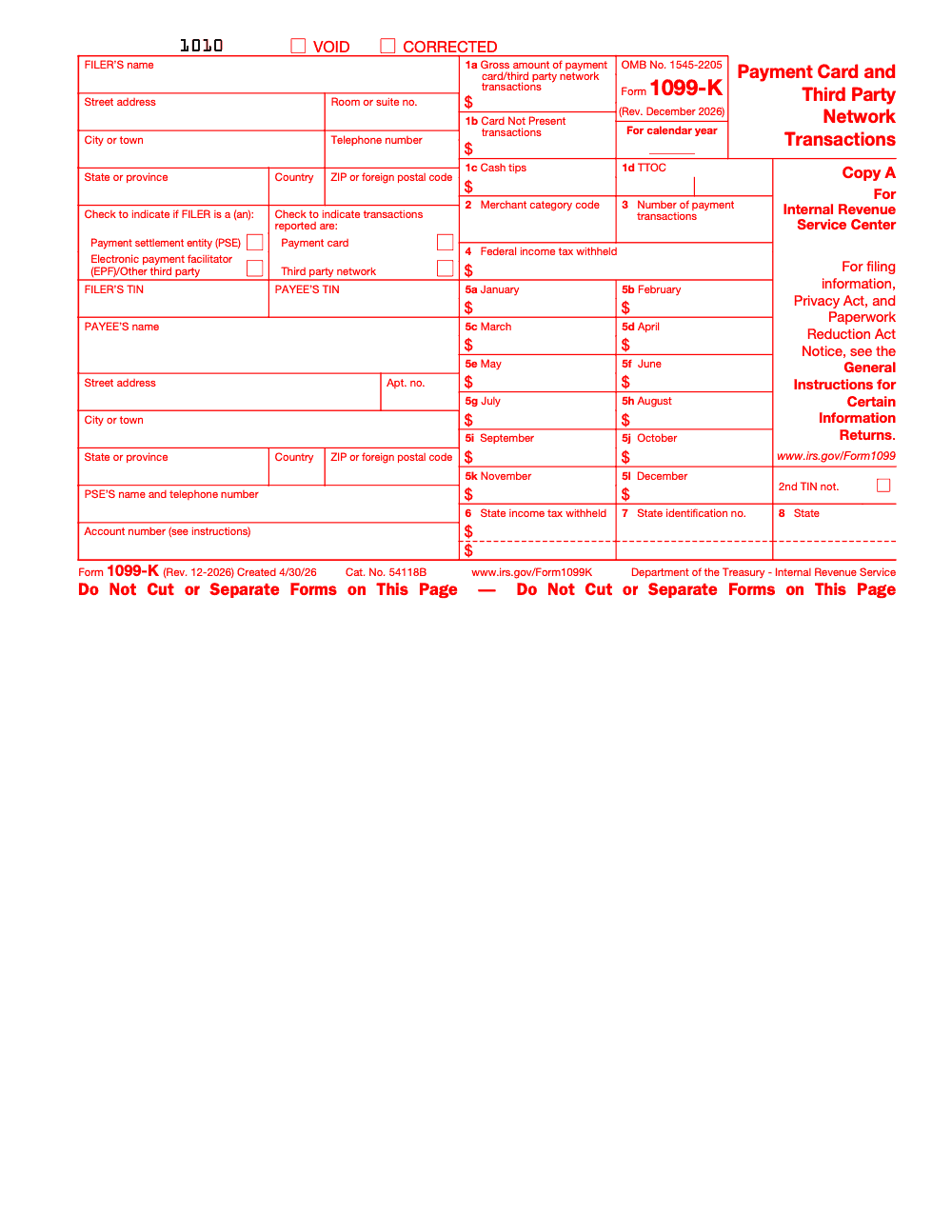
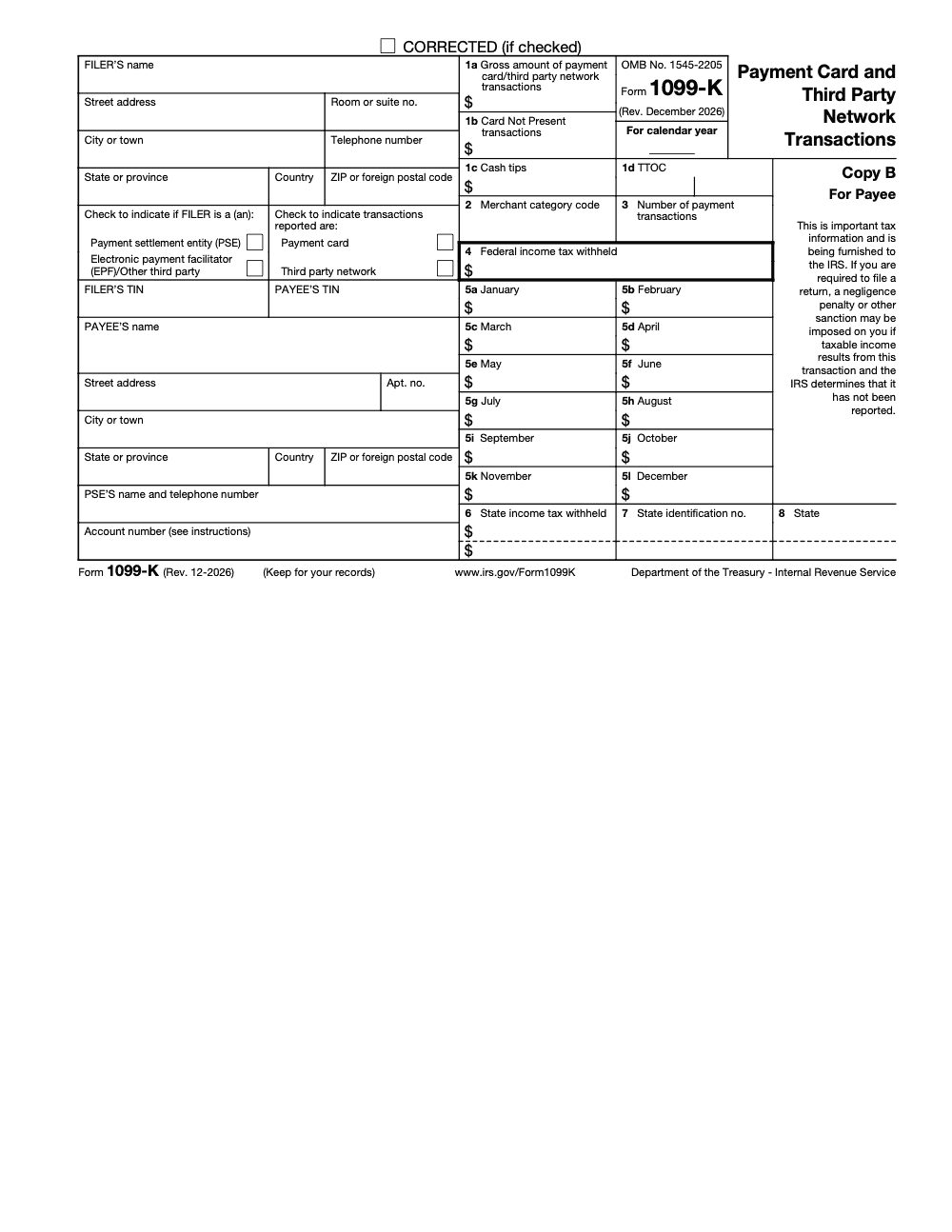
Form 1099‑K is an information return that shows the gross amount of reportable payments you received for goods or services through two channels, payment card networks and third‑party settlement organizations, or TPSOs. Think Visa and Mastercard on the card side, then platforms like PayPal, Venmo business profiles, Etsy, eBay, Airbnb, or Turo on the TPSO side. It is sent to you and to the IRS, and you reconcile that gross figure to your books on the tax return.
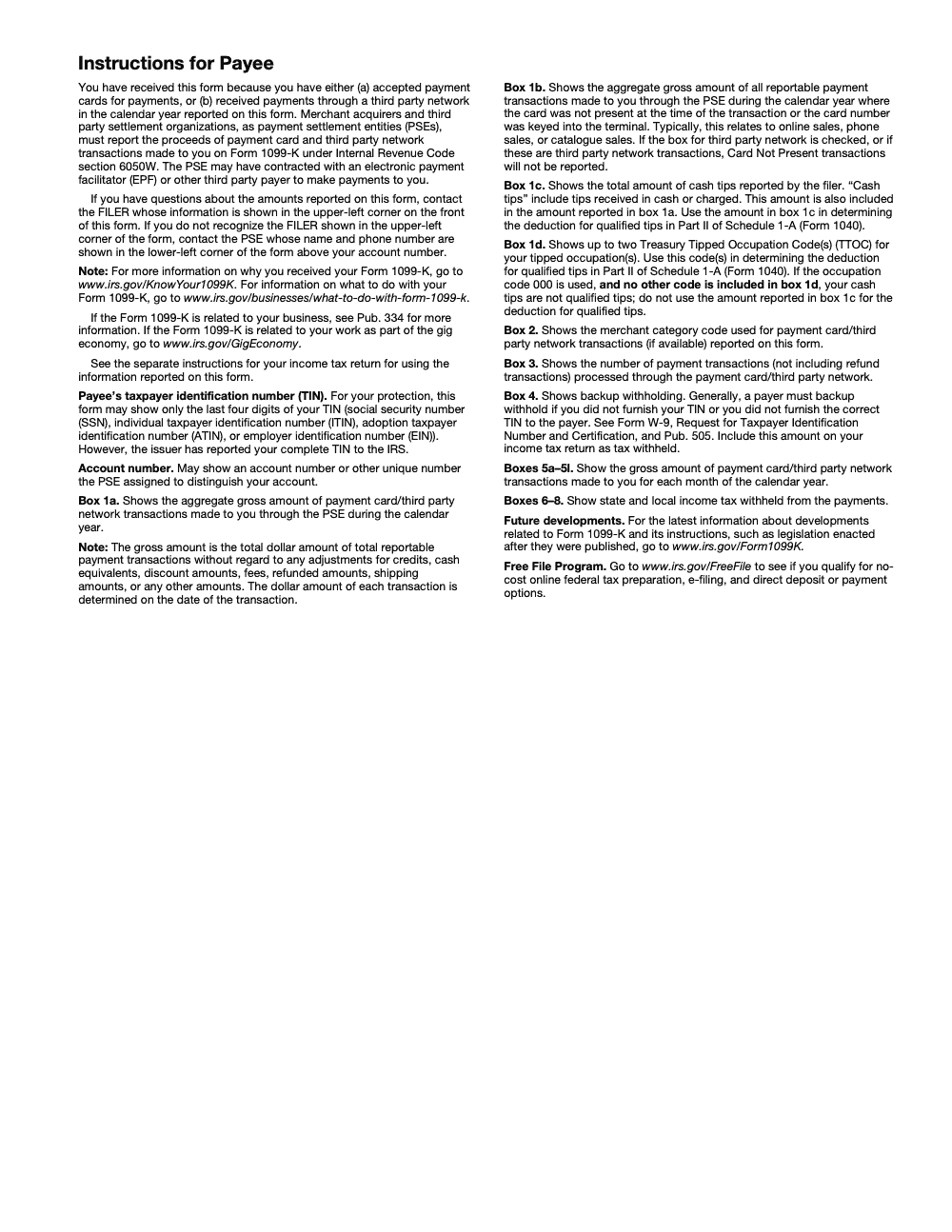
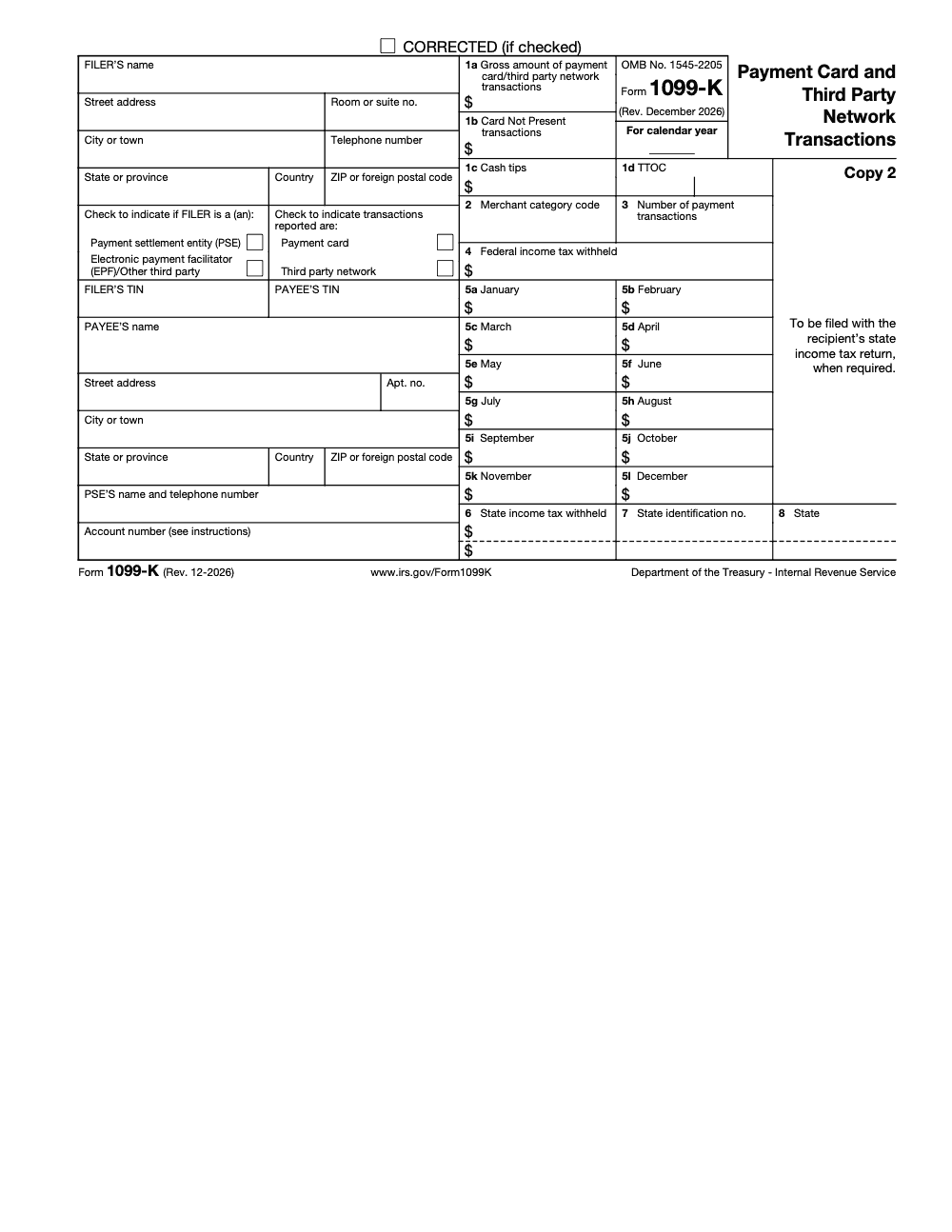
- Box 1a shows gross receipts per the processor, not your net sales (the gross is reported without reduction for fees, refunds, chargebacks, discounts, or shipping).
- Boxes 5a–5l break out monthly totals.
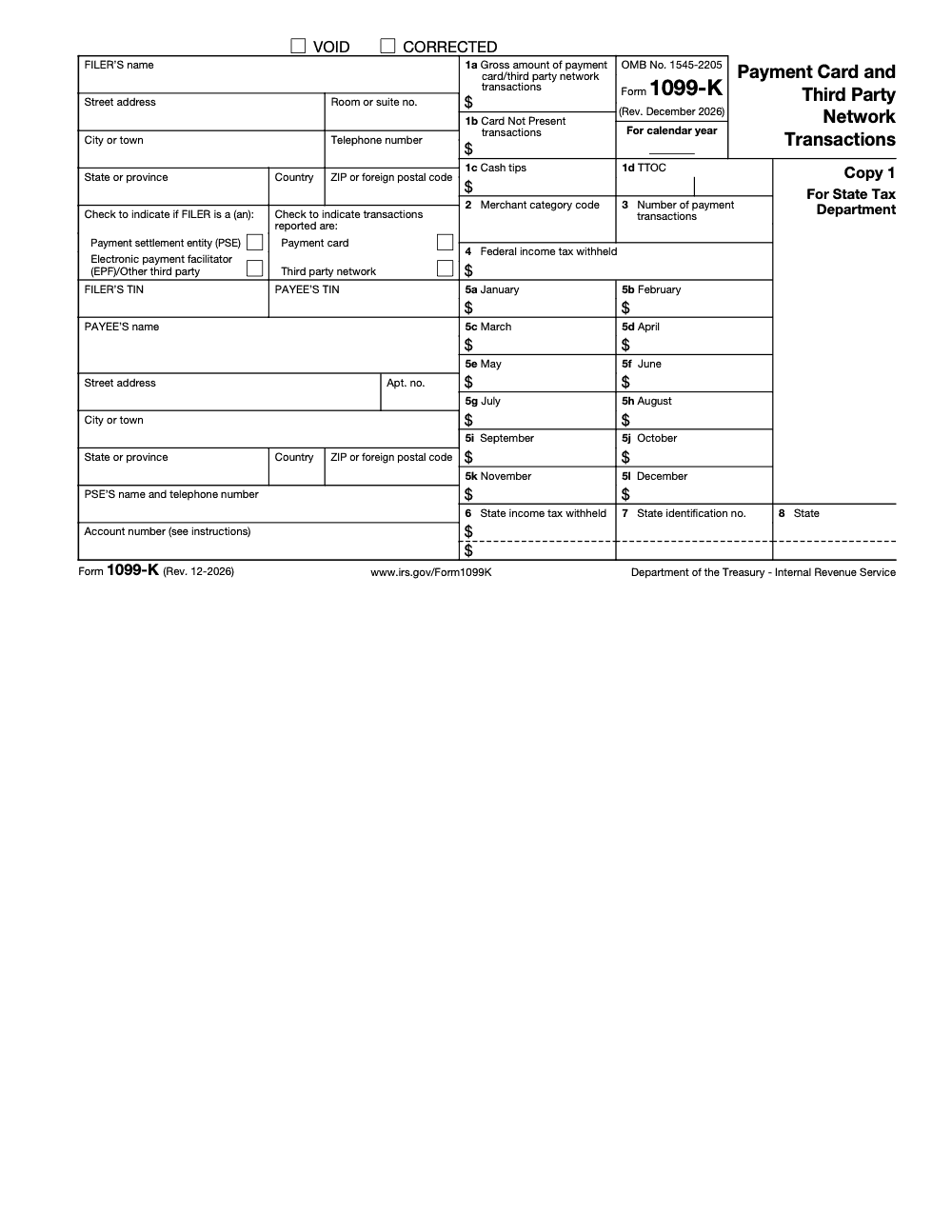
- Boxes 6–8 may include state information if the filer participates in a state program or must submit copies to a state tax department.
Important, whether or not you get a form, taxable income is still taxable. The 1099‑K is a signal, not a substitute for accounting.
Who Sends Form 1099‑K
Payment Card Processors
Merchant acquiring entities, for example your card processor, must file a Form 1099‑K for any reportable card payments you accept for goods or services. There is effectively no federal minimum for card transactions. If card payments occurred, expect a 1099‑K.
Third‑Party Settlement Organizations, TPSOs
Platforms that move money between buyers and sellers issue a 1099‑K when you cross the federal threshold in the tax year. For 2025, Congress restored the prior standard, more than $20,000 and more than 200 transactions. If you used three different platforms, each can send its own 1099‑K.
Pro tip, some platforms may still furnish forms below the federal requirement, especially if backup withholding occurred. Treat those as information to reconcile, then report the correct income on your return.
Who Receives Form 1099‑K
You receive a 1099‑K if you were paid for goods or services via cards, marketplaces, or payment apps and the issuer’s reporting rules apply, federal or state. If you sell on a platform and run card payments in a point‑of‑sale, you can receive multiple forms for the same business. That is normal. Aggregate in your records, do not add the same sale twice.
Payments That Trigger 1099‑K
- Card payments, reportable with no minimum threshold.
- Platform payments, reportable when the 2025 federal test is met, more than $20,000 and more than 200 transactions for that platform and TIN.
- Multiple processors, each issues its own form, so you may see several.
Personal Payments Excluded
Gifts, reimbursements, friends‑and‑family transfers, and similar personal payments should not be on a 1099‑K. If they were mixed into a business account and misclassified, keep documentation and ask the issuer to correct the form. If the issuer will not correct, you can explain the difference on the return with records to support the adjustment.
2025 Thresholds, What Changed And Why It Matters
Here is the part most people want in one place. On October 23, 2025, the IRS published FAQs reflecting a new law that restored the traditional federal TPSO threshold. For payments received in tax year 2025, a platform must issue a 1099‑K only when the gross amount exceeds $20,000 and the count exceeds 200 transactions for that payee. If you do not meet both, no federal 1099‑K is required from a TPSO, though a platform can still issue one voluntarily.
In contrast, payment card processors continue to report all goods or services card transactions with no minimum. This split rule, no threshold for cards, threshold for TPSOs, has not changed.
If you are wondering about the earlier phased plan that mentioned $5,000 for 2024 and $2,500 for 2025, you remember correctly. The IRS announced transition relief in November 2024, then Congress’s 2025 law superseded that plan and reinstated $20,000 and 200 for TPSOs. When guiding clients, quote dates and the IRS reference so no one is relying on outdated drafts.
Bottom line for 2025, TPSOs follow more than $20,000 and more than 200 transactions, card processors report all card payments, and you must still report all taxable income even if no form arrives.
Multiple Platforms, Multiple Forms
Using Etsy, eBay, and a payment app with a business profile can generate separate 1099‑Ks for the same EIN or SSN. That is expected. Your job is to reconcile each form to platform statements and your general ledger, then present one cohesive revenue number on the return. Differences usually come from fees, refunds, chargebacks, tips, or timing around year end.
Practical workflow you can hand your team:
- Export annual statements for each platform, include fee detail, refunds, and chargebacks.
- Tie monthly platform totals to Boxes 5a–5l on each 1099‑K.
- Record fees to expense accounts so gross 1099‑K amounts bridge to net revenue.
- Keep screenshots or CSVs in your workpapers for review protection.
Personal vs Business, Keep Them Separate
If one account mixes personal and business payments, misclassifications happen. Encourage clients to set up dedicated business profiles and label transfers correctly. If a payer marks a personal reimbursement as “goods and services,” that amount can land on a 1099‑K. Request a corrected form with proof, for example, chat logs, invoice notes, or app tags. The IRS agrees that personal money from family and friends should not be reported on Form 1099‑K.
Federal And State Rules Are Different
Federal, TPSO Threshold For 2025
- More than $20,000 and more than 200 transactions per platform and TIN.
- Applies to payments for goods or services on TPSOs.
- Platforms may issue forms below that threshold, especially if backup withholding occurred.
Cards, No Minimum
- Card processors file 1099‑K for all reportable card sales, there is no de minimis threshold.
- Even small card amounts can generate a 1099‑K.
Always Report Taxable Income
- The information return does not determine what is taxable, your books do.
- Report all business income, then subtract valid deductions and basis.
Fast Reference Table
| Scenario | What triggers a 1099‑K in 2025 | What you should do |
| Card payments at your POS | Any amount, no minimum | Reconcile processor totals to gross revenue, then deduct fees and refunds in the books. |
| Platform payments on a TPSO | More than $20,000 and more than 200 transactions | Aggregate by platform and TIN, maintain fee detail, and tie to return totals. |
| Personal transfers | Should not be reported | Keep evidence, request a corrected form if included by mistake. |
| Issuer did backup withholding | Issuer must file regardless of threshold | Verify withholding on 1099‑K and Form 945 totals. |
State Rules That Can Survive Federal Changes
Federal law sets a floor, but states can set their own 1099‑K triggers. In practice, this means you might have state reporting even when no federal TPSO form is required.
- Massachusetts requires TPSOs to file when a payee with a Massachusetts address receives $600 or more for the year, regardless of transaction count. Massachusetts publishes this in regulation and on its DOR site.
- Maryland also uses $600 under state guidance, which can create a state form even when the federal test is not met.
- New Jersey applies $1,000 with no transaction minimum, so low‑volume sellers can receive a state 1099‑K well below the federal rule. When you see a New Jersey form but no federal form, this is why.
States That Do Not Use the Combined Federal, State Filing Program For 1099‑K
Two common tripping points for filers, Florida and Tennessee require direct submissions. If you file federally and assume CF/SF takes care of it, you can miss a state requirement and trigger penalties.
- Tennessee requires entities that file 1099‑K federally to also file the same information with the Department of Revenue within 30 days of the IRS due date. Tennessee does not participate in CF/SF for 1099‑K.
- Florida requires electronic submission of 1099‑K to the Department of Revenue and is not a CF/SF participant. Plan for a separate state file.
Action item, build a year‑end checklist that tags payees by state address, flags lower state thresholds, and marks non‑CF/SF states for separate submissions. It saves notices and rework in March.
Using Payment Apps And Online Marketplaces
If you take money through PayPal, Venmo business, Square, Stripe, Etsy, eBay, Airbnb, or Turo, treat platform statements as your source of truth. Keep monthly CSV exports with fee lines, refunds, and any chargebacks. For 2025, most sellers will only see a federal 1099‑K from TPSOs if they cross more than $20,000 and more than 200 transactions on that platform, but states like Massachusetts, Maryland, and New Jersey may still generate a form. Regardless, you report your actual taxable profit, not the gross figure on the form.
| Key point | What you should do |
| Platform reports gross, not net | Record fees and refunds to bridge to net revenue on your return. |
| Federal TPSO threshold for 2025 | Expect a form only if more than $20,000 and more than 200 transactions per platform. |
| States may differ | Plan for state forms at $600 or $1,000 in certain states. |
| Personal payments | Tag friends‑and‑family correctly to avoid accidental reporting. |
What To Do If The Form Is Incorrect
Start with a reconciliation worksheet. Line up the 1099‑K Box 1a amount with your platform‑level reports by month. Identify timing differences, refunds, and fees. When you find true misreporting, for example, personal transfers or wrong TIN, ask the issuer for a corrected form and provide documentation, screenshots, and statements. If the issuer will not fix it in time, report the correct income, include an explanation with the return, and retain your evidence. The IRS allows for corrected reporting and emphasizes that your books control the tax outcome.
If backup withholding appears on the form, make sure the withheld amount matches both the 1099‑K and the issuer’s Form 945 reporting. You will want that credit to land correctly on the return.
A Simple 1099‑K Reconciliation Checklist
- Pull 12 months of statements from each processor or platform.
- Match monthly totals to Boxes 5a–5l. Note fees, refunds, chargebacks.
- Identify any personal payments and request corrections with evidence.
- Confirm state filings for payees in lower‑threshold states, for example, MA and MD at $600, NJ at $1,000. Plan separate filings for Florida and Tennessee.
- Tie your final gross to revenue, subtract fees and refunds, then post adjusting entries so your return agrees to the books.
When Accountably Can Help
If your firm spends February and March untangling 1099‑K mismatches, the fix is trained offshore preparers placed inside your workflow, ramped on your software and SOPs in under 3 weeks. Multi-layer review stands between their work and your signature, so 1099‑K reconciliation and state submissions get done cleanly and on time. We work in your systems, from QuickBooks and Xero to Canopy, Karbon, and TaxDome. If you want stable capacity without the hiring grind, ask us about dedicated offshore talent, white‑label delivery teams, or a build‑operate‑transfer unit. Not a fit in 45 days? We replace them free.
Proof before your name is on the line. Don’t trust us. Test us.
Final Notes And Sources
- Federal TPSO threshold for 2025 restored to more than $20,000 and more than 200 transactions.
- Card processors, no de minimis threshold for reportable card payments.
- Transition relief that mentioned $5,000 for 2024 was superseded by 2025 law, but many legacy articles still reference it. Verify dates when advising clients.
- State examples, Massachusetts and Maryland at $600, New Jersey at $1,000. Florida and Tennessee require direct state filings, not CF/SF.
Brief Disclosure
This guide was prepared by our team and reviewed by senior practitioners. We used software and automated checks to verify citations and dates against IRS and state sources, then a human editor finalized the copy. All guidance is general information, not legal or tax advice. For your specific facts, consult your tax advisor.
Common Mistakes We See Every Season
Most 1099-K cleanup we see traces back to the same handful of misreads. The fixes are mechanical once you spot the pattern.
Reusable Checklists
These checklists are written to drop straight into your SOP. Each box maps to a real workpaper step we run on 1099-K engagements.
Multi-Platform Reconciliation Packet
- Pull 12 months of platform statements for every TPSO and card processor (Etsy, eBay, PayPal, Stripe, Square, Airbnb, and similar).
- Export fee detail, refund logs, and chargeback reports from each platform.
- Tie each platform's monthly totals to Boxes 5a through 5l on its 1099-K.
- Bridge Box 1a gross to general ledger revenue; post adjusting entries for fees, refunds, and chargebacks so the return agrees to the books.
- Document any year-end timing differences (settlement-date versus transaction-date splits).
- Save reconciliation worksheets, CSVs, and platform screenshots in the engagement workpapers for review protection.
State Filing Scan
- Tag every payee by state of address on the year-end roster.
- Flag Massachusetts and Maryland payees against the $600 TPSO trigger; flag New Jersey at $1,000 (no transaction minimum).
- Flag Florida and Tennessee payees for direct state submission, since neither participates in the Combined Federal/State Filing program for 1099-K.
- Calendar Tennessee's state filing for 30 days after the federal due date.
- Confirm the CF/SF election for participating states; do not assume CF/SF covers Florida or Tennessee.
- Reconcile state identification numbers and Boxes 6 through 8 before transmission.
Corrected Form Workflow
- Identify the specific records to correct; per IRS Publication 1220, resubmit only the corrected records, never the original file.
- If the original was filed via IRIS or FIRE, file the correction in the same system.
- For mis-coded personal transfers landing on a business account, retain chat logs, invoice notes, and app tags; request a corrected form from the issuer with that evidence.
- If the issuer will not correct in time, report the accurate figure on the return and retain reconciliation evidence inside the engagement file.
- Track corrections inside the 3-calendar-year window, or 4 calendar years where Box 4 backup withholding under IRC §3406 applies.
- For Box 4 amounts, confirm the withheld total ties to the issuer's Form 945 reporting before claiming credit on the payee return.
Keep 1099-K Season From Stalling
1099-K season compresses two distinct deadlines onto the same team. Per IRS Publication 1220, payee Copy B is due January 31, 2026 and IRS e-file Copy A is due March 31, 2026. Per the General Instructions for Certain Information Returns, the §6721 per-return penalty for late or incorrect 1099-Ks is $340, with a small-filer annual maximum of $1,366,000, so a February backlog is not just an operational problem; it is a balance-sheet item.
The teams that ship cleanly are not faster typists. They run a repeatable process that locks the TCC, the multi-platform reconciliation template, and the state-filing scan before December, then keep corrections moving inside the same system the original was filed in.
- File the Transmitter Control Code application by November 1, since IRIS and FIRE access takes about 45 business days under IRS Publication 1220. Aggregate all information returns when sizing against the 10-return e-file threshold; per Treasury Decision 9972 the count is across the full 1099, W-2, and 1095 series combined.
- Build the reconciliation template before December: 12-month statement pulls, fee and refund detail, monthly ties to Boxes 5a through 5l, and a Box 1a gross-to-ledger bridge. Box 1a is gross under the General Instructions, so the bridge is not optional.
- Separate Form 8809 (automatic 30-day IRS-filing extension) from Form 15397 (recipient-furnishing extension, capped at 30 days, must be received by the original recipient due date). Filing 8809 when 15397 was needed is one of the most common compliance misses we untangle in March.
- Scan Box 4 backup withholding (24% under IRC §3406) at intake. Records with backup withholding carry a 4-year retention rather than the standard 3, and corrected returns with backup withholding have a 4-calendar-year correction window.
- Stand up a corrected-return queue that resubmits only the changed records in the original system (IRIS or FIRE). Resubmitting the full original file creates duplicate-reporting penalties under IRC §6721.
That is the discipline our offshore preparers bring to 1099-K engagements: documented workpapers, a state-tagging step at intake, and a corrected-return queue that does not stall review. If 1099-K reconciliation is eating February capacity, talk to us about structured tax preparation delivery – we carry the production load while your team focuses on review and judgment.
FAQs
It reports the gross amount of payments you received for goods or services through card processors and TPSOs. It is an information return sent to you and the IRS, and you reconcile it to your accounting records on your return.
Expect a notice, potential penalties, and interest. The IRS matches information returns to filed returns, so reconcile the form to your books and report the correct income even if a form is wrong or missing.
For a sole proprietor, start with a reconciliation, then report business income and deductions on Schedule C. For rentals, marketplace income can flow to Schedule E. Always tie 1099‑K totals to your ledger and attach explanations if numbers differ due to corrections.
Yes. You must report all taxable income from sales or services, with or without a form. The 1099‑K is a cross‑check, not a gatekeeper.
No. Money from friends and family that is a gift or reimbursement should not be on a 1099‑K. If it appears, request a corrected form and keep records.
Other forms this guide names
- Form 8809: Information Return Extension Guide
- Form 15397: 30-Day Recipient Copy Extension Guide (2025)
- Form 945: Backup Withholding, Deadlines, and Deposits
- Form W‑2: Deadlines, E‑File Rules, Boxes, and W‑2c Corrections
Summarize this article with AI
About this guide
Accountably helps US CPA, EA, and accounting firms hire trained accountants and tax preparers in India.
About us Reviewed byJugal Thacker, CPAFounder and CEO at Accountably
A Washington-licensed CPA with 7+ years inside US firms – PwC, a real-estate tax practice, then a full-service firm, rising from reviewer to manager to advisory. This article was reviewed against current IRS guidance for the 2025 tax year and updated for filers preparing late returns, amendments, and 2026 estimates.
View profile →How we research, review, and update this guide
Every Accountably guide is researched against primary IRS sources, reviewed by a U.S. CPA, and refreshed as guidance evolves. Read our Editorial Guidelines to see how we source, fact-check, and update our content.