Key dates
Summarize this article with AI
In Brief
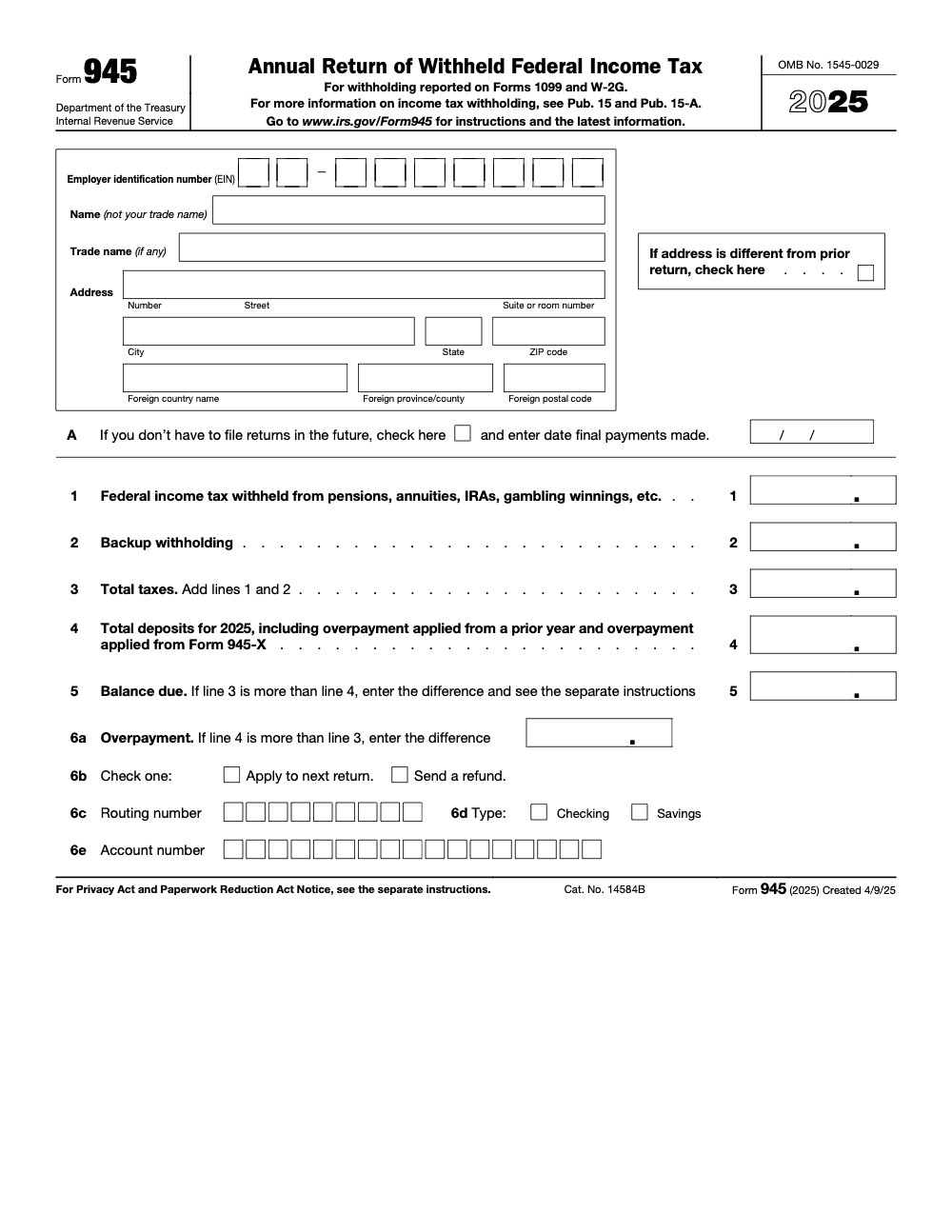
Form 945 is the Annual Return of Withheld Federal Income Tax – it reports nonpayroll withholding (pensions, IRA distributions, gambling winnings, and 1099 backup withholding at the 24% rate), per the IRS Form 945 instructions for 2025. Total tax sits on line 3; the 2025 return is due February 2, 2026, or February 10, 2026 when every required deposit was timely and in full.
A practitioner once told me the Form 945 return itself was simple and the calendar made it messy, and that is exactly right. Form 945 reports nonpayroll withholding, the federal income tax pulled from pensions, IRA distributions, gambling winnings, and 1099 backup withholding at the 24% rate, with the total tax sitting on line 3.
The 2025 return is due February 2, 2026, or February 10, 2026 when every required deposit was timely and paid in full. The threshold numbers are what trip people: the 2,500 figure decides whether deposits are required at all, and the 100,000 next-day rule overrides your schedule the moment you hit it. Late filing can run 5% per month up to 25%, with a minimum penalty of 510 if you are more than 60 days late on returns due after December 31, 2024.
Key Takeaways
- Form 945 reports federal income tax you withhold from nonpayroll payments, including backup withholding. Think pensions, annuities, IRA distributions, military retirement, gambling winnings, Indian gaming profits, and more.
- For the 2025 calendar year, the filing due date is Monday, February 2, 2026. If every required deposit was on time and in full, you may file by Tuesday, February 10, 2026. Calendar shifts matter.
- Backup withholding remains 24% in 2025. Apply it when required and reconcile it on Form 945, line 2 (note: backup withholding does not apply to wages, pensions, annuities, IRAs, ESOP distributions, MSAs, HSAs, long-term-care benefits, or real estate transactions – those follow separate withholding regimes).
- Deposit rules use a monthly or semiweekly schedule. The lookback test sets your schedule, the $2,500 threshold determines whether deposits are required, and the $100,000 next‑day rule overrides everything if you hit it on any day.
- Semiweekly depositors, and monthly depositors who tripped the $100,000 rule during the year, generally attach Form 945‑A. Do not file 945‑A if net annual liability is under $2,500. Match Form 945 line 3 to Form 945‑A line M.
- Make deposits electronically. Schedule EFTPS by 8 p.m. Eastern the day before the due date to be on time.
- Late filing can cost 5% per month up to 25%, with a minimum penalty of $510 if over 60 days late for returns due after December 31, 2024. Deposit penalties are separate.
What Is IRS Form 945
Form 945, Annual Return of Withheld Federal Income Tax, reports the federal income tax you withheld from nonpayroll payments, including backup withholding. Common nonpayroll categories include pension and annuity payments, IRA distributions, certain government and tribal payments, military retirement, and gambling winnings that appear on W‑2G. Indian gaming profits and voluntary withholding on certain government payments also live here. The IRS explicitly confirms these are nonpayroll items for Form 945.
You’ll total those nonpayroll withholding amounts for the year, add any backup withholding, and reconcile the sum to your deposits. If you follow the semiweekly schedule at any point, you will likely complete Form 945‑A to show liability by date and ensure the annual total ties out.
Who Must File Form 945
You must file if you withheld, or were required to withhold, federal income tax from nonpayroll payments at any time during the calendar year. If you had only payroll wage withholding, that belongs on quarterly Form 941 or annual Form 944, not on Form 945. If you had no nonpayroll withholding for the year, you generally do not file Form 945. The IRS instructions say it plainly.
Special note on H‑2A workers without a TIN
If an H‑2A worker does not provide a TIN and total annual wages reach the reportable threshold ($600 in 2025, rising to $2,000 starting in 2026 under P.L. 119-21), you report those wages and any backup withholding on Form 1099‑MISC, and you include the backup withholding on Form 945, line 2. This one trips teams every season, so put it on your year‑end checklist.
When Is Form 945 Due for 2025
Although Form 945 is annual, your deposits happen during the year. The return due date follows the calendar year you are reporting. For the 2025 year, the IRS instructions set the filing deadline as Monday, February 2, 2026, with the option to file by Tuesday, February 10, 2026, if every required deposit was made on time and in full. If a due date falls on a weekend or federal holiday, the deadline moves to the next business day.
If you only remember one thing about timing, remember this: make deposits correctly during the year to keep your February filing calm.
Payments Included on Form 945 and Where They Appear
When you prepare Form 945, split your totals into two buckets that roll into the same tax:
- Line 1, nonpayroll withholding: pensions, annuities, IRA distributions, military retirement, gambling winnings, Indian gaming profits, voluntary withholding on certain government payments. These are the classic nonpayroll items the IRS lists for Form 945.
- Line 2, backup withholding: the flat‑rate withholding, typically 24% in 2025, that applies when a payee fails to furnish a correct TIN, when you receive a CP2100 or CP2100A name‑TIN mismatch notice, when the IRS directs you to start withholding for underreporting, or when certification is missing.
Add lines 1 and 2 to get line 3, the total tax for the year. Line 4 reflects total deposits and any credits. Those four lines, kept clean, resolve most notices.
Backup withholding in practice
Two common triggers:
- You pay a vendor who never gave you a W‑9. Backup withholding applies at 24% until you receive a valid TIN. Deposit it on your Form 945 schedule and report it on line 2.
- You receive a CP2100 or CP2100A listing name‑TIN mismatches. You must send the appropriate “B” notice and begin backup withholding if the payee does not respond by the required window. Deposit under your 945 schedule and keep documentation.
Deposit Rules, Schedules, and Thresholds
Here is the quick map that keeps teams out of trouble:
- If your annual Form 945 tax is under $2,500, you generally pay with the return, and no periodic deposits are required (if you are unsure whether you will land under $2,500, deposit on the regular schedule anyway – paying with the return on amounts that should have been deposited still triggers a 10% FTD penalty).
- Otherwise, your deposit schedule is monthly or semiweekly. Your schedule for 2026 is based on what you reported on line 3 of your 2024 Form 945 (Form 945 uses a single calendar-year lookback two years back, not the 4-quarter rolling lookback used for Form 941). If it was $50,000 or less, you are monthly. If it was more than $50,000, you are semiweekly.
- The $100,000 next‑day rule overrides the normal schedule. If your Form 945 tax liability hits $100,000 on any day, you must deposit so the funds settle the next business day, and you become a semiweekly depositor for the rest of that year and the next.
Think of the $100,000 rule as a fire alarm. When it rings, you move immediately, and your schedule changes the very next day.
Deposit timing, in plain English
- Monthly depositor: deposit by the 15th of the following month.
- Semiweekly depositor: liability from Wednesday through Friday is due the following Wednesday, and liability from Saturday through Tuesday is due the following Friday.
- To be on time in EFTPS, schedule the deposit by 8 p.m. Eastern the day before the due date.
Quick reference table
| Schedule | What triggers it | When deposits are due | Practical note |
| Monthly | Lookback amount on 2024 Form 945 line 3 was ≤ $50,000 | 15th of the following month | Good for steady, lower volumes. |
| Semiweekly | Lookback amount on 2024 Form 945 line 3 was > $50,000 | Wed–Fri liability due next Wednesday, Sat–Tue liability due next Friday | Use a daily log for liability dates. |
| Next‑day | Any day’s liability reaches $100,000 | Next business day | You become semiweekly for the rest of the year and the next year. |
When to Attach Form 945‑A
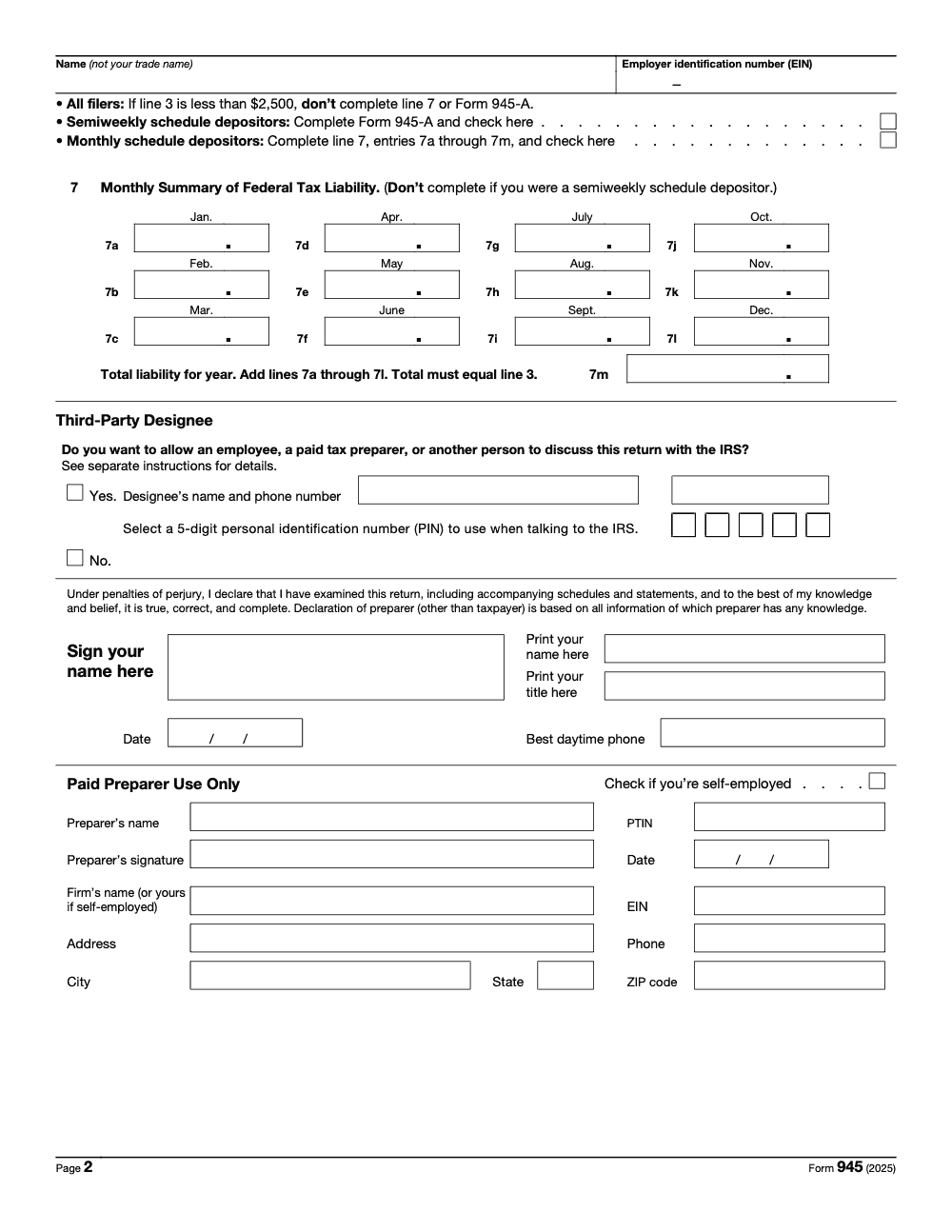
File Form 945‑A if you are a semiweekly depositor for the year. Monthly depositors who trip the $100,000 rule must also complete and file Form 945‑A for the entire year. Do not complete 945‑A if your net annual liability is under $2,500. When you file it, make sure line M on Form 945‑A equals line 3 on Form 945.
A simple internal check I use is to run a one‑page “line 3 to line M” tie‑out with signatures. It takes 30 seconds and avoids a needless notice.
How to Complete Form 945 Step by Step
Gather the right records
- EIN, legal name, and address exactly as shown on IRS records.
- Annual totals of federal income tax withheld from nonpayroll payments, plus a separate total for backup withholding.
- EFTPS deposit confirmations for the year.
- If you were semiweekly at any point, your Form 945‑A liability detail by date.
Enter the lines that matter
- Line 1, nonpayroll withholding: totals tied to Forms 1099‑R and W‑2G, plus any other eligible nonpayroll items the IRS lists for Form 945.
- Line 2, backup withholding: all backup withholding taken during the year at the current 24% rate when applicable.
- Line 3, total taxes: line 1 plus line 2. If you attach 945‑A, line M must equal this amount.
- Line 4, total deposits and credits: match EFTPS. Keep printouts or exports with your workpapers.
- Lines 5–6: show balance due or overpayment and select refund or apply forward.
Sign the return using an approved role or have a paid preparer complete the declaration. E‑file is encouraged and reduces errors, and you should never combine other forms’ deposits with Form 945 deposits.
Correcting errors
Use Form 945‑X to correct a prior year’s Form 945. If backup withholding was missed after a CP2100, correct the payee account, start or stop withholding as required, deposit the tax, and amend. Keep the CP notices, B‑notice mail proof, and deposit trail in the file.
Payment Rules and Using EFTPS Well
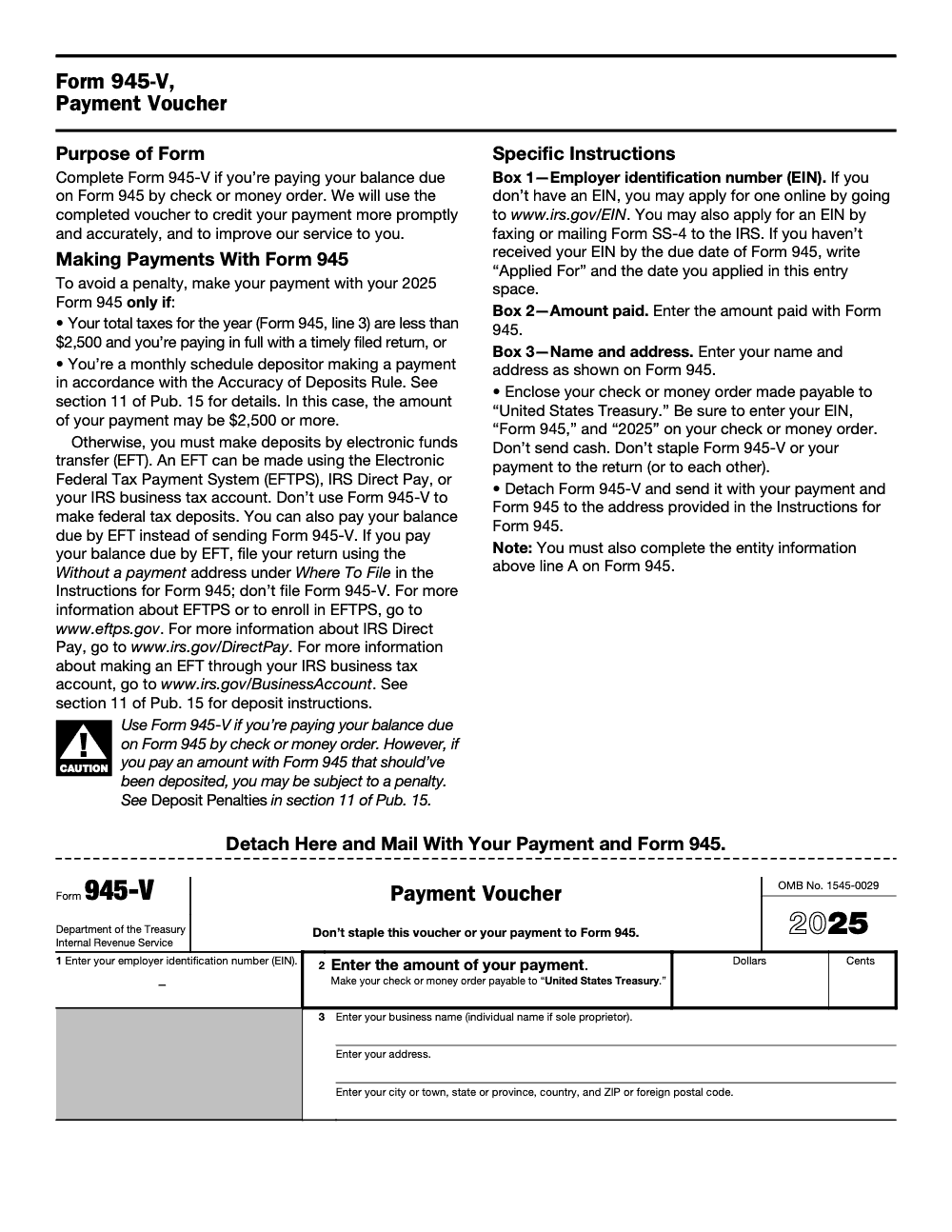
All federal tax deposits for Form 945 must be electronic (Form 945‑V is only for paying a balance due with the return, not for making deposits – using a check for amounts that should have been deposited triggers a 10% FTD penalty). You can use EFTPS, the IRS business tax account, or IRS Direct Pay for businesses. For timeliness, schedule EFTPS by 8 p.m. Eastern the day before the due date. If you run lean during peak season, build calendar holds and shared reminders so no one assumes “someone else” clicked Submit.
Semiweekly depositors should keep a daily liability sheet that ties each payment date to a deposit date. It looks old‑school, but it saves you when a Friday holiday shifts a Wednesday due date.
The calendar is your control. Align liability dates, deposit dates, EFTPS confirmations, and 945‑A totals, and Form 945 becomes quiet work.
Common Errors That Trigger Notices
- Missing or understated backup withholding on line 2, especially after CP2100 cycles.
- Mismatch between Form 945 line 3 and Form 945‑A line M. The IRS cross‑checks these amounts.
- Using the wrong deposit schedule because the lookback test was not updated at year‑start.
- Missing the $100,000 next‑day deposit after a one‑time spike, often from a large distribution or backup withholding event.
- Combining Form 945 deposits with employment tax deposits for other forms. The IRS says not to combine them.
A simple prevention plan: one page with your schedule, a running liability log, and a monthly reconciliation to EFTPS.
Penalties, Interest, and Reasonable Cause
There are two different penalty families to watch:
- Filing and payment penalties on the return itself. The failure‑to‑file penalty is 5% per month up to 25%. If the return is more than 60 days late, the minimum penalty for returns due after December 31, 2024, is $510, or the tax due, if less. Failure‑to‑pay runs at 0.5% per month and can reduce the failure‑to‑file rate when both apply. Interest accrues daily.
- Deposit penalties when a required monthly, semiweekly, or next‑day deposit is late or short. The IRS Internal Revenue Manual describes the $100,000/one‑day rule and the expectation that next‑day deposits settle by the following business day, with weekend and holiday relief rules.
If you receive a notice, respond quickly. Document facts that support reasonable cause, especially for first‑time issues, bank cutoffs, or disasters. Include EFTPS screenshots, internal emails, and calendars.
Filing Methods and Where to File
E‑file your Form 945. You will reduce keying errors and receive electronic acknowledgments. If you must paper file, use the “Where to file” table in the official instructions for your location and whether a payment is included. Remember, deposits belong in EFTPS during the year, not in the envelope with your return.
A short checklist for year‑end
- Confirm your 2026 deposit schedule based on your 2024 lookback.
- Verify that line 3 equals 945‑A line M if you were semiweekly.
- Reconcile EFTPS totals to line 4.
- Confirm all CP2100 backup withholding actions are finished and documented.
Tools and Simple Workflow Tips
You do not need fancy tools to get this right. You need repeatable workflow:
- A shared 945 calendar with deposit dates and a reminder to schedule EFTPS by 8 p.m. ET the day before the due date.
- A daily liability log for semiweekly periods.
- A month‑end tie‑out that proves line 3, line M, and EFTPS totals agree.
If your firm handles high volumes of W‑2G and 1099‑R, consider software that tags each payment with a liability date and generates Form 945‑A automatically. Your goal is simple, consistent reconciliation.
How Accountably Can Help, Briefly
If your team spends late January chasing deposits and reconciling 945‑A, that is a capacity problem you can hand off, once you trust the work. Accountably places trained offshore preparers inside your workflow with SOPs, structured workpapers, and multi-layer review, so the tie‑outs are clean before they reach your desk. That gives you predictable turnaround and fewer review loops, without giving up control. Proof before your name is on the line: don't trust us, test us. Use us where it matters, then keep your partner time for advisory work.
We keep mentions light in this guide on purpose. If you want help building a calm, disciplined 945 process, that is what we do.
Final Checklist You Can Reuse
- Verify your 2026 deposit schedule from the 2024 lookback.
- Confirm whether you are under $2,500 for the year or must make deposits.
- Calendar every deposit and schedule EFTPS by 8 p.m. ET the day before it is due.
- If semiweekly, attach Form 945‑A and make sure line M equals line 3.
- Reconcile Form 945 line 4 to EFTPS totals and retain confirmations.
- Keep CP2100 documentation, B‑notice proof, and backup withholding deposits with your workpapers.
Conclusion
You already know the tax rules. The edge is delivery. Treat Form 945 like a mini‑project with a calendar, clean records, and one final tie‑out. Use the IRS lookback to set your schedule, obey the $100,000 rule, deposit through EFTPS on time, and match line 3 to line M when 945‑A applies. That is how you file on time, skip penalties, and keep January calm.
Common Mistakes We See Every Season
Every January, the same Form 945 errors show up across new clients we onboard. These are not arguments about the rules – they are workflow gaps that turn a clean annual return into a CP2100 or failure-to-deposit notice.
Reusable Checklists
These checklists are built for firm SOPs – copy them into the engagement tracker, run them as standing tasks, and tick items as you go. Each targets a specific Form 945 risk surface.
Annual deposit schedule classification (run every November)
- Pull 2024 calendar-year Form 945, line 3 from the prior year's filed return.
- Compare to the $50,000 lookback threshold – at or below means monthly, above means semiweekly.
- Document the schedule designation in the 2026 engagement file with the source line 3 figure.
- Flag any client whose 2025 year-to-date liability is trending above $50,000 even if 2024 was below – they may flip mid-year via the $100,000 rule.
- Confirm EFTPS enrollment is active for every Form 945 filer before the first 2026 deposit is due.
- Note any client expected to fall below $2,500 for the year and tag them for the payment-with-return option.
Backup withholding (24%) trigger review
- List every payee receiving $600 or more in reportable payments for 2025 (the aggregate reportable payment threshold rises to $2,000 for payments made in calendar year 2026 under OBBBA, Public Law 119-21).
- Match each payee's TIN against the Form W-9 on file – flag any missing or visibly invalid TINs.
- Cross-check IRS CP2100 and CP2100A notices received in the prior 12 months against the withholding ledger.
- For any payee on a B-notice, confirm 24% backup withholding started within the required timeframe and is being remitted to Form 945, line 2.
- For payees who cured the TIN issue, document the date backup withholding stopped and notify the AR or AP system owner.
- Confirm no backup withholding amount has been routed to Form 941 or Form W-2 by mistake.
January tie-out before filing Form 945
- Sum line 1 (nonpayroll FIT) and line 2 (backup withholding) and confirm the total equals line 3.
- For monthly depositors, verify lines 7a through 7l sum to line 7m and that 7m equals line 3 exactly.
- For semiweekly depositors, verify Form 945-A, line M equals Form 945, line 3 to the dollar.
- Reconcile line 4 (total deposits) to EFTPS transaction history and pull confirmation numbers into the workpaper.
- Confirm no 1099-NEC or 1099-MISC backup withholding leaked into Form 941 totals for the year.
- If 2024 line 3 was below $2,500 but 2025 exceeded the threshold, calculate the 10% FTD penalty exposure on amounts that should have been deposited.
- File on February 2, 2026 unless every 2025 deposit was timely and in full – then the February 10 grace applies.
Keep 945 Season From Stalling
Form 945 looks like a one-deadline-a-year return, but the deposit work runs through the entire year. Per IRS Publication 15, monthly depositors owe deposits by the 15th day of the following month, and semiweekly depositors owe deposits within three business days of every covered period. When firms wait for January to reconcile, line 3 rarely matches line 7m or Form 945-A, line M – and CP notices follow.
The way out is not more hustle in January. It is a quarterly tie-out that catches mismatches while they are still cheap to fix, plus a tagging discipline inside EFTPS so Form 945 deposits never get confused with Form 941 payroll deposits.
- Reconcile EFTPS deposits to the backup withholding general ledger account at the end of every quarter, not just at year-end.
- Tag every Form 945 deposit to the 945 tax form code in EFTPS – never combine it with a Form 941 or Form 943 deposit transaction.
- Flag any single-day liability approaching $100,000 and flip the depositor to semiweekly for the rest of the year and the next calendar year, per IRS Publication 15.
- Pull the 2024 calendar-year Form 945, line 3 in November and lock the 2026 deposit schedule before year-end planning starts.
- Confirm Form 945-A, line M equals Form 945, line 3 before sign-off – the two must match to the dollar for semiweekly filers.
That kind of structure is what we build into every Form 945 engagement at Accountably's tax delivery service – documented SOPs, EFTPS tagging discipline, and reviewer-led tie-outs so the annual return is a confirmation, not a scramble.
FAQs
It reports annual federal income tax withheld from nonpayroll payments, including backup withholding. Typical items include pensions, annuities, IRA distributions, gambling winnings, and certain government or tribal payments.
The return is due Monday, February 2, 2026, or Tuesday, February 10, 2026, if all required deposits were made on time and in full.
The current rate is 24%. Start or stop backup withholding when the IRS rules require it, and report it on Form 945, line 2.
Attach it if you are a semiweekly depositor for the year, or if you were monthly but crossed the $100,000 threshold and became semiweekly. Do not file it if net annual liability is under $2,500.
If your Form 945 liability reaches $100,000 on any day, you must deposit so the funds settle on the next business day. You also become a semiweekly depositor for the rest of the year and the next year.
No. The IRS says not to combine Form 945 deposits with deposits for other employment tax returns. Keep them separate for deposit rules and for reconciliation.
File late and you can face 5% per month, up to 25%, with a minimum $510 penalty if more than 60 days late for returns due after December 31, 2024. Deposit penalties are separate and depend on how late or short the deposit was.
Form 945 family
- Form 945-X Guide: Correct Withholding Errors Fast
Other forms this guide names
- Form 945-A: Daily Liability, Next-Day Rule, Line M Guide
- Form 941: Employer's Quarterly Tax Return Guide 2025
- Form W‑2: Deadlines, E‑File Rules, Boxes, and W‑2c Corrections
- Form W‑2G: Gambling Winnings Reporting Guide
- Form 1099‑MISC: Deadlines, Boxes, Thresholds & Filing Guide
- Form W-9: Guide & Instructions
Summarize this article with AI
About this guide
Accountably helps US CPA, EA, and accounting firms hire trained accountants and tax preparers in India.
About us Reviewed byJugal Thacker, CPAFounder and CEO at Accountably
A Washington-licensed CPA with 7+ years inside US firms – PwC, a real-estate tax practice, then a full-service firm, rising from reviewer to manager to advisory. This article was reviewed against current IRS guidance for the 2025 tax year and updated for filers preparing late returns, amendments, and 2026 estimates.
View profile →How we research, review, and update this guide
Every Accountably guide is researched against primary IRS sources, reviewed by a U.S. CPA, and refreshed as guidance evolves. Read our Editorial Guidelines to see how we source, fact-check, and update our content.