Summarize this article with AI
In Brief
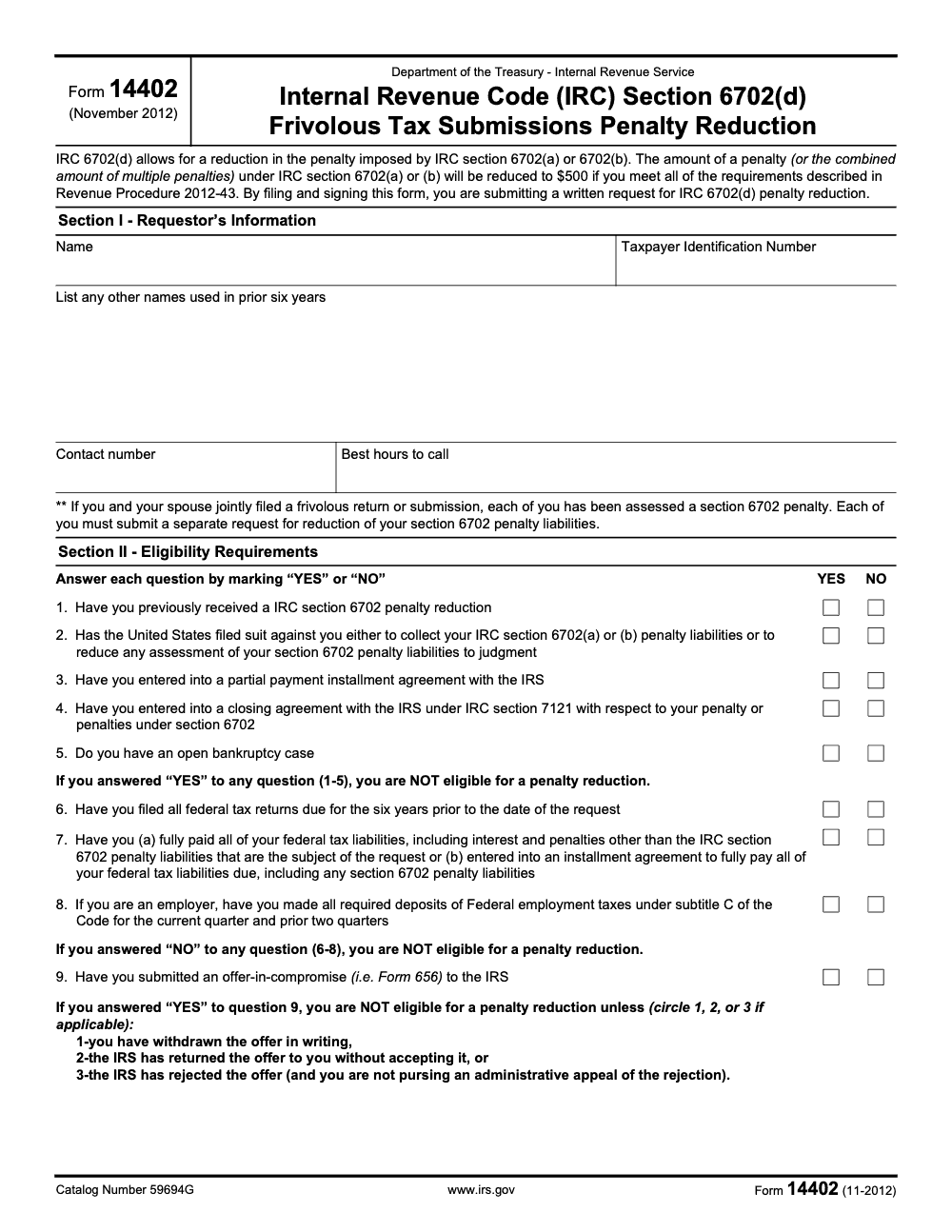
Form 14402 caps qualifying unpaid IRC §6702 frivolous-submission penalties at a flat $500 under Revenue Procedure 2012-43 (per IRS Form 14402 instructions, Rev. November 2012). At least $250 must accompany the request unless the requestor is on a qualifying full-payment installment agreement that covers the $500 balance, and the package mails to the IRS Frivolous Return Program at 1973 N. Rulon White Blvd., M/S 4450, Ogden, UT 84404. Reduction is once per taxpayer for life, with no administrative appeal if the request is rejected. See tax execution support for the workpaper discipline §6702 packages need.
A client opens the notice, sees a §6702 frivolous-submission penalty, and assumes the move is to appeal it. That is the misread that costs them. Form 14402 does not argue the merits and it does not chase a refund. It asks the IRS to reduce a qualifying unpaid §6702 penalty to a flat $500 under Revenue Procedure 2012-43, and only if every eligibility condition lines up first.
The mechanics are where requests fall apart. You owe $500 in total, and at least $250 has to ride along with the request unless a qualifying full-payment installment agreement already covers the balance. Get the packaging wrong and there is no second try, because denials are not appealable to IRS Appeals and the reduction is a once-per-taxpayer privilege. Everything mails to the Frivolous Return Program in Ogden, and the window stays open only until the Department of Justice serves a complaint to collect or reduce the assessment to judgment.
Key Takeaways
- What it does: Form 14402 requests a one‑time reduction of your unpaid §6702 penalties to $500, if you meet Rev. Proc. 2012‑43’s eligibility rules. It is not for refunds or arguing the merits.
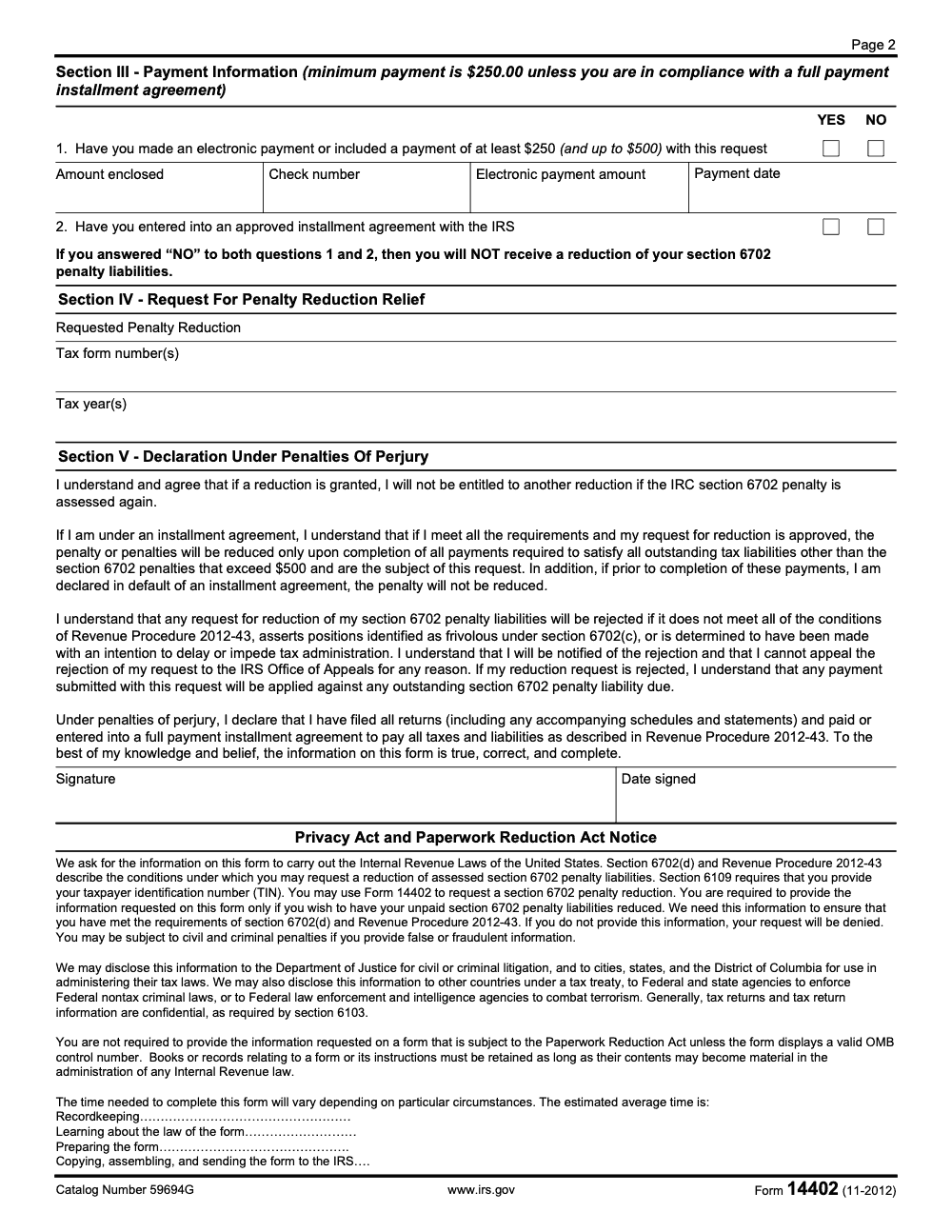
- Payment mechanics: You must pay $500 in total. Most filers either, a, include at least $250 with the request and pay the rest later, or b, pay the $500 through a qualifying full‑payment installment agreement. If the IRS approves and the full $500 is paid, accrued interest on the §6702 penalties is abated.
- No appeals: Denials are not appealable to IRS Appeals. To challenge the penalty itself, you generally must pay and pursue a refund claim or use other authorized channels.
- Where to mail: Send Form 14402 to the Ogden Frivolous Return Program, “Attn: FRP, M/S 4450, 1973 N. Rulon White Blvd., Ogden, UT 84404.”
- Time limits: You must file before the Department of Justice serves a complaint to collect or reduce the §6702 assessment to judgment.
What Form 14402 Is, And What It Is Not
Form 14402 is the IRS’s prescribed way to request a reduction of any unpaid IRC §6702 penalties, which are usually assessed at $5,000 per penalty. If the IRS agrees you meet every condition in Rev. Proc. 2012‑43, it reduces your total unpaid §6702 penalties to $500 in the aggregate. This request does not challenge whether the penalty was properly assessed, and it is not a vehicle for refunds of amounts already paid.
A helpful nuance, if you cannot locate the fillable form, the IRS will accept a written statement that contains the same information the form requests, signed under penalties of perjury. For many readers, using the official form is simpler, but it is good to know a parallel option exists.
Who Typically Uses It
- You have one or more unpaid §6702 penalties, and you want them capped at $500 in total.
- You have filed all required federal returns for the prior six years, including returns for entities you control.
- You have paid all other federal taxes, penalties, and interest, or you are in a qualifying full‑payment installment agreement.
Eligibility, The 60‑Second Checklist
Use this quick screen. If any item trips you up, fix it before you file.
- You filed every required federal return for the past six years, including entities you control.
- You paid all other federal balances, or you entered a full‑payment installment agreement and you are in compliance.
- You are not in an open bankruptcy and your §6702 penalty is not dischargeable in that open case.
- You have not previously received a §6702 reduction.
- You do not have an active Offer in Compromise that includes §6702, unless it was withdrawn, returned, or rejected and not under appeal.
- You have not entered a partial‑payment installment agreement for the §6702 penalty.
- You have not executed a closing agreement under §7121 that includes §6702.
- You have not filed a new frivolous return or submission while your request is pending.
- If you are an employer, your federal employment tax deposits are current for the present quarter and prior two quarters.
- The United States has not served a DOJ complaint to collect or reduce your §6702 assessment to judgment.
Payment Rules Explained In Plain English
Think of the $500 as the final price tag for your §6702 penalties if your request is granted. You can get there in two common ways.
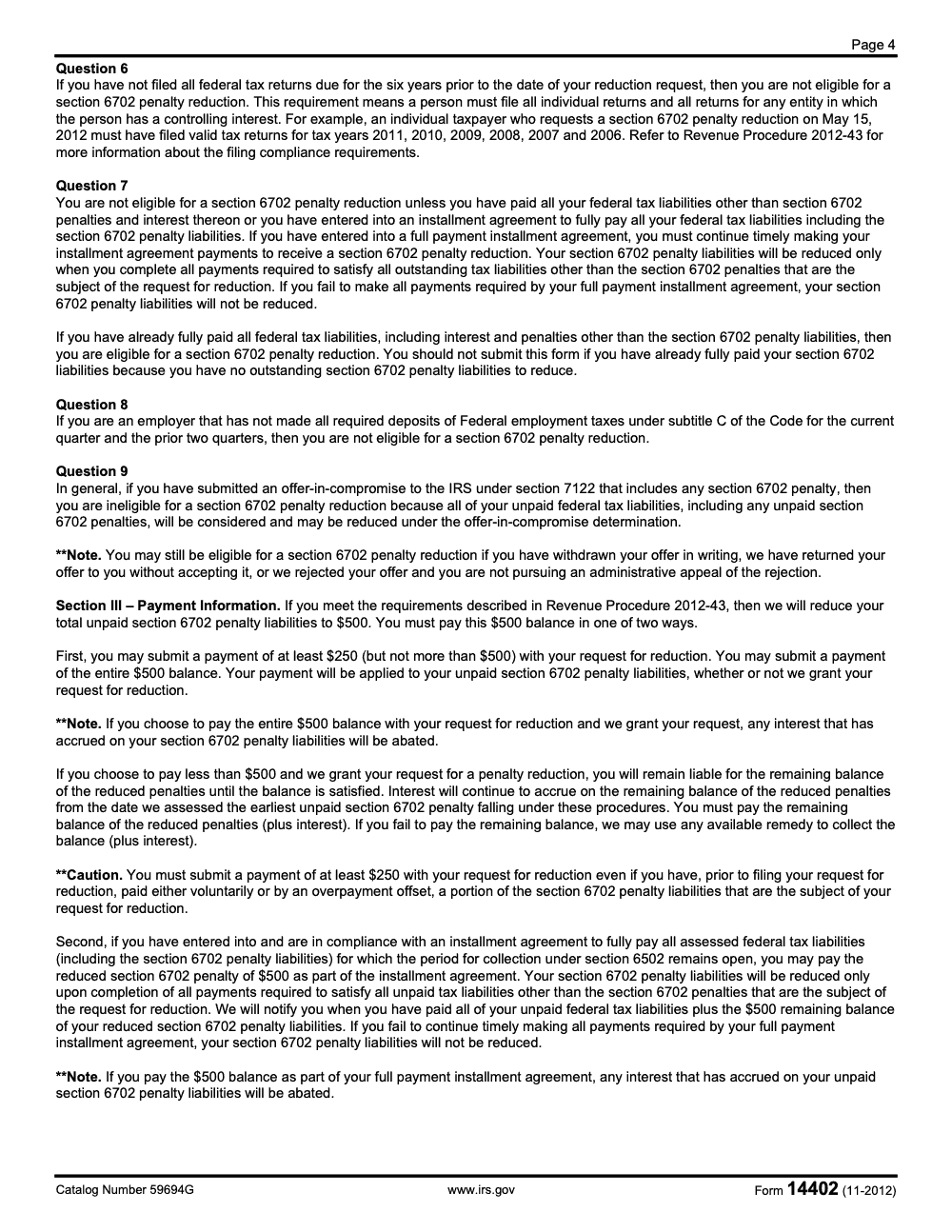
- Path A, include at least $250 with your request, then pay the balance to reach $500 (this $250 must be a fresh payment submitted with the request; voluntary payments or overpayment offsets already applied to the §6702 penalty do not satisfy the $250 minimum). Interest keeps running on the unpaid portion until it is fully paid. Once approved and the $500 is fully paid, the IRS abates accrued interest tied to those §6702 penalties.
- Path B, set up a full‑payment installment agreement and include the $500 within that plan. When you complete all required payments, the reduction is implemented and the interest is abated. A default voids the reduction.
Tip, if you can, pay the full $500 upfront with the request. If the IRS approves, interest is wiped away faster and your administrative to‑do list shrinks.
Quick Comparison, Payment Paths
| Option | Upfront Cash | Interest While Pending | When Interest Is Abated |
| At least $250 with the request | Lower | Continues on unpaid balance until $500 is fully paid | When approval is granted and the full $500 is paid |
| Full‑payment installment agreement | None at filing, payments per plan | Continues until you reach $500 within the plan | When $500 posts and you complete the plan |
Sources, Rev. Proc. 2012‑43 §§4.01(2) and 5.01.
Disqualifiers You Should Not Ignore
Several statuses block relief even if everything else looks good. Clear these before you file.
- Prior §6702 reduction, this is a one‑time opportunity.
- DOJ suit pending, once the Department of Justice serves a civil complaint in U.S. District Court to collect or reduce the §6702 assessment to judgment, you are out of time (routine IRS administrative collection actions like notices, liens, and levies do not trigger this disqualifier on their own).
- Open bankruptcy, or a §6702 penalty that is dischargeable in that open case.
- Active Offer in Compromise that includes §6702, unless withdrawn, returned, or rejected without appeal.
- Partial‑payment installment agreement for §6702.
- Closing agreement under §7121 that already resolved §6702.
- New frivolous filing after you submit your request, even if you later withdraw it.
Employer‑Only Trap, Deposit Compliance
If you have employees, make sure your federal employment tax deposits are current for the present quarter and the prior two quarters before you file Form 14402. If they are not, fix that first.
Where To Send Form 14402
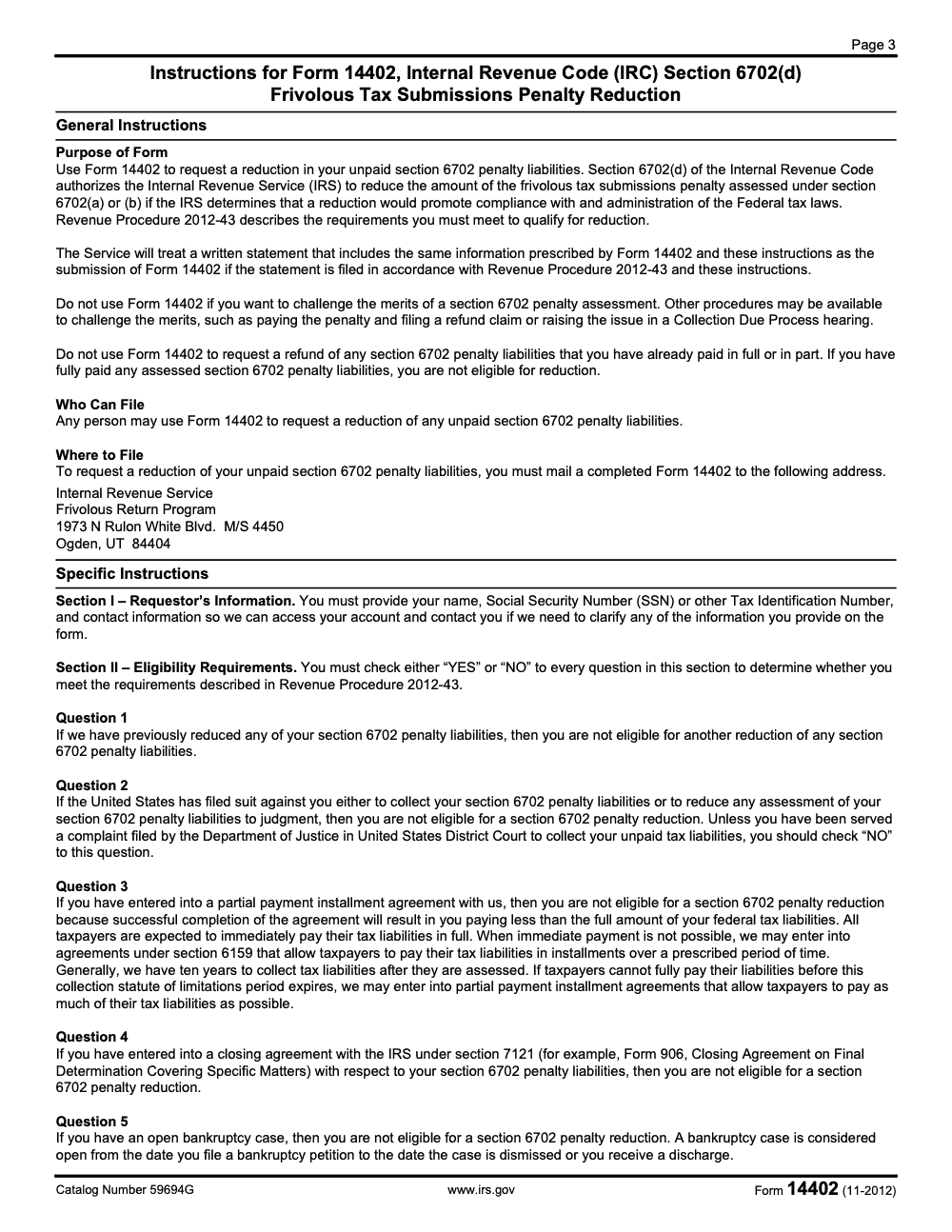
Mail your signed Form 14402, or a written statement with the same information, to the IRS Frivolous Return Program at this address:
Internal Revenue Service Attn: FRP, M/S 4450 1973 N. Rulon White Blvd. Ogden, UT 84404.
This Ogden address is consistently referenced across the IRS’s Internal Revenue Manual and FRP routing guidance, and it is current for calendar year 2026. If you include a check, the IRS will apply it to §6702 liabilities whether or not your reduction request is granted, so submitting payment is not refundable if the request is rejected. Keep copies of everything you mail.
Step‑By‑Step, How To Complete And Send Form 14402
Follow this sequence to avoid rework and delays.
1.Gather identifiers and notices
- Your legal name, TIN, address, phone, and email as they appear on IRS records.
- IRS notices that show the §6702 assessment, the form numbers, and the tax years involved.
- Your requested reduction amount, remember the cap is $500 in total.
- Confirm eligibility exactly
- Walk through the checklist in this guide and Rev. Proc. 2012‑43, sections 4 and 5.
- Fix any missing returns or unpaid balances, or enter a qualifying full‑payment installment agreement.
- If an OIC is open, withdraw it first or wait for it to be returned or rejected without appeal.
- Decide your payment path
- Include at least $250 with the request and plan for the remainder, or
- Use a full‑payment installment agreement and include the $500 within that plan.
- Prepare and sign
- Complete Form 14402 or draft a written statement that mirrors it, list penalty periods and amounts, and sign under penalties of perjury.
- Mail to Ogden FRP
- Use the FRP address above. If you are sending a check, include it in the same envelope and note the amount in your cover letter for your records.
What Happens After You File
- The FRP unit reviews eligibility under Rev. Proc. 2012‑43.
- If approved and the $500 is paid, the IRS abates accrued interest on the §6702 liabilities.
- If you sent $250 but not the full $500, you remain liable for the balance and interest until paid.
- If you used a full‑payment installment agreement, the reduction takes effect once you complete the plan, and a default voids the reduction.
Reminder, penalty‑reduction denials are not appealable to IRS Appeals. If you want to contest the underlying penalty, different procedures apply, usually after full payment.
Real‑World Example
A taxpayer with three unpaid §6702 penalties totaling $15,000 cleaned up six years of filings, paid all other balances, and applied with Form 14402. They enclosed $500 with the request. The IRS approved the reduction, cut the §6702 total to $500, and abated accrued interest once the $500 posted. The taxpayer did not recover amounts paid before filing, which is normal, since reductions do not generate refunds.
Documentation Discipline, Your Insurance Policy
You will sign Form 14402 under penalties of perjury, so your package should make it easy for the FRP team to validate your answers. Include clear references to each notice, each tax year, and the exact penalty periods. If you run a firm and prepare these requests for clients, standardized workpapers, consistent naming, and a simple cover letter checklist reduce review time and prevent back‑and‑forth with the IRS.
In places where it genuinely helps, teams use partners like Accountably to keep tax workpapers standardized, review‑ready, and complete, so requests like Form 14402 do not stall for avoidable gaps. Use help only where it adds control and speed, not as a shortcut.
Common Mistakes And How To Avoid Them
Most rejected Form 14402 requests fail for reasons that have nothing to do with the merits of the §6702 penalty. They fail on payment math, missed returns, or Section II disqualifiers the requestor did not flag. Here are the patterns we see most often, with the SOP-style fix for each.
Quick Reference Tables
Eligibility vs. Disqualifiers
| Item | You Qualify When | You Are Disqualified When |
| Filing compliance | All required returns filed for past 6 years, including controlled entities | Any required return missing |
| Payment status | All non‑§6702 liabilities fully paid, or full‑payment IA in place | Partial‑payment IA, unpaid balances without a full‑payment IA |
| Prior actions | None | Prior §6702 reduction, §7121 closing agreement that includes §6702 |
| Offers | No active OIC that includes §6702 | OIC still open or under appeal |
| Court status | No DOJ suit served | DOJ complaint served |
| Bankruptcy | No open case involving dischargeable §6702 | Open bankruptcy or penalty dischargeable in that case |
| New filings | No new frivolous submission | New frivolous submission after request |
| Employers | Deposits current this quarter and prior two | Deposits not current |
Sources, Rev. Proc. 2012‑43 §4.
Mailing And Routing
| What | Where |
| Form 14402 or equivalent statement | IRS, Attn: FRP, M/S 4450, 1973 N. Rulon White Blvd., Ogden, UT 84404 |
| If payment enclosed | Same envelope, keep copies for your records |
Source, IRS IRM routing to Ogden FRP, M/S 4450.
What If You Are Not Eligible Right Now
If an OIC is pending, withdraw it first or wait for a return or rejection without appeal. If filings are missing, file them, including entity returns you control. If you are on a partial‑payment plan, convert it to a full‑payment agreement if feasible, then recheck eligibility. If a DOJ complaint has already been served, consult a tax attorney immediately, since Form 14402 will not be available.
Pro move, do not submit Form 14402 until your filing and payment house is in order. One clean, complete package beats three rushed submissions every time.
Editor’s Notes, Search Intent And Compliance
- This guide targets readers searching for “Form 14402,” “IRS Form 14402,” “IRC 6702 penalty reduction,” and “frivolous submission penalty.”
- It answers the fast questions first, what it does, who qualifies, payment rules, where to mail, then goes deeper with eligibility, disqualifiers, and FAQs.
- Citations reflect the IRS Revenue Procedure and Internal Revenue Manual pages reviewed through January 17, 2026. Always confirm if your facts change.
Light CTA For Help, Only Where It Adds Value
If you are a taxpayer, consult a qualified tax professional before you file. If you are a CPA, EA, or firm ops lead building repeatable documentation and review workflows for requests like Form 14402, make sure your internal SOPs, workpapers, and naming standards are tight. That discipline shortens IRS review cycles and prevents avoidable denials. If you need a vetted offshore delivery layer to keep packages clean and on time, consider adding structured help only where it improves control and quality.
Disclaimer
This article is for education, not legal or tax advice. Tax facts and mailing details reflect IRS materials reviewed as of January 17, 2026, which can change. For personalized guidance, consult a licensed tax professional.
Sources
- Rev. Proc. 2012‑43, one‑time reduction of unpaid §6702 penalties to $500, eligibility, payment, time limits, disqualifiers, consideration and interest abatement.
- IRM 8.11.8, Appeals guidance on §6702, no administrative appeal for reduction requests.
- IRM 20.1.10, §6702 overview and the role of Form 14402.
- IRM 25.25.10, Frivolous Return Program operations and payment requirements, including the $250 minimum in most cases.
- IRM routing to Ogden FRP, M/S 4450, confirmed address for FRP mail.
- IRS Letter 3176C page, confirms reduction possibility and acceptance of a written statement mirroring Form 14402.
Final Checklist Before You Mail
- Eligibility met for every item in Rev. Proc. 2012‑43 §4
- Six years of returns filed, including entities you control
- All non‑§6702 balances paid or in a full‑payment IA
- Payment path chosen, at least $250 with the request or $500 within a qualifying plan
- Signed declaration under penalties of perjury
- Clear indexing of penalty periods and notices
- Copy package retained, tracking used for mailing
- Addressed to FRP, M/S 4450, 1973 N. Rulon White Blvd., Ogden, UT 84404
Reusable Checklists
These checklists are copy-paste ready for firm SOPs. Workpapers built around them shorten Frivolous Return Program review cycles and keep the perjury-declared package clean.
Pre-file eligibility scan
- Confirm at least one unpaid §6702 penalty assessment exists; if every assessment is paid, Form 14402 does not apply.
- Verify this is the taxpayer's first §6702(d) reduction request. A prior grant disqualifies for life.
- Walk Section II questions 1 through 9 against client facts: prior reduction, DOJ suit, partial-payment IA, §7121 closing agreement, open bankruptcy, six-year filing compliance, full payment of non-§6702 balances, employer deposit compliance, and OIC status.
- Index six years of personal and controlled-entity returns. Flag any gaps and resolve before filing.
- For employer requestors, pull the current quarter and prior two quarters of federal employment tax deposit records.
- Confirm no pending OIC covers the §6702 penalty, or that one of the three Question 9 exceptions clearly applies.
- Document the eligibility conclusion in a signed worksheet stored in the client file.
Payment package assembly
- Choose the payment path: a fresh $250 to $500 with the request, or a full-payment installment agreement that includes the $500 balance.
- If paying at filing, cut a dedicated check or schedule an electronic payment for at least $250 (capped at $500). Record check number, amount, and date in Section III.
- Do not credit prior voluntary payments or overpayment offsets toward the $250 minimum.
- If paying via IA, confirm it is a full-payment agreement with the IRC §6502 collection statute still open for every covered liability.
- Note the interest-abatement rule on the workpaper: full $500 at filing or completed IA abates accrued interest; partial payment leaves interest accruing from the earliest §6702 assessment date.
- Keep a payment receipt and IA confirmation copy in the client folder for the duration of the reduction window.
Mailing handoff QA
- Complete Section I with current legal name, TIN, contact number, best hours to call, and every other name used in the past six years.
- Complete Section IV with each tax form number, each tax year, and the requested reduction amount per period.
- Sign Section V under penalties of perjury. For joint frivolous filings, prepare one signed form per spouse in separate envelopes.
- Address to Internal Revenue Service Frivolous Return Program, 1973 N. Rulon White Blvd., M/S 4450, Ogden, UT 84404.
- Mail via tracked delivery (certified or private courier with return receipt) and log the tracking number against the client matter.
- Retain a full duplicate package, including the signed form, payment proof, and supporting workpapers, in the client file.
- Calendar a 90-day follow-up to call the FRP if no acknowledgement is received.
Keep 14402 Season From Stalling
Form 14402 work does not follow a calendar season the way a 1040 or 941 does, but it follows a clock all the same. Each request lands when an unpaid §6702 frivolous-submission penalty is already assessed, often after a Letter 3176C, and the eligibility window narrows fast as new installment agreements, OIC submissions, or controlled-entity filing gaps quietly close the door. Per IRM 25.25.10, which governs Frivolous Return Program operations and payment requirements, most rejections trace back to payment math errors or Section II disqualifiers that surface only when the nine eligibility questions are walked line by line.
The fix is not more bodies on the file. It is tighter package discipline so the eligibility worksheet, payment ledger, and mailing index look the same on every client and the FRP review team can validate the request without bouncing it back.
- Build a Section II walkthrough that maps each of the nine questions to a documented client fact, including six years of personal and controlled-entity returns.
- Lock the $250 minimum payment as a fresh draft cut at filing, never credited against prior voluntary payments or overpayment offsets.
- For employer requestors, pull the current and prior two quarters of federal employment tax deposit records before signing the Section V perjury declaration.
- Index every §6702 notice with its assessment date and tax year so Section IV reductions and the Ogden FRP routing are unambiguous.
- Stage the mailing to FRP M/S 4450 with tracked delivery and a duplicate retention package, since there is no appeal and the one-per-taxpayer-lifetime privilege does not reset.
When the eligibility worksheet, payment ledger, and mailing index are standardized across files, Form 14402 stops being a one-off scramble. That is where Accountably's tax execution support earns its keep, with disciplined workpapers, multi-layer review, and predictable turnaround so the §6702 reduction lands on the first submission.
FAQs
Yes. You can request reduction of more than one §6702 penalty in a single submission, as long as you list the periods and amounts clearly and meet all eligibility rules for each.
No. Denials are not appealable to Appeals under Rev. Proc. 2012‑43. To contest the penalty itself, you typically must pay and pursue a refund claim or use other authorized procedures where jurisdiction exists.
You have two options. Include at least $250 with the request and pay the rest to reach $500, or use a full‑payment installment agreement that includes the $500. A default voids the reduction.
If your request is approved and the $500 is fully paid, either upfront or through an eligible installment agreement, the IRS abates accrued interest on the §6702 liabilities.
The IRS treats a signed written statement with the same information as the form. Many practitioners still prefer using the form when available, but you have a fallback.
Letter 3176C is often associated with §6702 issues. The IRS’s page for that letter confirms the possibility of reduction under §6702(d) and acknowledges written statements that mirror Form 14402.
No. The reduction applies to unpaid §6702 penalties, and the IRS will not refund amounts paid before the request date. To recover a §6702 penalty you have already paid, you generally have to use a refund-claim procedure (for example, Form 843), not Form 14402.
The Ogden FRP address and routing were confirmed in IRS Internal Revenue Manual updates reviewed in late 2025 and 2026. Always check for updates, but this is current as of January 17, 2026.
Other forms this guide names
- Form 1040: Filing Guide for 2025 Returns (AGI, Deductions, Deadlines)
About this guide
Accountably helps US CPA, EA, and accounting firms hire trained accountants and tax preparers in India.
About us Reviewed byJugal Thacker, CPAFounder and CEO at Accountably
A Washington-licensed CPA with 7+ years inside US firms – PwC, a real-estate tax practice, then a full-service firm, rising from reviewer to manager to advisory. This article was reviewed against current IRS guidance for the 2025 tax year and updated for filers preparing late returns, amendments, and 2026 estimates.
View profile →How we research, review, and update this guide
Every Accountably guide is researched against primary IRS sources, reviewed by a U.S. CPA, and refreshed as guidance evolves. Read our Editorial Guidelines to see how we source, fact-check, and update our content.