Summarize this article with AI
In Brief
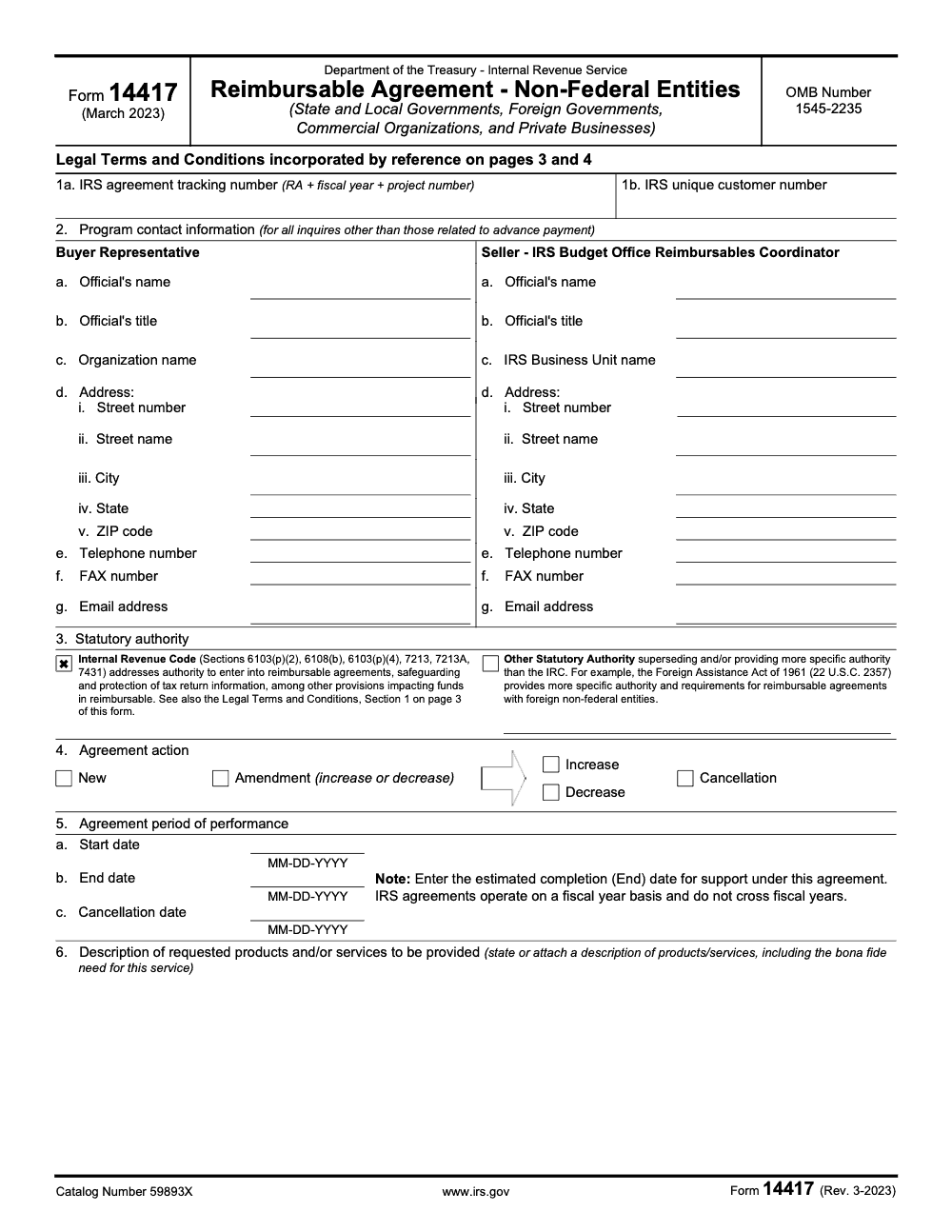
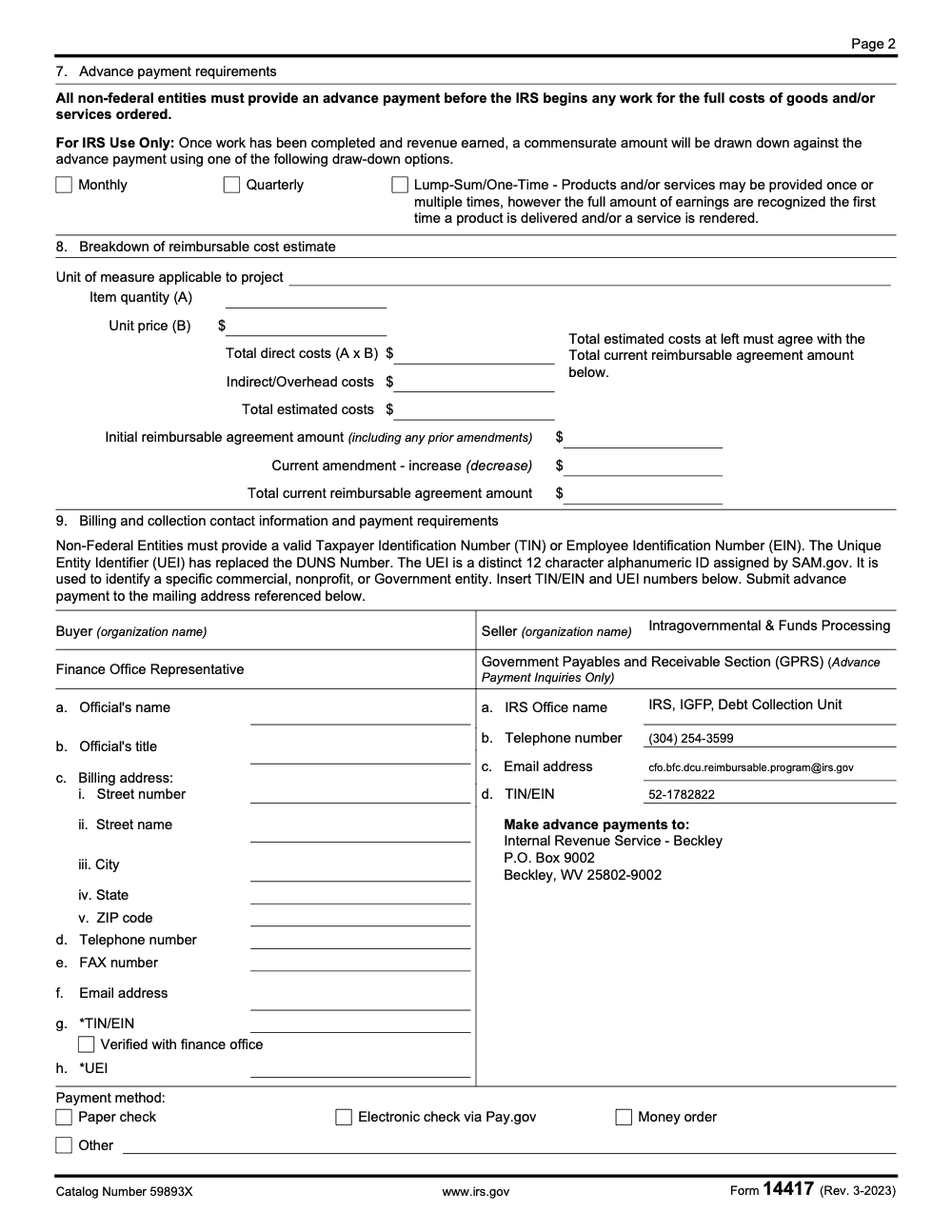
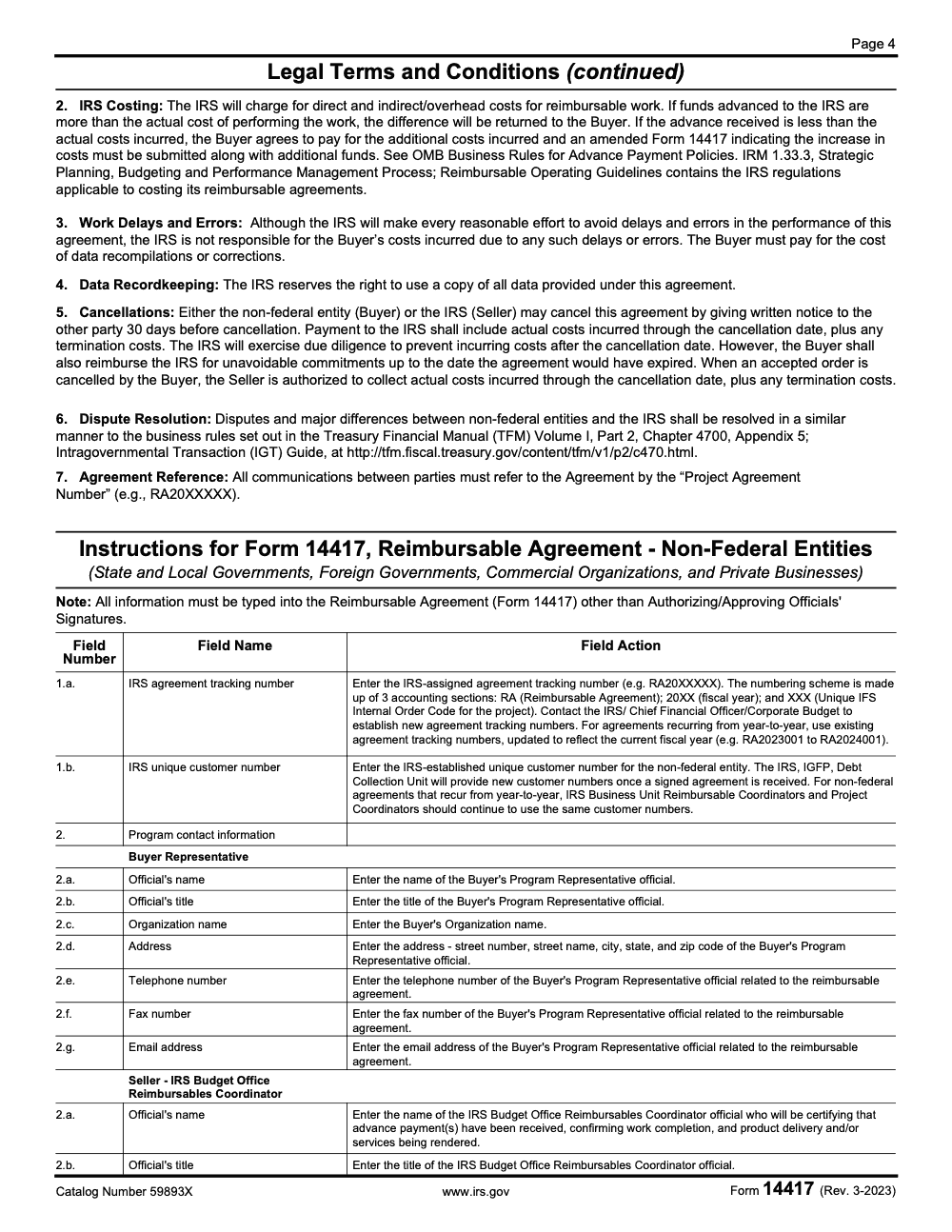
Form 14417 is the IRS Reimbursable Agreement for Non-Federal Entities (Rev. March 2023, OMB 1545-2235, Catalog 59893X) – state, local, and foreign governments and commercial buyers use it to order IRS goods or services and lock in scope, full-cost estimates, billing cadence, and approvals. Per the form's legal terms, the full advance payment must reach Internal Revenue Service - Beckley, P.O. Box 9002, Beckley, WV 25802-9002 before any IRS work begins, the agreement operates on a single fiscal year, and either party may cancel with 30 days written notice. Where the production lift is heavier than the buyer's team can absorb, our taxation services handle the field-by-field routing.
A state agency signs off on an IRS project, marks a start date, and then the day arrives and nothing happens. Almost every time, the advance payment never reached the IRS-Beckley P.O. box, because under the form's legal terms the full advance has to land before any IRS work begins. Form 14417 is what sets that agreement up: scope, full-cost estimates, billing cadence, and approvals for state, local, and foreign governments and commercial buyers ordering IRS goods or services.
The numbered fields are where control lives. Each one locks in something the buyer's controller and the IRS reviewer will both check later, and the IRC §6103(p) and OMB 1545-2235 references are not decoration. Two pieces people miss: the agreement runs on a single fiscal year, so last year's advance does not carry over, and Form 14417-A documents the Statistics of Income user-fee detail that feeds billing under Form 14417.
Key Takeaways
- You use IRS Form 14417 to set up cost reimbursable agreements with non‑federal partners under IRC §6103(p), including scope, deliverables, full cost estimates, funding, billing cadence, and how modifications will be handled.
- Form 14417 and Form 14417‑A fall under OMB Control No. 1545‑2235. The latest publicly listed package for this collection references an expiration of 2023‑01‑31, so you should verify the current status on RegInfo before you rely on it.
- You must obtain approval before services begin, then keep your agreement, costs, and invoices aligned in the IRS financial system for budgeting, billing, and collections.
- Form 14417‑A documents Statistics of Income user fee details that feed billing under Form 14417.
What Form 14417 Does
Form 14417 is the IRS’s Reimbursable Agreement for Non‑Federal Entities. It documents the legal, financial, and operational terms so you can receive IRS goods or services on a cost reimbursable basis, while meeting safeguard and funding controls.
In practice, you complete Form 14417 to define scope, deliverables, estimated costs, funding sources, billing frequency, and how changes will be approved. Those details enable setup, accounting, and collections tied to IRC §6103(p), the part of the Code that allows the IRS to share returns or return information with outside entities, but only with written safeguards and oversight. The IRS enforces those safeguards through its Internal Revenue Manual and related procedures.
You must have a signed, fully executed Form 14417 on file before any work begins. That protects both parties. It also ensures your billing and collection trail matches what you agreed, which matters when auditors, budget officers, or oversight bodies ask for evidence. The IRS relies on the Paperwork Reduction Act clearance for this collection, labeled OMB 1545‑2235, and has previously described the program in the Federal Register. Always confirm current clearance dates as part of your kickoff checklist.
Purpose and Scope, Plainly
Form 14417 exists because the IRS can only provide services to non‑federal partners when strict conditions are met. Those conditions include:
- Written agreement and approval before any service begins
- Documented safeguards under IRC §6103(p) for any return information involved
- Full cost recovery, not just direct labor
- Clear billing cadence, collections, and closeout rules
The IRS details safeguarding responsibilities in the Internal Revenue Manual, including oversight by the Office of Safeguards, annual reporting, and the ability to suspend disclosures if safeguards are not met. That is the backbone behind the form, and it is why documentation, file control, and reporting discipline matter so much.
Who Uses It, And When
You will use Form 14417 if you are a state or local agency, a foreign government body, or a commercial entity seeking defined IRS deliverables that require cost recovery. Typical examples include:
- Data extracts and tabulations from Statistics of Income
- Custom reports aligned to a program objective
- Limited technical support that fits IRS obligations
For SOI products and custom data requests, the IRS uses Form 14417‑A to capture user fee specifics, required contacts, advance payment language, and legal terms. Those fee details feed the reimbursable agreement so that billing lines up with approved work and payment rules.
Why the OMB Control Number Matters
Every federal information collection that affects the public must show a valid OMB control number. For Form 14417 and 14417‑A, that number is 1545‑2235. Historical entries and Federal Register notices show this collection has been extended over time. The most recent public listing many practitioners rely on shows an expiration of January 31, 2023, which means you should verify the current status and any re‑clearances before relying on a specific dated version in 2025. Build this check into your intake process so you are not caught off guard during a review.
Quick status check
- Look up OMB Control No. 1545‑2235 on RegInfo to confirm if a new expiration date is posted.
- Keep a copy of the active Supporting Statement and the current form version in your project file.
- If an update is pending, document the review status and plan billing only after approval is confirmed.
OMB Control Number and Regulatory Authority
The collection behind Form 14417 sits under the Paperwork Reduction Act as OMB Control No. 1545‑2235. A 2023 Federal Register notice describes the purpose and burden for Forms 14417 and 14417‑A, and the OMB.report inventory lists the package history. Since collections can be renewed or modified, confirm the current status as part of your kickoff. If you keep a standard “Form 14417 binder,” make the OMB status sheet and the latest Supporting Statement your first tab.
IRC §6103(p) as your legal footing
IRC §6103 is the IRS disclosure statute. Subsection (p) requires written safeguards, annual reporting, and enforcement tools that allow the IRS to pause disclosures if recipients fail to protect tax data. The Internal Revenue Manual explains these responsibilities, including Office of Safeguards oversight, reporting categories, and enforcement steps. In short, your agreement is not just a pricing sheet, it is a commitment to protect Federal Tax Information with controls that the IRS can review.
The IRS may suspend or terminate disclosures if an authorized recipient does not maintain safeguards or has not taken adequate corrective action after an incident. Build your processes as if a safeguard review could occur at any time.
What this means for your team
- Treat confidentiality clauses as operational requirements, not boilerplate.
- Align your documentation with Publication 1075 standards referenced in the IRM.
- Keep a clean trail for accounting under §6103(p)(3) and be ready to report.
Eligible Entities and Common Use Cases
The form applies to non‑federal customers that the Code allows the IRS to serve on a reimbursable basis. If you fall in one of these buckets, you likely need Form 14417 before work begins.
Examples you can model
| Eligible entity | Example use case |
| State government | Aggregate SOI statistics to support policy analysis |
| Local government | Data match support under an approved disclosure authority |
| Foreign government body | Bilateral information‑sharing deliverables within limits |
| Commercial entity | Custom SOI tabulations with user‑fee billing |
| Multi‑jurisdiction consortium | Coordinated data products across members |
When you set up the agreement, document scope, unit costs, funding sources, billing frequency, and how you will account for project earnings and collections. Then get approvals, capture signatures, and keep a tight audit trail. The Federal Register entry and IRM sections underscore why these steps exist.
Relationship to Form 14417‑A
Think of Form 14417‑A as the SOI fee engine. You use it to capture product details, user fees, contacts, and advance payment requirements for Statistics of Income data. Those inputs flow into the Form 14417 agreement so billing lines up with what you ordered and what IRS agreed to deliver. The form text itself calls out advance payment rules, legal terms, and the Beckley Finance Center for remittances. Keep a signed copy of the 14417‑A with your 14417 file so anyone can tie fee math to the agreement and to collections.
Practical tip
- Use consistent project identifiers on both forms, then mirror them in your ledger and invoice references.
- If your scope changes, update both the 14417 and 14417‑A figures, route the modification for approval, and retain the older versions for audit history.
Where Accountably fits, briefly
Accountably is offshore accounting and tax staffing for CPA, EA, and accounting firms, built by a CPA. If your firm is buried in production, agreements stall or drift. We place trained offshore accountants and tax preparers inside your workflow, ramped on your software and SOPs, with standardized workpapers, multi‑layer review, and live tracking that reduce rework and keep agreements aligned with cost and billing rules. If you need help carrying the operational side of reimbursable work so partner review time drops and deadlines stop slipping, that is where trained offshore staffing helps. Keep this mention practical, use it only if it serves your readers, and lean on your internal processes first.
Required Information and Key Fields
When you sit down to complete Form 14417, think like a reviewer. They need to see who is accountable, what is being delivered, how much it will cost, when bills will run, and how changes will be handled. Use this checklist to keep your file clean and review ready.
The essentials you must capture
- Parties and roles
- IRS selling unit and your organization’s legal name
- Project Manager and Billing Contact, with full addresses and direct contact info
- Period of performance
- Clear start and end dates, plus any option periods
- Agreement amounts
- Total AGREEMENT AMOUNT, the funding authorized for the current fiscal year (single fiscal year only – multi-year funding cannot be retained or applied to future fiscal years, so recurring agreements require a fresh Form 14417 each year with an updated RA tracking number, e.g., RA2023001 to RA2024001), any additional lines by fund source
- Billing cadence and method
- Monthly, quarterly, or other schedule, with the accounting line to receive invoices
- Modification protocol
- How changes are initiated, routed, approved, and documented
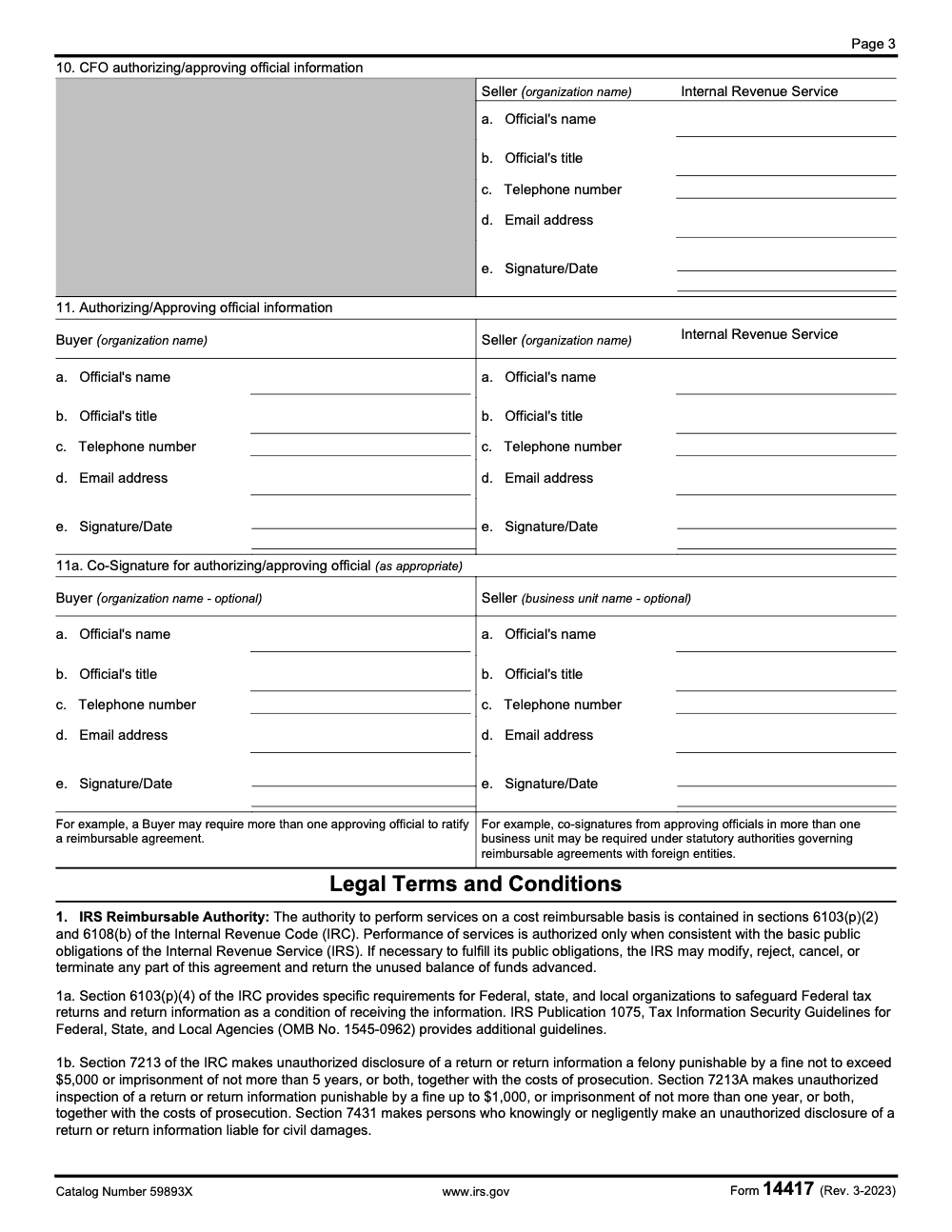
- Signatures and acceptance
- Cognizant officials for both parties, date of execution
- Administrative identifiers
- Reference OMB Control No. 1545‑2235, include IC identifiers, and file the current form version and supporting statements with the agreement
Pro tip, use a consistent project code on your form, your cost worksheet, your invoices, and your ledger. Reviewers love when the dots already connect.
To finish the package, attach the scope or statement of work, the current cost worksheet, any required legal opinions or authority memos, and the Form 14417‑A if SOI user fees apply. Keep every signed modification in the same file so the audit trail tells a clear story from kickoff to closeout.
Costing, Billing, and Funding, how to keep control
The fastest way to lose control of a reimbursable project is to treat costs and billing as an afterthought. The form requires full cost recovery, which means you must account for direct labor, non‑labor direct costs, indirects, overhead, and FTE planning. Then you convert that plan into a predictable billing cadence and track it against funding and collections.
Full cost estimating that stands up to review
- Build the estimate in the Corporate Budget cost worksheet template
- Include direct labor by labor category and rate, non‑labor direct costs, indirects, and overhead
- Document your assumptions, source data, and rate logic
- For non‑labor‑only projects, obtain the required approval from the Director, Budget Execution
- Load the estimate to your financial system of record, then update it when scope changes
- Notify Corporate Budget when you modify estimates, and keep a simple “mod log” with dates, approvers, and reasons
If someone outside the project can recreate your math from the file, you did it right. If they cannot, add the missing assumptions and sources.
A simple cost categories table
| Cost area | What to include | Where it lives |
| Direct labor | Hours by role, rate, FTE plan | Cost worksheet, agreement summary |
| Non‑labor direct | Data extraction fees, software, printing, postage | Cost worksheet line items |
| Indirects | Program support, shared services | Cost worksheet, rate explanation |
| Overhead | Facilities, admin, common IT | Rate basis note, calculation tab |
| Contingency logic | When scope is variable | Assumptions tab with triggers |
Keep your math conservative, then true‑up through modifications when the scope gets clearer. Never “hide” indirects. If you forget them, you will feel the pain at closeout.
Billing Frequency Controls
Your billing cadence is the heartbeat of the agreement. Pick a rhythm you can actually sustain, then mirror it in your accounting entries and collections.
Set a cadence, then make it real
- Choose monthly, quarterly, or a schedule tied to measurable milestones
- Put the cadence in the agreement, not just in an email
- Park and post earnings in your financial system consistent with the cadence
- Reconcile collections against earnings monthly, then correct variances right away
- Track advances (the Buyer must remit the full advance payment to the IRS-Beckley P.O. Box before any IRS work begins – the IRS does not bill after services; the draw-down only governs revenue recognition against an already-deposited advance), notify the appropriate budget offices when advances are received, and apply them accurately
- When cadence or cost changes, route a modification package and update your records
If you only bill at year‑end, everyone panics, and audit flags multiply. A steady monthly cadence, even for small amounts, keeps both sides in sync and reduces closeout stress.
Funds Management Oversight
Strong funds control is your safety net against over‑obligation or an Antideficiency Act problem. Treat this as a monthly ritual.
The monthly oversight loop
- Compare approved funding to expenditures and earned revenue, then capture the month’s variance and driver
- Reconcile costs to subledgers, including labor, non‑labor, and overhead
- Confirm availability controls are working, and that new obligations cannot exceed apportioned amounts
- Document scope changes, then decide if a modification is required
- Assign and record responsible officials for any corrective actions
Build this loop into your calendar, assign named owners, and keep a short summary in the file each month. When auditors come calling, you will be ready in minutes, not weeks.
Aligning With IRS Reimbursable Operating Guidelines
Form 14417 is the front page, the Guidelines are the playbook. Aligning with the IRS Reimbursable Operating Guidelines means your file has authority, cost, approval, billing, and reporting in one place, and every change is traceable.
What good alignment looks like
- Authority, you cite the statutory basis, including IRC §6103(p) when tax information is involved
- Cost, you attach the full cost worksheet that matches the form’s totals
- Approvals, you include signatures, date stamps, and any internal clearance memos
- Billing, you document cadence, earnings, and collections, with monthly reconciliations
- Modifications, you keep a complete chain of changes with reasons and approvals
- Closeout, you show that deliverables were met, final bills were issued, and funds were released
Think of your file as a courtroom exhibit. If it can stand on its own, you have reduced risk and saved your future self a lot of time.
G‑Invoicing and Federal Agreement Considerations
If your trading partner is a federal agency, you will not use Form 14417. You will move into G‑Invoicing and the FS 7600A and 7600B interagency agreement forms. The principles are the same, the platform and documents are different.
Getting the federal side right
- Confirm both agencies are onboarded to G‑Invoicing and roles are assigned
- Build full cost in your cost worksheet first, then mirror it in the platform
- Validate interfaces to your financial system, and test small transactions before scale
- Record setup, modifications, billing, and settlements in both systems, then reconcile
- Guard against Antideficiency Act risk by confirming funding availability and order acceptance steps are complete before work begins
If you are not yet onboarded, follow your Federal Agreements procedures and coordinate with Budget Execution and the Bureau of the Fiscal Service resources. The goal is the same, deliverables that match funding, costs that are fully recoverable, and documentation that proves it.
Submission, Availability, and Supporting Documents
You can typically access Form 14417 and Form 14417‑A as printable PDFs associated with OMB Control No. 1545‑2235. Before you use a copy, verify three things, version, expiration, and whether any new instructions were posted.
Build a smart source file
- The form PDFs and instructions, current versions only
- The Supporting Statement, which explains burden and helps you understand the program’s intent
- Your cost worksheet, assumptions tab, and rate logic
- A short index page that lists every document in the file with dates and signers
If the listing does not show e‑submission availability, plan for a signed, scanned package and store it in a controlled repository. Missing signatures and scattered documents are the top reasons agreements stall at review.
Compliance, Oversight, and Recordkeeping
Treat your agreement like a financial instrument. It requires continuous oversight, not a onetime setup.
Keep your file audit ready
- Policies, include apportionments, authority memos, and references to the current collection
- Agreements, keep the signed form and every modification, labeled and indexed
- Costs, store the original estimate, every update, and the reason for change
- Billing, keep invoices, earnings postings, collections, and reconciliations
- Oversight, include monthly variance notes and any corrective actions
If you discover a control issue, document it, fix it, and keep the record. Auditors reward honest, timely corrections. They punish silence.
Note, this guide is for educational purposes, it is not legal or tax advice. Confirm your facts with current IRS publications, your counsel, and your agency’s policies before you rely on them.
Putting It All Together
If you remember nothing else, remember this sequence. Define scope, prove authority, estimate full cost, set a real billing rhythm, then document every change. When you do that, Form 14417 becomes more than a form. It is your proof that services started only after funding, safeguards, and responsibilities were crystal clear.
A quick startup template you can reuse
- Create a Form 14417 folder with subfolders for Authority, Costs, Agreement, Billing, Modifications, Closeout
- Save the current form PDF and Supporting Statement under Authority
- Build your cost worksheet, document assumptions, get the approvals, then save the signed copy
- Draft the agreement with scope, period, cadence, and signature blocks, then route for execution
- Set your monthly oversight calendar, assign owners, and log reconciliations and variances
- When scope shifts, prepare a one‑page modification memo, update costs, route for signatures, and post the new version, keep the old one for history
Where disciplined delivery helps
If your team struggles with production peaks, review bottlenecks, or documentation drift, you are not alone. Many firms have the clients and the approvals, they lack the trained capacity that keeps work on time, at quality, and at scale. Accountably places trained offshore accountants and tax preparers inside your firm, ramped on your software and SOPs, with SOP‑driven execution, structured workpapers, multi‑layer review, clear SLAs, and live tracking that reduce revision cycles and help you protect review time. It maps neatly to how Form 14417 expects you to work, structured, documented, and accountable.
If you want a second set of eyes on your files or a tighter workflow for reimbursable projects, bring in help to standardize the process, not to add random hands.
Conclusion
Form 14417 is not red tape, it is risk control. When you anchor your agreement in IRC §6103(p), reference OMB 1545‑2235, attach a full cost estimate, set a billing cadence you can maintain, and keep a clean modification trail, you create auditable evidence. That evidence protects your funding, your team, and your partners. It also frees you to focus on the real work, delivering what you promised, on time, without surprises.
Common Mistakes We See Every Season
The errors that derail a Form 14417 agreement repeat across buyers and fiscal years. Five we see most often:
Reusable Checklists
Copy these into your SOP files. The list items track to actual Form 14417 fields and IRM 1.33.8 oversight points, so a new buyer-side analyst can close the loop without re-reading the form.
Pre-signature packet
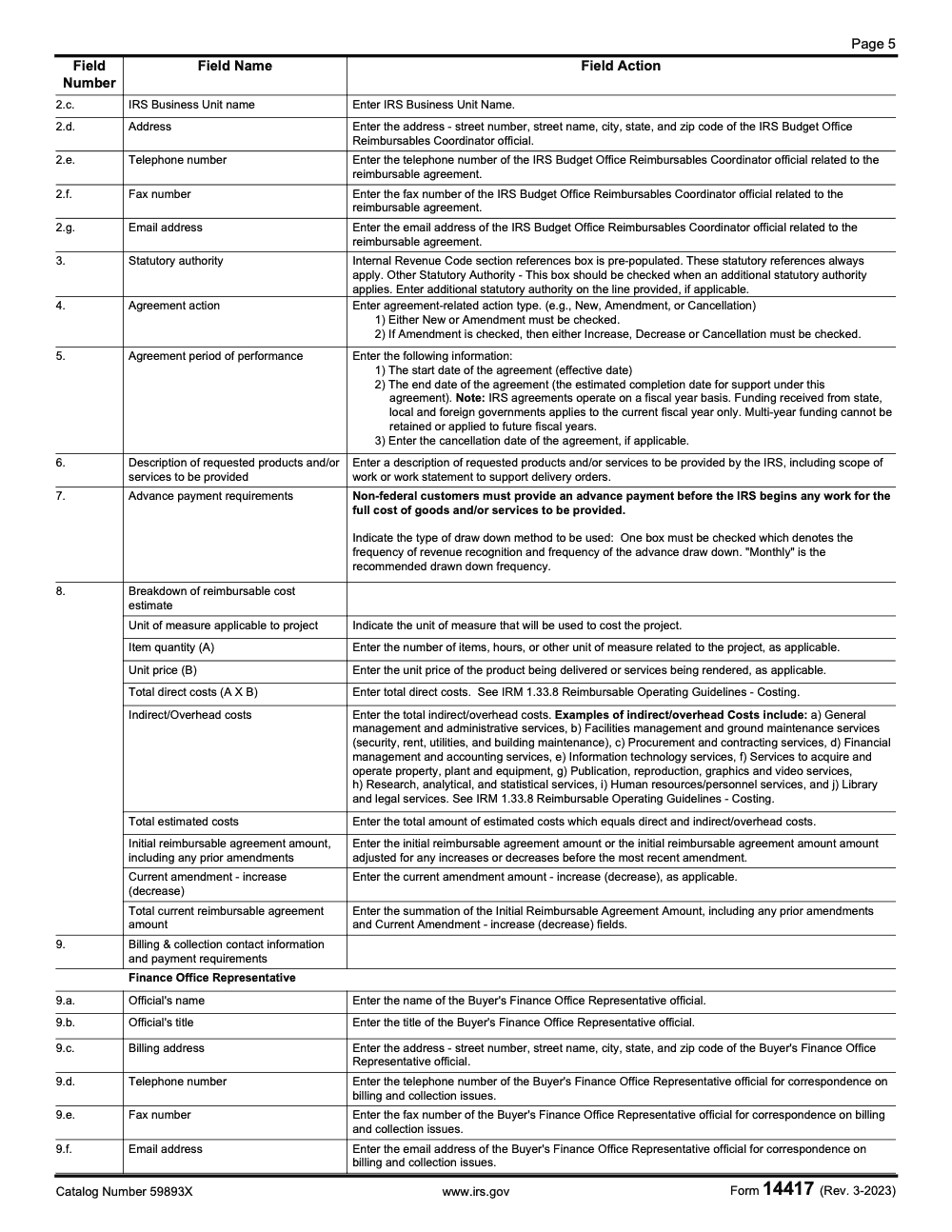
- Field 1a tracking number issued by IRS Chief Financial Officer / Corporate Budget (format: RA + fiscal year + project number).
- Field 1b customer number assigned by IRS IGFP Debt Collection Unit (or confirmed reused from prior year).
- Field 3 statutory authority confirmed: IRC §6103(p)(2), §6108(b), §6103(p)(4), §7213, §7213A, §7431 pre-populated; foreign-entity work also checks Other and cites 22 U.S.C. 2357.
- Field 4 action type set: New, or Amendment (Increase / Decrease / Cancellation).
- Field 5 start, end, and cancellation dates in MM-DD-YYYY format, all inside one fiscal year.
- Field 6 description names the bona fide need for the goods or services.
- Field 8 cost estimate breaks out unit of measure, quantity, unit price, direct costs, and indirect / overhead by the ten IRM 1.33.8 categories.
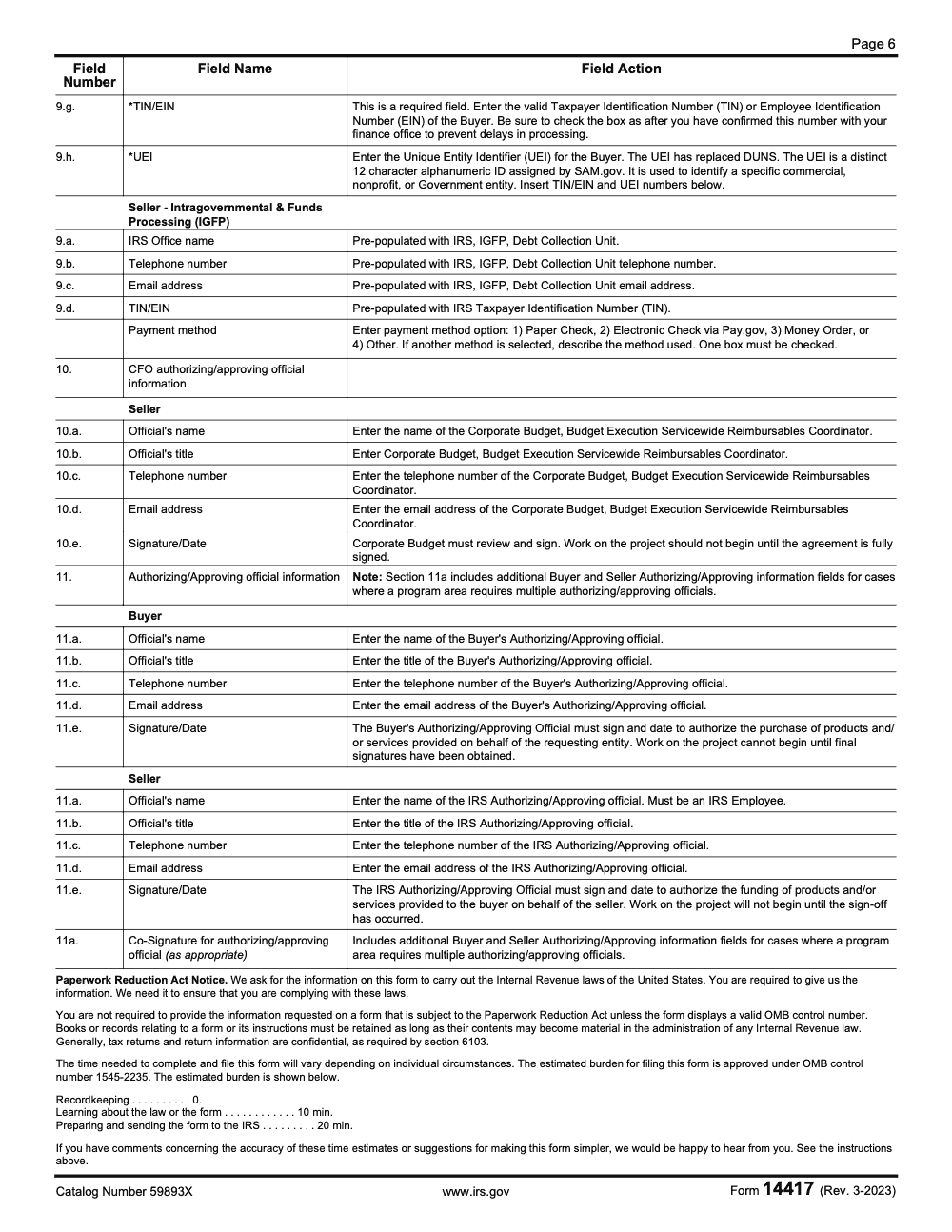
- Field 9.g buyer TIN or EIN entered and verification box checked.
- Field 9.h buyer UEI (12 characters from SAM.gov) entered (not legacy DUNS).
- Field 10 (Corporate Budget) and Field 11 (Buyer + IRS approving officials) signature blocks routed; Field 11a co-signature added only if a buyer program area or foreign-entity rule requires it.
Advance payment and work-launch
- Payment method selected in Field 7: Paper check, Electronic check via Pay.gov, Money order, or Other (with description if Other).
- Full advance amount mailed to Internal Revenue Service - Beckley, P.O. Box 9002, Beckley, WV 25802-9002.
- Draw-down frequency in Field 7 set (Monthly is IRS-recommended; Quarterly or Lump-Sum / One-Time only with documented reason).
- All three signatures captured (Field 10 Corporate Budget, Field 11 Buyer, Field 11 IRS) before any IRS work starts.
- Project Agreement Number (RA20XXXXX) cited on every communication between buyer and IRS.
- Buyer Finance Office contact in Field 9 routed to receive billing and collection correspondence, separate from the Field 2 Program Representative.
Fiscal-year handoff and renewal
- Forecast actual vs. advance spend 60 days before fiscal year end; flag overrun risk (Field 4 Amendment / Increase) or refund expectation.
- For continuing relationships, draft a new Form 14417 with the existing root tracking number updated for the new fiscal year (e.g., RA2024001 to RA2025001).
- If cancelling, issue 30 days written notice and tally actual costs through the cancellation date plus termination costs and unavoidable commitments through the original expiration date.
- Reconcile any refund of unused advance funds against the buyer's general ledger.
- Archive the signed Form 14417, all amendments, and the related IRS Publication 1075 safeguard record per IRC §6103(p)(4) retention requirements.
Keep 14417 Season From Stalling
Form 14417 work does not move on a calendar season the way a 1040 or 941 cycle does. It moves on the buyer's fiscal year close and the IRS Corporate Budget signature queue, both of which compress in the last 60 days before September 30. Per the Form 14417 legal terms, no IRS work can begin until Field 10 and Field 11 signatures are in place and the full advance has cleared the Beckley P.O. box; per IRM 1.33.8, the agreement also has to live entirely inside one fiscal year. An unsigned agreement in October is a work-stoppage waiting to happen.
The fix is not heroics in the last week. It is a documented intake-and-routing system that names who owns each field of the form, who reviews it, and who countersigns. When that system runs, the agreement closes on time and the buyer's program team starts on day one of the period of performance instead of week three.
- Assign a single owner for Field 1a tracking number issuance and Field 1b customer number confirmation; do not let those fields wait on whoever opens the email.
- Standardize the Field 8 cost-estimate template across direct and indirect / overhead lines so reviewers see the same ten IRM 1.33.8 categories every time.
- Pre-route Field 9 buyer finance contact and Field 2 program contact separately; the IRS cannot send billing correspondence to a program inbox.
- Build a 30-day cancellation-clock dashboard so any written cancellation notice automatically triggers an actual-costs reconciliation through the cancellation date plus termination and unavoidable commitments.
- Track UEI renewal dates in SAM.gov alongside the agreement file; an expired UEI blocks Field 9.h and stalls every downstream signature.
Where the work piles up faster than the buyer's team can absorb it, this is the production layer we handle: routing the fields, drafting the cost estimate, chasing the Corporate Budget signature, and keeping the audit binder defensible. See our taxation services for how we plug in.
FAQs
There is no IRS Form 14817. You likely mean Form 14417, which is the Reimbursable Agreement for Non‑Federal Entities – a budget and agreement instrument filed by non‑federal buyers of IRS services (state/local governments, foreign governments, commercial organizations, private businesses), not a tax return and not filed by individuals or federal agencies. Use it to define scope, estimate full cost, set billing frequency, capture signatures, and keep a defensible audit trail tied to your financial system.
For personal or business tax account issues, start with IRS Online Account to view balances, set payment plans, and access transcripts. The Interactive Tax Assistant can guide you through common questions. If you face hardship or delays, the Taxpayer Advocate Service may be able to help.
Read the notice fully, verify the amounts, and confirm the deadline. Gather your documents, follow the reply instructions, and record what you send. If you disagree, follow the listed appeal steps. Keep copies of everything, including mail receipts or confirmation numbers.
Section 467 covers certain rental agreements and determines how rent is recognized over time. It can require you to allocate or impute rent differently than the contract schedule. If you think Section 467 applies, talk with a qualified tax professional before you make changes to your accounting.
Other forms this guide names
- Form 7213: Claim Nuclear Production Credits (45J & 45U) Guide
About this guide
Accountably helps US CPA, EA, and accounting firms hire trained accountants and tax preparers in India.
About us Reviewed byJugal Thacker, CPAFounder and CEO at Accountably
A Washington-licensed CPA with 7+ years inside US firms – PwC, a real-estate tax practice, then a full-service firm, rising from reviewer to manager to advisory. This article was reviewed against current IRS guidance for the 2025 tax year and updated for filers preparing late returns, amendments, and 2026 estimates.
View profile →How we research, review, and update this guide
Every Accountably guide is researched against primary IRS sources, reviewed by a U.S. CPA, and refreshed as guidance evolves. Read our Editorial Guidelines to see how we source, fact-check, and update our content.