Summarize this article with AI
In Brief
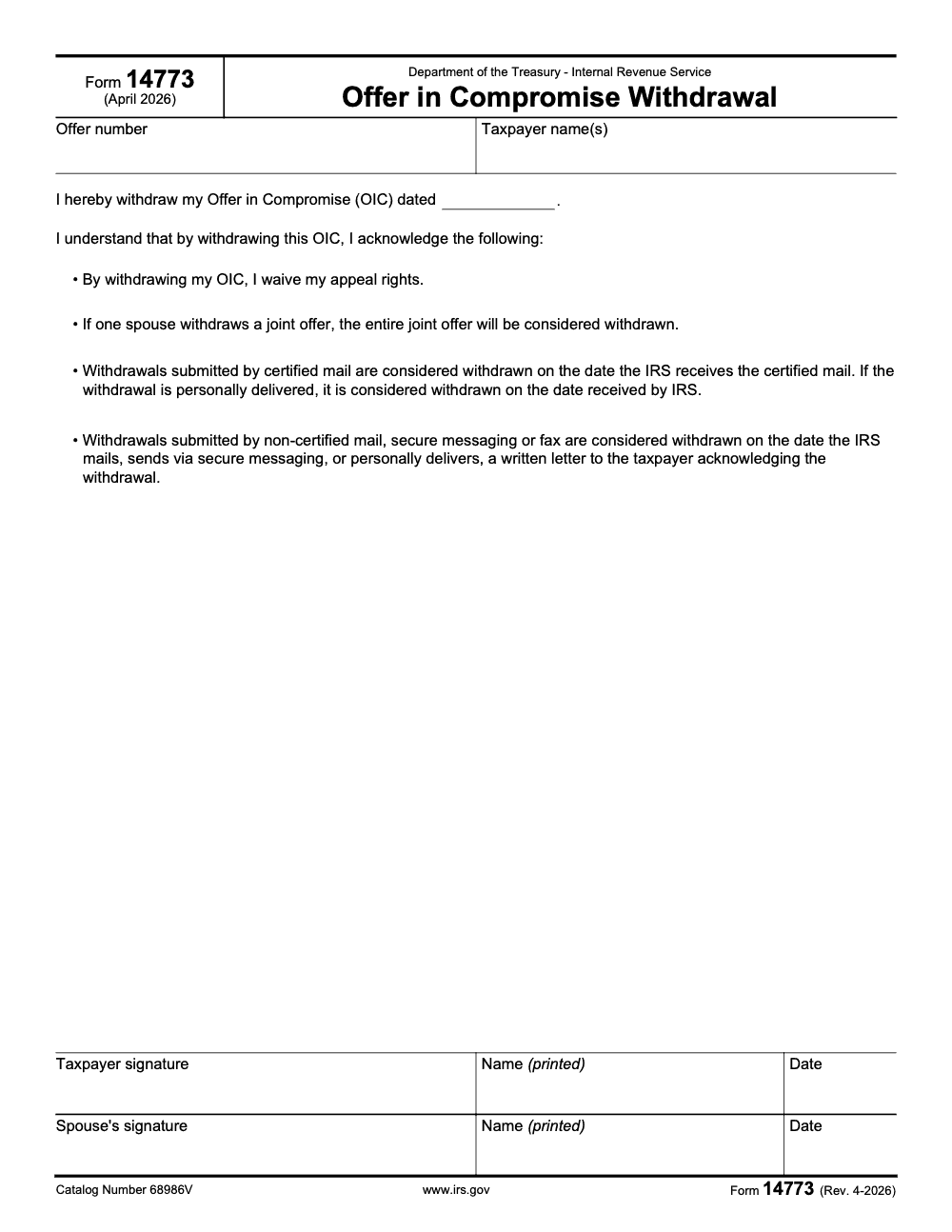
Form 14773 is the IRS form used to withdraw a pending Offer in Compromise, including a joint offer. It needs the offer number, both taxpayer names, and the date of the original offer, and signing it waives your appeal rights for that offer while the underlying tax debt, with penalties and interest, stays owed in full (per the IRS Internal Revenue Manual). The withdrawal is effective on the date the IRS receives it for certified mail or personal delivery, and on the date the IRS issues its written acknowledgment for fax, secure message, or non-certified mail. Firms that handle this volume can standardize it through our tax services.
An Offer in Compromise that made sense when it was filed sometimes stops making sense halfway through review, and a strategy reset is a legitimate reason to pull it. Form 14773 is the IRS withdrawal form for a pending OIC, including a joint offer. It asks for the offer number, both taxpayer names, and the date of the original offer.
Signing it carries weight worth understanding upfront. Withdrawing waives your appeal rights for that offer, the underlying tax debt stays owed in full with penalties and interest, and fees and initial payments are generally nonrefundable. Collections can resume once the offer is gone, so resetting and choosing a better path is a reasonable call.
Key Takeaways
- Form 14773 is the IRS’s Offer in Compromise Withdrawal form. It is used to withdraw a previously submitted OIC, and its spouse signature block lets it withdraw a joint offer as well as an individual one. A signed, written withdrawal is the documented path the IRS recognizes.
- One spouse can withdraw a joint OIC. Current Collection guidance says if one spouse requests withdrawal, the entire joint offer is treated as withdrawn. Best practice is still a signed, written withdrawal for the record.
- You send the withdrawal to the office handling your OIC. Use the address or channel on your IRS OIC correspondence, or the sites listed in Form 656‑B.
- Collections can resume once the OIC is withdrawn. Fees and initial payments are generally nonrefundable, and the IRS moves your case back into normal collection status. Withdrawing also waives your appeal rights for that offer, so it is not a step to reverse lightly.
- Timing matters. The effective date of a withdrawal depends on how the IRS receives it, certified mail, fax, secure message, or in person.
What Form 14773 Is, And When You Should Use It
Form 14773, titled Offer in Compromise Withdrawal, is the IRS’s own device for documenting a voluntary withdrawal of a previously submitted OIC, including a joint OIC through its spouse signature block. A signed, written withdrawal on Form 14773 is the documented path taxpayers use to withdraw an offer.
You should use Form 14773 when both of these are true:
- You and your spouse filed a joint OIC that is still pending in the IRS system, and
- You now want to end that joint case cleanly and quickly.
If you are withdrawing only because one spouse wants out, understand the current rule in Collection, a joint OIC is considered withdrawn if one spouse asks for withdrawal. In Appeals, employees are told to verify both spouses concur. In practice, you avoid drama by getting a clean, signed statement, via Form 14773, that links to the correct OIC number.
Who This Guide Is For
- You manage tax resolution work inside a CPA, EA, or accounting firm, and a couple’s joint OIC needs to be withdrawn.
- You are a tax manager or ops lead who wants a precise, documented process that does not bounce in review.
- You are a partner who wants to protect client trust, avoid needless rework, and keep your team out of email loops.
In our work supporting firms through busy seasons, the messiest OIC moments are not about eligibility, they are about process. Missing numbers, poor file naming, unsigned withdrawals, or sending to the wrong site blow up timelines. That is fixable.
Why You Might Withdraw A Joint OIC
- The joint strategy no longer makes sense after a separation, divorce, death, or a meaningful change in income or assets.
- One spouse intends to file a separate OIC or prefers an installment agreement while the other does not.
- You want to preserve the option to pursue other relief, for example, innocent spouse relief, outside the constraints of a joint offer.
- Timelines and acceptance probabilities shifted. IRS Data Book figures for FY 2024 show acceptance dropped to roughly one in five. Strategy shifts are normal.
A cleanly documented withdrawal prevents wrong‑case actions, unnecessary lien activity, and avoidable back‑and‑forth.
Quick Definitions, So You Are Grounded
- Offer in Compromise, An agreement to settle a tax debt for less than the full amount owed, based on ability to pay, income, expenses, and asset equity. See Form 656‑B for rules.
- Form 14773, The one‑page joint OIC withdrawal form recognized by the IRS IRM. Written withdrawals are encouraged.
- Form 14773, The IRS Offer in Compromise Withdrawal form, which includes a spouse signature block and can be used to withdraw a joint offer as well as an individual one.
Accountably note, This article lives on Accountably.com. We are careful not to push services you do not need. If you run a firm and want help standardizing tax ops so steps like this do not stall in review, we can share our checklists and SOP patterns. Otherwise, use the templates and steps below and you will be in good shape.
How To Withdraw A Joint OIC With Form 14773, Step By Step
Here is the fast, reliable path firms use to avoid rework.
Step 1, Confirm Scope
- Confirm the OIC you plan to withdraw is the same joint OIC on file. Match names, SSNs or ITINs, tax periods, and the OIC number exactly.
- Decide the path, a signed Form 14773 from both spouses, or a written withdrawal signed by one spouse, which the IRS may accept. Written is best.
Step 2, Complete The Form
- Use the current one‑page layout for Form 14773 and fill in identifying details precisely as they appear on the original Form 656, names, last four of SSN or ITIN, tax periods, OIC number, and date of the original offer.
- State clearly that you withdraw the joint OIC, and sign and date. If you submitted any deposit with the OIC before 2022, designate refund or application. Fees and initial payments are nonrefundable.
Step 3, Attach A Clean Record
You will speed verification if you include:
- A copy of the original Form 656 showing both signatures and the OIC number.
- Copies of relevant IRS letters on the joint OIC.
- If represented, a copy of Form 2848 that matches the names and periods. These attachments are not required by the IRM, but they reduce follow‑ups.
Step 4, Send It To The Right Place
- Submit to the same IRS office or site that is handling your open OIC. Use the address or submission channel on the most recent IRS correspondence or the site listings in Form 656‑B. The IRS now also supports certain OIC submissions via email to designated sites and via the Individual Online Account for some actions.
Step 5, Confirm Receipt And Effective Date
- Track delivery and keep proof. The effective date of a voluntary withdrawal depends on how the request is received. Use the table below to set expectations.
Effective Date By Method, What The IRM Says
| Method you use | When the withdrawal is effective |
| Certified mail, written | The date the IRS receives the certified mail, not the postmark date. |
| Personal delivery | The date the IRS receives your notification. |
| Fax or non‑certified mail, or secure messaging | The date the IRS mails or delivers its written acknowledgment to you. |
What Happens Inside The IRS After Withdrawal
- The IRS closes the offer as a withdrawal on AOIC, reverses the pending transaction code for the offer, and normal collection timelines open back up. Expect liens or levies to proceed under normal rules unless you set a new arrangement.
Eligibility And Scope, Keep It Tight
- Form 14773 is only for a previously submitted OIC, individual or joint, that is still in process. It is not for new offers, appeals, or modifications. Use Form 656 to file a new offer or Form 13711 to appeal a rejection.
- The IRS allows a voluntary withdrawal of a pending OIC on Form 14773. Collection will treat a joint offer as withdrawn if one spouse asks. In practice, use a signed written withdrawal to protect the record.
Operational Tips For Firms, So Reviews Do Not Stall
- Use a standard file name, OIC‑Withdraw_14773_ClientLast_ClientFirst_OIC‑####.pdf, plus date.
- Put the OIC number and tax periods in the email subject or cover letter.
- Log the submission date and set a follow‑up task for 21 days to confirm IRS acknowledgment.
- Capture a PDF of USPS tracking or fax confirmation to the client file.
Accountably builds this discipline into offshore and onshore delivery so partners are not stuck in review loops. If you want our OIC withdrawal checklist, we can share it, no sales call necessary.
Small operational habits, exact naming, complete attachments, and a timed follow‑up, are how you save hours later.
Fields To Complete On Form 14773
Required Identification
- Full legal names for both spouses, formatted exactly as on the original Form 656.
- Last four digits of each SSN or ITIN, matching IRS records.
- OIC case or offer number, tax periods, and original offer date.
- Current mailing address and a daytime phone or email for contact.
The Withdrawal Statement
- A simple sentence works, for example, We withdraw our joint Offer in Compromise dated [date] for [periods]. We understand this waives appeal rights for this offer.
- Each spouse signs and dates. If only one spouse will sign, Collection may accept it, but get both signatures when possible to avoid later disputes.
Deposit Direction, If Applicable
- For older offers that included a deposit, indicate whether you want any deposit refunded or applied, with amounts and periods. Note, the application fee and initial payments are nonrefundable.
Documents To Attach, To Avoid Follow‑ups
Make it easy for the IRS to match your withdrawal to the right case.
- Copy of the original Form 656 and submission page with signatures.
- Copies of recent IRS notices on the OIC, especially the most recent letter with the site address or contact details.
- Form 2848, if you are a representative, with matching names and periods.
- If there has been a recent name or address change, include proof so records update cleanly. These attachments are recommended, not mandated, but they reduce back‑and‑forth.
Where And How To Submit
- Send the signed withdrawal to the same IRS office handling the joint OIC. That is typically the COIC site listed on the taxpayer’s OIC correspondence or in the Form 656‑B instructions. The IRS also notes that certain OIC submissions can be sent by email to the designated sites, and that individuals can use their Online Account for select OIC actions. Follow the instructions in your latest letter first.
- Avoid third‑party addresses you find online. Always confirm against the IRS page for Offers in Compromise and Form 656‑B.
What To Expect After You File
- The withdrawal is routed through the standard OIC workflow. There is no special turnaround SLA published. Expect weeks, sometimes months, depending on workload. Keep proof of filing.
- You will receive a mailed acknowledgment or status update. That acknowledgment establishes the effective date if your request was not sent by certified mail or delivered in person, both of which are effective on the date the IRS receives them.
- Once closed as a withdrawal, the IRS reverses the pending OIC transaction and returns the account to normal collection status, with liens or levies handled under standard procedures unless a new arrangement is in place.
What Changes After Withdrawal
| Change | What it means for you |
| OIC status | The joint OIC is closed as withdrawn, not rejected or returned. |
| Collections | Standard collection actions can resume unless you set a new arrangement; the underlying tax debt, with accrued penalties and interest, remains owed in full. |
| Fees and initial payments | Generally nonrefundable, per OIC rules. |
| Future options | You can file a new OIC, appeal a different action, or set an installment agreement. |
A Note On Acceptance Rates And Strategy
If your original joint offer reflected an earlier financial picture, it may no longer be your best path. The IRS’s 2024 Data Book shows only 7,199 of 33,591 offers were accepted, which argues for careful timing and accurate, current numbers in any new filing.
Form 14773 Versus Other OIC Forms
| Purpose | Use this | Notes |
| Withdraw a pending joint OIC | Form 14773 | Its spouse signature block covers joint offers. IRS may also accept a written withdrawal signed by one spouse, since one spouse’s withdrawal ends the entire joint offer. Aim for a signed form for clean records. |
| Withdraw a pending OIC (individual or joint) | Form 14773 | The same standalone form handles both individual and joint offers. |
| Submit a new OIC | Form 656 with 433‑A(OIC) or 433‑B(OIC) | Addresses and email options appear in Form 656‑B and on the IRS OIC page. Fees and initial payments are nonrefundable. |
| Appeal an OIC rejection | Form 13711 | Appeals timelines apply. |
Avoid Delays, The Mistakes We See Most
- Missing or wrong OIC number, names, or tax periods that do not match the original Form 656.
- Only one signature on a joint form, when both spouses are available to sign. Collection can still close on one signature, but dual signatures prevent disputes later.
- Sending to an old or unofficial address. Use the current COIC site listed in your IRS letter or in Form 656‑B.
- No proof of delivery. Use certified mail or secure fax and keep the receipt.
- No follow‑up task. Set a 21‑day reminder to confirm IRS acknowledgment.
Final Checklist
- Fill Form 14773 with exact matching identifiers.
- Attach the original Form 656 signature page and recent OIC letters.
- Get both signatures when possible, even though one can withdraw.
- Send to the correct IRS office and keep proof.
- Calendar a follow‑up to confirm IRS acknowledgment.
Your goal is a clean record the first time, so your client can pivot without friction.
Closing Thought, And A Light CTA
If you manage tax resolution work across dozens of client files, the fastest way to avoid surprises is consistent process, exact naming, and a short follow‑up loop. If you want our OIC withdrawal checklist and SOP template, reach out and we will share it. If you need help building disciplined, scalable production so steps like this do not clog partner time, our team at Accountably can advise without adding noise.
Sources
- Offer in Compromise, program rules, fees, filing sites, and online account updates, IRS page reviewed May and December 2025.
- IRM 5.8.7, Return, Terminate, Withdraw, and Reject Processing, updated April 24, 2025, including Voluntary Withdrawal of a Joint Offer and effective date rules.
- IRM 8.23.7, Appeals, Doubt as to Liability, written withdrawals encouraged, Form 14773 recognized.
- IRS Data Book 2024, offers received and accepted, FY 2024 acceptance figures.
- Spouses filing together may owe separate amounts, for related concepts like separate assessments and innocent spouse relief context.
Common Mistakes We See Every Season
Across joint OIC withdrawals, the errors I see are rarely about eligibility. They cluster around dates, signatures, and a misread of what withdrawal actually does to your appeal rights and your balance due.
Reusable Checklists
These checklists are copy-paste ready for a firm SOP. Drop them into your tax resolution workflow so a joint OIC withdrawal lands clean the first time.
Before you sign Form 14773
- Confirm the offer is joint and still pending with the IRS.
- Copy the offer number, both taxpayer names, and the original OIC date from the filed Form 656.
- Match each spouse's SSN or ITIN and the tax periods to IRS records.
- Confirm both spouses agree and understand that signing waives appeal rights for the offer.
- Confirm the client knows the underlying tax debt, with penalties and interest, stays owed in full.
- Choose the submission method based on the effective date you need.
Complete and submit
- Enter the offer number, taxpayer names, and original OIC date exactly as filed.
- Write a short statement that you withdraw the joint Offer in Compromise for the listed periods.
- Have both spouses sign, date, and print their names.
- Confirm any deposit direction and fee handling against the current Form 656-B instructions.
- Attach the Form 656 signature page, recent IRS OIC letters, and Form 2848 if you represent the client.
- Send to the IRS office handling the offer, using certified mail or personal delivery for a fixed effective date.
After you file
- Save proof of delivery and, for non-certified methods, the IRS acknowledgment letter.
- Record the effective date based on the method you used.
- Set a reminder about three weeks out to confirm the IRS acknowledgment.
- Confirm the IRS closed the case as a withdrawal, not a rejection or return.
- Calendar the next resolution step so collection activity does not surprise the client.
Keep 14773 Season From Stalling
Joint OIC withdrawals never arrive in a tidy season. They land one couple at a time, often mid-engagement, when a separation, a death, or a changed financial picture forces a fast call. As the IRS Data Book shows offer acceptance tightening, more couples withdraw and reset, and per IRM 5.8.7 each move carries a hard effective date and an appeal-rights waiver you cannot reverse.
The fix is not more urgency, it is a repeatable lane. When the offer number, the dual signatures, the submission method, and the follow-up all live in one SOP, a withdrawal stops being a fire drill and becomes a short, reviewable task.
- Lock the three identifiers, the offer number, both taxpayer names, and the original OIC date, against the filed Form 656 before anyone signs.
- Capture both spouses' signatures and printed names so the joint withdrawal is unambiguous in the record.
- Choose the submission method on purpose: certified mail or personal delivery for an effective date on IRS receipt, fax or secure message when the acknowledgment-letter date is acceptable.
- Record the effective date the method produces, then calendar the next resolution step before collection resumes.
This is the discipline we build into delivery at Accountably, so partners are not chasing signatures or guessing effective dates during the busiest weeks. If you want that structure across your resolution and compliance work, our tax services team can fold these steps into your existing review process.
FAQs
No. Current Collection guidance allows a joint OIC to be treated as withdrawn if one spouse requests withdrawal, and says a written withdrawal signed by one spouse may be accepted. That said, get both signatures whenever possible for a clear record and to satisfy Appeals’ preference to verify concurrence.
Send it to the office handling your OIC. Use the address or channel shown on your latest IRS correspondence, or follow the site directions in Form 656‑B. Avoid third‑party addresses that are not on irs.gov.
Fees and initial payments for an OIC are nonrefundable. If you had a deposit with an older offer, you can designate refund or application, but that is different from fees and initial payments.
It depends on how the IRS receives it. For certified mail and personal delivery, it is effective on IRS receipt. For fax, secure message, non‑certified mail, it is effective when the IRS mails or delivers its written acknowledgment.
Yes. A withdrawn joint OIC does not block a new offer. Make sure the new filing reflects current income, assets, and expenses, and check updated instructions in Form 656‑B or your Individual Online Account for submission options.
Once an OIC is withdrawn and processed, the case returns to standard IRS collection procedures. If you need protection, consider an installment agreement or a new OIC if facts support it.
Other forms this guide names
- Form 656: How to File an Offer in Compromise, Requirements and Checklist
- Form 656-B: OIC Guide, Low-Income, Fees, Addresses
- Form 2848: Guide to Line 3, Filing, and Rules
- Form 13711: Appeal an IRS OIC Rejection in 30 Days
About this guide
Accountably helps US CPA, EA, and accounting firms hire trained accountants and tax preparers in India.
About us Reviewed byJugal Thacker, CPAFounder and CEO at Accountably
A Washington-licensed CPA with 7+ years inside US firms – PwC, a real-estate tax practice, then a full-service firm, rising from reviewer to manager to advisory. This article was reviewed against current IRS guidance for the 2025 tax year and updated for filers preparing late returns, amendments, and 2026 estimates.
View profile →How we research, review, and update this guide
Every Accountably guide is researched against primary IRS sources, reviewed by a U.S. CPA, and refreshed as guidance evolves. Read our Editorial Guidelines to see how we source, fact-check, and update our content.