Summarize this article with AI
In Brief
Form 15254 is the request for IRS consent to revoke a partnership's section 754 election – filed within 30 days after the close of the partnership tax year for which the revocation should take effect, per Regulations section 1.754-1(c)(1). Mail Form 15254 to the IRS Service Center, Ogden, UT 84201-0011; revocation only takes effect once the IRS issues an approval letter, not at the filing date.
A partnership made a Section 754 election years back, the original signer is long gone, and the operating partner is now tired of carrying basis adjustments that no longer earn their keep. Form 15254 is the request for IRS consent to revoke that election, and consent is the operative word, because turning it off is not automatic.
The deadline is the trap. File the revocation request no later than 30 days after the close of the partnership tax year you want it to take effect, counting from the year-end close and not from the day you file. Mail it to the IRS Service Center in Ogden, UT 84201-0011, show a sufficient reason backed by attachments, and remember the revocation only bites once the IRS issues an approval letter.
Key Takeaways
- Form 15254 is the IRS’s standard way to ask permission to revoke a prior Section 754 election. Consent is not automatic. You must show “sufficient reason.”
- The deadline is firm. File your revocation request no later than 30 days after the close of the partnership tax year you want the revocation to take effect (the 30 days run from the year‑end close, not from when you file Form 1065).
- File at the IRS Service Center in Ogden, UT 84201-0011. The IRS will issue an approval or denial letter.
- Strong reasons include a change in the nature of the business, a substantial increase or change in the character of assets, or more frequent ownership changes that create material administrative burden.
- Do not seek revocation to dodge a basis step‑down. The IRS cites that motive as a reason to deny.
- Include a precise narrative plus attachments that prove your case. Sign as a partner or attach Form 2848 for a representative.
What Form 15254 Is And Why It Exists
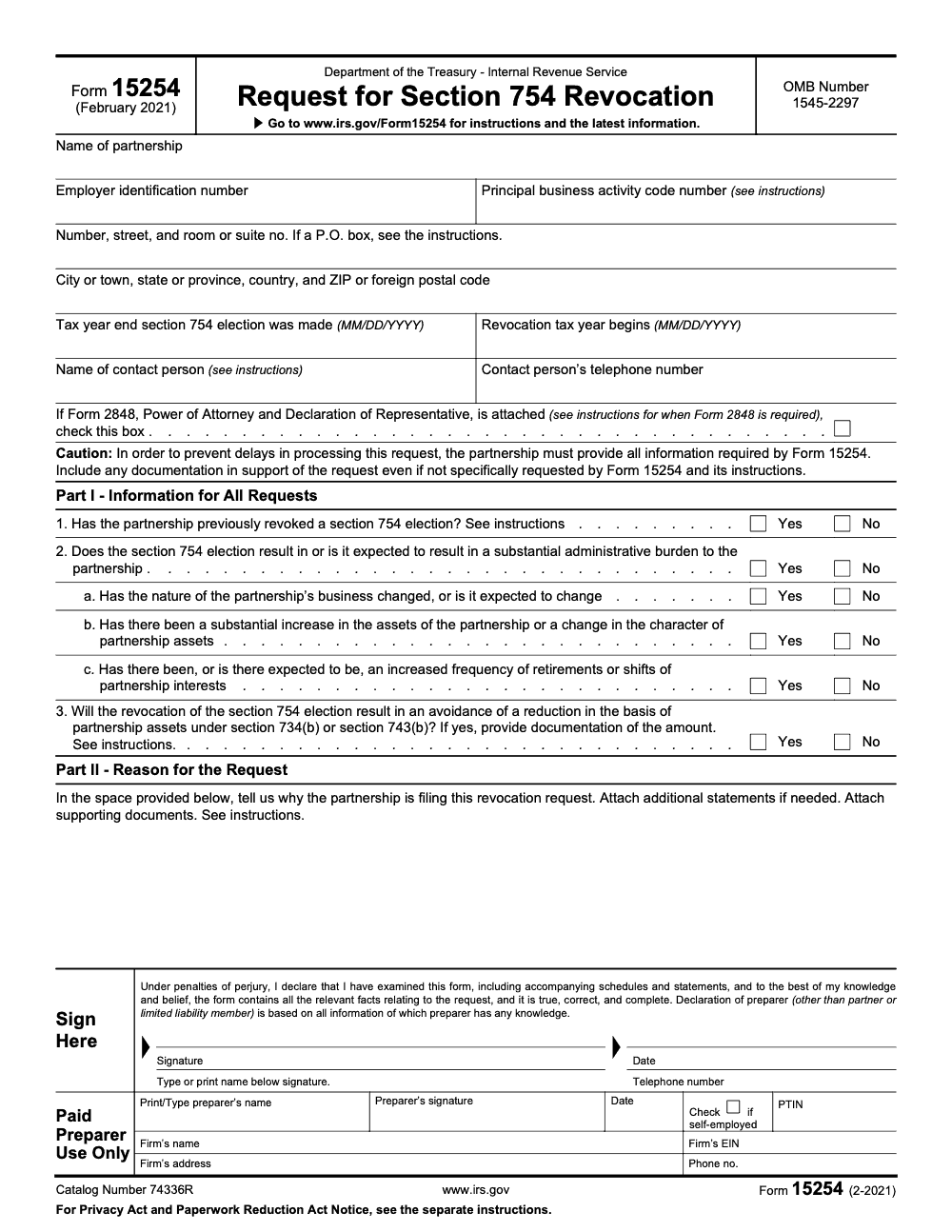
Form 15254, Request for Section 754 Revocation, standardizes how you present a revocation case to the IRS. The form and instructions live on the IRS website with OMB Control No. 1545‑2297. It asks for identifying details, two tax years, and a structured narrative of why the election no longer makes sense for your partnership.
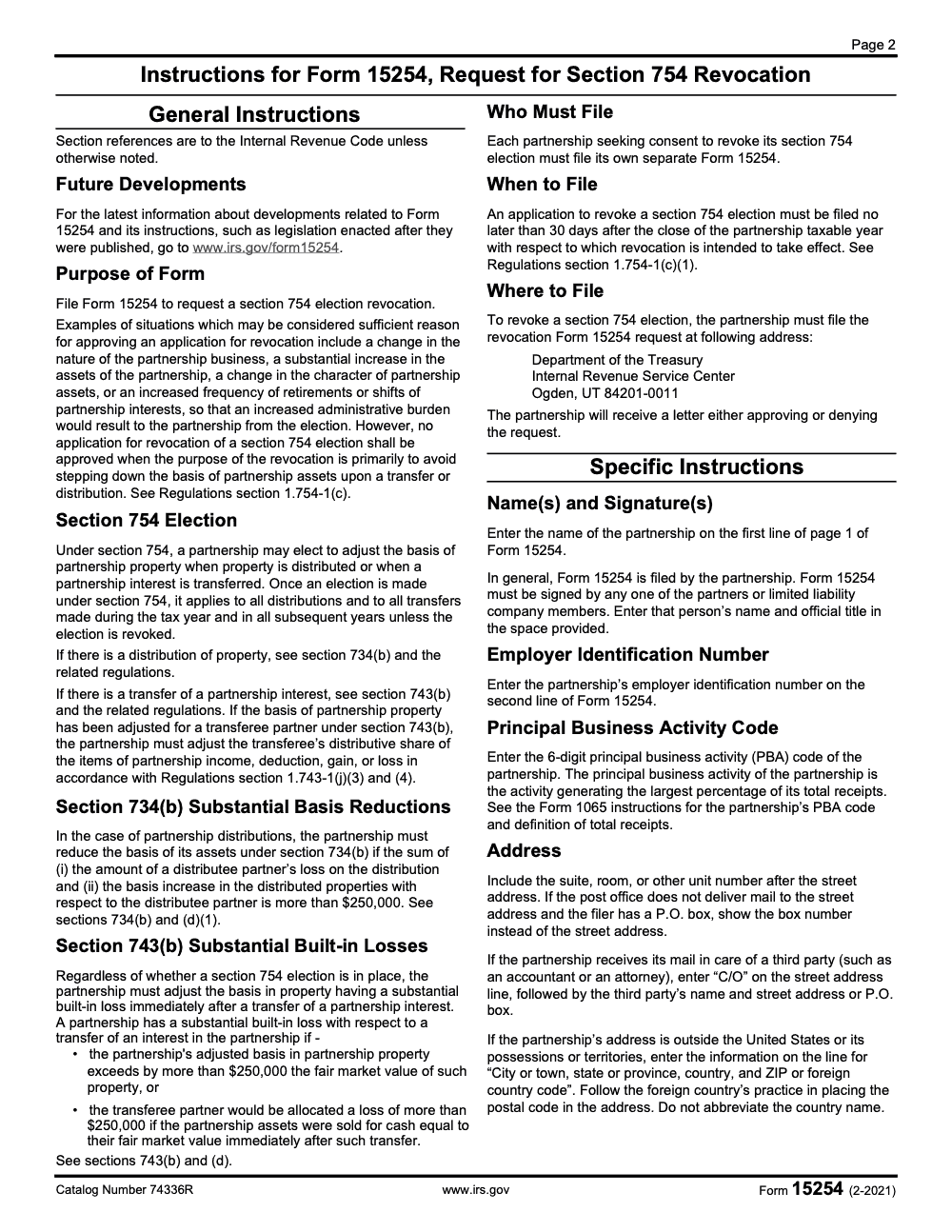
The governing rule has not changed. Under Treasury Regulation §1.754‑1(c)(1), a partnership may revoke a Section 754 election only with IRS consent, and it must submit the request no later than 30 days after the close of the year for which the revocation is intended to be effective. The regulation also lists examples of “sufficient reason,” which the IRS still uses as touchstones.
After the Tax Cuts and Jobs Act repealed technical terminations, partnerships could no longer “reset” elections by creating a deemed new partnership year. That shifted practical weight to formal revocation requests, which the IRS now channels through Form 15254.
Timing, Authority, And Where To File In 2025
- Authority. The regulation refers to filing with the “district director,” which is an older term in the text of the regulation. In practice, the IRS instructions now route your request through a service center review. Consent is still required, and it will arrive by letter.
- Deadline. File the request within 30 days after the close of the partnership taxable year for which revocation should apply. Miss that window and you are generally waiting another year.
- Where to file. Mail your Form 15254 package to:
- Internal Revenue Service Center, Ogden, UT 84201‑0011. The IRS’s own instructions confirm the address and the promise of a response letter.
For clarity, the IRS page “About Form 15254” links the current revision and confirms the purpose of the form. That page’s “Last Reviewed or Updated” date is September 29, 2025, which is current for our December 17, 2025 review.
When The IRS May Approve A Revocation
You need facts that rise above preference. The regulation’s examples remain the best guideposts. Your narrative should match at least one of these and prove it:
- A change in the nature of the business.
- A substantial increase in partnership assets.
- A change in the character of partnership assets.
- An increased frequency of retirements or shifts of partnership interests that creates meaningful administrative burden.
In practice, I have seen approvals when the team showed year‑over‑year growth in deal count and asset lines, a spike in partner buy‑ins and redemptions, and actual hours spent on basis computations and tracking. The IRS wants documented burden, not generic statements. Include the original 754 election, recent Schedules K‑1, and sample §734(b)/§743(b) schedules that demonstrate the recurring workload. The Form 15254 instructions encourage you to include all supporting documentation, even if not explicitly listed.
When The IRS May Deny A Revocation
The fastest way to a denial is a late filing. If you submit after the 30‑day window, the regulation points you away from relief, and in typical cases the IRS will deny. A second hard stop is intent. If the primary purpose is to avoid stepping down the basis of partnership assets on a transfer or distribution, the regulation instructs that consent should not be granted. Unsupported claims with no exhibits also fail. Build your file like you expect a reviewer to ask “where is that in writing?”
The IRS’s internal manual echoes these standards and even paraphrases the regulatory examples of sufficient reason. Treat the IRM as a window into how exam and processing staff think about these requests, then shape your attachments accordingly.
What The Form Actually Asks For
Form 15254 is four pages, but the core is brief.
- Part I, checkboxes. You disclose any prior revocation, whether the election creates or is expected to create substantial administrative burden, and whether revocation would avoid a basis step‑down under §734(b) or §743(b).
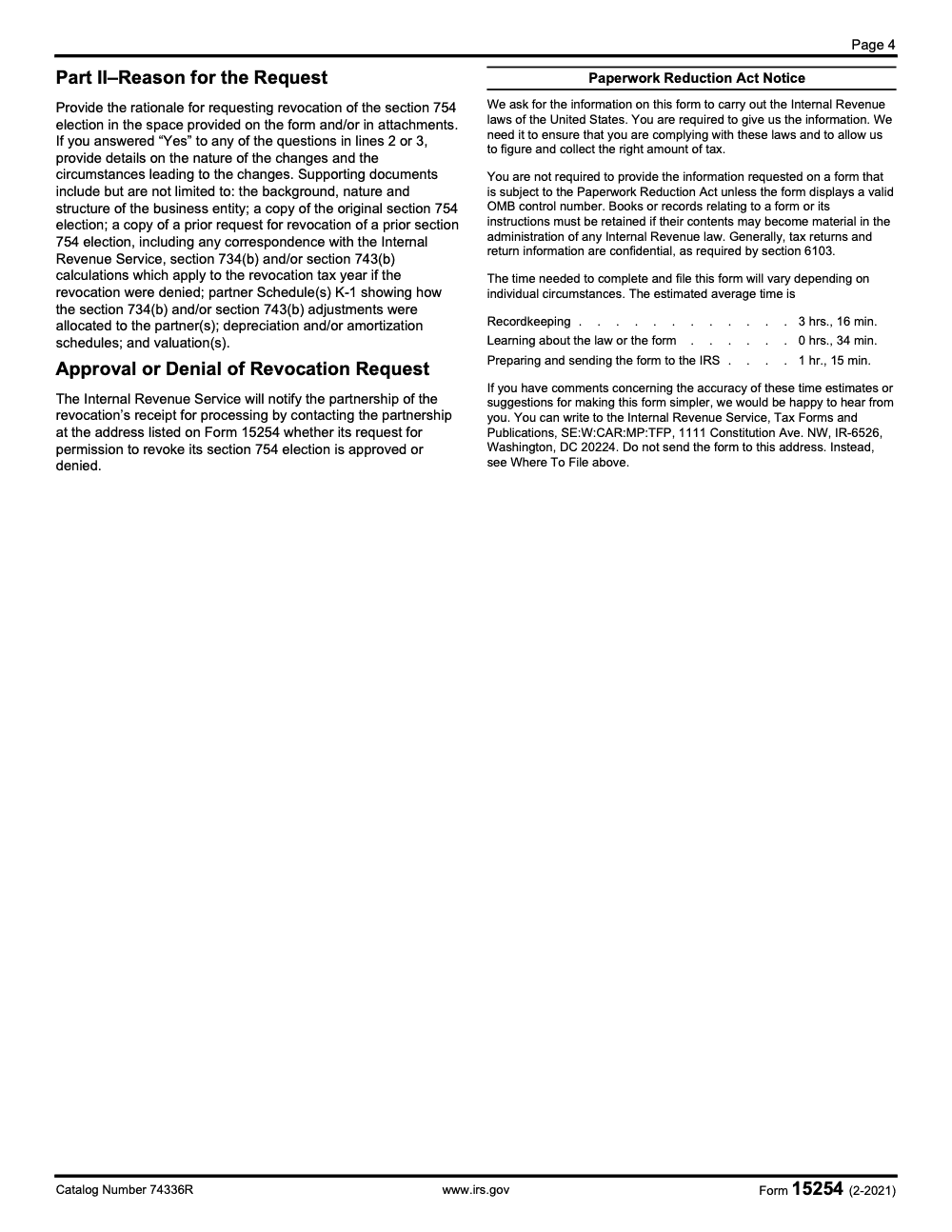
- Part II, your reason. This is your narrative. Explain the facts, the timing, and why continued application of §754 is now inefficient for your partnership. Attach proof.
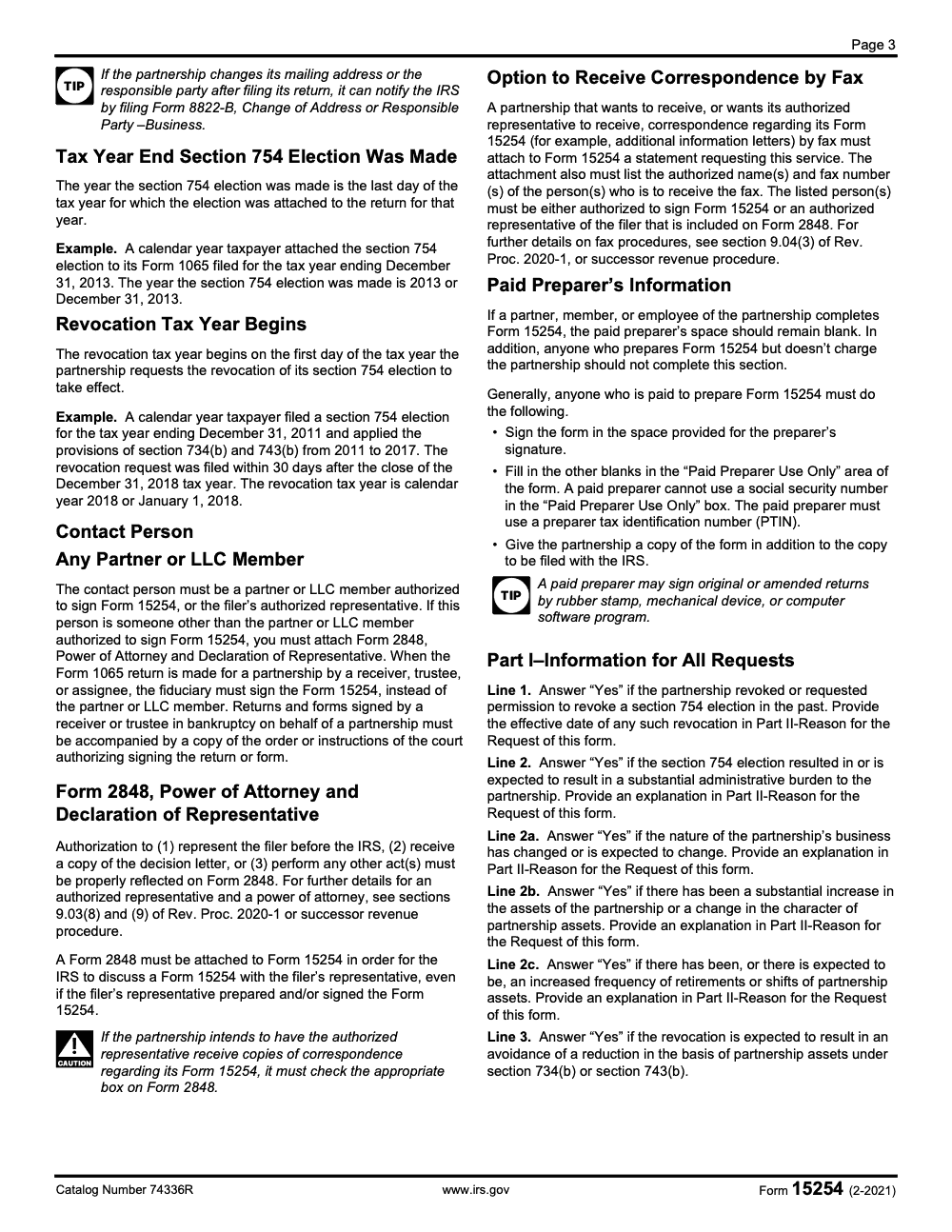
- Signature. One partner or LLC member signs under penalties of perjury. If a representative signs or discusses the case, attach Form 2848.
Quick Table, The Essentials
| Item | What to do | Source |
| When to file | Within 30 days after the close of the tax year you want the revocation to take effect | |
| Where to file | IRS Service Center, Ogden, UT 84201‑0011 | |
| Who signs | Any one partner or LLC member, or a representative with a valid Form 2848 | |
| Who decides | IRS consent required, decision by letter | |
| OMB number | 1545‑2297 |
Attachments That Strengthen Your File
Your exhibits carry the weight. The instructions say to include all required information and any documentation that supports the request. In my experience, a clean package includes:
- A copy of the original signed 754 election that was attached to Form 1065 in the year it was made.
- Recent partnership returns and Schedules K‑1 that show ownership changes or growth.
- Examples of §734(b)/§743(b) computations from recent transactions, with a one‑page summary of hours, systems, and reviewer time spent each year on these tasks.
- A short business description that shows how your activity or assets changed, with dates and drivers.
- Transaction support, for example, buy‑sell agreements, capital events, or distribution statements that triggered repeated adjustments.
Aim for a 5 to 10 page core file, plus schedules in an appendix. Think “reviewer friendly.”
Filing Process, POA, And Communication
- Signer. A partner or LLC member signs. If a representative will discuss or receive letters, attach Form 2848 and check the correspondence box on the POA so copies are sent to them (Form 2848 is required for the IRS to discuss Form 15254 with a representative even if that same representative prepared or signed the form). The instructions point to Rev. Proc. 2020‑1 for POA mechanics.
- Address and response. Mail to Ogden, UT 84201‑0011. The IRS will issue an approval or denial letter. Keep proof of mailing and a full copy of your package.
- Content. The form warns that missing information can delay processing. Include supporting documents, even if not specifically requested.
Built‑In Loss And Mandatory Adjustments
Remember the $250,000 triggers. Some basis adjustments are mandatory even without a 754 election, for example substantial built‑in loss under §743(d) or substantial basis reduction under §734(d). Your narrative should acknowledge these rules, especially if they already mitigate the outcomes you are citing as burdens.
If the mandatory rules already create the same adjustments you dislike, the case for revocation weakens. Address that head‑on with facts.
Planning Tips Before You File
- Model next year’s ownership changes and deal pipeline. If transfers or distributions will slow, the administrative argument may be weaker. If activity is rising, quantify it.
- Compare compliance hours with and without §754. Use concrete numbers across at least two years. Review time counts.
- Track basis schedules in a standard format, then sample them in your exhibits. The IRS wants to see how the burden shows up in your workflow, not just that it exists.
- Calendar the 30‑day deadline as soon as the tax year closes. For a December 31 year, that means planning in December and finalizing the package in the first two weeks of January.
Example Narrative You Can Adapt
The partnership made a Section 754 election for the year ended December 31, 2015. Since 2022, the partnership’s assets have shifted from long‑held real property to active short‑term investments across multiple entities. Ownership transfers increased from two per year to nine per year, with three retirements and six partial redemptions in 2024. The number of §743(b) adjustments rose accordingly, creating higher preparation and review time. Attached schedules show twelve adjustments in 2024 and project sixteen for 2025. The administrative burden now outweighs the benefit. We request consent to revoke effective for the tax year beginning January 1, 2025. See attached original election, sample computations, partner schedules, and transaction documents.
Keep it factual. Add dates, counts, and exhibits. Avoid motives that sound like tax outcome shopping, especially around avoiding a step‑down.
Step‑By‑Step Checklist
- Confirm your year just ended and compute the 30‑day deadline.
- Pull the original signed 754 election from the year it was made.
- Draft your Part II narrative with dates and facts.
- Build exhibits, including recent K‑1s, §734(b)/§743(b) samples, and transaction proof.
- Complete Part I checkboxes carefully.
- Decide the signer. If a representative will speak with the IRS, prepare Form 2848.
- Print, sign, and date Form 15254.
- Assemble a clean PDF set for your files and a paper package for mailing.
- Mail to Ogden, UT 84201‑0011 with tracking.
- Watch for the approval or denial letter and store it with your 1065 records.
Common Pitfalls To Avoid
- Filing after day 30. No, “close enough” does not work here.
- Thin narratives that simply say “burdensome.” Show the burden with counts, dollars, or hours.
- Leaving out the original election or sample computations.
- Forgetting Form 2848 when a representative needs to receive or discuss correspondence.
- Mailing to the wrong address or without tracking.
- Ignoring mandatory adjustment rules under §734(d) and §743(d) when they cut against your argument.
How Accountably Fits, When It Actually Helps
You should not be buried in production the week a 30‑day window starts. If your firm is short on reviewer hours or documentation discipline, that clock feels impossible. This is where a controlled offshore delivery layer can help, not as a staffing patch, but as a documented process that produces clean exhibits fast. For example, standardized workpapers, consistent naming, and a two‑layer review make your §734(b)/§743(b) schedules easier to trust and faster to sign. If you already use tools like UltraTax, CCH Axcess, ProConnect, Lacerte, or Thomson Reuters, trained offshore teams can work inside your systems and templates under SLAs, with clear checklists and visibility, so partners spend time on the narrative, not the hunt for files. That is the only reason to mention us here, because tight deadlines reward disciplined delivery.
If you need production help, look for process, not resumes. You want structure, standardized files, and a review ladder that protects partner time.
Final Filing Checklist
- Confirm the year‑end and compute the 30‑day deadline.
- Complete Form 15254, Parts I and II.
- Attach the original 754 election, recent K‑1s, and sample §734(b)/§743(b) schedules.
- Include transaction documents that prove ownership changes or asset shifts.
- If a representative will speak with the IRS, attach Form 2848 and select correspondence preferences.
- Sign as a partner or LLC member. Date the form.
- Mail to Internal Revenue Service Center, Ogden, UT 84201‑0011, with tracking.
- Save a complete copy and your mailing proof.
- Monitor mail for the decision letter.
Key Definitions And Numbers
- Section 754 election, an election that allows your partnership to adjust the basis of partnership property for distributions and transfers. The election itself is made by a written statement attached to a timely‑filed Form 1065 (Form 15254 only revokes it, not makes it), and once made, it continues unless revoked with IRS approval.
- Substantial basis reduction, for distributions, when the required basis decrease exceeds $250,000.
- Substantial built‑in loss, for transfers, when the partnership’s aggregate basis exceeds fair market value by more than $250,000, or the transferee would be allocated a loss of more than $250,000 upon a deemed sale.
Common Mistakes We See Every Season
Almost every denial or processing delay we see on Form 15254 traces back to a small handful of recurring errors. Catch them at intake and your package usually clears review without a follow-up letter.
Reusable Checklists
The checklists below are copy-paste ready for firm SOPs. Drop them into your tax workflow tool, an engagement template, or a shared partnership compliance file – each item is a step a preparer or reviewer can act on without a separate brief.
Pre-File Packet
- Confirm a Section 754 election is on file. Pull the original signed election statement from the Form 1065 in the year of election.
- Compute the 30-day deadline from the close of the revocation tax year, per Regulations section 1.754-1(c)(1).
- Verify partnership EIN, current mailing address, and the 6-digit principal business activity code from the Form 1065 instructions.
- Identify any prior revocation request and IRS correspondence so Part I Line 1 can be answered with dates.
- Pull the last three years of Schedules K-1 showing ownership changes and 743(b) allocations.
- Pull recent depreciation and amortization schedules tied to the partnership assets.
- Confirm the signer is a partner, LLC member, or authorized fiduciary with documented authority.
Administrative Burden Narrative
- Document any change in the nature of the partnership business with dates and supporting transactions.
- Quantify any substantial increase in partnership assets year over year in dollars, not adjectives.
- Note any change in the character of partnership assets (for example, real property to securities, operating to investment holdings).
- Count partner retirements, redemptions, and transfers for the last three years and project the next year.
- Run the 734(b) and 743(b) calculations for the revocation tax year to confirm Line 3 can be answered without an anti-avoidance flag.
- Acknowledge mandatory 734(d) and 743(d) adjustments above the $250,000 thresholds and explain why burden remains substantial.
- Estimate preparation and reviewer hours spent on 734(b) and 743(b) work per year, with cited source workpapers.
- Attach sample 734(b) and 743(b) computations from recent transactions so the narrative is grounded in documents, not assertions.
POA and Ogden Mail-Out
- Prepare Form 2848 if any non-partner representative will discuss or receive correspondence on the case.
- Check the correspondence box on Form 2848 so the representative receives IRS letters.
- Check the corresponding Form 2848 box on Form 15254 itself.
- Sign and date Form 15254 under penalties of perjury (any one partner or LLC member can sign).
- Assemble the four-page form, Part II narrative, and all supporting attachments (original election, K-1s, 734(b) and 743(b) samples, transaction documents).
- Mail to Internal Revenue Service Center, Ogden, UT 84201-0011, with tracking.
- Save a complete PDF copy of the package and the mailing receipt in the partnership's permanent file.
- Calendar a 90-day follow-up to monitor for the IRS approval or denial letter, then file the letter with the partnership's 1065 records.
Keep 15254 Season From Stalling
Form 15254 work hits at a different rhythm than quarterly compliance. The 30-day window opens the day the partnership tax year closes, and the IRS will not entertain late requests for that same revocation year, per Regulations section 1.754-1(c)(1). For practitioners supporting multi-partner LLCs and family partnerships, that timing collides with year-end close and K-1 production – the same staff are wanted in three places at once.
What slows the package is not the form itself – Part I has three questions and Part II is narrative. What slows it is the supporting file: the original 754 election attached to a Form 1065 from years ago, prior revocation correspondence, 743(b) and 734(b) calculations tied to specific transfers and distributions, partner K-1 schedules showing prior allocations, and depreciation rolls that reconcile to the asset history. If any of that surfaces late, the 30-day window closes before the IRS even reviews the rationale.
- Pull the original 754 election from your 1065 archive on day 1. Part II references the date the election was made, and the IRS expects a copy attached. If the election predates your engagement, request prior-year 1065 statements before drafting begins.
- Run 734(b) and 743(b) calculations BEFORE answering Line 3. Line 3 asks whether revocation would result in avoiding a basis reduction. If the calculations show a step-down was coming, the IRS will deny on anti-avoidance grounds, and you need to either restructure the rationale or withdraw the request.
- Get Form 2848 signed at the same time as Form 15254. The IRS will not discuss the request with a preparer or representative without a separate Power of Attorney on file, even when that person prepared and signed the form itself. Late POA filings stall the case mid-review.
- Document the administrative burden in numbers, not adjectives. Cite hours spent tracking 743(b) adjustments per transfer, partner turnover frequency, and changes in the character of partnership assets. Burden without quantification reads as a tax-avoidance pretext to IRS reviewers.
- Keep the Ogden filing address separate from the Washington comments address. Form 15254 itself goes only to Ogden, UT 84201-0011. Comments on the form go to a separate IRS Tax Forms and Publications address in Washington, DC – mixing them delays processing.
Partnership revocation work rewards practitioners who treat the 30-day window as a documentation project, not a form. Accountably's tax delivery teams handle the supporting workpaper build – prior-year election retrieval, 734(b) and 743(b) calculation packages, POA preparation, and Ogden mailing logistics – so senior review time stays on the rationale narrative and the IRS response queue.
FAQs
At this time, the IRS instructions provide a mailing address, not an e‑file channel. Send your request to Ogden, UT 84201‑0011 and keep proof of mailing. Always check the IRS “About Form 15254” page for updates before you file.
Consent is required under the regulations. Operationally, you file at the IRS Service Center, and the IRS issues an approval or denial letter after review. The regulation’s consent requirement controls, and the instructions tell you where to send the request.
Timelines vary. The IRS does not post a fixed processing time for Form 15254. Build your package so it can be understood without calls or follow‑ups, which can shorten the back‑and‑forth once it is in the queue. Check the IRS page for any posted updates.
If §734(d) or §743(d) triggers mandatory adjustments, the case for relief is weaker. Acknowledge those mechanics in your narrative and explain why the ongoing administrative burden is still substantial.
Other forms this guide names
About this guide
Accountably helps US CPA, EA, and accounting firms hire trained accountants and tax preparers in India.
About us Reviewed byJugal Thacker, CPAFounder and CEO at Accountably
A Washington-licensed CPA with 7+ years inside US firms – PwC, a real-estate tax practice, then a full-service firm, rising from reviewer to manager to advisory. This article was reviewed against current IRS guidance for the 2025 tax year and updated for filers preparing late returns, amendments, and 2026 estimates.
View profile →How we research, review, and update this guide
Every Accountably guide is researched against primary IRS sources, reviewed by a U.S. CPA, and refreshed as guidance evolves. Read our Editorial Guidelines to see how we source, fact-check, and update our content.