Summarize this article with AI
In Brief
Form 2678 is the IRS form to appoint or revoke a §3504 employment tax agent for the seven covered employment tax returns – Form 941, 943, 944, 945, CT-1, CT-2, plus Form 940 for home care service recipients only – per Form 2678, Rev. December 2024 (OMB 1545-0029). The agent has no authority until the IRS issues an approval letter; an agent filing an aggregate Form 941 uses its own EIN and must attach Schedule R to allocate wages and taxes to each employer represented (per IRS Publication 15-A, Section 7).
A payroll service starts running a client's deposits, files the first quarterly return under its own name, and assumes the agent relationship is live, but the IRS recognizes the appointment only after it mails an approval letter, and that letter sets the effective date. File and act before it arrives and you are unwinding deposits that were never authorized.
Form 2678 appoints or revokes a section 3504 employment tax agent for returns like Form 941, 943, 944, and 945, with Form 940 reserved for home care service recipients. Processing generally takes about 30 days from receipt, so the timing of when you submit it matters as much as how you fill it out.
Key Takeaways
- Form 2678 is how you appoint or revoke an IRC section 3504 agent for specific employment tax filings and deposits. The IRS recognizes that authority only after it issues an approval letter that shows the effective date and scope.
- As of November 22, 2025, the current form revision is Rev. 12/2024. Do not use older versions. The PDF itself shows “Rev. December 2024” and OMB No. 1545‑0029.
- Processing generally takes about 30 days from IRS receipt. No agent authority exists before approval. The revocation letter controls the end date.
- Most agents use aggregate filing. When an approved 3504 agent files an aggregate Form 941, they use their EIN and must attach Schedule R. Aggregate FUTA on Form 940 with Schedule R is limited, mainly for approved home care service recipient arrangements (where the recipient receives home care services through a program administered by a federal, state, or local government agency).
- Employers and agents share liability while the appointment is in effect. Section 3504 makes that explicit, so build controls and proof of deposits, even if a third party helps the agent.
What Form 2678 Actually Does, And When It Starts
Form 2678 sits on a specific legal foundation. Section 3504 of the Internal Revenue Code and the related regulation allow the IRS to authorize an agent to perform an employer’s employment tax acts. That includes withholding, reporting, and paying FICA, RRTA, and income tax withholding, and, in limited circumstances, FUTA for home care service recipients. The employer remains on the hook along with the agent, which is why internal controls matter.
The form does two things. First, it lets you request approval to appoint an agent for specified returns and deposits. Second, it lets you revoke a past appointment. The IRS will send an approval letter after it accepts the request, and authority starts on the exact date in that letter. If you revoke, the IRS sends a revocation letter, and that date controls when authority ends. Do not act early or assume backdating.
As of today, the current form is the 12/2024 revision. You can confirm that on the IRS page for Form 2678 and on the face of the PDF. Older versions are obsolete and the IRS says not to use them. The live instructions page was last reviewed in December 2024 and continues to control process steps in 2025.
Why This Matters To Your Delivery Team
If you run a CPA or EA firm, growth often stalls on delivery, not demand. Payroll and employment tax handoffs create review loops and deadline risks when roles are fuzzy. Form 2678 helps by clarifying who files, who deposits, and which EIN goes on what. That clarity only holds if you set the scope precisely, calendar the approval date, and use Schedule R correctly on any aggregate filings. In my experience, that is where most rework starts.
- You cut review time when your team can see exactly which returns the agent files and which still sit with you.
- You reduce notices when every aggregate 941 and 940 is paired with the right Schedule R and EIN allocations.
- You protect client trust when you refuse to file as an agent before the letter is in hand, even if the quarter is closing.
Quick Glossary You Can Share With Your Staff
- Section 3504 agent, an IRS‑approved agent that performs employer employment tax acts. Joint liability applies.
- Aggregate filing, a single return filed by an approved agent for multiple clients under the agent’s EIN. Requires Schedule R.
- Schedule R, the allocation schedule that maps aggregate wages, deposits, and liabilities to each client’s EIN on Forms 941 and 940.
- Approval letter, the IRS letter that starts the appointment on its printed date.
- Revocation letter, the IRS letter that ends the appointment on its printed date.
How To Complete Form 2678 The Right Way
Here is the fast, practical path my team follows when we prepare or review a 2678 package. It aligns with the current IRS instructions and avoids the common pitfalls that trigger delays.
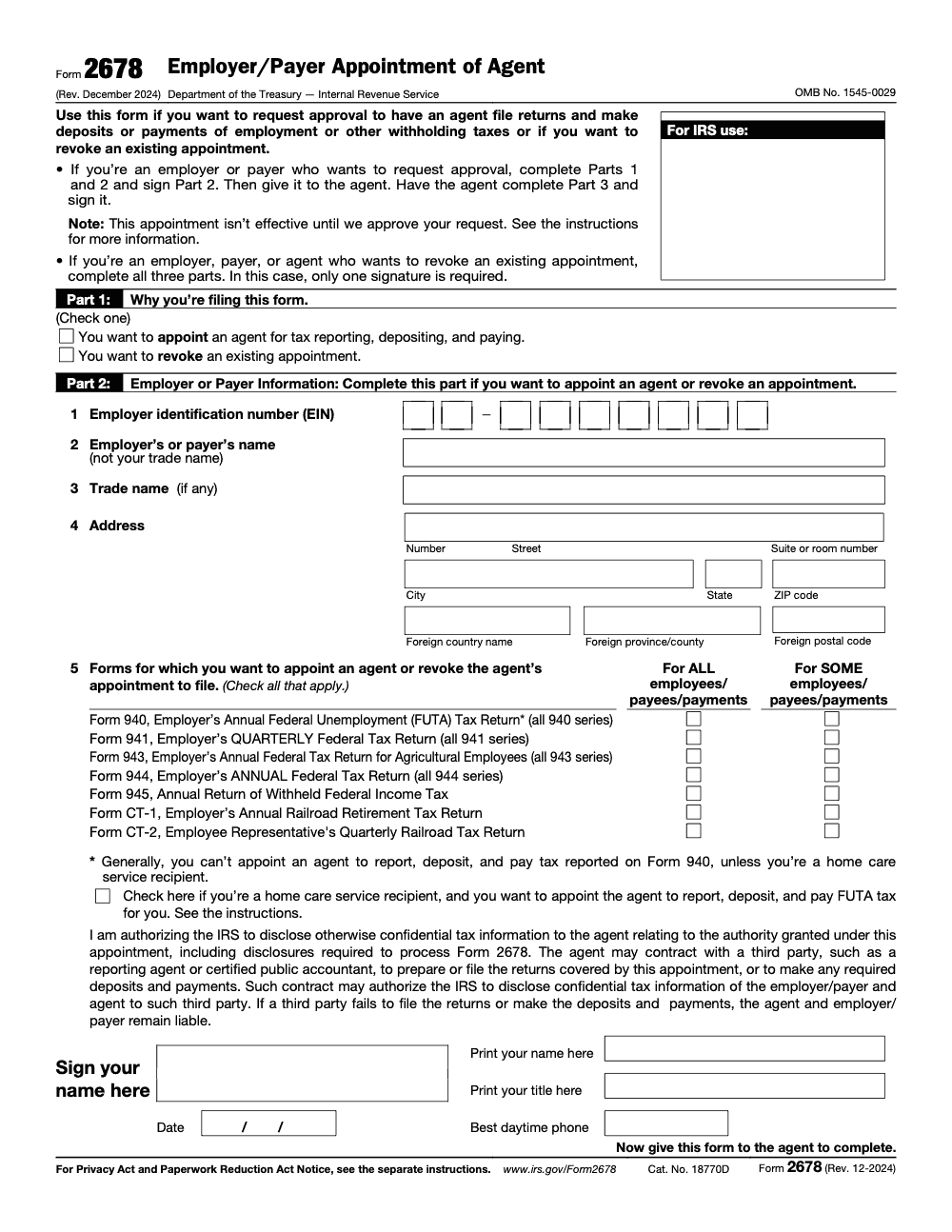
Part 1, Why You’re Filing
- Choose one box, appoint or revoke.
- Plan for timing. Authority begins only when the IRS issues the approval letter. If you are revoking, one signature is enough, and the revocation takes effect on the date of the IRS letter.
Tip, build your payroll calendar around the letter, not the mailing date. If quarter end is tight, keep filings under the employer EIN until the green light arrives.
Part 2, Employer or Payer Information
- Match the employer’s legal name and EIN to IRS records, and include the full mailing address.
- On line 5, check only the forms and tax types you want the agent to handle. If you leave boxes unchecked, they stay with the employer.
- If the authority is limited to some employees or payments, select the “SOME” column and keep a clean attachment describing the limits.
- Sign and date Part 2, then send the form to the agent for Part 3.
Important home care note, if you are a home care service recipient receiving home care services through a program administered by a federal, state, or local government agency, and you want an agent to handle FUTA, you must also appoint the agent for FICA and income tax withholding. The IRS will reject combinations that do not meet that rule.
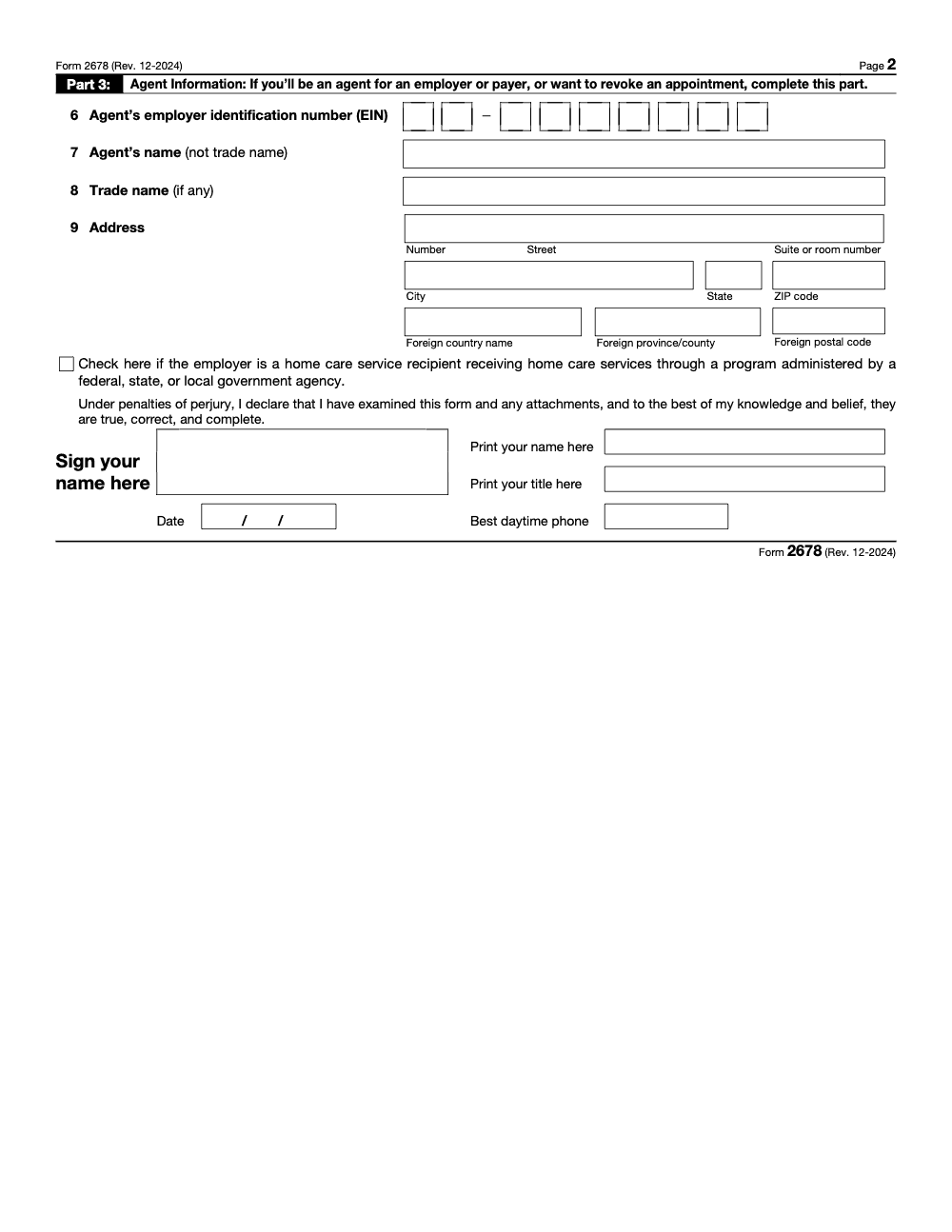
Part 3, Agent Information
- Enter the agent’s legal name, EIN, and address exactly as they appear on tax records. If a corporate officer, partner, or tax matters partner signs, they must have authority to bind the agent.
- Check the boxes for the forms the agent will file. If this will involve aggregate filing, be ready to attach Schedule R to each aggregate 941, and, where allowed, to aggregate 940 filings for home care arrangements.
- The agent signs and dates to accept the appointment. If the filing is only a revocation, the agent’s signature is not required.
One‑Page Table You Can Use During Prep
| Item | Who completes | What to verify | Why it matters |
| Part 1 box | Employer or agent | Appoint vs revoke | Drives processing and letter type |
| Employer legal name and EIN | Employer | Exact IRS match | Prevents TIN‑name control delays |
| Scope boxes in line 5 | Employer | Only what the agent will handle | Unchecked items remain with employer |
| Agent legal name and EIN | Agent | Exact IRS match | Avoids approval delays |
| Signature blocks | Employer and agent | Authority and dates | Acceptance is required for appointments |
| Version control | Preparer | Rev. 12/2024 form | Older forms are obsolete |
Sources for the above steps, IRS instructions, the live PDF, and Schedule R rules for aggregate filing.
Effective Dates, Approvals, And Revocations
Think in dates, not assumptions.
- Approval letter date, the start of the agent’s IRS‑recognized authority. The IRS says authorization is effective on the date shown in the letter. Generally, processing takes about 30 days from receipt. Until approval, the agent has no liability to file or deposit.
- Revocation letter date, the end of the agent’s authority. One signature is enough to revoke. After the revocation date, the IRS restricts disclosure for later periods.
Calendar these letters, align deposit schedules, and assign ownership for any quarters that straddle approval or revocation. If a client pays executive bonuses directly while the agent runs payroll for staff, those employer‑paid wages must still be reported under the employer’s EIN. The IRS includes examples like this in its instructions to make the split clear.
Legal Grounding And Shared Liability, What To Know
The joint responsibility theme runs through section 3504 and the IRS guidance. All provisions that apply to the employer also apply to the approved agent. That means penalties, deposits, filings, and the duty to keep records. In practice, you should demand bank proof of deposits, reconcile liabilities to EFTPS, and hold the agent to your close checklist every quarter.
For background and special procedures, keep Revenue Procedure 2013‑39 handy. It outlines how a person becomes a section 3504 agent for employment taxes and includes the narrow conditions that allow an agent to handle FUTA for home care service recipients.
Schedule R, Aggregate Filings, And Keeping EINs Straight
If you are an approved section 3504 agent and you file an aggregate Form 941, you must attach Schedule R every quarter. Schedule R allocates wages, deposits, and liabilities to each client’s EIN. Missing or mismatched allocations are a top cause of notices. Treat this as part of your month‑end close, not an afterthought at quarter end.
For aggregate Form 940, the rule is tighter. Aggregate 940 filing is generally not allowed, except for approved home care service recipient arrangements (limited to recipients receiving home care services through a federal, state, or local government program) and for CPEOs. If you are in one of those allowed categories, attach Schedule R to your aggregate 940 as well.
Practical Steps That Keep You Out Of Notice Hell
- Reconcile every Schedule R total to the face of the aggregate return before you e‑file or mail.
- Tie EFTPS deposits to EIN‑level liabilities shown on Schedule R.
- Keep audit‑ready workpapers that show how payroll reports roll forward to Form 941 and 940 by EIN.
- If both the employer and the 3504 agent paid wages to the same person in a quarter, each files Form 941 for the wages it paid and each issues a W‑2 for the wages it paid. The 3504 agent uses its EIN on its filings and W‑2s.
Quick Reference, What Requires Schedule R
| Filing situation | Schedule R required | Notes |
| Section 3504 agent filing aggregate 941 | Yes | Must file Schedule R each quarter |
| CPEO filing aggregate 941 | Yes | Must file electronically in most cases |
| Non‑certified PEO, client claims research credit | Yes | Include client‑by‑client amounts |
| Section 3504 agent filing aggregate 940 | Sometimes | Mainly home care service recipient arrangements |
| Employer filing its own 941, no aggregate | No | Report under employer EIN |
Source rules appear in the instructions for Form 941 and 940, and the IRS Schedule R overview.
Special Rules For Home Care Service Recipient Agents
If you support a home care service recipient receiving home care services through a program administered by a federal, state, or local government agency, the IRS sets a few unique conditions. The agent can be approved for FUTA only if the appointment also covers FICA and income tax withholding. Approval letters for these appointments are sent to the agent, not to the care recipient. Use the current 12/2024 form and follow the same Where To File guidance.
In my reviews, the most common miss here is checking FUTA without checking FICA and ITW. The IRS rejects the package, and the whole plan slips a month. Avoid that with a simple pre‑submission check.
Where To File And Timing
File Form 2678 at the address shown in the instructions for the employer’s location. The IRS will send letters after it approves or revokes the appointment. Plan on about 30 days from receipt to approval. Do not delegate filings or deposits to the agent before the letter arrives. For revocations, the letter date is the termination point for the agent’s authority and for IRS disclosures for later periods.
If you need a quick confidence check on your broader employment tax process, the current instructions for Forms 941 and 940 include up‑to‑date filing and deposit notes for 2025. Keep those open while you finalize quarter end.
Compliance, Privacy, And Recordkeeping
Section 6109 requires accurate taxpayer identification numbers. Mismatched EIN and name control data is a common cause of processing delays. Section 6103 protects returns and return information, with specific exceptions for disclosures to the Department of Justice, states, treaty partners, and certain federal agencies. Keep that in mind when you write procedures and vendor contracts.
On paperwork burden and OMB numbers, the current Form 2678 shows OMB No. 1545‑0029 on its face. That OMB number also appears in the instructions’ Paperwork Reduction Act notice. If you see references to other OMB numbers from old drafts, update your templates.
Controls That Stand Up In Review
- Proof of deposits, require bank confirmations tied to the EFTPS trace, not only payroll reports.
- Workpaper standard, maintain a standing binder that maps each client’s payroll registers to Form 941 line items and to Schedule R columns.
- EIN discipline, lock name control and EIN into your templates to prevent keystroke errors.
- Scope tracker, keep a simple index of which boxes were checked on each client’s 2678 and the letter dates, then build your closing checklist around that index.
Common Mistakes That Trigger Notices
The following checklists are copy-paste ready for your firm's SOP library. Each item is specific to the §3504 agent lifecycle, so a preparer can run the steps straight from the page.
Pre-Submission Packet (Form 2678 Rev. 12/2024)
- Confirm the form revision date in the upper right reads Rev. December 2024 (OMB 1545-0029, Cat. 18770D).
- Part 1: tick the correct filing-reason box, appoint or revoke. Only one of two.
- Part 2 line 1: employer EIN matches IRS records currently on file.
- Part 2 lines 2 to 4: legal name (not trade name) on line 2, trade name on line 3, full address on line 4.
- Part 2 line 5: tick ALL or SOME for each of Forms 940, 941, 943, 944, 945, CT-1, CT-2 the agent will handle.
- For Form 940: confirm the employer is a home care service recipient under a federal, state, or local government program before checking that line.
- Part 3 lines 6 to 9: agent's own EIN, legal name, trade name, address.
- Two signatures present for a new appointment (employer in Part 2, agent in Part 3); one signature for a revocation.
- Address of record matches the employer's own address; file Form 8822-B if an update is needed before sending Form 2678.
- Calendar the 30-day approval window per the IRS About Form 2678 page; do not file or deposit as the agent before the approval letter date.
Aggregate Form 941 with Schedule R
- Approved Form 2678 on file for every employer that will appear on the Schedule R allocation lines.
- Agent's own EIN at the top of the aggregate Form 941, not any client EIN (per IRS Publication 15-A, Section 7).
- Schedule R (Form 941) attached, with each client EIN and its wage, tax, and credit allocations matched to the parent Form 941 line items.
- Column totals on Schedule R reconcile to the aggregate Form 941 totals to the dollar.
- Filing covers only the employers and the ALL or SOME scope set on the original Form 2678 line 5 elections.
- Deposits for the quarter made under the agent's EIN through EFTPS; client Inquiry PINs activated so each employer can monitor its own account.
- If aggregate Form 940 is also being filed, confirm every listed employer is a qualified home care service recipient and Schedule R (Form 940) is attached.
Revocation and Handoff
- Confirm which party is initiating the revocation, employer, payer, or agent; only one signature is required.
- Complete all three parts of Form 2678 with current information, then the initiating party signs the relevant block.
- Note the last quarter the agent is filing under its own EIN so the next preparer knows where the handoff starts.
- Update EFTPS enrollments so future deposits route under the employer's EIN, not the outgoing agent's.
- Confirm IRS address of record via Form 8822-B if the outgoing agent's address was on file.
- Retain a signed copy of the revocation Form 2678 together with the original approval letter in the client file.
A Short, Real‑World Checklist You Can Steal
- Version check, confirm you are using Form 2678 Rev. 12/2024.
- Scope, mark only the boxes you want the agent to handle, and document any “SOME” limits.
- Signatures, employer signs Part 2 for an appointment, the agent signs Part 3 to accept. One signature is enough to revoke.
- Calendar, track the approval letter date and revocation letter date. Build your deposit plan around those dates.
- Aggregate control, attach Schedule R to each aggregate 941, and when allowed on 940. Reconcile totals to the return and EFTPS before filing.
- Records, retain EIN‑level allocation workpapers and bank proof of deposits. Follow section 6103 awareness in your contracts.
Where Accountably Fits
When a firm asks us to help on Form 2678 work, we focus on two things. First, getting the form right so authority starts cleanly on the letter date. Second, building the day‑to‑day discipline that keeps aggregate filings and Schedule R allocations accurate with less partner review. If you want a quick eyes‑on review of your 2678 flow or a seasonal aggregate filing plan, our team can help without changing your systems. We keep it inside your tools and templates, then we document the close so anyone on your team can step in.
Closing Thoughts And Next Steps
Form 2678 is simple on paper, and expensive when rushed. Treat the approval letter like the on switch. Lock down EIN and name control fields. Keep Schedule R as part of your normal close, not a last‑minute add. If you do those three things, you will avoid most notices and you will protect client confidence.
- Download the current Form 2678 and instructions, confirm the 12/2024 revision, and refresh your template.
- Review your client list for who needs an agent appointment in Q1 2026, then backward‑plan 30 days for processing.
- Build a one‑page SOP for Schedule R tie‑outs and EFTPS proof, then test it on your next quarter end.
Light Compliance Note
This article is for informational purposes only. It reflects IRS guidance available as of November 22, 2025, including Form 2678 Rev. 12/2024 and related instructions. Confirm facts against the official IRS pages before you file.
Reusable Checklists
Form 2678 work breaks teams in a quieter way than Form 941 or Form 1040 ever do. The approval gap between filing the form and the IRS issuing an approval letter runs about 30 days per the IRS About Form 2678 page, and during that window the would-be agent has zero authority to file, deposit, or pay on the employer's behalf. IRS Publication 15 Section 16 lists five distinct third-party payer arrangements, and conflating a §3504 agent with a reporting agent (Form 8655) or a payroll service provider is where most cleanup work starts.
The fix is to treat the appointment as a delivery workflow, not a one-off form. Build the packet, the approval-letter calendar, and the EIN switchover into one repeatable lane so the §3504 arrangement stops being a surprise every time a client moves to aggregate filing.
- Lock the Form 2678 Rev. December 2024 version into the template library; the IRS does not accept older revisions.
- Track each line 5 election per client (ALL vs SOME, per form) so the wrong return never gets filed under the agent's EIN by mistake.
- Pair every aggregate Form 941 with Schedule R from the start of preparation, not at review; a missing Schedule R is the single most common notice trigger on aggregate filings (per IRS Publication 15-A, Section 7).
- Hard-stop every Form 940 request that is not a home care service recipient under a federal, state, or local government program; the form rules on that line are strict.
- Calendar the approval-letter ETA at filing date plus 30 days, with a second reminder at day 45 to chase the IRS if no letter has arrived.
- Keep the employer as the IRS address of record via Form 8822-B so notices about the §3504 arrangement reach the employer directly, not the agent.
This is the workflow our tax outsourcing teams run on every §3504 agent engagement. The form itself is a side activity; the delivery system around it is what keeps notices, joint-liability exposure, and EIN errors out of the file.
Keep 2678 Season From Stalling
Form 2678 doesn't live on a normal filing calendar. It's an approval-gated authorization, which means every payroll cycle the agent runs before the IRS approval letter posts is exposure that sits on someone's desk. The form covers seven employment tax returns – Forms 940, 941, 943, 944, 945, CT-1, and CT-2 (per Form 2678, Rev. December 2024, OMB 1545-0029) – and per IRS Publication 15, Section 16, the employer and the §3504 agent are jointly liable for every dollar of tax the agent is authorized to handle. Most delivery breakdowns we see at intake aren't about the form itself. They come from teams treating a §3504 agent like a reporting agent on Form 8655, using the wrong EIN on deposits, and skipping Schedule R on aggregate Form 941 filings.
The fix is a documented intake that respects how the appointment actually works: a two-signature request with a per-form scope, an approval-letter dependency before the agent can act, and aggregate-filing rules that require Schedule R the moment more than one employer rolls up. Once that intake is built, the §3504 quarter runs on the same predictable rhythm as any other engagement.
- Lock the Part 2 / Part 3 signature sequence into the SOP – the employer signs Part 2 first, then routes to the agent for Part 3. A new appointment needs two signatures; a revocation needs only one (employer, payer, or agent).
- Capture the line 5 ALL-vs-SOME scope per form on intake. A 941 appointment for ALL employees and a 944 appointment for SOME are two different checkbox decisions, and the IRS approval letter is scoped to exactly what the employer marked.
- Build Schedule R (Form 941) into the aggregate-filing checklist as a hard gate. No aggregate Form 941 ships without the allocation schedule attached (per IRS Publication 15-A, Section 7); the same rule applies to Schedule R (Form 940) for home care recipients and Schedule R (Form 943) where it applies.
- Track the §3504 agent's own EIN on every deposit, return, and W-2 the agent issues – never the employer's EIN. Reporting agents on Form 8655 use the employer's EIN and carry no agent liability; §3504 agents use their own EIN and share joint liability. Mixing the two is the single most common cleanup we inherit.
- Default-reject any Form 940 inclusion on a 2678 appointment unless the client is a documented home care service recipient receiving services through a federal, state, or local government program. The exception is narrow, the program qualifier is non-negotiable, and the dedicated home care checkbox in Part 3 has to be marked.
That discipline is what we wire into every §3504 agent engagement at Accountably – approval-letter tracking, EIN handling, Schedule R as a non-negotiable filing gate, and a one-signature revocation path documented before the relationship ever starts. See how the same structure shows up in our broader engagement models, from on-demand cleanup to dedicated outsourced teams running the full filing calendar.
FAQs
Form 2678 is the IRS form you use to appoint or revoke an agent under IRC section 3504 to handle defined employment tax filings and deposits. The IRS recognizes the agent only after it issues an approval letter, and that letter sets the effective date and scope.
The IRS says the processing time frame is generally about 30 days from receipt. Authorization is effective on the date shown in the approval letter, not before. Build your quarter around that date.
Yes for aggregate filings. An approved 3504 agent uses its own EIN on aggregate 941 filings, and must attach Schedule R to allocate amounts to each client EIN. Aggregate 940 filings are limited and require Schedule R when allowed.
They describe the same relationship. “Form 2678” is the appointment mechanism, and “section 3504 agent” is the authority under the Code and regulations.
Other forms this guide names
- Form 941: Employer's Quarterly Tax Return Guide 2025
- Form 940: FUTA Tax Return Filing Guide 2025
- Form 943: Agricultural Employer Guide, Deadlines, Filing Steps
- Form 944: Eligibility & Due Dates
- Form 8655: Reporting Agent Authorization, Payroll Guide
- Form 8822-B: IRS Change of Address and Responsible Party Guide
Summarize this article with AI
About this guide
Accountably helps US CPA, EA, and accounting firms hire trained accountants and tax preparers in India.
About us Reviewed byJugal Thacker, CPAFounder and CEO at Accountably
A US-licensed CPA with 7+ years inside US firms – PwC, a real-estate tax practice, then a full-service firm, rising from reviewer to manager to advisory. This article was reviewed against current IRS guidance for the 2025 tax year and updated for filers preparing late returns, amendments, and 2026 estimates.
View profile →How we research, review, and update this guide
Every Accountably guide is researched against primary IRS sources, reviewed by a U.S. CPA, and refreshed as guidance evolves. Read our Editorial Guidelines to see how we source, fact-check, and update our content.