Summarize this article with AI
In Brief
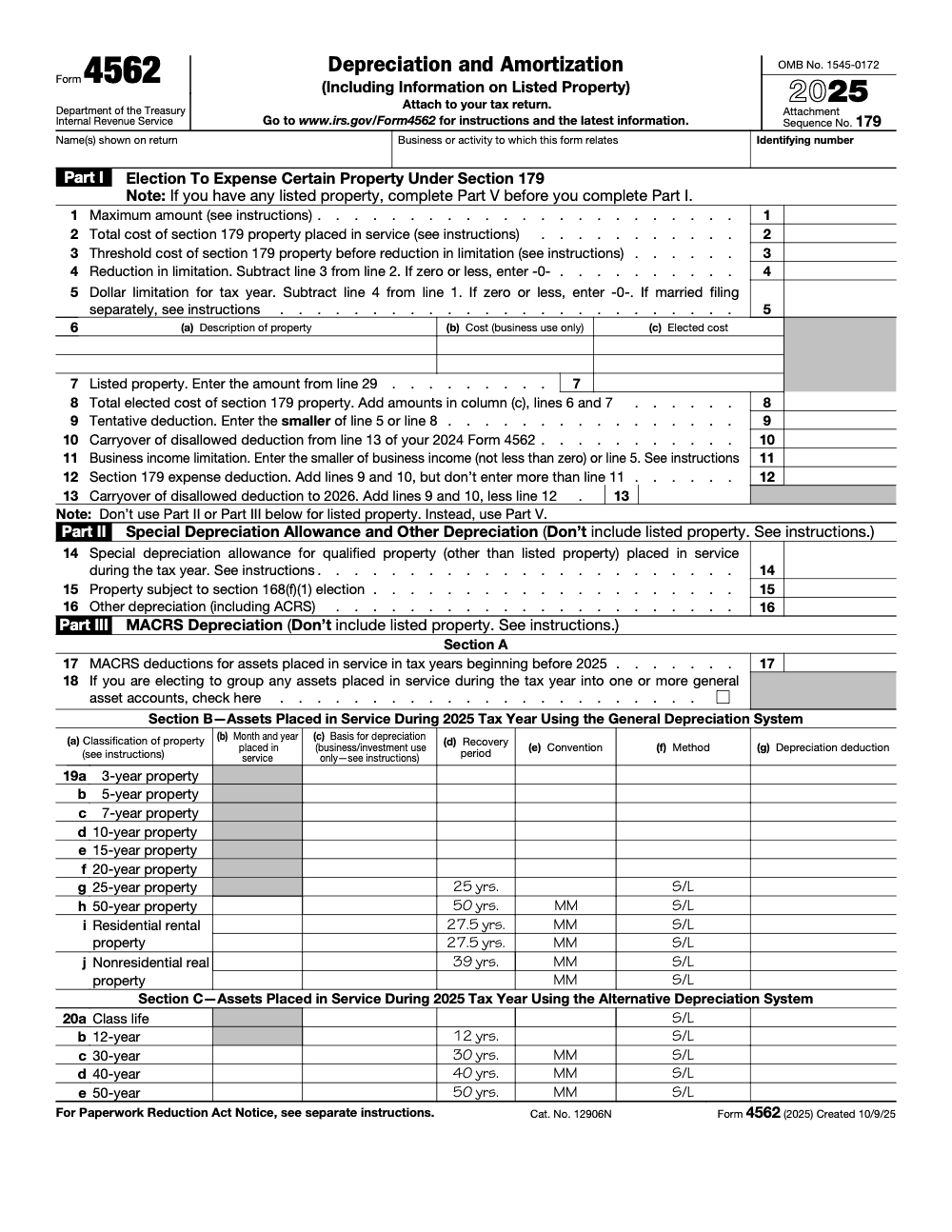
Form 4562 reports depreciation, amortization, and Section 179 for U.S. business assets – six parts cover §179 (Part I), bonus depreciation (Part II), MACRS (Part III), the summary on line 22 (Part IV), listed property (Part V), and §197 amortization on lines 42 to 44 (Part VI). For tax years beginning in 2025 the §179 ceiling is $2,500,000 with phase-out starting at $4,000,000 (per the One Big Beautiful Bill Act, P.L. 119-21, July 2025), and bonus depreciation is 100% for qualified property acquired and placed in service after January 19, 2025.
A manufacturing client signs a multi-million-dollar equipment purchase in mid-January and books the full cost as 100% bonus, then learns the acquisition date changes everything. For tax years beginning in 2025, bonus depreciation is 100% for qualified property acquired and placed in service after January 19, 2025, under the One Big Beautiful Bill Act, and property contracted earlier follows transition rules. The current-year deduction can move by a large amount on a single purchase, all because of a date.
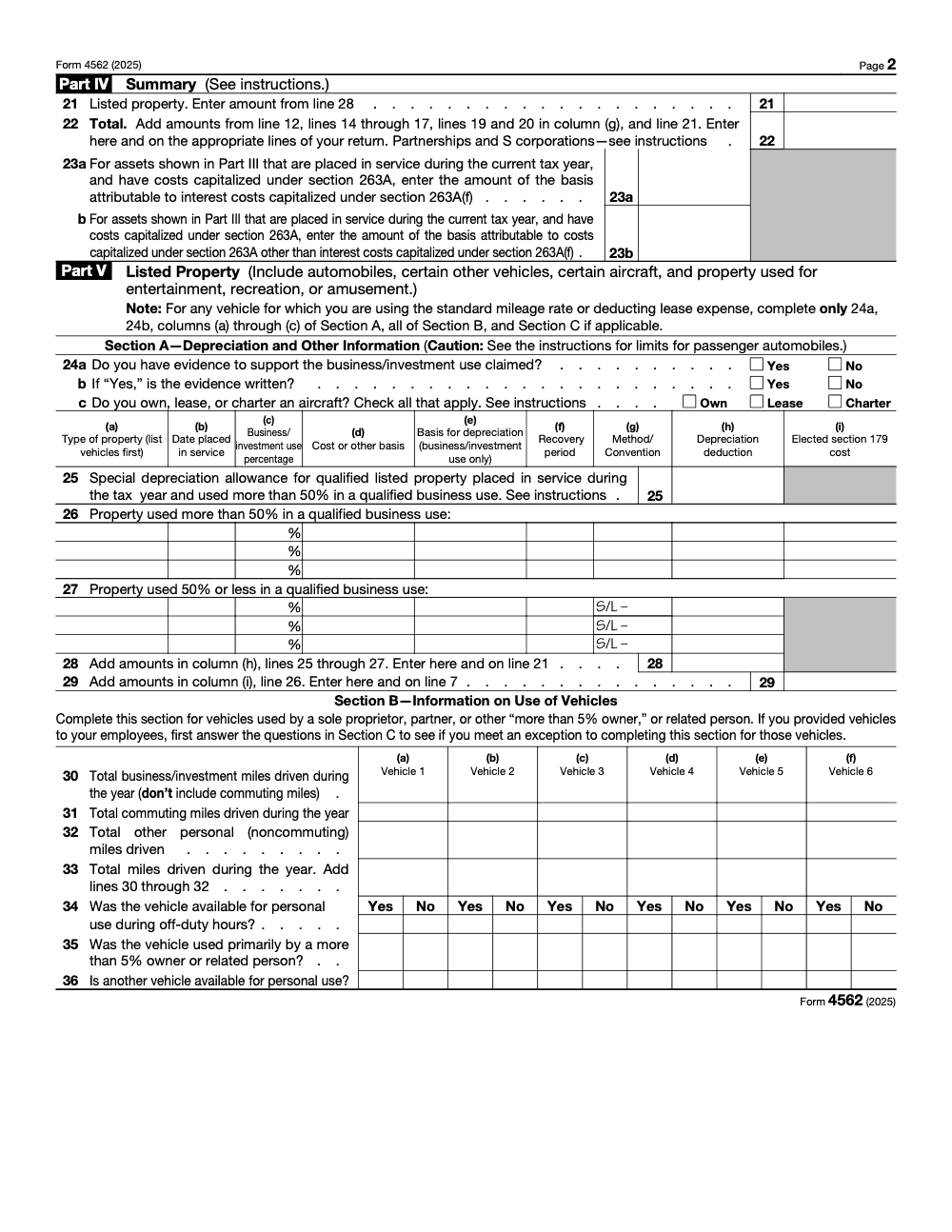
Form 4562 reports depreciation, amortization, and Section 179 across six parts: Section 179 in Part I, bonus depreciation in Part II, MACRS in Part III, the summary on line 22 in Part IV, listed property in Part V, and Section 197 amortization on lines 42 to 44 in Part VI. For 2025 the Section 179 ceiling is $2,500,000 with phase-out starting at $4,000,000, and the first-year luxury auto limit for passenger automobiles is $20,200 with bonus or $12,200 without, prorated by business use.
Key Takeaways
- Form 4562 is where you claim depreciation, amortization, Section 179, bonus depreciation, and report listed property like passenger autos. Keep one per activity. Totals flow to the return.
- For tax years beginning in 2025, Section 179’s maximum deduction is generally 2,500,000, reduced when total qualifying property placed in service exceeds 4,000,000. SUV caps and other details still apply.
- Congress restored 100% bonus depreciation for qualified property placed in service after January 19, 2025. Transition rules apply to property acquired or contracted before that date. If you place property in service earlier in 2025, legacy percentages still apply.
- 2025 luxury auto limits for passenger automobiles are first year 20,200 with bonus, or 12,200 without bonus, then 19,600, 11,800, and 7,060 thereafter, all prorated by business use.
- Real property is not all equal. Buildings are depreciable, land is not. Distinguish qualified improvement property, consider elections, and document methods, conventions, and placed‑in‑service dates in your depreciation ledger.
What Is IRS Form 4562
Form 4562, Depreciation and Amortization, is the return schedule you use to deduct depreciation and amortization, make Section 179 elections, claim bonus depreciation, and report listed property. You attach it to your annual return in any year you claim any of those deductions or report business use of listed property. If you have multiple activities, keep a separate 4562 per activity and reconcile totals. Think of it as the control sheet for your fixed asset and intangibles story each year.
- Part I, Section 179, where you elect amounts per asset, apply income limits, and track carryovers.
- Part II, Special Depreciation Allowance, where bonus depreciation lands after Section 179.
- Part III, MACRS, where you compute regular depreciation by class, method, and convention.
- Part IV, Summary, where totals flow to your return.
- Part V, Listed Property, where you report vehicles and other listed items and their business‑use percentage.
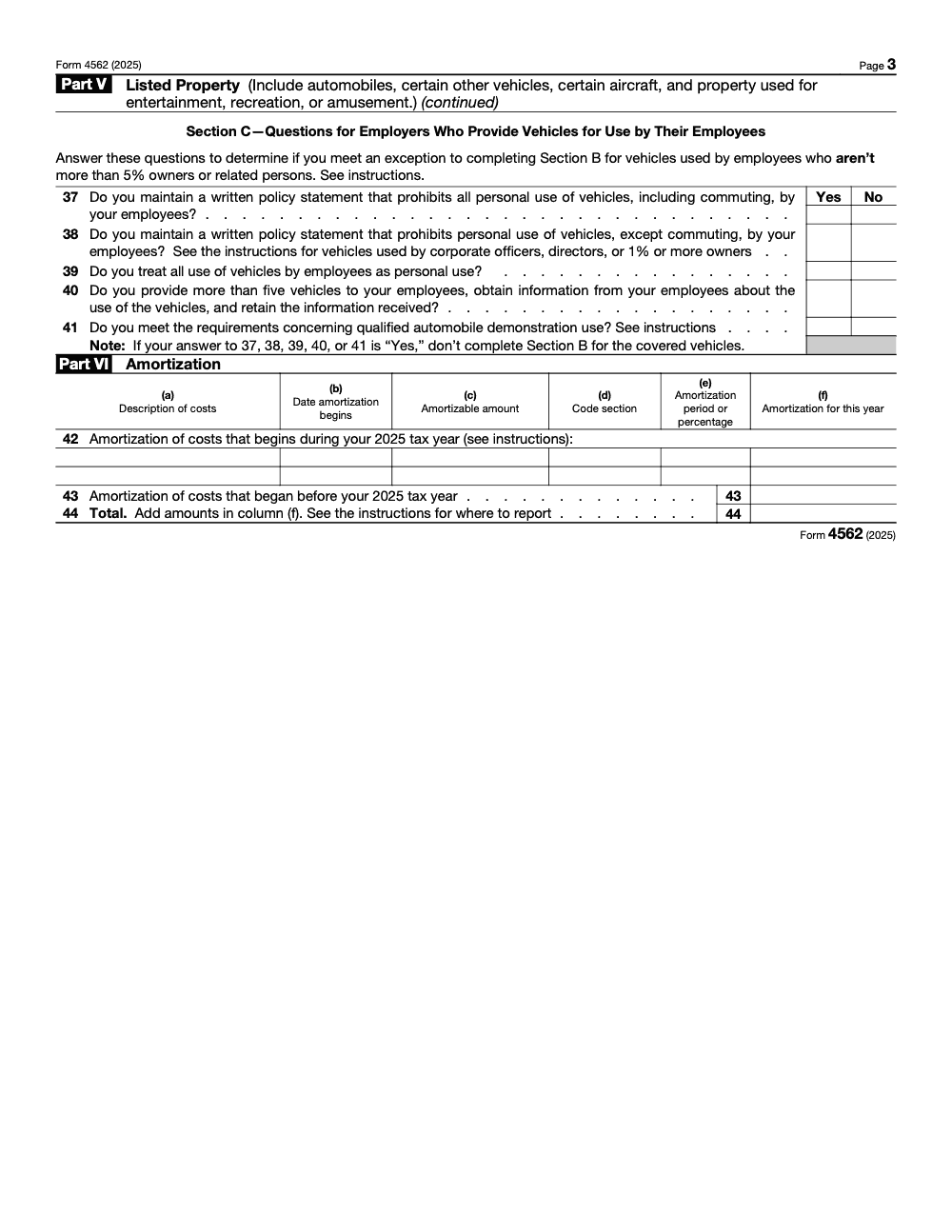
- Part VI, Amortization, where you record Section 197 intangibles and other amortizable items.
Tip for reviewers: if your firm’s “4562 packet” always starts with a clean fixed‑asset ledger, a placed‑in‑service log, and mileage substantiation for vehicles, reviews move from hunting to approving.
Why Firms Struggle With 4562 In Busy Season
If you manage a team, you have seen it. Capacity spikes, partner time gets trapped in review loops, and workpapers become inconsistent across preparers. Turnover and late‑season hiring create gaps. The result is missed dates or rushed schedules that trigger rework. The cure is not more heroics, it is standardization. You need SOPs that spell out naming conventions, version control, asset class mapping, how to document business use, and a clear routing from preparer to senior to quality to final. That discipline is how you compress review time without sacrificing quality.
On Accountably’s side, we only mention this because it matters for your Form 4562. When teams build SOP‑driven execution, maintain structured workpapers, and enforce internal checklists before review, revision cycles drop and partner review time falls. If you choose to integrate an offshore team, it must be trained on U.S. methods, tools, and review logic, and it must work inside your systems and templates. That is the only way offshore capacity helps instead of creating chaos.
What Changed For 2025, The Numbers You Need
- Section 179. For tax years beginning in 2025, the maximum Section 179 deduction is 2,500,000, reduced dollar‑for‑dollar when qualifying purchases exceed 4,000,000. These amounts reflect 2025 law changes noted by the IRS in the Internal Revenue Bulletin. Plan SUV caps separately (the §179 SUV cap is $31,300 for 2025 for sport utility vehicles between 6,001 and 14,000 lbs GVW, and applies in addition to the listed-property 50% test and recapture rules, not in place of them).
- Bonus depreciation. New law restored 100% bonus for qualified property both acquired and placed in service after January 19, 2025. There are transition rules for property acquired under binding contracts before January 20, 2025, and elections for reduced percentages in certain 2025 cases. For property placed in service earlier in 2025, legacy TCJA percentages still apply, such as 40% in many cases. Check acquisition date, contract status, and placed‑in‑service date before you claim.
- Luxury auto limits. For vehicles placed in service in 2025, first‑year limits are 20,200 with bonus or 12,200 without bonus, then 19,600, 11,800, and 7,060 thereafter. Prorate by business‑use percentage, and apply listed‑property rules if business use is 50% or less.
- Listed property definition and records. Vehicles remain listed property with strict substantiation. Publication 946 also describes certain entertainment equipment as listed property in specific circumstances (note: computers and peripheral equipment were removed from the listed property definition by TCJA for property placed in service after December 31, 2017, so the 50% business-use test no longer applies to business computers acquired after that date). Maintain contemporaneous records to protect your deduction and avoid recapture.
Compliance note: Always cite the tax year on your schedules. For 2025 filings, do not use last year’s caps or percentages without verifying the current rules and dates above.
Depreciation Basics You Can Train On
Depreciation spreads the cost of business property over its IRS recovery period. Under MACRS you choose a system, GDS or ADS, a method like 200% declining balance or straight line, and a convention like half‑year, mid‑quarter, or mid‑month. Your goal is simple, assign the correct class life, method, and convention, then document it so reviewers do not have to guess. Most equipment is 5 or 7 year, residential rental buildings are 27.5 years, and nonresidential real property is 39 years.
Three steps for preparers:
- Set basis on the placed‑in‑service date. If you converted from personal to business use, use the lesser of adjusted basis or FMV, then apply business‑use percentage.
- Pick the right method. Accelerated MACRS creates larger early deductions than ADS.
- Evaluate first‑year options. Consider Section 179 and bonus before you compute regular MACRS.
What Property Is Depreciable
You depreciate tangible property used in a trade or business that lasts more than a year, like buildings, machinery, furniture, and vehicles. Land is excluded. Certain intangibles are not depreciated, they are amortized, often under Section 197 over 15 years.
Examples You Can Hand To Staff
- Buildings and improvements. Depreciable, not land. Classify qualified improvement property correctly and consider bonus eligibility based on law and dates.
- Equipment and furniture. Typically 5 or 7 year under GDS.
- Vehicles. Depreciable, but they are listed property with annual dollar caps and strict business‑use documentation.
Non‑Depreciable Land, The Clean Rule
Land never goes on Form 4562. When a purchase includes land and a building, allocate purchase price between them using a reasonable method such as an appraisal or the closing statement percentages. Only the depreciable portion belongs on the schedule. Record site improvements like fencing, paving, or drainage as separate assets with appropriate lives.
Assets You Cannot Depreciate And Mixed‑Use Basics
Do not depreciate land or soil. Do not depreciate personal‑use property. For conversions to business use, basis is the lesser of adjusted basis or FMV on the conversion date and only the business‑use percentage is depreciable.
Listed Property, What Actually Counts In 2025
Listed property includes passenger automobiles and other transportation property. Publication 946 also treats property used for entertainment as listed property (note: computers and peripheral equipment were removed from the listed property definition for property placed in service after December 31, 2017, so the 50% business-use test does not apply to computers acquired after that date). What matters for you is the substantiation. If business use is 50% or less, you must switch to ADS straight line and you cannot take accelerated benefits (and once triggered, the ADS straight-line requirement applies every remaining year of the recovery period, not just the current year). Keep business‑use logs and, for vehicles, contemporaneous mileage that distinguishes business miles from commuting.
Reviewer cue: if an engagement file has a vehicle on Part V with no mileage log, stop the review and request it. Without it, you risk disallowance or recapture.
Vehicle Depreciation Limits That Apply In 2025
When you compute depreciation for passenger automobiles, you must apply the annual caps and prorate by business‑use percentage. For vehicles placed in service in 2025, the limits are:
| Year | With Bonus | Without Bonus |
| Year 1 | 20,200 | 12,200 |
| Year 2 | 19,600 | 19,600 |
| Year 3 | 11,800 | 11,800 |
| Each later year | 7,060 | 7,060 |
Remember to reduce limits by the business‑use percentage on Part V. If business use is 50% or less, use ADS and expect smaller deductions.
Mileage Records That Survive Review
- Track total, business, and commuting miles for each vehicle.
- Keep date, origin, destination, and business purpose for every trip.
- If you converted a vehicle midyear, compute business‑use percentage based on miles after conversion and apply it to the lesser of adjusted basis or FMV at conversion.
Where Advisory Work Gets Buried, And How To Fix It
Many firms want to scale advisory, but teams are buried in production because basic schedules are not prepared to a review‑ready standard. The unlock is simple: documented SOPs for fixed assets, a standardized 4562 packet, and an internal checklist that must be green before review. If you augment capacity offshore, make sure the team works inside your systems, uses your templates, and follows a multi‑layer review so partner time is protected. That is how you get work out on time, at quality, and at scale without burning people.
Section 179 Election And 2025 Limits
Section 179 lets you expense qualifying property placed in service during the year, asset by asset. For tax years beginning in 2025, the maximum deduction is generally $2,500,000, reduced dollar‑for‑dollar when total qualifying property exceeds $4,000,000. You still must respect the taxable income limitation and SUV caps, and disallowed amounts carry forward. Model it before you elect.
Practical steps:
- Verify eligibility and business use exceeds 50%.
- Project taxable income, including pass‑through allocations, to avoid wasting the election.
- Watch the phase‑out threshold as acquisitions approach 4,000,000.
Bonus Depreciation Rules You Must Re‑check For 2025
Under prior TCJA rules, bonus was phasing down, and for much of 2025 many assets would have been at 40%. New law changed that mid‑stream. For qualified property placed in service after January 19, 2025, bonus is restored to 100%. There are transition rules for property acquired under binding contracts before January 20, 2025, and elections for reduced percentages in certain 2025 returns. Always document both the acquisition date or contract date and the placed‑in‑service date.
Training note: put a “date panel” in every asset workpaper that shows placed‑in‑service date, acquisition date or contract date, and the law path you applied. That one box saves hours in review.
179 Or Bonus First, And Why
The order still matters. You apply Section 179 first, then bonus depreciation, then MACRS on the reduced basis. Section 179 is elective and can be modeled to fit income. Bonus is generally automatic unless you elect out by class. This allows you to fine‑tune first‑year deductions, keep income where you want it, or preserve basis for future years.
Quick Comparison You Can Share With Clients
| Feature | Section 179 | Bonus Depreciation | Regular MACRS |
| When applied | Before bonus | After Section 179 | After 179 and bonus |
| 2025 rule of thumb | Up to 2,500,000, with 4,000,000 phase‑out | 100% for qualified property placed in service after Jan 19, 2025, with transition rules | Based on class life, method, convention |
| Elective | Asset by asset | Election out by class | No election, standard |
| Income limit | Yes, cannot create or increase a loss | No taxable income limit | No income limit |
| Carryover | Yes, disallowed 179 carries | N/A | N/A |
Cite both dates and law in your file, especially for assets around January 2025.
Mini Case, How The Numbers Can Shift
You place 850,000 of 5‑year equipment in service on February 3, 2025, acquired under a binding contract signed January 10, 2025. Because the contract predates January 20, transition rules can apply. If you elect out of bonus or use the reduced percentage allowed by transition guidance, you might prefer to maximize Section 179 within taxable income and carry over any disallowed amount, preserving some basis for later years to shape margins. If you instead buy the same equipment on March 1 with no pre‑Jan 20 contract, 100% bonus is available, so you will likely claim 179 strategically on other assets and bonus the rest. Document your choice and the dates.
Listed Property, Vehicles, And Records That Pass Audit
In Part V you disclose listed property when you claim depreciation, actual vehicle expenses, or even the standard mileage rate. Passenger automobiles are capped by the annual tables. If your business use is 50% or less, you must use ADS straight line and you cannot use accelerated MACRS. Keep contemporaneous mileage logs and do not include commuting in business miles.
Pull‑quote for staff training: “No mileage log, no deduction you can defend.”
Amortization Of Intangibles, Part VI
Section 197 intangibles such as goodwill, customer lists, franchises, trademarks, and noncompete agreements are amortized straight line over 15 years starting when placed in service. On Form 4562, list description, date placed in service, cost basis, amortization period, method, and the current‑year deduction. Non‑197 intangibles follow specific rules, for example many purchased software arrangements use 36 months straight line. Track all prior deductions and basis reductions, and attach an explanation if you use a nonstandard method.
How To Complete Each Part Of Form 4562 Without Rework
- Part I, Section 179. List each asset, enter the elected amount, apply the business income limit, compute any carryover.
- Part II, Bonus depreciation. Enter the applicable percentage based on dates and law, then the deduction.
- Part III, MACRS. Assign the correct recovery period, method, convention, and compute the deduction or use the tables.
- Part V, Listed property. Enter basis, business‑use percentage, method, and apply caps.
- Part VI, Amortization. List each intangible and compute the annual amortization.
- Part IV, Summary. Roll totals to the return and reconcile to your fixed‑asset ledger.
Recordkeeping, What Reviewers Expect To See
- A depreciation schedule for each activity with description, date, cost, class life, method, convention, current and accumulated depreciation, plus any 179 or bonus per asset.
- Invoices, purchase agreements, and proof of payment.
- For conversions, FMV at conversion and adjusted basis.
- For vehicles, a contemporaneous mileage log and business‑use percentage.
- Disposition records showing date, proceeds, adjusted basis, and any recapture.
- A reconciliation that ties your ledger to Form 4562 totals.
The Delivery Piece, How To Keep 4562 Off The Critical Path
If you lead a firm, you already know the pain, capacity spikes, review loops, inconsistent workpapers, and missed dates that erode trust. The fix is not a motivational speech, it is operations. The teams that scale Form 4562 work use SOP‑driven execution, structured file naming, internal checklists, and layered reviews. If you choose to add offshore capacity, it should operate inside your systems, your templates, and your review cadence, with U.S.‑led quality control. That way, preparer to senior to quality to final moves smoothly, partner time is protected, and deadlines stop being a coin toss.
On our side, Accountably staffs firms this exact way, not resume farming, but trained offshore preparers placed inside your workflow, ramped on your software and SOPs, with multi-layer review so reviewers spend time on judgment, not detective work. Proof before your name is on the line, so you hand off because the work earned it. Use that model if it fits your firm’s risk and growth goals, and keep mentions of any partner, including us, grounded in how it improves delivery for your clients and your team.
Quick Compliance Checklist, Use This In Your SOP
- Confirm placed‑in‑service dates, acquisition or contract dates, and law path applied.
- Map each asset to class life, method, and convention.
- Decide Section 179 per asset, model income limit and carryover.
- Apply bonus based on dates, transition rules, and any class election out.
- For vehicles, compute business‑use percentage from a contemporaneous mileage log and apply the 2025 caps.
- Keep a clean reconciliation from the fixed‑asset ledger to Form 4562 totals.
Closing And Next Step
You have the blueprint to make Form 4562 a non‑event in review. Set class lives correctly, pick the right methods and conventions, document every date that matters, and model Section 179 and bonus with the 2025 rules in mind. If your bottleneck is capacity or review friction, invest in SOPs and structured workpapers. If you consider offshore production to stabilize workload, do it with workflow discipline, documented processes, and layered quality so partners spend time on strategy again.
This article is for general guidance. It is not tax advice. Always confirm current law and your facts before filing.
- Sources for 2025 rules and references used in this guide: IRS Form 4562 Instructions, IRS Publication 946, Internal Revenue Bulletin entries on 2025 Section 179 changes, Illinois IL‑4562 guidance on federal bonus transition, and IRS Rev. Proc. 2025‑16 auto caps.
Optional CTA
If you want a review‑ready Form 4562 packet template with SOP checklists your team can drop into busy season, reach out to our team. We keep mentions of Accountably light and focused on delivery discipline, the only kind that actually saves partner time.
Common Mistakes We See Every Season
These are the patterns I flag for senior review every season. Each one maps back to a specific Form 4562 part, line, or 2025 rule change that quietly reset a model the team built before the One Big Beautiful Bill Act passed.
Reusable Checklists
These checklists are copy-paste ready for firm SOPs. Each block reflects the 2025 updates to §179 limits, bonus rates, and listed-property rules under P.L. 119-21, and survives a partner-level review pass.
Asset Register Prep (run before any 4562 entry)
- Confirm every 2025 addition has an acquisition date, a placed-in-service date, and a basis tied to a vendor invoice or closing statement.
- Allocate purchase price between land and depreciable components for any real-property addition. Land never enters Form 4562.
- Tag each asset's MACRS class (3, 5, 7, 10, 15, 20, 25, 27.5, or 39 years) using IRS Publication 946 recovery period tables.
- Flag every passenger automobile and listed-property asset for the more-than-50% qualified-business-use test.
- Pull §197 intangibles into a separate ledger for Part VI (lines 42 to 44), not Part III MACRS.
- Identify related-party acquisitions and exclude them from any §179 election (§267 / §707(b) definitions apply).
- Mark dispositions for Form 4797 routing before §179 or bonus is calculated on replacement assets.
- Run the mid-quarter trigger check: if more than 40% of MACRS personal property basis lands in the last three months of the year, mid-quarter applies to every personal-property asset placed in service that year.
Bonus Depreciation Date Triage (2025-specific)
- For every qualifying asset, record the binding contract or acquisition date alongside the placed-in-service date.
- Acquired and placed in service after January 19, 2025: 100% bonus available under restored §168(k).
- Acquired before January 20, 2025 and placed in service in 2025: 40% bonus, or 60% for long-production property and certain aircraft.
- Document whether the taxpayer is electing the 40% alternative (60% for long-production or aircraft) for the first tax year ending after January 19, 2025.
- Confirm qualifying property has a MACRS recovery period of 20 years or less.
- Exclude any ADS-required property from bonus, including listed property that fails the 50% test and certain foreign-use or tax-exempt-use property.
- Apply §179 first, then bonus on the remaining basis, then MACRS on what is left. Document this ordering in the workpaper.
- For property placed in service after July 4, 2025, evaluate the new §168(n) Qualified Production Property election (100% allowance) separately from regular bonus.
Listed Property Year-Over-Year Audit
- Pull current-year qualified business-use percentage for every listed-property asset (passenger automobiles, business aircraft, other transportation property, and certain entertainment, recreation, and amusement property).
- Compare to the prior-year percentage. Flag any asset where current-year qualified business use is 50% or less.
- For flagged assets in a year after the placed-in-service year: run the excess-depreciation recapture worksheet and route ordinary income to Form 4797 Part IV.
- Step up basis by the recapture amount and switch to straight-line over the ADS recovery period for all remaining years.
- For business aircraft, confirm BOTH the §280F(b) 50% test AND the §280F(d)(6)(C)(ii) 25% qualified-business-use test are met, documented on a per-flight, per-passenger basis.
- For passenger automobiles placed in service in 2025, confirm the annual cap ($20,200 year one with bonus, $12,200 without; $19,600 year two; $11,800 year three; $7,060 year four and later) and document whether bonus was claimed.
- Exclude commuting miles from qualified business use, even if a business call was taken during the trip.
- Confirm investment use is NOT counted toward the 50% qualified-business-use test, even though it can be added to the depreciation deduction percentage once the test is met.
Keep 4562 Season From Stalling
Form 4562 is not a single-deadline scramble like 941 or 1099-NEC. It is a review-heavy schedule that ties back to every fixed-asset addition, disposition, vehicle use shift, and intangible buyout across the year. The 2025 cycle is heavier than usual because the One Big Beautiful Bill Act (P.L. 119-21, enacted July 2025) reset the Section 179 ceiling to $2,500,000 with a $4,000,000 phase-out and restored 100% bonus depreciation for property acquired and placed in service after January 19, 2025, which means every existing depreciation model needs a fresh pass before review.
The fix is not more hours. It is tighter packet hygiene before review begins. Most 4562 review loops break down because Part I (§179), Part II (bonus), Part III (MACRS), and Part V (listed property) get prepared by different hands without a single asset register driving them. Build the register first, then let the form follow.
- Reconcile line 12 (§179 expense) back to the asset register before bonus is layered on. §179 is applied first, and any disallowed amount carries forward on line 13 (per IRS Publication 946).
- Flag every passenger automobile against the 2025 caps ($20,200 year one with bonus, $12,200 without; $19,600, $11,800, and $7,060 thereafter) and document whether bonus was claimed. The $8,000 year-one gap is the most common planning miss.
- Track listed property business use year over year. A drop to 50% or less triggers ordinary-income recapture on Form 4797 Part IV, not a prospective adjustment.
- Keep Part VI (§197 intangibles, 15-year straight-line on lines 42 to 44) separate from Part III. Mixing goodwill, customer lists, or covenants into MACRS is a recurring rework cause.
- Confirm the bonus rate by acquisition date. Property acquired before January 20, 2025 stays at 40% (60% for long-production property and certain aircraft). Only post-January 19, 2025 acquisitions qualify for 100% bonus.
That is the version of 4562 prep that survives a fast review cycle. If the asset register, vehicle log, and intangibles schedule are not holding the work together, our tax preparation and review team can build the SOP and run the year's depreciation rollforward without burning partner time.
FAQs
Form 4562 is used to claim depreciation and amortization, elect Section 179, claim bonus depreciation, and report listed property, including vehicles subject to annual caps. It must be attached in any year you claim those deductions or report listed property.
Yes, in years you claim depreciation or amortization for the activity. Residential rental buildings are generally 27.5‑year straight line with the mid‑month convention. Keep cost allocation between land and building, and maintain improvement versus repair documentation.
No. Allocate purchase price between land and depreciable components, then depreciate only the building and qualifying improvements. Land is never on Form 4562.
For vehicles placed in service in 2025, first‑year limits are $20,200 with bonus or $12,200 without bonus, then $19,600, $11,800, and $7,060. Prorate by business‑use percentage and apply listed‑property rules if business use is 50% or less.
For tax years beginning in 2025, the maximum deduction is $2,500,000, reduced when total qualifying property exceeds $4,000,000. The taxable income limitation still applies, and disallowed amounts carry over.
New law restored 100% bonus depreciation for qualified property placed in service after January 19, 2025, with transition rules for property acquired under binding contracts before January 20, 2025, and elections for reduced percentages on certain 2025 returns. Property placed in service earlier in 2025 may still follow the legacy percentages. Verify dates before you claim.
Other forms this guide names
- Form 4797: Depreciation Recapture and Section 1231
Summarize this article with AI
About this guide
Accountably helps US CPA, EA, and accounting firms hire trained accountants and tax preparers in India.
About us Reviewed byJugal Thacker, CPAFounder and CEO at Accountably
A Washington-licensed CPA with 7+ years inside US firms – PwC, a real-estate tax practice, then a full-service firm, rising from reviewer to manager to advisory. This article was reviewed against current IRS guidance for the 2025 tax year and updated for filers preparing late returns, amendments, and 2026 estimates.
View profile →How we research, review, and update this guide
Every Accountably guide is researched against primary IRS sources, reviewed by a U.S. CPA, and refreshed as guidance evolves. Read our Editorial Guidelines to see how we source, fact-check, and update our content.