Summarize this article with AI
In Brief
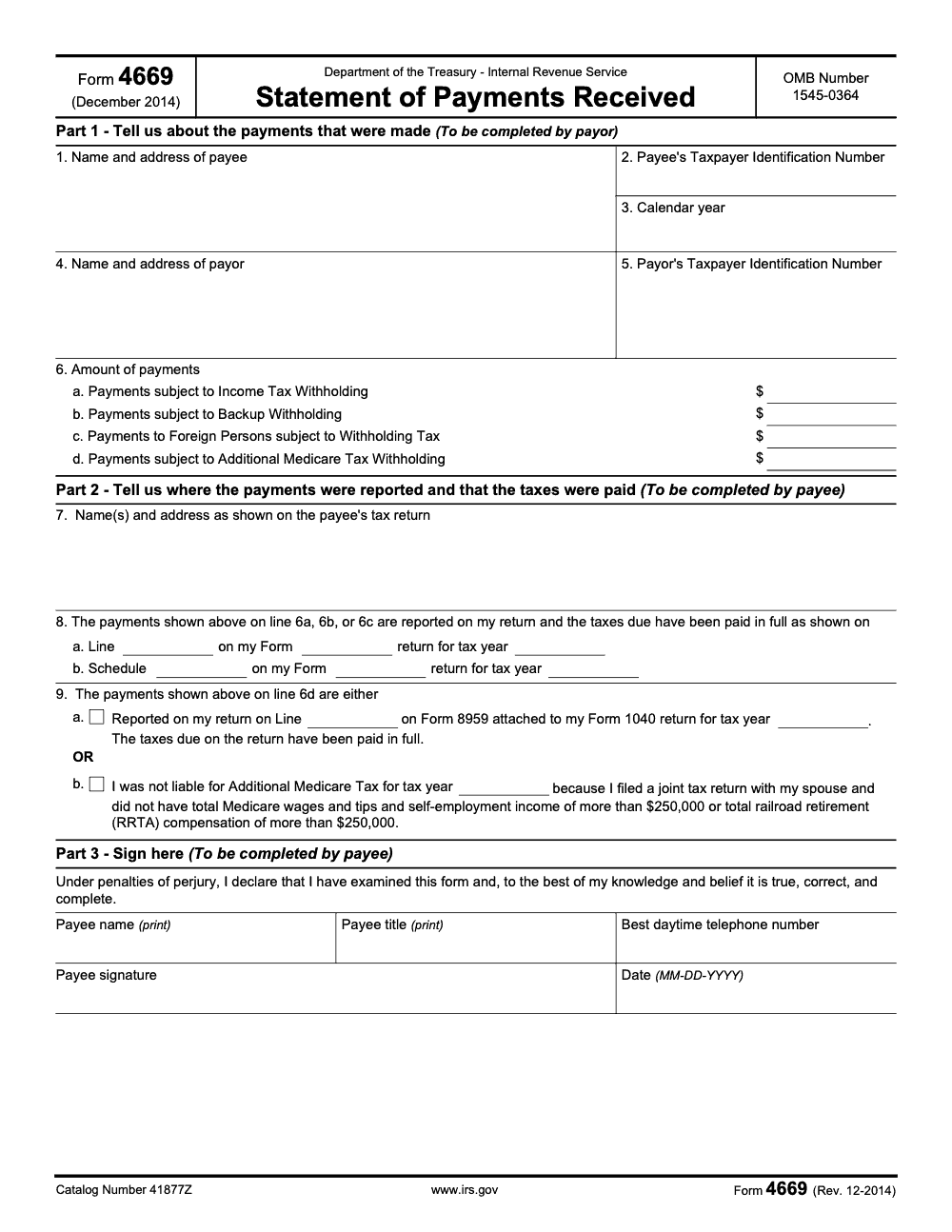
Form 4669, Statement of Payments Received (Rev. December 2014), is the payee’s signed certification that the listed payments were reported as taxable income, and it supports a payor’s request for relief from income tax withholding liability under IRC §3402(d). The payor completes Part 1 (lines 1-6), the payee completes Part 2 (lines 7-9) and signs Part 3 under penalties of perjury, and the payor transmits the collected statements to the IRS with Form 4670 (per the IRS Form 4669 instructions, OMB 1545-0364).
The first Form 4669 most people chase comes out of a worker-reclassification exam. A client paid contractors the examiner decides were really employees, and the income tax that was never withheld comes due under Section 3402. The assessment looks frightening until you confirm every one of those workers already reported and paid tax on the money, and a signed statement from each of them can turn that bill into a closed file.
Form 4669 is the payee's signed certification, under penalties of perjury, that the listed payments were reported as taxable income, and it supports the payor's request for relief from income tax withholding liability under Section 3402(d). It works as a pair: the payor completes Part 1 on lines 1 to 6, the payee completes Part 2 on lines 7 to 9 and signs Part 3, and the payor transmits the collected statements with Form 4670. There is no annual filing deadline. You submit it during an IRS examination or in response to a specific inquiry, not on a calendar cycle.
Key Takeaways
- Form 4669 is a payee statement. The person who received payments signs it to certify those amounts were or will be included in their gross income.
- It works as a pair with Form 4670. The payer submits both – 4669 from the payee, 4670 from the payer – to request relief from income tax withholding liability under IRC §3402(d).
- No annual filing deadline. Form 4669 is submitted during an IRS examination or in response to a specific inquiry, not on a calendar-year cycle.
- The payee must have reported the income. Relief is only available if the payee actually included the payment in their income and paid the resulting tax. The IRS will verify this.
- Backup withholding and income tax withholding are distinct issues. Form 4669 itself documents payments subject to backup withholding (line 6b) and supports relief for them; what it does not relieve is the separate penalties for failure to collect backup withholding under IRC §3406.
- SOP tip: Add a “4669 ready” flag to your engagement checklist for any client who makes non-payroll payments to individuals without withholding. If an audit ever hits, having payee contact information current is the first thing you’ll need.
What Form 4669 Is and When to Use It
Form 4669, Statement of Payments Received, is a statement completed in two parts: the payor fills in Part 1 (lines 1-6) describing the payments, and the payee – the person or entity that received payments from a payer during a given tax year – completes Parts 2 and 3. The payee certifies, under penalties of perjury, that the listed payments were or will be included in their gross income for federal income tax purposes.
The form exists to break a chain of potential double collection. When a payer fails to withhold income tax from payments to an individual, the IRS can assess the payer for the unwithheld amount under IRC §3403. But if the payee has already paid tax on that same income through their own return, collecting again from the payer results in a windfall for the Treasury. IRC §3402(d) provides relief – and Form 4669 is the documentary evidence the IRS requires to grant it.
The form is most commonly used in these scenarios: an employer did not withhold income tax on supplemental wages, bonuses, or non-cash compensation; a business made miscellaneous payments to individuals without collecting withholding; or an examiner discovers that a Form W-2 or 1099 understated withholding. When Form 4670 is filed by the payer to request relief, Form 4669 from each affected payee is the required supporting attachment.
What Form 4669 Is Not
Form 4669 does not dispute whether withholding was required. It does not request a refund. It is not a substitute for a Form W-2 or 1099. Its sole function is to document that the payee acknowledged receiving specific payments and reported them as taxable income, thereby enabling the payer to seek relief from the underlying withholding liability.
It also does not provide relief from penalties for failure to file information returns, or from FICA/FUTA tax obligations. Those are entirely separate assessments with separate relief procedures.
How to Complete Form 4669
Form 4669 is straightforward – it has one purpose and relatively few fields. Here is a section-by-section walk-through.
Part 1 – Tell Us About the Payments That Were Made (Completed by the Payor)
| Field | What to Enter | Practitioner Note |
|---|---|---|
| Name | Full legal name of the payee (individual or entity) | Match exactly to the name on the payee’s Form W-9 on file |
| Taxpayer Identification Number | SSN, EIN, or ITIN of the payee | Critical – the IRS matches this TIN against the payee’s filed return to verify income was reported |
| Address | Current mailing address of the payee | Use the address matching the tax year in question, not necessarily today’s address |
| Payer name | Name of the business or individual who made the payments | Must match the name on the payer’s EIN records exactly |
Part 2 – Where the Payments Were Reported
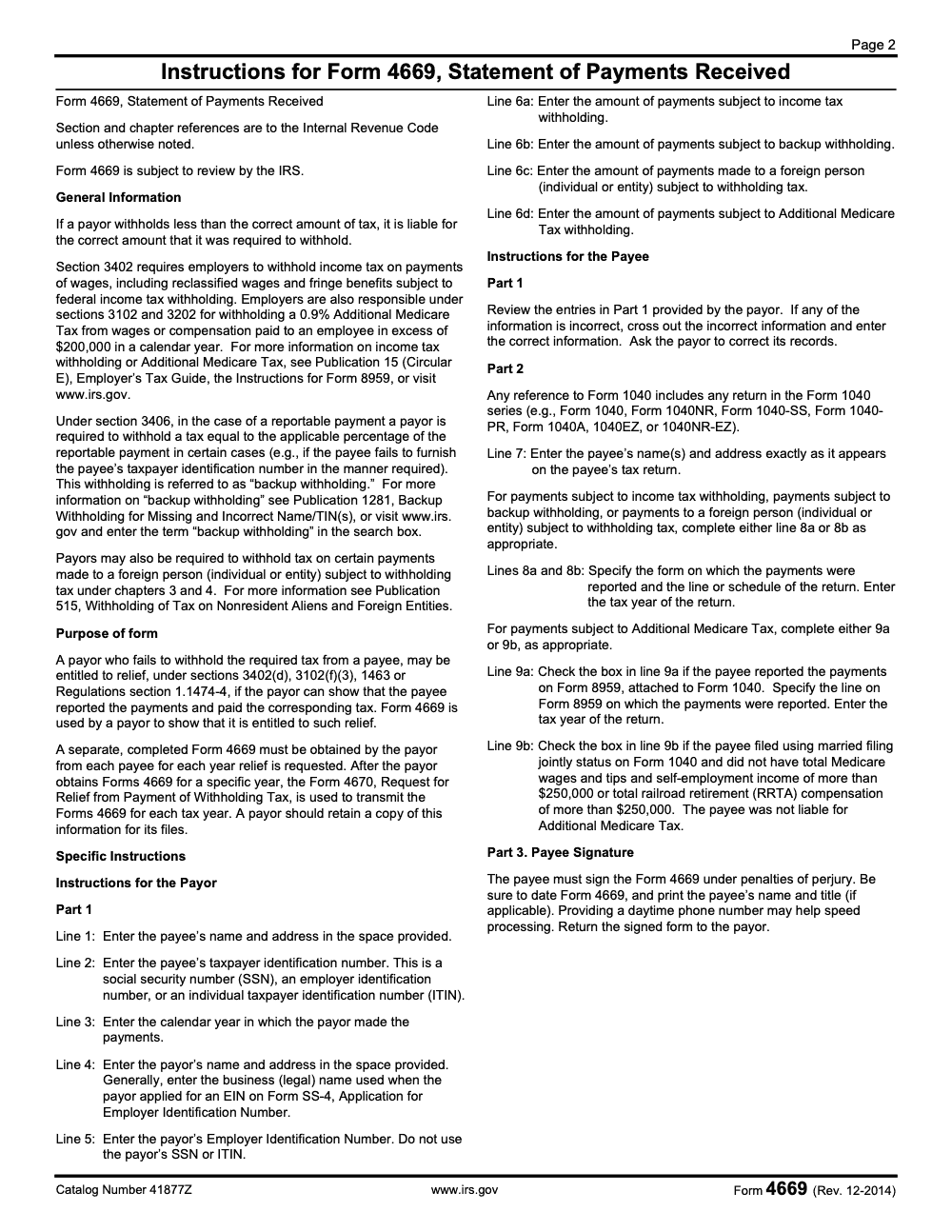
In this part the payee shows where the payments were reported on their own return. For payments subject to income tax, backup, or foreign-person withholding, the payee completes line 8a or 8b (identifying the line, schedule, form, and tax year on which the income was reported); for Additional Medicare Tax, the payee completes line 9a or 9b. The payment amounts themselves are entered by the payor in Part 1, line 6. If the payments span multiple years, do not combine them on one statement – the IRS requires a separate, completed Form 4669 from each payee for each calendar year relief is requested, so prepare one form per payee per year.
Be specific about payment descriptions. “Consulting fees paid January–June 2023” is better than “miscellaneous income.” Vague descriptions give examiners room to question whether the exact amounts were reported.
Part III – Payee Certification
The payee signs under penalties of perjury, certifying that the amounts in Part II were included (or will be included) in their gross income and that the information is true, correct, and complete. An authorized officer or representative may sign for an entity payee, but individual payees must sign personally. Do not accept a signature from a representative who is not authorized under a valid power of attorney.
Date the statement with the actual signing date, not backdated. A backdated signature on a perjury-certified document creates a different kind of problem than the original withholding failure.
Deadlines, Penalties, and Filing Requirements
| Item | Details |
|---|---|
| Form 4669 due date | No fixed calendar deadline. Filed during an IRS examination, in response to a notice, or as part of a Form 4670 relief request package. |
| Form 4670 companion filing | Payer submits Form 4670 with all Form 4669 attachments to the IRS office conducting the examination. |
| Income tax withholding liability (payer) | IRC §3403 makes the employer/payer liable for unwithheld income tax, and where the payer withheld some but less than the correct amount, that liability runs to the full amount the law required, not merely the shortfall. Relief is granted only if IRC §3402(d) conditions are met. |
| Backup withholding penalties (separate) | Form 4669/4670 does not relieve penalties for failure to collect backup withholding under IRC §3406. Those are assessed separately and are not waived by this relief process. |
| Information return penalties | Penalties under IRC §6721/6722 for failure to file or furnish correct 1099s are also separate and not relieved by Form 4669/4670. |
| FICA/FUTA (separate) | Employment tax assessments for payroll misclassification are not resolved through this process. Use Forms 941-X and 940-X for those corrections. |
From my side of the desk, the biggest timeline risk is locating and getting signatures from former employees or contractors. Build this into your examination response timeline early – do not assume a payee will respond in 48 hours. Allow at least two to three weeks, and send the request in writing with a clear explanation of why the signature is needed.
Form 4669 and IRC §3402(d) Relief
IRC §3402(d) is the statutory basis for why Form 4669 exists. It provides that if a payer fails to deduct and withhold income tax from wages or other payments, and the payee subsequently files a return and pays the tax on that income, the payer’s liability for the unwithheld tax is extinguished. The Treasury cannot collect the same tax twice. Note, though, that this relief reaches the underlying withholding tax only – penalties for failure to deposit or to file correct information returns, along with interest on the under-withholding, are not automatically waived by Form 4669 and remain payable unless separate abatement applies.
The critical qualification is “subsequently files a return and pays the tax.” The IRS takes this seriously. During an examination, they will cross-reference the payee’s TIN against filed returns to confirm the income appears and that the resulting tax was paid. If the payee hasn’t filed, or filed but excluded the income, Form 4669 will not be accepted as a basis for relief – even if the payee signs it.
What “Paid the Tax” Means in Practice
A payee who received $25,000 in consulting income, included it on Schedule C, but had an overall refund because of deductions did not “pay the tax on that income” in any meaningful sense. The IRS’ application of IRC §3402(d) can become nuanced when the payee has large offsetting deductions. Experienced examiners will look at whether the marginal tax on the payment can be traced.
In cases where this is uncertain, I have seen practitioners supplement Form 4669 with a statement from the payee’s CPA confirming the income was reported and explaining the overall tax position. It is not required, but it can defuse examiner skepticism.
Social Security and Medicare Tax Are Not Covered
IRC §3402(d) relief applies specifically to income tax withholding, not to FICA taxes. If the payments were wages for which Social Security and Medicare taxes should have been withheld, those assessments proceed separately. For failure to withhold Additional Medicare Tax, there is a separate relief mechanism under IRC §3102(f)(3), which has its own set of conditions. Do not conflate the two.
Form 4669 vs. Form 4670 – The Two-Form System
These two forms work together and are almost never filed separately. Understanding the division of responsibility between them prevents confusion on both the payer and payee side.
| Form | Who Completes | What It Says | Who Files It |
|---|---|---|---|
| Form 4669 | Payee (income recipient) | “I received these payments and included them in my taxable income.” | Attached to payer’s Form 4670 |
| Form 4670 | Payer (employer or payor) | “I failed to withhold income tax. I am requesting relief because the payee reported and paid the tax.” | Payer submits to IRS with Form 4669 attachments |
A common misconception is that only one form needs to be filed, or that the payer can submit Form 4670 without collecting Form 4669 first. That approach will not work – the IRS requires Form 4669 as supporting evidence. If even one payee refuses to sign or cannot be located, the relief for payments made to that individual may not be granted.
When Only One Form is Needed
If the payer is also the payee – for example, a sole proprietor who paid themselves through a separate legal entity – the analysis changes. In these cases, consult the specific facts carefully, because the separation of payer and payee identities is what makes the relief mechanism function. Circular arrangements raise audit red flags.
Also note that Form 4669 is not used for FUTA relief. There is no equivalent “payee-paid, therefore payer relieved” mechanism for FUTA. That unemployment tax is purely employer-side, and failure to deposit it is not cured by the employee’s personal tax filing.
Common Mistakes That Slow Things Down
The same handful of errors come up every time a relief request crosses my desk. None of them are exotic, and each one is avoidable with a quick check before the package reaches the examiner.
Practical Checklists You Can Reuse
These are copy-paste ready for a firm SOP. Drop them into your examination-response workflow and check items off as you assemble the relief package.
Form 4669 intake (per payee)
- Confirm one statement per payee for each calendar year of relief.
- Verify the line 2 payee TIN (SSN, EIN, or ITIN) matches the filed return.
- Confirm line 5 carries the payor EIN, not an SSN or ITIN.
- Match the line 4 payor name to the EIN registration.
- Check that line 3 shows the calendar year the payments were made.
- Mark the correct boxes among lines 6a-6d for the payment type.
- Confirm line 7 carries the name exactly as on the payee return.
- Verify line 8a or 8b is completed (line 9a or 9b for Additional Medicare Tax).
- Obtain the Part 3 signature, date, and printed name under penalties of perjury.
Form 4670 relief package
- Confirm the payee actually filed a return for the year and reported the income.
- Verify the tax on the payments was paid, not just reported.
- Assemble every signed Form 4669 behind one Form 4670 transmittal.
- Keep a copy of each Form 4669 and the Form 4670 for the payor files.
- Flag penalties and interest that fall outside IRC §3402(d) relief.
- Send the package to the IRS office conducting the examination.
Keep 4669 Season From Stalling
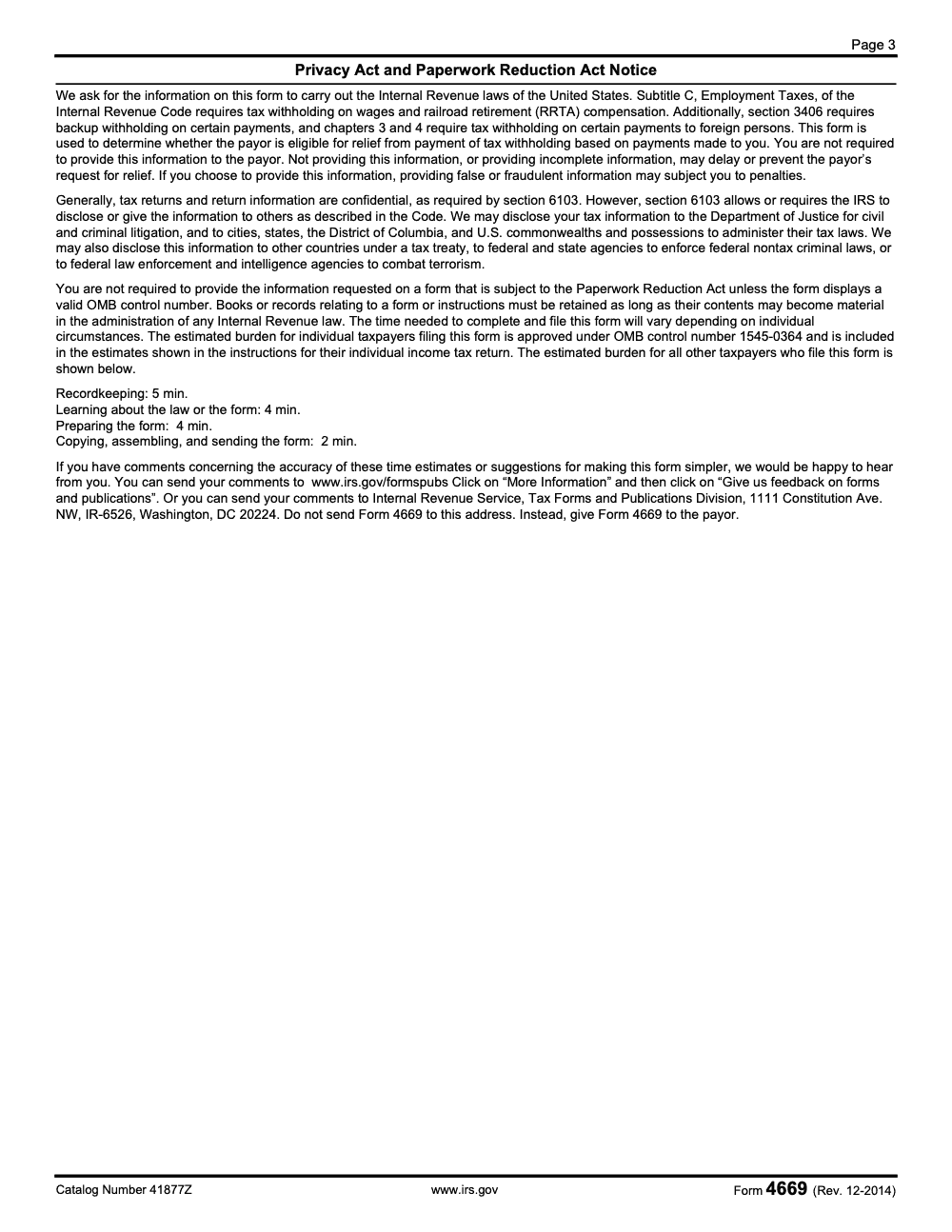
Form 4669 never lands on a predictable calendar. It surfaces when an examiner challenges withholding, often months or years after the payments, and suddenly a payor needs a signed statement from every affected payee. The IRS pegs the form itself at roughly 15 minutes for a business filer (per the Form 4669 Paperwork Reduction Act notice), but that estimate hides the real work: locating former employees and contractors, explaining why their signature matters, and collecting one statement per payee for each calendar year in question.
The bottleneck is rarely the form. It is the chase, the cross-checking, and the assembly under an examiner’s clock. A little structure turns that scramble into a repeatable workflow your team can run the same way every time.
- Match each payee’s line 2 TIN to a filed-return confirmation before requesting a signature, so a 4669 never goes out for income that was not reported.
- Keep a payor profile with the correct line 5 EIN and line 4 legal name on hand, so reclassification exams do not stall on a missing identifier.
- Maintain one Form 4669 per payee per calendar year and reconcile the set against the Form 4670 count.
- Separate the withholding lines (6a-6c) from Additional Medicare Tax on line 6d, since each routes to a different payee cross-reference (8a/8b versus 9a/9b).
- Log signature requests with dates so a slow-responding payee does not quietly blow the examination deadline.
When the volume climbs or the deadline tightens, this is exactly the kind of structured, documented execution our tax delivery teams handle, so a relief package is built once, checked twice, and ready before the examiner asks.
FAQs
Form 4669 is a Statement of Payments Received, signed by the payee to certify that amounts received from a payer were included in their gross income. It is the supporting document payees provide to payers who are seeking relief from income tax withholding liability under IRC §3402(d). Without signed Form 4669 statements, a payer cannot successfully file Form 4670 to request that relief.
Both parties complete it: the payor fills in Part 1 (lines 1-6) describing the payments, and the payee completes and signs Parts 2 and 3. The payee is the person or business that received the payments and is certifying – under penalties of perjury – that the income was reported on their federal tax return. The payer then collects the signed statement and attaches it to Form 4670, which the payer files with the IRS.
Form 4669 addresses income tax withholding relief under IRC §3402(d), not the penalties for failure to collect backup withholding under IRC §3406 – though the form itself does report payments subject to backup withholding on line 6b for relief purposes. The forms do not eliminate backup withholding penalties assessed against the payer for failure to collect the required 24% from a payee who provided an incorrect TIN or did not certify their TIN. Those assessments are handled separately and are not relieved by the 4669/4670 process.
There is no fixed annual deadline. Form 4669 is submitted as part of an examination or in response to an IRS notice, within the timeframe established by the examining agent. As a practical matter, the sooner you collect signed statements from payees, the better – payees move, change contact information, and become harder to reach over time. Build a target of responding to any withholding examination with a complete Form 4669 package within 30 days of initial contact.
Yes. The IRS will independently verify that the payee filed a return for the applicable tax year and included the reported income. If the payee’s return does not reflect the payments – whether due to non-filing, amended returns with income removed, or mismatched amounts – the relief request will be denied for those payments. Collecting the signature is necessary but not sufficient. Transcript verification is essential before submitting.
Other forms this guide names
About this guide
Accountably helps US CPA, EA, and accounting firms hire trained accountants and tax preparers in India.
About us Reviewed byJugal Thacker, CPAFounder and CEO at Accountably
A Washington-licensed CPA with 7+ years inside US firms – PwC, a real-estate tax practice, then a full-service firm, rising from reviewer to manager to advisory. This article was reviewed against current IRS guidance for Form 4669 (Rev. December 2014) and updated for payors and payees assembling Section 3402(d) withholding-relief packages during examinations.
View profile →How we research, review, and update this guide
Every Accountably guide is researched against primary IRS sources, reviewed by a U.S. CPA, and refreshed as guidance evolves. Read our Editorial Guidelines to see how we source, fact-check, and update our content.