Summarize this article with AI
In Brief
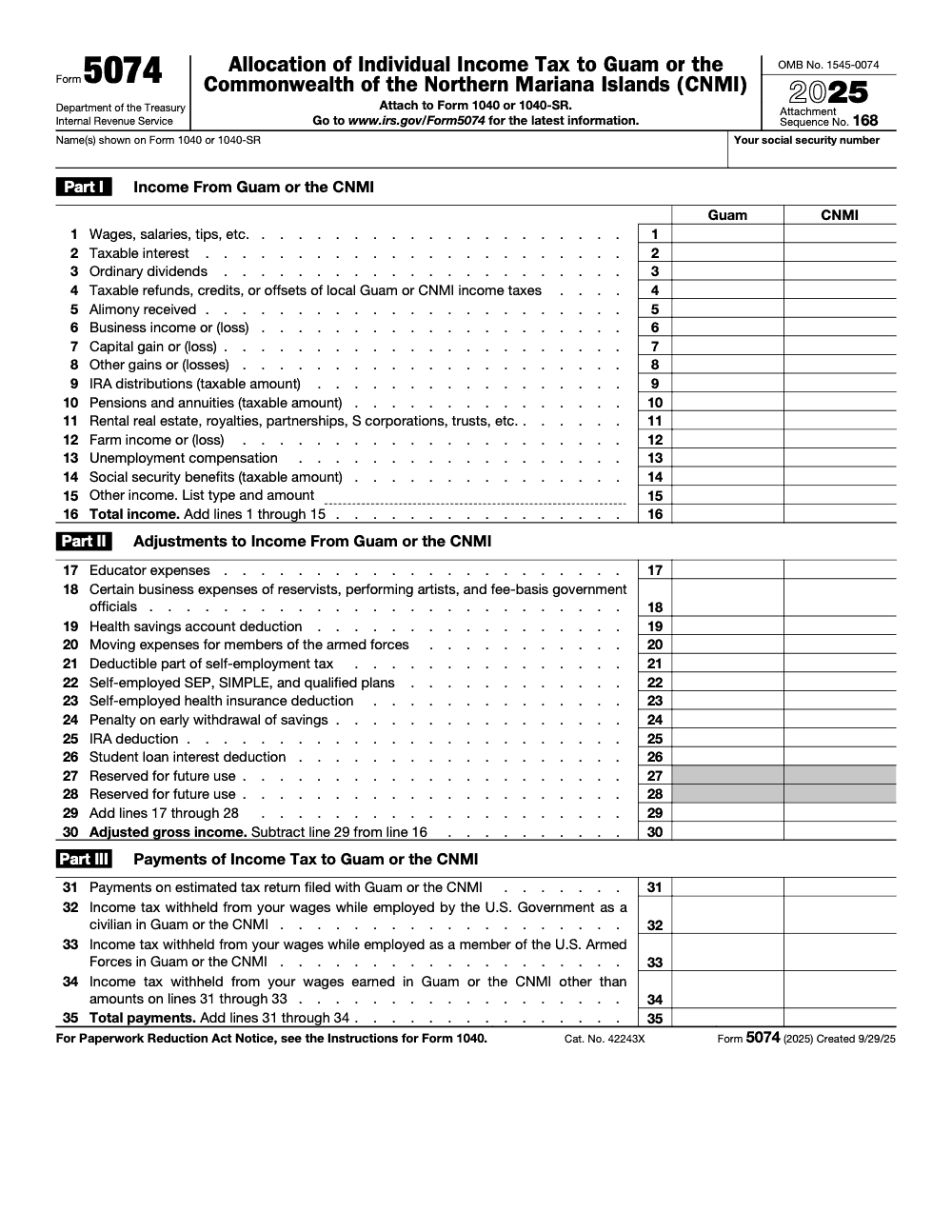
Form 5074 is the IRS allocation worksheet that splits an individual's income tax between the United States and Guam or the CNMI – a U.S. citizen or resident alien who is NOT a bona fide territory resident attaches it to Form 1040 or 1040-SR when all three conditions apply at once: a U.S. return is filed, AGI is $50,000 or more, and at least $5,000 of gross income comes from Guam or CNMI sources (per the 2025 Form 5074 instructions, OMB 1545-0074). Side-by-side Guam and CNMI columns run from line 1 (wages) through line 35 (total territory payments), and a residency change may also require Form 8898 with a $1,000 per-failure penalty.
A contractor splits the year between Guam and the mainland, working federal contracts in one and living in the other, and the return has to decide where the income tax actually gets paid. Form 5074 is the allocation worksheet that divides an individual's income tax between the United States and Guam or the CNMI, attached to Form 1040 or 1040-SR.
It only comes into play when all three conditions hit at once: a U.S. return is filed, AGI is $50,000 or more, and at least $5,000 of gross income comes from Guam or CNMI sources. The piece people get wrong is residency. Whether the territory or the IRS receives the payment turns on bona fide resident status, so for any client with Guam or CNMI income, settle the §937 residency analysis before completing the form, because it drives the entire allocation. The deadline follows Form 1040: April 15, extended to October 15 with a valid extension.

Key Takeaways
- Form 5074 – “Allocation of Individual Income Tax to Guam or the Commonwealth of the Northern Mariana Islands (CNMI)” – is used by U.S. citizens and resident aliens (other than bona fide residents of Guam or the CNMI) who have income from Guam or the CNMI to allocate their federal income tax liability between the IRS and the applicable territory tax authority.
- Guam and the CNMI each have separate income tax systems that mirror the federal tax code, but tax is paid to the territory rather than the IRS for income sourced to that territory by a bona fide resident.
- Form 5074 is attached to the U.S. Form 1040 or Form 1040-SR and is used when the taxpayer has income from both mainland U.S. sources and Guam/CNMI sources, requiring an allocation of income and tax liability.
- The filing deadline follows Form 1040: April 15 (extended to October 15 with a valid extension), with a unique rule that bona fide residents of Guam or the CNMI may owe tax to the territory, not to the IRS.
- The most common error is incorrectly determining bona fide residency status, which determines whether the territory or the IRS receives the tax payment.
- Quick rule you can copy into your SOP: for any client with Guam or CNMI income, determine bona fide residency status under the IRC §937 rules before completing Form 5074 – the residency analysis drives the entire allocation.
What Form 5074 Is and When to Use It
Form 5074 is an allocation schedule used by U.S. citizens and resident aliens who have income from Guam or the Commonwealth of the Northern Mariana Islands (CNMI). The tax systems of both territories mirror the federal Internal Revenue Code, but instead of paying tax to the IRS, territory residents and those with territory-sourced income pay tax to the territory tax authority (Guam Department of Revenue and Taxation, or the CNMI Division of Revenue and Taxation).
Form 5074 is used specifically when a taxpayer has income from both U.S. mainland sources and Guam or CNMI sources during the same year, the taxpayer is not a bona fide resident of Guam or the CNMI, AGI on the U.S. return is $50,000 or more, AND at least $5,000 of gross income on the return is from Guam or CNMI sources (see Who Must File below for the full three-condition gate). It allocates the total income tax liability between the IRS and the territory based on where income was sourced and the taxpayer’s residency status.
From my side of the desk, the challenge with Form 5074 is not the math – it is the foundational residency and sourcing analysis that must come before the form. Get the bona fide residency determination wrong, and you will allocate tax to the wrong authority, creating penalties and amended return work on both sides of the allocation.
Who Must File Form 5074
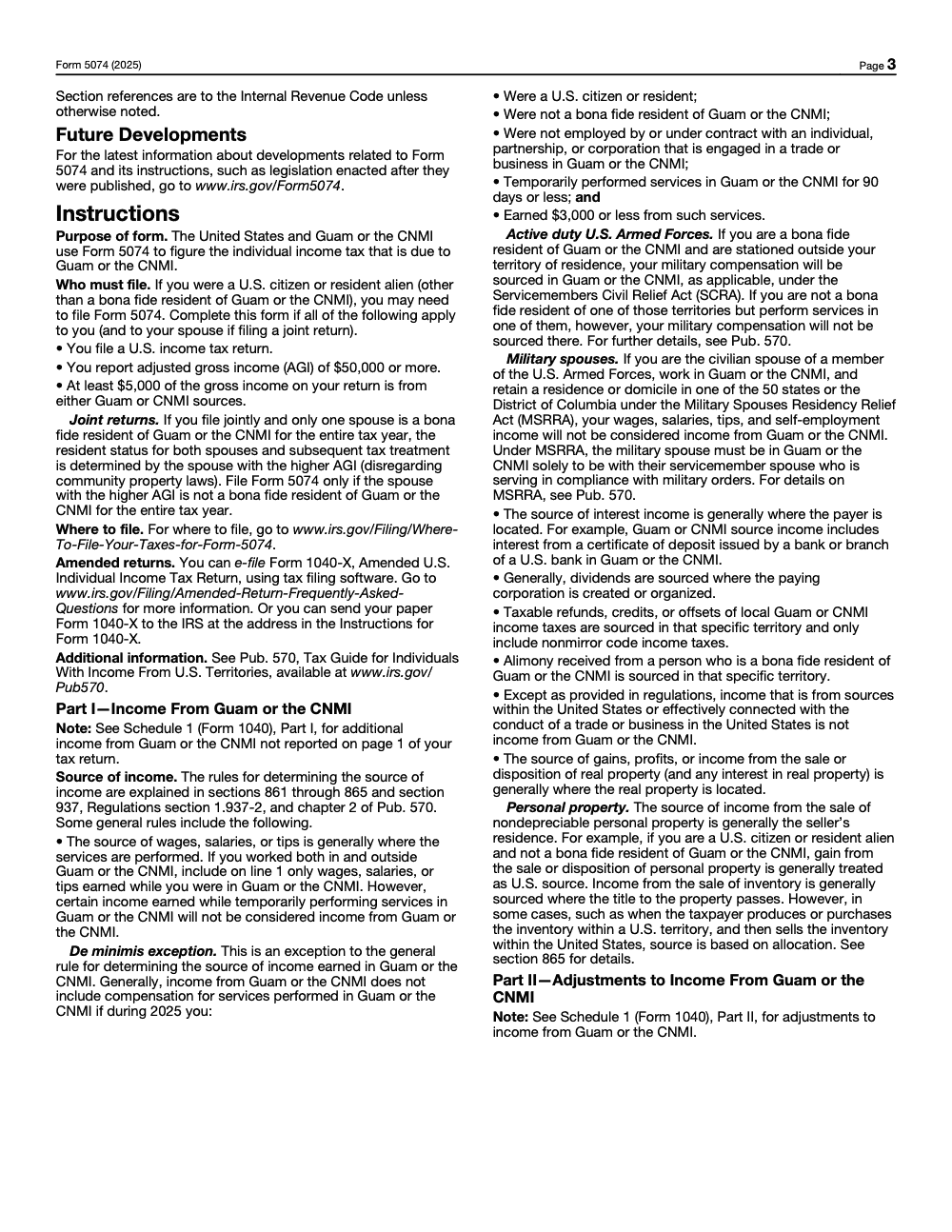
Form 5074 is filed only by U.S. citizens and resident aliens who are NOT bona fide residents of Guam or the CNMI, and only when all three of the following conditions apply at the same time: a U.S. income tax return is filed, adjusted gross income is $50,000 or more, AND at least $5,000 of gross income on the return is from Guam or CNMI sources. Bona fide residents of Guam or the CNMI do not file Form 5074 – they file directly with the territory under the mirror-code system. The specific filing obligation depends on the income sourcing and residency analysis under IRC §§935, 936, and 937.
The Role of Bona Fide Residency
Bona fide residency in Guam or the CNMI is determined using the same general framework as for other U.S. territories, based on physical presence, closer connection, and tax home tests under IRC §937. A bona fide resident of Guam files a territorial return and pays tax to Guam, not the IRS. Form 5074 is NOT the mechanism for that allocation – it is filed only by individuals who are NOT bona fide residents of Guam or the CNMI but who have Guam or CNMI source income meeting the filing thresholds.
Guam Mirror Code vs. CNMI
Guam has a “mirror code” tax system – it adopts the federal tax code verbatim, substituting “Guam” for “United States.” The CNMI has its own tax system that generally mirrors the federal code but has some differences. This distinction matters for how the Form 5074 allocation is calculated and which authority receives each portion of the tax.
How to Complete Form 5074
Form 5074 is a multi-part calculation form. The exact structure depends on which territory is involved and the taxpayer’s residency status. Here is the general workflow.
Step 1: Determine Bona Fide Residency
Before completing Form 5074, complete the residency analysis. Use Form 8898 (Statement for Individuals Who Begin or End Bona Fide Residence in a U.S. Territory) if there was a change in residency status during the year (failure to file when required carries a $1,000 penalty for each separate failure – not a single per-taxpayer cap – unless reasonable cause and not willful neglect can be shown). The residency determination governs how income is allocated and which authority receives which portion of the tax.
Step 2: Identify Territory-Sourced Income
Identify all items of income and deduction sourced to Guam or the CNMI. Territory-sourced income generally includes income from employment in the territory, business income from territory operations, and rental income from territory property. Income from U.S. sources is sourced to the IRS regardless of where the taxpayer lives.
| Income Type | Typical Sourcing | Allocated To |
|---|---|---|
| Wages from Guam employer (services performed in Guam) | Guam (where services performed, not employer location) | Guam tax authority |
| Wages from U.S. employer for work in Guam | Guam (if worked in Guam) | Guam tax authority (if bona fide resident) |
| Investment income (U.S. stocks, bonds) | U.S. source | IRS |
| Federal government wages (civilian employees) | Special rules apply | Confirm per specific contract and residency status |
| Rental income from Guam property | Guam | Guam tax authority |
Step 3: Calculate the Allocation
Form 5074 does not apply a single proportion-based split of total tax liability. Instead, it uses side-by-side Guam and CNMI columns to allocate specific income, adjustment, and payment lines to each territory. Part I (lines 1 through 16) reports Guam or CNMI source income line by line, Part II (lines 17 through 30) reports adjustments attributable to each territory, and Part III (lines 31 through 35) reports estimated tax payments and income tax withheld paid to Guam or the CNMI. Follow the actual 2025 Form 5074 instructions precisely for each line, since each numeric line carries its own Guam and CNMI column entry.
Attaching to Form 1040
Form 5074 is attached to the U.S. Form 1040 or Form 1040-SR. The taxpayer files with the IRS the portion of the return that relates to U.S.-sourced income and IRS-allocated tax. A separate return is filed with the territory tax authority for territory-sourced income and territory-allocated tax.
Deadlines, Penalties, and Filing Requirements
| Filing Event | Deadline | Notes |
|---|---|---|
| Form 1040 with Form 5074 to IRS | April 15 | Extension available to October 15 |
| Territory tax return to Guam or CNMI | April 15 (territory deadline) | Confirm current territory deadline with local tax authority |
| Form 8898 (if residency changed) | Due with Form 1040 | Required when changing bona fide residency status |
Penalty for Incorrect Allocation
If the allocation on Form 5074 is incorrect – either directing too much tax to the IRS or too much to the territory – both the IRS and the territory tax authority can assess penalties for the underpayment on their side. Double exposure is possible, which is why the residency and sourcing analysis must be accurate before any numbers are put on the form.
Guam vs. CNMI: Filing Rules Compared
While both Guam and the CNMI are covered by Form 5074, the specific rules and tax authority relationships differ between the two territories.
Guam: Mirror Code Territory
Guam operates a mirror code tax system that adopts the federal Internal Revenue Code with “Guam” substituted for “United States.” Bona fide Guam residents who have only Guam-sourced income generally pay all their income tax to the Guam Department of Revenue and Taxation and may not need to file with the IRS at all. Those who are NOT bona fide Guam residents and have mixed income (Guam and mainland sources) use Form 5074 to allocate, but only when all three conditions apply at the same time: a U.S. return is filed, AGI is $50,000 or more, AND at least $5,000 of gross income on the return is from Guam or CNMI sources.
CNMI: Separate Tax Agreement
The CNMI has a separate tax implementation agreement with the United States that established its own tax collection system. CNMI bona fide residents generally pay income tax to the CNMI tax authority. The interaction between federal and CNMI tax obligations involves specific coordination rules that may differ from the Guam mirror code approach. Confirm current-year CNMI-specific rules from the Form 5074 instructions.
Federal Employees in Guam and CNMI
U.S. federal civilian employees working in Guam and CNMI have historically been treated differently from private-sector employees under the mirror code and tax agreements. Federal wages may be subject to different sourcing rules. This is an area where practitioners must be especially careful and should review the current IRS guidance and any bilateral agreements in effect for the applicable tax year.
Bona Fide Resident Status and Territory Tax Obligations
Bona fide residency in a U.S. territory is not simply a question of where you live – it is a multi-factor legal determination with significant tax consequences.
The Three-Part Test Under IRC §937
To be a bona fide resident of Guam or the CNMI, the taxpayer must meet: (1) a physical presence test (at least 183 days in the territory during the year); (2) a tax home test (the territory is the primary tax home); and (3) a closer connection test (closer ties to the territory than to the U.S. mainland or any other foreign country). All three conditions must be satisfied for bona fide residency to apply.
Partial-Year Residency
If the taxpayer moved to or from a territory during the year, Form 8898 may be required to notify the IRS of the change in bona fide residency status. For the year of the move, income must be allocated between the pre-move and post-move periods, with each period’s income sourced and taxed according to the applicable rules for that residency status.
Impact on Form 5074 Allocation
The bona fide residency status directly determines how Form 5074’s allocation is structured. A bona fide Guam resident pays Guam for territory-sourced income; a non-resident with Guam income pays a different allocation. Getting this determination wrong upstream creates an incorrect Form 5074 downstream. Small errors create big cleanup.
Common Mistakes That Slow Things Down
Form 5074 mistakes cluster around three things: which thresholds actually trigger the filing, how each income line gets sourced between Guam, the CNMI, and the U.S. mainland, and whether a related residency change requires Form 8898 on the side.
Practical Checklists You Can Reuse
These three checklists are copy-paste ready for a firm SOP – the threshold gate runs at intake, the sourcing workpaper runs during preparation, and the residency-change packet runs whenever bona fide residency in Guam or the CNMI starts or ends.
Threshold and eligibility gate
- Confirm a U.S. Form 1040 or 1040-SR is being filed for the year.
- Calculate AGI on the U.S. return and confirm it is $50,000 or more.
- Calculate gross income from Guam and CNMI sources separately and confirm at least $5,000 total.
- Confirm the taxpayer is NOT a bona fide resident of Guam or the CNMI under IRC §937.
- For joint returns, identify the higher-AGI spouse and apply residency tests to that spouse alone, ignoring community property.
- If all gates pass, attach Form 5074 (attachment sequence 168) to Form 1040 or 1040-SR.
Per-line sourcing workpaper
- Line 1 wages: source by where services were performed, not the employer's location.
- Line 2 interest: source to the location of the paying bank or institution.
- Line 3 dividends: source to where the paying corporation is created or organized.
- Line 4 tax refunds: include only nonmirror-code Guam or CNMI income tax refunds.
- Lines 6 through 13 business, capital, rental, farm, unemployment: confirm each amount against the underlying schedule.
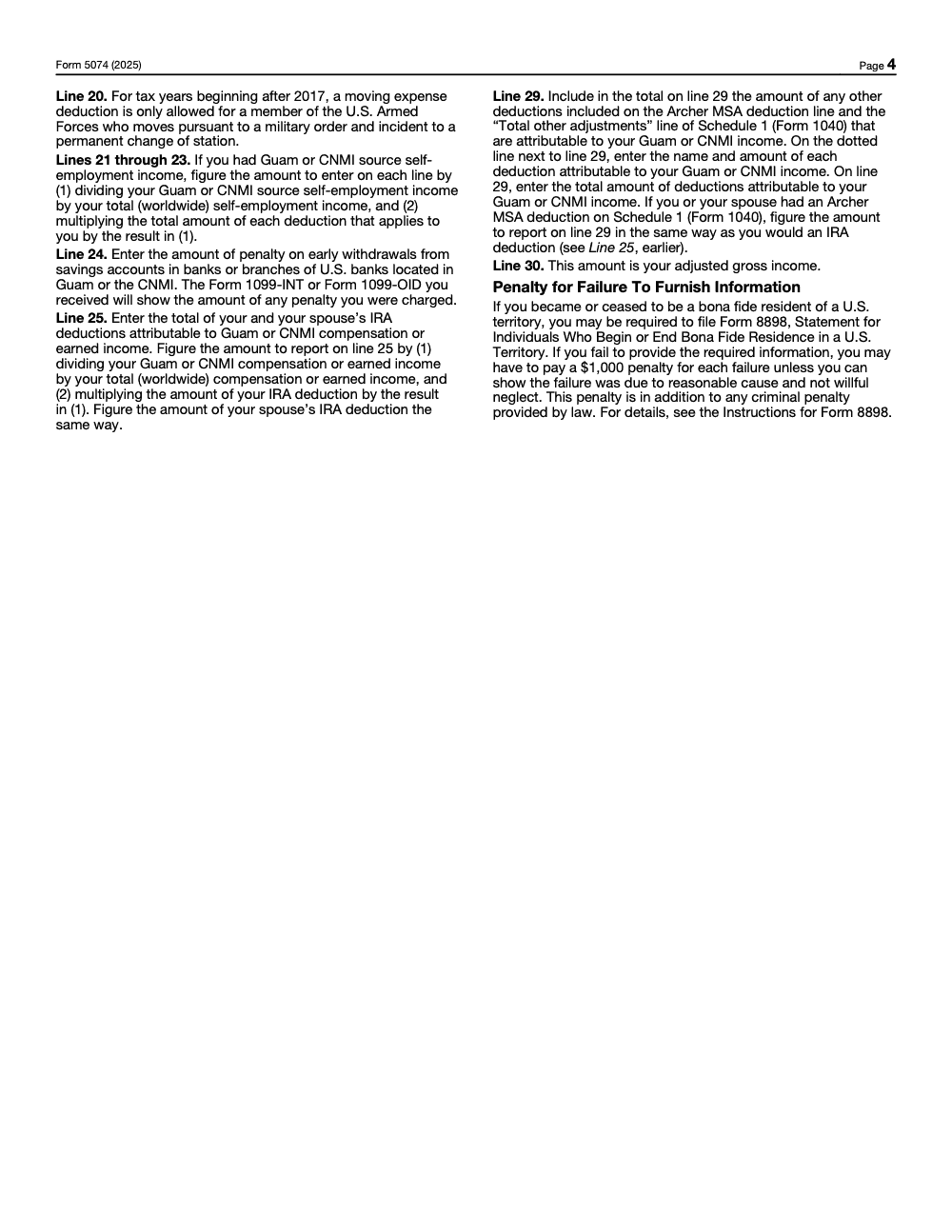
- Lines 21 through 23 SE-related deductions: allocate by the Guam or CNMI SE-income ratio over worldwide SE income.
- Line 25 IRA deduction: allocate by each spouse's own compensation ratio, not by AGI.
- Line 29: add any Archer MSA deduction and other Schedule 1 adjustments attributable to the territory, with the name and amount written on the dotted line.
- Lines 27 and 28: confirm blank (reserved for future use, greyed out on the 2025 form).
- Use the side-by-side Guam and CNMI columns on every numeric line; do not combine territories.
Residency-change packet (Form 8898 trigger)
- Confirm whether the taxpayer began OR ended bona fide residence in Guam or the CNMI during the tax year.
- If yes, prepare Form 8898 alongside Form 5074 and document the dates of physical presence.
- Capture the three IRC §937 tests (183-day presence, primary tax home, closer connection) in the workpaper.
- Note that the failure-to-furnish penalty on Form 8898 is $1,000 per failure, not a single cap.
- If reasonable cause exists, attach the contemporaneous documentation now, not at audit.
- For active-duty servicemembers, attach the SCRA residency declaration; for civilian spouses, attach MSRRA support.
- For joint filers, apply the higher-AGI spouse rule and document why community property allocation was disregarded.
Keep 5074 Season From Stalling
Form 5074 work tends to land late in the cycle because territory sourcing is rarely caught at intake. The client mentions a Guam consulting engagement or a CNMI rental, the AGI threshold is already at $50,000 or more, and the $5,000 territory-gross test gets crossed by accident. By the time the workpaper is rebuilt for two side-by-side columns across 35 line items and three Parts (per the 2025 Form 5074 instructions, OMB 1545-0074), the preparer is already against the April 15 deadline.
The fix is upstream, not at review. A short residency and territory-sourcing gate at intake removes the surprise, and a per-line workpaper that mirrors the form's two-column structure removes the rework. Most of the cost in 5074 work is in finding out late.
- Add a Guam or CNMI source question to the client intake before scoping, so the $50,000 AGI test and the $5,000 territory-gross test are scored before the engagement letter goes out.
- Lock the line 1 wages source to where services were performed, and capture SCRA or MSRRA declarations for any military or military-spouse client before touching lines 1, 32, and 33.
- Run lines 21 through 23 through a Guam or CNMI SE-income ratio for the SE-related deductions, and run line 25 through a compensation ratio for the IRA deduction, with each spouse's numerator and denominator documented separately.
- Flag any client whose bona fide residency began or ended in the year for a parallel Form 8898 packet, since the failure-to-furnish penalty is $1,000 per occurrence.
- Verify lines 27 and 28 are blank and the dotted line beside line 29 carries the named Archer MSA or other Schedule 1 adjustment attributable to the territory.
Accountably's U.S. tax delivery teams run this gate at intake and the line-by-line allocation inside a documented SOP, so the partner review is reading a finished Guam-and-CNMI allocation rather than building it from scratch under a deadline.
FAQs
Form 5074 allocates a U.S. taxpayer’s individual income tax liability between the IRS and the Guam or CNMI tax authority. It is attached to Form 1040 or Form 1040-SR when the taxpayer has income from both U.S. and territory sources during the same year. The allocation determines how much tax is paid to the IRS and how much to the territory tax authority.
Form 5074 is filed only by U.S. citizens and resident aliens who are NOT bona fide residents of Guam or the CNMI, and only when all three conditions apply at the same time: a U.S. income tax return is filed, AGI is $50,000 or more, and at least $5,000 of gross income on the return is from Guam or CNMI sources. Bona fide residents of Guam or the CNMI do not file Form 5074 – they file directly with the territory under the mirror-code system.
A bona fide resident must satisfy three tests under IRC §937: at least 183 days of physical presence in the territory, the territory as the primary tax home, and a closer connection to the territory than to the U.S. mainland or any foreign country. All three conditions must be met for bona fide residency to apply for tax purposes.
Form 5074 is due with Form 1040 on April 15, extendable to October 15 with a valid extension. A separate territory tax return must also be filed with the Guam or CNMI tax authority by the territory deadline, which is typically also April 15. Confirm the current-year territory deadline with the local tax authority.
Other forms this guide names
- Form 8898: Guide to Bona Fide Residency, Filing Rules & Penalty
- Form 1040: Filing Guide for 2025 Returns (AGI, Deductions, Deadlines)
- Form 1040-SR: Standard Deduction, Schedules, E-file Tips
About this guide
Accountably helps US CPA, EA, and accounting firms hire trained accountants and tax preparers in India.
About us Reviewed byJugal Thacker, CPAFounder and CEO at Accountably
A Washington-licensed CPA with 7+ years inside US firms – PwC, a real-estate tax practice, then a full-service firm, rising from reviewer to manager to advisory. This article was reviewed against current IRS guidance for the 2025 tax year and updated for filers preparing late returns, amendments, and 2026 estimates.
View profile →How we research, review, and update this guide
Every Accountably guide is researched against primary IRS sources, reviewed by a U.S. CPA, and refreshed as guidance evolves. Read our Editorial Guidelines to see how we source, fact-check, and update our content.