Summarize this article with AI
In Brief
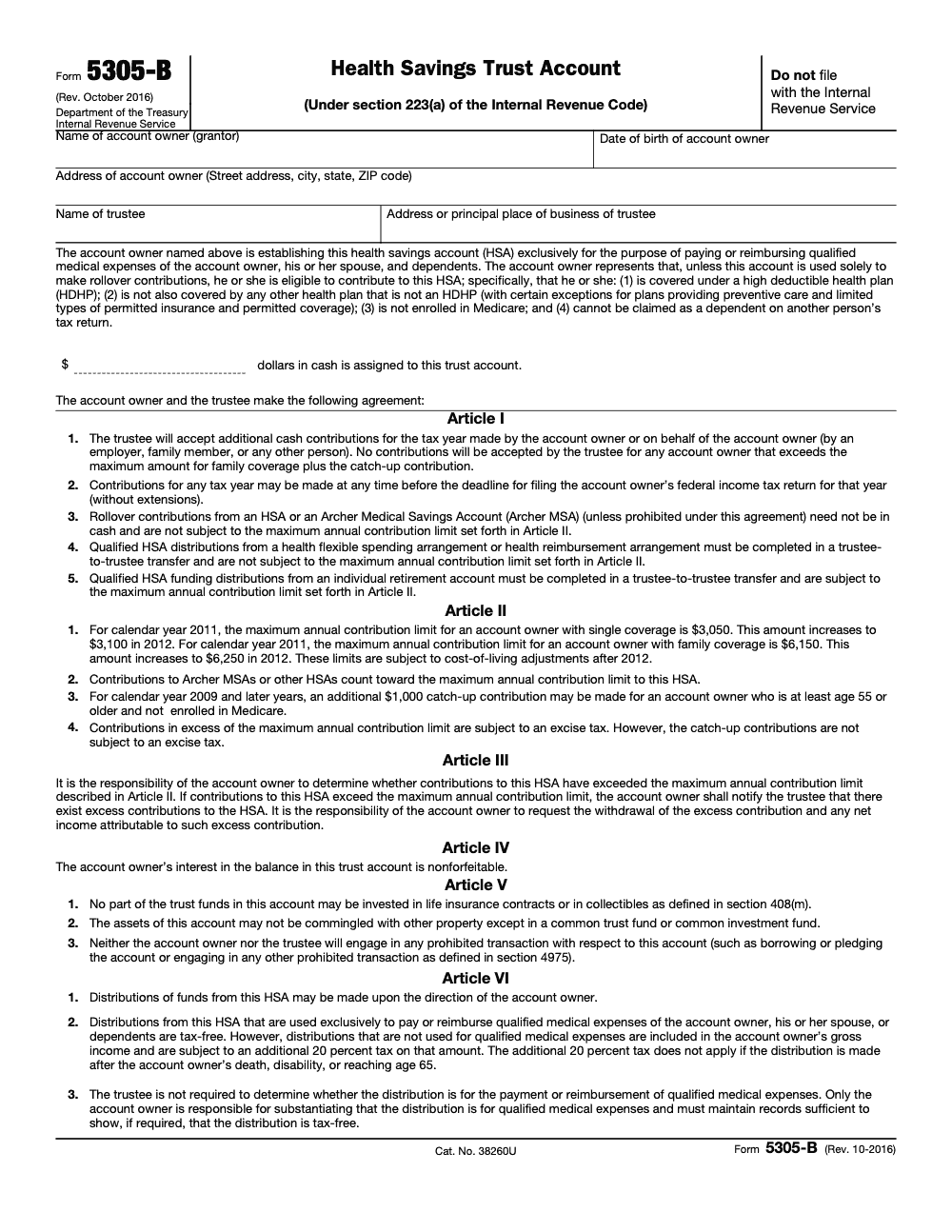
Form 5305-B is the IRS model trust agreement that establishes a Health Savings Account (HSA) under Internal Revenue Code §223(a), per Form 5305-B (Rev. October 2016); use it for a trust HSA and Form 5305-C for a custodial HSA. It is not filed with the IRS – the account owner and trustee execute and retain it – and 2025 HSA contributions are due by April 15, 2026 without extensions, with execution support available through our tax services.
People reach for Form 5305-B expecting a SIMPLE IRA document, and that is the wrong shelf entirely. Form 5305-B is the IRS model trust agreement that establishes a Health Savings Account under IRC §223(a). A SIMPLE IRA gets adopted on Form 5304-SIMPLE or Form 5305-SIMPLE, depending on whether employees can choose the financial institution.
Knowing which document you are signing changes everything downstream, because the rules do not overlap. An HSA carries its own annual limits, with 2025 figures of $4,300 self-only and $8,550 family, while a SIMPLE IRA has its own deferral caps and a 25% early distribution tax in the first two years. Form 5305-B itself is not filed with the IRS; the account owner and trustee execute and retain it, and 2025 HSA contributions are due by April 15, 2026 without extensions.
Key Takeaways
- Form 5305-B is the IRS model trust agreement for Health Savings Accounts, HSA trust version. It is not a SIMPLE IRA or SEP document. Keep it on file, you do not file it with the IRS.
- SIMPLE IRAs are adopted on Form 5304-SIMPLE or Form 5305-SIMPLE, depending on whether employees can choose the financial institution. Do not use 5305-B for SIMPLE.
- SIMPLE IRA employee deferrals are set by the IRS each year. For 2024 the limit is 16,000 with a 3,500 catch-up. For 2025 the limit increases to 16,500, with special “super” catch-up for ages 60–63 under SECURE 2.0. Verify limits annually.
- SIMPLE IRA distributions in the first two years can trigger a 25% early distribution tax, and rollovers are restricted during that window.
- HSAs have their own annual limits and HDHP rules. For 2025 the HSA limits are 4,300 self-only and 8,550 family, increasing to 4,400 and 8,750 in 2026.
What Form 5305-B Actually Is
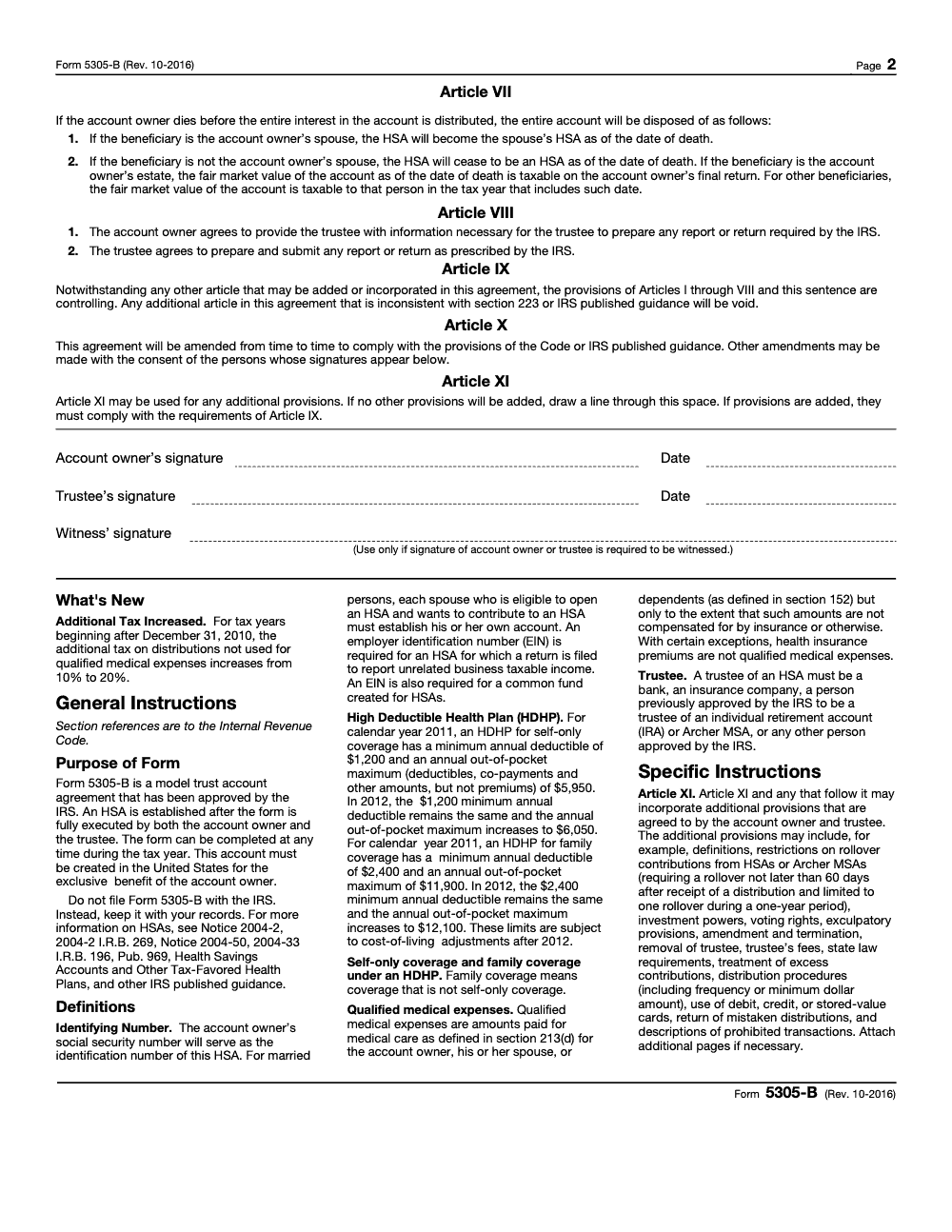
Form 5305-B is the IRS’s model Health Savings Trust Account agreement. It is the boilerplate trust language that banks, trust companies, and approved trustees use when opening HSAs in trust form. You do not send it to the IRS. You adopt it with a qualified trustee, keep it with your records, and use it as the governing agreement for the HSA. There is also a custodial version, Form 5305-C, that serves the same purpose under a custodial arrangement.
A few practical notes:
- The form sets the legal framework for contributions, distributions, prohibited transactions, and trustee duties for HSAs.
- Your employees’ payroll HSA contributions can feed accounts opened under this agreement or the 5305-C custodial version.
- Employers making HSA contributions must follow comparability or cafeteria plan rules, explained in IRS Publication 969.
What Form 5305-B Is Not
Form 5305-B is not a retirement plan document. It is not used for:
- SIMPLE IRAs, which require Form 5304-SIMPLE or Form 5305-SIMPLE to adopt the plan.
- SEPs, which use Form 5305-SEP.
- Traditional or Roth IRAs, which use the 5305 and 5305-R series respectively.
Using 5305-B to stand up a SIMPLE IRA, a SEP, or any IRA will lead to rejected paperwork, corrected contributions, and wasted time. Keep these toolboxes separate.
Which Form Do I Use? A Fast Comparison
| Plan or Account | Purpose | IRS model form(s) | File with IRS? |
| HSA, trust version | Health Savings Account, trust | 5305-B | No |
| HSA, custodial version | Health Savings Account, custodial | 5305-C | No |
| SIMPLE IRA, participants choose institution | Adopt SIMPLE plan | 5304-SIMPLE | No |
| SIMPLE IRA, employer designates institution | Adopt SIMPLE plan | 5305-SIMPLE | No |
| SEP-IRA | Adopt SEP plan for employer contributions | 5305-SEP | No |
| Traditional IRA | IRA agreement | 5305 or 5305-A | No |
| Roth IRA | IRA agreement | 5305-R or 5305-RA | No |
Source references for the model forms listing are on the IRS retirement plan forms index.
Why the mix-ups happen
Many small employers and even seasoned admins assume anything with a “5305” label relates to IRAs. Some do. Form 5305-B does not. It lives in the HSA world. A quick double check against the IRS forms list before you order packets can save you a week of back-and-forth.
SIMPLE IRA Essentials, So You Do Not Use the Wrong Form
If your goal is a SIMPLE IRA for a small employer, here is the clean path.
- Use Form 5304-SIMPLE when participants can choose their own financial institution. Use Form 5305-SIMPLE when you require all contributions to go to one designated institution. Adopt the plan by completing and signing the correct model form, keep it on file, do not file it with the IRS, and provide the annual employee notice.
- Eligibility is generally 100 or fewer employees who earned 5,000 or more in the prior year, with employees eligible if they earned 5,000 in any two prior years and are expected to earn 5,000 this year.
- You must pick one employer funding method each year, either a match up to 3% of pay or a 2% nonelective to all eligible employees.
- Deposit timing matters. Employee salary reduction contributions must be deposited promptly, generally no later than 30 days after the end of the month withheld. Many SIMPLE plans qualify for a 7 business day safe harbor under DOL timing rules. Employer contributions are due by the tax return due date, including extensions.
SIMPLE IRA Limits for 2024 and 2025
- 2024 employee deferral limit is 16,000, with 3,500 catch-up at age 50 or older. The aggregate personal limit across multiple employer plans is 23,000 for 2024.
- 2025 employee deferral limit increases to 16,500. SECURE 2.0 also adds special catch-up rules for ages 60–63 that can increase the catch-up for certain plans, often discussed as a “super” catch-up for SIMPLEs. Confirm your plan’s features before you communicate numbers.
Pro tip for controllers and payroll teams, codify the annual update process each fall. Document where you pull the numbers, who approves the update, and when you refresh payroll election forms and employee notices.
The SIMPLE IRA Two-Year Rule and 25% Early Distribution Tax
SIMPLE IRAs carry a special two-year clock. Withdrawals in the first two years are subject to an additional 25% early distribution tax if the normal IRA exceptions do not apply. During that same two-year period, rollovers are restricted. You can move money only to another SIMPLE IRA. After the two-year period, standard IRA rollover options open up. Make sure your 1099-R coding and any trustee-to-trustee transfers respect this rule.
If you are ever unsure, check the first date your employer deposited to that participant’s SIMPLE IRA. That is day one for the two-year window.
HSAs at a Glance, Because Form 5305-B Lives Here
If you are setting up HSAs, 5305-B is right in your lane.
- Purpose. HSAs are tax-favored accounts for people covered by an HSA-eligible high deductible health plan, though HDHP coverage alone is not enough to contribute: the account owner must also carry no other disqualifying coverage, not be enrolled in Medicare, and not be claimable as a dependent on another tax return. Contributions can be made by employees or employers, and qualified medical withdrawals are tax free. Publication 969 is your operating manual.
- Limits. For 2025, the HSA contribution limits are 4,300 self-only and 8,550 family. For 2026, the limits rise to 4,400 and 8,750. The 55+ catch-up stays at 1,000, but only for an account owner who is not enrolled in Medicare; Medicare enrollment stops all HSA contributions, including the catch-up.
- HDHP thresholds. The IRS also updates minimum deductibles and maximum out-of-pocket limits each year for HSA-qualifying HDHPs. Always confirm the current thresholds before you communicate eligibility.
5305-B vs 5305-C, Which One Should You Use?
- 5305-B, the trust version, is common when a bank or trust company serves as trustee under a trust agreement.
- 5305-C, the custodial version, is used when an HSA is set up as a custodial account. Many retail HSA providers use the custodial format. Both are IRS model documents. Your provider will tell you which vehicle they support.
How to Complete and Adopt Form 5305-B Correctly
Here is a straightforward, repeatable way to keep 5305-B clean and compliant.
- Confirm you are using the current IRS model form and that your trustee supports the trust version. Many providers offer the custodial version, 5305-C, instead. Check before payroll begins.
- Open and complete the PDF with a current PDF reader so all fields render properly. Save a signed copy to your plan files and, if applicable, provide employees with the account agreement from your bank or HSA provider.
- Align your payroll setup with Publication 969 rules. If you contribute as an employer outside a cafeteria plan, apply the comparability rules or route contributions through the Section 125 plan to use the separate cafeteria plan rules. Communicate clearly which approach you use.
- Calendar annual updates. Each fall, confirm next year’s HSA limits and HDHP thresholds before open enrollment. Update your employee communications and payroll caps accordingly.
HSAs are not filed with the IRS when opened. You keep the executed agreement with the trustee’s file set, the same way you retain SIMPLE or SEP plan documents.
Common Mistakes We See, And Quick Fixes
The same handful of slip-ups shows up on almost every HSA setup we review, and each one is avoidable with a quick check before documents go out.
Where To Find Official Guidance Fast
- Model forms and retirement plan form index for IRAs, SIMPLE, and SEPs.
- SIMPLE plan setup and annual notice requirements, plus timing rules.
- SIMPLE two-year rule and 25% early distribution tax details.
- Publication 969 for HSA rules, employer contributions, and cafeteria plan interactions.
- Annual HSA and HDHP limits for 2025 and 2026.
A short note for busy firm owners
If your internal team is already stretched by peak season, year-end, or payroll cycles, these document choices and annual thresholds can slip through the cracks. At Accountably, we build SOPs and review steps that keep plan documents, notices, and payroll caps aligned, then we monitor the dates so updates do not get missed. It is not about more people, it is about clean, repeatable delivery. We only mention this because getting the right form in the right process is exactly the kind of guardrail that protects deadlines and trust.
Reusable Checklists
These are copy-paste ready for your firm SOPs. Drop them into your HSA setup and open-enrollment workflows and tick each item as you go.
HSA setup and 5305-B adoption packet
- Confirm the plan is an HSA, not a SIMPLE IRA or SEP, before pulling any model form.
- Verify the trustee supports the trust version (5305-B) rather than the custodial version (5305-C).
- Open the current IRS model form in an up-to-date PDF reader so all Articles render.
- Confirm each owner is HSA-eligible: HDHP coverage, no disqualifying coverage, not enrolled in Medicare, not claimable as a dependent.
- Record the owner’s Social Security number as the account identifier; reserve an EIN only for a UBTI return or a common HSA fund.
- Obtain signatures and dates from both the account owner and the trustee.
- Save the executed agreement to the plan file and do not mail it to the IRS.
- Open a separate HSA for each spouse who wants to contribute; HSAs cannot be jointly owned.
Open-enrollment limit refresh
- Pull current-year HSA contribution limits from the year’s IRS revenue procedure (Rev. Proc. 2024-25 for tax year 2025).
- Pull current HDHP minimum deductibles and out-of-pocket maximums for self-only and family coverage.
- Confirm the $1,000 age-55 catch-up applies and exclude any owner enrolled in Medicare.
- Update payroll contribution caps and any Section 125 cafeteria-plan elections to the new figures.
- Refresh employee communications so no one relies on the historical figures printed on Form 5305-B.
- Set the 2025 contribution deadline of April 15, 2026 without extensions in client reminders.
HSA eligibility and distribution review
- Confirm the owner is covered under an HSA-eligible HDHP before contributing.
- Check for disqualifying second coverage, setting aside permitted preventive-care and limited coverage.
- Confirm no Medicare enrollment, including Part A, before allowing any contribution.
- Track excess contributions and request withdrawal of the excess plus net income before the return due date to avoid the 6% excise tax.
- Reimburse only qualified medical expenses under IRC §213(d); remember most insurance premiums do not qualify.
- Keep receipts on file, because the trustee does not substantiate qualified expenses.
- Apply the 20% additional tax to non-qualified distributions, with exceptions for death, disability, or age 65.
Keep 5305-B Season From Stalling
Form 5305-B has no single filing deadline, and that is exactly why it slips. The work clusters in the fall, when next year’s HSA contribution limits and HDHP thresholds have to be confirmed against the year’s IRS revenue procedure before open enrollment, then again ahead of the April 15 contribution deadline that no filing extension moves. Because the form has not been revised since October 2016, every current limit lives in a separate revenue procedure someone has to look up, and Publication 969 keeps shifting around it.
When that lookup is one more thing on an overloaded team, the historical figures on the form get quoted by mistake, Medicare-eligible owners keep contributing, and excess-contribution corrections pile up after the deadline. A structured process catches most of it before it reaches a client.
- Lock an annual step to refresh HSA limits and HDHP deductible and out-of-pocket thresholds from the current IRS revenue procedure, then update payroll caps.
- Confirm each owner’s HSA eligibility and Medicare status before allowing the $1,000 age-55 catch-up.
- Verify the trustee supports the trust version, 5305-B, against the custodial 5305-C, before documents go out.
- Track excess contributions and trigger withdrawal of the excess plus net income before the return due date to avoid the 6% excise tax.
- Keep executed agreements in the plan file and confirm none were mailed to the IRS.
That is the kind of repeatable, reviewed delivery we build into our tax services: documented SOPs, multi-layer review, and calendar-driven updates so the limits, eligibility checks, and deadlines stay current without adding headcount.
FAQs
No. Like other IRS model account agreements, 5305-B is adopted with a qualified trustee and kept on file. You do not submit it to the IRS when you open the HSA.
No. Use 5304-SIMPLE or 5305-SIMPLE for SIMPLE plans, and 5305-SEP for SEPs. 5305-B is specifically for HSAs.
For 2024, the deferral limit is 16,000 with a 3,500 catch-up. For 2025, it rises to 16,500, and certain plans for ages 60–63 allow a larger catch-up under SECURE 2.0. Always verify the latest figures before open enrollment.
If no exception applies, the additional early distribution tax jumps to 25%, and rollovers are restricted to another SIMPLE IRA during that period. After two years, standard IRA rollover options apply.
For 2025, HSAs allow 4,300 self-only and 8,550 family. For 2026, limits increase to 4,400 and 8,750. Catch-up at 55+ remains 1,000.
Other forms this guide names
- Form 5305‑C: HSA Guide for Employers and CPAs
- Form 5305‑SEP: Limits, Eligibility, Setup & Deadlines
- Form 5305: Traditional IRA Trust Account Setup Guide
- Form 5305-R: Roth IRA Trust Account Setup Guide
About this guide
Accountably helps US CPA, EA, and accounting firms hire trained accountants and tax preparers in India.
About us Reviewed byJugal Thacker, CPAFounder and CEO at Accountably
A Washington-licensed CPA with 7+ years inside US firms – PwC, a real-estate tax practice, then a full-service firm, rising from reviewer to manager to advisory. This article was reviewed against current IRS guidance for the 2025 tax year and updated for filers preparing late returns, amendments, and 2026 estimates.
View profile →How we research, review, and update this guide
Every Accountably guide is researched against primary IRS sources, reviewed by a U.S. CPA, and refreshed as guidance evolves. Read our Editorial Guidelines to see how we source, fact-check, and update our content.