Summarize this article with AI
In Brief
Schedule C (Form 5713) computes the loss of tax benefits from participation in an international boycott under IRC §999. File it only when you completed Schedule A or Schedule B of Form 5713: box 1a uses the boycott factor from Schedule A, line 3, and box 1b uses specifically attributable taxes from Schedule B, line o. The September 2018 revision is still current for 2025 returns and attaches to the main return by April 15, 2026 (October 15, 2026 with extension), per the Instructions for Form 5713.
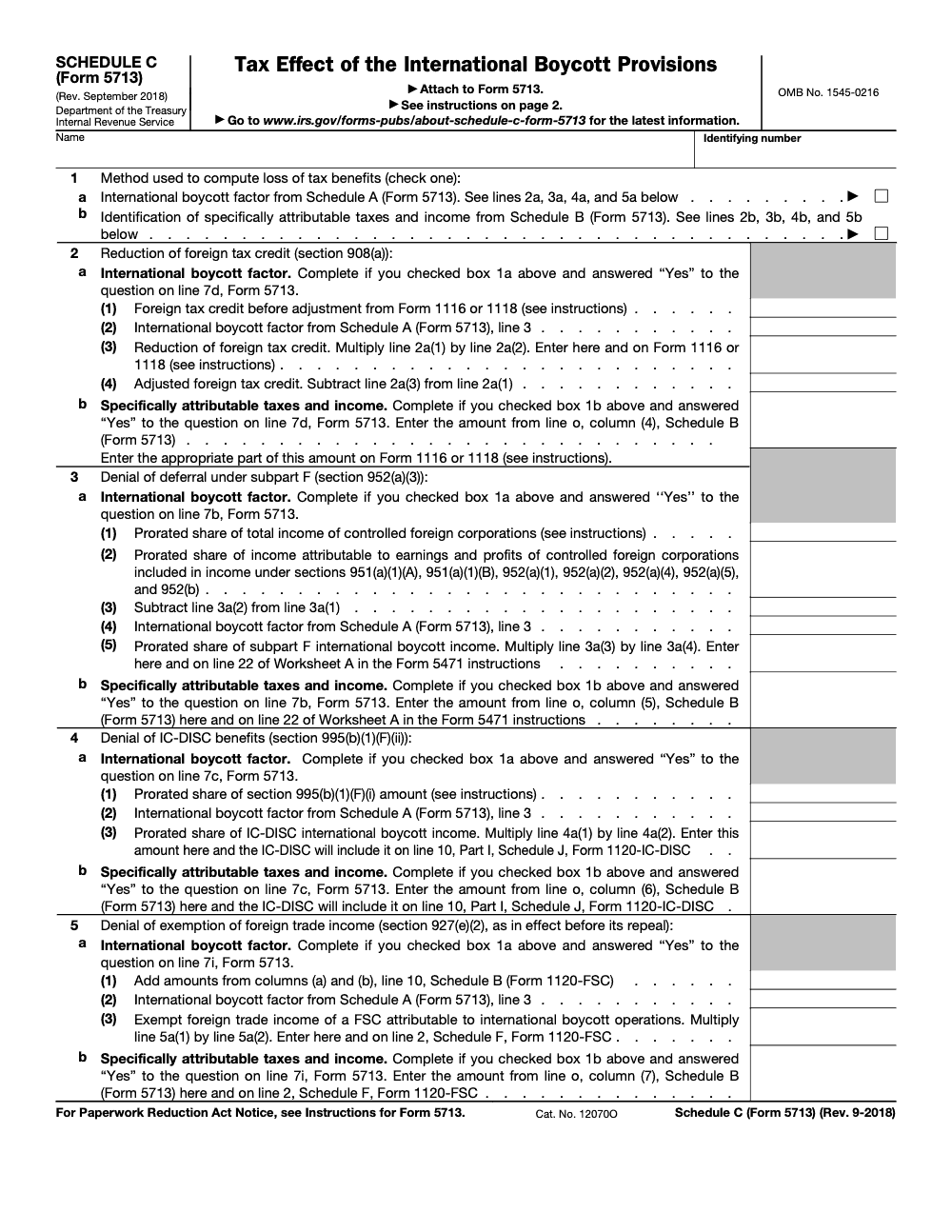
Box 1a of Schedule C (Form 5713) takes the boycott factor from Schedule A, line 3, and box 1b takes the specifically attributable taxes from Schedule B, line o. Schedule C computes the loss of tax benefits from participation in an international boycott under IRC §999, and you file it whenever you file Schedule A or Schedule B.
Choose the method first, because using a factor on Schedule A while feeding Schedule C with inputs from a specific attribution approach is one of the common misses. The September 2018 revision is still current for 2025 returns, it attaches to the main return by April 15, 2026, or October 15, 2026 with an extension, and the disallowed foreign tax credits have to tie back to Form 1116 or 1118.
Key Takeaways
- You file Schedule C whenever you file Schedule A or Schedule B with Form 5713. It translates boycott reporting into disallowed foreign tax credits and denied deferral benefits.
- The choice of method happens first. Schedule A uses the international boycott factor under section 999(c)(1). Schedule B uses specifically attributable taxes and income under section 999(c)(2). Schedule C aggregates and applies your chosen method.
- You attach Form 5713, including Schedule C, to your federal return by the normal due date for that return, including extensions. For calendar‑year 2025 filers, that is April 15, 2026, or October 15, 2026 if extended.
- As of 2025 Treasury notices, the published boycott list included Iraq, Kuwait, Lebanon, Libya, Qatar, Saudi Arabia, Syria, and Yemen. Always confirm the latest Federal Register notice before filing.
- Common misses are incomplete tie outs to Form 1116 or 1118, omitted carryovers, fuzzy documentation, and using a factor on Schedule A while feeding Schedule C with inputs that came from a specific attribution approach.
What Form 5713 and Schedule C actually do
- Form 5713 reports operations in, or related to, boycotting countries, plus requests to cooperate with a boycott. Schedules A and B quantify the scope, by factor or by specific attribution. Schedule C then computes the tax effect, including disallowed foreign tax credit, and any denied deferrals like IC‑DISC items.
- The instructions also reference regimes like FSC and the extraterritorial income exclusion. Those statutes were repealed, however section 999 computations still reference them for historical framework and certain legacy interactions noted in the instructions.
A quick map of the schedules
- Schedule A, International Boycott Factor, section 999(c)(1). Use a ratio that reflects boycott‑related receipts or activities.
- Schedule B, Specifically Attributable Taxes and Income, section 999(c)(2). Use direct tracing when you can substantiate that specific foreign taxes and income are tied to boycott operations.
- Schedule C, Tax Effect. Convert Schedule A or B results into disallowed credits and denied deferral benefits, then feed those amounts to the relevant forms, usually Form 1116 or 1118, and any applicable IC‑DISC or legacy FSC items.
Who needs to file Schedule C with Form 5713
If you file Schedule A or B with Form 5713, you also complete Schedule C, full stop. That includes U.S. persons with operations in or related to a boycotting country, members of controlled groups, U.S. shareholders of foreign corporations, partners, and certain trust owners. If you are a partner, you complete Schedule C on your return, while the partnership completes parts of Schedules A or B for partner use (the partnership itself does not file Schedule C – each partner files a separate one).
Think of Schedule C as the bridge between compliance reporting and your actual U.S. tax calculation. Skip it, and your Form 5713 is not complete, and your FTC math will not reflect section 999.
When it is due and how to submit it
- Due date. Attach Form 5713 with all applicable schedules to your federal income tax return by the return’s due date, including extensions. For most calendar‑year entities and individuals for 2025, that means April 15, 2026, or October 15, 2026 if extended.
- E‑file note. If you e‑file Form 5713 as an attachment to your e‑filed return, you do not need to submit a duplicate paper copy. Follow your main return’s e‑file attachment procedures.
- Penalties. Willful failure to file can bring a fine up to 25,000, up to one year in prison, or both, so treat the schedule as essential, not optional.
What Schedule C computes under IRC section 999
Schedule C is where you put numbers to your boycott reporting. It aggregates either the boycott factor from Schedule A or the specifically attributable amounts from Schedule B. Then it computes the loss of U.S. tax benefits, most commonly a reduction of the foreign tax credit, and in some cases the denial of deferral benefits like IC‑DISC amounts. The outputs then flow to Form 1116 or 1118 and, if relevant, IC‑DISC or legacy FSC filings noted in the instructions.
The loss of tax benefits, translated
- Foreign tax credit. Disallow the portion of foreign taxes tied to boycott activity. This increases your U.S. tax, dollar for dollar against the disallowed FTC.
- IC‑DISC. Measure forfeited exclusion or commission deductions connected to boycott cooperation, which increases U.S. taxable income.
- FSC and ETI. Referenced in the instructions for historical context, as they were repealed, but still part of the section 999 interaction described there.
Factor method vs specific attribution
- Factor method, Schedule A. Apply the international boycott factor, a ratio that captures boycott‑related receipts or activities, across taxes, income, and deferral items to determine how much to disallow.
- Specific attribution, Schedule B. When you can trace the income and foreign levies directly to boycott transactions, compute disallowances using the specifically attributable amounts instead of a ratio.
- Either path, Schedule C. You always use Schedule C to convert those inputs into the tax effect.
The current boycott list, check it before you file
The Treasury publishes the “List of Countries Requiring Cooperation With an International Boycott” at least quarterly in the Federal Register. In 2025 notices, the list included Iraq, Kuwait, Lebanon, Libya, Qatar, Saudi Arabia, Syria, and Yemen. Before you finalize Schedule C, confirm the latest notice because the list can change.
Tip, keep a PDF of the most recent Federal Register notice in your workpapers and reference the publication date in your memo, reviewers and future you will thank you.
Data to gather before you touch Schedule C
You will prepare faster, and review will go smoother, if you pull these items up front and map each one to where it will land on Schedule C.
- Your chosen method. Confirm if you are using the section 999(c)(1) factor method with Schedule A or the section 999(c)(2) specific attribution method with Schedule B.
- Foreign taxes, paid or accrued, and the related foreign‑source income for the year.
- The boycott factor from Schedule A, or the specifically attributable taxes and income from Schedule B.
- Your overall U.S. taxable income and your foreign tax credit limitation and carryovers.
- Any IC‑DISC items affected by boycott participation.
- Evidence supporting classification, allocation, and any tracing you used.
Quick risk radar to keep on your desk
| Item | What you might feel | What can go wrong |
| Missing FTC data | Unease that numbers are incomplete | Disallowance or incorrect Form 1116 or 1118 |
| Thin support for tracing | Concern during review | Adjustments, questions you cannot answer |
| Misclassified income | Frustration reconciling | Penalties or amended returns |
| Omitted carryovers | Regret when the notice arrives | Overpayment or messy corrections |
| Weak allocations | Alarm as deadlines loom | IRS challenge during exam |
The IRS instructions explicitly note where these amounts flow and how Schedules A, B, and C fit together. Use that as your line‑by‑line map while you build and review your binder.
Step by step, computing the loss on Schedule C
Step 1, confirm your path and lock inputs
- Verify whether you are feeding Schedule C with a boycott factor from Schedule A or with specifically attributable amounts from Schedule B.
- Pull the exact figures, not estimates. Tie each back to a labeled worksheet and keep PDFs of source documents like invoices or contracts that support the attribution.
Step 2, calculate the reductions
Use your method to compute the disallowable portion of the foreign tax credit and any affected deferral items, then post to the exact columns and lines on Schedule C. After that, recompute U.S. tax to show the incremental impact.
| Item | What to do |
| Foreign tax credits | Reduce credits using factor or specific attribution, then recompute U.S. tax |
| Excluded or deferred amounts | Recharacterize or disallow the boycott portion |
| Reconciliations | Crossfoot Schedule C to Form 1116 or 1118 and any IC‑DISC schedules |
If you used Schedule A or B, Schedule C is mandatory. Keep the math transparent.
How Schedule C hits FTC, IC‑DISC, and legacy items
Foreign tax credit, the most visible impact
Most teams feel the effect in the FTC first. Once Schedule C disallows a portion of foreign taxes, your FTC on Form 1116 or 1118 drops, and your U.S. tax goes up by that same amount, subject to the limitation rules. Make sure your reviewer can follow the bridge from Schedule C totals to the specific Form 1116 or 1118 lines, by basket, if relevant.
IC‑DISC, do not forget the boycott overlay
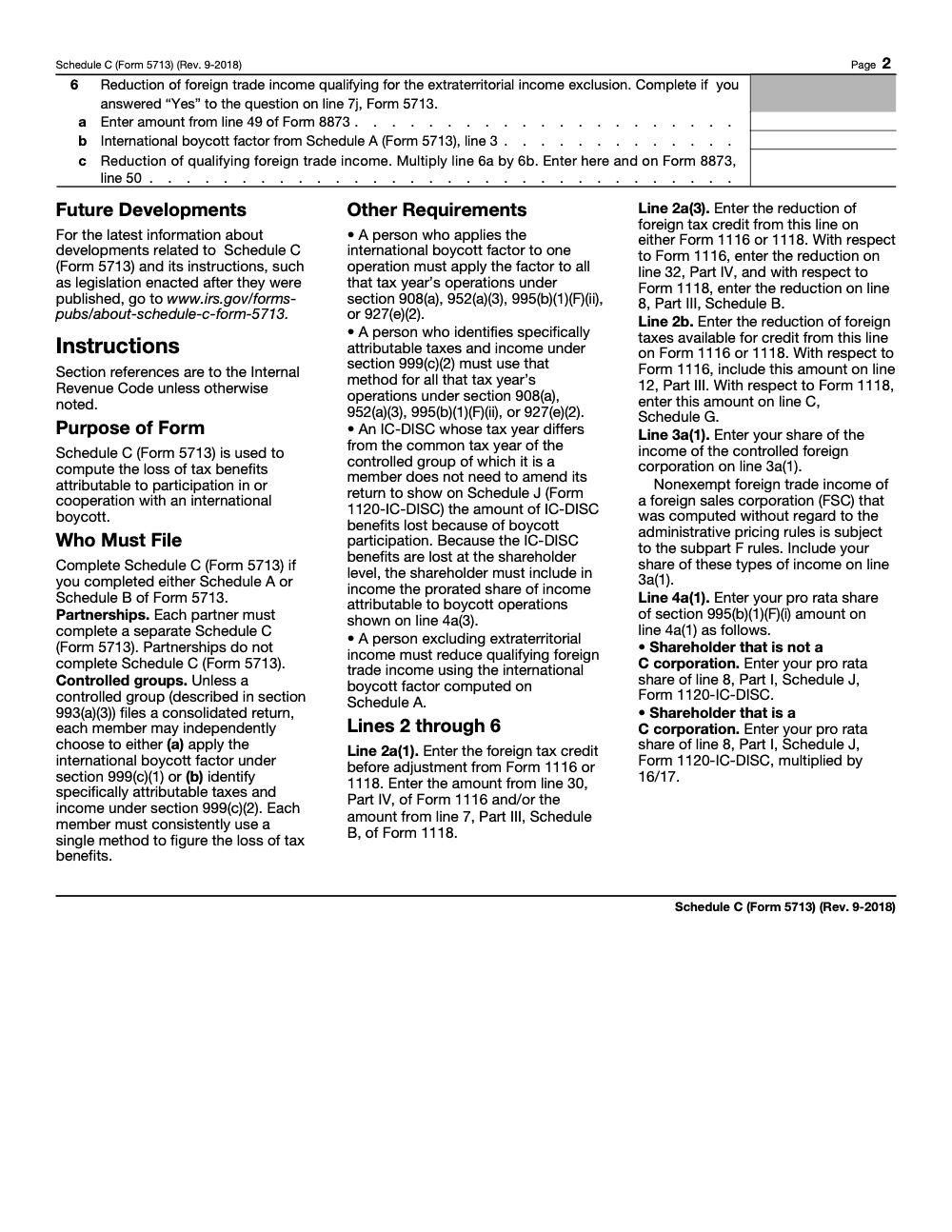
If you operate an IC‑DISC and any exports involve boycott cooperation, you need to measure the forfeited commission deduction or exclusion. Document the connection, show the calculation, and keep a short memo that cites section 999 and the Schedule C lines you used. C-corporation shareholders must multiply their pro rata share of line 8, Part I, Schedule J, Form 1120-IC-DISC by 16/17 before entering it on line 4a(1) – non-C-corporation shareholders enter the pro rata share without the multiplier, and skipping the 16/17 step overstates the boycott income. The instructions still refer to the interaction here.
FSC and ETI references, why they still appear
The Foreign Sales Corporation regime and the extraterritorial income exclusion were repealed, yet the instructions continue to list them when describing possible lost benefits (Schedule C line 5 still applies section 927(e)(2) as in effect before its 2000 repeal, so FSCs with grandfathered transactions still complete line 5a or 5b – the line is not obsolete). That historical context helps explain why some legacy terminology shows up in section 999 discussions. If a reviewer asks, note that the citations remain in the instructions.
Common Schedule C errors I keep seeing, and how you avoid them
- Skipping Schedule C after filing Schedule A or B. Schedule C is required to compute the tax effect, and Form 5713 is not complete without it.
- Mixing methods. Teams sometimes compute a factor on Schedule A, then feed Schedule C with a hybrid of factor and specific attribution. Pick one method and use it consistently across every boycott-affected operation that year under sections 908(a), 952(a)(3), 995(b)(1)(F)(ii), and 927(e)(2) – the choice is all or nothing, not line by line.
- Weak tie outs. If Schedule C does not tie to Form 1116 or 1118, reviewers will kick it back, and IRS agents will ask the same questions.
- Rounding and transposition errors. Put a one‑page reconciliation at the end of your binder that foots and cross‑foots to the dollar.
- Documentation gaps. Keep the latest Federal Register boycott notice in your file with a short note that explains how the list applies to your facts.
A simple fix that pays dividends, add a last page in your workpapers called “Reviewer Map.” It lists each Schedule C line and the exact worksheet name and cell where the number originates.
Filing mechanics, attachments, and recordkeeping
- Attach Form 5713 with Schedules A, B, and C as applicable to your main return, by the return’s due date, including extensions. For calendar‑year 2025, that is April 15, 2026, or October 15, 2026 if extended.
- E‑file mechanics. If you e‑file your return and attach Form 5713 electronically, you do not need to file a duplicate. Follow your software’s attachment guidance.
- Where Schedule C flows. Be ready to post results to Form 1116 or 1118, and if relevant, IC‑DISC or legacy FSC forms named in the instructions. Include a short cross‑reference sheet in your binder.
- Penalties. Willful failure to file may carry a 25,000 fine, imprisonment up to one year, or both. Build a calendar tickler now so this never becomes an issue.
A lightweight binder structure that reviewers love
- Cover memo, facts, method selection, citations, and the current boycott list notice date.
- Schedule A or B worksheets, with labeled tabs and source documents in PDF.
- Schedule C computations, with a summary page that bridges to Form 1116 or 1118.
- Federal Register notice PDF, plus any internal emails documenting boycott requests.
- Reviewer Map page, a one‑pager with line‑by‑line cross‑references.
Choose Schedule A or B before you calculate Schedule C
Your first decision, factor or specific attribution, sets everything else in motion.
- Choose Schedule A if a pro rata approach reasonably reflects your boycott exposure and you do not have clean tracing.
- Choose Schedule B if you can document that specific foreign taxes and income relate to boycott transactions.
- Whichever you choose, keep a short method memo in the file that references section 999(c)(1) or 999(c)(2) and explains why your choice is more accurate for the year. Then move to Schedule C.
A simple example
Say you operate in a country on the Treasury boycott list and your team completed Schedule A with an international boycott factor of 6.0 percent. Your foreign income taxes paid were 2,000,000 and related foreign‑source income was 10,000,000. You would apply the 6.0 percent to determine the disallowed portion of the foreign tax credit and any affected deferral amounts, then post those results to Schedule C and finally to Form 1116 or 1118. Keep the math and sources in one worksheet that the reviewer can audit in two minutes.
Data discipline that speeds reviews
A short checklist to pull before you start
- Current Federal Register boycott list printout or PDF.
- Final Schedule A or B worksheets with locked cells.
- Foreign tax paid or accrued detail by jurisdiction, with support.
- Foreign‑source income tie out by basket if needed for Form 1116 or 1118.
- FTC limitation worksheet and carryover rollforward.
- IC‑DISC computations if applicable.
A tiny table that keeps you honest
| Schedule C line | Source schedule | Workpaper tab | Reviewer note |
| FTC disallowance | Sch A or B | WP‑C‑1 | Bridges to Form 1116, Part III |
| Income adjustments | Sch A or B | WP‑C‑2 | Basket impact documented |
| IC‑DISC effect | Sch B or A | WP‑DISC | Cite section 999 memo |
| Totals to Form 5713 | C totals | WP‑Recon | Cross‑foot to the dollar |
Practical review safeguards that save partner time
- Lock your method early, then run a draft Schedule C and a draft Form 1116 or 1118 so you can reconcile before the final push.
- Create a two‑minute reviewer path. Show the current Federal Register list, the method memo, the input worksheet, and the bridge to the return.
- Add a final page called “What changed from last year” so reviewers and partners can spot differences without digging.
How Accountably can help without adding chaos
You might not need more people, you might need better delivery. When teams get buried, tie outs slip and review time balloons. If your firm wants a disciplined, offshore delivery layer that works inside your systems, follows SOPs, and protects review time, Accountably integrates trained accountants who adapt to your templates and keep workpapers standardized for Schedule A, Schedule B, and Schedule C. That way, partners spend less time in the weeds and more time on strategy. Use this if it is helpful to you, skip it if it is not.
The goal is simple, stable capacity, predictable turnaround, and clean reviews, especially during peak season.
Compliance note and sources to keep handy
- Verify the latest IRS page for Form 5713 and the instructions page before you finalize a return.
- Pull the most recent Federal Register notice for the boycott list and keep it in your binder.
- If you e‑file, confirm your software attachment process for Form 5713.
- If you have a question about penalties, read the instructions section on penalties and due dates for Form 5713.
Mini checklist you can copy into your binder
- Confirm boycott list and save the notice PDF.
- Choose method, section 999(c)(1) factor with Schedule A or section 999(c)(2) specific attribution with Schedule B.
- Build input worksheet, foreign taxes, foreign‑source income, FTC limitation and carryovers, IC‑DISC items if any.
- Compute Schedule C, post to Form 1116 or 1118, reconcile to the dollar.
- Final review, add the Reviewer Map, lock files, and attach with your return by the deadline.
Conclusion
You now have a clear playbook. Decide the method, collect the right data, compute the disallowances on Schedule C, and tie the numbers to the rest of the return. Keep your binder simple and your citations current, especially the boycott list and filing mechanics. If you do those things, Schedule C becomes routine, your FTC reconciliations will stand up to review, and you will file on time with confidence.
Common Mistakes We See Every Season
Schedule C (Form 5713) sees the same handful of errors year after year, partly because it is rare and partly because its six lines reach into four different statutes and at least six other forms. Catch these before review and you will save real cleanup time.
Reusable Checklists
These are copy-paste ready for your firm SOP. Strip what you do not need and add the client-specific notes inline.
Method selection check (run before any Schedule C line)
- Confirm exactly one of box 1a or box 1b is checked, never both, per the Instructions for Schedule C (Form 5713).
- If a controlled group is filing without a consolidated return, document each member's method election independently under IRC §993(a)(3).
- List every IRC §§908(a), 952(a)(3), 995(b)(1)(F)(ii), and 927(e)(2) operation for the year on one page.
- Verify the chosen method (factor or specific attribution) is used for ALL operations on that page.
- Note the Schedule A, line 3 boycott factor (box 1a) or Schedule B, line o columns 4-7 (box 1b) that downstream lines will reference.
- Save the citation on the cover memo: IRC §999(c)(1) for box 1a, IRC §999(c)(2) for box 1b.
Schedule C line-by-line tie-out
- Line 2a(1) sources from Form 1116, line 30, Part IV (individuals, estates, trusts) or Form 1118, line 7, Part III, Schedule B (corporations).
- Line 2a(3) reduction flows to Form 1116, line 32, Part IV (individuals) or Form 1118, line 8, Part III, Schedule B (corporations).
- Line 2b reduction flows to Form 1116, line 12, Part III (individuals) or Form 1118, line C, Schedule G (corporations).
- Lines 3a(5) and 3b post to line 22 of Worksheet A in the Form 5471 instructions.
- Lines 4a(3) and 4b post to line 10, Part I, Schedule J, Form 1120-IC-DISC.
- Lines 5a(3) and 5b post to line 2, Schedule F, Form 1120-FSC.
- Line 6a sources from Form 8873, line 49, and line 6c posts to Form 8873, line 50.
- Foot and cross-foot the bridge sheet to the dollar before sign-off.
Boycott documentation and binder packet
- Pull the current Federal Register boycott-country notice (the 2025 notice covers Iraq, Kuwait, Lebanon, Libya, Qatar, Saudi Arabia, Syria, and Yemen) and save the PDF in the binder.
- Save any internal correspondence or contract terms that document a boycott request.
- Map each Form 5713, line 7 trigger to its Schedule C subsection: 7b drives line 3, 7c drives line 4, 7d drives line 2, 7i drives line 5, 7j drives line 6.
- Attach the method-selection memo (factor or specific attribution) on the cover page.
- Add a Reviewer Map page listing each Schedule C line, the source worksheet, and the destination form and line.
- Confirm Schedule C is attached to Form 5713 (it does not file standalone) and Form 5713 is attached to the main return by the due date, including extensions.
- Note that the September 2018 revision of Schedule C (Form 5713) is still the current version for the 2025 tax year per the Instructions for Form 5713.
Keep 5713-SC Season From Stalling
Schedule C (Form 5713) is one of the rare forms that touches four different statutes – IRC §§908(a), 952(a)(3), 995(b)(1)(F)(ii), and 927(e)(2) – and posts numbers into Form 1116, Form 1118, Form 5471 Worksheet A, Form 1120-IC-DISC, Form 1120-FSC, and Form 8873 depending on the facts (per the Instructions for Schedule C (Form 5713), Rev. September 2018). Most teams see it once a year and re-learn it every time, which is exactly when filing-deadline pressure on the main return is at its peak.
The fix is not more hours. It is a fixed SOP and a single Reviewer Map that survives staff turnover.
- Lock the method choice at intake. Box 1a (Schedule A boycott factor under IRC §999(c)(1)) versus box 1b (Schedule B specifically attributable taxes and income under IRC §999(c)(2)) gets decided before any line is computed, and is documented on the cover memo.
- Run a Form 5713, line 7 trigger map. Yes on 7b drives line 3, 7c drives line 4, 7d drives line 2, 7i drives line 5, and 7j drives line 6 – every Yes that lacks a corresponding Schedule C line is a missed reduction.
- Pre-stage the destination lines. Line 2a(3) into Form 1116, line 32 or Form 1118, Part III, Schedule B, line 8; line 3a(5) into Form 5471 Worksheet A, line 22; line 4a(3) into Form 1120-IC-DISC, Schedule J, Part I, line 10; line 6c into Form 8873, line 50. The bridge sheet is built before computation, not after.
- For C-corporation IC-DISC shareholders, the 16/17 multiplier on line 4a(1) lives in the standard workpaper as a fixed cell reference, not as a manual override. Non-C-corporation shareholders skip it.
- Treat the Federal Register boycott-country notice as a year-one artifact. Pull the current list, save the PDF, and tie it into the Schedule A factor computation as a sourced input rather than a memory check.
This is the kind of disciplined, repeatable workpaper structure Accountably's offshore tax delivery teams are built to run, so the rare but statute-heavy schedules stop owning your senior reviewer's calendar.
FAQs
Any U.S. person with operations in, or related to, a boycotting country, or who received boycott requests, must file Form 5713. Controlled group members, U.S. shareholders of certain foreign corporations, partners, and some trust owners are included. The form attaches to your main return and includes Schedules A, B, and C as applicable.
If you file Schedule A or Schedule B, you must also complete Schedule C to compute the tax effect under section 999. If you are a partner, you complete Schedule C on your own return, while the partnership completes parts of Schedules A or B for you to use.
Choose the factor method when a ratio reasonably captures boycott exposure and you cannot cleanly trace items. Choose specific attribution when your documentation can show which taxes and income relate directly to boycott transactions. Then post to Schedule C.
They generally flow to Form 1116 or 1118, and if relevant, to IC‑DISC filings or legacy FSC references described by the instructions. Put a one‑page bridge in your binder so anyone can follow the path without hunting.
Always check the latest Federal Register notice before filing. Notices in 2025 listed Iraq, Kuwait, Lebanon, Libya, Qatar, Saudi Arabia, Syria, and Yemen. Save the PDF with your workpapers.
Other forms this guide names
- Form 1116: Foreign Tax Credit Guide 2025, How to Claim
- Form 1118: Corporate FTC Filing, Baskets, Limits, Carryovers
- Form 8873: Extraterritorial Income Exclusion, PDF & Instructions
- Form 1120‑IC‑DISC: Filing Guide, Schedules, Deadlines
- Form 952: Consent to Extend the Time to Assess Tax Under Section 332(b)
- Form 5471: Filing Categories, Schedules, Penalties
Summarize this article with AI
About this guide
Accountably helps US CPA, EA, and accounting firms hire trained accountants and tax preparers in India.
About us Reviewed byJugal Thacker, CPAFounder and CEO at Accountably
A Washington-licensed CPA with 7+ years inside US firms – PwC, a real-estate tax practice, then a full-service firm, rising from reviewer to manager to advisory. This article was reviewed against current IRS guidance for the 2025 tax year and updated for filers preparing late returns, amendments, and 2026 estimates.
View profile →How we research, review, and update this guide
Every Accountably guide is researched against primary IRS sources, reviewed by a U.S. CPA, and refreshed as guidance evolves. Read our Editorial Guidelines to see how we source, fact-check, and update our content.