Summarize this article with AI
In Brief
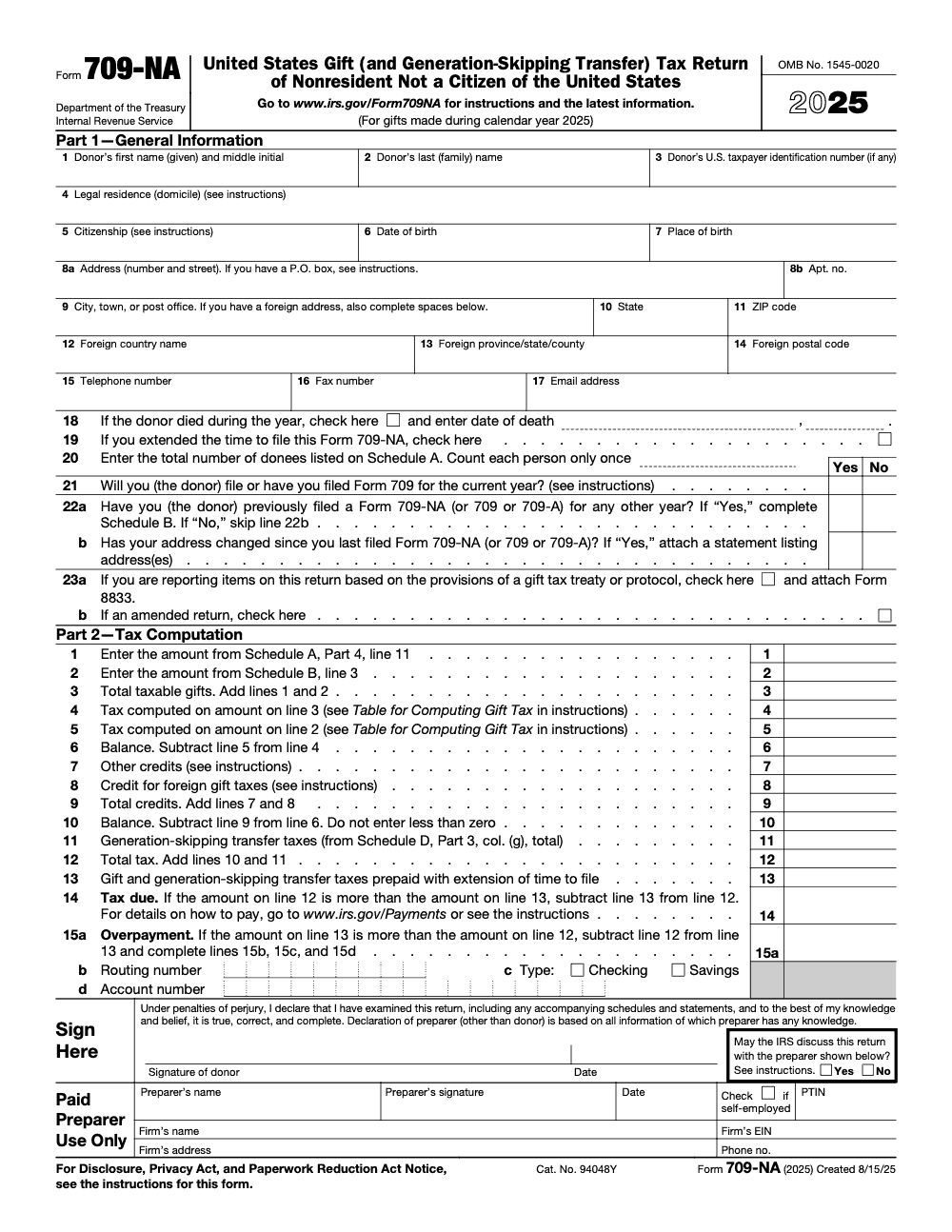
Form 709-NA is the U.S. gift tax return for a nonresident not a citizen of the United States, used to report gifts of U.S.-situs real estate or tangible personal property under IRC §2511(a). For 2025, the per-donee annual exclusion is $19,000 and the noncitizen-spouse exclusion is $190,000 (per IRS Form 709-NA instructions and Rev. Proc. 2024-40). The return for 2025 gifts may not be filed before January 1, 2026 and must be filed no later than April 15, 2026. The $13,990,000 lifetime basic exclusion does NOT apply to nonresident noncitizen donors, so tax accrues on the first dollar of taxable U.S.-situs gifts above the annual exclusion. See our individual tax return service for help with cross-border filings.
A nonresident, non-U.S. citizen gives a U.S. vacation home or a piece of tangible property to a family member and assumes a foreign donor is outside the U.S. gift tax. U.S.-situs real estate and tangible personal property are exactly what Form 709-NA reaches under IRC §2511(a), so that gift is reportable even though most intangibles, like U.S. corporate stock, are not.
It is a paper filing, never e-file. For 2025 the per-donee annual exclusion is $19,000, the noncitizen-spouse exclusion is $190,000, and the top gift and GST rate stays 40%. The return for 2025 gifts may not be filed before January 1, 2026 and must be filed no later than April 15, 2026, with the lifetime basic exclusion at $13,990,000.
Key Takeaways
- If you are a nonresident, non‑U.S. citizen and you gift U.S.‑situs tangible or real property, Form 709‑NA is your return. It is a paper filing, not e‑file.
- Report present‑interest gifts above the annual exclusion per donee and report all future‑interest gifts, even small ones. For 2025, the annual exclusion is 19,000.
- Gifts to a spouse who is not a U.S. citizen have a higher annual exclusion, 190,000 for 2025, then you report the excess.
- Gift splitting generally requires both spouses to be U.S. citizens or residents. Nonresident spouses cannot use normal gift‑splitting rules.
- Due date is April 15 after the gift year. You can extend the filing deadline with Form 8892 or by filing Form 4868 for your U.S. income tax return, but the payment date does not move. Mail to the Kansas City service center.
- Most intangibles, like U.S. corporate stock, are not subject to U.S. gift tax for nonresident donors, but special expatriation rules can change that.
- The lifetime GST exemption is indexed, and GST is computed at the top rate, currently 40%. Consider allocating GST exemption on the return.
What Form 709‑NA Is, And When You Must File
Form 709‑NA is the IRS return nonresident, non‑U.S. citizens use to report gifts of U.S.‑situs tangible or real property, and to figure any gift or generation‑skipping transfer tax. Think U.S. homes, land, vehicles, artwork in U.S. storage, and other tangible items located in the United States. It parallels the domestic Form 709, but it is tailored for nonresident donors and has its own instructions, mailing address, and coordination rules.
You must file if either of these applies for the year of gift:
- You made any gifts of future interests in U.S.‑situs tangible or real property.
- Your present‑interest gifts to any one person exceeded the annual exclusion for that year, or your outright gifts to a noncitizen spouse exceeded the special spousal exclusion. For 2025, those thresholds are 19,000 and 190,000.
A quick but important scope check. For nonresident donors, most U.S. intangible property, like stock of a U.S. corporation, is not a taxable gift for U.S. gift tax, so it typically does not trigger 709‑NA. One exception lives in the expatriation rules, which can pull certain intangible gifts into the net. If you are a covered expatriate under section 877(b), read that footnote carefully and get help.
What Counts As U.S.‑Situs Property For Gifts
- Real property located in the United States.
- Tangible personal property located in the United States when the gift is made.
- Not usually includable, for nonresident donors, are intangibles like stock in a U.S. corporation, unless you are within expatriation rules that say otherwise.
The 2025 Numbers You Need
The annual gift tax exclusion per donee is 19,000 for gifts made in 2025. The special annual exclusion for gifts to a spouse who is not a U.S. citizen is 190,000. The lifetime estate and gift tax exclusion is 13.99 million in 2025, but that figure applies to U.S. citizen and resident donors only – a nonresident noncitizen donor filing Form 709-NA gets no lifetime gift-tax exemption under IRC §2505 and pays tax on every taxable U.S.-situs gift above the annual exclusion. The maximum gift and GST tax rate is 40%. These figures help determine if you file, what you owe, and how you plan GST allocations.
Note for planners: IRS inflation tables show the annual exclusion per donee rising to 19,000 in 2025. The 2026 IRS release states the noncitizen spouse annual exclusion becomes 194,000 in 2026, which implies 190,000 in 2025, a figure also reflected in major financial guidance.
Spouses, Community Property, And Gift‑Splitting
Here is where cross‑border gifts often go sideways. There is no joint gift tax return. Each spouse files their own return if required. If the property is community property, each spouse is treated as making half the gift. That half‑gift rule often means both spouses must file their own 709‑NA for the year.
Gift splitting is different. The familiar gift‑splitting election under section 2513 generally requires both spouses to be U.S. citizens or residents for that year. Nonresident spouses cannot use standard gift‑splitting, so do not plan around it. If you thought gift splitting would cover a large present‑interest gift to an adult child, you likely still have two separate filings and no split.
Special Annual Exclusion For A Noncitizen Spouse
You may give more to a spouse who is not a U.S. citizen without using lifetime exclusion. For 2025, the special annual limit is 190,000. Above that amount, you report the excess on 709‑NA. Future‑interest gifts to a noncitizen spouse must be reported regardless of size because the annual exclusion does not apply to future interests.
When Form 709‑NA Is Required, Plain English And Real Scenarios
If you are a nonresident, non‑U.S. citizen, you file Form 709‑NA when you make gifts of U.S.‑situs tangible or real property and either, the gift to any one person is above the annual exclusion for that year, or the gift is a future interest. That is the simple rule, but the situations can feel messy when spouses, community property, and trusts get involved.
Fast decision path you can use today
- Is the asset U.S. real estate or tangible property located in the United States on the date of the gift, for example a vehicle or artwork stored in New York, then keep reading.
- Was the gift a present interest, meaning the recipient can use and enjoy it now, and does the value to that one person exceed the annual exclusion, then you likely file.
- Was the gift a future interest, for example a remainder interest in a U.S. home placed into a trust where the donee must wait, then you file, regardless of value.
- Was the recipient your spouse who is not a U.S. citizen, then compare the amount to the special annual exclusion for that year. If you went over, you report the excess.
- Was any of the property community property, then assume half came from you, and check whether both spouses now have a filing duty on their share.
Examples that match what we see in practice
- Present interest, over the line You live in Singapore. In June you gift your adult child a classic car that sits in California. It is a present interest. The fair market value is above the annual exclusion. You file Form 709‑NA and attach valuation support.
- Future interest, report even if small You deed a U.S. lake house into a trust that gives your niece possession only after five years. That is a future interest. Even if the value you transfer is under the annual exclusion, you still file Form 709‑NA, and you report the full value of what you transferred.
- Spouse, noncitizen special limit You gift U.S. tangible property to a spouse who is not a U.S. citizen. Compare the gift to the special annual exclusion for noncitizen spouses. Over that limit, you report the excess on Form 709‑NA. If any piece is a future interest, file regardless of the amount.
- Community property halves, two filings You and your spouse, both nonresidents, own a Miami condo as community property and give it to your daughter. Each of you is treated as making half the gift. That often means each spouse files their own Form 709‑NA. Keep your workpapers in sync, but do not file a joint return.
Gifts Covered, What Is Excluded, And Why It Matters
Form 709‑NA focuses on U.S.‑situs tangible and real property. The common traps occur when people assume the annual exclusion covers everything, or when they mix up present and future interests. Use this table as a quick filter.
| Item | Covered on 709‑NA | Excluded from filing |
| Present‑interest gifts of U.S. real or tangible property above the annual exclusion | Yes | No |
| Future interests in U.S. real or tangible property, any value | Always | Never |
| Direct payments for tuition to an educational institution | No | Yes |
| Direct payments for medical care to a provider | No | Yes |
| Gifts to political organizations | No | Yes |
A note on intangibles. For nonresident donors, many intangible gifts, for example stock of a U.S. corporation, are not subject to U.S. gift tax. That is why they usually do not trigger Form 709‑NA. If you have expatriation or treaty wrinkles, pause and get advice. The filing decision can flip if special rules apply.
Spouses And Community Property, What Changes And What Does Not
Marriage can change the allocation, it does not change who files. There is no joint gift tax return. If you and your spouse give U.S. property that is community property, each of you is treated as giving half. That half‑gift rule often means both spouses file, each reporting their share, each signing their own return.
Gift splitting is not a shortcut here. The familiar gift‑splitting election generally requires both spouses to be U.S. citizens or residents, so nonresident spouses cannot rely on it. Plan with the rules you actually have, not the ones you wish you had.
Working example, community property plus noncitizen spouse
- Facts Two nonresident spouses own a Texas home as community property. They deed the home to their child in 2025. Value, 900,000.
- Allocation Each spouse is treated as making a 450,000 gift. There is no gift splitting available.
- Filings Each spouse evaluates filing. Each spouse files a separate Form 709‑NA, each includes the same appraisal, each signs their own return. Workpapers should match.
- Spousal exclusion does not apply The noncitizen spouse exclusion is for gifts to a noncitizen spouse, not gifts to your child. Do not mix those rules.
Future Interest Gifts, Why They Trigger A Filing
A future interest means the recipient does not have immediate possession or enjoyment. Think remainder interests, a right to use a home only after another term ends, or a trust that delays access. The annual exclusion is aimed at present interests, so future interests do not get that shelter. That is why you file even when the dollar amount is modest.
How to show the value
- Define the property and the rights you transferred, in words a reviewer can follow.
- Attach a qualified appraisal when required, for example art, collectibles, or real estate.
- If a trust is involved, include the trust agreement pages that define timing and enjoyment.
- Use consistent property descriptions across the deed, appraisal, and Schedule A entry.
Reviewer friendly workpapers save time. A clear asset description, a labeled appraisal, and a short note that explains present versus future interest will cut follow‑up questions and reduce the chance of rework.
Deadlines, Extensions, And Where To File
Your filing deadline is April 15 for gifts made in the prior calendar year, and unlike Form 709 you cannot file Form 709-NA before January 1 of that year – the earliest-filing date is unique to this form. If April 15 falls on a weekend or federal holiday, the due date moves to the next business day. You can extend the filing date two ways, file Form 8892, or, if you file Form 4868 for your U.S. income tax return, that generally extends your gift tax return as well. An extension to file does not extend time to pay. If you expect gift tax, pay by the original due date to avoid penalties and interest. Paper filing is required. Use the Kansas City, Missouri service center address listed in the current year instructions, and keep your postmark proof.
Deadline checklist you can copy
- Circle April 15 for the gift year just ended.
- Decide by March 31 whether you will file on time or extend.
- If extending, prepare Form 8892 or rely on a timely Form 4868.
- If tax is due, send payment with your extension by April 15.
- Mail the paper return with tracking, keep the receipt with your workpapers.
How To Complete Form 709‑NA, Step By Step
I like to set this up as a repeatable checklist so nothing gets missed during review season.
- Confirm you are the right filer
- You are a nonresident, non‑U.S. citizen.
- The gifts involve U.S.‑situs real or tangible property.
- Present interests over the annual exclusion, or any future interest, will be reported.
- Donor information
- Complete name and foreign address.
- U.S. TIN if available – Part 1 line 3 is optional per the Form 709-NA instructions, so leave it blank if the donor has no SSN or ITIN.
- If the donor died before filing, the executor completes and signs.
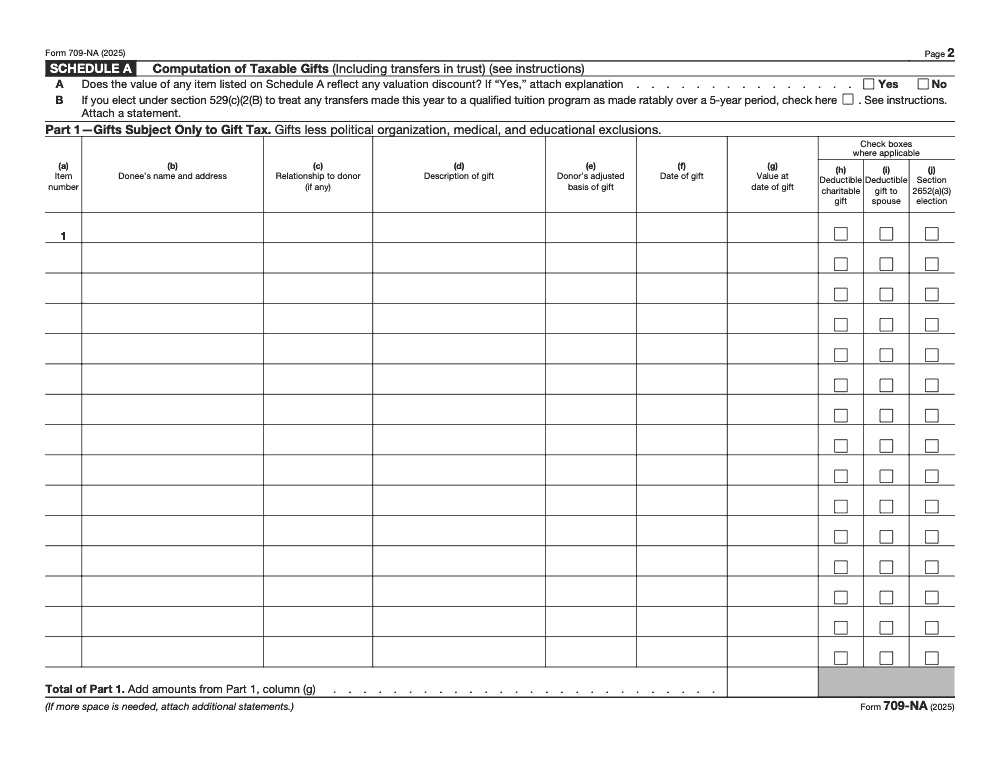
- Schedule A, list each gift
- Description of the property, for example “Condominium at 123 Beach Ave, Miami, FL.”
- Date of the gift, donee’s name and address, relationship.
- Fair market value on the date of gift, and how you determined it.
- Columns for charitable, marital, or other deductions when relevant.
- Attach support, appraisals, deeds, trust pages, and any elections.
- Spousal rules
- If the donee is your spouse who is not a U.S. citizen, track against the special annual exclusion first. Report any excess.
- Do not elect gift splitting if you are a nonresident. It is generally not available.
- Community property, report your half and coordinate with your spouse’s separate return.
- GST coordination
- Identify skip persons, for example a gift to a grandchild.
- Decide whether to allocate GST exemption to protect future transfers.
- Make a clear, specific allocation on the return. Match the property descriptions to Schedule A.
- Compute, sign, and assemble
- Compute tax after exclusions and any allowable deductions.
- Sign the return. If there is an executor, the executor signs.
- Include payment if tax is due.
- Assemble the package, return on top, schedules, then exhibits. Tab or label exhibits for easy review.
Workpaper set that makes review painless
- Property summary sheet, one line per gift, with values and donee names.
- Appraisal folder, labeled by asset, with a short cover note.
- Deed copies, trust excerpts, and any loan or lien terms.
- Basis schedules and valuation methods.
- Timeline page with the due date, extension choice, and mailing proof.
Coordinating GST Tax And Exemption Allocation
GST planning is about avoiding a surprise decades from now. On Form 709‑NA, you report any generation‑skipping transfers and you can allocate GST exemption to covered gifts. The allocation can be automatic in some domestic settings, but for nonresident donors and U.S.‑situs tangible property, make the allocation explicit, gift by gift.
Practical steps for a clean GST allocation
- Identify skip persons and skip trusts at the start, not at the end.
- Decide whether to allocate GST exemption now, based on the family plan and future estate goals.
- Write the allocation in a way a future reviewer can understand without digging through files.
- Match names and property descriptions between Schedule A and your GST allocation.
- If you do not allocate on purpose, add a one sentence note to your workpapers that says why.
A precise GST allocation today protects the family from a 40 percent hit later. One paragraph of clarity now can save months of cleanup work for the next generation.
Common Pitfalls And How To Avoid Them
- Treating future interests like present interests Future interests do not get the annual exclusion. File and report the full value transferred. Add the trust page that shows the timing rules.
- Assuming gift splitting is available For nonresident spouses, the normal gift‑splitting election is generally off the table. Do not rely on it. If property is community property, handle each half and expect two filings.
- Weak valuations Real estate and art often need a qualified appraisal. Provide a clear summary page and make sure the appraisal date matches the gift date.
- Missing documentation The IRS loves contemporaneous records. Include deeds, trust excerpts, photos when relevant, and basis schedules. Label every exhibit so a reviewer can find it in seconds.
- Extension confusion Form 8892 or a timely Form 4868 extends the filing date, not the payment date. If you owe tax, pay by April 15 to stop penalties and interest.
A Short Closing Checklist
- Confirm you are a nonresident, non‑U.S. citizen donor with U.S.‑situs tangible or real property gifts.
- Sort gifts by present interest versus future interest.
- Compare amounts to the annual exclusion per donee, and if a spouse is not a U.S. citizen, compare to the special spousal exclusion.
- Build your Schedule A with clean descriptions and appraisals.
- Make any GST allocations clearly, gift by gift.
- Paper file by April 15, extend if needed, but pay on time.
- Keep a copy of the full package, with mailing proof and a one page index.
This article is general information, not legal or tax advice. Figures and thresholds are based on IRS releases available as of November 27, 2025. Always confirm current year instructions before you file.
If you are a firm and want a calm filing season, ask for a workflow review. If you are a donor and want a second set of eyes on your package, reach out to a qualified cross‑border tax professional.
Common Mistakes We See Every Season
Form 709-NA looks like a slimmer Form 709, so practitioners new to nonresident gift filings often carry over assumptions that simply do not apply to a nonresident noncitizen donor. Below are the misfires my team catches most often in review.
Reusable Checklists
The three checklists below are copy-paste ready for firm SOP files. Each one tracks a specific stage of the Form 709-NA cycle, from intake through GST reconciliation.
Nonresident Donor Intake Packet
- Confirm donor's legal residence (Part 1 line 4) and citizenship (Part 1 line 5) in writing.
- Collect donor's U.S. TIN if any; leave Part 1 line 3 blank if no SSN or ITIN exists.
- List every 2025 gift with date, donee name, relationship, and U.S.-situs status.
- For each gift, classify as U.S. real estate, U.S.-situs tangible personal property, or intangible. Drop intangibles from the Schedule A draft.
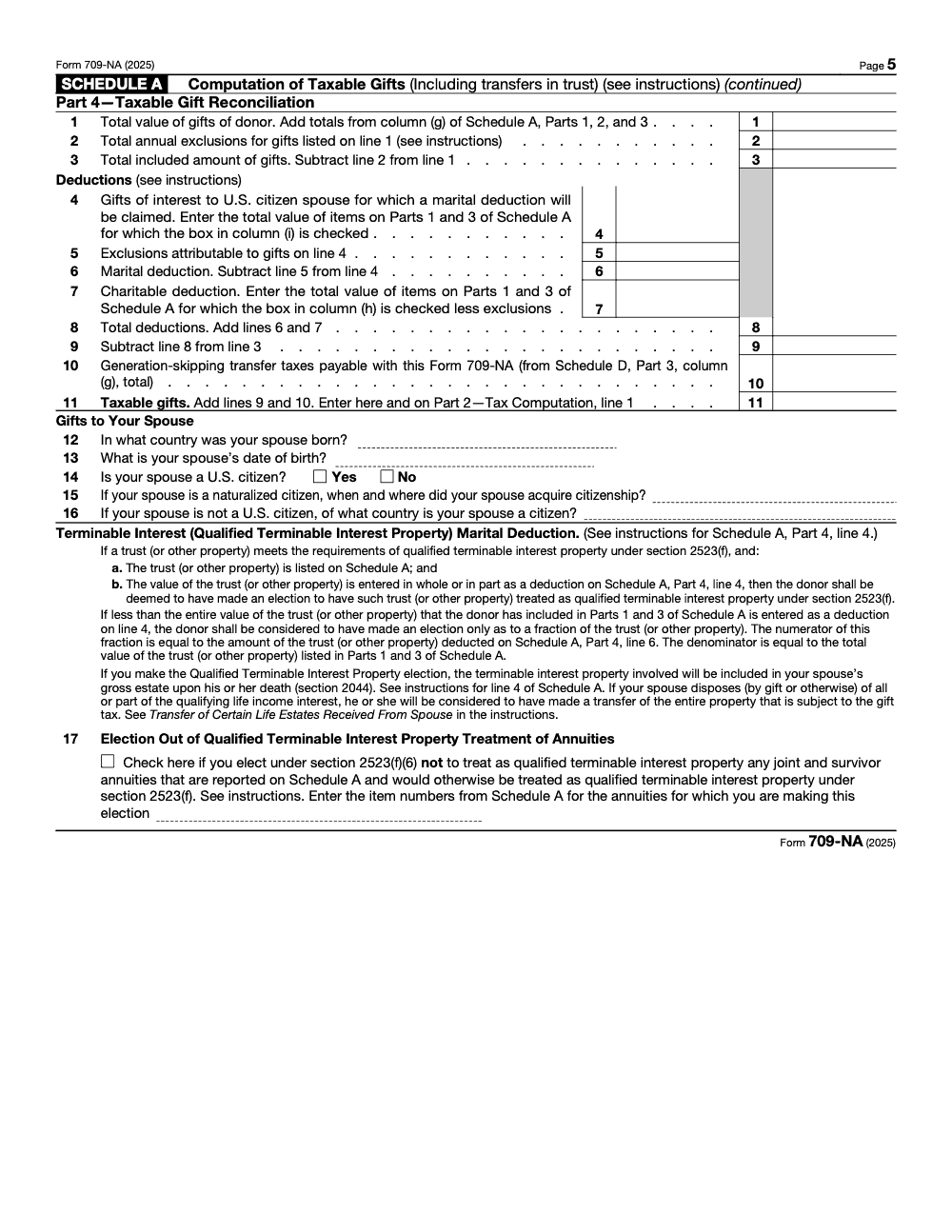
- Capture spouse citizenship and date of birth for Schedule A lines 12 to 16 if any spousal gift occurred.
- Flag any treaty position; queue Form 8833 attachment and check Part 1 line 23a.
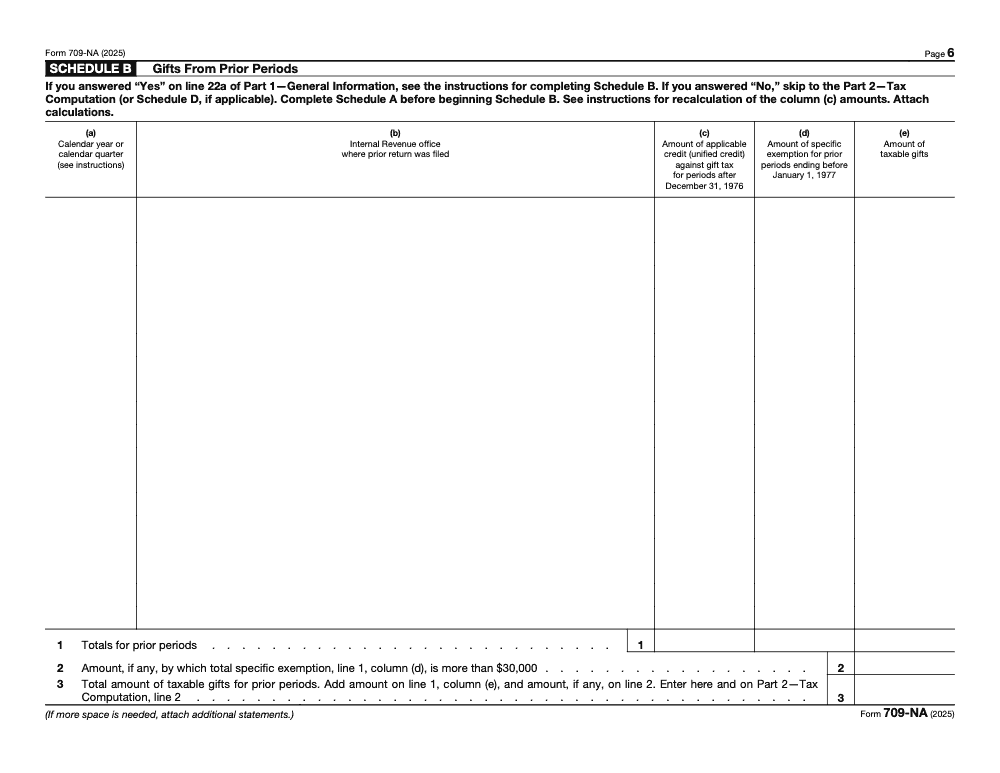
- Note any prior Form 709-NA, 709, or 709-A filings (Part 1 line 22a) and pull prior workpapers for Schedule B.
- Check Part 1 line 22b if the donor's address has changed since the last filing and attach the prior-address statement.
Schedule A Build and Annual-Exclusion Reconciliation
- Enter each donee only once on the donee roster supporting Part 1 line 20.
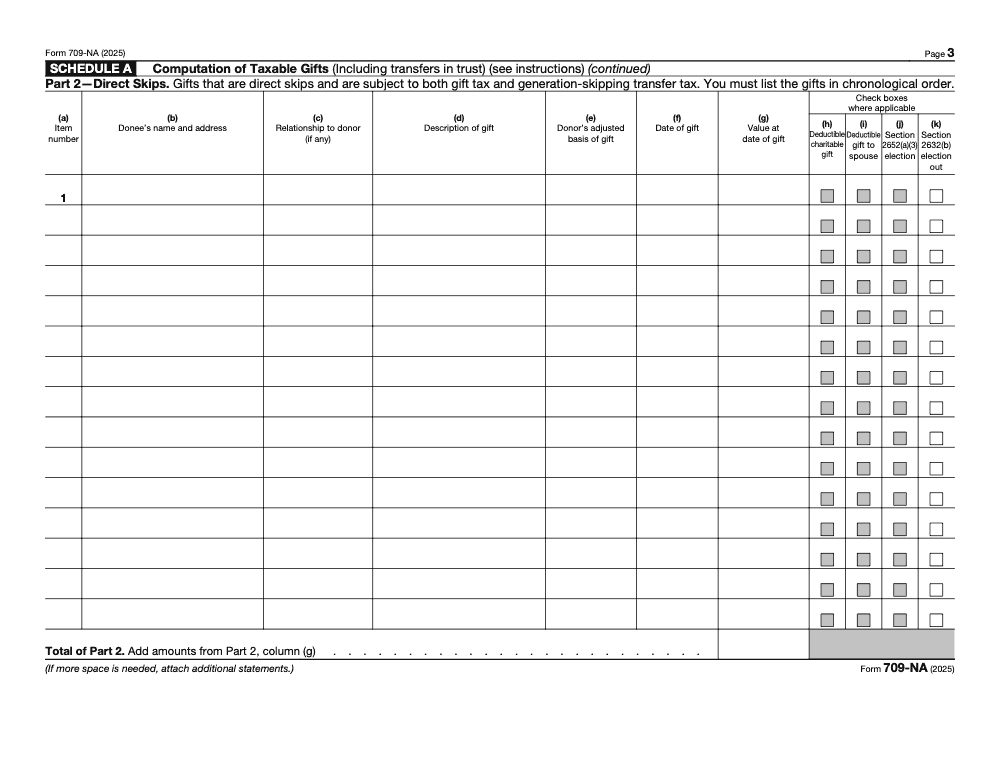
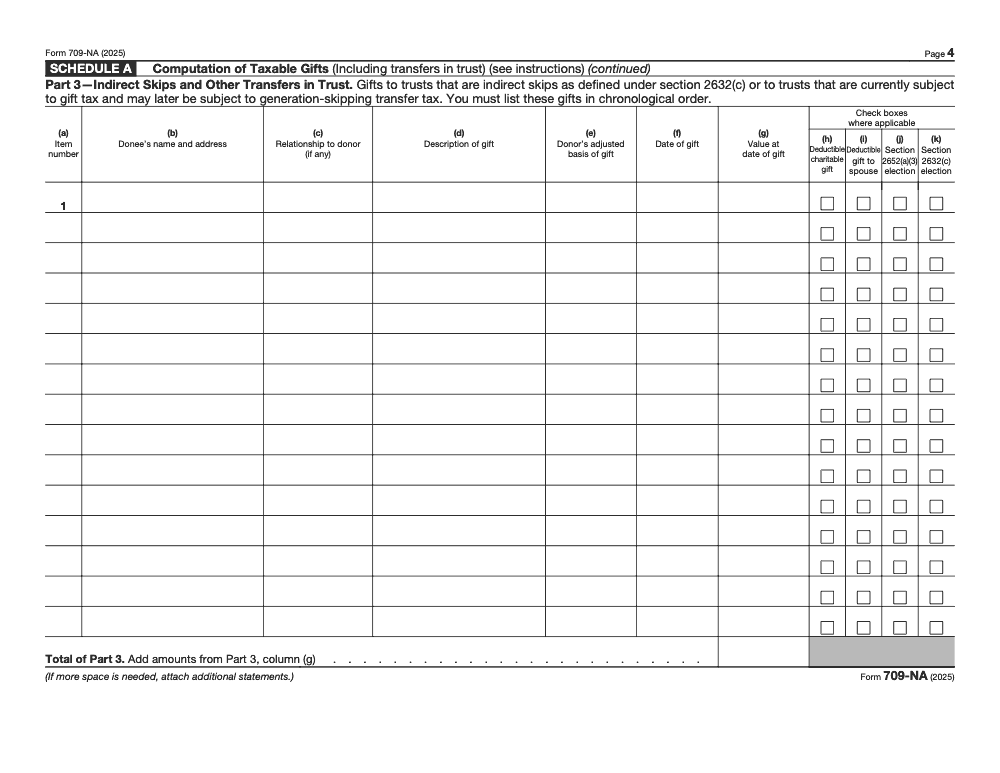
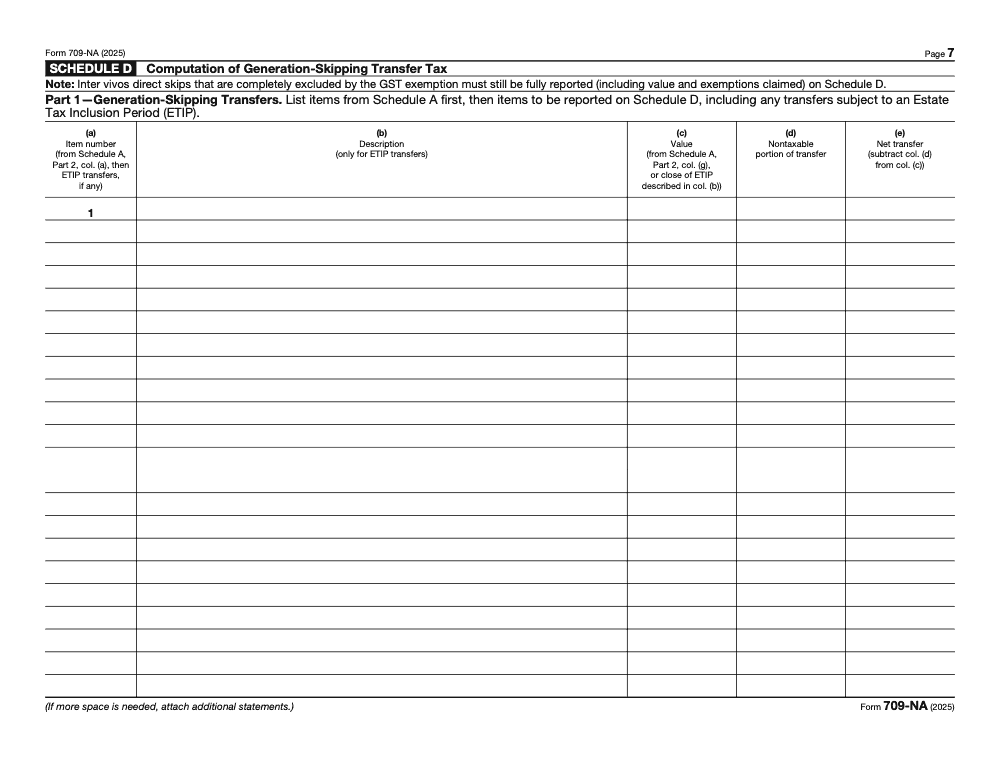
- List Part 2 direct skips and Part 3 indirect skips in chronological order.
- Apply $19,000 per-donee annual exclusion to non-spouse donees on Part 4 line 2.
- Apply $190,000 noncitizen-spouse exclusion on Part 4 line 2 (Total annual exclusions); do NOT also enter the gift on Part 4 line 4.
- Confirm any future-interest gifts are excluded from the annual-exclusion total per IRS Form 709-NA instructions.
- If any gift uses a valuation discount, check Schedule A item A as Yes and attach the discount explanation.
- For 529-plan transfers electing the 5-year spread under IRC §529(c)(2)(B), check Schedule A Box B and attach the statement.
- Tie Schedule A Part 4 line 11 back to Part 2 Tax Computation line 1 before sign-off.
GST Exemption Reconciliation and Filing Window
- List every direct skip on Schedule D Part 1 (items from Schedule A Part 2), even if fully exempted.
- For each indirect skip, decide allocation: accept the automatic §2632(c) allocation or attach an Election Out statement.
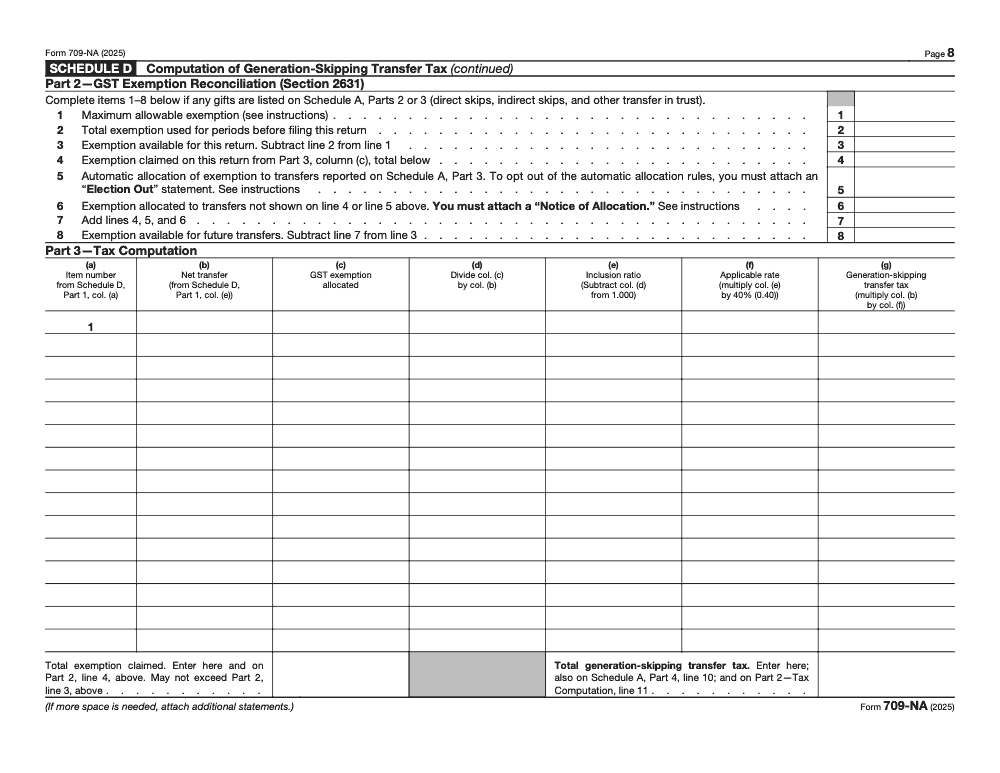
- Allocate GST exemption on Part 2 line 4; back into the cumulative usage on lines 1 through 3.
- For any discretionary allocation outside lines 4 and 5, attach a Notice of Allocation supporting Part 2 line 6.
- Verify Part 3 column (c) total does not exceed Part 2 line 3.
- Compute inclusion ratio in Part 3 column (e) and applicable rate at 40 percent in column (f).
- Carry GST tax from column (g) total to Schedule A Part 4 line 10 and Part 2 Tax Computation line 11.
- Confirm filing window: not before January 1, 2026 and not after April 15, 2026 (extend via Form 4868 or Form 8892 if needed).
Keep 709-NA Season From Stalling
Form 709-NA filings cluster around the April 15 deadline, with a meaningful tail through October 15 for extended returns, and the work is harder than a Form 709 because every assumption a U.S.-citizen donor enjoys has to be tested again. Each return touches U.S.-situs analysis under IRC §2511(a), citizenship of the donee spouse for the marital deduction, and cumulative GST exemption tracking on Schedule D, often with no in-house pattern library for nonresident facts (per IRS Publication 559 due-date guidance and the IRS Form 709-NA instructions).
The structural fix is to stop treating 709-NA as a one-off and start treating it as a workflow that recurs every year. The same intake fields, the same edge cases, and the same review steps repeat across donors. Standardizing them shifts senior time off mechanical checks and onto the genuinely judgmental work, such as treaty positions and valuation discounts.
- Build a U.S.-situs classifier into intake with real estate, tangible personal property, and intangible buckets, where the intangible bucket drops out of Schedule A entirely.
- Standardize the spouse-citizenship test driving Schedule A lines 12 to 16, so Part 4 line 4 (citizen-spouse marital deduction) and Part 4 line 2 ($190,000 noncitizen-spouse annual exclusion) never get crossed.
- Keep a cumulative GST exemption ledger per donor that ties Schedule D Part 2 lines 1 through 8 across years, and reconcile to Schedule B prior-period totals at filing.
- Maintain a treaty checklist (for example, U.S.-France, U.S.-Germany, and U.S.-Japan gift treaty positions) tied to Form 8833 attachment, with Part 1 line 23a flagged at draft stage.
- Calendar a January 1 earliest-send gate and an April 15 deadline gate, and queue Form 8892 or Form 4868 status for each donor file by mid-March.
Accountably's offshore tax delivery teams run this workflow as a documented SOP. The intake classifier, the spouse-citizenship gate, the GST exemption ledger, and the treaty checklist are built into the standard 709-NA workpaper template, so senior reviewers spend their time on positions rather than mechanics.
FAQs
It is the U.S. gift and GST tax return for nonresident, non‑U.S. citizens who make gifts of U.S.‑situs tangible or real property. You also use it to make or withhold GST exemption allocations, attach valuations, and document elections.
A nonresident, non‑U.S. citizen who makes present‑interest gifts above the annual exclusion to any one donee, or who makes any future‑interest gift of U.S.‑situs tangible or real property, must file. If property is community property, each spouse reports their half on their own return.
It is detailed. The return itself is manageable, but valuation, future interest analysis, community property splits, and GST allocations add friction. Use a checklist, attach clean support, and extend if needed.
Late filing can bring penalties and interest, and it can leave the statute of limitations open on that gift. You also risk losing the chance to make a clean GST allocation. If you missed a year, speak with a qualified advisor and fix it.
Other forms this guide names
About this guide
Accountably helps US CPA, EA, and accounting firms hire trained accountants and tax preparers in India.
About us Reviewed byJugal Thacker, CPAFounder and CEO at Accountably
A Washington-licensed CPA with 7+ years inside US firms – PwC, a real-estate tax practice, then a full-service firm, rising from reviewer to manager to advisory. This article was reviewed against current IRS guidance for the 2025 tax year and updated for filers preparing late returns, amendments, and 2026 estimates.
View profile →How we research, review, and update this guide
Every Accountably guide is researched against primary IRS sources, reviewed by a U.S. CPA, and refreshed as guidance evolves. Read our Editorial Guidelines to see how we source, fact-check, and update our content.