Summarize this article with AI
In Brief
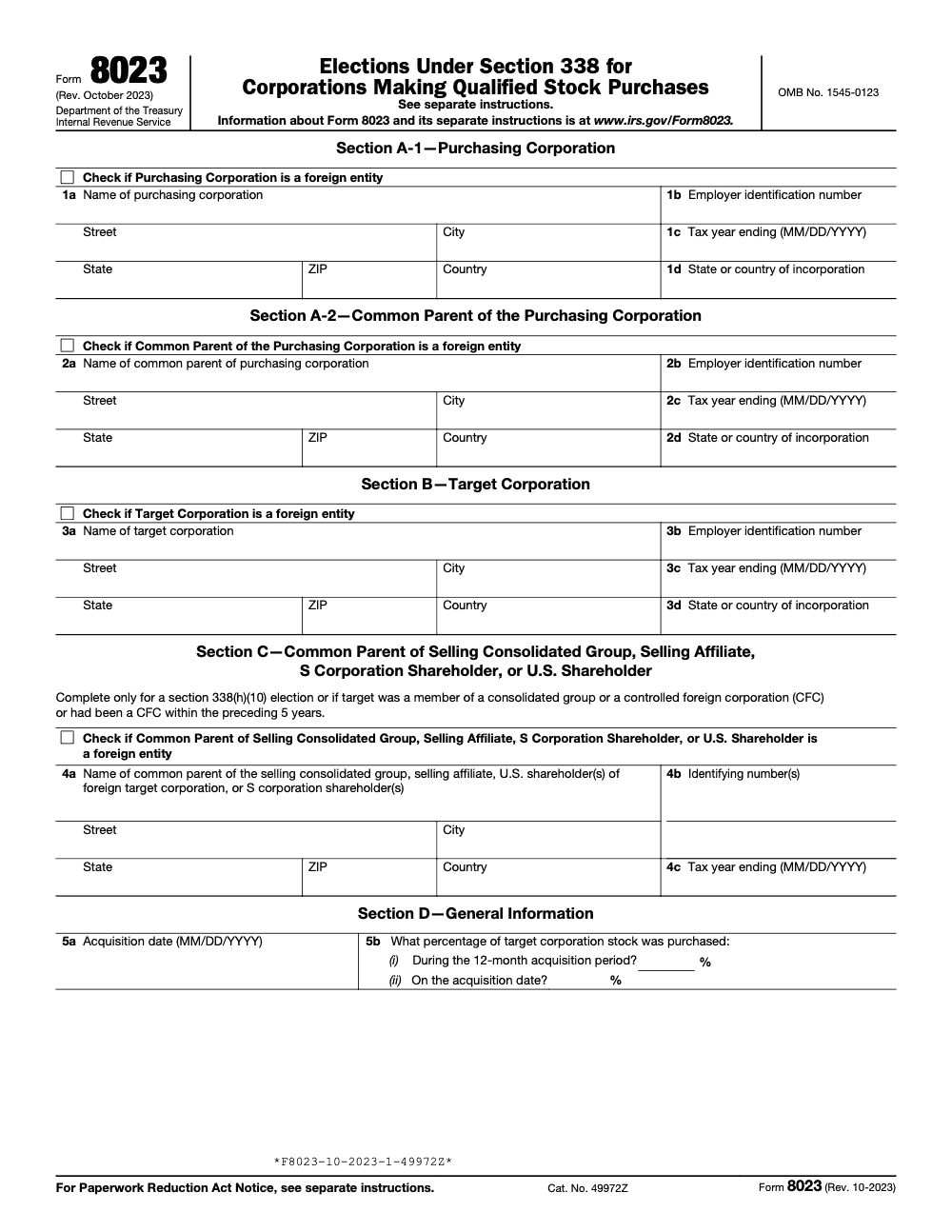
Form 8023 elects Section 338 treatment for a qualified stock purchase – the purchasing corporation files it to treat a stock buy as a deemed asset sale for federal tax purposes (per IRC §338 and IRS Publication 542). A Qualified Stock Purchase requires acquiring at least 80% of voting power AND at least 80% of value within a 12-month period, and Form 8023 is due by the 15th day of the 9th month beginning after the month that includes the acquisition date. Pair it with Form 8883 to allocate the deemed asset purchase price, since the election alone does not report the allocation.
The deadline on this form is not measured the way people expect. Form 8023 elects Section 338 treatment so a qualifying stock purchase is treated as a deemed asset sale, and it is due by the 15th day of the 9th month beginning after the month that includes the acquisition date. The clock counts from the month following the acquisition month, not from the acquisition date itself, which is exactly where filers lose days they thought they had.
First, fix the acquisition date. A Qualified Stock Purchase happens when you acquire at least 80 percent of voting power and 80 percent of value within a 12-month period, and the first day you hit 80 percent starts the filing clock. Choose 338(g) or 338(h)(10) based on the seller profile; a 338(h)(10) requires joint signatures, including all S corporation shareholders when the target is an S corp. Then match your purchase price allocation on Form 8883 using the residual method, with names, EINs, dates, and totals aligned across both forms.
Key Takeaways
- Use Form 8023 to elect Section 338 treatment so a qualifying stock purchase is treated as a deemed asset sale and repurchase for tax.
- A Qualified Stock Purchase (QSP) happens when you acquire at least 80 percent of voting power and 80 percent of value within 12 months. The first day you hit 80 percent is the acquisition date, which starts the filing clock.
- File by the 15th day of the ninth month beginning after the month that includes the acquisition date (the statute counts from the month following the acquisition month, not from the acquisition date itself, so a March 5 acquisition produces a December 15 deadline). Late relief exists, but it is limited and not guaranteed.
- Choose 338(g) or 338(h)(10) based on seller profile and tax posture. A 338(h)(10) requires joint signatures, including all S corporation shareholders when the target is an S corp.
- Report your purchase price allocation on Form 8883 using the residual method. Keep names, EINs, dates, and totals aligned with your Form 8023.
- You can file by mail to IRS Ogden or by e‑fax, using a simple cover sheet. Always verify the current address and fax instructions on IRS.gov before filing.
What Form 8023 actually does
You bought stock, but you want tax results that look like an asset purchase. A valid Section 338 election gives you that. The law treats the target as if it sold all assets on the acquisition date, then a new target bought those assets the next day. You get a basis step up or step down to fair value, which drives depreciation, amortization, and future tax attributes. You then report the allocation on Form 8883.
Two flavors, same goal
- Section 338(g) The target recognizes gain or loss at the corporate level on a deemed asset sale. You, as the purchaser, get a fresh asset basis. This is common when the seller is a C corporation or when a joint election is not available.
- Section 338(h)(10) Available when you are buying from a selling consolidated group, a selling affiliate, or S corporation shareholders. The transaction is a deemed asset sale followed by a deemed liquidation to sellers. You still get new basis, but the tax impact shifts to the selling side. This version requires a joint filing with the seller and, for S corporations, every shareholder.
Why firms stumble here
- The acquisition date is the first day the 80 percent threshold is met, not always the closing date. If you reached 80 percent earlier through step purchases or options, that earlier day controls your deadline.
- Missing one S corporation shareholder signature on a 338(h)(10) can invalidate the election.
- Filing 8023 on time, then letting Form 8883 drift or misalign, creates follow up work that slows reviews and rattles clients.
When a disciplined delivery model helps
Most teams do not fail on tax analysis, they fail on the handoffs. A standard intake, clear workpaper names, a short signature matrix, and a weekly status tracker prevent the last minute fire drill. If your staff is buried in compliance, this is the kind of repeating work that benefits from structure. At Accountably, we build SOP driven execution, structured workpapers, and layered QC so partners spend less time in review and more time advising clients. You do not need that support for every election, but it pays off when volume spikes or when foreign disclosure is involved.
Define the Qualified Stock Purchase and fix the acquisition date
A Qualified Stock Purchase (QSP) occurs when a purchasing corporation acquires at least 80 percent of the total voting power and 80 percent of the total value of the target’s stock within a 12 month period. Preferred stock described in section 1504(a)(4) does not count toward the 80 percent test.
The acquisition date is the first day you cross both 80 percent thresholds. That single day sets your Form 8023 filing deadline, your deemed sale day, and the tax years that must reflect Form 8883 allocations.
Close attention to that one date avoids most timing mistakes. Confirm it with cap tables, purchase schedules, and any option exercises.
Track affiliated purchasers and step deals
If multiple members of an affiliated group buy shares, aggregate those acquisitions when testing for a QSP. If more than one group member purchases stock, list on Form 8023 the member that acquired the largest value stake, then attach a schedule for the others.
Options and step acquisitions can move the needle quietly. A small top up that pushes you from 79 percent to 81 percent is the moment your clock starts, even if the closing ceremony happens later.
Milestones at a glance
| Milestone | Trigger | Action |
| 80 percent threshold | Vote and value within 12 months | Fix the acquisition date in a one page memo |
| Filing window | 15th day of 9th month beginning after the acquisition month | Calendar the deadline for Form 8023 |
| Group buyers | Largest value purchaser leads | List others on an attached schedule |
| Step acquisitions | Options or later tranches | Reconfirm the first day you crossed 80 percent |
| Foreign purchaser | U.S. shareholder rules may apply | Prepare the signed U.S. shareholder statement |
A quick example you can reuse
- Day 0, you own 79 percent. No QSP yet.
- Day 10, you buy 2 percent more. You now own 81 percent, so Day 10 is the acquisition date.
- Your Form 8023 deadline falls on the 15th day of the ninth month beginning after the month that includes Day 10 (the statute counts from the month following the acquisition month, not from Day 10 itself). Put it on the calendar that same day.
- Begin collecting signatures immediately if you plan a 338(h)(10) election.
Common acquisition date pitfalls
- Treating the closing date as the acquisition date without checking earlier trades.
- Forgetting that both tests matter, vote and value.
- Missing indirect purchases by affiliates that push you across the line earlier than expected.
- Not documenting the computation, which makes reviews slow and arguments longer.
A 10 minute memo that shows your 80 percent math will save an hour in review and days in a dispute. Keep it simple, show the numbers, and file it in the binder.
Section 338(g), tax effects and filing rhythm
Once you complete a QSP, a Section 338(g) election recharacterizes the deal for tax. The target is deemed to sell all assets on the acquisition date, recognizing gain or loss at the corporate level. You, the purchasing corporation, are deemed to buy those assets the next day, which gives you a fresh basis.
- File Form 8023 by the 15th day of the ninth month beginning after the month that includes the acquisition date (count from the month following the acquisition month, not from the acquisition date itself).
- Report the purchase price allocation on Form 8883 under the residual method.
- Expect a basis step up or step down that affects depreciation and amortization schedules for years.
When 338(g) is the practical choice
- The seller cannot, or will not, join a joint election.
- You are buying from a C corporation where seller level stock treatment is not the priority.
- Timing and certainty matter more than seller level allocation outcomes.
Section 338(h)(10), joint election and signature discipline
A Section 338(h)(10) election treats the deal as a deemed asset sale followed by a deemed liquidation to the sellers. It applies only if you buy from a selling consolidated group, a selling affiliate, or S corporation shareholders (foreign target corporations do not qualify; for a foreign target, use a regular Section 338(g) election instead, optionally with the gain recognition election on line 8).
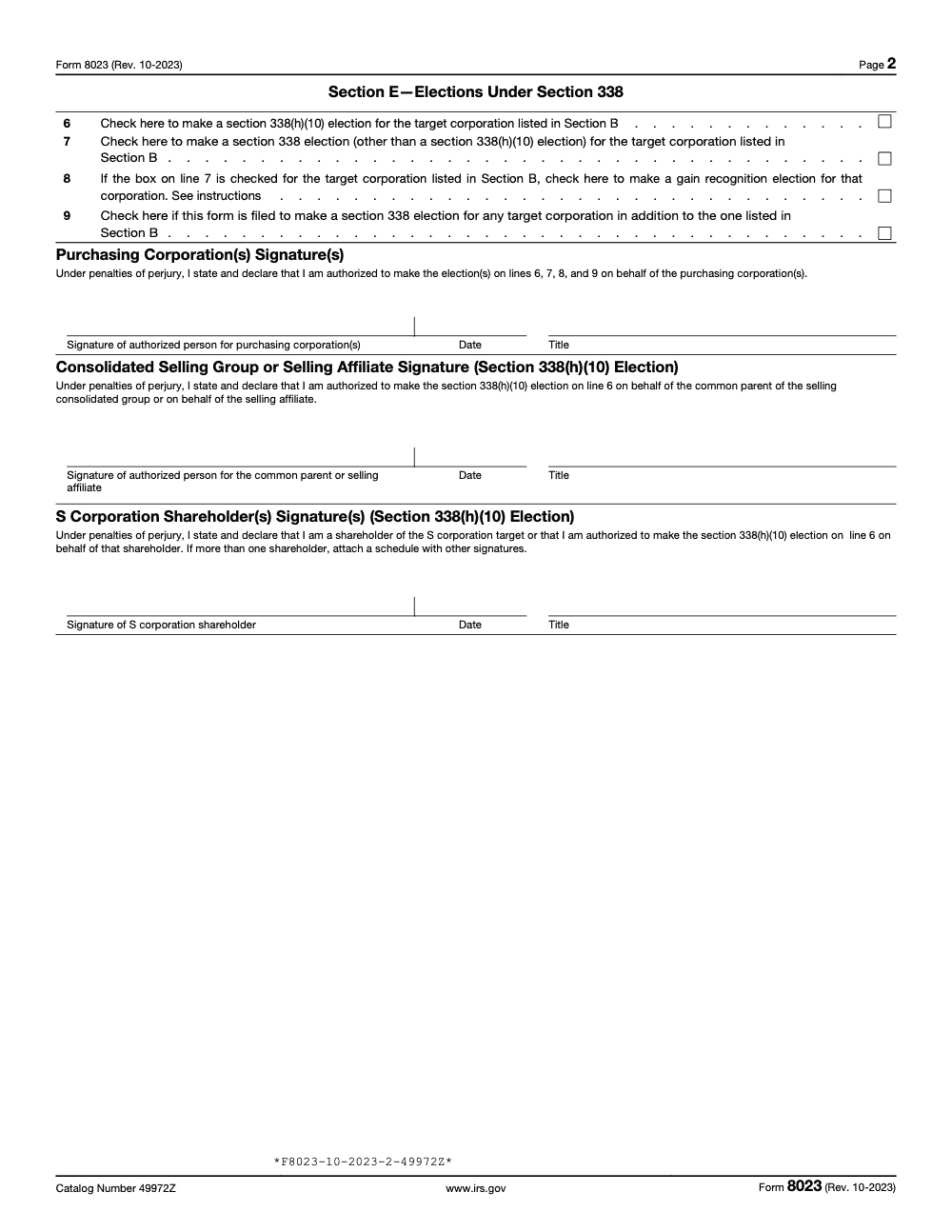
- It is a joint election, so you must collect signatures from the purchaser and the selling side.
- For an S corporation target, every S corporation shareholder must join, including non sellers.
- Missing signatures can invalidate the election, so build a complete signer list on day one.
Which version to choose
| Situation | Likely path | Why it tends to fit |
| Seller is a C corp, no joint path | 338(g) | Purchaser files alone, clear target level tax |
| Seller is an S corp with aligned shareholders | 338(h)(10) | Joint filing, seller level sale and liquidation treatment |
| Consolidated seller parent can coordinate | 338(h)(10) | Centralized seller signature and information flow |
| Timing is tight, seller unresponsive | 338(g) | Fewer signatures, faster process |
Review hints from the field
- Confirm whether the selling side can legally join a joint election before you draft the 338(h)(10) packet.
- Use a single spreadsheet to track signers, capacity, email, and status.
- Put the penalties of perjury language on any SIGNATURE ATTACHMENT so you do not chase form edits later.
Teams rarely lose the technical plot here. They lose time and credibility when signatures arrive late or arrive incomplete. Start signature collection early, and make it easy for signers to execute.
Eligibility limits, definitions, and special rules
A QSP requires at least 80 percent of vote and 80 percent of value within a 12 month period. Do not count preferred described in section 1504(a)(4). The acquisition date is the first day you reach that threshold. That date drives your filing deadline and the tax years for reporting.
Special rules matter in real life deals.
- Lower tier targets If electing for a parent target means a lower tier subsidiary is also a deemed target, you make a separate election for the lower tier as if the direct purchaser of the upper tier were also the purchaser of the lower tier. Follow the same signature and timing rules.
- Affiliated purchasers Aggregate purchases by affiliated group members to test for a QSP. On Form 8023, list the member that acquired the largest value stake, and schedule the others.
- Foreign purchasers If the purchaser is foreign and not otherwise required to file a U.S. return for the year that includes the acquisition date, U.S. shareholders may make the election. A signed statement listing each U.S. shareholder’s details must be attached, and each U.S. shareholder will attach the election to Form 5471 for that year.
Who must file and how joint filings work
The purchasing corporation files Form 8023. For 338(h)(10), treat it as a joint election. You need the purchaser signature and the correct seller signatures.
S corporation signatures you cannot skip
- Every S corporation shareholder must join.
- If an entity signs for a shareholder, show capacity.
- If you run out of space, write See attached and include a signed schedule that repeats the perjury declaration.
Signature requirements and authorized signers
The person signing must be an authorized signer for the entity. If a U.S. individual signs for a corporate purchaser or for an entity shareholder, state authority and sign under penalties of perjury. Keep a short authority memo in the file so reviewers and the IRS can follow the chain if asked.
A simple signature matrix
| Election or fact pattern | Required signers | Practical tip |
| 338(g) | Purchasing corporation | Verify officer title and authority early |
| 338(h)(10), consolidated seller | Purchaser and selling group parent | Start routing well before the deadline |
| 338(h)(10), S corp target | Purchaser and every S shareholder | Use a consolidated SIGNATURE ATTACHMENT |
| Multiple affiliated purchasers | Each non consolidated purchaser | Put the perjury declaration on the attachment |
| Lower tier target | Treat direct purchaser as purchaser for lower tier | Mirror signatures across tiers and cross reference schedules |
Good elections fail more often on signature gaps than on tax rules. Start with a complete list of signers and capacities, then route the packet with clear instructions.
Filing deadline and how to file without drama
You must file Form 8023 by the 15th day of the ninth month beginning after the month that includes the acquisition date (count from the month following the acquisition month, not from the acquisition date itself). That is not flexible, so put the deadline on your calendar the day you cross 80 percent.
If you miss the deadline, you may explore late relief under the general extension of time rules. Relief is fact specific and not guaranteed. Treat it as a backup plan, not a strategy. And remember the election is irrevocable once filed, so model the tax consequences carefully before you send the form.
Where and how to file
You have two common options. You can mail the form to IRS Ogden, OTSA Mail Stop 4916, 1973 Rulon White Blvd., Ogden, UT 84201, or you can submit by electronic fax. Before you file, visit IRS.gov to confirm the current address and e‑fax instructions, since the Service updates intake channels from time to time.
If you fax, include a simple cover sheet that says Form 8023, your name, title, phone number, address, date, and total pages. Do not list EINs or SSNs on the cover sheet. Keep your transmission log, since you will not receive a confirmation.
Pick one method, mail or fax, not both. Duplicate submissions create tracking issues and can delay processing.
Required information and identifiers
You will provide the basics for each listed corporation.
- EIN Enter an Employer Identification Number for each corporation that has, or is required to have, one. If an entity is not required to have an EIN, note that status and keep consistency across attachments.
- Tax year ending Use each corporation’s regular tax year ending, determined without regard to the QSP. Enter month and day accurately.
- Country or state of incorporation For foreign corporations, include the country and political subdivision if applicable. For domestic corporations, list the state of incorporation. Keep formats consistent across the form and any schedules.
- Foreign entity indicators Check the foreign status boxes where applicable, then ensure the jurisdiction information matches.
Foreign purchaser and U.S. shareholder statement
If the purchasing corporation is foreign and the rule set applies, attach a signed U.S. shareholder statement that lists each shareholder’s name, address, identifying number, country of organization, and percentage interest. Coordinate early with the shareholders so each can attach the required materials to Form 5471 for the year that includes the acquisition date.
Foreign purchaser elections add moving parts. Align responsibilities early so you are not chasing signatures and attachments during busy season.
Multiple purchasers and multiple target filings
Complex structures are normal. The form can handle them if you stay organized.
- Multiple affiliated purchasers List in Section A‑1 the purchaser that acquired the largest value stake. Attach schedules for other purchasers with names, classes, percentages, EINs, and tax year endings. Each non consolidated purchaser must sign on the form or on a SIGNATURE ATTACHMENT.
- Multiple targets You can cover multiple targets on a single Form 8023 by checking line 9 and attaching schedules for any target corporations beyond the one listed in Section B. Replicate Sections A‑1, A‑2, B, C, and D data per target within the packet, and keep the identifiers aligned. You will still file separate Form 8883 allocations for each target.
- Lower tier targets Treat the election for a lower tier as if the direct purchaser of the upper tier were the purchaser of the lower tier. Mirror the signatures and attach a clear ownership chain schedule.
Controls that keep these filings tidy
| Control point | Why it matters | What to do |
| Single source of truth | Prevents mismatched names and EINs | Keep a master sheet and lock it for edits |
| Signature tracker | Avoids last minute gaps | Capture signer name, capacity, email, status |
| Acquisition date memo | Anchors timing across targets | One page with cap tables and computations |
| Filing method | Prevents duplication | Pick mail or fax, not both |
| Proof of filing | Speeds up any inquiry | Save the fax log or certified mail receipt |
Forms 8883 and 5471 coordination
Once the election is made, Form 8883 reports how you allocate the adjusted deemed sales price and the adjusted grossed up basis by asset class using the residual method. The allocation to any asset, other than Class VII, cannot exceed fair market value on the acquisition date.
When a foreign purchasing corporation is involved and the U.S. shareholder election path applies, each relevant U.S. shareholder attaches Form 8023 and Form 8883 to Form 5471 for the tax year that includes the acquisition date. Build a mini timeline that shows when each filer will attach, then confirm someone is responsible for collecting copies for the deal binder.
Residual method refresher
- Reduce consideration by Class I assets first.
- Allocate sequentially to Classes II through VI based on relative fair value.
- Assign any remainder to Class VII.
- Respect fair value caps for all but Class VII.
Treat the election and the allocation like a single story. If the names, dates, or amounts change between filings, your reviewer will ask why. Consistency buys you time and trust.
Final checklist you can paste into your binder
- QSP verified, 80 percent vote and value within 12 months
- Acquisition date memo prepared with cap tables and step acquisition notes
- Election type selected, 338(g) or 338(h)(10)
- Signers identified, capacities confirmed, SIGNATURE ATTACHMENT prepared if needed
- Filing method selected, mail or e‑fax, not both
- Cover sheet prepared without sensitive identifiers
- Foreign purchaser review completed, U.S. shareholder statement ready if applicable
- Form 8883 drafted, reviewed, and tied to 8023 details
- Proof of filing saved, binder indexed, reviewer sign off captured
Common Mistakes We See Every Season
Form 8023 is filed once per deal and lives or dies on dates, percentages, and signatures. The same five misses surface in nearly every Section 338 cleanup we touch.
Reusable Checklists
Three checklists firms can paste straight into a deal binder or SOP repository. The page remembers your checks per device, so use them as you work a live transaction.
QSP confirmation packet
- Acquisition period locked, start and end dates documented within a 12-month window
- Voting power schedule built, total voting shares acquired confirmed at or above 80%
- Value schedule built, total value acquired confirmed at or above 80%
- Acquisition date set to the first day both 80% tests are met, not the first purchase date in the series
- Target eligibility verified (domestic C corp, S corp, consolidated-group member, or controlled foreign corporation)
- Purchaser confirmed as a corporation (or entity taxed as a corporation) for Section 338 eligibility
- QSP memo signed by reviewer before Form 8023 drafting starts
Section 338 pre-file packet
- Election type chosen, 338(g) on line 7 or 338(h)(10) on line 6, never both for the same target
- Gain recognition election on line 8 evaluated only when line 7 is checked and the target is foreign
- Section A-1 completed for purchasing corporation, A-2 added if it is a member of an affiliated group filing a consolidated return
- Section B completed for the target, foreign-entity checkbox checked when applicable
- Section C completed only when 338(h)(10) is elected, the target was a consolidated-group member, the target is a current CFC, or the target was a CFC within the preceding 5 years
- Line 5a acquisition date and line 5b(i)/(ii) percentages entered in MM/DD/YYYY format
- Line 9 checked when filing covers more than one target corporation
- Filing deadline calendared (15th day of the 9th month beginning after the month that includes the acquisition date)
- Pre-election tax model reviewed and signed off, election treated as irrevocable from filing onward
Signature and Form 8883 handoff
- Purchasing corporation authorized signer identified and signature block prepared under penalties of perjury
- For 338(h)(10) with a consolidated target, selling group's common parent or selling affiliate signature secured
- For 338(h)(10) with an S corp target, every shareholder signature collected (including non-sellers)
- Additional-signatures schedule attached when signature blocks on the form run short
- Filing channel selected (mail to OTSA Ogden or the IRS e-fax channel), current address or fax number verified on IRS.gov, and not both channels used
- Certified mail receipt or fax transmission log filed in the deal binder
- Form 8883 workpaper opened the same day, names, EINs, acquisition date, and consideration totals cross-tied to Form 8023
- Reviewer sign-off captured before submission, both forms reconciled in a single packet
Keep 8023 Season From Stalling
Section 338 elections do not follow a calendar, they follow deals, and the clock is unforgiving. Form 8023 is due by the 15th day of the 9th month beginning after the month that includes the acquisition date (per IRC §338(g)(1)), and missing that deadline forfeits the election subject only to narrow 9100 relief. A buyer who structured the deal around a deemed asset sale almost never accepts that outcome quietly.
The stalls we see are not technical disagreements about Section 338. They are documentation gaps – an uncertain acquisition date, a missing S corp shareholder signature, a Form 8883 workpaper nobody opened until the week before filing. The fix is to treat every Qualified Stock Purchase as a project with named owners, a written timeline, and a paper trail.
- Set the line 5a acquisition date the day the 80% vote AND 80% value tests are both first met, not the day of the first stock purchase, and memo the math
- Decide between 338(g) on line 7 and 338(h)(10) on line 6 in writing before Form 8023 is drafted, since the signature lift and seller buy-in differ sharply between the two
- Run a signature inventory early, because a 338(h)(10) with an S corp target needs every shareholder's signature, not just the sellers
- Trigger Section C only when one of the four conditions applies (338(h)(10) election, consolidated-group target, current CFC, or former CFC within 5 years), and confirm the trigger with the deal team in writing
- Pair every Form 8023 with a Form 8883 file opened the same day, with names, EINs, acquisition date, and consideration totals reconciled across both forms before either is signed
That production discipline is what most lean tax groups cannot sustain across multiple deals running in parallel. Our tax delivery teams build the QSP worksheets, signature trackers, filing-channel logs, and Form 8883 workpapers as one defensible packet, so the election is reviewable the day it ships and still reviewable months later when the buyer's diligence team asks for backup.
FAQs
- What is the deadline for Form 8023 File by the 15th day of the ninth month beginning after the month that includes the acquisition date (count from the month following the acquisition month, not from the acquisition date itself). The acquisition date is the first day you cross 80 percent of vote and value within 12 months.
- Who must sign a 338(h)(10) It is a joint election. The purchaser must sign, plus the selling consolidated group’s parent or the selling affiliate. For an S corporation target, all shareholders must sign, including non sellers.
- Can I fax Form 8023 Yes, the IRS has offered an e‑fax channel. Include a simple cover sheet, keep your transmission log, and verify the current fax number on IRS.gov before you send.
- Where do I mail Form 8023 The Office of Tax Shelter Analysis in Ogden processes mailed elections. Verify the OTSA Ogden address on IRS.gov before you ship and keep the certified mail receipt.
- How do I coordinate with Form 8883 Prepare Form 8883 for the year that includes the acquisition date. Match names, EINs, dates, and totals to your Form 8023. Use the residual method and keep valuation workpapers.
- What about foreign purchasers If the purchaser is foreign and the rule applies, U.S. shareholders can make the election. Attach a signed U.S. shareholder statement and ensure each shareholder includes the election and Form 8883 with Form 5471 for the correct year.
Other forms this guide names
About this guide
Accountably helps US CPA, EA, and accounting firms hire trained accountants and tax preparers in India.
About us Reviewed byJugal Thacker, CPAFounder and CEO at Accountably
A Washington-licensed CPA with 7+ years inside US firms – PwC, a real-estate tax practice, then a full-service firm, rising from reviewer to manager to advisory. This article was reviewed against current IRS guidance for the 2025 tax year and updated for filers preparing late returns, amendments, and 2026 estimates.
View profile →How we research, review, and update this guide
Every Accountably guide is researched against primary IRS sources, reviewed by a U.S. CPA, and refreshed as guidance evolves. Read our Editorial Guidelines to see how we source, fact-check, and update our content.