Summarize this article with AI
In Brief
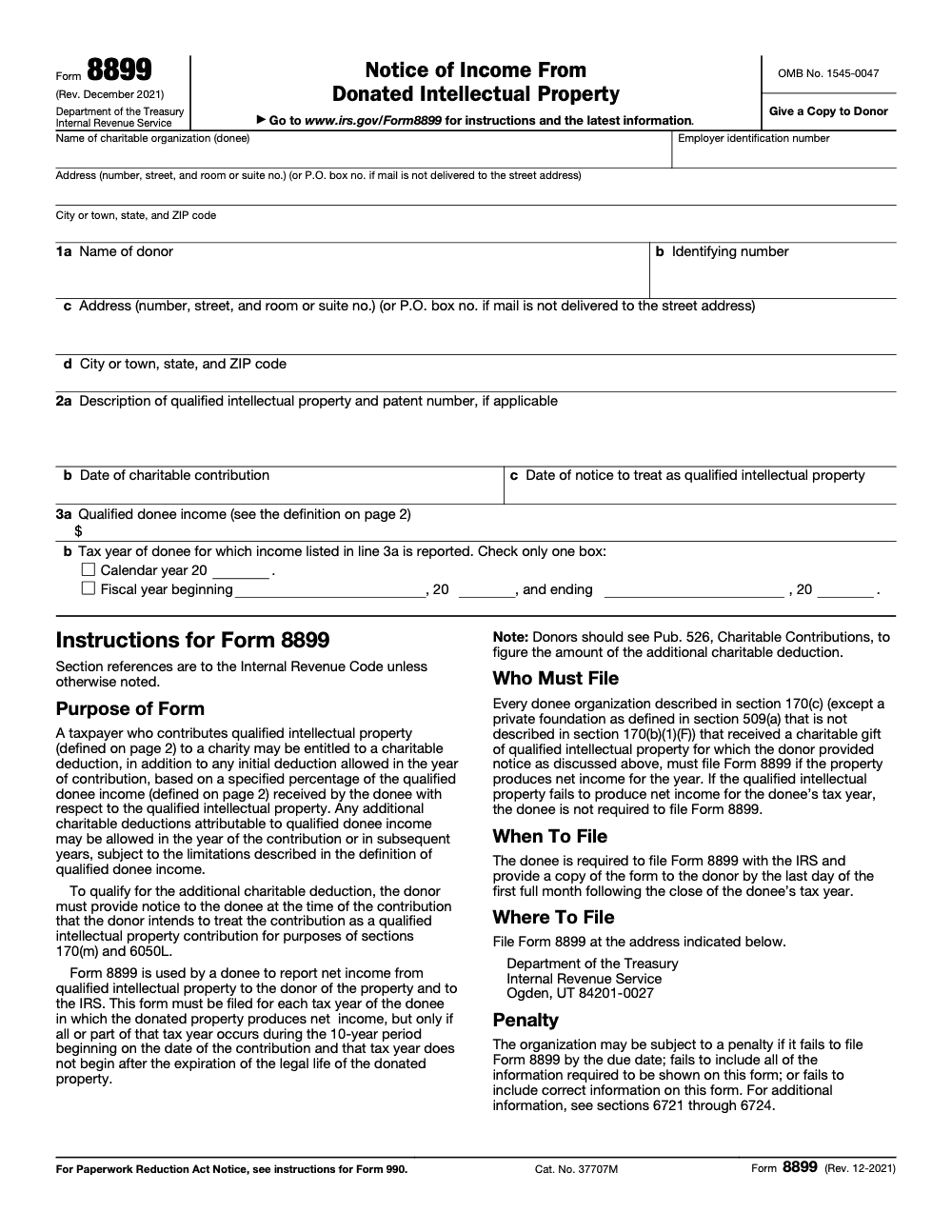
Form 8899 is the notice a charity (the donee) files to report net income from donated qualified intellectual property, sending one copy to the IRS and a copy to the donor so the donor can figure any additional charitable deduction under section 170(m) (per the IRS Instructions for Form 8899, Rev. December 2021). The qualified donee income goes on line 3a, and a calendar-year charity must file by the last day of the first full month after year-end, so income for a year ending December 31, 2025 is due January 31, 2026.
Form 8899 is the form a charity forgets it owns. A nonprofit books a healthy year of patent royalties from a donated invention, calls the books clean, and almost signs a Form 990 swearing every required notice was filed. The notice they never filed is this one, and the donor is still waiting on their copy to support an additional charitable deduction under section 170(m).
The donee files Form 8899 to report net income from donated qualified intellectual property, sending one copy to the IRS and one to the donor, with the qualified donee income going on line 3a. A calendar-year charity files by the last day of the first full month after year-end, and keeps filing for each year the IP produces net income inside the 10-year window. Form 990, Part V, Line 7g asks whether every required Form 8899 was filed, so Form 8899 and Form 990 have to tell the same story.
Key Takeaways
- You file Form 8899 when a donated piece of qualified intellectual property, like a patent or trademark, produces net income for your organization in that year. The form goes to the IRS and a copy goes to the donor.
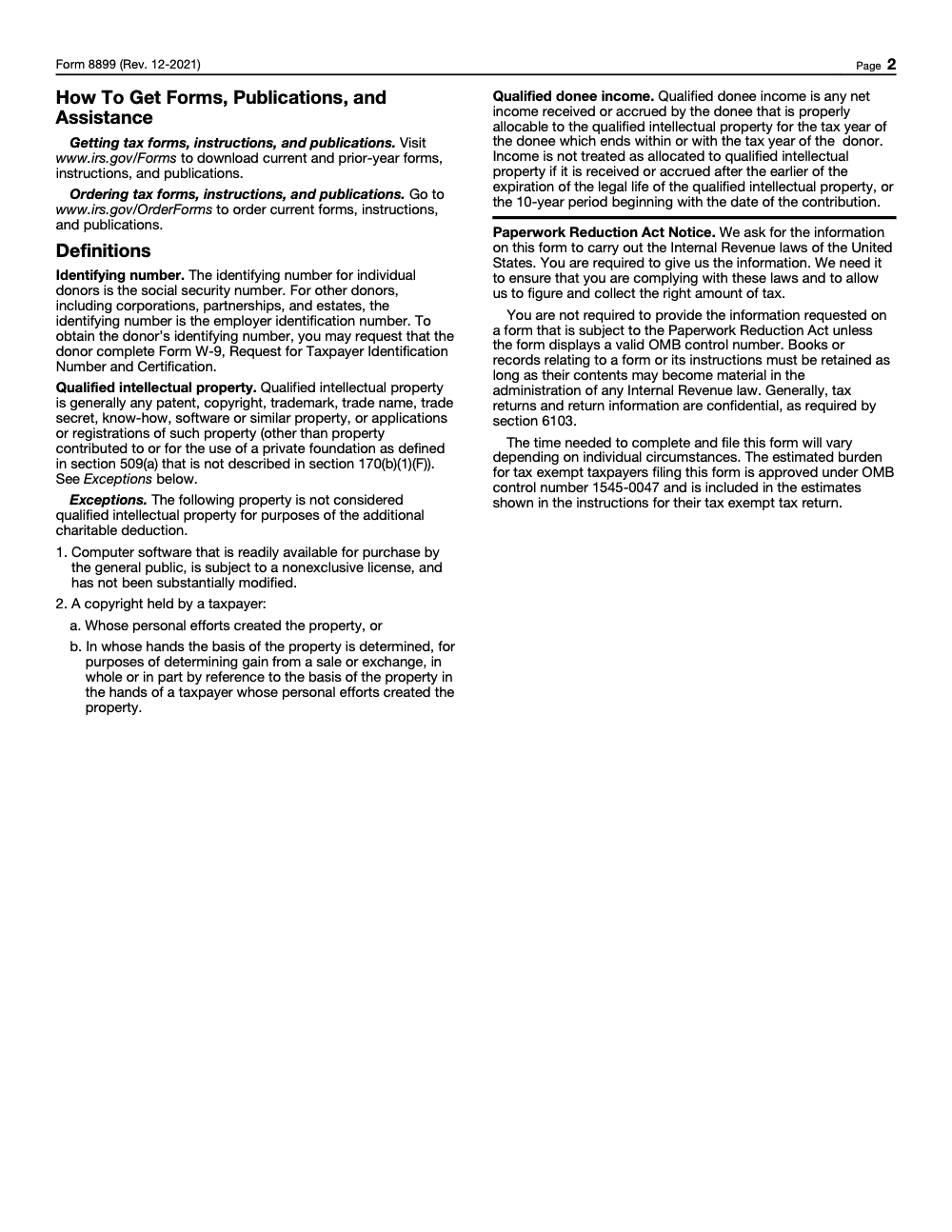
- “Qualified intellectual property” includes patents, trademarks, trade secrets, know‑how, eligible copyrights, and certain software. Off‑the‑shelf software and most self‑created copyrights are excluded.
- File by the last day of the first full month after your tax year ends, and keep filing for each year the IP yields net income within the 10‑year window, unless the legal life has expired.
- Form 990, Part V, Line 7g asks if you filed all required Forms 8899. Answer “Yes” only if every required filing is complete and timely.
- Keep agreements, valuations, royalty statements, calculations, and submission proof. Late or incorrect filings can trigger penalties.
What Form 8899 Is And Why It Exists
Form 8899 is the notice a charity must send to the IRS and the donor when donated qualified intellectual property produces net income for the charity. The donor needs this to support potential additional deductions under section 170(m). You need it to show clean compliance and to keep your Form 990 answers accurate.
Two timing rules frame your obligation. First, the filing is due by the last day of the first full month after your tax year closes. Second, the duty to file repeats each year the asset produces net income during the 10‑year period that starts on the contribution date, unless the legal life ends sooner.
On your Form 990, Part V, Line 7g, you check “Yes” only if you provided all required Forms 8899 for the year. If your organization never received a qualifying IP contribution, you leave that line blank.
Who Must File
You must file if all of the following are true:
- Your organization is described in section 170(c) and is not a private foundation that falls outside the exception.
- You received a charitable contribution of qualified intellectual property.
- That property produced net income during your tax year that falls within the 10‑year window and before the property’s legal life expires.
- The donor gave notice at the time of the gift that they intend to treat it as a qualified IP contribution.
If the IP does not produce net income in a given year, you do not file Form 8899 for that year.
Where This Connects To Your 990
Form 990, Part V, Line 7g is the annual checkpoint. It asks whether you filed all required Forms 8899 for net income from donated qualified IP. If you filed them all, mark “Yes.” If you did not, do not mark “Yes,” and be ready to correct the record.
Keep the story consistent. Royalties on your ledger, the income line on the 8899, and the 990 answer should all agree.
What Counts As Qualified Intellectual Property
Qualified intellectual property, or QIP, covers a familiar set of assets when they are donated to a charity and later produce income. Think patents with royalty streams, a registered trademark you license, a trade secret or know‑how used in a paid program, or software that is not off‑the‑shelf. Applications and registrations count once they lead to net income.
Qualified IP Examples
- A donated patent that generates royalty checks.
- A registered trademark licensed to a third party for fees.
- Documented know‑how or trade secrets used in services that earn revenue.
- Proprietary software, not publicly available, that your team licenses.
When any of these produce net income, you file Form 8899 for that year and give a copy to the donor.
Key Exclusions You Should Not Miss
Two exclusions cause most confusion:
- Off‑the‑shelf software that is publicly available, nonexclusive, and not substantially modified is not qualified IP.
- A copyright created by a person’s own efforts, or with a carryover creator basis, is not qualified IP for these purposes.
If an asset is excluded, Form 8899 is not triggered, even if it generates money. Always verify definitions before you file.
Quick Comparison
| Asset type | Is it QIP for Form 8899? | Notes |
| Patent with royalty income | Yes | File 8899 for each year with net income, within the 10‑year window. |
| Registered trademark licensed for fees | Yes | Treat license revenue as income other than contributions on 990. |
| Trade secret or know‑how used in paid programs | Yes | Document how the income ties to the IP. |
| Proprietary, not off‑the‑shelf software | Often | Confirm it is not publicly available and not self‑created in the excluded sense. |
| Off‑the‑shelf software | No | Excluded if publicly available, nonexclusive, not substantially modified. |
| Self‑created copyrights | No | Excluded if created by personal efforts or with creator carryover basis. |
When You Must File, And For How Long
You must file Form 8899 for each tax year that the donated qualified intellectual property produces net income, as long as the year falls within the 10‑year period that starts on the contribution date, and the property’s legal life has not ended.
- Due date, last day of the first full month after your tax year ends.
- Recipients, file with the IRS and provide a copy to the donor.
- If the IP does not produce net income in a given year, you do not file for that year.
How This Ties To Form 990, Part V, Line 7g
Line 7g is a simple question with big implications. If the donated QIP produced net income and you filed all the Forms 8899 required for the year, check “Yes.” If there was no qualifying contribution, leave the line blank. Mismatches here are common reasons for IRS follow‑ups.
Triggering Events Table
| Trigger | What you do |
| Donated patent pays royalties | File Form 8899 and answer 990 Line 7g accordingly. |
| Donated know‑how generates service fees | File Form 8899. |
| Off‑the‑shelf software is donated | Generally no Form 8899. |
| Trademark licensed for revenue | File Form 8899. |
| No QIP with net income in the year | Leave 990 Line 7g blank. |
Sanity check, the income you report on 8899 should appear on your books as income other than contributions, for example royalty income, not as donations.
Filing Steps, Deadlines, And Required Information
Work this as a repeatable checklist that sits inside your year‑end calendar.
- Identify the qualifying donation
- Confirm it meets the QIP definition. Gather the donor’s notice that they intend to treat the gift as qualified IP (the notice must have been given at the time of the contribution; a statement supplied after the fact does not unlock the section 170(m) treatment or create a Form 8899 filing duty).
- Confirm net income for the year
- Tie royalty or license statements to your general ledger. Compute net income allocable to the IP.
- Complete the form
- Enter your organization’s name, EIN, and address, describe the IP, list dates, report the qualified donee (net) income, and specify the donee’s tax year.
- File and furnish
- File with the IRS and provide a copy to the donor by the last day of the first full month following your tax year end. Save submission proof.
- Mirror the story on Form 990
- Answer Part V, Line 7g based on what you filed. Reconcile amounts across your return and statements.
Documentation To Keep
- Gift agreements and any assignment documents.
- Valuations and appraisal files.
- License or royalty contracts and periodic statements.
- Ledger entries, workpapers, and your net income calculation.
- Proof you filed and furnished Form 8899 on time.
Aim for audit‑ready. If a new controller joins midyear, they should be able to follow your trail without a single meeting.
Common Errors And How To Avoid Them
- Missing a required Form 8899 after income hits the bank. Solve with monthly royalty reviews and a quarter‑end checkpoint.
- Marking “Yes” on 990 Line 7g when you did not file all required forms. Cross‑check before you sign.
- Treating off‑the‑shelf software or self‑created copyrights as QIP. Train intake teams with a one‑page decision tree.
- Filing late, with missing data, or with incorrect information, any one of which can trigger penalties under sections 6721 to 6724. Put the due date on your close checklist with a named owner.
Workflow Tips That Protect Review Time
- Flag potential IP revenue streams at gift acceptance, not months later.
- Create a single “8899 packet” template with required exhibits.
- Tie royalty statements to ledger entries before the controller review.
- Store donor copies and IRS confirmations in a dedicated folder with uniform names.
Where Accountably Fits
If your internal team is buried in production work every busy season, you can assign a trained offshore preparer to assemble the 8899 packet, reconcile royalties, and route it for review inside your systems. That keeps partner or CFO time focused on sign‑off and 990 consistency, not file wrangling. Use this only where it truly adds value, keep your policies and controls in front, and preserve your security standards.
Compliance note, do not sacrifice controls for speed. Your procedures should meet your security and confidentiality standards, including access, logging, and file encryption, especially when donor details and IP agreements are involved.
Conclusion And Next Steps
Form 8899 compliance is mostly an operational habit. When a donated patent, trademark, or know‑how starts earning, your 8899 workflow should kick in, the form should go to the IRS and the donor on time, and your 990 answer should match. Build a short checklist, keep a clean packet of proof, and review the file before year‑end close. If you do that, you protect donors, your return, and your team’s sanity.
Common Mistakes We See Every Season
The same handful of slips show up year after year on Form 8899, and almost all of them trace back to a missing step at intake or a rushed year-end. Here are the ones my team watches for.
Reusable Checklists
Paste these into your firm or nonprofit SOP and run them straight off the page. Each item maps to a line or a step the IRS expects on Form 8899.
8899 Packet Build
- Confirm the donee is described in section 170(c) and is not a private foundation outside the section 170(b)(1)(F) exception.
- Locate the donor's written notice, given at the time of the gift, electing qualified IP treatment under sections 170(m) and 6050L.
- Enter the donor's name, identifying number, and address on lines 1a through 1d (SSN for an individual, EIN for an entity).
- Describe the IP and any patent number on line 2a, record the contribution date on line 2b, and the notice date on line 2c.
- Compute net income properly allocable to the IP and enter qualified donee income on line 3a.
- Check the single correct box on line 3b for the donee tax year, calendar or fiscal.
- Enter the charity's name and EIN in the donee header.
File And Furnish
- Confirm the due date: last day of the first full month after your tax year ends (January 31 for a calendar-year charity).
- Mail the completed Form 8899 to the IRS at Ogden, UT 84201-0027; the form is not part of the exempt-organization e-file program.
- Furnish a complete copy of the form to the donor by the same due date.
- Save proof of both the IRS filing and the donor copy in a dated folder.
- Reconcile the line 3a amount to your royalty or license statements and ledger.
- Answer Form 990, Part V, Line 7g to match exactly what you filed.
Annual IP Income Watch
- List every donated qualified IP asset still inside its 10-year window and legal life.
- Review royalty and license activity each quarter for first-dollar net income.
- Flag any asset whose legal life expires during the year so reporting stops on time.
- Skip the filing for any asset that produced no net income this year.
- Hand the active assets to the preparer building this year's 8899 packet.
Keep 8899 Season From Stalling
Form 8899 rarely earns its own slot on a close calendar, and that is exactly why it stalls. It fires only in years a donated patent, trademark, or know-how throws off net income, the deadline lands on the last day of the first full month after year-end (January 31 for a calendar-year charity, per the IRS Instructions for Form 8899, Rev. December 2021), and it sits months ahead of the Form 990 most teams are actually watching.
The fix is to treat the filing as a small, repeatable production task rather than a once-in-a-while scramble. When the asset tracking, the packet, and the review are standardized, a single preparer can turn the whole thing around without pulling a partner or controller off sign-off work.
- Maintain a live register of donated qualified IP with each asset's contribution date, legal-life expiry, and 10-year cutoff.
- Pre-build the 8899 packet so lines 1a through 3b populate from one source: the donor notice, royalty statements, and the net income calculation.
- Reconcile the line 3a qualified donee income to the ledger before review, not after.
- Stage the IRS mailing to Ogden and the donor copy as one paired step, with proof saved for both.
- Tie the Form 990, Part V, Line 7g answer to the packet so the return and the notice never disagree.
That is the kind of structured, documented execution we build into every engagement. When your team is buried in production as these notices come due, our tax execution support can assemble the packet, reconcile the income, and route it for review inside your systems, while your reviewers keep control of the sign-off.
FAQs
It is the form a charity files when a donated piece of qualified intellectual property produces net income. You file it with the IRS, give a copy to the donor, and repeat for each year with net income within the 10‑year window or until the legal life ends.
No. You only file for years in which the donated qualified IP produces net income. Track the asset each year so you do not miss the first dollar that arrives.
Part V, Line 7g asks whether you filed all required 8899 forms for the year. Check “Yes” only if every required filing is complete and timely. If there was no qualifying contribution, leave the line blank.
Patents, trademarks, trade names, trade secrets, know‑how, certain copyrights, and non‑excluded software, along with applications and registrations. Off‑the‑shelf software and self‑created copyrights are generally out.
It is the net income you receive or accrue that is properly allocable to the qualified IP. The donor’s additional deduction is tied to this amount (it is an input to the donor’s Publication 526 calculation, not the deduction itself), which is why the IRS cares about your annual notice.
Different topic. Form 8889 is for Health Savings Accounts, where individuals report HSA contributions and distributions. It is unrelated to Form 8899, but the similar numbering causes mix‑ups.
By the last day of the first full month after your tax year ends. For a calendar‑year filer that ends on December 31, the due date is January 31. Send a copy to the donor too.
The filing requirement generally applies to organizations described in section 170(c), except a private foundation that is not described in section 170(b)(1)(F). Most private foundations are excluded, but private operating foundations and similar section 170(b)(1)(F) entities are in scope and must file when donated qualified IP produces net income for the year. Confirm your status with counsel if you are unsure.
Report it as income other than contributions, for example royalty income, not as a contribution. Align your 8899 numbers with your financials.
Other forms this guide names
Summarize this article with AI
About this guide
Accountably helps US CPA, EA, and accounting firms hire trained accountants and tax preparers in India.
About us Reviewed byJugal Thacker, CPAFounder and CEO at Accountably
A Washington-licensed CPA with 7+ years inside US firms – PwC, a real-estate tax practice, then a full-service firm, rising from reviewer to manager to advisory. This article was reviewed against current IRS guidance for the 2025 tax year and updated for filers preparing late returns, amendments, and 2026 estimates.
View profile →How we research, review, and update this guide
Every Accountably guide is researched against primary IRS sources, reviewed by a U.S. CPA, and refreshed as guidance evolves. Read our Editorial Guidelines to see how we source, fact-check, and update our content.