Summarize this article with AI
In Brief
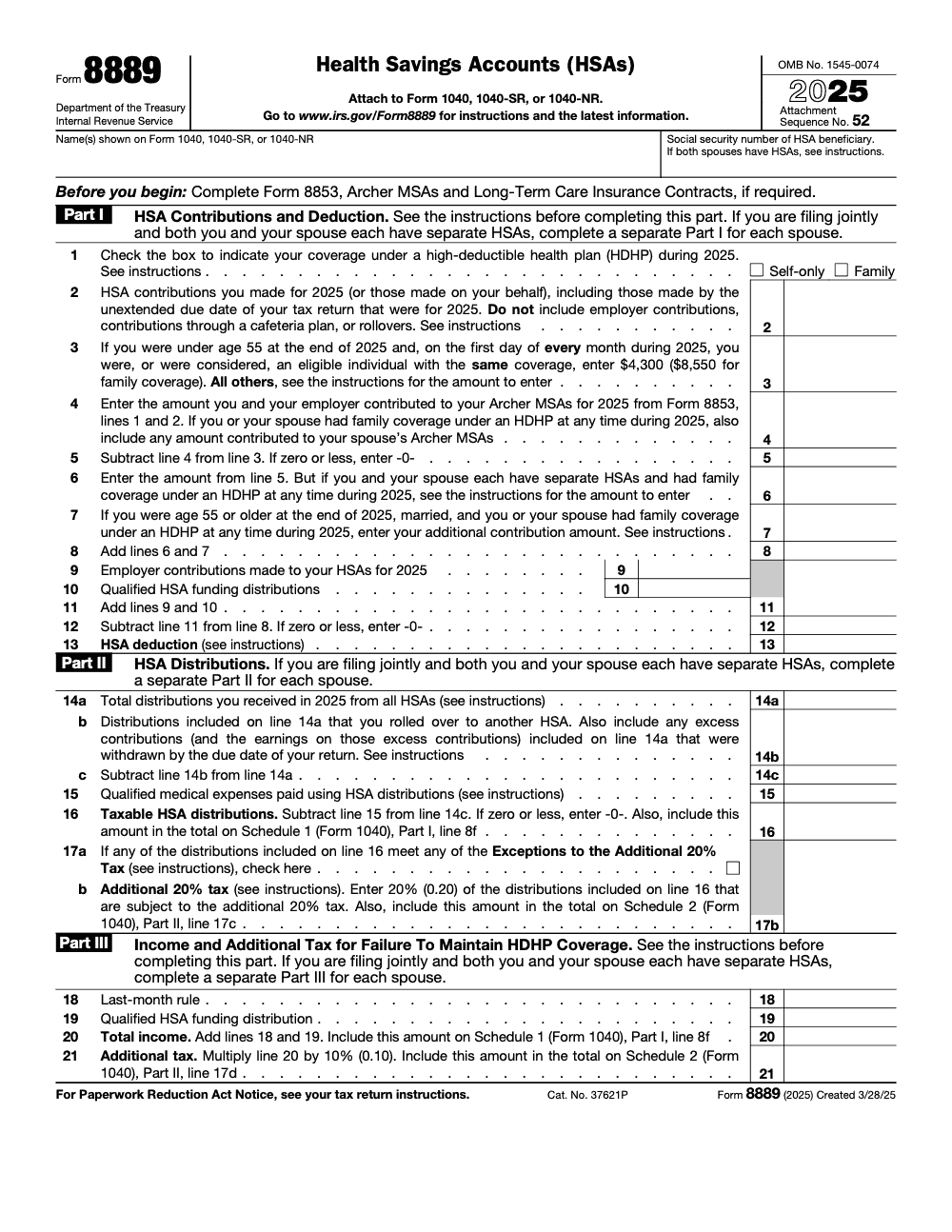
Form 8889 reports Health Savings Account (HSA) contributions and distributions and is filed as Attachment Sequence No. 52 to Form 1040, 1040-SR, or 1040-NR (per IRS Form 8889, March 28, 2025 revision). The 2025 contribution limits are $4,300 self-only and $8,550 family, with an additional catch-up amount for HSA owners age 55 or older at year-end. The HSA deduction lands on line 13 and flows to Schedule 1 (Form 1040); 2025 returns and prior-year HSA contributions are both due April 15, 2026, regardless of any Form 4868 extension.
The line that quietly decides a Form 8889 outcome is line 15, which is only for qualified medical expenses incurred after the HSA was established. A client who pays an old bill from before the account existed, then reimburses it from the HSA, has just turned a clean distribution into a taxable one, and the 20 percent additional tax follows unless they are 65, disabled, or deceased.
The contribution side is where the planning lives. For 2025 the limits are $4,300 self-only and $8,550 family, plus a catch-up for owners age 55 or older at year-end, and Part I subtracts the employer amounts already shown on your W-2 in code W. The last-month rule can let you fund as if eligible all year, but break the 12-month testing period and you owe income plus a 10 percent additional tax computed in Part III.
Key Takeaways
- You must file Form 8889 with Form 1040 for any year you contribute to, or take distributions from, an HSA.
- 2025 HSA limits, 4,300 self‑only, 8,550 family, plus 1,000 catch‑up at age 55 or older. HDHP minimum deductibles are 1,650 self‑only and 3,300 family, and out‑of‑pocket caps are 8,300 and 16,600.
- Part I calculates your HSA deduction, subtracting employer amounts reported on your W‑2, code W.
- Part II reconciles all 1099‑SA distributions, and line 15 is only for qualified medical expenses incurred after the HSA was established.
- Nonqualified distributions are taxable and usually carry a 20 percent additional tax unless you are 65, disabled, or deceased.
- The last‑month rule can let you fund as if eligible all year, but failing the 12‑month testing period triggers income and a 10 percent additional tax computed in Part III.
What Form 8889 does and when you must file
Form 8889 reports your HSA contributions and distributions, determines your deduction, and computes any taxable amounts or additional taxes tied to HSAs. You file it for any year you made contributions, including amounts someone made on your behalf, or any year you received HSA distributions. This includes employee pre‑tax cafeteria plan contributions and employer contributions that appear on your W‑2 with code W, which reduce the amount you can deduct in Part I.
You also use Part II to reconcile every distribution reported on Form 1099‑SA. That is where you show which withdrawals paid for qualified medical expenses, which keeps them tax‑free. Part III comes into play if you broke a rule, for example, you used the last‑month rule and did not remain eligible through the testing period.
Eligibility and 2025 contribution limits
You can only contribute to an HSA if you are covered by a qualifying HDHP, you are not enrolled in Medicare, you are not claimed as a dependent, and you do not have disqualifying first‑dollar coverage. For 2025, the annual HSA contribution limits are 4,300 for self‑only and 8,550 for family coverage. If you are 55 or older by December 31, you can add a 1,000 catch‑up. Your employer contributions, including amounts through a cafeteria plan, count toward the annual limit and must be subtracted when you compute your deduction.
If you use the last‑month rule, being HSA‑eligible on December 1 treats you as eligible for the entire year. You can contribute up to the full annual limit, however, you must stay eligible through the end of the following December. If you do not, you include in income the amount that would not have been allowed and you owe a 10 percent additional tax. Part III handles this calculation.
Quick reference, 2024 vs 2025 HSA and HDHP numbers
| Item | 2024 | 2025 |
| HSA contribution limit, self‑only | 4,150 | 4,300 |
| HSA contribution limit, family | 8,300 | 8,550 |
| Catch‑up at 55+ | 1,000 | 1,000 |
| HDHP minimum deductible, self‑only | 1,600 | 1,650 |
| HDHP minimum deductible, family | 3,200 | 3,300 |
| HDHP out‑of‑pocket max, self‑only | 8,050 | 8,300 |
| HDHP out‑of‑pocket max, family | 16,100 | 16,600 |
Numbers reflect Rev. Proc. 2024‑25 and 2024 Form 8889 instructions for 2024 figures.
Documents you will use
- Form 1099‑SA, your HSA trustee reports total distributions in box 1, and other details that drive Part II.
- Form 5498‑SA, your HSA trustee reports total contributions received and the account’s fair market value, which helps you confirm Part I.
- Your W‑2, box 12 code W shows employer and cafeteria plan contributions that reduce your deduction.
Tip, contributions for a tax year can be made up to the unextended filing deadline for that year (a Form 4868 extension to file does not push the HSA contribution window). For example, 2025 contributions can be made up to the April 15, 2026 unextended filing deadline, subject to IRS rules and trustee reporting. Always follow the current year’s instructions for Form 8889.
How to complete Form 8889, line by line without the usual stress
Work the form in order, Part I for contributions and your deduction, Part II for distributions and qualified expenses, Part III only if a testing period or excess contribution rule applies. Keep your 1099‑SA, 5498‑SA, and receipts nearby.
Part I, compute your 2025 HSA deduction
- Line 1, check self‑only or family HDHP coverage.
- Line 2, enter contributions you made for the year, including amounts made by someone on your behalf, but do not include employer or cafeteria plan amounts (those flow through line 9 and produce no further deduction), rollovers, or IRA‑to‑HSA funding distributions.
- Line 3, apply the annual limit based on your coverage and eligibility. For 2025, that is 4,300 self‑only or 8,550 family (the 1,000 catch‑up for age 55 or older belongs on line 7, not line 3). If you were not eligible all year, use the limitation worksheet in the instructions.
- Lines 9 and 10, reduce by employer W‑2 code W amounts, and account for any qualified HSA funding distribution (a once‑in‑a‑lifetime IRA‑to‑HSA transfer under IRC §408(d)(9)).
- Line 13, the allowable HSA deduction flows to Schedule 1.
Pro move, if you and your spouse both have HSAs and family HDHP coverage, you share the family limit between you, and each spouse files a separate Form 8889 with the joint return. Coordinate so your combined contributions, including employer amounts, do not exceed 8,550 for 2025. If you are both 55 or older and each has an HSA, each of you can make your own 1,000 catch‑up to your own HSA.
Part II, reconcile every dollar on your 1099‑SA
- Line 14a, enter total distributions from all HSAs, match box 1 of every 1099‑SA. If you used an HSA debit card, those swipes are included.
- Line 14b, enter rollovers and timely withdrawals of excess contributions, including related earnings, that you removed by the return due date (excess contributions left in the HSA past that date trigger a 6 percent excise tax on Form 5329 each year they remain).
- Line 14c, compute net distributions.
- Line 15, enter only qualified medical expenses you paid, or reimbursed yourself for, that were incurred after your HSA was established and were not reimbursed by other coverage.
- Line 16, if 14c is greater than 15, the difference is taxable income.
- Lines 17a and 17b, if the taxable amount is a nonqualified distribution, calculate the 20 percent additional tax unless you meet an exception, age 65, disability, or death.
Common slip, people enter insurance premiums on line 15. Most health insurance premiums are not qualified HSA expenses, a few exceptions exist, for example COBRA, Medicare premiums once you are 65, and coverage while receiving unemployment. Check Publication 969 if in doubt, then keep the receipt with your tax records.
Part III, rules that can add income and extra tax
Use Part III if you funded your HSA under the last‑month rule or used an IRA‑to‑HSA qualified funding distribution, then failed the testing period. If you do not stay eligible for the full testing period, you add back the amount that would not have been allowed and pay a 10 percent additional tax on that amount. The testing period runs from the last month of the tax year through the end of the following year.
Example, a clean 2025 filing
- You had family HDHP coverage all year, you turned 55 in May 2025, and your employer contributed 2,000 through payroll, code W.
- You contribute 6,550 to reach the 8,550 family limit, and you also add your 1,000 catch‑up to your own HSA.
- Part I shows 7,550 on line 2, limit of 8,550 plus 1,000, minus 2,000 employer, your deduction is 6,550.
- Part II, your 1099‑SA shows 800 of distributions, and your receipts for qualified expenses total 800, line 15 equals line 14c, nothing taxable.
Example, last‑month rule hiccup
- You became HSA‑eligible on December 1, 2025 with family coverage and contributed 8,550 for 2025 using the last‑month rule.
- In June 2026, you moved off HDHP coverage. You failed the testing period, so in 2026 you must include the difference between what you contributed and what you would have been allowed using monthly proration, and you owe a 10 percent additional tax on that amount. Part III walks you through the numbers.
Avoid penalties with tight documentation
Keep your 1099‑SA, your 5498‑SA, your W‑2, and receipts or invoices that prove each qualified medical expense. Make sure line 14a equals the totals on your 1099‑SA forms, that your rollovers are marked on 14b, and that line 15 includes only eligible expenses. If you spot a mistaken distribution and your trustee allows it, the IRS has guidance for returning certain mistaken distributions so they are not taxable or subject to the 20 percent additional tax. Follow the current year instructions and trustee rules.
Recent updates, tips, and a calm filing routine
- 2025 HSA limits increased to 4,300 and 8,550, catch‑up remains 1,000. HDHP thresholds also rose slightly. For planning beyond this filing season, the IRS has already published 2026 amounts, 4,400 self‑only and 8,750 family, with HDHP minimum deductibles of 1,700 and 3,400. Use these only for 2026 planning, not for 2025 returns.
- You can make prior year HSA contributions up to the unextended filing deadline, usually mid‑April (a Form 4868 extension to file does not push the HSA contribution window to October), so confirm timing if you are topping off after year end and keep the confirmation from your HSA custodian.
- If a distribution is taxable, check whether an exception to the 20 percent additional tax applies, for example distributions after the date you turned 65. The Form 8889 instructions show how to mark 17a and compute 17b.
Quick workflow for individuals
- Confirm your eligibility months and your coverage type for the year.
- Gather your W‑2, every 1099‑SA, and your 5498‑SA.
- Add up your own contributions, subtract code W amounts, and compare to the annual limit.
- Reconcile distributions line by line, match 14a to box 1 totals, and enter only qualified expenses on line 15.
- Review Part III only if you used the last‑month rule or a qualified HSA funding distribution and did not meet the testing period.
Quick workflow for firm preparers
If you run a busy tax practice, most Form 8889 issues are process issues, not knowledge gaps. Standardize workpapers, enforce naming rules for receipts, and use a two‑layer review for Part II totals and line 15 documentation before partner review. This simple structure shortens review time and cuts rework.
For firms that need seasonal capacity without quality drift, Accountably integrates trained offshore teams into your workflow with SOPs, structured workpapers, and layered review, so partners spend less time stuck in loops and more time on client strategy. Use it if you need production stability, not resumes. Keep it minimal, keep it accountable.
Final checklist and compliance note
- Match 1099‑SA totals on line 14a and keep receipts that support line 15.
- Confirm your 2025 limit before claiming the deduction on line 13.
- Use Part III only if a testing period rule applies.
- If you are over 65, check the exception to the 20 percent additional tax for nonqualified distributions.
This guide is for general education, it is not tax advice. Tax rules change, and your facts matter. For complex situations, work with a qualified tax professional and always rely on the current IRS instructions and revenue procedures for the year you file.
Common Mistakes We See Every Season
Every HSA season we see the same handful of errors repeat across returns, and most of them trace back to one of two issues: confusion about where employer and cafeteria-plan money belongs on the form, or assumptions about deadlines and testing periods that do not match what the instructions say.
Reusable Checklists
These checklists are built to drop straight into a firm SOP or client onboarding packet. Line numbers reference the 2025 Form 8889 (March 28, 2025 revision).
Pre-file HSA review
- Confirm HDHP coverage type (self-only or family) for line 1.
- Pull Form 5498-SA from the HSA custodian for total contributions.
- Pull W-2 Box 12 Code W for employer and cafeteria-plan amounts.
- Separate after-tax contributions (line 2) from employer or cafeteria amounts (line 9).
- Verify age at year-end for the catch-up contribution on line 7.
- Check eligible-individual status for every month of 2025.
- Document any mid-year coverage change for the proration calculation.
- Confirm Archer MSA activity on Form 8853 before completing line 4.
Distribution match against Form 1099-SA
- Tie line 14a total to the gross distribution box on Form 1099-SA.
- Identify HSA-to-HSA rollovers and document on line 14b.
- Identify corrective excess withdrawals with earnings (also line 14b).
- Total qualified medical expenses paid from the HSA for line 15.
- Match each expense to a receipt or EOB before signing off.
- Calculate taxable distributions: line 14c minus line 15, into line 16.
- Check line 17a if an exception (age 65, disability, death) applies.
- Route line 16 to Schedule 1 line 8f and line 17b to Schedule 2 line 17c.
Testing-period sweep for Part III
- List clients who used the last-month rule on a prior-year Form 8889.
- List clients who took a qualified HSA funding distribution from an IRA.
- Confirm HDHP eligibility continued through December 31 of the testing year.
- Flag any client who lost HDHP coverage early (Medicare enrollment, FSA election, plan change).
- Compute the line 18 or line 19 add-back amount.
- Compute the 10% additional tax on line 21.
- Route line 20 to Schedule 1 line 8f and line 21 to Schedule 2 line 17d.
- Update the client's permanent file with the testing-period outcome.
Keep 8889 Season From Stalling
Form 8889 rides along with every Form 1040 that includes HSA activity, and the volume is not small. According to IRS Publication 1304 (SOI TY2022), the agency processes roughly 161 million individual returns each year, and a meaningful slice of them carry an attached Form 8889. The result is a March-April compression that pushes HSA reconciliation work – matching contributions against Form 5498-SA, distributions against Form 1099-SA, and employer amounts against W-2 Box 12 Code W – to the bottom of the priority queue exactly when reviewers have the least bandwidth.
The fix is not more hands on the desk. It is a tighter intake, a clean separation of contribution sources, and a documented routing of each Form 8889 line to the correct downstream schedule. When that workflow is repeatable, the form stops being a season-end scramble and becomes a 20-minute review item per return.
- Build a single intake form that captures HDHP coverage type, months of eligibility, age at year-end, and any Archer MSA activity before any line on Form 8889 is filled.
- Separate line 2 (after-tax contributions) from line 9 (employer plus cafeteria-plan amounts) on the working paper so the deduction never double-counts.
- Run a line-by-line route check: line 13 to Schedule 1, line 16 to Schedule 1 line 8f, line 17b to Schedule 2 line 17c, line 20 to Schedule 1 line 8f, line 21 to Schedule 2 line 17d.
- Add a testing-period flag to the client's permanent file the year any last-month rule or qualified funding distribution is used, so Part III review is automatic the following year.
- Build a pre-April 15 excess-contribution sweep into the close calendar; corrective withdrawals after the deadline trigger a 6% excise on Form 5329 every year the excess remains.
This is the kind of disciplined, line-aware execution our tax delivery teams handle inside a documented SOP and a multi-layer review process, so reviewers see a clean Form 8889 with every line traced to its source document.
FAQs
You file Form 8889 if you, or someone on your behalf, contributed to an HSA, or if you took HSA distributions during the year. Attach it to Form 1040. Skipping it can delay refunds and cause IRS notices if your 1099‑SA is unmatched.
You can get the form and the instructions at IRS.gov, and most tax software includes them. Always use the instructions for the tax year you are filing, since limits and worksheets change.
1099‑SA reports distributions, which flow to Part II. 5498‑SA reports contributions received by your HSA trustee and the year‑end fair market value, which helps you confirm Part I. Save both with your receipts and invoices.
That is fine, it simply means you had more qualified expenses than distributions, and you may have paid some expenses with non‑HSA funds. Keep your receipts anyway, since you can reimburse yourself tax‑free in a later year if the expense occurred after you opened the HSA. Publication 969 explains qualified expenses and timing.
You compute a recapture in Part III, include the amount in income in the year you failed the testing period, and pay a 10 percent additional tax on that amount. The testing period runs from the last month of the tax year through the end of the next calendar year.
Other forms this guide names
- Form 1099-SA: HSA Distributions, Codes, Penalties & Filing
- Form W‑2: Deadlines, E‑File Rules, Boxes, and W‑2c Corrections
- Form 5498-SA: HSA & Archer MSA Contribution Reporting
- Form 1040: Filing Guide for 2025 Returns (AGI, Deductions, Deadlines)
- Form 4868: IRS Tax Extension 2025 Guide to Filing
About this guide
Accountably helps US CPA, EA, and accounting firms hire trained accountants and tax preparers in India.
About us Reviewed byJugal Thacker, CPAFounder and CEO at Accountably
A Washington-licensed CPA with 7+ years inside US firms – PwC, a real-estate tax practice, then a full-service firm, rising from reviewer to manager to advisory. This article was reviewed against current IRS guidance for the 2025 tax year and updated for filers preparing late returns, amendments, and 2026 estimates.
View profile →How we research, review, and update this guide
Every Accountably guide is researched against primary IRS sources, reviewed by a U.S. CPA, and refreshed as guidance evolves. Read our Editorial Guidelines to see how we source, fact-check, and update our content.