Summarize this article with AI
In Brief
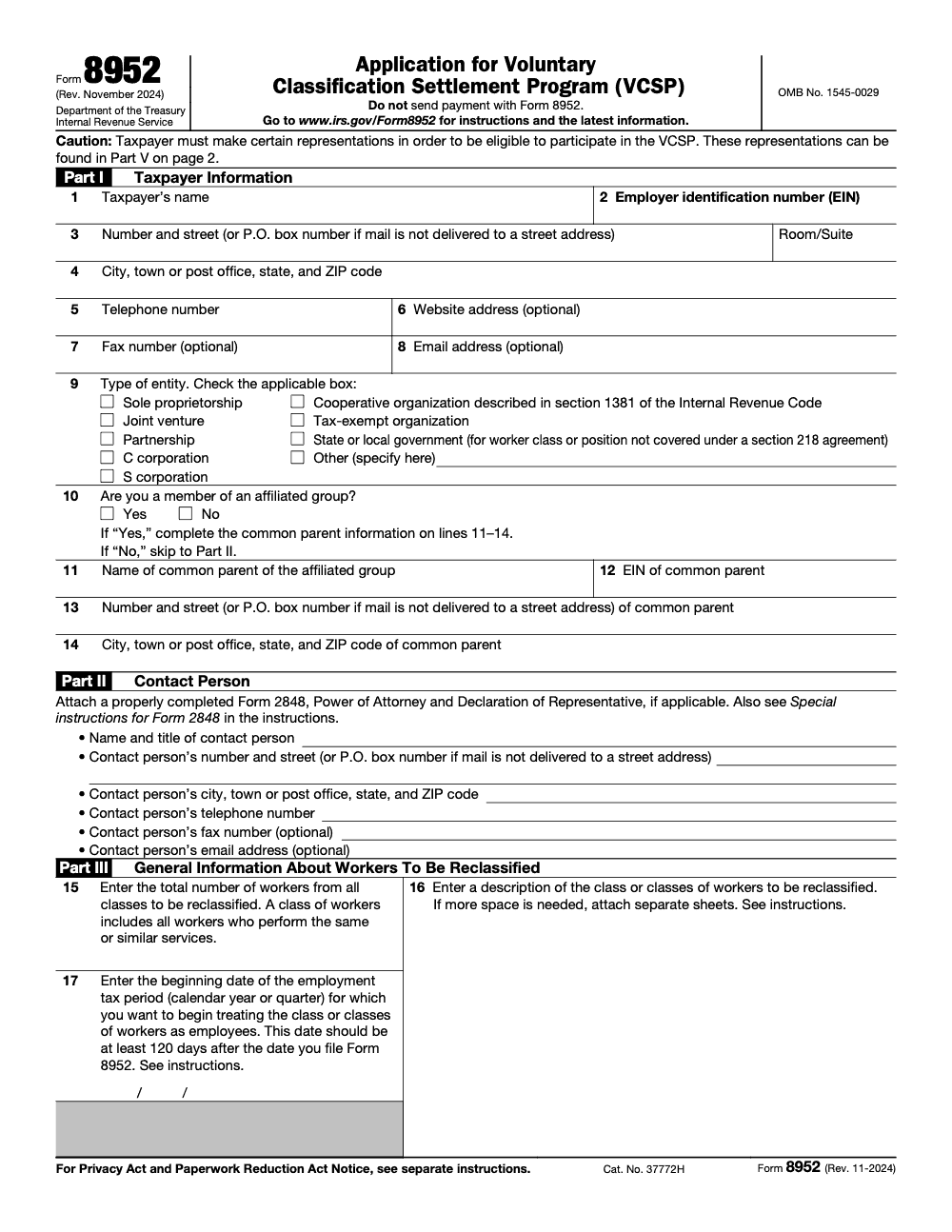
Form 8952 is the IRS Application for Voluntary Classification Settlement Program (VCSP) – U.S. employers use it to voluntarily reclassify a class of workers from contractors to employees on a prospective basis (per IRS Form 8952 instructions, Rev. November 2024). The application must be filed at least 120 days before the desired effective date on Line 17, the VCSP payment computed on Line 24 equals 10 percent of the Section 3509(a)-reduced employment tax liability, and no payment is submitted with the form itself. For payroll-side coordination, see our tax services page.
An employer realizes a whole class of workers has been treated as contractors when they should have been employees, and wants to fix it without an interest-and-penalty fight. Form 8952 is the application for the Voluntary Classification Settlement Program, which lets you reclassify that class as employees on a prospective basis.
Timing and arithmetic decide this one. You file at least 120 days before the effective date on Line 17, the payment on Line 24 equals 10 percent of the Section 3509(a)-reduced employment tax liability, and no payment goes in with the application. You must have filed all required Forms 1099 for the prior three years, mail to the Detroit Federal Building rather than Ogden, and agree to extend the assessment statute to six years per Announcement 2012-45.
Key Takeaways
- The VCSP lets you prospectively reclassify a worker class as employees, pay 10 percent of the employment taxes that would have applied for the most recent completed year under Section 3509(a), and avoid interest and penalties.
- File Form 8952 at least 120 days before your requested start date. Do not include payment with the application. You pay after the IRS issues a closing agreement.
- The IRS mailing location for Form 8952 is the Detroit Federal Building, not Ogden. Use the exact address listed in the current instructions.
- You must have treated the class as nonemployees and filed all required Forms 1099 for the prior three years, and you cannot be under an IRS employment tax audit or a DOL or state worker‑classification audit. Some taxpayers previously audited may still qualify if they complied and are not contesting the results.
- VCSP participants must agree to extend the statute of limitations on assessment to six years for each of the first three calendar years beginning after the reclassification effective date (Announcement 2012-45).
What Form 8952 Is and Why It Matters
Form 8952 is the IRS application for the Voluntary Classification Settlement Program. You submit it to reclassify a defined class of workers as employees starting on a future date. If accepted, you sign a closing agreement and pay 10 percent of the employment tax amount that would have been due for the most recently completed calendar year using Section 3509(a) rates. No interest or penalties apply to that payment, and the IRS will not conduct employment tax audits on prior years for the covered workers.
You should file at least 120 days before the date you want W‑2 treatment to begin – this is not a soft recommendation, the IRS uses that window to review the application and issue the closing agreement, so filing closer than 120 days risks rejection or processing delay. The IRS encourages that lead time so your effective date lands on the quarter you request. Do not send money with the application, the IRS will calculate and confirm the amount and collect it when you return the signed closing agreement.
Two points many teams miss:
- You can reclassify some or all worker classes. You do not have to convert every contractor in your business, you can scope the filing to a clearly defined class.
- VCSP relief is federal. It does not bind states. Plan for state payroll tax, unemployment, and benefits effects in parallel with your federal change.
If delivery pressure has you stuck in review loops, Form 8952 gives you a clean path forward that you can schedule, track, and finish without derailing client work. When you combine VCSP with tight workpapers and a clear internal rollout, your partners get out of rework and back to client strategy.
Who Qualifies To Apply For The VCSP
You are eligible if you currently treat a class of workers as contractors, you will treat that class as employees on a go‑forward basis, you issued all required Forms 1099 for the prior three years (this is a binary eligibility gate – any missing 1099s must be properly filed before you sign Part V, they cannot be cured alongside the VCSP application), and you are not under an IRS employment tax audit or a DOL or state worker‑classification audit. Exempt organizations and government entities can participate if they meet these conditions, but state and local governments are eligible only for worker classes or positions NOT covered under a Social Security Act Section 218 agreement.
If you were previously examined by the IRS or the Department of Labor on worker classification for this class, you may still be eligible if you complied with the results and you are not contesting them in court. Members of an affiliated group are ineligible if any member is under an IRS employment tax audit.
Quick Eligibility Checklist
- Consistent contractor treatment for the class during the last three years, and all required 1099s filed for each of those years.
- No current IRS employment tax audit, and no current DOL or state worker‑classification audit.
- If previously audited on classification, you complied with the outcome and are not contesting it in court.
- If part of an affiliated group, confirm that no member is under an IRS employment tax audit.
Why This Matters For Delivery
When status is corrected, payroll setup becomes predictable, reviewers stop tripping over incomplete contractor files, and managers stop guessing about withholding. The program trades a one‑time, formula‑based cost for a lasting reduction in delivery friction. If your teams are already stretched, that swap is worth it.
What The VCSP Does Not Do
- It does not cover state rules. Coordinate state payroll registrations, SUTA, and any benefit timing.
- It does not leave the standard three-year statute of limitations in place. Per Announcement 2012-45, participants must agree to extend the assessment period to six years for each of the first three calendar years beginning after the reclassification effective date.
Key Benefits, Cost, And Risk Control
The headline benefit is cost certainty. Your settlement equals 10 percent of the employment tax amount computed under Section 3509(a) for the most recent completed year, often described as an effective 1.068 percent up to the Social Security wage base and 0.324 percent above the wage base, because you pay ten percent of the 3509(a) totals. No interest or penalties apply on the covered amount.
You also cut audit risk for prior years on the covered workers. Once accepted and signed, the IRS will not examine earlier periods for worker classification on that class. Your focus shifts to clean payroll and documentation going forward.
Tip, anchor your internal plan to quarter boundaries. Pick an effective date that matches the start of a quarter, document it in your engagement notes, and train staff on what changes on day one.
- Predictable, formula‑based settlement, 10 percent of the 3509(a) amount.
- No interest or penalties for the covered periods.
- Prior‑year IRS employment tax audit protection for the covered workers.
Information You Need Before You Complete Form 8952
The fastest VCSP approvals I have seen came from teams that treated this like a mini audit file. You pull the essentials, prove eligibility in writing, and make the IRS review easy.
Core Eligibility Proof
- Three full years where you treated the class as contractors, with required Forms 1099 filed for each worker in each of those years. Keep copies or filing confirmations handy.
- No current IRS employment tax audit, and no current worker classification audit by the Department of Labor or a state agency. If you were audited before, you complied and you are not contesting the result in court.
- You plan to prospectively convert the defined class to employees, and you will sign a closing agreement if accepted.
Data To Assemble
- Legal name, EIN, and address that match IRS records. If you need an EIN, secure it before filing.
- A precise description of each worker class you intend to reclassify, plus headcount per class.
- Total compensation for the most recently completed calendar year, by worker, so you can compute the Section 3509(a) base and support the VCSP amount. The instructions explain how to handle the Social Security wage base and special cases.
- A list of names and Social Security numbers for workers being reclassified, attached to the form, which the IRS explicitly requires.
Timing And Address
- File at least 120 days before your requested effective date, for example file by October 1 if you want a January 1 start. Do not include payment with the application.
- Mail Form 8952 to the current IRS address in the instructions, which as of November 2025 is the Detroit Federal Building, 985 Michigan Avenue, 4th Floor CETO, Detroit, MI 48226. Use a trackable method.
Pro move, set your effective date to the first day of a quarter, and coordinate payroll setup, benefits, and timekeeping changes to that same date. It keeps reconciliations clean.
Step‑By‑Step Guide To Completing Form 8952
Use this as your prep checklist before you print and sign.
| Step | What You Do | What To Double Check |
| 1 | Confirm eligibility and scope the worker class | Three years of consistent contractor treatment, required 1099s, no current audits |
| 2 | Gather entity data | Legal name, EIN, address match IRS records |
| 3 | Describe each class | Duties, supervision level, how work is assigned, one description per class |
| 4 | List workers | Names and SSNs attached, as required for processing |
| 5 | Choose start date | At least 120 days after filing, ideally the first day of a quarter |
| 6 | Compute payment base | Use most recent completed calendar year compensation, apply Section 3509(a) framework |
| 7 | Review and sign | Taxpayer must personally sign Part V (a Power-of-Attorney representative cannot sign Part V because it carries a penalty-of-perjury statement); attach POA if a representative is the contact |
| 8 | Mail, then wait for IRS contact | Do not include payment, pay only when you sign the closing agreement |
Small But Important Details
- Contact person and POA. If a representative will speak with the IRS, include Form 2848 with “Voluntary Classification Settlement Program” in the description of matter, and leave the tax form number and years blank as the instructions specify. Form 8821 Tax Information Authorization is not a substitute, it authorizes information disclosure only, not representation.
- Paid preparer. If a paid preparer completed the form, they must sign and include their PTIN and firm details.
Where And How To File Form 8952
- Method, paper only, there is no e‑file for Form 8952. Print, sign, and mail with a trackable service that gives you proof of delivery.
- Timing, file at least 120 days before your requested start date. The IRS will try to process in time for your requested quarter, but give them room.
- Address, send the form to the Detroit Federal Building address shown in the current instructions. If you use a designated private delivery service, follow the IRS street address rules for that service.
Important, do not include payment with the form. The IRS will calculate and confirm the amount, then collect when you return the signed closing agreement.
How The VCSP Payment Is Calculated
Here is the logic you will see in the instructions and FAQs, in plain English.
- Identify compensation for the most recently completed calendar year for the workers being reclassified. This is your base.
- Compute the employment tax that would have applied for that year using Section 3509(a) rates. The instructions explain how to apply the Social Security wage base per employee.
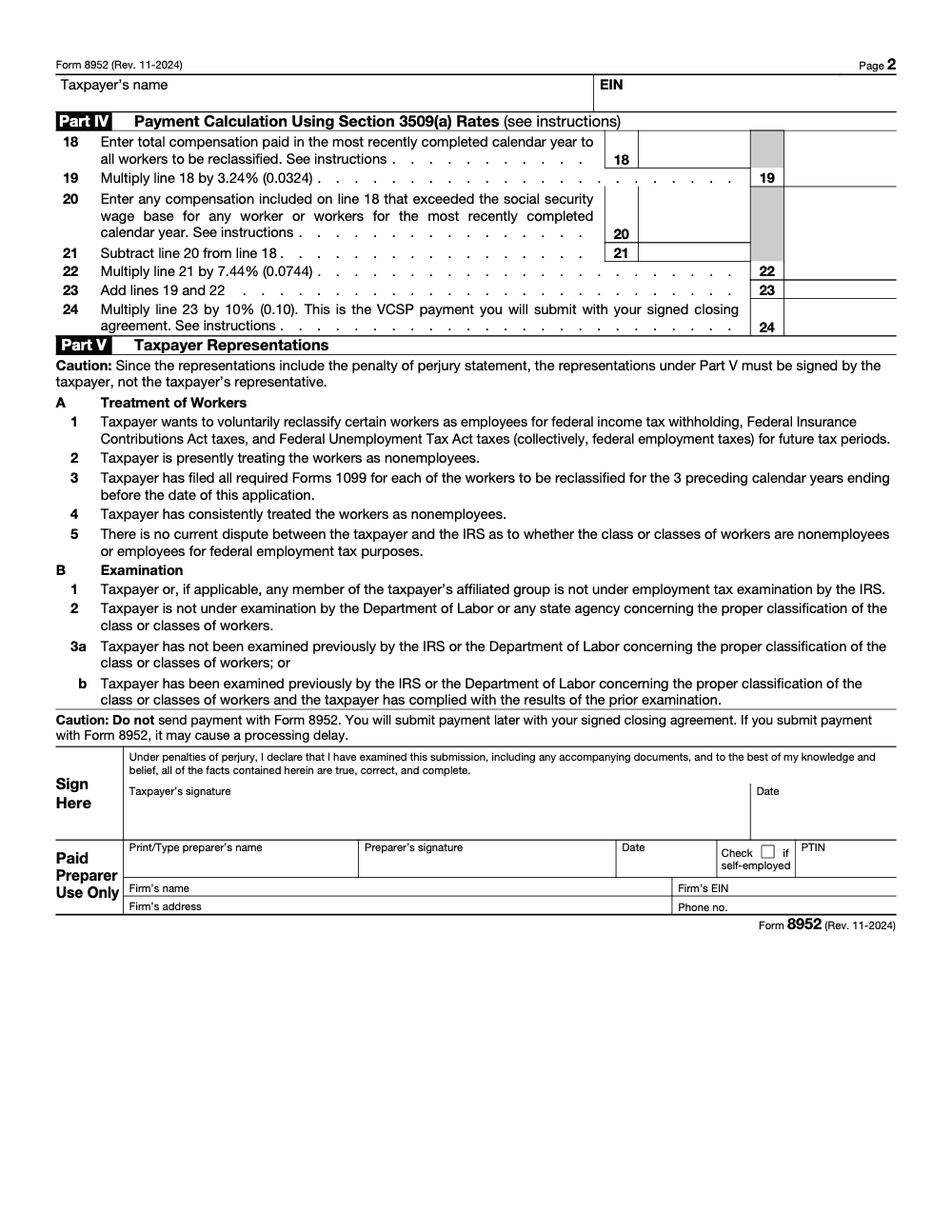
- Multiply that amount by 10 percent. That result is your VCSP payment, due only after you sign the closing agreement. No interest or penalties are added to that amount.
The instructions list the Social Security wage base by year, including 2023 at 160,200, 2024 at 168,600, and 2025 at 176,100, which you apply on an employee by employee basis when computing the 3509(a) amounts.
Example, your 2024 compensation for the class is 1,500,000, and your Section 3509(a) computation totals 160,200. Your VCSP payment equals 10 percent of that, or 16,020, due with the signed closing agreement, not with the application.
Shortcut, many firms keep an internal worksheet that mirrors Part IV of the instructions. Build yours once, save the logic, and reuse it each time you scope a VCSP class.
What Happens After You Submit Form 8952
Once you mail Form 8952, the IRS reviews your eligibility, confirms your requested effective date, and reaches out to your contact person. You will receive either a request for clarification or a proposed closing agreement. Do not send money with the application. You only pay after you sign and return the closing agreement.
Practical tip, if you filed with a POA, make sure your internal point of contact and the POA both track incoming IRS mail. Missed letters cause avoidable delays.
The Closing Agreement, What To Expect
- The agreement lists the worker class, the effective date for employee treatment, and the amount due, which is tied to the Section 3509 calculation you supported in your file.
- You sign and return the agreement with payment, then switch the affected workers to employees on the agreed date.
- Keep a copy in your permanent tax file and in your payroll compliance folder.
Your Internal Rollout Checklist
Use this operational checklist so the people side does not lag behind the tax decision.
- Payroll and benefits set up
- Add the workers to payroll, set federal and state withholding, and enroll in benefits if applicable.
- Update timekeeping codes and overtime rules if hourly.
- State registrations
- Confirm you are registered for state withholding and unemployment in every state where the workers are located.
- Contracts and communications
- Issue updated offer letters or employee agreements.
- Send a clear FAQ to the workers explaining pay cycles, taxes, benefits, and who to contact with questions.
- Accounting and systems
- Recode vendor profiles that are converting to employees.
- Update approval workflows and document storage locations.
- Controls and documentation
- File your signed closing agreement, your 3509 worksheet, and your worker list in a shared, access‑controlled folder.
- Record your effective date in your close calendar so reviewers know exactly when treatment changed.
Common Eligibility Pitfalls And How To Avoid Them
Small misses can sink an otherwise solid filing. Here is a quick map of what trips teams up, and how to avoid it.
| Pitfall | Why It Derails You | Fix That Works |
| Incomplete 1099 history | The program requires three years of consistent contractor treatment with required 1099s | Pull transcripts, reconcile forms, and correct gaps before filing |
| Mixing workers inside a single class | Cherry‑picking within one class undercuts your representation | Define classes by duties and supervision, then include the full class |
| Active audit | Current IRS or DOL or state worker‑classification audits block entry | Wait until audit status is closed, then reassess eligibility |
| Vague class description | The IRS cannot tell who is covered | Write plain‑English duties, reporting lines, and how work is assigned |
| Rushed timing | Too little lead time to hit your preferred quarter | File early, target the first day of a quarter, and plan backward 120 days |
| Wrong mailing details | Misaddressed or untracked mailing causes delays | Use the current IRS address in the instructions and a trackable service |
Pro move, run a pre‑mortem with your team. Ask, if this were rejected, what would be the most likely reason? Fix that now, before you mail.
Documentation And Workpaper Standards That Speed Review
When the IRS reviewer can follow your story, your odds improve. Treat your file like a clean audit binder.
Build A Binder That Tells A Straight Story
- Part A, Eligibility narrative
- One page confirming three years of contractor treatment, your 1099 proof, and that you are not under a worker‑classification audit.
- Part B, Class definition
- Duties, how work is assigned, who reviews the work, number of workers, and locations.
- Part C, Worker list
- Names and SSNs, clearly tied to the class.
- Part D, Payment support
- Compensation totals for the most recent completed year, your Section 3509 worksheet, and notes on wage base handling.
- Part E, Effective date plan
- The date you will start W‑2 treatment and a short internal rollout plan covering payroll, benefits, and state registrations.
How This Improves Delivery
A tight file keeps partners out of review loops and helps operations hit the effective date without last‑minute chaos. If you have limited internal capacity, assign a single owner who tracks the filing, the closing agreement, and the payroll switch, and who reports status weekly until the conversion date passes.
Making The Most Of Your Effective Date
Reclassification is more than a form, it is a project. Pick a date, brief your people leaders, and rehearse the change.
- For January 1 starts, finish file prep in late summer, file in early fall, and schedule payroll setup in December.
- For April 1, July 1, or October 1 starts, back up your preparation about four months.
- Send a plain‑English announcement to the workers two to three weeks before the switch. Explain how pay stubs will look different, what taxes will be withheld, and where to get help.
If you run multiple states or entities, create a simple matrix of each worker’s state, SUTA rate, and any local tax entries. Your reviewers will thank you when quarter end arrives.
If your internal team is already at capacity, it might be smarter to get production help. Offshore delivery can work well here if it is structured, documented, and review‑friendly. Avoid resume‑only vendors. You want disciplined teams that work in your systems, use your templates, and protect your review time. That is the only way this change helps delivery instead of adding noise.
Compliance, Privacy, And Recordkeeping
Treat your VCSP file like a permanent record. Build it once, and you will reuse the framework the next time a worker class needs to convert.
Practical Recordkeeping Rules
- Keep your signed closing agreement, the Section 3509 worksheet, the worker list, and your eligibility narrative in an access‑controlled folder.
- Align retention with your firm policy for employment tax records.
- Limit access to need‑to‑know staff, and log who can view worker SSNs.
- Store mail receipts and delivery confirmation with the file.
- Document your effective date and payroll changes in your standard operating procedures so new reviewers understand the history.
Add a short client‑facing memo if you serve as an outsourced controller or CAS provider. It proves you handled the change carefully and it reduces future questions.
Real‑World Example You Can Model
A multi‑state CAS team converted 42 contractor bookkeepers to employees effective July 1. They pulled three years of 1099 confirmations, built a Section 3509 worksheet from payroll summaries, and mailed Form 8952 in March using a trackable service. The IRS issued a closing agreement in early June. The team signed, paid the amount due, and flipped payroll at quarter start. Because they scheduled everything to the quarter and trained managers ahead of time, quarter‑end close stayed on track, and partner review time actually fell because documentation and approvals were consistent.
Bringing It All Together
You do not need to choose between compliance and delivery. Form 8952, used well, gives you a clean, predictable way to reclassify contractors as employees and remove a hidden strain on your workflows. Build a proof‑ready file, file early, choose a quarter start, and run a tight rollout. That is how you keep partners out of review loops and protect deadlines while you fix classification.
If you want help with the workpaper discipline and day‑to‑day production while you execute this change, Accountably can integrate trained offshore teams into your systems. The focus is simple, standard operating procedures, structured workpapers, and layered reviews that protect partner time. Use that kind of support if your internal bench is thin and you need extra hands without adding chaos.
Quick Action Plan
- Decide the class you will convert and your target quarter start.
- Pull three years of 1099 confirmations and write a one‑page eligibility memo.
- Build your Section 3509 worksheet using the most recent completed year.
- Complete Form 8952, attach the worker list, print, sign, and mail with tracking.
- Prepare payroll, state registrations, benefits, and worker communications.
- Sign the IRS closing agreement when it arrives, remit payment, and flip payroll on day one of the quarter.
That is the playbook. Follow it, and you will reduce risk, stabilize delivery, and give your team room to focus on higher value work.
Common Mistakes We See Every Season
We see the same handful of VCSP missteps every season. The pattern: filers treat Form 8952 like a quick eligibility waiver instead of a class-level prospective election with hard timing, signature, and prerequisite rules.
Reusable Checklists
The checklists below are copy-paste ready for firm SOPs. Drop each into your VCSP intake workflow and check items off as the engagement moves from eligibility review through closing-agreement handoff.
Pre-application eligibility gate
- Confirm the client currently treats the worker class as nonemployees, with no shift toward employee treatment already underway.
- Confirm consistent past nonemployee treatment for the entire class (no intermittent W-2 / 1099 history).
- Pull Forms 1099 filing history for every worker in the class for the three preceding calendar years; flag any gaps as a hard stop.
- Confirm no current IRS dispute, SS-8 review, DOL audit, or state classification exam touching the class.
- For affiliated groups, confirm no employment-tax exam exposure on any group member.
- If a prior IRS or DOL classification exam exists, document full compliance with its results before proceeding.
- Verify the entity type matches one of the nine Line 9 options; for state and local governments, confirm the class is outside any Social Security Act Section 218 agreement.
Line 18 to Line 24 payment workpaper
- Pull total compensation paid to every worker in the class for the most recently completed calendar year; this is Line 18.
- For each worker, compute the excess (if any) of that worker's compensation over the Social Security wage base for the same year (2024: $168,600; 2025: $176,100). Sum the per-worker excesses into Line 20.
- Compute Line 19: Line 18 multiplied by 3.24 percent.
- Compute Line 21 as Line 18 minus Line 20, then Line 22 as Line 21 multiplied by 7.44 percent.
- Add Line 19 and Line 22 to derive Line 23, the pre-reduction Section 3509(a) total.
- Compute Line 24 as Line 23 multiplied by 10 percent; this is the VCSP payment, to be remitted after the closing agreement.
- Reviewer ties every input back to source payroll or vendor reports and signs off before the taxpayer signs Part V.
Post-filing and closing-agreement handoff
- Track the 120-day clock forward from the filing date; confirm Line 17 still aligns to a calendar quarter or year boundary.
- Calendar the IRS closing-agreement response window; flag any case silent past 90 days for follow-up.
- On receipt of the closing agreement, route signature to the taxpayer or authorized officer, not the representative.
- Schedule the VCSP payment to be remitted with the countersigned closing agreement, not before.
- Update payroll to onboard the reclassified class as W-2 employees from the Line 17 effective date forward.
- Note the six-year statute of limitations on assessment for the first three reclassification years; flag those years in the audit calendar.
- Separately address state employment-tax, unemployment-insurance, and workers' compensation classification with each applicable state; VCSP does not close state exposure.
Keep 8952 Season From Stalling
Form 8952 work clusters around two pressure points: the eligibility review, which can stall a planned reclassification if the three-year 1099 history or the affiliated-group exam status is not nailed down early, and the 120-day timing gate that locks in months before the effective date on Line 17. The IRS Form 8952 instructions, Rev. November 2024 set both as hard prerequisites, not soft recommendations, and a missed gate pushes the workforce conversion into the next quarter or calendar year.
The fix is not more hours; it is a sequenced workflow that handles eligibility, the Section 3509(a) payment computation, and the Part V signature in distinct passes with documented owners at each step. Most recurring VCSP errors in our review notes trace back to either rushed eligibility scoping or a Part V routed to the wrong signer.
- Lock the eligibility memo before any time goes into the Part V representations: confirm the three-year 1099 history per worker, the no-exam status across the affiliated group, and the consistent nonemployee treatment.
- Run the Line 18 to Line 24 payment workpaper as a separate task with a senior preparer and a reviewer; the per-worker Social Security wage base subtraction on Line 20 is the most common math error.
- Calendar the 120-day countdown from the desired Line 17 effective date and treat it like a court deadline; for a January 1 start, the file-by date is in early September of the prior year.
- Route Part V to the taxpayer or authorized officer with a cover note that the signature is not delegable, and keep Form 2848 representation work in the Paid Preparer block.
- Hold the VCSP payment until the IRS issues and the taxpayer countersigns the closing agreement; document the two-step sequence in the engagement letter so the client expects it.
That sequence is exactly the structure we run on every VCSP engagement, preparer to senior to final review. If your team is buried in eligibility memos and per-worker wage-base worksheets right when a client wants the reclassification on the books, our tax services team can take the production load and keep the timing gates intact.
FAQs
No. You apply by worker class. You can choose which classes to convert, but within a class you must be consistent. Define classes based on duties and supervision, not individuals.
File at least 120 days before your requested start date. Aim for the first day of a quarter to keep payroll and reconciliations clean.
No. You do not pay with Form 8952. You pay only after you receive and sign the IRS closing agreement.
No. VCSP relief is federal. Plan for state registrations, SUTA, and local requirements separately.
VCSP is prospective. It does not convert past periods. If you need to address prior years, speak with your advisor about other options.
Yes. Per Announcement 2012-45, VCSP participants must agree to extend the statute of limitations on assessment to six years for each of the first three calendar years beginning after the reclassification effective date.
If any member is under an IRS employment tax audit, the group is not eligible. Confirm status across the group before you file.
Other forms this guide names
About this guide
Accountably helps US CPA, EA, and accounting firms hire trained accountants and tax preparers in India.
About us Reviewed byJugal Thacker, CPAFounder and CEO at Accountably
A Washington-licensed CPA with 7+ years inside US firms – PwC, a real-estate tax practice, then a full-service firm, rising from reviewer to manager to advisory. This article was reviewed against current IRS guidance for the 2025 tax year and updated for filers preparing late returns, amendments, and 2026 estimates.
View profile →How we research, review, and update this guide
Every Accountably guide is researched against primary IRS sources, reviewed by a U.S. CPA, and refreshed as guidance evolves. Read our Editorial Guidelines to see how we source, fact-check, and update our content.