Summarize this article with AI
In Brief
Form 8958 splits community income, withholding, and credits between spouses or registered domestic partners filing separately in nine community property states – Arizona, California, Idaho, Louisiana, Nevada, New Mexico, Texas, Washington, and Wisconsin (per IRS Form 8958 instructions, Rev. November 2023, and IRS Publication 555). It attaches to Form 1040, 1040-SR, or 1040-NR (attachment sequence 63); for tax year 2025 it is due April 15, 2026, with an extension to October 15, 2026 if Form 4868 is filed on time. Note: Form 4868 extends only the time to file – any tax shown on the underlying 1040 is still due by April 15, 2026, and interest accrues from that date on any unpaid balance.
Two spouses file separately, both live in a community property state, and the figures on their returns no longer match the payer records on a W-2 or 1099. Form 8958 is what reconciles that. It splits community income, withholding, and credits between spouses or registered domestic partners filing separately across the nine community property states: Arizona, California, Idaho, Louisiana, Nevada, New Mexico, Texas, Washington, and Wisconsin.
The split that surprises people is not the income; it is the self-employment tax. Wages and most community income generally divide 50,50 for income tax, but the spouse who runs the sole proprietorship pays 100% of the self-employment tax on that business income. The form attaches to Form 1040, 1040-SR, or 1040-NR, a copy goes with each return, and for tax year 2025 it is due April 15, 2026, with an extension to October 15, 2026 if Form 4868 is filed.
Key Takeaways
- Form 8958 allocates community income, deductions, credits, and withholding between two separate federal returns so payer records match what you report. Attach a copy to both returns.
- You generally need it if you are Married Filing Separately and domiciled in a community property state, or you are a registered domestic partner in CA, NV, or WA filing separate federal returns.
- Wages and most other community income are usually split 50,50 for income tax, but the spouse who runs a sole proprietorship pays 100% of the self‑employment tax on that business income.
- Use Publication 555 for definitions, state nuances, special situations when community rules are disregarded, and examples. The current revision was reviewed in 2025.
- The IRS “About Form 8958” page was reviewed January 28, 2025, and confirms the form’s purpose and who uses it.
What Form 8958 Is, and When You Must Use It
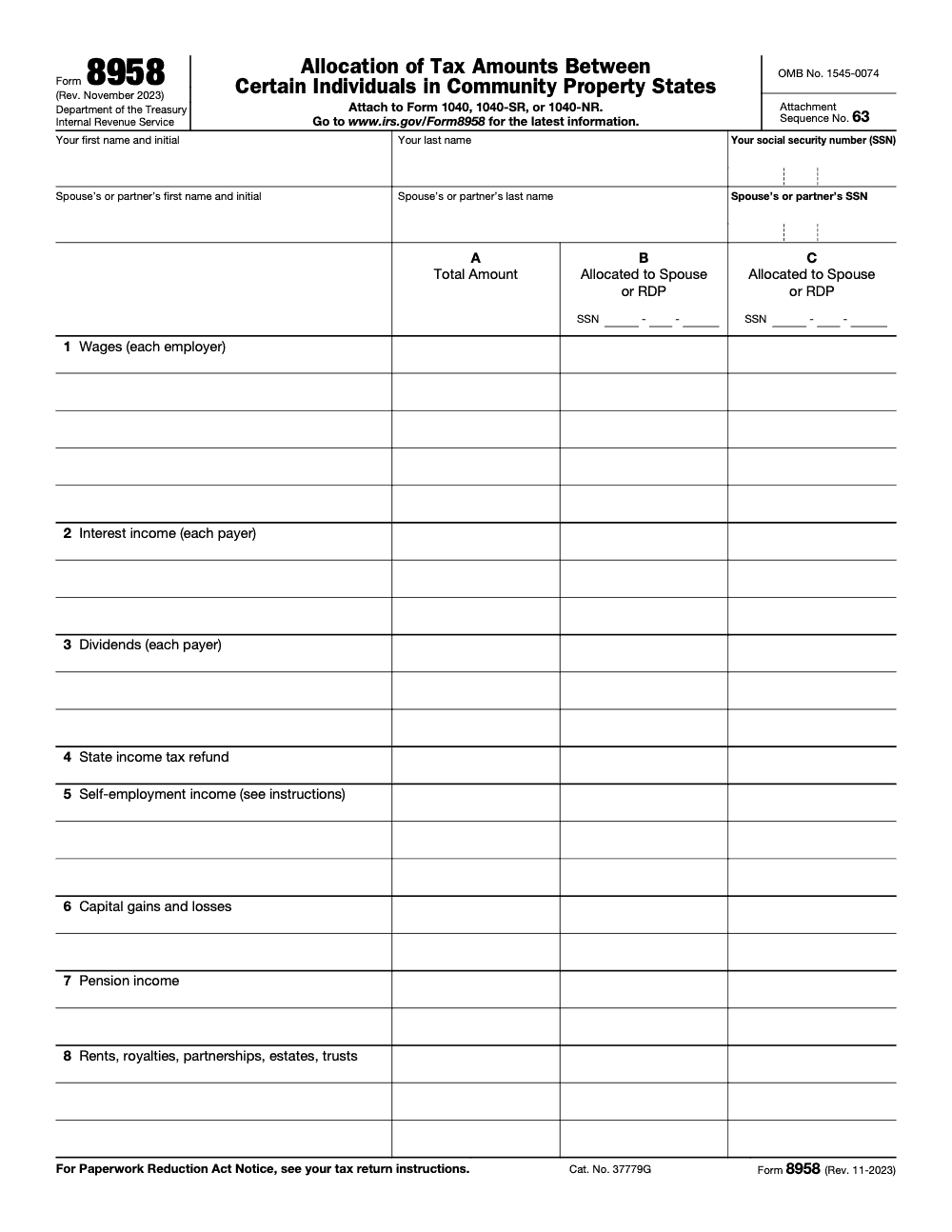
Form 8958 is the worksheet and attachment that documents your allocation under community property law when two people file separate federal returns. It lists each payer, the total amount reported to the IRS, and the split between you and your spouse or registered domestic partner. Without it, IRS matching sees one person’s W‑2 totals but only half the wages on that person’s return, which can trigger notices.
You must complete and attach Form 8958 when community property law applies and you file separate federal returns. Each spouse or partner attaches their own copy to their own return, showing how the shared items were divided.
Where Community Property Rules Apply
The IRS lists nine community property states. If either spouse is domiciled in one of these states during the year and you file separately, you generally allocate community items and attach Form 8958.
- Arizona
- California
- Idaho
- Louisiana
- Nevada
- New Mexico
- Texas
- Washington
- Wisconsin
Publication 555 also covers registered domestic partners in California, Nevada, and Washington. RDPs are not married for federal tax status, but they generally split community items and attach Form 8958 to their separate returns.
Note, Alaska has an optional community property regime by agreement. Publication 555 specifically notes that it does not address the federal tax treatment of income or property subject to Alaska, Tennessee, or South Dakota community property elections. If you opted in, confirm treatment with a qualified tax pro and current IRS guidance before filing.
How Community Allocations Actually Work
Think of Form 8958 as your reconciliation map. You list each W‑2 or 1099 in full and then show the allocation that matches state community rules. On the tax return itself, you report only your share. The attachment tells the IRS why your return shows half the wages and half the withholding while the employer’s W‑2 shows the full amount under one SSN.
Here are the common items you will allocate:
- W‑2 wages and federal withholding
- 1099‑INT and 1099‑DIV amounts
- 1099‑B capital gains and losses
- 1099‑G state tax refunds
- Business income from a sole proprietorship for income tax allocation, with a separate self‑employment tax rule, see below
- Credits, estimated tax payments, and overpayments applied
A Simple W‑2 Example
- Spouse A W‑2, wages 40,000, withholding 4,000
- Spouse B W‑2, wages 60,000, withholding 6,000
Community split on separate returns:
- Each reports wages of 50,000 and withholding of 5,000
- Form 8958 shows both employers and the 100,000 total wages, then allocates 50,000, 50,000 and 5,000, 5,000 for withholding
This approach aligns your return with payer records and avoids mismatch notices.
Tip, if your software allows, enter both W‑2s on each separate return with the halved amounts, then use Form 8958 to show the total and the allocation by person. Always keep the source documents and your allocation worksheet in your workpapers.
Special Rules You Cannot Ignore
Self‑Employment Income and Self‑Employment Tax
Two rules operate at the same time.
- For income tax purposes, net profits from a sole proprietorship are community income, so you usually split the net income 50,50 on the two separate returns.
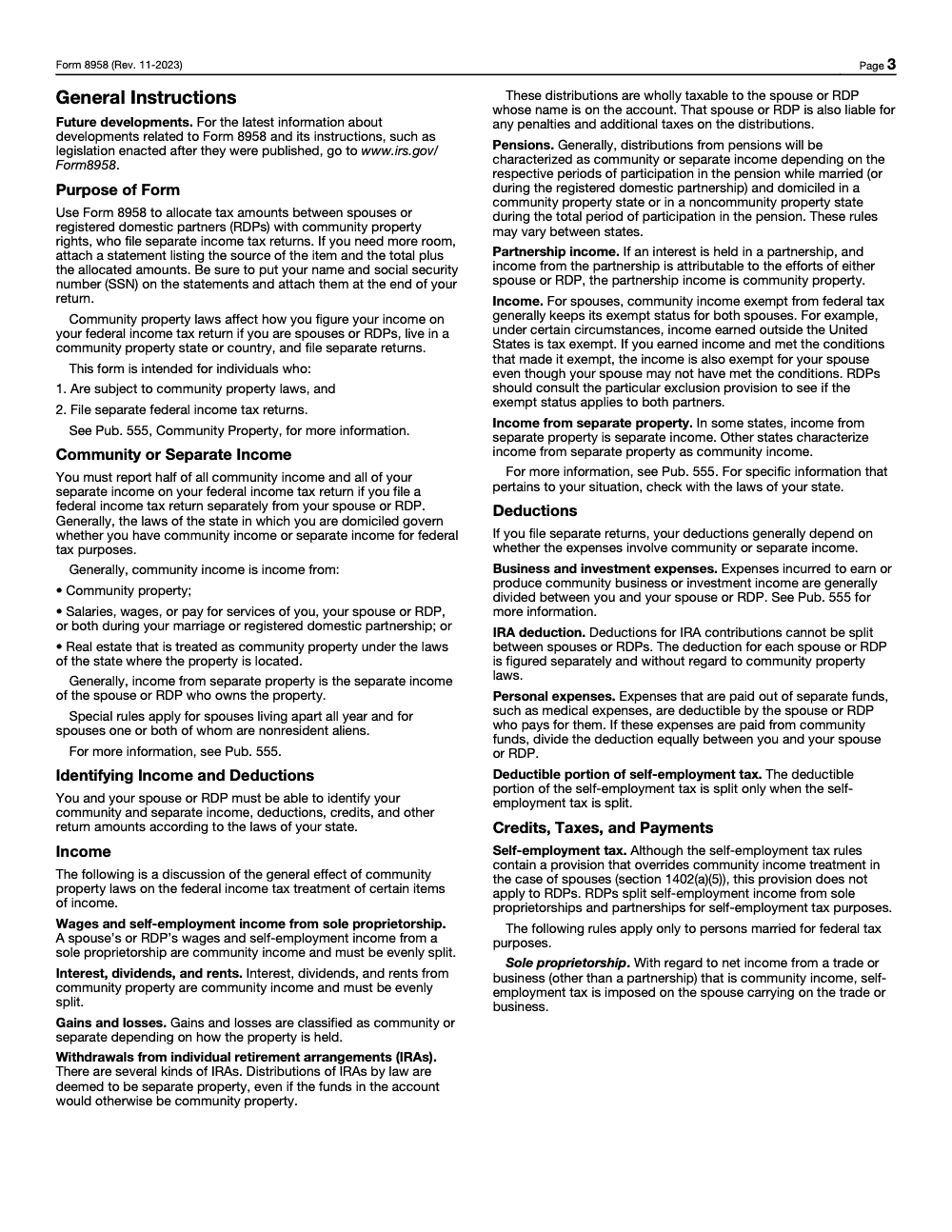
- For self‑employment tax, the entire SE tax is imposed on the spouse who carries on the trade or business. The operator computes and pays 100% of the SE tax on Schedule SE, even though the income is community for income tax purposes. Note this SE tax override applies only to married spouses under IRC 1402(a)(5); RDPs are not subject to it and instead split self‑employment income for SE tax purposes.
If the business is a partnership, each partner’s distributive share is used for their own SE tax, even if community rules shift part of the income for income tax reporting. If both spouses are partners, SE tax follows each spouse’s share.
Quick check, if you run a sole proprietorship and file separately in a community state, expect to split the profit for income tax, then calculate SE tax only on the operator’s side.
Registered Domestic Partners
Publication 555 instructs RDPs in California, Nevada, and Washington to follow state community property rules on separate federal returns. An RDP generally reports half of the combined community income and all of their separate income, then attaches Form 8958 to show how the allocation was figured. Filing status remains Single or Head of Household if eligible. Unlike married spouses, RDPs also split self‑employment income from sole proprietorships and partnerships for SE tax purposes because the IRC 1402(a)(5) override does not apply to RDPs.
Withholding, Estimates, and Overpayments
Wage withholding from community wages is treated as a community item. You typically allocate federal withholding 50,50 when wages are community, and you reflect that split on Form 8958. Publication 555 also addresses how to allocate estimated payments and prior year overpayments when filing separately in community states. Attach your allocation with the form so payments can be matched correctly.
Step‑by‑Step, How To Complete Form 8958
Follow this order and you will avoid most mismatches.
- Gather every payer statement Collect all W‑2s, 1099s, brokerage statements, K‑1s, and notices of state refunds. Confirm totals against year‑end payroll and brokerage reports.
- Decide community versus separate Use state law and Publication 555 to classify each line item. Pay close attention to separate property income, money earned while domiciled in a non‑community state (work location alone does not control, only domicile does), and periods of separation that your state treats as separate.
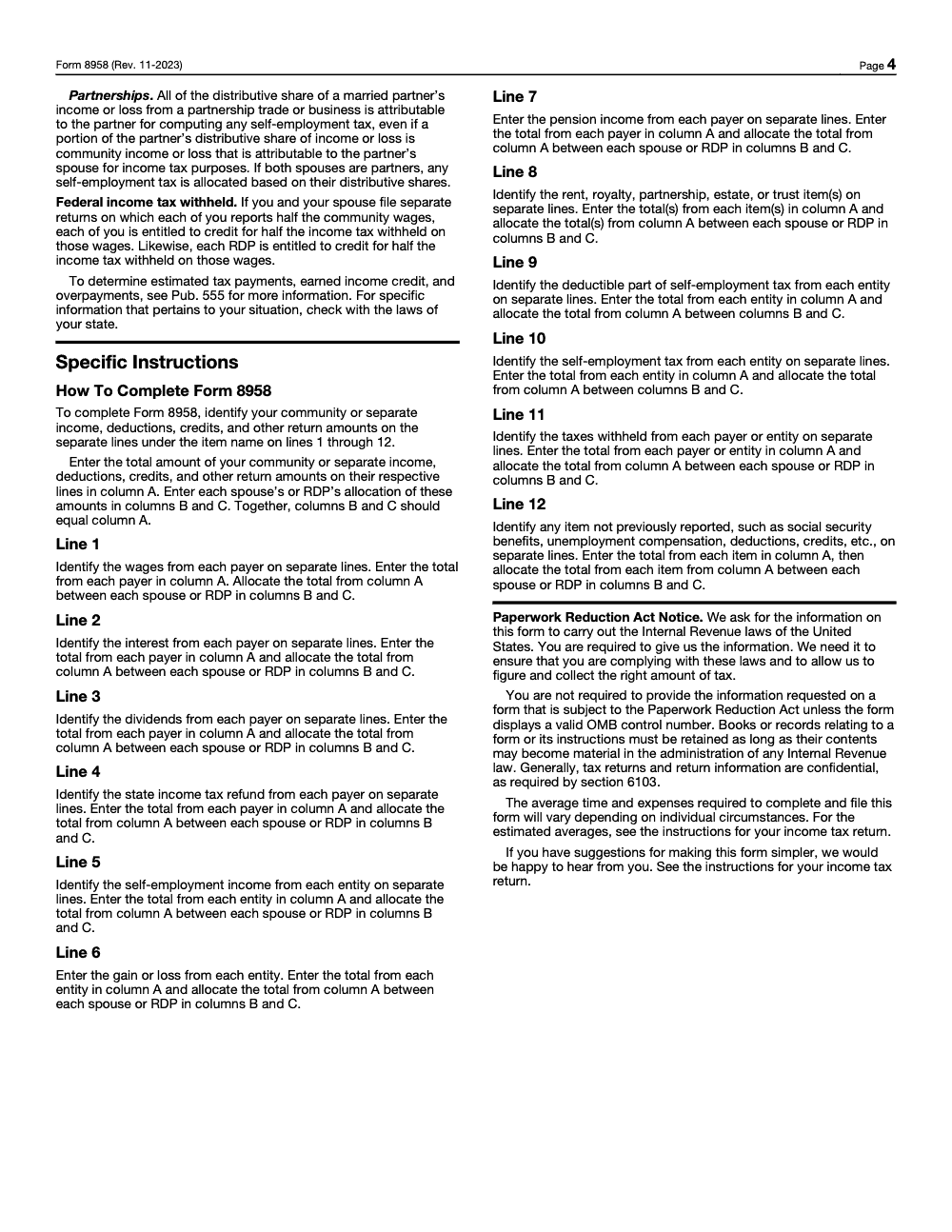
- List each source on Form 8958 On the form, enter the payer name and the total amount reported to the IRS. Next, enter the amount allocated to you and the amount allocated to your spouse or partner. The two allocations must equal the payer total.
- Split wages and withholding consistently If wages are community, split both Box 1 wages and Box 2 federal withholding in the same proportions, most often 50,50. Record the split on Form 8958, then report only your share on your return.
- Handle self‑employment correctly Split net profit for income tax on the two returns, but compute and pay the entire SE tax on the operator’s return. Show the income allocation on Form 8958.
- Allocate credits, estimates, and refunds Apply the same community logic to estimated tax payments and prior year overpayments, and document it on the form.
- Attach a form to each return Each spouse or partner attaches a separate Form 8958 to their own return. This is what reconciles your separate reporting with payer data.
Quick Allocation Table You Can Copy
| Item type | Total shown to IRS | Your share | Spouse or partner share | Notes |
| W‑2 wages | 100,000 | 50,000 | 50,000 | Split withholding the same way |
| W‑2 federal withholding | 10,000 | 5,000 | 5,000 | Keep Box 2 in sync with wages |
| Interest, dividends | 2,400 | 1,200 | 1,200 | If community property sources |
| Schedule C net profit | 80,000 | 40,000 | 40,000 | Split for income tax, operator pays 100% SE tax |
| State refund | 600 | 300 | 300 | Based on prior year payments |
Keep a short memo in your workpapers explaining your method, the state law basis, and any exceptions you applied. It makes future years faster and protects you in an exam.
Community Property States and Optional Regimes
For quick reference, here is a current summary of where community rules apply for federal income tax allocations on separate returns, with the important Alaska note.
| Category | States or notes |
| Community property states | Arizona, California, Idaho, Louisiana, Nevada, New Mexico, Texas, Washington, Wisconsin |
| Registered domestic partners covered in Pub. 555 | California, Nevada, Washington |
| Optional community property regime by agreement | Alaska has an opt‑in regime, but Pub. 555 does not address the federal tax treatment of income or property subject to these elections. Confirm before filing. |
Publication 555 was revised December 2024 and reviewed March 4, 2025. The IRS “About Publication 555” page shows no recent developments as of January 29, 2025. Both pages are the best primary sources to check before you file for the 2025 season.
When Community Property Rules May Be Disregarded
Publication 555 includes situations where income that looks community under state law may not be treated as community for federal purposes, for example certain separated spouses, or if one spouse acted as the only person entitled to income and failed to inform the other. Review those exceptions before you split an item.
Documentation Checklist
- Copies of all W‑2s and 1099s for both spouses or partners
- Brokerage year‑end statements and realized gain, loss reports
- Schedule C or K‑1s, with notes on who operated the business
- Prior year return and proof of estimated payments
- A one‑page memo with state law citations and your allocation method
- Completed Form 8958 for each separate return, ready to attach
Pro move, create a standard naming convention for workpapers and a short index, for example “8958‑W2‑EmployerName‑2025, 8958‑INT‑BankName‑2025.” Consistent names speed reviews and reduce rework.
Common Traps, and How To Avoid Them
- Splitting wages but not withholding If Box 1 is split, Box 2 should move in lockstep. Inconsistent splits cause refund and balance errors, and matching issues.
- Treating sole proprietorship SE tax as 50,50 Do not split self‑employment tax for a sole proprietorship. The operator pays 100% of SE tax (this is the spouse rule under IRC 1402(a)(5); for RDPs in CA, NV, or WA, SE income IS split for SE tax purposes per Pub. 555).
- Missing attachment on one spouse’s return Each spouse or partner attaches a copy. If you forget one, the IRS can question the allocation and delay processing.
- Ignoring separate property income rules Money earned while domiciled in a non‑community state and income from separate property can be separate. Get the facts right before you split.
- Overlooking special state rules For example, some states treat income from separate property as community income. Publication 555 flags Idaho, Louisiana, and Texas for this consideration.
Mini Case Study
You and your spouse lived in Nevada all year, filed separately, and one spouse operated a consulting sole proprietorship with 120,000 net profit. The wage earner had 80,000 of W‑2 wages with 8,000 withholding.
- On income tax, you split the 120,000 profit and the 80,000 wages 50,50.
- On SE tax, the operator computes SE tax on the full 120,000.
- On withholding, you split the 8,000 as 4,000 each.
- You attach Form 8958 to both returns with a clear list of sources and allocations.
This is the clean, exam‑ready way to do it.
Practical Workflow Tips For Busy Seasons
- Start with a two‑column tracker listing every W‑2 and 1099 for both people. Add a third column for the total and two columns for each person’s share.
- Reconcile withholding early. Most notices come from Box 2 mismatches.
- Add a short cover memo in your e‑file archive that repeats the allocation headline, for example “Wages and withholding split 50,50, Schedule C profit split 50,50, SE tax on operator.”
- Lock naming conventions for workpapers so reviewers can find items fast.
For Firms Handling Many 8958 Cases
If your firm prepares a high volume of Married Filing Separately returns in community states, standardize your allocation workpapers and review flow. A structured, SOP‑driven process, clear file naming, and layered review reduce rework and partner time in review. Accountably works with CPA and EA firms that need disciplined, secure offshore capacity built around standardized workpapers, turnaround SLAs, and review protection. Teams work inside tools like UltraTax, CCH Axcess, ProConnect, Lacerte, Drake, QuickBooks, Xero, and your workflow system, with role‑based access and audit logs. Use this kind of structure when you scale, not ad hoc staffing.
This section is informational for firms that need operational maturity during filing peaks.
Compliance, Sources, and 2025 Freshness Check
- Publication 555, Community Property, revised December 2024, reviewed March 4, 2025, is your primary reference for community and separate items, RDP rules, special exceptions, and how to handle wages, business income, withholding, credits, estimates, and overpayments.
- About Form 8958, page reviewed January 28, 2025, confirms who uses the form and that each separate filer attaches it.
Quick Start Checklist You Can Use Today
- Confirm your domicile and whether community rules apply.
- Classify each item as community or separate using Pub. 555.
- List every payer and total on Form 8958.
- Allocate wages and withholding together in the same split.
- For Schedule C, split income for income tax, then compute SE tax only on the operator’s return.
- Allocate credits, estimates, and refunds.
- Attach the form to both returns, and retain your memo and workpapers.
Closing Thoughts
When you file separately in a community property state, the math is not hard, the workflow is. If you list every source, split items consistently, and attach Form 8958 to both returns, you will avoid mismatches and cut down review time. Keep your process simple, your documents labeled, and your allocations explained in plain English. That combination, plus Publication 555 at your elbow, is how you file clean returns with confidence in 2025.
Common Mistakes We See Every Season
Every MFS season we see the same allocation slips, almost all rooted in either misreading what the law treats as separate property or rushing the column math. The fixes below tighten the workflow before the form ever reaches the reviewer.
Reusable Checklists
The three checklists below are written to be copy-paste ready for firm SOPs and personal-prep workflows alike. Use them in order: intake first, then line-by-line, then a pre-review math check before the return leaves preparer hands.
Pre-allocation client packet
- Confirm filing status: MFS for spouses, or single (separate) for RDPs in California, Nevada, or Washington.
- Document state of domicile for each filer for the full tax year, not just the work location.
- Pull every W-2, 1099-INT, 1099-DIV, 1099-NEC, 1099-R, 1099-B, and Schedule K-1 issued for the year.
- Note the SSN on each IRA, brokerage, and partnership account so separate-vs-community character is unambiguous.
- Pull mortgage statements and deed records for each parcel of real estate, with situs state noted.
- Screen for IRC §66(a) (spouses living apart all year) and any nonresident-alien spouse fact pattern.
- Map every account and asset as community or separate using the domicile-state rule in IRS Publication 555.
- Confirm Form 8958 is required: subject to community property laws AND filing a separate federal return.
Form 8958 line-by-line allocation
- Line 1 wages: list each employer separately; split community wages 50/50 across columns B and C.
- Line 2 interest: list each payer; allocate based on the character of the underlying property.
- Line 3 dividends: list each payer; apply the same separate-vs-community screen as interest.
- Line 4 state refund: split only if the prior-year state tax was paid from community funds.
- Line 5 SE income: split community Schedule C net income and community K-1 income 50/50 for income tax.
- Line 6 capital gains and losses: classify by the character of the underlying property, not the destination of the proceeds.
- Line 7 pension: apply the participation-period fraction; split only the community-period share.
- Line 8 rents, royalties, partnerships, estates, and trusts: split only the community-source share.
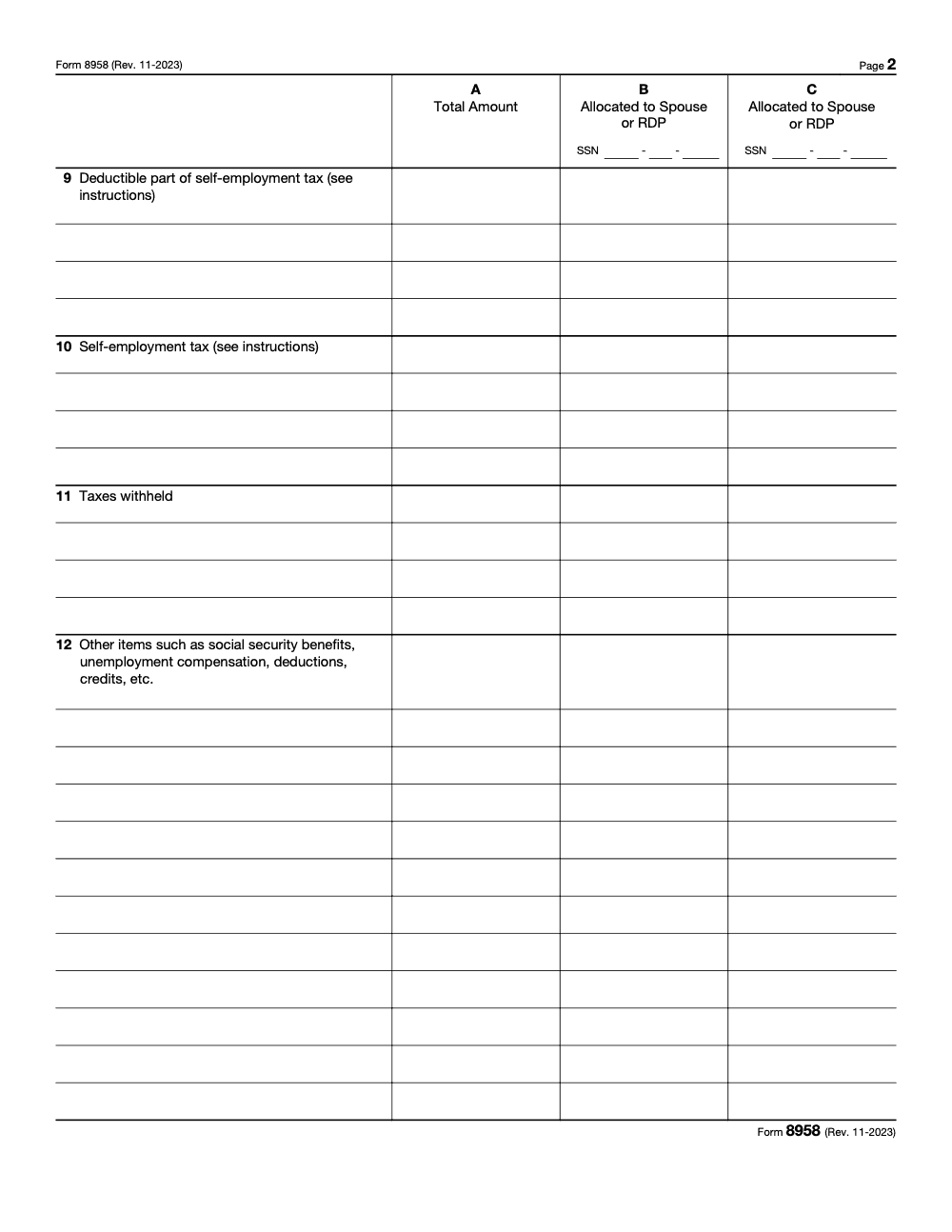
- Line 9 deductible part of SE tax: follows the line 10 SE tax allocation, not the line 5 income split.
- Line 10 SE tax: spouses do not split (IRC §1402(a)(5)); RDPs do split.
- Line 11 withholding: split in the same ratio as the underlying wages on line 1.
- Line 12 other items: itemize Social Security, unemployment, deductions, and credits one source per row.
Pre-review math and attachment check
- Confirm column B + column C = column A on every numbered line.
- Confirm the other spouse's or RDP's SSN appears in the column C header.
- Spot-check that IRA distributions sit 100% with the account-holder filer (no community split).
- Confirm SE tax on line 10 and the deductible portion on line 9 match the spouse-vs-RDP rule.
- Confirm Form 8958 is attached to Form 1040, 1040-SR, or 1040-NR (attachment sequence 63), not filed standalone.
- Attach a supporting statement (with name and SSN) for any item that ran past the printed rows.
- Reconcile the final allocations against the same year's Form 8958 on the other spouse's or RDP's return.
- Retain workpapers as long as their contents remain material under IRS recordkeeping rules.
Keep 8958 Season From Stalling
Form 8958 work clusters into the same March-April window as every other 1040, but the prep load is heavier because each separate return needs a mirrored allocation across twelve numbered lines and three columns, with every figure cross-tied to the spouse or RDP on the other side. IRS Publication 555 covers nine community property states (Arizona, California, Idaho, Louisiana, Nevada, New Mexico, Texas, Washington, and Wisconsin) and the registered domestic partnership regimes in California, Nevada, and Washington – and the state-by-state differences mean a single template cannot be reused without first re-running the domicile and situs screens.
The way through the bottleneck is not faster typing; it is a tighter intake and a stricter pre-review screen. Treat Form 8958 like a workpaper, not a form fill: every source document is mapped to community or separate before any column receives a number.
- Capture domicile, separate-property origins, and IRC §66(a) facts on the intake checklist before the engagement letter is signed.
- Cross-tie each line of Form 8958 to the source W-2, 1099, or K-1 it pulls from, so the B + C = A check can run on the workpaper before the reviewer opens the return.
- Lock the SE tax rule per filer at intake (IRC §1402(a)(5) keeps SE tax with the operating spouse; RDPs split SE income), so it is not missed on line 10.
- Use a single shared allocation schedule across the two returns; do not let preparers build two separate spreadsheets that drift between offices.
- Carry IRS Publication 555 state-specific rules into a one-page domicile cheat sheet, so preparers do not rely on memory for whether income from separate property is community in Texas, Idaho, and Louisiana.
That is exactly where a structured offshore delivery team carries the weight – running the intake, the cross-tie, and the pre-review screen so the senior reviewer only sees allocations that already pass the math. Accountably's taxation services are built around that handoff, so MFS workpapers reach the review queue clean, on time, and with documented allocation logic behind every line.
FAQs
Anyone filing a separate federal return who is subject to community property rules, typically spouses filing Married Filing Separately in the nine community states, and registered domestic partners in CA, NV, or WA. Each spouse or partner attaches their own Form 8958.
No. Joint filers usually report community items together, so Form 8958 is not used with a joint return. It is for separate federal returns.
If wages are community, split both Box 1 and Box 2 in the same proportion, most often 50,50, and reflect the split on Form 8958 and on each return.
Split the net profit for income tax, but the spouse who runs the business pays 100% of self‑employment tax. Partnerships follow distributive shares for SE tax.
Yes, if domiciled in California, Nevada, or Washington and filing separate federal returns, RDPs generally split community items and attach the form. Filing status is Single or Head of Household if qualified.
Publication 555 provides guidance for separated spouses and when community rules may be disregarded. Document your method, cite your state law, and consider professional help.
Yes, major software supports e‑filing with Form 8958 as an attachment. Follow your software’s prompts and confirm both returns include the form.
Expect mismatch notices or processing delays because payer records will not align with what you reported. File Form 8958 with both separate returns to prevent that.
Arizona, California, Idaho, Louisiana, Nevada, New Mexico, Texas, Washington, and Wisconsin. Publication 555 lists them and is the primary IRS reference.
Alaska has an optional community property regime by agreement. Publication 555 notes it does not address federal tax treatment for these elections, so confirm with a tax professional and current IRS guidance.
Other forms this guide names
- Form W‑2: Deadlines, E‑File Rules, Boxes, and W‑2c Corrections
- Form 1099‑INT: Guide to Boxes, Reporting, Deadlines
- Form 1040: Filing Guide for 2025 Returns (AGI, Deductions, Deadlines)
- Form 1099-DIV: guide, boxes and deadlines
- Form 1099‑R: Box 7 Codes, Rollovers, 2025 Filing Guide
- Form 1099-B: Report Broker & Barter Proceeds
Summarize this article with AI
About this guide
Accountably helps US CPA, EA, and accounting firms hire trained accountants and tax preparers in India.
About us Reviewed byJugal Thacker, CPAFounder and CEO at Accountably
A Washington-licensed CPA with 7+ years inside US firms – PwC, a real-estate tax practice, then a full-service firm, rising from reviewer to manager to advisory. This article was reviewed against current IRS guidance for the 2025 tax year and updated for filers preparing late returns, amendments, and 2026 estimates.
View profile →How we research, review, and update this guide
Every Accountably guide is researched against primary IRS sources, reviewed by a U.S. CPA, and refreshed as guidance evolves. Read our Editorial Guidelines to see how we source, fact-check, and update our content.