Summarize this article with AI
In Brief
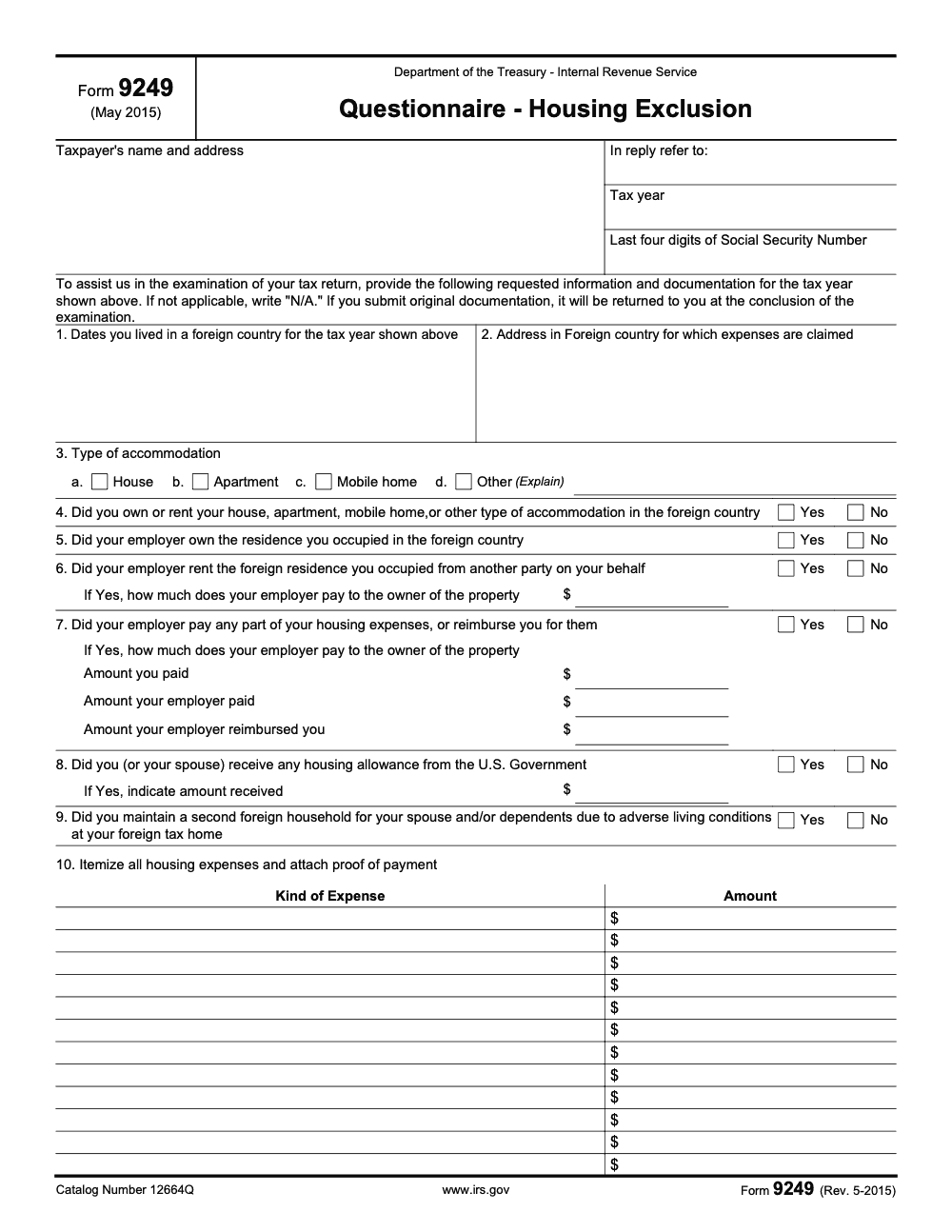
Form 9249, Questionnaire - Housing Exclusion (Rev. 5-2015, Cat. No. 12664Q), is an IRS examination questionnaire – not a tax return or an election. An examiner requests it to substantiate a foreign housing exclusion already claimed on Form 2555: the taxpayer answers its 14 questions, enters ‘N/A’ on anything that does not apply, supplies only the last four digits of the SSN, and returns it by the date set in the examiner’s letter (as printed on Form 9249, Rev. 5-2015). The form itself states no dollar caps – those limits live in the Form 2555 instructions and IRS Publication 54.
The line that decides how a Form 9249 response goes is the answer date printed in the examiner's letter, which often gives you about 30 days. Miss it, or send back a thin response, and the examination of your foreign housing exclusion stalls right there. Treat the questionnaire as routine mail and the clock keeps running against you.
Form 9249 is the IRS Questionnaire - Housing Exclusion, and an examiner uses it to substantiate a foreign housing exclusion you already claimed on Form 2555. It is not a tax return and not an election. You answer its questions, enter N/A on anything that does not apply, supply only the last four digits of your Social Security number, and return it by the examiner's date, ideally with the Form 2555 workpapers already pulled.
Key Takeaways
- Form 9249 is an IRS examination questionnaire – the Questionnaire - Housing Exclusion (Rev. 5-2015) – an examiner uses to gather information and documentation supporting a foreign housing exclusion claimed on Form 2555.
- Form 9249 is not a tax return or an election – it is a supplemental questionnaire an examiner requests during the examination of a return that already claimed the foreign housing exclusion on Form 2555.
- Taxpayers under examination for a foreign housing exclusion are the recipients – the form arrives with the examiner’s contact letter and asks for documentation tied to Form 2555.
- The biggest pitfall is missing the examiner’s deadline – respond by the date in the examiner’s letter (typically 30 days), since a slow or incomplete response can stall the examination of the housing exclusion.
- Quick rule you can copy into your SOP: route any IRS correspondence referencing Form 9249 to the preparer who handled the Form 2555 immediately – do not treat it as junk mail, and pull the housing-exclusion workpapers right away.
- Advisors serving clients with foreign earned income should keep complete Form 2555 workpapers, since Form 9249 activity signals the IRS is examining a foreign housing exclusion claim.
What Form 9249 Is and When to Use It
Form 9249, the Questionnaire - Housing Exclusion, is issued by an IRS examiner to gather the information and documentation needed to substantiate a taxpayer’s foreign housing exclusion during the examination of their tax return. The foreign housing exclusion itself is claimed on Form 2555 under IRC §911; Form 9249 simply documents the facts behind that claim so the examiner can verify it.
The form appears in two primary contexts. First, an examiner sends it after a return claiming the foreign housing exclusion is selected for examination, asking the taxpayer to document the housing costs reported on Form 2555. Second, it arrives with the examiner’s contact letter (such as Letter 566), which sets the response window – typically 30 days – for returning the completed questionnaire.
From my side of the desk, I treat any Form 9249 contact as a live examination, not a survey. The IRS is gathering documentation to test one taxpayer’s foreign housing exclusion, not sector-wide data, so every answer should reconcile to the Form 2555 already on file. A complete, well-supported response is the fastest path to closing the exam; a slow or incomplete one can stall the examination and put the exclusion at risk.
Who Receives Form 9249
The IRS sends Form 9249 to an individual taxpayer (and, where relevant, their spouse) whose return claiming the foreign housing exclusion has been selected for examination. A representative with a valid power of attorney can handle the response, but the questionnaire still concerns the individual taxpayer’s own foreign housing costs. The examiner issues it as part of the normal examination of the Form 2555 housing-exclusion claim, not through any sampling or outreach program.
Relationship to Form 2555
Because Form 9249 documents a foreign housing exclusion, it is tied directly to Form 2555, Foreign Earned Income, where that exclusion is claimed. A taxpayer who owned their foreign home will face different questions than one whose employer paid the rent, and a self-employed filer must address carryover housing costs – but every answer maps back to the figures reported on Form 2555. Understanding which Form 2555 lines the examiner is testing is essential context for drafting any response.
How to Complete Form 9249
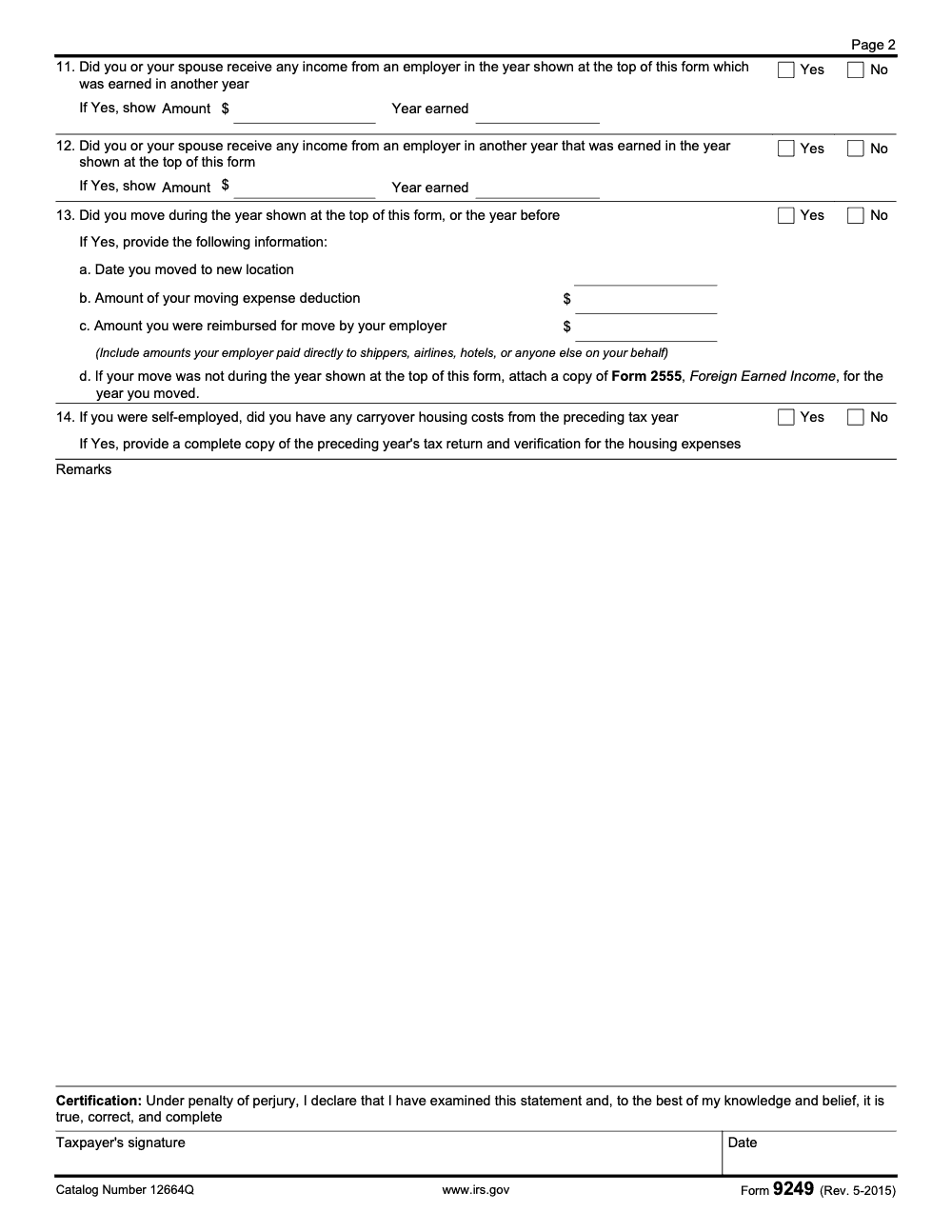
Form 9249 is a fixed two-page questionnaire (Rev. 5-2015) with 14 numbered questions; the format does not change from one examination to the next. The taxpayer must enter the last four digits of their SSN, answer each of the 14 questions, and write “N/A” on anything that does not apply. Vague or incomplete answers often trigger follow-up correspondence.
| Section | What to Provide | Practitioner Tip |
|---|---|---|
| Taxpayer Identification | The taxpayer’s name and the last four digits of the Social Security Number | Match the identifying details to the return under examination and the Form 2555 already on file |
| Contact Information | The taxpayer’s name and, where a representative is handling the response, the representative named on the power of attorney | Keep one point of contact for the examiner – the taxpayer or the authorized representative who drafted the response |
| Tax Year | The tax year under examination, shown in the header block at the top of the form | Confirm this matches the IRS’s reference year in the letter – responding about the wrong year creates confusion |
| The 14 Questions | A substantive answer to each of the 14 numbered questions (Q1–Q14) | Answer every question and write “N/A” on any item that does not apply – leaving fields blank signals non-cooperation; attach supporting documentation when the question references specific disclosures |
| Certification / Signature | The taxpayer’s signature under penalty of perjury | The taxpayer (or, with a valid power of attorney, an authorized representative who drafts while the taxpayer signs) |
Drafting Substantive Responses
The quality of the response matters as much as completeness. For each of the 14 questions, tie the answer back to the relevant Form 2555 line and the receipts that support the housing costs claimed. Where the IRS has raised a potential inconsistency, address it directly rather than deflecting. My team always prepares a brief response memo alongside Form 9249 submissions so the client has a record of what was said and why.
When to Involve Counsel
If the housing-exclusion exam expands into larger residency or foreign-earned-income questions – for example, whether the taxpayer met the bona fide residence or physical presence test – involve a tax controversy advisor before responding. A questionnaire that looks routine can be the entry point to a broader adjustment, and attorney-client privilege may be important to preserve.
Deadlines, Penalties, and Filing Requirements
Form 9249 carries no statutory deadline of its own; the response date is set by the examiner’s contact letter – typically 30 days from the letter date. Because the form is part of an open examination, ignoring it does not avoid the issue – the examiner can simply disallow the foreign housing exclusion and adjust the return. A complete, on-time response is the taxpayer’s best chance to keep the exclusion intact.
| Situation | Typical Deadline | Consequence of Non-Response |
|---|---|---|
| Examination response (Form 9249) | The date set in the examiner’s contact letter (typically 30 days) | The examiner may disallow the housing exclusion claimed on Form 2555 |
| Examiner requests additional documentation | As stated in the examiner’s letter (typically 30 days) | Adjustment to the return and disallowed exclusion if unanswered |
| Extension request | Submit before the stated deadline | Examiners generally grant reasonable extensions if requested in writing before the deadline |
Requesting an Extension
If the taxpayer needs more time to gather documentation or consult with advisors, send a brief written extension request to the IRS contact named in the letter before the deadline. State the reason for the extension and propose a specific new response date. In my experience, examiners are generally willing to grant a reasonable extension when a taxpayer needs more time to reconstruct two-year-old housing receipts.
How Form 9249 Fits the Examination Process
An IRS examiner can request several documents during the examination of a foreign housing exclusion. Form 9249 is the standardized questionnaire that captures the facts behind the claim. Understanding how it fits into the examination of Form 2555 helps practitioners respond efficiently.
Examination of the Housing Exclusion
The examiner is testing a single taxpayer’s housing-exclusion claim, not running any sector-wide program. Form 9249 appears when the IRS opens an examination of a return that claimed the foreign housing exclusion on Form 2555. The 14 questions and their attachments give the examiner what they need to confirm the exclusion was computed correctly. A thorough, well-documented response is the fastest way to close the exam without an adjustment.
What Triggers a Housing-Exclusion Exam
A return claiming the foreign housing exclusion can draw examiner attention when the housing costs look large relative to income, when employer-provided housing is involved, or when the move dates and Form 2555 figures do not line up. Taxpayers who keep clean Form 2555 workpapers and receipts are well positioned to answer Form 9249 quickly if an exam opens.
Foreign Housing Exclusion Context – What Advisors Need to Know
Advising a client on Form 9249 requires familiarity with the foreign earned income and foreign housing exclusion rules under IRC §911. The form does not exist in isolation – it connects directly to the Form 2555 the client filed, the residency tests behind it, and the receipts that support the housing costs claimed.
Form 2555 and the Housing Exclusion
The foreign housing exclusion is claimed on Form 2555, which a taxpayer files with their Form 1040 to elect the foreign earned income and housing exclusions under IRC §911. Form 9249 always ties back to that Form 2555. Make sure your engagement file identifies the Form 2555 at issue and that the filed copy – and the receipts behind the housing costs – are readily accessible.
Documentation Best Practices
Taxpayers who keep disciplined records – a clean copy of Form 2555, dated rent and utility receipts, and a log of any employer-paid or reimbursed housing – are far better positioned to answer Form 9249 with confidence. Gaps in documentation are what invite follow-up questions. My team recommends assembling the housing-exclusion workpapers when the return is filed, not when the exam letter arrives.
Common Mistakes That Slow Things Down
From my side of the desk, the errors on Form 9249 are rarely about the housing math. They show up in how taxpayers answer the examiner’s 14 questions and what they forget to attach. Here are the ones my team corrects most often.
Practical Checklists You Can Reuse
Quick rule you can copy into your SOP: build a standard Form 9249 response packet so nothing gets missed when an exam letter lands. These three lists are copy-paste ready for firm checklists.
Form 9249 response packet
- Confirm the tax year shown at the top of the form matches the year under examination.
- Answer all 14 questions; write ‘N/A’ on every item that does not apply.
- Enter only the last four digits of the taxpayer’s SSN.
- For Q7, separate the three amounts: amount the taxpayer paid, amount the employer paid, and amount the employer reimbursed.
- For Q8, state any U.S. Government housing allowance the taxpayer or spouse received.
- Set the response date from the examiner’s letter, not from the April or October return deadlines.
- Have the taxpayer (or an authorized representative who drafts while the taxpayer signs) sign under penalty of perjury.
Question 10 housing-expense itemization
- List each housing expense type on its own row (Q10 provides 12 rows).
- Attach proof of payment for every line item.
- Reconcile the itemized total to the housing figures on Form 2555.
- For Q6, disclose the amount the employer paid the property owner if the employer rented on the taxpayer’s behalf.
- Flag any Q9 second-foreign-household costs only where adverse living conditions apply.
- Keep original receipts together so they can be returned at the conclusion of the exam.
Exam document attachments
- Attach the current-year Form 2555 that supports the housing exclusion under review.
- If Q13 reports a move in an earlier year, attach the Form 2555 for that move-year.
- For Q14 self-employed carryover, attach the complete preceding-year return and verification of the housing expenses.
- For Q11 and Q12, document any cross-year income with both the amount and the year it was earned.
Keep 9249 Season From Stalling
Form 9249 does not arrive on a calendar you control. It lands when an examiner opens a foreign housing exclusion claimed on Form 2555, and it reaches back into a return you already filed. The response window is short, often the 30 days stated in the examiner’s letter, and the work is reconstruction: matching 14 questions to receipts and to the Form 2555 already on file (per Form 9249, Rev. 5-2015).
The firms that handle this without losing a week treat it as a defined workflow, not ad-hoc correspondence. A housing-exclusion questionnaire should not stall the rest of the desk while a preparer hunts for two-year-old documents.
- Map each of the 14 questions to a source document before drafting answers, so Q7, Q10, and Q13 are not left for the last day.
- Rebuild the Q10 itemization from receipts, not memory, and reconcile it to the housing figures on Form 2555.
- Separate the three Q7 amounts early, since the split between taxpayer-paid, employer-paid, and employer-reimbursed drives the exclusion-versus-deduction treatment.
- Confirm whether Q13 covers a prior-year move so the right-year Form 2555 is pulled before the deadline.
- Track the examiner’s response date as a hard SLA, kept separate from the standard return deadlines.
When exam questionnaires like Form 9249 collide with a full return calendar, the response is what slips. Our tax execution teams run that reconstruction work to a documented SOP and a turnaround SLA, so a housing-exclusion exam gets a complete, signed response without pulling your reviewers off everything else.
FAQs
Form 9249 is not optional in the way a true feedback survey would be. It is part of an open examination of the foreign housing exclusion you claimed on Form 2555, and the examiner’s letter sets a response date – usually 30 days. Ignoring it does not make the issue go away; the examiner can simply disallow the exclusion. My standard advice is to respond fully and on time.
Ignoring the questionnaire typically triggers a follow-up letter, and because the return is already under examination, the examiner can disallow the foreign housing exclusion and adjust the tax owed. The examiner notes a non-response in the case file. A well-reasoned, timely response is almost always the better outcome.
Yes, with a valid Form 2848 (Power of Attorney) or Form 8821 (Tax Information Authorization) on file. The response should still reflect the taxpayer’s accurate information and be signed by the taxpayer under penalty of perjury – the advisor typically drafts and reviews, while the taxpayer signs. Retain a copy of the POA alongside the response.
Form 9249 is part of an examination of the foreign housing exclusion you claimed on Form 2555 – it is not separate from the exam, it is how the examiner gathers the supporting facts. Your answers and attachments should reconcile to the Form 2555 already on file. Treat every answer as load-bearing: it directly affects whether the exclusion stands.
For a routine housing-exclusion questionnaire, your CPA or enrolled agent can typically handle the response. When the exam expands into larger questions – whether you met the bona fide residence or physical presence test, or whether the foreign earned income itself qualifies – involve a tax controversy advisor before responding. Attorney-client privilege may be valuable if the matter later becomes adversarial.
Other forms this guide names
- Form 2555: Foreign Earned Income Exclusion & Housing
About this guide
Accountably helps US CPA, EA, and accounting firms hire trained accountants and tax preparers in India.
About us Reviewed byJugal Thacker, CPAFounder and CEO at Accountably
A Washington-licensed CPA with 7+ years inside US firms – PwC, a real-estate tax practice, then a full-service firm, rising from reviewer to manager to advisory. This article was reviewed against current IRS guidance for the 2025 tax year and updated for filers preparing late returns, amendments, and 2026 estimates.
View profile →How we research, review, and update this guide
Every Accountably guide is researched against primary IRS sources, reviewed by a U.S. CPA, and refreshed as guidance evolves. Read our Editorial Guidelines to see how we source, fact-check, and update our content.