Summarize this article with AI
In Brief
Form 944 is the Employer's ANNUAL Federal Tax Return – filed once a year only by small employers the IRS notifies in writing, generally those expecting $1,000 or less in annual employment tax (per the IRS Form 944 instructions). The 2025 return is due February 2, 2026 (January 31 falls on a Saturday), or February 10, 2026 if every deposit was made in full and on time; if Line 9 is under $2,500 you may pay with the return instead of depositing.
Form 944 is not a form you choose. You file it only because the IRS notified you in writing, generally because your annual employment tax is expected to run about $1,000 or less. That single distinction is where most of the confusion starts, since the rest of the small-business world is filing Form 941 every quarter.
For the 2025 year the return is due February 2, 2026, because January 31 falls on a Saturday, or February 10, 2026 if every deposit was made in full and on time. Watch the deposit question separately: if Line 9 lands under $2,500, you can usually pay with the return instead of depositing through the year.
Key Takeaways
- Form 944 is the annual employment tax return for certain small employers whose total yearly federal withholding plus both shares of Social Security and Medicare is about 1,000 or less, and only if the IRS authorizes your EIN. You need written notice to use 944.
- The return is due January 31 following the tax year (for 2025 returns this rolls to February 2, 2026, because January 31, 2026 is a Saturday), or February 10 if all deposits were on time and in full.
- The $2,500 rule controls deposits, not eligibility. If your annual 944 tax is under 2,500, you can usually pay with the return. At or above that level, follow the monthly or semiweekly deposit schedule.
- To switch between 941 and 944, you must get IRS approval during the January 1 to April 1 window. Phone and written request options are available, and you must wait for written confirmation before changing.
- Use Form 944‑X to fix prior year errors, filing it separately on paper for the year being corrected (it cannot be e-filed through MeF), and follow the interest‑free correction timing if you underreported tax.
What Is IRS Form 944
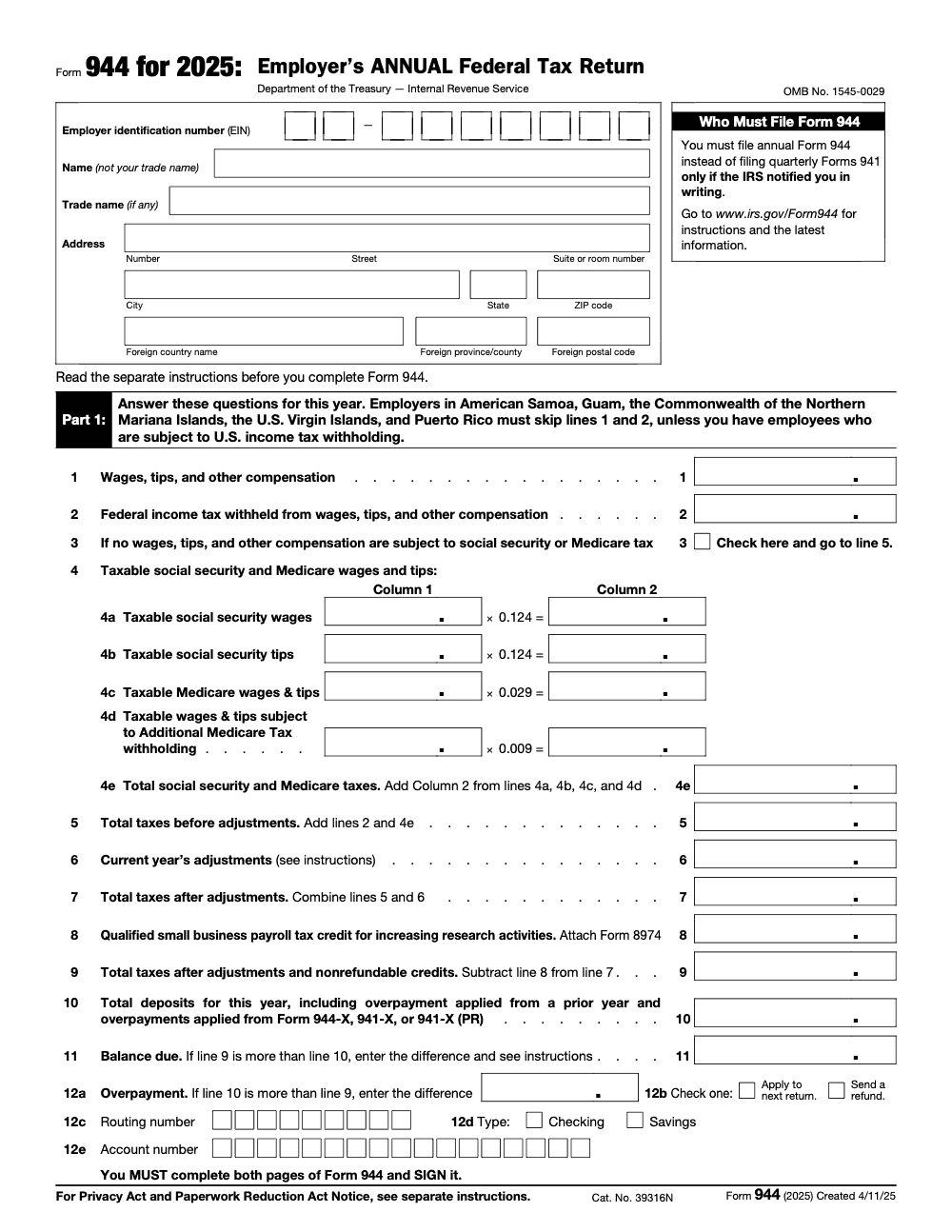
Form 944, Employer’s Annual Federal Tax Return, lets qualifying small employers report, and pay, federal income tax withheld from employees plus both the employer and employee portions of Social Security and Medicare taxes once a year instead of quarterly. The IRS designed it specifically for employers with an annual employment tax liability of $1,000 or less, and you must be told in writing that your EIN is in the 944 program.
You report annual totals for wages and tips, federal income tax withheld, and Social Security and Medicare wages and tips, then apply any adjustments or credits. Because it is an annual form, you file only once per calendar year for your payroll in that year. The due date is January 31 of the following year (for the 2025 return this rolls to February 2, 2026, because January 31, 2026 falls on a Saturday), or February 10 if you made all required deposits on time and in full. For example, 2025 wages are generally reported by February 2, 2026 (January 31, 2026 falls on a Saturday, so the deadline rolls to the next business day), or by February 10, 2026 if every deposit was timely and in full.
A quick word on eligibility, the $1,000 figure is an IRS design target, not a self‑election switch. You cannot simply decide to file 944 because your tax seems small. You need the IRS notice for your EIN, or you must request approval during the allowed window, then wait for written confirmation.
Taxes Included On Form 944
- Federal income tax withheld from employee pay.
- Social Security tax, 6.2% employee plus 6.2% employer, up to the Social Security wage base.
- Medicare tax, 1.45% employee plus 1.45% employer, with no wage cap.
- Additional Medicare Tax, 0.9% on employee wages above $200,000 for withholding purposes, which has no employer match. Employers must begin withholding once an employee’s year‑to‑date Medicare wages exceed $200,000.
For 2025 payrolls, the Social Security wage base is $176,100. You stop calculating Social Security tax on an employee’s wages once they hit that amount for the year, but you continue Medicare and Additional Medicare withholding as applicable.
Who Typically Qualifies
In practice, truly small payrolls qualify. As the IRS notes, when total wages subject to FICA and federal withholding are around 5,000 or less for the year, the resulting employment tax often falls near the 1,000 mark. That is only a directional gauge. Your actual eligibility still hinges on IRS authorization for your EIN.
If the IRS instructs you in writing to file Form 944, you must file Form 944, even if your actual annual employment tax later exceeds $1,000 for that year. The IRS will notify you if your filing requirement changes for future years.
Examples At A Glance
- A single‑employee shop paying 5,000 in taxable wages likely has total employment taxes near 1,000, so the IRS may place it in the 944 program or approve a request. You must still wait for the written notice.
- A business that grows midyear and ends with more than 2,500 of annual tax will still file Form 944 for that year, but it must follow deposit rules instead of paying with the return.
Small note on style and trust, this guide uses plain terms and practical steps. The goal is to help you file correctly, not just to define acronyms. If you need hands‑on help building repeatable year‑end workflows, Accountably can support that, although we will keep the focus on the filing details you came for.
Form 944 vs. Form 941, Which One Fits Your Payroll
When your payroll is small, filing once a year can feel like flipping a “less admin” switch. Still, 944 is not a preference, it is a permission. The IRS must assign your EIN to the annual program, or you must request approval during the window. Here is how to think about the choice in practical terms.
Filing Frequency And Flow
- Form 944 is filed once per year. You total wages, withholding, Social Security, and Medicare for the calendar year, then reconcile deposits.
- Form 941 is filed every quarter. You repeat the same calculations four times, one return for each quarter.
If the IRS told you to file 944, you file 944 even if your payroll grew during the year. If you were told to file 941, you keep filing 941 unless you request, and receive, permission to switch.
A quick tip, many owners only realize they are in the 944 program when a notice arrives in the mail. Keep that letter with your payroll records. It is your simple proof for the year.
Eligibility And Thresholds
Both forms report the same taxes, not different taxes. The real separation is size and approval.
- Use Form 944 only if the IRS notifies you in writing, or approves your request, and your annual employment tax liability is typically $1,000 or less.
- Without that notice tied to your EIN, you stay on quarterly 941 filing.
- Household only and most agricultural only employers are not eligible for 944.
A practical gauge some practitioners use, when total annual taxable wages are very low, the math often lands near the 1,000 liability mark. That is only a quick sense check, not a green light. Wait for written authorization before changing your cadence.
Switching Between 941 And 944
The switch is a controlled process. You cannot simply mail a different form because it seems easier this year. Follow these steps instead.
- Mark your calendar for the request window, January 1 to April 1.
- Call the IRS employer line or submit a written request to change your filing requirement for the coming year.
- Wait for written confirmation. Keep that letter with your payroll file.
- Follow the instruction for the entire year. Do not mix forms.
Quick Reference Table
| Action | Timing | Rule |
| Receive IRS notice to file 944 | Anytime in prior year | Establishes your 944 filing requirement |
| Request to switch 941 ↔ 944 | Jan 1 to Apr 1 | Phone or written request, wait for written approval |
| File Form 944 | By Jan 31 (Feb 2, 2026 for the 2025 return, since Jan 31, 2026 is a Saturday), or Feb 10 if all deposits were on time | File even if no tax is due for the year |
| Keep filing method | Ongoing until told otherwise | Change only after written IRS instruction |
Deposit Rules, Separate From Eligibility
This is where many owners get tripped up. The $2,500 figure you hear about is a deposit rule, not a filing permission. On 944, if your total annual employment tax is less than $2,500, you can usually pay with the return. If it is $2,500 or more, follow the monthly or semiweekly deposit schedule, exactly like a 941 filer would. This is why some very small employers love 944, fewer deposits and one return, while others still need deposits during the year even though they file only once.
A Short Story, Two Coffee Shops
- Shop A pays two part‑timers a small amount all year. The IRS assigns 944. Total tax ends up well under 2,500, so they pay with the return and file once. Easy.
- Shop B starts tiny in January, then hires three more baristas in summer. They are still assigned to 944 for the year, but their annual tax breaks 2,500. They must make deposits during the year, then file 944 once in January. The filing form is annual, the cash timing is not.
The lesson, 944 changes when you report, not what you owe. Keep deposits on schedule, file the return on time, and you will be fine.
Who Must File Form 944
If the IRS tells you in writing to file Form 944 instead of quarterly Form 941, you must file Form 944 for that year. That instruction ties to your EIN and stays in place until the IRS directs you to change back.
- You are eligible to file only if you receive that notice and your annual employment tax liability is typically $1,000 or less.
- Do not switch from 941 to 944 without approval. A self‑selected 944 can be rejected, which leads to late filing issues you do not want.
- Household only and most agricultural only employers are not eligible, so they should stick to their required returns.
- If you believe you qualify but did not receive a notice, contact the IRS between January 1 and April 1 to request authorization before changing.
Keep it simple, file what the letter says. If your facts change, ask for the switch during the window, then follow the new instruction next year.
Deadlines And Key Dates
Form 944 is due January 31 of the year after the tax year (for the 2025 return this is February 2, 2026, because January 31, 2026 falls on a Saturday). If you made all deposits on time and in full, you get until February 10. If the due date lands on a weekend or federal holiday, file the next business day.
- Keep filing annually as long as the IRS instructed you to use 944.
- If you stop paying wages or close the business, file a final return for that year.
- Missed deadlines can trigger penalties and interest, so if you are late, file and pay as soon as possible. If you spot an error later, fix it with Form 944‑X.
A small practice tip, put three reminders on your calendar, one for the first week of January to reconcile totals, one for mid January to review the draft, and one for the final file date. That buffer prevents last‑minute scrambles.
Annual Filing Due Date, Extensions, And Penalties Explained
The Standard Due Date
- The annual Form 944 is due on January 31 for the prior calendar year (the 2025 return rolls to February 2, 2026, because January 31, 2026 is a Saturday).
- If every required deposit was made on time and in full, you can file by February 10.
- If January 31 or February 10 falls on a weekend or federal holiday, your due date moves to the next business day.
Even if you had no wages in part of the year, you still file if the IRS assigned you to 944 for that year, unless you have already filed a final return. If you ceased operations, check the final return box and report wages through your last payroll date.
Penalties, What Happens If You Miss
Two penalties can apply, and they stack up fast.
- Failure to file, generally 5% of unpaid tax per month or part of a month, up to 25%.
- Failure to pay, generally 0.5% per month, plus interest, until paid.
When both apply for the same period, the failure to file penalty is reduced by the failure to pay amount. The fastest way to stop the clock is to file the return, pay what you can now, then set up an installment plan for the rest if needed.
If you made a good‑faith mistake, consider a penalty relief request. Reasonable cause or first‑time abatement can help in specific cases. Document what happened and fix the process so it does not repeat.
Deposit Timing, A Quick Walkthrough
- If your total annual 944 tax is under $2,500, you can usually pay with the return.
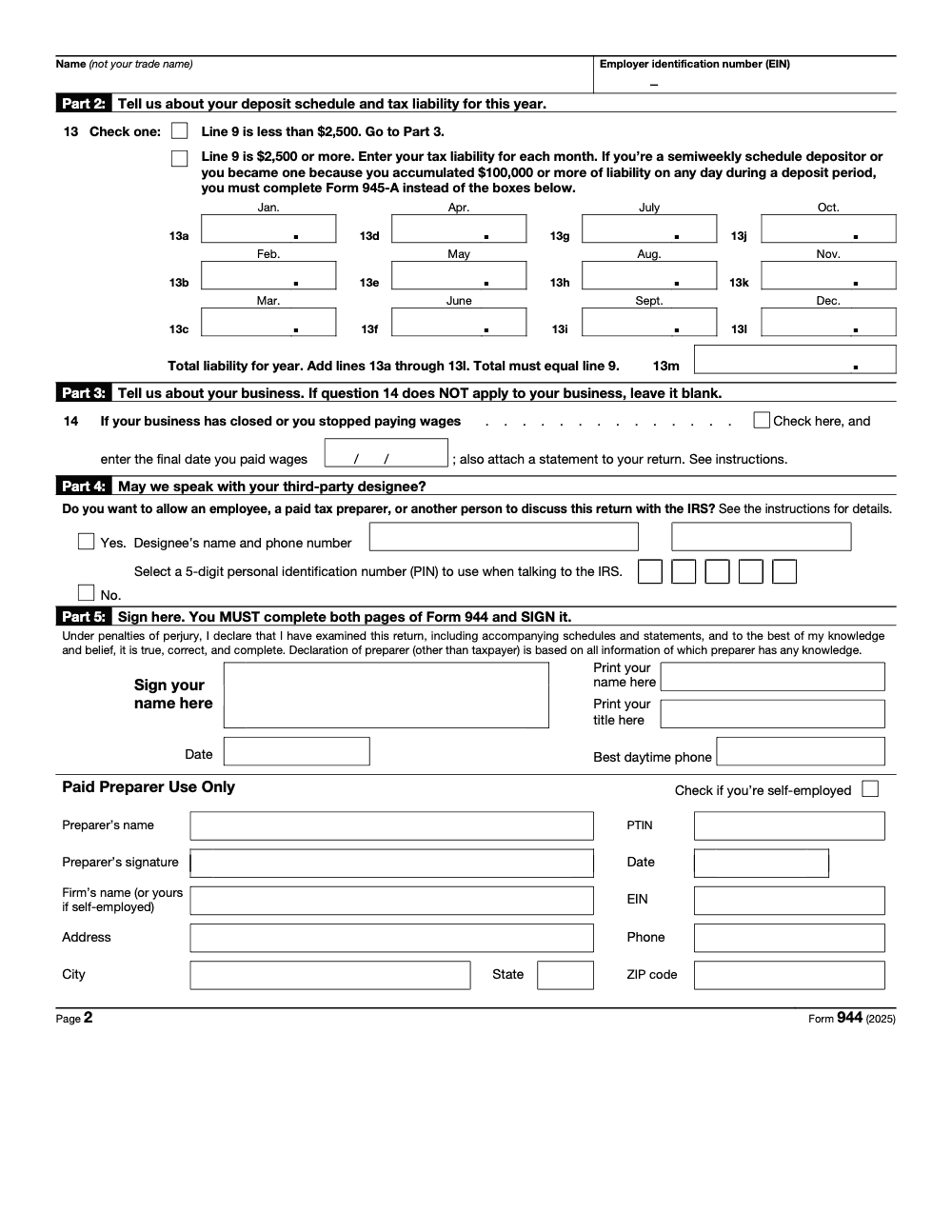
- If it is $2,500 or more, you follow the monthly or semiweekly deposit schedule, and you will complete Part 2 of Form 944 to show your monthly tax liability amounts (semiweekly schedule depositors complete Form 945‑A instead and attach it to the return).
- If you hit a one‑day deposit rule threshold during the year, tested on your accumulated tax before any reduction for nonrefundable credits, you must deposit by the next banking day. That rule applies to 944 filers when their liability spikes.
This is why your year‑end reconciliation is more peaceful when you track deposits and liabilities monthly. You will know early if you need to switch to deposits, and you will avoid a painful catch‑up.
How To Complete Form 944, Step By Step
You can fill Form 944 in one calm sitting if you gather the right items first.
What You Need Before You File
- Your legal name, trade name, address, and EIN exactly as they appear on IRS records.
- Annual totals for wages and tips, federal income tax withheld, and Social Security and Medicare wages and tips.
- Employer and employee shares of Social Security at 6.2% each, up to the wage base, and Medicare at 1.45% each, no cap. Include Additional Medicare Tax withheld from employees above the threshold.
- A reconciliation of deposits and any credits or advances, for example, small business credits or prior period adjustments.
- Proof of timely deposits, for the February 10 extension.
Keep source reports from your payroll system with the return copy, and retain records for at least four years.
Line‑By‑Line Roadmap You Can Follow
The exact line numbers can move when the IRS refreshes the form, but the flow stays consistent.
- Identification, Enter your EIN, legal name, trade name, and address.
- Wage totals, Report total wages and tips subject to withholding.
- Federal income tax withheld, The annual total from employee pay.
- Social Security and Medicare, Compute both employee and employer portions based on taxable wages and tips. Apply the Social Security wage base limit, continue Medicare without a wage cap, and include Additional Medicare Tax withheld from employees.
- Adjustments and credits, Record adjustments, for example, sick pay or group term life, and credits such as those tied to prior filings where applicable.
- Total tax for the year, Add it all up after adjustments.
- Deposits and payments, Enter deposits made during the year and any overpayments applied from a prior year.
- Balance due or overpayment, If you owe, plan to pay by the deadline. If overpaid, choose a refund or apply to next year.
- Part 2, If your total tax is $2,500 or more, list each month’s liability, the tax accrued that month and not the deposits you actually made, to support the deposit schedule.
- Part 3, Indicate if this is your final return, checking the box and entering the final date you paid wages if your business has closed or you stopped paying wages (Form 944 has no seasonal-employer indicator, that is a Form 941 feature).
- Part 4, Third‑party designee authorization, optional.
- Part 5, Signature, Sign as the responsible official. Paid preparer section if a professional files for you.
Pro move, reconcile your year‑to‑date payroll reports to your general ledger before you touch the form. That five minute check catches mismatches that would otherwise turn into notices.
A Simple Example
- You paid one employee 5,000, withheld a small amount of federal income tax, and you calculated Social Security and Medicare for both employee and employer shares. Your total annual employment tax comes out under 2,500, and your deposits were made on time. You can file 944 by February 10, pay with the return, choose to apply a tiny overpayment to next year, and you are done until next season.
- If you added a part‑timer in Q4 and your annual tax crept over 2,500, you would follow the deposit schedule, fill Part 2 with monthly liability amounts, then still file 944 once in January.
Filing Methods And Where To Send
You have two clean options.
- E‑file, Use IRS‑approved software or work with an authorized tax professional. E‑filing is faster, it reduces keying errors, and it lets you schedule an electronic payment.
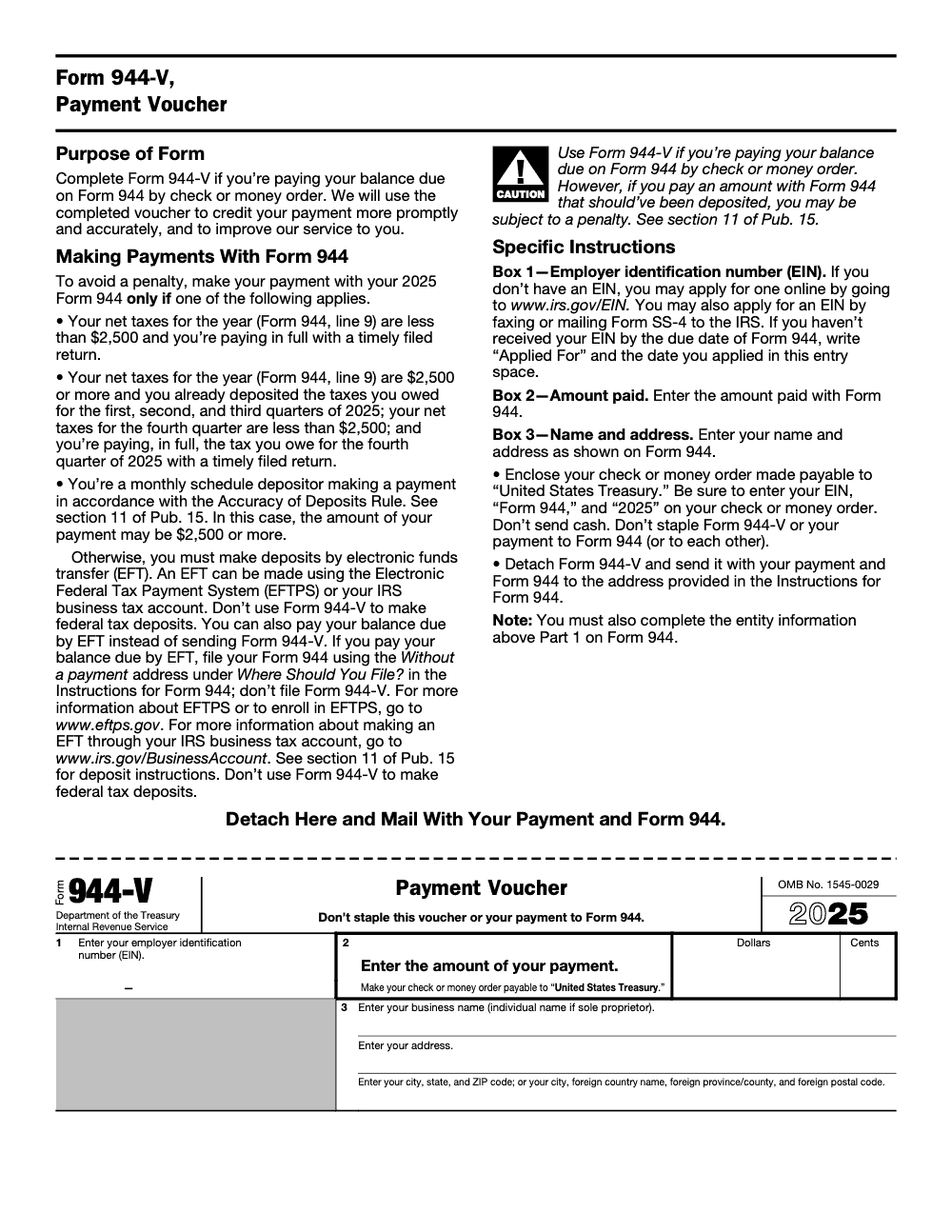
- Paper filing, If you mail the return, use the correct IRS address for your state and whether a payment is enclosed. The addresses live in the current Form 944 instructions. If you mail a check or money order, include payment voucher Form 944‑V (use Form 944‑V only to pay a balance due with the return, never to make a federal tax deposit, which must go through EFT).
Payments, Use EFTPS, IRS Direct Pay, or an authorized card processor. If you can, pay electronically and keep the confirmation with your return copy. If you use paper, send certified mail with tracking and keep the receipt. That tiny slip can save you hours later.
Corrections, Compliance, And Clean Up
Even careful teams spot a missed penny or a mis‑keyed box later. The fix is straightforward if you follow the rules.
Use Form 944‑X For Corrections
- File Form 944‑X to correct an error on a previously filed Form 944 for that tax year, filing it separately on paper for the year being corrected, not attached to a current Form 944 and not through MeF e‑file.
- You can use it to report additional tax due or to claim a refund or abatement when you overreported.
- Follow the instructions for whether to use the “adjusted return” or “claim” process, then pay any amount due with the form to stop interest from growing.
Keep a packet with your original 944, payroll reports, deposit confirmations, and a short note explaining what changed and why. If the IRS writes with a question, your answer will be ready to send the same day.
Avoiding Deposit Penalties
Deposit penalties are among the most common payroll notices. You can reduce your risk with three habits.
- Watch your annual total, The $2,500 threshold decides whether you pay with the return or follow a deposit schedule. If you are close, plan to deposit.
- Follow the schedule, If you trigger monthly or semiweekly deposits, calendar the exact days for the entire year. Do not rely on memory in busy season.
- Use EFTPS, Schedule deposits a few days early and set alerts. Confirm status after each submission.
Record Retention And Audit Readiness
Keep payroll records, returns, and deposit proofs for at least four years. Organize your binder or folder in this order, it speeds up reviews and calms nerves.
- IRS notices about your 944 filing requirement.
- Copies of filed Forms 944 and 944‑X.
- Payroll registers and quarterly wage detail reports.
- W‑2 and W‑3 copies and submission confirmations.
- Deposit confirmations, EFTPS or bank proof.
- Any correspondence and your responses.
If you ever change payroll systems midyear, export and save reports from both systems with the same naming convention. You will thank yourself at year‑end.
Where Accountably Helps, Only When It Truly Adds Value
You came here for filing clarity, and you have it. If you also need a steadier way to get year‑end payroll reporting out the door, Accountably can help in the background.
- We set up disciplined workpapers and naming that make reviews faster.
- We staff trained preparers who work in your systems with your templates.
- We add simple checklists so deposits, due dates, and forms are tracked in one place.
That structure matters most in January, when 944, W‑2s, and 940 all hit at once. If your firm needs controlled capacity, we can be your quiet extra set of hands while you keep quality and security tight.
Practical Checklists You Can Use Today
Here are the exact checklists my team keeps in our Form 944 SOP. Copy them straight into your own workpapers, and the boxes below will remember what you have ticked.
Form 944 eligibility and assignment check
- Confirm the IRS sent written notice assigning your EIN to the Form 944 program; without it, keep filing quarterly Form 941.
- If you expect $1,000 or less in annual employment tax and want to switch, contact the IRS in the first calendar quarter (by April 1) and wait for written approval.
- File Form 944 every year you remain in the program, including a zero-wage return, until you file a final return.
- Confirm you are not a household-only or agricultural-only employer, which report on Schedule H or Form 943 instead.
- Keep the IRS authorization letter in your permanent payroll file.
Year-end Form 944 packet
- Pull annual wage, tip, and federal income tax withholding totals from payroll and tie them to your general ledger.
- Compute Line 4a and 4b at the 0.124 social security rate, capping wages at the $176,100 wage base, and Line 4c Medicare at 0.029.
- Withhold Additional Medicare Tax at 0.009 on each employee's wages above $200,000 on Line 4d, with no employer match.
- Total Line 9 (taxes after adjustments and nonrefundable credits) and compare it to $2,500 to set your deposit obligation.
- If Line 9 is $2,500 or more, complete the monthly liability boxes on Lines 13a through 13l so Line 13m equals Line 9.
- Tie your W-2 and W-3 totals back to the Form 944 figures before you file.
Deposit and safe-harbor review
- Set your deposit schedule from the lookback year: $50,000 or less in Line 9 means monthly, more than $50,000 means semiweekly (per IRS Publication 15).
- Make every federal tax deposit by EFT through EFTPS or your IRS business tax account; never use Form 944-V as a deposit voucher.
- Watch the $100,000 next-day rule, tested on gross tax before credits, which converts a monthly depositor to semiweekly.
- For any shortfall, apply the safe harbor of the greater of $100 or 2% and pay the makeup amount by the return due date.
- If you deposit semiweekly, attach Form 945-A instead of completing Lines 13a through 13l.
- Closing out, When you stop paying wages or close the business, check the final return box and complete all steps through your last payroll date.
- Poor documentation, Keep your letter, reports, and confirmations together. Neat packets cut response time if a notice arrives.
If a notice shows a mismatch, compare your 944 totals to the W‑3 box totals first. Most year‑end notices boil down to a simple tie‑out issue.
Step‑By‑Step, From “I Think I Qualify” To “Filed”
- Confirm the assignment, Check last year’s IRS letter, or request authorization between January 1 and April 1 if you believe you qualify. Wait for written approval.
- Prepare totals, Pull annual wage and tax reports from your payroll system. Reconcile to your general ledger if you keep one.
- Check deposits, Add up deposits for the year. If you are under $2,500, plan to pay with the return, if allowed. At or above $2,500, make sure you followed the deposit schedule.
- Complete Form 944, Enter identification, totals, adjustments, deposits, and compute balance due or overpayment. Complete Part 2 if deposits were required. Mark final return if applicable.
- File and pay, E‑file if possible, or mail to the correct IRS address. Pay electronically and save the confirmation.
- Archive, Save a PDF copy of everything, including the confirmation number, with the same file names you use every year.
Final Word, Keep It Calm And Simple
You do not need four quarterly employment tax returns if the IRS has placed your EIN in the annual program. With a short checklist, a tidy packet, and attention to the two key dates, January 31 (February 2, 2026 for the 2025 return, since January 31, 2026 falls on a Saturday) and February 10, Form 944 becomes a once‑a‑year task you can finish in an afternoon. If your payroll grows, great, just follow deposits and request a switch during the January 1 to April 1 window when you are ready.
If your firm wants help building a repeatable year‑end process that your team can run every January, we can plug in quietly. Accountably focuses on disciplined execution, so you keep control of quality, security, and deadlines while getting the extra capacity you need in peak season.
Call To Action
- If you are an owner, download your year‑end payroll reports, confirm your filing requirement, and add two reminders to your calendar today.
- If you lead an accounting team, standardize your 944 packet and tie‑out checklist so reviewers spend minutes, not hours, on each file.
- If you want structured capacity for busy season, reach out to Accountably. We work in your systems, follow your SOPs, and give you predictable turnaround without sacrificing quality.
Common Mistakes We See Every Season
Most Form 944 trouble starts before the return is even filled in. These are the eligibility and deposit traps I see most.
Keep 944 Season From Stalling
When a 944 notice lands on my desk, it usually traces back to one of these year-end filing mistakes.
FAQs
Form 944 is the annual federal employment tax return for certain small employers. You report total employee wages, federal income tax withheld, and both shares of Social Security and Medicare for the calendar year, then reconcile deposits and pay any balance due. You file it only if the IRS authorizes your EIN, otherwise you remain on quarterly Form 941.
Both report the same employment taxes. The difference is timing and authorization. Form 941 is filed quarterly by most employers. Form 944 is filed once a year by small employers the IRS assigns to the 944 program. You cannot switch without IRS approval, and the deposit rules still apply when your annual tax reaches the deposit threshold.
Household only employers and most agricultural only employers are not eligible to use 944. Also, any employer that did not receive IRS authorization for their EIN must file Form 941 instead, even if their tax looks small.
Submit a request between January 1 and April 1 and wait for written IRS confirmation before changing. Keep that letter with your year‑end file. Until you receive approval, keep filing whatever form the IRS last assigned to your EIN.
Form 940 is the annual federal unemployment tax return. It is generally due January 31 for the prior year, with a February 10 deadline if all FUTA deposits were made on time. It is separate from your 944 filing, so put both dates on your calendar.
Most seasonal employers still use Form 941 unless the IRS specifically authorizes the EIN for 944. If you are seasonal and want to explore 944, call during the January 1 to April 1 window and ask, then wait for written approval.
File a final Form 944 for that year, checking the box that indicates it is your final return. Report wages through your last payroll date, make any final deposits, and keep your records for at least four years.
Form 944 family
- Form 944-X: Instructions, Deadlines, How to File
Other forms this guide names
- Form 941: Employer's Quarterly Tax Return Guide 2025
- Form W-3: What It Is, Filing Deadline, W-3c Corrections
- Form 940: FUTA Tax Return Filing Guide 2025
- Form W‑2: Deadlines, E‑File Rules, Boxes, and W‑2c Corrections
- Form 945-A: Daily Liability, Next-Day Rule, Line M Guide
Summarize this article with AI
About this guide
Accountably helps US CPA, EA, and accounting firms hire trained accountants and tax preparers in India.
About us Reviewed byJugal Thacker, CPAFounder and CEO at Accountably
A Washington-licensed CPA with 7+ years inside US firms – PwC, a real-estate tax practice, then a full-service firm, rising from reviewer to manager to advisory. This article was reviewed against current IRS guidance for the 2025 tax year and updated for filers preparing late returns, amendments, and 2026 estimates.
View profile →How we research, review, and update this guide
Every Accountably guide is researched against primary IRS sources, reviewed by a U.S. CPA, and refreshed as guidance evolves. Read our Editorial Guidelines to see how we source, fact-check, and update our content.