Summarize this article with AI
In Brief
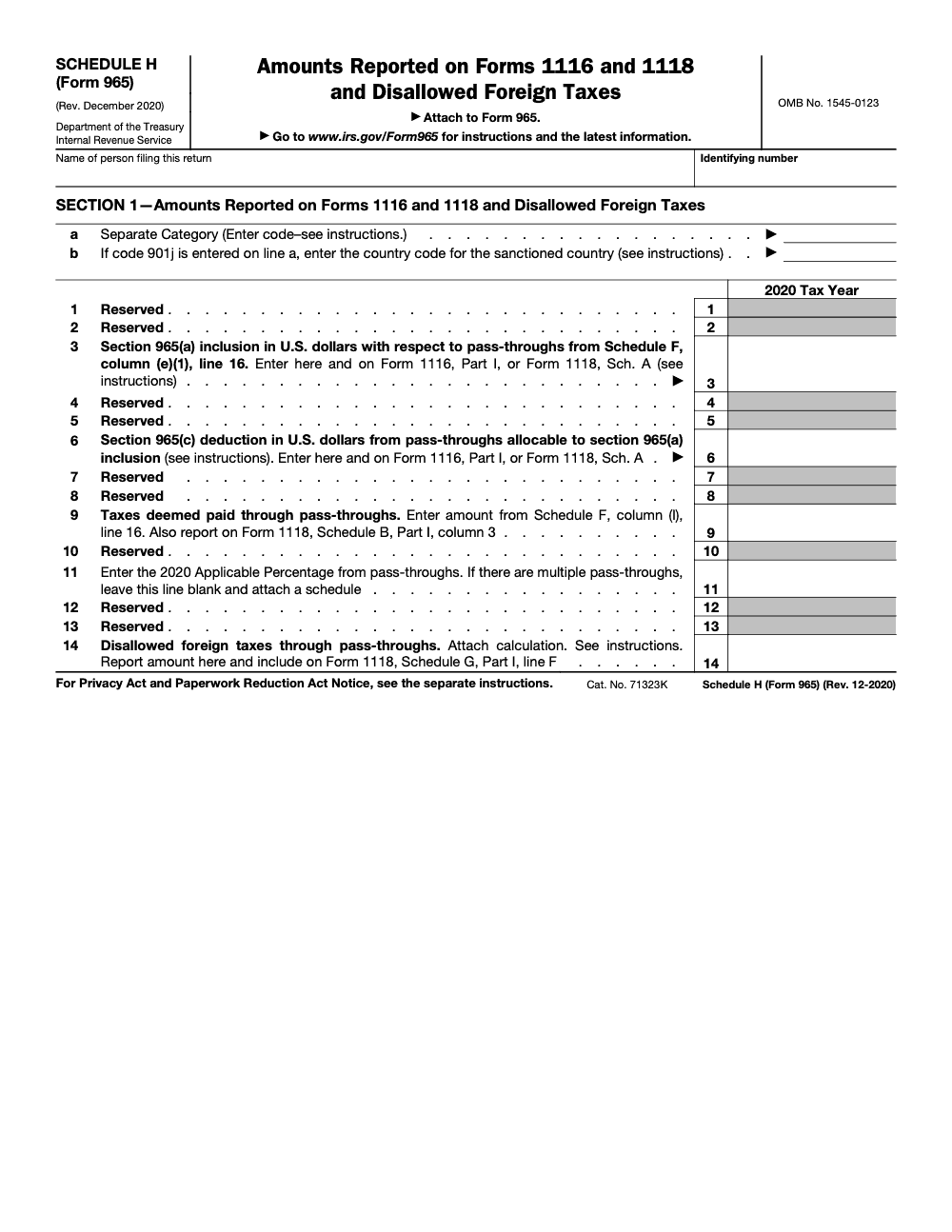
Schedule H (Form 965) reconciles pass-through section 965 amounts to your foreign tax credit filings – it carries the 965(a) inclusion and 965(c) deduction to Form 1116, Part I, or Form 1118, Schedule A; the deemed-paid taxes (line 9) to Form 1118, Schedule B, Part I, column 3; and the 965(g) disallowed taxes (line 14) to Form 1118, Schedule G, Part I, line F. The current version is Rev. December 2020 (per the IRS Form 965 instructions on IRS.gov), and a separate Schedule H is required for each FTC limitation category.
Schedule H is the reconciliation that ties pass-through Section 965 amounts back to your foreign tax credit filings, and it surfaces every season when a K-1 carries a residual inclusion the owner assumed was finished. The 965(a) inclusion and 965(c) deduction route to Form 1116 or 1118, the deemed-paid taxes on line 9 carry to Form 1118 Schedule B, and the 965(g) disallowed taxes on line 14 land on Schedule G.
The form has not been re-released since Rev. December 2020, so filers go hunting for a version that does not exist and sometimes paper-clip the wrong layout. A separate Schedule H is required for each pass-through, and accuracy lives in the small things, basket classification, entity IDs, and clean tie-outs, which is the difference between a reviewer signing off and sending it back.
Key Takeaways
- Schedule H links Schedule F to Forms 1116/1118, showing the section 965(a) inclusion from pass‑throughs, the related section 965(c) deduction, the deemed‑paid foreign taxes, and the portion disallowed under section 965(g).
- The current Schedule H is the December 2020 revision, and it is designed to capture pass‑through items that tie to your 2017 or 2018 transition‑tax inclusion and flow into your 2020 reporting, then onward to the foreign tax credit forms. Attach it to Form 965.
- Installment and deferral filers must keep reporting annually. If you elected the 965(h) 8‑year installment or hold a 965(i) S‑corp deferral, you file Form 965‑A or 965‑B every year until the liability is fully paid or triggered, and successive installments are due with your return due date without regard to extension. Pay each installment separately from current‑year tax.
- Section 965(g) reduces creditable foreign taxes for the transition‑tax inclusion and related PTI distributions, so you must reflect the disallowance on Schedule H and on Form 1118 Schedule G.
- Accuracy lives in the details, basket classification, entity IDs, and tie‑outs. If your process is sloppy, you risk misstatements, credit loss, and time‑consuming rework at review.
What Schedule H covers and why it exists
Schedule H, Amounts Reported on Forms 1116 and 1118 and Disallowed Foreign Taxes, is the one‑page bridge that carries your pass‑through section 965(a) inclusion, the section 965(c) deduction, and the related foreign taxes into the foreign tax credit system (its scope is narrow – every active line header references pass‑throughs, so direct CFC‑level §965 amounts are reported on other Form 965 schedules and on Form 5471, not on Schedule H). The form explicitly asks you to:
- Report the inclusion and deduction amounts from pass‑throughs,
- Bring in taxes deemed paid through pass‑throughs from Schedule F, and
- Record the portion of foreign taxes that is disallowed under section 965(g) on line 14 – the form explicitly requires you to attach the supporting disallowance calculation – which then feeds Form 1118 Schedule G.
The current PDF is labeled Rev. December 2020 and tells you to attach Schedule H to Form 965 (no 2024 or 2025 revision exists – the Rev. 12‑2020 version remains the current form for 2025 reporting, and Schedule H has no standalone filing path). For instructions and updates, the IRS directs you to the Form 965 landing page. That date stamp matters because it tells you which lines are reserved and, more importantly, that this revision focuses on pass‑through shares that ultimately land on Forms 1116 or 1118.
Who must file and when
If you had a section 965(a) inclusion in your 2017 or 2018 tax year, or would have had one but for a 965(b) deficit, and you have related pass‑through activity reported in 2020, you complete Form 965 with the December 2020 schedules and attach Schedule H. From there, ongoing compliance shifts to the annual reporting of any unpaid net 965 tax liability on:
- Form 965‑A for individuals, trusts, and estates, and
- Form 965‑B for corporations and REITs, every year until the net 965 tax is fully paid.
If you elected the 965(h) eight‑year installment, your successive installments are due on the unextended due date for each following year, and the IRS asks that you pay those installments separately from your current‑year tax so they post against the original inclusion year. If you do not receive an installment voucher, you still must pay, and the IRS provides instructions and payment channels, including EFTPS and wire.
S‑corporation shareholders who made the 965(i) deferral keep filing Form 965‑A each year to report the deferred balance until a triggering event. A triggering event can create a new eight‑year installment schedule with consent, or it can require full payment if consent is not granted. Timeframes and the consent process are laid out in the IRS instructions.
Filing triggers, at a glance
| Trigger | Who | Required action |
| 2017 or 2018 section 965(a) inclusion, reported via pass‑through | U.S. shareholder | Attach Form 965 with Schedule H for the applicable reporting year |
| 965(h) installment election | Individual, trust, estate, or corporation | File Form 965‑A or 965‑B annually, pay the next installment by the unextended due date, pay separately from current‑year tax |
| 965(i) S‑corp deferral outstanding | S‑corp shareholder | File Form 965‑A annually, request consent and possibly elect 965(h) on trigger |
| Transfers or adjustments to net 965 tax | Transferor or transferee | Report on 965‑A or 965‑B per IRS instructions for adjustments and transfers |
Sources for filing cadence and payment rules are in the IRS instructions and FAQs on installment logistics and payment application.
Dates to keep in mind
- The installment schedule remains the familiar 8%, 8%, 8%, 8%, 15%, 20%, 25% pattern, applied to the net 965 tax. Adjustments to the original liability are generally spread across all installments.
- The IRS Internal Revenue Manual notes the transition‑tax statement period and provides internal handling guidance, a useful reminder that section 965 is still on the Service’s radar.
How Schedule H connects to Schedules F and G, plus Forms 1116/1118
Think of Schedule H as your “control total” for the foreign tax credit. You:
- Pull the section 965(a) inclusion and 965(c) deduction that came through pass‑throughs,
- Pull the deemed‑paid foreign taxes from Schedule F, line 16, column (l), and
- Record disallowed foreign taxes under section 965(g), which feed Form 1118 Schedule G.
On Schedule F, you list each DFIC, show the inclusion amounts, and compute taxes deemed paid, capping at 100% where required. Line 16 totals the pass‑through amounts that you bring into Schedule H. The form specifically references the pass‑through rollup and directs you to the Form 965 page for detailed instructions.
Pro tip, treat entity identifiers, country codes, and separate limitation categories like line items on a freight manifest. If the tags do not match on every schedule, your review will stall.
Mapping workflow that reviewers trust
- Start with a DFIC‑level ledger that feeds Schedule F, then roll up to Schedule H by basket.
- Confirm the “separate category” and any 901(j) country code entries on both schedules.
- Bring Schedule G’s 965(g) disallowance into Schedule H so Form 1116 or 1118 only sees the allowed portion.
- Tie the final Schedule H amounts to the specific Form 1116 or 1118 schedules you will file.
Basket classification, passive, general, and 901(j)
Your foreign tax credit limitation depends on getting baskets right. For the transition‑tax context, classify the section 965(a) inclusion amounts consistently with how the underlying earnings would be characterized. Most active business income falls in the general category, portfolio‑type items often fall in passive, and any income connected to sanctioned countries flows to 901(j). Schedule H prompts you to select the separate category code and, if 901(j) applies, to enter the sanctioned country. That selection drives where the amounts land on Forms 1116 or 1118.
Practical steps:
- Maintain basket‑specific ledgers from day one.
- Tie basket assignments to E&P workpapers and your inclusion computations.
- Mirror those baskets in the mapping to Form 1116 or 1118 schedules.
Computing deemed‑paid foreign taxes and the 965(g) disallowance
This is where most errors hide. Section 965(g) disallows an applicable percentage of the foreign taxes associated with the transition‑tax inclusion and with later distributions of previously taxed earnings and profits, both for directly paid taxes and for taxes treated as paid under section 960. The final regulations keep that disallowance in place to give effect to section 965(g)(3).
What that means in your file:
- On Schedule F, compute the taxes deemed paid that relate to the section 965(a) inclusion for each DFIC.
- On Schedule H, report those totals, then reduce them by the 965(g) disallowed portion.
- Carry the allowed portion to Form 1116 or Form 1118. Schedule H tells you exactly where to post, including Form 1118 Schedule B for deemed‑paid taxes and Schedule G for disallowed amounts (lines 9 and 14 route only to Form 1118 – individuals using Form 1116 do not have a corresponding line for these amounts on Form 1116 and follow the §965‑related FTC mechanics specified in the separate Form 965 instructions).
A note on years and forms, although the original inclusions were 2017 and 2018, the IRS revised Form 965 schedules in December 2020 to capture pass‑through items that flow into your 2020 reporting and on to the foreign tax credit forms. That is why the current Schedule H shows “2020 Tax Year” on its face, yet it reconciles taxes tied back to the transition‑tax inclusions.
Example, clean tie‑out in one sitting
- Your partnership’s K‑1 provides a section 965(a) inclusion, a 965(c) deduction, and deemed‑paid foreign taxes by basket.
- You enter the DFIC‑level details on Schedule F and total them on line 16.
- You put the inclusion, deduction, and taxes into Schedule H, select the correct separate category, and compute the 965(g) disallowed piece.
- You post the allowed taxes to Form 1118 Schedule B and the disallowed amount to Schedule G, then verify that Form 1118 totals match Schedule H.
Deadlines, installments, and annual cadence, do not miss these
- If you made the 965(h) installment election, each successive installment is due with the unextended due date for the following year. The IRS asks you to pay those installments separately from your current‑year income tax, and if you accidentally overpay, they will roll the excess forward to future installments, not refund it until the entire 965 liability is satisfied.
- Individuals and entities taxed like individuals file Form 965‑A annually while any net 965 tax remains unpaid. Corporations and REITs file Form 965‑B annually under the same rule.
Special rules for pass‑throughs, what owners need from the entity
If your partnership or S‑corporation is a U.S. shareholder of a DFIC, owners need a package that includes the pro forma Form 965 schedules and the transition‑tax statement details the IRS outlined. The statement must list the inclusion, aggregate foreign cash position if applicable, the section 965(c) deduction, deemed‑paid foreign taxes, disallowed taxes under section 965(g), the net 965 tax liability, any installments under 965(h), any 965(i) deferral, and elections made. Expect to keep filing Form 965‑A or 965‑B annually while a 965 balance remains.
Keep a single evidence file, DFIC‑by‑DFIC, that links inclusion math, basket assignments, and foreign tax pools to each line on Schedule H. It saves hours during review and answers most examiner questions before they are asked.
Common pitfalls and quick fixes
- Mixing baskets. One wrong category code can scramble the limitation, so lock basket selection to your E&P workpapers and apply it everywhere.
- Dropping the 965(g) reduction. If you carry gross deemed‑paid taxes to Form 1116 or 1118 without the disallowance, you overstate credits. The regulations and IRS guidance are clear that the disallowance applies to both directly paid and deemed‑paid taxes.
- Missing annual 965‑A or 965‑B filings. If you still owe any net 965 tax, you have an annual reporting job, and installments must be paid timely and separately from current‑year tax.
- Weak identifiers. Inconsistent DFIC names, reference IDs, or country codes make tie‑outs painful and delay reviews.
Where firm delivery breaks, and how to keep it tight
Schedule H is short, the process around it is not. Many firms stall because reviewers spend nights untangling workpapers, baskets, and revisions. In our experience building controlled delivery structure for accounting teams, the fix is operational, not heroic:
- Write SOPs that mirror the IRS mapping, DFIC ledger to Schedule F, to Schedule H, to Form 1118, and lock them into your workflow.
- Use structured workpapers, consistent naming, and version control so reviewers can approve faster.
- Apply a layered review, preparer to senior to quality, that catches basket and 965(g) issues before partner review.
At Accountably, we integrate trained offshore teams into your tax workflow only when structure exists, we work in your systems, follow your templates, and protect review time with SOPs and checklists. If you already have clean processes and just need capacity, that is where we fit. If not, fix the process first, then add people.
Final checklist and a note on dates
- Confirm basket codes and any 901(j) country code.
- Match Schedule F line 16 totals to Schedule H, then to Form 1116 or 1118.
- Compute and record the 965(g) disallowed taxes, then post to 1118 Schedule G.
- If you elected installments or hold a deferral, file 965‑A or 965‑B every year and pay on time.
Common Mistakes We See Every Season
Section 965 has been on the books since 2017, but the pass-through cleanup is still a steady source of review notes. The same handful of mistakes show up every cycle.
Reusable Checklists
These checklists are copy-paste ready for firm SOPs. They cover the three places Schedule H tends to drift: pass-through intake, line-by-line preparation, and reviewer handoff.
K-1 intake packet for §965 pass-throughs
- Pull the entity's prior-year Schedule H (Rev. 12-2020) and confirm the separate category code on line a.
- Confirm whether line b carries a 901(j) sanctioned-country code; if yes, capture the country code in the workpaper header.
- Request Schedule F (Form 965) from the pass-through, specifically column (e)(1) line 16 and column (l) line 16.
- Request the pass-through's §965(c) applicable percentage for the current year.
- Request the entity-level §965(g) disallowance worksheet, if prepared at the pass-through level.
- Document whether the owner is on the §965(h) 8-year installment election and capture the installment year.
- Confirm entity type to route lines 3 and 6 to Form 1116 (individuals, estates, trusts) or Form 1118 (corporations).
Schedule H line-by-line prep tie-out
- Enter the separate category code on line a; enter the country code on line b only when 901(j) applies.
- Leave reserved lines (1, 2, 4, 5, 7, 8, 10, 12, 13) blank.
- Carry Schedule F column (e)(1), line 16 to Schedule H, line 3; mirror the amount on Form 1116, Part I, or Form 1118, Schedule A.
- Compute the §965(c) deduction from pass-throughs and enter on line 6; mirror to Form 1116, Part I, or Form 1118, Schedule A.
- Carry Schedule F column (l), line 16 to Schedule H, line 9; report the same amount on Form 1118, Schedule B, Part I, column 3.
- Enter the §965(c) applicable percentage on line 11; if there are multiple pass-throughs, leave blank and attach a per-entity schedule.
- Enter the §965(g) disallowed taxes through pass-throughs on line 14; attach the disallowance calculation; report the amount on Form 1118, Schedule G, Part I, line F.
- Prepare one Schedule H per separate FTC limitation category.
Reviewer handoff for §965 returns
- Attach Schedule H to Form 965; confirm Form 965 is attached to the income tax return.
- Tag the line 11 supporting schedule (when multiple pass-throughs) in the workpaper index.
- Tag the line 14 §965(g) disallowance calculation in the workpaper index.
- Tie Schedule H line 3 and line 6 to the matching Form 1116, Part I, or Form 1118, Schedule A entry.
- Tie Schedule H line 9 to Form 1118, Schedule B, Part I, column 3.
- Tie Schedule H line 14 to Form 1118, Schedule G, Part I, line F.
- Confirm Form 965-A or 965-B is current if the owner is on the §965(h) installment election.
- Sign off the basket and country-code header before release.
Keep Form 965 (Schedule H) Season From Stalling
Section 965 reporting did not retire when the transition tax was enacted in 2017. According to the IRS Form 965 instructions on IRS.gov, the Rev. December 2020 Schedule H remains the active form for residual pass-through reporting, and filers on the §965(h) 8-year installment election are still paying down their net tax through 2025 and beyond. For practices that handle pass-through-heavy returns, that means Schedule H stays on the prep checklist every season even when the volume per return is small.
The fix is not more bodies, it is fewer touches. When Schedule H stalls, the pattern is the same every cycle: K-1 data lands late, the preparer cannot locate the prior-year applicable percentage, and the reviewer ends up reconstructing the §965(g) disallowance math from scratch. A short list of standing tie-outs eliminates most of the rework before it reaches the senior desk.
- Carry a prior-year Schedule H workpaper into the current-year file with the basket code, country code (when 901(j) applies), and §965(c) applicable percentage already populated.
- Lock the Schedule F line 16 totals before anyone starts Schedule H; lines 3 and 9 inherit those totals and cannot be reconciled cleanly if Schedule F shifts mid-prep.
- Tag every Schedule H line that requires a duplicate entry on Form 1116 or Form 1118 in the workpaper index, so the reviewer can confirm the carry in one pass.
- Keep the line 14 §965(g) disallowance calc as a standalone PDF attached to Form 965, with the math shown in the same units that land on Form 1118, Schedule G, Part I, line F.
- For returns with multiple pass-throughs, build the line 11 supporting schedule once per client and roll it forward; do not rebuild it return by return.
Accountably runs the production side of this with trained offshore preparers who already know the Schedule F to Schedule H to Form 1118 path and the §965(g) attachment rule. Our tax outsourcing model takes the Schedule H workpaper off the senior reviewer's desk, so the residual §965 inclusion clears in the same review pass as the rest of the return.
FAQs
Yes, if you have pass‑through activity tied to a section 965(a) inclusion that must be reported through the December 2020 revision, attach Schedule H to Form 965 and push the allowed and disallowed taxes to Forms 1116/1118. For ongoing years, your main recurring forms are 965‑A or 965‑B until the net 965 tax is fully paid.
Report the allowed deemed‑paid taxes on Form 1118 Schedule B and the disallowed portion on Schedule G. Schedule H tells you exactly which lines to use and ties back to Schedule F line 16 for pass‑through totals.
Apply the applicable percentage to the foreign taxes connected to the 965 inclusion or related PTI distributions, both for directly paid taxes and taxes treated as paid under section 960, then record the disallowed amount on Schedule H and Form 1118 Schedule G. The final regulations and IRS explanation confirm this approach.
Follow the standard 8%, 8%, 8%, 8%, 15%, 20%, 25% pattern. Each successive installment is due with the unextended due date for the next year. Pay it separately from current‑year tax using an approved channel such as EFTPS or wire, and the IRS will apply any excess to your next installments rather than refund it before the full liability is paid.
Keep DFIC‑level E&P and tax pools, Schedule F computations, your 965(g) reduction math, basket assignments, and the pro forma or transition‑tax statements that owners received. Store tie‑outs that show how Schedule H amounts land on Forms 1116 or 1118. The IRS emphasizes documentation and continued reporting while liabilities remain.
Other forms this guide names
- Form 1118: Corporate FTC Filing, Baskets, Limits, Carryovers
- Form 1116: Foreign Tax Credit Guide 2025, How to Claim
- Form 965-A: Installments, S Corp Deferral, E-file Guide
- Form 965-B: Corporate Filing, Installments, Deadlines Guide
About this guide
Accountably helps US CPA, EA, and accounting firms hire trained accountants and tax preparers in India.
About us Reviewed byJugal Thacker, CPAFounder and CEO at Accountably
A Washington-licensed CPA with 7+ years inside US firms – PwC, a real-estate tax practice, then a full-service firm, rising from reviewer to manager to advisory. This article was reviewed against current IRS guidance for the 2025 tax year and updated for filers preparing late returns, amendments, and 2026 estimates.
View profile →How we research, review, and update this guide
Every Accountably guide is researched against primary IRS sources, reviewed by a U.S. CPA, and refreshed as guidance evolves. Read our Editorial Guidelines to see how we source, fact-check, and update our content.