Summarize this article with AI
In Brief
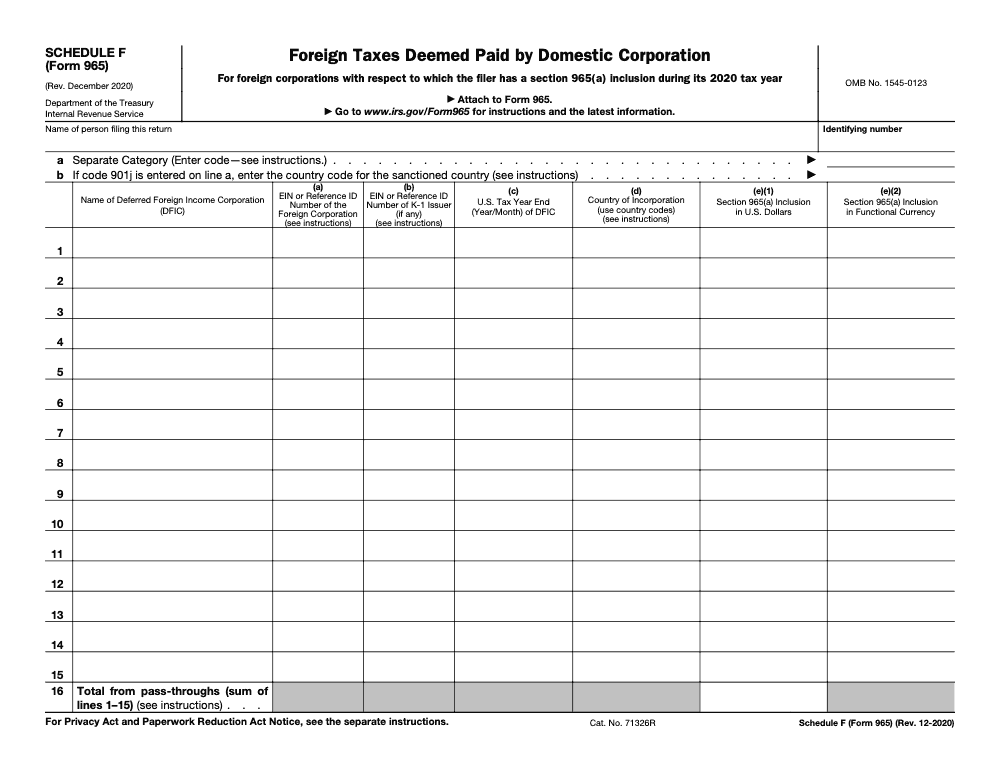
Schedule F (Form 965) computes foreign taxes deemed paid by a domestic C corporation on its Section 965(a) transition-tax inclusion, prepared one schedule per Section 904(d) separate category (per the IRS Form 965 instructions). The December 2020 revision remains the operative version through tax year 2025; for calendar-year C-corp filers with a 2017 inclusion year, the 8th and final Section 965(h) installment, at 25 percent of the net liability, is due April 15, 2026 (per IRC §965(h) and Rev. Proc. 2024-40 due-date references).
A common misread on Schedule F is that one schedule covers everything. It does not. You prepare a separate Schedule F for each Section 904(d) separate category, because the deemed-paid foreign taxes that relate to a Section 965(a) inclusion have to stay tagged to the right basket before anything flows onward.
Only the pro rata share of each DFIC's taxes tied to the inclusion is deemed paid; excess taxes follow the regular foreign tax rules, and amounts disallowed under Section 965(g) are not creditable at all. Those tagged figures feed Schedule H and then Forms 1116 and 1118. The December 2020 revision is still operative through tax year 2025, and for a calendar-year C corporation with a 2017 inclusion the final 965(h) installment, at 25 percent of the net liability, comes due April 15, 2026.
Key Takeaways
- Schedule F computes per‑DFIC foreign taxes deemed paid that relate to your Section 965(a) inclusion and tags them by country and foreign tax credit basket, general, passive, or section 901(j) – with a separate Schedule F completed for each separate category code on line a, not one Schedule F covering all baskets.
- Those tagged amounts flow into Schedule H, which aggregates and applies Section 965(g) disallowance, then pushes allowable amounts to Forms 1116 and 1118.
- Only the pro rata share of each DFIC’s taxes tied to the inclusion is deemed paid. Excess taxes follow regular foreign tax rules, and taxes disallowed under 965(g) are not creditable.
- Pass‑through owners need pro forma Schedule F and H detail to complete their returns and to preserve basket integrity on 1116 or 1118. Ongoing 965(h) installments or 965(i) deferrals still require annual reporting.
What Schedule F does and why it matters
Schedule F captures the foreign taxes, paid or accrued, that are attributable to the Section 965(a) inclusion from each specified foreign corporation that qualifies as a DFIC for you. It ties those taxes to the right income basket so the downstream limitation works as intended. Many software platforms wire Schedule F to Schedule H so entry happens once, and basket totals carry forward without manual re‑keying, which reduces mismatches and double counting.
Here is why this step is critical. The foreign tax credit is calculated separately by basket, and certain taxes tied to Section 965 are partially disallowed under Section 965(g). If you do not tag and route them correctly at the Schedule F stage, you risk overstating credits on Form 1116 or 1118, and you invite notices or amended returns. The 1116 instructions explicitly call out foreign taxes disallowed under 965(g) as not creditable, and corporate Form 1118 instructions add mechanics for reductions and 965 PTEP considerations.
Identifying specified foreign corporations and DFICs
You start by determining whether a foreign corporation is a specified foreign corporation, then whether it is a DFIC for your inclusion. A specified foreign corporation means any CFC, or any foreign corporation with at least one domestic corporate U.S. shareholder, except that a PFIC that is not a CFC is not treated as specified for this purpose.
A DFIC is any specified foreign corporation of a U.S. shareholder that had positive accumulated post‑1986 deferred foreign income on either measuring date, November 2, 2017 or December 31, 2017. For inclusion computations you use the greater of the two – do not default to the December 31 figure, because if the DFIC made distributions or had other E&P‑reducing events between November 2 and December 31, 2017, the November 2 amount may be the higher one. These definitions and measuring dates come straight from Section 965 and related guidance and remain the reference points, even as you continue reporting installments or deferrals today.
Ownership thresholds and measuring dates
- U.S. shareholder status generally means owning, directly, indirectly, or constructively, at least 10 percent of total combined voting power for tax years of foreign corporations beginning before January 1, 2018.
- SFC status is tested as of November 2, 2017 and December 31, 2017, and DFIC status requires positive accumulated post‑1986 deferred foreign income on at least one of those dates.
Keep a clean ownership chain file and measurement‑date E&P support. It saves hours during review and any IRS follow up.
A quick note on why this stage eats partner time
Even seasoned teams stumble at this stage because data lives in multiple places, workpapers use inconsistent naming, and reviewers spend partner time fixing categorization and documentation. If your firm has felt trapped in review loops or seen quality vary across preparers, the gap is rarely talent, it is whether the work is review-ready before it reaches the partner whose name is on the return. With trained preparers working to your SOPs, structured workpapers, and layered review, the 965 work stops clogging the pipeline and starts closing on time, at quality, and at scale. Keep that lens in mind as you read the how‑to sections that follow.
Data points you need to complete Schedule F
Create a simple intake checklist and gather the following per specified foreign corporation. This is where most errors start, so do not skip documentation.
- Entity identifiers: legal name, EIN or foreign reference ID, country, and the U.S. tax year end of the DFIC.
- Section 965(a) inclusion amounts in U.S. dollars and functional currency, plus any totals coming through pass‑throughs (the two columns are not interchangeable – translate the functional‑currency amount to U.S. dollars at the spot rate on the last day of the DFIC's inclusion year, so columns (e)(1) and (e)(2) will generally differ unless the DFIC's functional currency IS the U.S. dollar).
- Post‑1986 E&P and post‑1986 foreign income tax pools, beginning and ending, with functional currency tags.
- Foreign taxes paid or accrued for the relevant year, split by basket, general, passive, 901(j), and mapped to the inclusion.
- Section 965(g) disallowed portion, kept separate for Schedule H.
- A reconciliation to the DFIC’s books and returns, plus a rollforward to show how totals land on Schedule H and then 1116 or 1118.
Tip: Build a per‑entity “country and basket” worksheet, then lock the file naming convention. Your reviewers will thank you.
Country and basket tagging
- Tag every foreign tax by country (use the official IRS country code, not the country name or an informal abbreviation like 'UK' – free‑text country names cause IRS matching errors) and by basket, general, passive, section 901(j). This drives the limitation. The 1116 instructions list 901(j) income as a separate category and confirm that foreign taxes disallowed under Section 965(g) are not creditable. Keep those amounts segregated.
- For corporations, remember the 1118 structure and Schedule G reductions that can apply to taxes, including notes around distributions of section 965 PTEP where reductions are handled on Schedule G.
How to allocate and apportion foreign taxes to the 965(a) inclusion
Your goal is to deem paid only the portion of a DFIC’s foreign taxes that relates to the included E&P. A practical way to think about it:
- Compute the DFIC’s pro rata inclusion percentage. This is the portion of the DFIC’s post‑1986 deferred foreign income that was included for your Section 965(a) amount, using the measurement‑date E&P and the pro rata rules similar to section 951(a)(2).
- Multiply the DFIC’s relevant foreign taxes by that percentage to get the deemed‑paid amount tied to the inclusion.
- Split that deemed‑paid amount across baskets that match the character of the underlying income, general, passive, or 901(j).
- Track any excess taxes that are not attributable to the inclusion, those follow regular annual foreign tax rules, not the Section 965 deemed‑paid mechanism.
A quick numeric sketch
- Assume DFIC A has a 965 inclusion base of 1,000 and foreign taxes of 150 in the year, all tied to general category income. If your pro rata inclusion percentage is 60 percent, the deemed‑paid taxes for Schedule F are 90. The 90 then flows to Schedule H for 965(g) disallowance treatment, and the remainder flows to the general basket on 1116 or 1118, subject to overall limitation. The disallowed portion will not be creditable.
What not to include
- Do not include foreign taxes you do not legally owe or that must be reduced under other rules. The 1116 and 1118 instructions detail reductions and noncreditable taxes, and they explicitly reference 965(g) disallowance.
- Keep distributions of 965 PTEP and 965(b) PTEP in mind. Corporate rules reduce deemed‑paid taxes by applicable percentages on 1118 Schedule G, which is separate from Schedule F’s job but matters for the downstream credit.
Documentation that protects your review
- Maintain measurement‑date E&P workpapers with ties to section 964 and 986 methods.
- Store ownership chains that demonstrate U.S. shareholder status and attribution.
- Attach currency conversion support and average rate logic, if you accrue foreign taxes. The 1116 instructions give currency guidance.
If your firm struggles to keep these files consistent, consider standard file logic and checklists. Consistent naming and country‑by‑basket tabs shorten reviews and avoid late‑stage rework. This is where a controlled offshore delivery team, working inside your systems and templates with layered QC, can give you capacity without chaos. Keep the focus on SOPs and review protection, not resumes, so you can move faster without losing control.
Interaction with Schedule H, Forms 1116 and 1118
Think of the flow in three steps.
- Schedule F computes the deemed‑paid foreign taxes per DFIC and tags each amount by basket.
- Schedule H aggregates the tagged amounts, applies Section 965(g) disallowance, and produces category totals.
- Those category totals flow to Form 1116 for individuals or trusts, or to Form 1118 for corporations, where the foreign tax credit limitation is computed by basket.
Category mapping mechanics
- Keep your basket mapping consistent across Schedule F, Schedule H, and the applicable credit form. The foreign tax credit limitation is computed separately for each category, and the 1116 instructions require you to summarize credits from separate Parts III by category. Mislabeling here creates math that looks right but fails on limitation.
- If you make a section 962 election, you use Form 1118 to claim a credit based on your share of CFC taxes, and you still file Form 1116 for other taxes. This is where clean Schedule F and H tagging prevents double counting.
Simple mapping table
| Step | What you compute | Where it lands |
| Schedule F | Deemed‑paid taxes by DFIC, by country, by basket | Feeds Schedule H |
| Schedule H | Applies 965(g) disallowance and aggregates by basket | Feeds Form 1116 or 1118 |
| Form 1116, Form 1118 | Computes credit limitation by basket | Final credit result |
Disallowed foreign taxes under Section 965(g)
Section 965 allows deemed‑paid credits on the inclusion, but Section 965(g) partially disallows those credits, and the disallowed portion is not creditable. The 1116 instructions expressly list foreign taxes disallowed under 965(g) as not eligible for the credit. Treasury regulations also explain that foreign taxes on distributions of section 965 previously taxed E&P are subject to 965(g)(1) disallowance, which is why the Schedule H step matters.
Practical review cues
- Your Schedule H should clearly show the 965(g) disallowed amount, with narrative that ties back to each DFIC and basket.
- 1118 filers should check how 965 PTEP and related tax reductions appear on Schedule G, since the instructions point you to handle applicable percentage reductions there.
Worked micro‑example
You hold 25 percent of DFIC B. Inclusion base is 2,400. Foreign taxes are 300, all in the general basket. Your pro rata inclusion percentage is 50 percent, so the starting deemed‑paid amount is 150. Schedule H applies 965(g) disallowance and leaves, for example, 90 as allowable. The 90 then moves to the general basket on 1116 or 1118, subject to overall limitation. Your workpapers should show each step and the reason any amount was disallowed.
Common pass‑through owner scenarios
Pass‑through owners rely on the entity for correct Schedule F and H pro formas. If you elected 965(h) installments or 965(i) deferral, you still have annual reporting while any net 965 tax remains unpaid or deferred. The IRS confirms that 965‑A and 965‑B are filed each year there is outstanding liability or deferral, and that these rules continue beyond the original inclusion year. Keep those records current and reconcile any IRS payment schedules.
Short rule of thumb, if the 965 tax is still on your balance, your reporting is still on your calendar.
Software and documentation tips for accurate filing
Anchor your process in a modern 965 module so you enter DFIC‑level foreign taxes once, by country and basket, and let the system push the amounts to Schedule H and 1116 or 1118. Many platforms are built to do exactly this, and even vendor help centers describe how Schedule F and H are interrelated in their data flow. Still, lock your own controls so no one can override key tags downstream.
Control steps and evidence
| Control step | Evidence retained |
| Country tagging | Basket‑by‑country worksheet saved to the engagement file |
| DFIC mapping | Ownership chain and trial balance tie‑out to E&P workpapers |
| Installment and deferral checks | 965(h) schedule and any IRS records of payments or 965(i) deferral tracking |
| Reconcile pro forma schedules | Schedules F, G, and H rollforward with reviewer notes |
| Final export | Software audit trail PDF and currency conversion support |
Where disciplined offshore delivery helps, without losing control
If your team is buried in production and reviews, capacity alone will not fix Schedule F. You need structure. The most reliable offshore models work inside your systems and templates, follow your SOPs, and use layered review to protect partner time. That means preparer, senior, then quality review, with clear SLAs and early escalation. Accountably partners with firms that want this level of control, integrating trained teams who understand U.S. accounting workflows, IRS standards, and your file logic. The aim is simple, stable production, predictable turnaround, and fewer review loops, without giving up security or oversight.
Conclusion and quick checklist
You have now seen how Schedule F sets the stage for correct basket tagging, how Schedule H applies Section 965(g), and how Forms 1116 and 1118 compute the actual credit. Validate DFIC status, keep ownership and E&P support current, compute pro rata inclusion percentages, then tag every foreign tax by country and basket. If you own 30 percent of a Hong Kong DFIC, for example, you would compute the inclusion using the greater of the 2017 measurement‑date E&P amounts, map withholding by the right basket, apply 965(g) disallowance on Schedule H, and pass the allowable remainder to Form 1118 or 1116. The result is clean credits and fewer review surprises.
Common Mistakes We See Every Season
Schedule F is short on rows but heavy on cross-form coordination, and the same five errors surface every inclusion-year review.
Reusable Checklists
These pull straight from our inclusion-year review SOPs. Copy them into your workpaper template, your engagement letter, or your firm tracker.
DFIC inventory and SFC confirmation
- List every specified foreign corporation in which the domestic shareholder held stock in tax year 2017 (and any later year still under review).
- Exclude PFICs that are not CFCs; confirm CFC status against the most recent Form 5471.
- Pull post-1986 accumulated deferred foreign income at both measurement dates (November 2, 2017 and December 31, 2017).
- Tag each foreign corporation as a DFIC (positive accumulated income) or an E&P-deficit corporation (excluded from Schedule F).
- Reconcile the DFIC list to Form 965 line totals before opening Schedule F.
- Capture Reference ID Numbers consistent with the IDs used on Forms 5471 and 8865.
Schedule F basket mapping per Section 904(d)
- Open one Schedule F per separate category code (general, passive, 901(j), and any other applicable basket).
- Enter the separate category code on line a; if 901(j) appears on line a, enter the sanctioned-country code on line b.
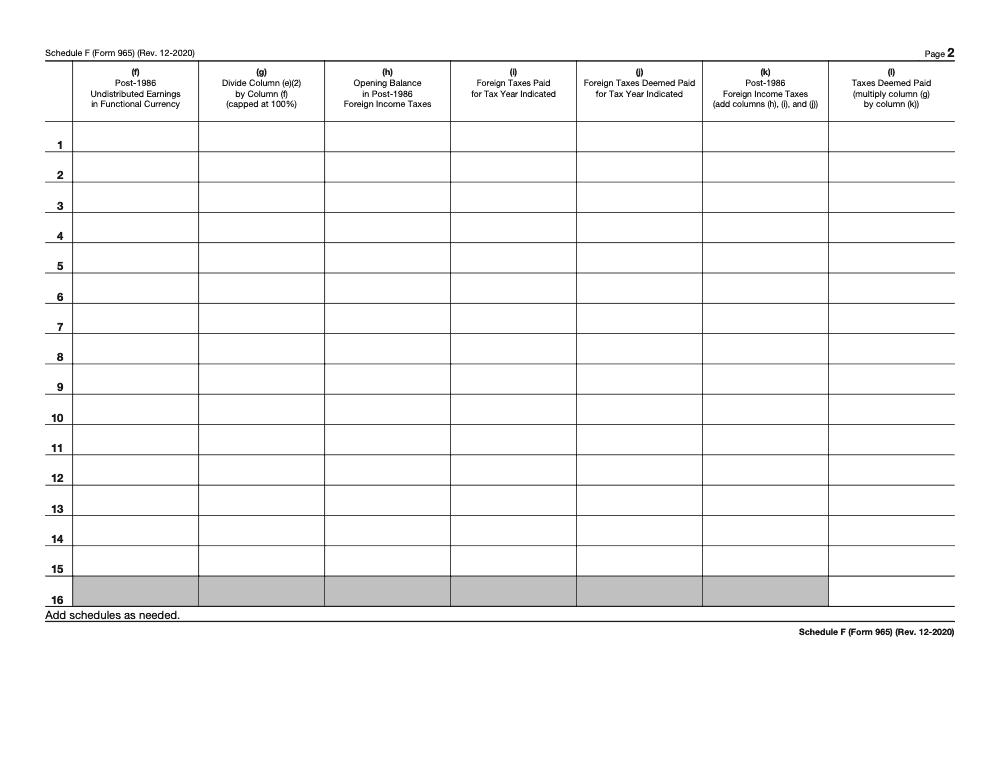
- For each DFIC row, populate columns (a) through (e)(2): name, K-1 issuer EIN if a pass-through, tax year end in Year/Month, IRS country code, and inclusion in both U.S. dollars and functional currency.
- Compute column (g) as (e)(2) divided by (f), capped at 100 percent.
- Build the column (k) post-1986 foreign income tax pool as the sum of columns (h), (i), and (j) (no subtraction).
- Calculate column (l) as g × k, gross of the Section 965(g) haircut.
- Use line 16 only for the pass-through total of lines 1 through 15, never as another DFIC entry.
965(h) installment year-end handoff
- Confirm which installment year applies (year 1 through year 8) and the corresponding back-loaded percentage (8 / 8 / 8 / 8 / 8 / 15 / 20 / 25 percent).
- Calendar the installment on the original (unextended) due date of the return; Form 7004 does not extend the payment deadline.
- Update Form 965-A (individual shareholders) or Form 965-B (corporate filers) for the current year's installment and prior-year history.
- Flag any acceleration events: liquidation, sale of substantially all assets, or cessation of business under IRC §965(h)(3).
- If a transfer agreement is required, file under Treas. Reg. §1.965-7(b) within 30 days of the triggering event to preserve the installment election.
- Verify cumulative installment payments tie to net Section 965 tax liability before sign-off.
Keep Schedule F (Form 965) Season From Stalling
Schedule F sits in an odd spot on the calendar. It is a transition-tax schedule rooted in 2017, but it is still on calendar-year C-corp desks in 2026, because the eighth and largest Section 965(h) installment, at 25 percent of the net liability, lands on April 15, 2026 (per IRC §965(h) and the IRS Form 965 instructions). Five years of 8 percent payments lull teams into routine, then the final three back-loaded installments at 15, 20, and 25 percent stack 60 percent of the remaining liability into one stretch.
What stalls reviews here is rarely the computation itself. It is the coordination across Form 965, Schedule F, Schedule H, Form 1118 (or Form 1116 for K-1 recipients), and the running installment ledger. The fix is to treat the inclusion-year package as one workflow with a defined handoff between schedules, not five disconnected tabs.
- Lock column (l) on Schedule F to the gross deemed-paid figure (g × k); apply the Section 965(g) disallowance downstream on Schedule H, never inside Schedule F itself.
- Open one Schedule F per Section 904(d) separate category, with the line a code and any line b sanctioned-country code pre-staged in the template.
- Calendar the Section 965(h) installment date separately from the Form 1120 extension date; the installment is due on the unextended due date regardless of any Form 7004 on file.
- Roll the post-1986 foreign income tax pool (columns (h) + (i) + (j)) in functional currency, then translate column (e)(1) at the spot rate on the last day of the DFIC inclusion year per Treas. Reg. §1.965-1.
- Reconcile Form 965-A or Form 965-B installment ledgers to the Form 1120 ledger before sign-off; mismatches surface in IRS notices months later.
Inclusion-year cleanup and installment-year reviews are the kind of structured, multi-schedule execution that benefits most from documented SOPs and layered review. Accountably's offshore tax delivery is built around exactly this rhythm: preparer, senior, then quality review against a standard workpaper template, so the final-installment year does not surface a surprise three weeks before the deadline.
FAQs
Schedule F itself is filed only by domestic C corporations – individuals who receive pass‑through Section 965(a) inclusions on a K‑1 claim their foreign taxes on Form 1116 instead, using pro forma detail from the upper‑tier entity rather than filing a personal Schedule F. Schedule F is prepared to compute deemed‑paid foreign taxes tied to Section 965(a) inclusions and to feed Schedule H and Forms 1116 or 1118. You will still encounter it when you complete or correct inclusion‑year packages, and when pass‑through entities furnish pro forma detail to owners who remain on 965 reporting because of 965(h) installments or 965(i) deferrals.
An SFC is a CFC or a foreign corporation with at least one domestic corporate U.S. shareholder, except a PFIC that is not a CFC is excluded. A DFIC has positive accumulated post‑1986 deferred foreign income on November 2, 2017 or December 31, 2017. You use the greater amount for inclusion.
General, passive, and section 901(j). Keep your mapping consistent because the credit is limited separately by basket, and 901(j) is reported separately.
A portion of the foreign taxes related to Section 965 inclusions, and taxes on distributions of 965 PTEP, are disallowed and not creditable. The disallowance is applied on Schedule H before amounts move to 1116 or 1118, and corporate filers reflect related reductions on 1118 Schedule G.
Form 965 (Schedule F) Guide family
- Form 965 (Schedule D): aggregate foreign cash position guide
- Form 965 (Schedule H): reconciliation guide for foreign tax credits
Other forms this guide names
- Form 1116: Foreign Tax Credit Guide 2025, How to Claim
- Form 1118: Corporate FTC Filing, Baskets, Limits, Carryovers
- Form 7004: Business Tax Extension Guide, Deadlines & E‑File
- Form 965-A: Installments, S Corp Deferral, E-file Guide
- Form 965-B: Corporate Filing, Installments, Deadlines Guide
- Form 1120: Corporation Tax Return Guide
About this guide
Accountably helps US CPA, EA, and accounting firms hire trained accountants and tax preparers in India.
About us Reviewed byJugal Thacker, CPAFounder and CEO at Accountably
A Washington-licensed CPA with 7+ years inside US firms – PwC, a real-estate tax practice, then a full-service firm, rising from reviewer to manager to advisory. This article was reviewed against current IRS guidance for the 2025 tax year and updated for filers preparing late returns, amendments, and 2026 estimates.
View profile →How we research, review, and update this guide
Every Accountably guide is researched against primary IRS sources, reviewed by a U.S. CPA, and refreshed as guidance evolves. Read our Editorial Guidelines to see how we source, fact-check, and update our content.