Summarize this article with AI
In Brief
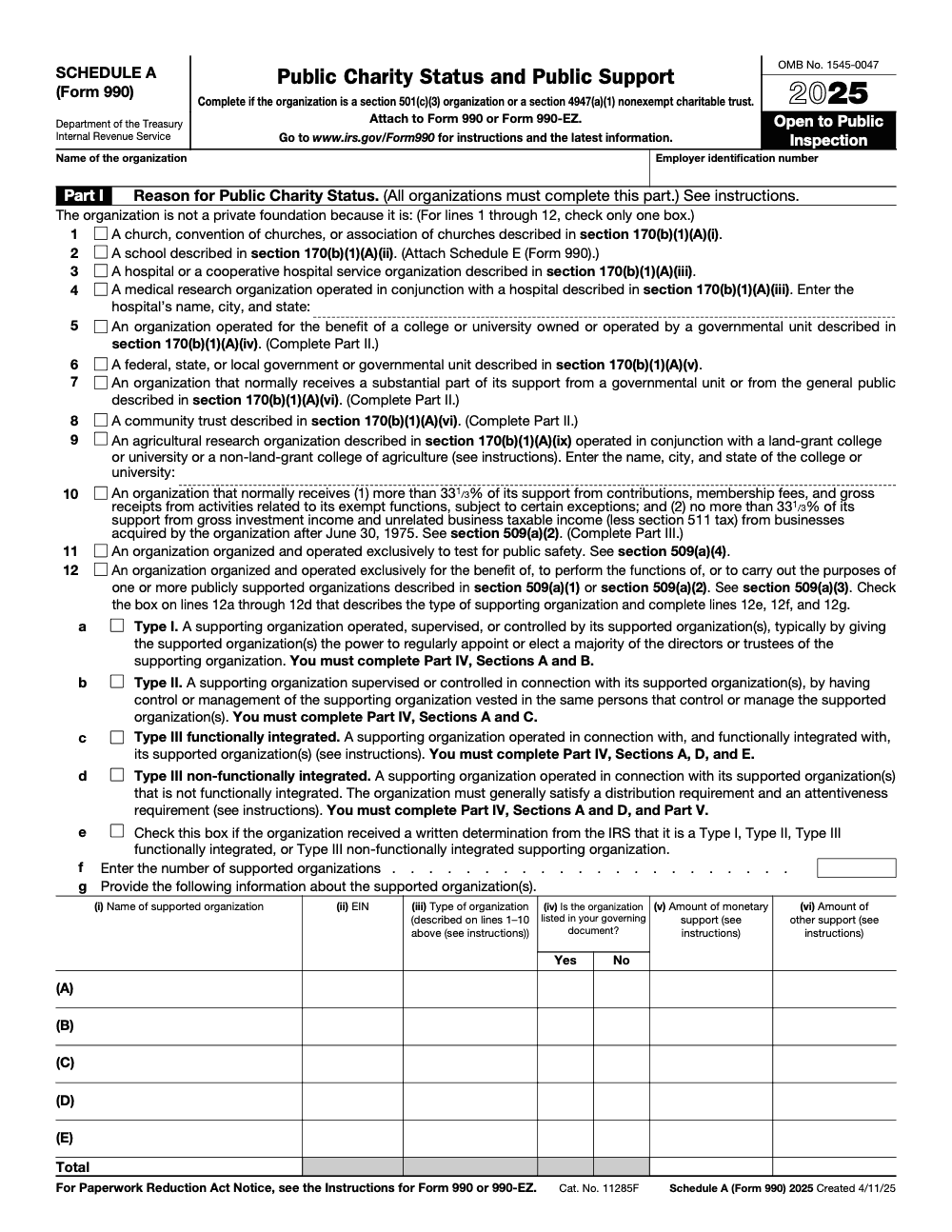
Schedule A (Form 990) is the public charity status test that section 501(c)(3) organizations and section 4947(a)(1) nonexempt charitable trusts attach to Form 990 or 990-EZ (per the 2025 Schedule A instructions). Pick one box in Part I, clear the 33-1/3% public support test over a rolling five-year window, or qualify under the 10% facts-and-circumstances alternative; calendar-year filers are due May 15.
A public support problem on Schedule A shows up later than the grants that cause it. A small arts group leans on a few large grants, and the return goes out clean. When the rolling five-year math catches up, public support slips under 33 1/3 percent, with the 2 percent donor cap in Part II pulling the numbers down, and the organization's public charity status is in question.
Schedule A proves why you are a public charity rather than a private foundation: pick one box in Part I, clear the 33 1/3 percent public support test over a rolling five-year window, or qualify under the 10% facts-and-circumstances alternative. Type III non-functionally integrated supporting organizations also carry a payout rule, the greater of 85 percent of adjusted net income or 3.5 percent of non-exempt-use assets, and calendar-year filers are due May 15.
Key Takeaways
- Schedule A proves why you are a public charity rather than a private foundation, and you file it with Form 990 or 990‑EZ when required. Miss it, and you can be pushed to Form 990‑PF.
- Use the same accounting method on Schedule A that you checked on Form 990, Part XII, line 1, or 990‑EZ, line G. There is a narrow exception for reporting certain Part V distributions on a cash basis.
- For the public support tests, you typically must clear 33 1/3 percent over a five‑year window, or use the 10 percent facts‑and‑circumstances alternative when allowed.
- Type III non‑functionally integrated supporting organizations have a payout rule. The distributable amount is the greater of 85 percent of adjusted net income or 3.5 percent of non‑exempt‑use assets.
- The filing deadline is the 15th day of the 5th month after your year end, for calendar‑year filers that means May 15, and e‑file is strongly encouraged. Extensions are available.
What Schedule A does for you
Schedule A is the IRS snapshot that shows why you are publicly supported, not a private foundation. In Part I you identify your public charity category, and that single selection drives which later sections you must complete. Parts II and III are where the five‑year support math happens, and supporting organizations go on to Part IV, with Type III non‑functionally integrated organizations also completing Part V.
Think of Schedule A as your public‑support passport, it confirms you belong in the public‑charity lane and avoids a detour into private foundation rules.
Who must file Schedule A
If you answered Yes on Form 990, Part IV, line 1, you must attach Schedule A. Any section 501(c)(3) organization that files Form 990‑EZ must attach it as well. This includes organizations described in sections 501(e), 501(f), 501(j), 501(k), 501(n), and certain nonexempt charitable trusts under 4947(a)(1) that are not private foundations.
Why this matters
If you do not qualify under any public charity category in Part I, you are treated as a private foundation for the year and should be filing Form 990‑PF instead of Form 990 or 990‑EZ. That is a costly, avoidable surprise.
Deadlines, extensions, and e‑file tips
File Schedule A with your Form 990 or 990‑EZ by the due date, the 15th day of the 5th month after your fiscal year ends, which is May 15 for calendar‑year organizations. You can request a six‑month extension using Form 8868. The IRS encourages electronic filing, it speeds acknowledgement and reduces rejections.
Missed attachments can trigger processing delays and even reclassification. Build a quick pre‑flight check to confirm Schedule A is included in every transmission.
Accounting method, keep it consistent
Schedule A must use the same accounting method you checked on your core return, cash, accrual, or other. This consistency applies across Parts II and III, with a specific exception in Part V where distributions are reported on the cash receipts and disbursements method. If you changed methods, explain the change and do not pull prior‑year figures that were prepared under a different basis into the current five‑year columns.
Cash vs accrual, what changes
Your accounting method changes the timing of support in the five‑year calculation. Under cash, you count what you received during the period. Under accrual, you include amounts when earned, including enforceable pledges. Either is fine, the key is to match Form 990 and apply one method throughout Schedule A, except where the Part V instructions say otherwise.
Quick comparison
| Basis | What you count | Practical impact |
| Cash | Receipts actually or constructively received | Timing swings can help or hurt the current percentage |
| Accrual | Earned revenue including receivables and pledges | Smoother trend lines, earlier recognition of pledges |
| Part V exception | Distributions reported on cash basis | Follow the Schedule A Part V instructions exactly |
Note, the Part V cash‑basis rule is intentional, so do not convert those distributions to accrual.
Reviewer tip
In reviews, the number one avoidable problem is mixing bases in Parts II and III. Confirm your Form 990, Part XII, line 1, then lock the same basis into Schedule A, and if there was a change year over year, explain it in Schedule O to keep your trail clean.
Part I, choose the right public charity box
Part I is more than a checkbox, it decides which math you must complete and which disclosures apply. Select only one line that reflects how you qualify this year, churches and schools, 170(b)(1)(A)(vi) publicly supported, 509(a)(2) publicly supported, or 509(a)(3) supporting organization. Do not select based only on your original determination letter if the facts changed.
One incorrect box can send you to the wrong test, or worse, trigger private foundation treatment for the year.
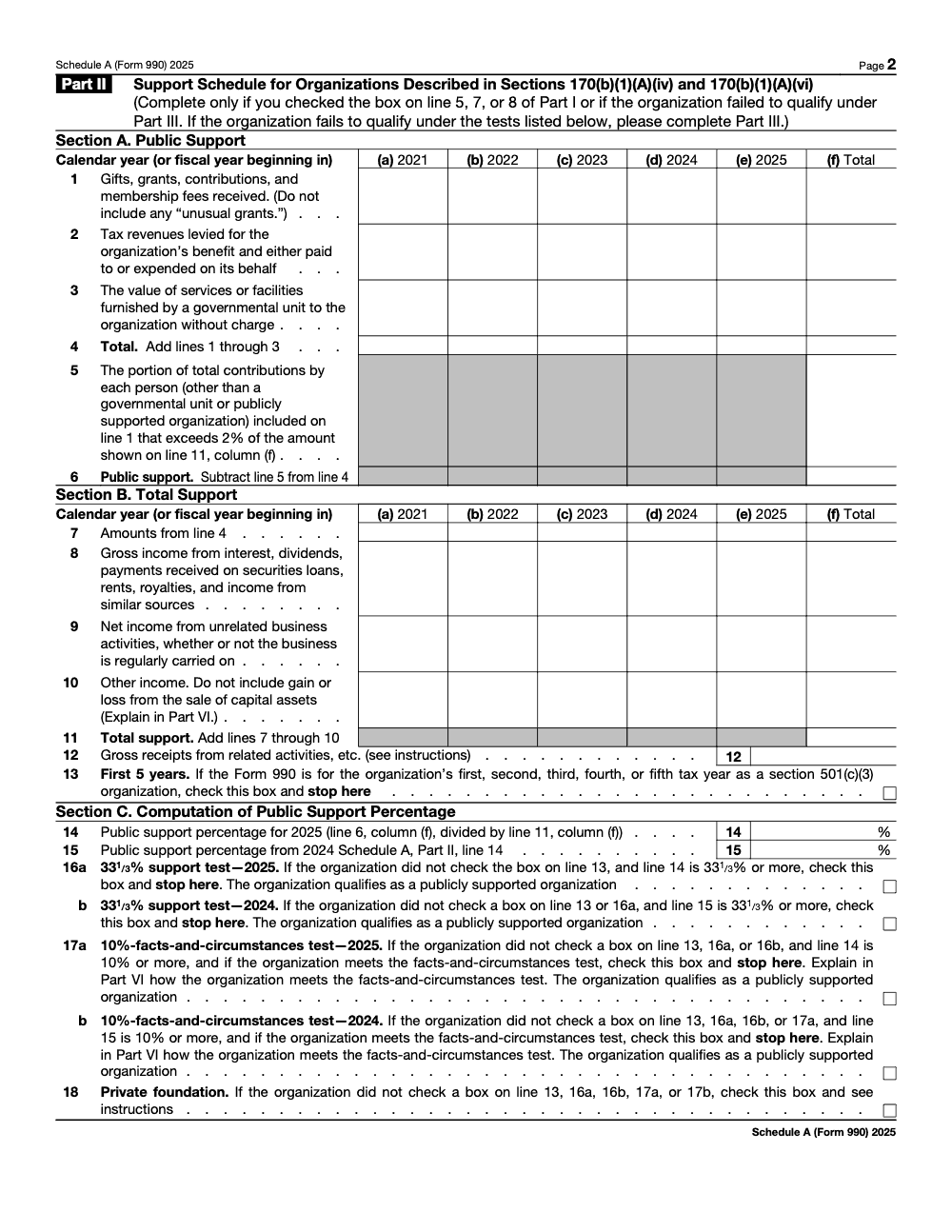
Part II, the 170(b)(1)(A)(vi) public support test
Use Part II if you checked line 5, 7, or 8 in Part I. Public support here consists of gifts, grants, contributions, and contribution‑type membership fees. Program service revenue is not included in public support for this test. You measure a rolling five‑year period, current year plus the four prior years.
The thresholds you must meet
- You qualify if public support is at least 33 1/3 percent of total support.
- If you are between 10 percent and 33 1/3 percent, you can still qualify under the facts‑and‑circumstances alternative, with a clear explanation in Part VI.
The 2 percent rule, who counts and who does not
Large donors are limited. For each donor subject to the limitation, you include only up to 2 percent of total support in the numerator, you still include the full amount in total support. Governmental units and publicly supported charities are not subject to the 2 percent cap, unless the grant is earmarked as a pass‑through. Keep the donor list in your records, but do not disclose names on the public return.
Mini example, applying the 2 percent cap
Assume your total support over five years is 600,000, so the 2 percent limit is 12,000. A single corporation gave 30,000 over the period. For public support, you include 12,000 from that donor and treat 18,000 as excess that stays in total support only. A 50,000 state grant remains fully in public support because government funding is not subject to the cap. Document these adjustments in Part VI without naming donors.
Common Part II mistakes to avoid
- Leaving Part II blank when you had support in the period.
- Forgetting to remove unusual grants from the numerator.
- Mixing cash and accrual between the core return and Schedule A.
- Missing the required Part VI facts‑and‑circumstances narrative when you rely on the 10 percent alternative.
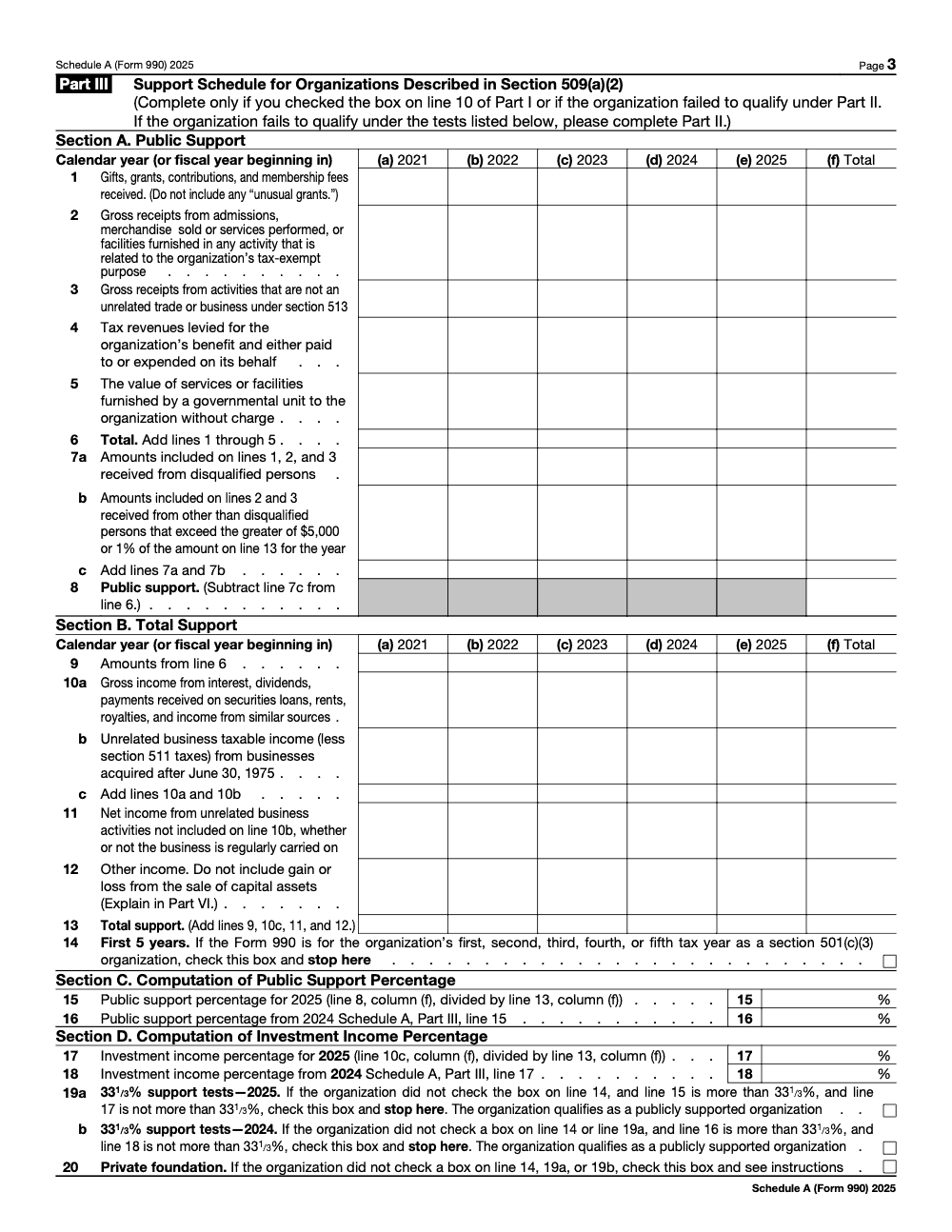
Part III, the 509(a)(2) public support test
Use Part III if you checked line 10 in Part I. This version includes gifts, grants, contributions, membership fees that support the organization, and gross receipts from related activities. It adds a second guardrail, no more than 33 1/3 percent of support may come from gross investment income and net unrelated business income from businesses acquired after June 30, 1975. The measurement period is the same five years.
When 509(a)(2) is the better fit
Organizations with meaningful related program receipts, for example small museums, performing arts groups, or community centers that sell tickets, often pass 509(a)(2) more easily than 170(b)(1)(A)(vi). If you cannot meet Part II, you should compute Part III before assuming private foundation status.
Guardrail on investment income
Track investment income carefully. If gross investment income and net UBI comprise more than one third of total support, you will fail 509(a)(2) even if your public support percentage clears 33 1/3 percent.
Pro tip, during volatile markets, review your five‑year averages midyear so you can course‑correct, for example by broadening small‑donor campaigns sooner rather than later.
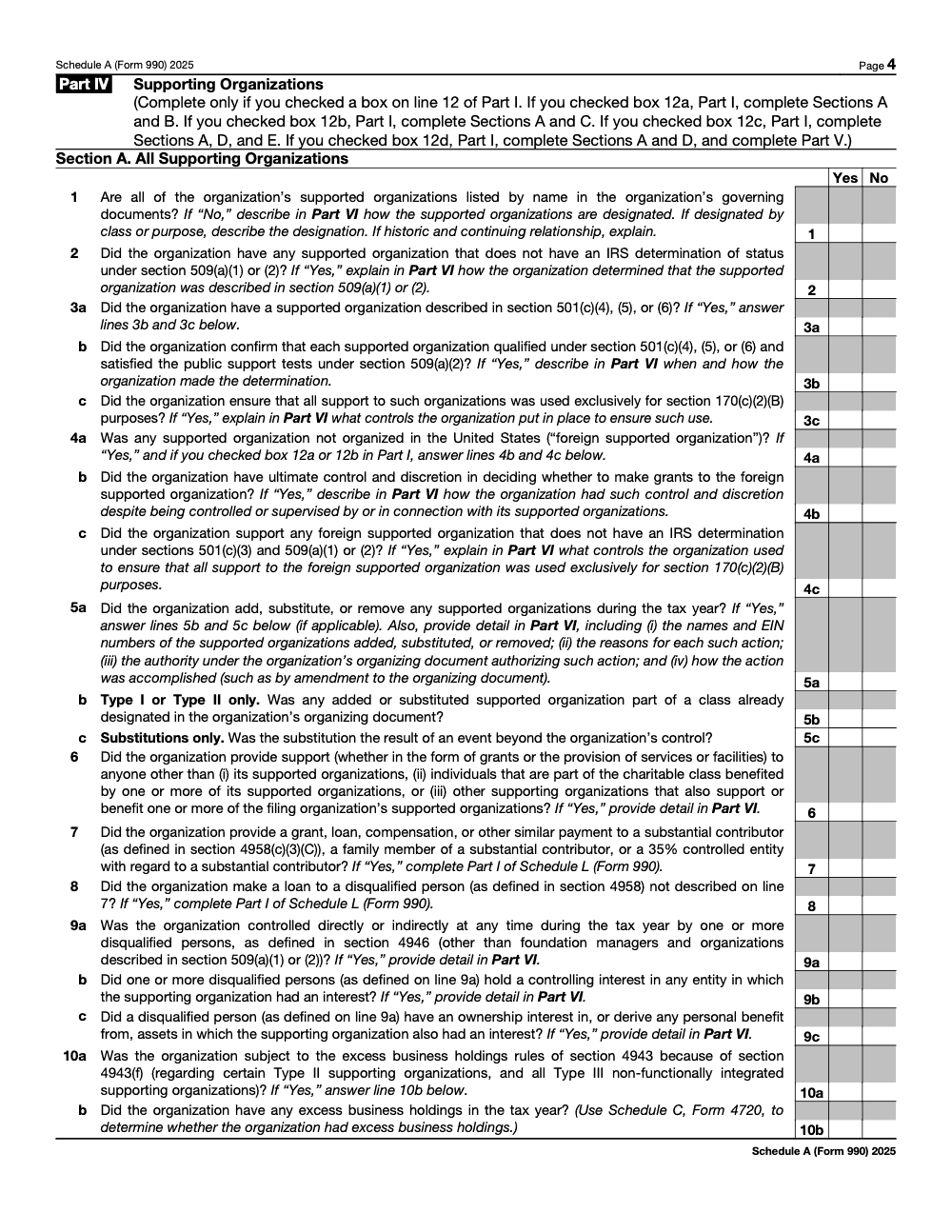
Part IV, supporting organizations done right
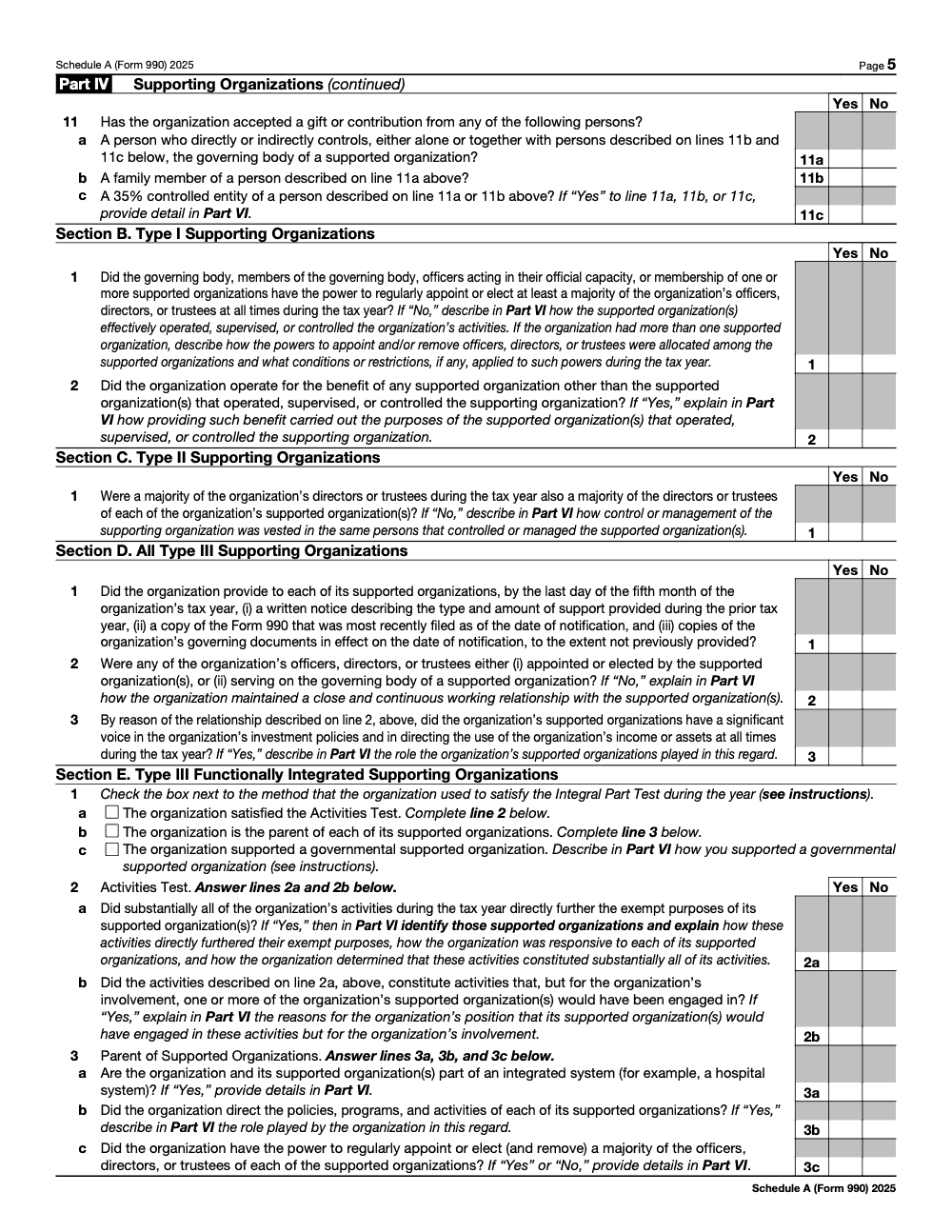
If you checked box 12 in Part I, you are a supporting organization and Part IV is mandatory. This section confirms who you support, how you are connected, and whether you meet the responsiveness and control standards. You will disclose whether your supported organizations are publicly supported, whether officers or directors overlap, how you make grants, and whether any donor or manager can control your decisions.
Know your type before you answer
- Type I, you are operated, supervised, or controlled by your supported organization, think parent‑subsidiary style.
- Type II, you are supervised or controlled in common with your supported organization, think siblings under a common board where a majority of your directors or trustees are also a majority of each supported organization’s directors or trustees, not just a few shared seats.
- Type III, you are operated in connection with your supported organization. Type III splits into functionally integrated and non‑functionally integrated, and only the latter completes Part V.
Get the type right, then the rest of Part IV flows. Your answers will point the IRS to the correct standards, responsiveness, integral part, and attentiveness.
The essentials you will need on hand
- The exact names and EINs of each supported organization.
- Board composition, overlap details, and any appointment powers.
- Written agreements that show how you support them and how they can influence you, for example, a right to approve budgets or plans.
- Documentation that the supported organizations are publicly supported and not controlled by disqualified persons.
Red flags to clear up in Part IV
- A single donor can effectively control both entities, disclose facts and show safeguards.
- The supported organization rarely communicates with you, address responsiveness with minutes, approvals, and reporting cadence.
- Grants appear unrelated to the supported organization’s exempt purposes, include clear descriptions that tie spending to their mission.
Treat Part IV as governance transparency. When your relationships are clear on paper, passing the tests is far easier.
Part V, Type III non‑functionally integrated payout math, without the headache
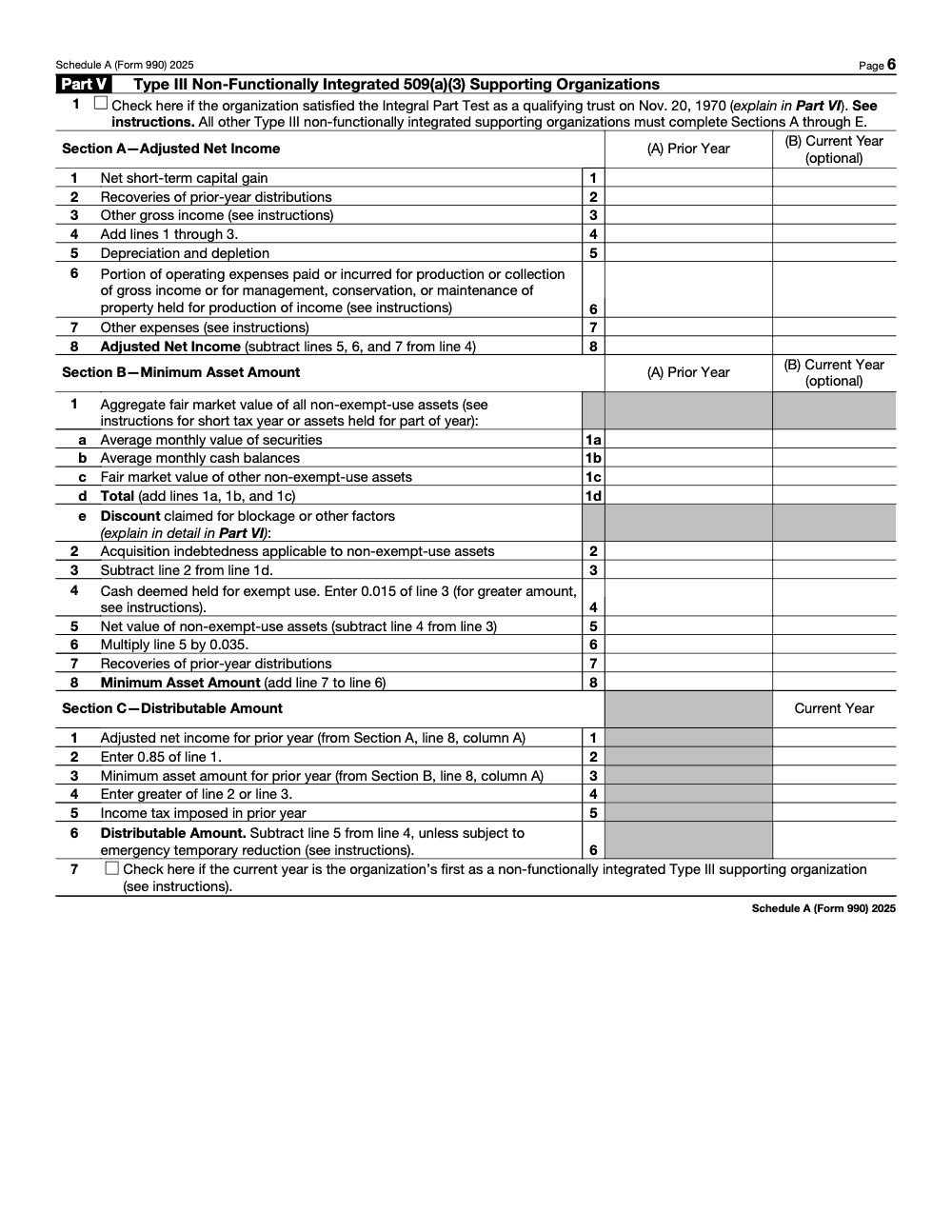
Type III non‑functionally integrated supporting organizations have a distribution requirement every year, and they must also satisfy a separate attentiveness requirement, so making distributions alone is not enough. Your distributable amount is the greater of two numbers, 85 percent of adjusted net income or 3.5 percent of the average fair market value of non‑exempt‑use assets. Then you compare what you were required to distribute to what you actually distributed for the supported organization’s use. If you fell short, you track carryovers and fix the gap in time.
Step‑by‑step worksheet you can follow
- Identify non‑exempt‑use assets. Exclude assets used directly in your exempt activities.
- Compute the 3‑year average fair market value of those non‑exempt‑use assets.
- Multiply by 3.5 percent to get the minimum‑asset‑amount base.
- Compute adjusted net income, start with net income and apply the specific inclusions and exclusions in the instructions.
- Your distributable amount is the greater of 85 percent of adjusted net income or the 3.5 percent figure.
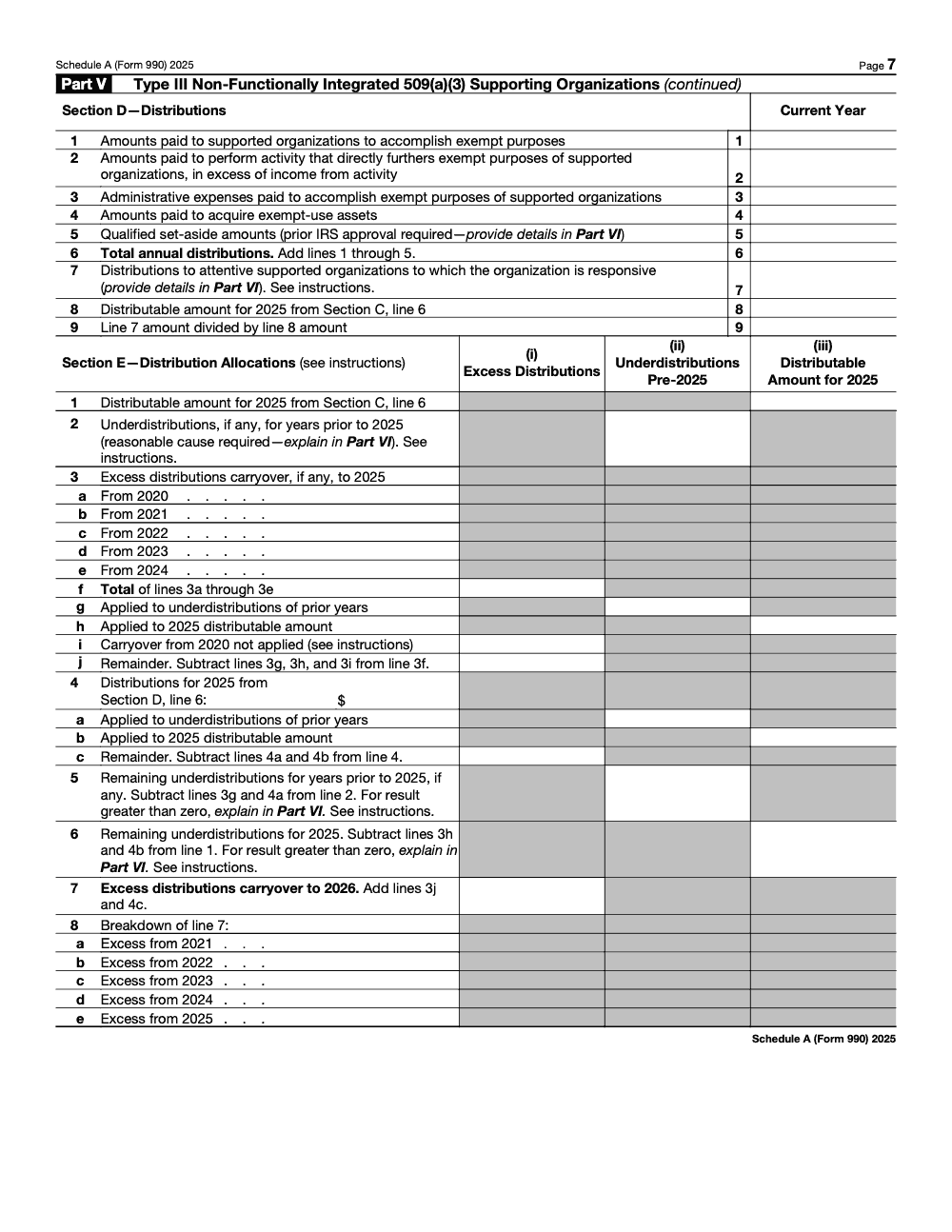
- List qualifying distributions paid during the year to supported organizations.
- Reconcile carryovers, prior shortfalls, and timing differences.
Part V distributions are reported on a cash basis. Follow that rule even if the rest of the return is accrual.
Small numeric example
- Non‑exempt‑use assets, 3‑year average FMV, 4,000,000.
- 3.5 percent of assets, 140,000.
- Adjusted net income, 120,000. Eighty‑five percent is 102,000.
- Distributable amount is the greater figure, 140,000.
- You granted 150,000 for the supported organization’s use, you met the requirement and have a 10,000 excess that may carry forward for up to 5 years, after which any unused carryover expires.
Common traps in Part V
- Including program‑use property in non‑exempt‑use assets, keep it out.
- Valuing investment assets at cost rather than fair market value for the average, use FMV.
- Treating pledges as paid distributions, remember, Part V uses cash.
- Forgetting to compute and disclose carryovers, keep a simple schedule so you do not lose credit.
Part VI, the narrative that saves you from guesswork
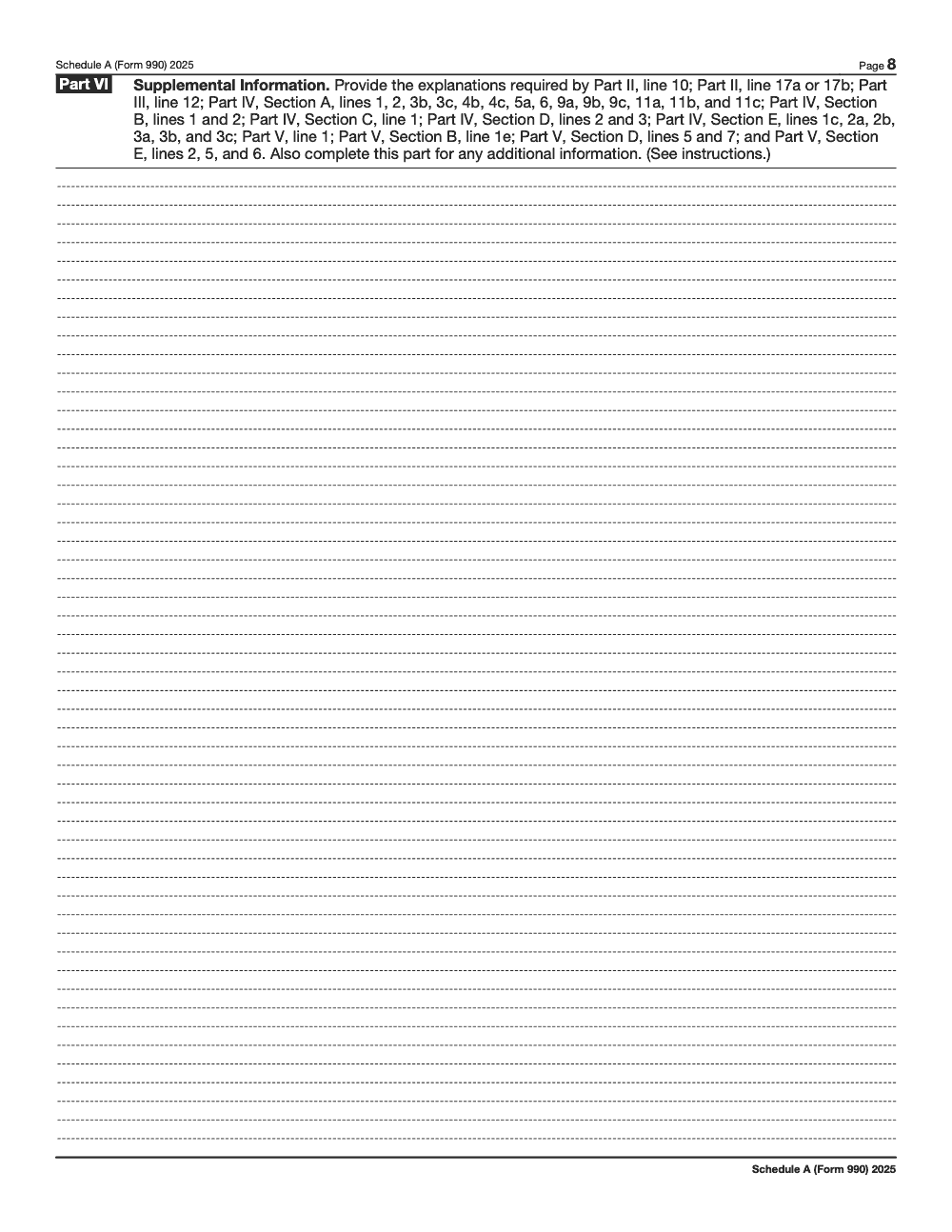
Part VI is where you give short explanations that make the numbers work for a reader. Use it to explain your 2 percent donor adjustments, unusual grants, method changes, facts‑and‑circumstances reliance under the 10 percent rule, and any reconciling items that affect Parts II through V. Keep names and personal details out of the public return. Reference lines, totals, and years so anyone can follow the math.
A clean example you can adapt
- “Part II, line 7, public support includes 12,000, the 2 percent limit, from a single donor whose aggregate contributions were 30,000 during the 5‑year period. The remaining 18,000 is included only in total support.”
- “We changed from cash to accrual in 2025. Schedule A figures are on accrual to match Form 990, Part XII. Prior years in the five‑year column were restated on an accrual basis for comparability.”
- “We rely on the facts‑and‑circumstances alternative. Our public support percentage is 18 percent, we have a broad base of recurring donors and robust community programs. See attached counts of donors and events, available upon request.”
Reviewer checklist for Part VI
- Tie every note to a specific line and year.
- Use totals, not donor names.
- Keep explanations concise and readable.
- Cross‑reference Form 990, Part XII and Schedule O if you changed methods.
Practical workflows that keep Schedule A clean
You will file faster and with fewer questions if you treat public support like a standing close process.
- Build a five‑year rolling worksheet with columns for public support, total support, 2 percent limits, and investment income.
- Tag each receipt in your ledger as contribution, program service, investment income, or other.
- Log all large funders that could trip the 2 percent cap, compute the cap once per year, and push the excess to a separate column.
- For Type III non‑functionally integrated filers, keep a separate Part V workbook that tracks non‑exempt‑use assets at fair value, adjusted net income, cash distributions, and carryovers.
- Draft your Part VI notes as you go, not at the deadline.
Quick table, who belongs in which test
| Situation | Likely test to start with | Why it often fits |
| Broad donor base, grants from government and public charities | Part II, 170(b)(1)(A)(vi) | Gifts and grants dominate, 2 percent cap manageable |
| Ticket sales, program fees, modest donations | Part III, 509(a)(2) | Related receipts count in support and there is an investment income guardrail |
| You exist to support one or more named public charities | Part IV, then Part V if Type III non‑FI | Relationship questions decide your status and payout rules |
Where disciplined delivery helps
If your team is buried in peak season or you struggle with clean workpapers and review loops, a structured delivery system prevents rework. This is where a partner like Accountably can help, especially when you need standardized support schedules, clear 2 percent calculations, and a predictable review path. Our teams work in your systems with SOPs, layered reviews, and named SLAs, so Schedule A math and narratives are consistent and ready for partner sign‑off. Use help where it reduces review time and protects your status, and keep ownership of the choices and disclosures.
Closing thoughts and next steps
You now have a straightforward map. Pick the right box in Part I, run the five‑year math in the correct section, keep your method consistent, and use Part VI to explain anything that would make a reviewer pause. Add a light midyear check so you can course‑correct before the deadline. If you operate as a supporting organization, maintain your governance records and, if you are Type III non‑functionally integrated, track the payout workbook monthly.
Your public charity status is not guesswork. With a clean worksheet and a short narrative, you will file on time, meet the tests, and get back to your mission.
Note, tax rules change. Always review the current year’s IRS instructions before you file, and document any method changes or unusual items in Schedule O and Part VI.
Common Mistakes We See Every Season
Most Schedule A problems are not math errors, they are status and disclosure errors that surface only when a reviewer or the IRS pushes back. Here are the ones my team flags every season.
Reusable Checklists
These are copy-paste ready for your firm SOP. Drop them into your nonprofit engagement file and check items off as you build the schedule.
Public charity status pre-file
- Confirm the filer is a section 501(c)(3) organization or a 4947(a)(1) nonexempt charitable trust filing Form 990 or 990-EZ, not a private foundation on 990-PF.
- Verify the effective date; if you are inside the first five tax years, check the First 5 Years box and stop the support math.
- Select one Part I box (lines 1 through 12) that matches this year's facts, not just the original determination letter.
- Match the accounting method to Form 990, Part XII, line 1, or 990-EZ, line G.
- Confirm Schedule A is attached before transmitting, since a missing attachment can delay processing or trigger reclassification.
Five-year public support test
- Build a rolling five-year worksheet: the current year plus the four prior years.
- Tag each receipt as contribution, program service, investment income, or other.
- Apply the 2 percent donor cap in Part II, or, in Part III, exclude all amounts from disqualified persons and cap amounts from other donors that exceed the greater of $5,000 or 1 percent of total support.
- Remove unusual grants from the numerator on line 1.
- Confirm public support is at least 33 1/3 percent, or document the 10 percent facts-and-circumstances narrative in Part VI.
- For 509(a)(2), confirm gross investment income plus post-June 30, 1975 UBTI is not more than 33 1/3 percent of total support.
Type III non-functionally integrated payout
- Identify and exclude exempt-use assets, then value the remaining non-exempt-use assets at fair market value.
- Compute the distributable amount as the greater of 85 percent of prior-year adjusted net income or the prior-year minimum asset amount (3.5 percent of net non-exempt-use assets).
- Report Part V distributions on the cash basis, even when the core return is on accrual.
- Track the excess distribution carryover across the five prior years, 2020 through 2024 for a 2025 return.
- Send the annual notice to each supported organization by the last day of the fifth month.
Keep Schedule A (Form 990) Season From Stalling
Schedule A does not move on its own schedule, it moves with Form 990, which is due the 15th day of the 5th month after year end, or May 15 for calendar-year filers (per the 2025 Schedule A instructions). The work that stalls is rarely the core return, it is the five-year support worksheet, the 2 percent donor caps, and the Part VI narrative that all have to reconcile before a partner will sign.
The fix is to treat public support like a standing close process rather than a May scramble. When the support schedule, the caps, and the supporting-organization parts are built and reviewed on a predictable cadence, the filing stops being a bottleneck and the review path gets shorter.
- Maintain a rolling five-year support worksheet so the current year drops in without rebuilding the prior four columns.
- Calculate the 2 percent cap in Part II, or the greater of $5,000 or 1 percent cap in Part III, once a year and park the excess in a separate column.
- Keep a Part V workbook for Type III non-functionally integrated filers: non-exempt-use assets at fair value, the distributable amount, cash distributions, and the five-year carryover.
- Draft Part VI explanations as adjustments happen, not at the deadline, and tie each note to a line and year.
- Run a pre-transmission check that Schedule A is attached and its accounting method matches Form 990, Part XII.
That cadence is exactly what a structured delivery partner protects. Accountably's tax preparation and review teams work inside your systems with documented SOPs, layered review, and named turnaround windows, so the support math and narratives stay consistent and ready for partner sign-off, season after season.
FAQs
It is the schedule that proves you are a public charity. You pick your public charity category in Part I, then complete the math, disclosures, and, if applicable, supporting‑organization questions that match that category. If you cannot qualify, you are treated as a private foundation for the year and should file Form 990‑PF.
“Disqualified person” is a defined term used for certain excise tax rules. You do not list names on Schedule A. For public support, your focus is on large donors and the 2 percent limitation in Part II, plus the investment income limit in Part III. Keep donor identities in your internal records, not on the public filing.
Part VII, Section A is the compensation table for officers, directors, trustees, and key employees. It is separate from Schedule A. Schedule A deals with public charity status and support tests, not compensation details.
Yes. If you are a 501(c)(3) that files Form 990‑EZ, you must attach Schedule A. Your Part I selection still drives which parts of Schedule A you complete, and you must match the accounting method to the core form.
First, check whether you qualify for the 10 percent facts‑and‑circumstances alternative in Part II, or whether Part III gives you a pass as a 509(a)(2). If neither works, you are a private foundation for the year, and Form 990‑PF applies. Consider how to broaden public support in the next period.
Other forms this guide names
- Form 990: Nonprofit Tax Return Filing Guide 2025
- Form 990‑EZ: Eligibility, Deadlines, E‑File, Schedules
- Form 990‑PF: Filing Guide, Payout, E‑File
Summarize this article with AI
About this guide
Accountably helps US CPA, EA, and accounting firms hire trained accountants and tax preparers in India.
About us Reviewed byJugal Thacker, CPAFounder and CEO at Accountably
A Washington-licensed CPA with 7+ years inside US firms – PwC, a real-estate tax practice, then a full-service firm, rising from reviewer to manager to advisory. This article was reviewed against current IRS guidance for the 2025 tax year and updated for filers preparing late returns, amendments, and 2026 estimates.
View profile →How we research, review, and update this guide
Every Accountably guide is researched against primary IRS sources, reviewed by a U.S. CPA, and refreshed as guidance evolves. Read our Editorial Guidelines to see how we source, fact-check, and update our content.