Summarize this article with AI
In Brief
Schedule C (Form 990) reports political campaign activity, lobbying, and proxy tax for exempt organizations that answered Yes on Form 990 Part IV (lines 3, 4, or 5), according to the 2025 Schedule C instructions. 501(c)(3) organizations that elected 501(h) on Form 5768 test lobbying against limits that scale from 20% of exempt purpose expenditures up to a $1,000,000 cap, with grassroots lobbying capped at 25% of that amount, while 501(c)(4), (5), and (6) filers use Part III to clear the 90% nondeductible-dues and $2,000 in-house lobbying gates before computing proxy tax (per IRS Publication 557).
Schedule C trips up exempt organizations because the rules change with the subsection, not just the activity. A 501(c)(3) that elected 501(h) on Form 5768 tests its lobbying against a nontaxable amount that starts at 20% of exempt purpose expenditures and scales up to a $1,000,000 cap, with grassroots lobbying capped at 25% of that figure. Cross the line and a 25% section 4911 tax follows on the excess.
Different filers face different gates. A 501(c)(4), (5), or (6) uses Part III to clear the 90% nondeductible-dues test and the $2,000 in-house lobbying threshold before any proxy tax is computed. The schedule is triggered by a Yes on Form 990 Part IV, line 3 for political campaign activity, line 4 for lobbying, or line 5 for proxy tax, and it is open to public inspection, so the narrative in Part IV carries real weight.
Key Takeaways
- Schedule C (Form 990) reports political campaign activity, lobbying, and proxy tax for exempt organizations. It is triggered by a “Yes” on Form 990, Part IV, line 3 (political campaign), line 4 (lobbying), or line 5 (proxy tax).
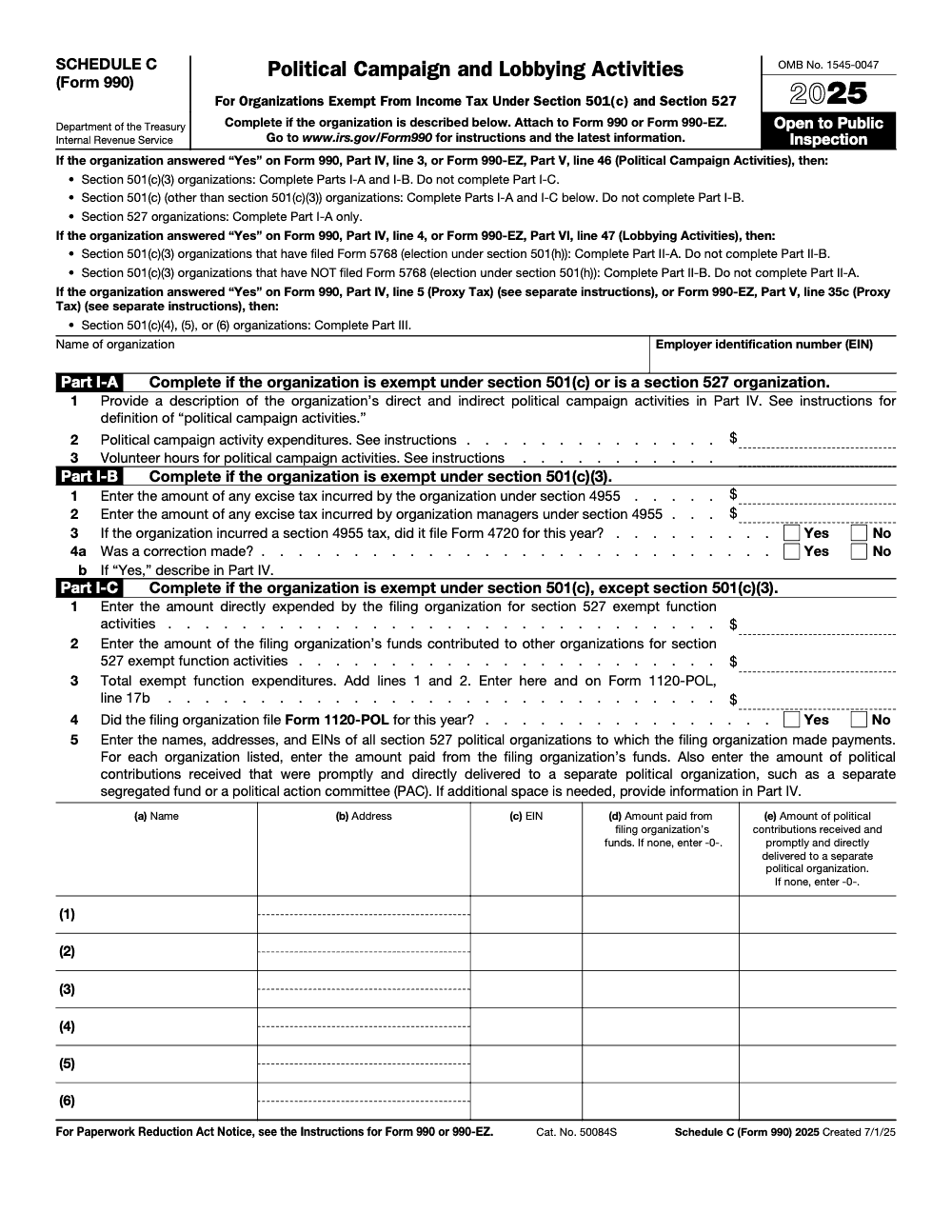
- 501(c)(3) organizations use Part I-A and I-B for political campaign activity and Part II for lobbying, completing Part II-A if they elected 501(h) on Form 5768, otherwise Part II-B.
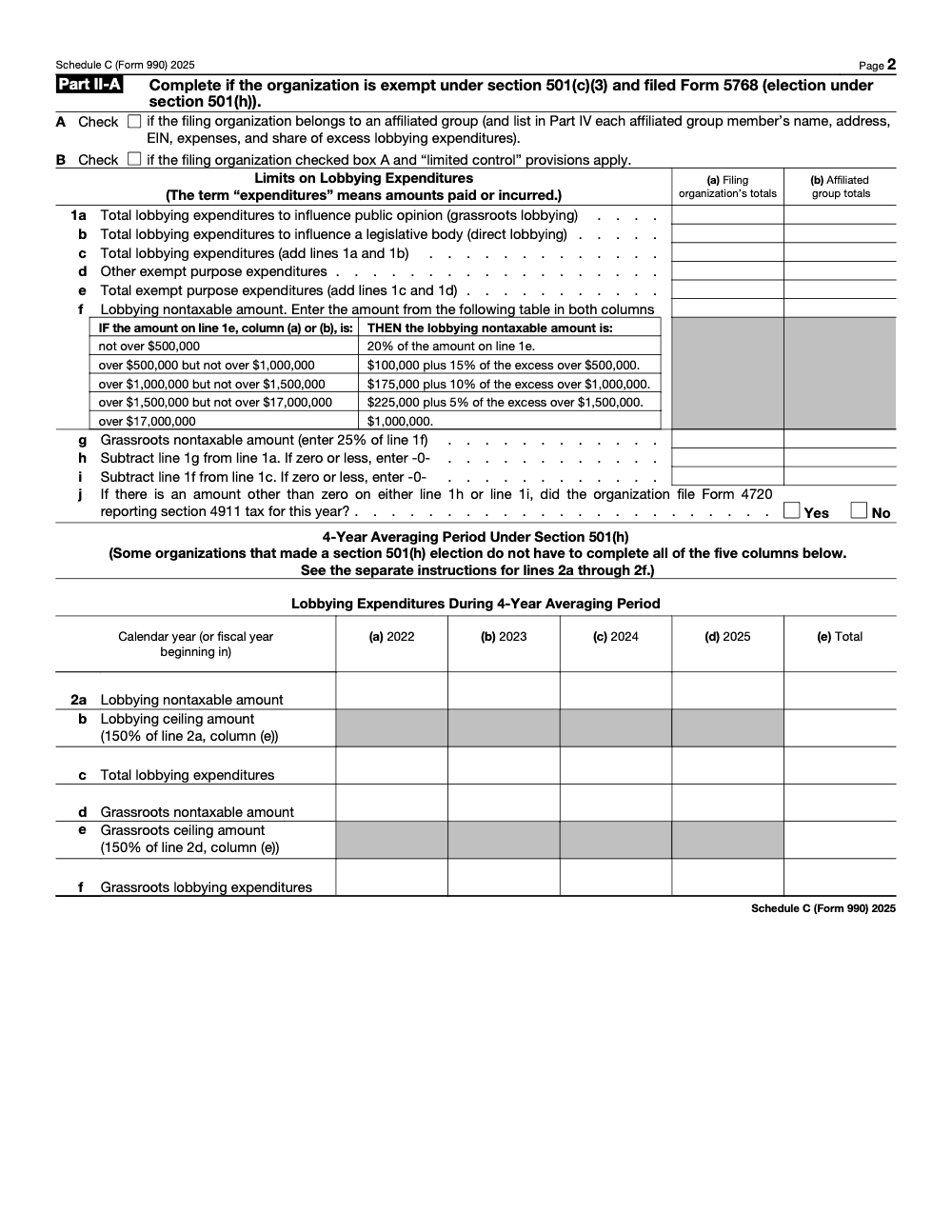
- Under the 501(h) election, the lobbying nontaxable amount starts at 20% of exempt purpose expenditures and scales up to a $1,000,000 cap; the grassroots nontaxable amount is 25% of that figure, and the lobbying ceiling is 150% of the 4-year total.
- Political expenditures by a 501(c)(3) can trigger a section 4955 excise tax (10% initial, escalating to 100% if not corrected), and excess lobbying by a 501(h) electing organization carries a 25% section 4911 tax; these excise taxes are reported on Form 4720.
- Part I-C line 3 totals the organization’s section 527 exempt-function expenditures and flows to Form 1120-POL, line 17b.
- 501(c)(4), (5), and (6) filers use Part III to clear the 90% nondeductible-dues test and the $2,000 in-house lobbying gate before computing proxy tax. Schedule C is open to public inspection.
Who must file Schedule C, and which parts apply
If you file Form 990 or 990‑EZ and you engaged in political campaign or lobbying activity during the year, you typically must attach Schedule C. The routing is straightforward once you map it to your exemption type.
- 501(c)(3) organizations complete Part I‑A and I‑B for any political campaign activity and Part II for lobbying, using II‑A if you elected 501(h) with Form 5768, otherwise II‑B.
- Other 501(c) organizations complete Part I‑A and I‑C when they had political campaign expenditures or made payments to section 527 organizations.
- Section 527 political organizations that file Form 990 or 990‑EZ complete Part I‑A only.
- 501(c)(4), (c)(5), and (c)(6) organizations complete Part III when member dues fund lobbying or political activity and you must either send nondeductible dues notices or compute proxy tax.
Plain cue, if you supported or opposed candidates, you are in Part I. If you tried to influence legislation as a 501(c)(3), you are in Part II. If you collect dues and advocate as a 501(c)(4)/(5)/(6), test Part III.
Part I overview, political campaign activities
Part I captures campaign activity that supports or opposes candidates for public office. It is split into three subparts so the IRS can apply the right rules based on your exemption.
Who completes what in Part I
- 501(c)(3): complete Part I‑A and I‑B, do not complete I‑C.
- Other 501(c): complete Part I‑A and I‑C, do not complete I‑B.
- Section 527: complete Part I‑A only.
What to report in Part I‑A
Part I‑A is the universal section. You report the total spent on political campaign activities, estimate volunteer hours devoted to those activities, and give a short description of what you did. Keep the description focused here. Then use Part IV to expand with the who, what, when, where, amounts, and hours.
- Aggregate political campaign expenditures for the year.
- Estimated volunteer hours tied to campaign efforts.
- Whether expenditures aimed to influence federal, state, or local elections.
- A concise description, with the full narrative reserved for Part IV.
Practical examples
- 501(c)(3) example, your charity made a one‑time payment that benefited a candidate. You complete I‑A and I‑B, report any Section 4955 tax on Form 4720, and describe corrective actions in Part IV.
- 501(c)(6) example, your trade association paid a 527 organization and ran a candidate forum. You complete I‑A, then I‑C to list each recipient 527 with name, address, EIN, and amount, and you expand with purposes in Part IV.
- 527 filer example, you only complete I‑A, reporting your total campaign expenditures and volunteer hours, then you use Part IV for detail if space is tight.
Data to gather before you start Schedule C
- Your Form 990 or 990‑EZ checklist and any “Yes” responses related to campaign or lobbying.
- General ledger exports for political campaign, lobbying, and dues, clearly tagged for easy roll‑up.
- Volunteer hour logs tied to campaign activities, and for nonelecting 501(c)(3)s, logs that inform lobbying narratives.
- Payment support for any section 527 recipients, including names, addresses, and EINs.
- Draft narratives that tie each activity to a specific line, with dates, amounts, and hours.
- For 501(c)(4)/(5)/(6), dues totals by member class, nondeductible notice language, and any prior year carryovers.
Pro tip, create a year‑labeled folder with four subfolders, “Part I,” “Part II,” “Part III,” and “Part IV.” Place workpapers, screenshots, and approvals behind the exact line they support. Reviewers fly through returns when support mirrors the form.
Part I‑A, reporting for 501(c) and 527 organizations
Think of Part I‑A as your one‑page summary of campaign activity. You enter total spending and estimated volunteer hours, answer whether expenses were meant to influence federal, state, or local elections, and include a short description of activities. The description is not the place for long stories. Use Part IV to tell the full story, then cross‑reference back to the exact line in I‑A.
How to write the short description
- Lead with the activity, then name the office, and include the date range.
- Keep it factual, avoid advocacy language.
- Leave all names of candidates, event locations, and totals for Part IV unless space allows.
Example, “Hosted two candidate forums for City Council District 3, October 14 to November 2, print and venue costs incurred.”
Part I‑B for 501(c)(3), political expenditures and Section 4955
A single political expenditure can trigger Part I‑B, because a 501(c)(3) faces an absolute prohibition on campaign intervention rather than a dollar limit, so even one such expenditure can put exempt status at risk on top of the Section 4955 excise tax. Section 4955 defines political expenditures broadly. It includes payments, gifts, loans, advances, deposits, or anything of value used to support or oppose a candidate. If you are here, you likely also file Form 4720 to report the excise tax and you describe corrective actions that prevent recurrence.
What to enter in I‑B
- Whether a taxable political expenditure occurred.
- The excise tax amount, as reported on Form 4720.
- Whether the organization or its managers paid the tax.
- Corrective actions, for example reimbursement, discipline, or policy changes, expanded in Part IV.
Common traps to avoid
- Treating in‑kind support as “free.” Design, printing, staff time, and donated facilities can be political expenditures when used for a candidate. Track and report the value.
- Forgetting manager liability when a manager knowingly approves a 4955 expenditure that is not corrected.
- Leaving Part IV blank. If I‑B is checked, Part IV must tell the story with dates, amounts, people involved, actions taken, and references to Form 4720.
Recovery matters. If the organization can recover the amount from a person who approved the expenditure, document that action and show where the funds were returned. Recovery alone is not a complete correction, though. You also have to establish safeguards, such as policy changes, board resolutions, or training, to prevent future political expenditures, or the second-tier 100 percent Section 4955 tax can still apply.
Quick refresher on Form 4720
Form 4720 is used to report and pay the Section 4955 excise tax on political expenditures. For 501(h) electors, it is also used to pay the Section 4911 tax if lobbying exceeds limits. Keep a copy of the filed Form 4720 with your Schedule C workpapers and cite the filing date in your Part IV narrative. This way a reviewer can connect the dots in one sitting.
Part I‑C for non‑(c)(3) filers, payments to section 527 organizations
If you are a 501(c) that is not a 501(c)(3), Part I‑C is where you disclose section 527 “exempt function” payments. You report total exempt function spending and indicate whether dollars were direct or indirect, then you list each section 527 recipient with its name, address, EIN, and amount. If you need more space, continue in Part IV.
Documentation checklist for I‑C
- Payment support that shows purpose, approval, and the general ledger link.
- Verification of each recipient’s name, address, and EIN, preferably from the organization’s official filing.
- Copies of any Form 1120‑POL you filed, if your spending triggered taxable political expenditures.
Small errors in names and EINs create matching issues. Use a template and a second reviewer to catch typos before e‑filing.
Part II for 501(c)(3) lobbying, choose 501(h) or the substantial part path
Part II starts with a fork. If you elected 501(h) by filing Form 5768, you complete Part II‑A, which measures actual lobbying dollars against clear limits. If you did not elect, you complete Part II‑B and explain your lobbying under the substantial part test with narrative and hours.
Why many charities prefer the 501(h) election
Boards like clarity, and 501(h) gives it. Your lobbying limit scales with your exempt purpose expenditures, and there is a separate grassroots cap at 25 percent of your overall lobbying limit. If you exceed either limit, you pay a 25 percent excise tax on the excess using Form 4720. Keep in mind that this excise tax is what an annual overage triggers, while loss of 501(c)(3) status happens only if lobbying or grassroots spending normally exceeds 150 percent of the nontaxable amount averaged over the 4-year period. The election remains in effect until revoked, so you do not refile it every year, but Form 5768 must be signed and postmarked within the first tax year to which it applies, and a revocation must be signed and postmarked before the first day of the tax year it covers.
The 501(h) limits at a glance
| Exempt purpose expenditures | Nontaxable lobbying amount |
| Up to 500,000 | 20% of EPE |
| Over 500,000 to 1,000,000 | 100,000 plus 15% of EPE over 500,000 |
| Over 1,000,000 to 1,500,000 | 175,000 plus 10% of EPE over 1,000,000 |
| Over 1,500,000 | 225,000 plus 5% of EPE over 1,500,000, not to exceed 1,000,000 total |
Grassroots limit equals 25% of the nontaxable lobbying amount.
What to enter in Part II‑A
- Lines 1a and 1b separate grassroots and direct lobbying. Line 1c totals them.
- Lines 1d and 1e calculate exempt purpose expenditures, and line 1f sets your lobbying nontaxable amount.
- If you are part of an affiliated group that shares the test, compute group totals, allocate the limit to each electing member, and list affiliates in Part IV. If the group exceeds the limit, each electing member files Form 4720 for its share, and if the group normally exceeds the 150 percent ceiling over the averaging period, every member for which the election is effective loses 501(c)(3) status, not just the electing member that tipped the total.
If you did not elect 501(h), Part II‑B
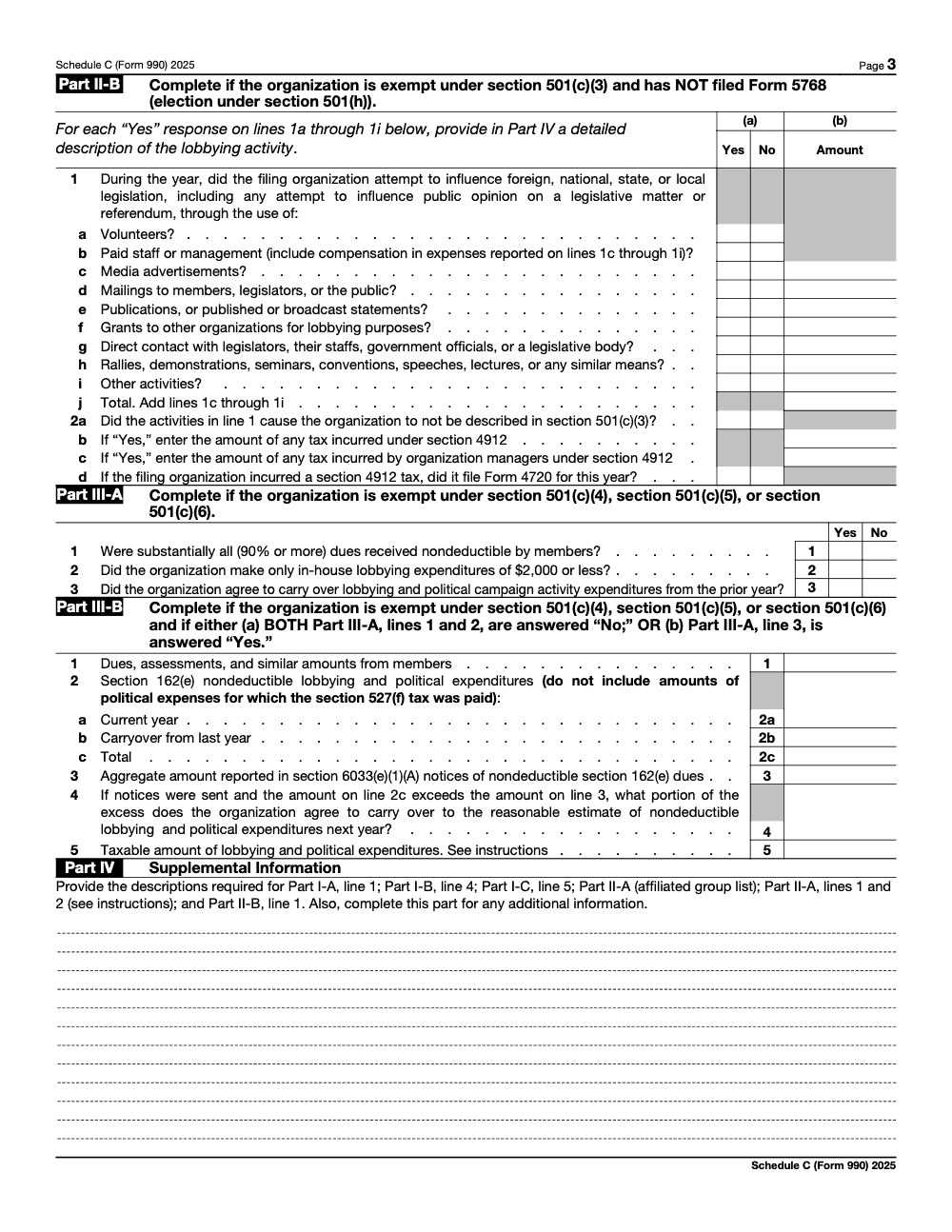
Part II‑B asks qualitative questions, then collects dollars, hours, and volunteer time. The IRS looks at whether lobbying was a substantial part of your overall activities. Be specific about methods used, for example meetings with legislators, grassroots calls to action, publications, or grants that include lobbying.
Tip, if your lobbying budget is growing and you want predictability, file Form 5768 and move to the 501(h) expenditure test next year. Many organizations find the math‑based approach easier to govern and review.
Tracking and allocation that hold up in review
Lobbying and campaign activity often involve shared costs. Get your allocations and records right the first time, then use the same logic every year.
- Track staff time on lobbying projects in your time system, including prep, meetings, travel, design, printing, and media.
- Split direct and grassroots lobbying consistently. Direct lobbying is communication with legislators or their staff about specific legislation. Grassroots lobbying is asking the public to contact legislators about specific legislation.
- Document your cost allocation methods for shared overhead, for example rent and software, and keep a workpaper that explains the formula. Reference it in Part IV.
- Tie every dollar in Part I and Part II to the general ledger and bank activity. Reviewers should be able to vouch the totals in minutes.
Part III, Section 6033(e) notices and proxy tax for 501(c)(4)/(5)/(6)
Part III tests whether your dues funded lobbying or political activity and whether you handled those costs through member notices or proxy tax. You start with Part III‑A’s gates. If you fail the gates, you complete Part III‑B to compute nondeductible dues and possible proxy tax. Watch the carryover question too, a Yes answer to the prior-year carryover line in Part III‑A also pulls you into Part III‑B even when both dues gates are otherwise met.
The two gates
- The 90 percent nondeductible dues exception. If substantially all (90% or more) of the dues you received are nondeductible by members, you may be excepted from the notice and proxy rules. Keep records that show how you reached this conclusion.
- The $2,000 in‑house lobbying threshold. If in‑house lobbying is $2,000 or less for the year, you can meet an exception. Remember this $2,000 ceiling counts only in‑house lobbying; any lobbying you pay an outside firm to perform disqualifies the exception no matter how small the dollar amount. Test this annually and keep the math in your binder.
How Part III‑B flows
- Line 1, total dues, assessments, and similar amounts.
- Line 2, current year lobbying and political costs plus any carryovers.
- Line 3, nondeductible portion you actually notified to members.
- Line 5, the amount subject to proxy tax after notices and carryovers. If tax is due, report it on Form 990‑T and arrange payment. One offset to remember, the proxy tax does not apply to any amount on which section 527(f) tax was already paid on Form 1120‑POL.
Governance practices that reduce questions
- Send clear dues notices that state the nondeductible portion related to lobbying or political activity.
- Keep annual workpapers that show your calculation, including carryovers when lobbying costs exceed dues.
- Reconcile dues revenue in your financials to Part III amounts, then have a second reviewer sign off.
Think ahead. If you routinely fail the gates, decide whether to budget for proxy tax or to move to consistent notices with improved allocation records next year.
Part IV, your narrative superpower
Part IV ties everything together. Use it whenever a line asks for an explanation, when space runs out, or when a reviewer would benefit from context.
- Label each entry with the exact part, line, and column.
- Use dates, amounts, hours, names, and EINs.
- Distinguish direct and grassroots lobbying, identify payers, and describe methods.
- For Part I‑B, document 4955 corrective actions and any Form 4720 filing.
- For Part I‑C, list each section 527 recipient and the purpose of each payment.
- For Part II‑A affiliated groups, list members and allocation methods.
Example entry, “Part I‑A, line 1, description, District 3 forum, Oct 14 to Nov 2, volunteers 120 hours, venue and printing 7,800, moderator stipend 600, recorded video posted Nov 3.”
Common mistakes and how to avoid them
The same handful of errors shows up across Schedule C every season, and most of them come from reading a limit or a line the wrong way. Catch these before partner review and you avoid the costly rework.
A step‑by‑step Schedule C workflow you can reuse
- Confirm which parts apply based on your exemption and your 990 checklist.
- Export the general ledger for campaign, lobbying, and dues and tie it to bank activity.
- Collect volunteer hours and staff time reports relevant to Part I and Part II.
- Prepare a list of section 527 recipients with names, addresses, and EINs, then attach support.
- Draft Part IV narratives that cross reference exact lines and include dates, dollars, and hours.
- If you elected 501(h), compute your limit using the table, apply the 25% grassroots cap, and prepare Form 4720 if you exceeded a limit.
- If you are a 501(c)(4)/(5)/(6), test the 90% dues exception and the $2,000 in‑house lobbying threshold. If you fail, compute III‑B and plan for Form 990‑T.
- Run an internal review that mirrors the IRS instructions, then route to a second reviewer for a cold read.
E‑filing and software hygiene
Use reputable software that supports Schedule C prompts, validates EIN formats for section 527 recipients, and flags math errors. Before you transmit, do a final PDF pass from the top of the 990 through Schedule C and Part IV. Confirm that each narrative ties back to a specific line and that any Form 4720 or 990‑T filings are scheduled. Most exempt returns are accepted quickly, yet turnaround can slow during peak season, so build in buffer time.
Delivery discipline, the hidden edge
You do not scale compliance by working later. You scale it by building a repeatable delivery system. Standard operating procedures, structured workpapers, layered reviews, turnaround SLAs, and predictable escalation paths reduce rework and protect reviewer time. If you need extra hands, bring in trained support that works inside your systems, uses your templates, and understands U.S. standards, so you gain capacity without losing control.
Our team has seen firms cut Schedule C review time by hours once they standardize naming, introduce preparer checklists, and add a quality layer that catches missing EINs and vague narratives before partner review. That is the kind of simple, durable win that sticks year after year.
Final checklist and a calm close
- Confirm which parts of Schedule C apply for your exemption.
- Gather clean support for dollars, hours, and recipients, then write clear Part IV narratives with dates and amounts.
- For 501(h) electors, compute limits, apply the 25% grassroots cap, and prepare Form 4720 if needed. For 501(c)(4)/(5)/(6), test the gates and compute proxy tax on 990‑T if required.
- Run a final review using a checklist that mirrors the form, then e‑file early to avoid peak season slowdowns.
If your internal team is stretched, add capacity the right way. Trained, accountable support that works inside your systems, follows your SOPs, and respects your review notes will keep quality high and filings on time. That way, Schedule C becomes a smooth, repeatable part of your compliance calendar, not a source of last‑minute stress.
This guide is for general information. It is not legal or tax advice. Always apply the most current IRS instructions to your facts and consult a qualified advisor when you have edge cases or uncertainty.
Reusable Checklists
These checklists are copy-paste ready for your firm SOPs and your year-end binder. Drop each one behind the matching Schedule C part so the support mirrors the form.
Schedule C routing and data packet
- Confirm which Form 990 Part IV questions were answered Yes (lines 3, 4, and 5).
- Map your exemption to the right parts: 501(c)(3) uses I-A and I-B plus II-A or II-B; other 501(c) uses I-A and I-C; section 527 uses I-A only.
- Export general ledger detail for campaign, lobbying, and dues, tagged by Schedule C part.
- Pull volunteer hour logs and staff time reports tied to Part I and Part II.
- Verify each section 527 recipient name, address, and EIN for the Part I-C line 5 table.
501(h) lobbying limit calculation
- Total exempt purpose expenditures on line 1e, including lobbying and excluding separate fundraising-unit costs.
- Apply the sliding scale: 20% up to $500,000, then $100,000 plus 15%, $175,000 plus 10%, $225,000 plus 5%, capped at $1,000,000.
- Set the grassroots nontaxable amount on line 1g at 25% of the line 1f lobbying nontaxable amount.
- Compare line 1c total lobbying to line 1f and line 1a grassroots to line 1g, flooring any excess at zero.
- Build the 4-year averaging table (2022 through 2025) and test the 150% lobbying and grassroots ceilings.
- If an annual limit is exceeded, prepare Form 4720 for the 25% section 4911 excise tax.
Proxy tax gate test for 501(c)(4)/(5)/(6)
- Confirm whether substantially all dues, meaning 90% or more, are nondeductible by members (Part III-A line 1).
- Confirm whether in-house lobbying was $2,000 or less for the year (Part III-A line 2), counting in-house only.
- Check the prior-year carryover question on Part III-A line 3, since a Yes answer pulls you into Part III-B even when both dues gates are met.
- If you complete Part III-B, compute line 2c total section 162(e) nondeductible expenditures and line 5 the taxable proxy amount.
- Report any proxy tax on Form 990-T, and remember it does not apply to amounts already taxed under section 527(f) on Form 1120-POL.
Keep Schedule C (Form 990) Season From Stalling
Schedule C rarely fails on its own deadline. It stalls because it rides the full Form 990 cycle and then asks you to route seven reporting parts, I-A through III-B, plus the Part IV narrative, against rules that shift with each exemption type, according to the 2025 Schedule C instructions. The 501(h) math alone spans a four-year averaging period covering 2022 through 2025, so a single mislabeled lobbying dollar can ripple across years.
The fix is not more hours in April. It is a routing-first workflow that decides which parts apply before anyone touches a number, then locks every calculation to a specific line reference.
- Route by exemption first: 501(c)(3) to I-A, I-B, and II-A or II-B; other 501(c) to I-A and I-C; section 527 to I-A only.
- Tie every campaign and lobbying dollar in Part I and Part II to the general ledger so reviewers can vouch totals quickly.
- Lock the 501(h) calculation to line 1f for the grassroots cap and run the 4-year averaging table before signing.
- For 501(c)(4)/(5)/(6) filers, test the 90% dues and $2,000 in-house lobbying gates in Part III-A every year and keep the math in the binder.
- Cross-reference each Part IV entry to its exact part, line, and column with dates, amounts, and EINs.
That structure is what keeps Schedule C predictable. When the in-house team is stretched, trained support that works inside your systems and follows your SOPs can carry the routing, allocation, and review, so the return stays on time without quality loss. Our tax preparation and review support is built for exactly that kind of capacity.
FAQs
It is the schedule that reports political campaign activities, lobbying, and, for certain membership organizations, dues allocations and proxy tax exposure. It keeps your advocacy on the record in a way that matches IRS rules and gives your board a clear view of risk and compliance.
Yes. If you filed Form 990 or 990‑EZ and engaged in political campaign or lobbying activity, you attach Schedule C and complete the parts that match your exemption. 501(c)(3)s use I‑A and I‑B for campaign activity and II‑A or II‑B for lobbying. Other 501(c)s use I‑A and I‑C. Section 527 filers use I‑A only.
Under 501(h), your lobbying ceiling scales with exempt purpose expenditures up to $1,000,000, and your grassroots lobbying is capped at 25% of that ceiling. If you exceed a limit, you owe a 25% excise tax on the excess using Form 4720. The election is made on Form 5768 and stays in effect until revoked.
If you are a 501(c)(4), (c)(5), or (c)(6) and you use dues for lobbying or political activity without sending proper nondeductible dues notices, you generally owe proxy tax. Part III helps you test the 90% dues exception, the $2,000 in‑house lobbying threshold, and any carryovers. If proxy tax applies, you report it on Form 990‑T.
If a 4955 political expenditure occurred, report it in Part I‑B, file Form 4720 for the excise tax, and describe corrective actions in Part IV. If managers knowingly approved the expenditure and it was not corrected, manager liability may also apply.
Other forms this guide names
- Form 4720: IRS Excise Tax Guide for Foundations and Managers
- Form 990: Nonprofit Tax Return Filing Guide 2025
- Form 5768: 501(h) Election Guide for Nonprofits
- Form 990‑T: UBTI Filing Guide, Schedule A, Deadlines, E‑file
- Form 990‑EZ: Eligibility, Deadlines, E‑File, Schedules
- Form 1120-POL: Filing, Deadlines & e-file Rules
Summarize this article with AI
About this guide
Accountably helps US CPA, EA, and accounting firms hire trained accountants and tax preparers in India.
About us Reviewed byJugal Thacker, CPAFounder and CEO at Accountably
A Washington-licensed CPA with 7+ years inside US firms – PwC, a real-estate tax practice, then a full-service firm, rising from reviewer to manager to advisory. This article was reviewed against current IRS guidance for the 2025 tax year and updated for filers preparing late returns, amendments, and 2026 estimates.
View profile →How we research, review, and update this guide
Every Accountably guide is researched against primary IRS sources, reviewed by a U.S. CPA, and refreshed as guidance evolves. Read our Editorial Guidelines to see how we source, fact-check, and update our content.