Summarize this article with AI
In Brief
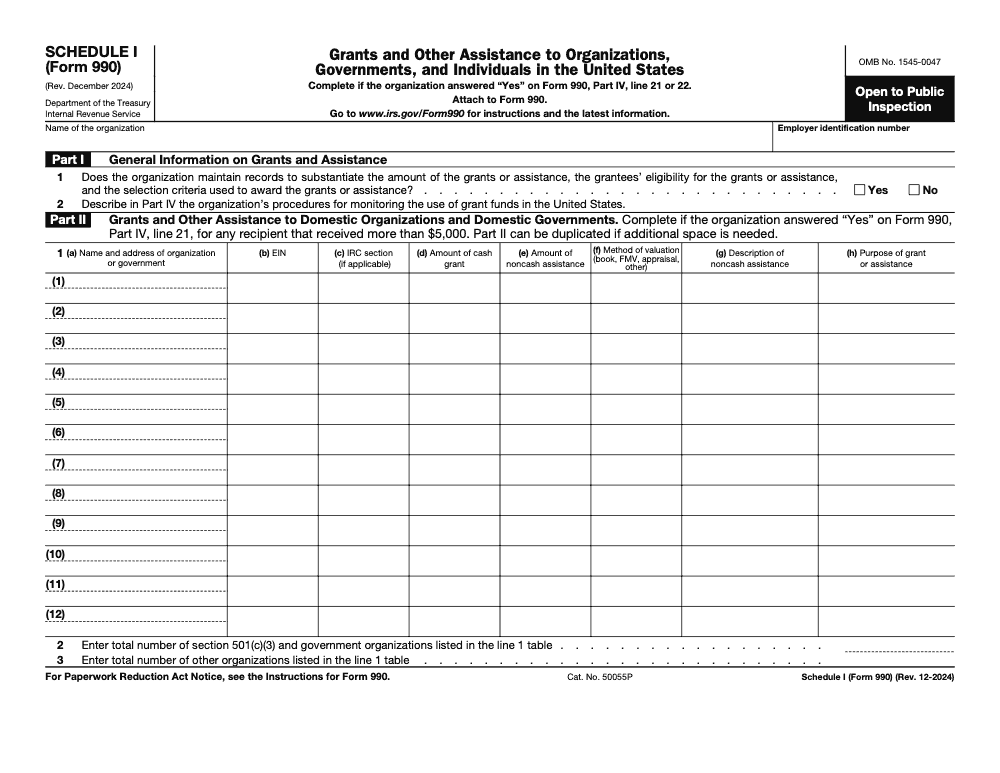
Schedule I (Form 990) reports grants and other assistance to domestic organizations, governments, and individuals. You complete it when you answer Yes on Form 990, Part IV, line 21 or line 22. Itemize any single domestic organization or government that received more than $5,000 in Part II, aggregate assistance to individuals over $5,000 by type in Part III, and tie Part II to Part IX, line 1 and Part III to line 2 (per the Schedule I (Form 990) instructions). Need a team to handle the prep? See our tax services.
Schedule I is where a clean Form 990 quietly comes apart. You file it when Part IV, line 21 or line 22 is Yes, then itemize in Part II any single domestic organization or government that received more than $5,000, and aggregate assistance to individuals by type in Part III. The trap is small grants under $5,000 that someone drops, which leaves Part II refusing to tie to Part IX, line 1.
The tie-outs are the whole job. Part II must reconcile to Part IX, line 1 and Part III to line 2, with noncash amounts at fair market value and a stated valuation method. Run a short pre-file pass on those reconciliations and the schedule holds up the first time a reviewer reads it, instead of eating an afternoon to chase a number that will not match.
Key Takeaways
- You file Schedule I when Form 990, Part IV, line 21 or 22 is “Yes.” That means you reported more than $5,000 of grants or assistance to domestic organizations or governments on Part IX, line 1, or more than $5,000 to domestic individuals on Part IX, line 2.
- Part II itemizes each domestic organization or government that received over $5,000, showing name, address, EIN, cash, noncash at FMV with the valuation method, and a specific purpose. Totals must reconcile to Form 990, Part IX, line 1.
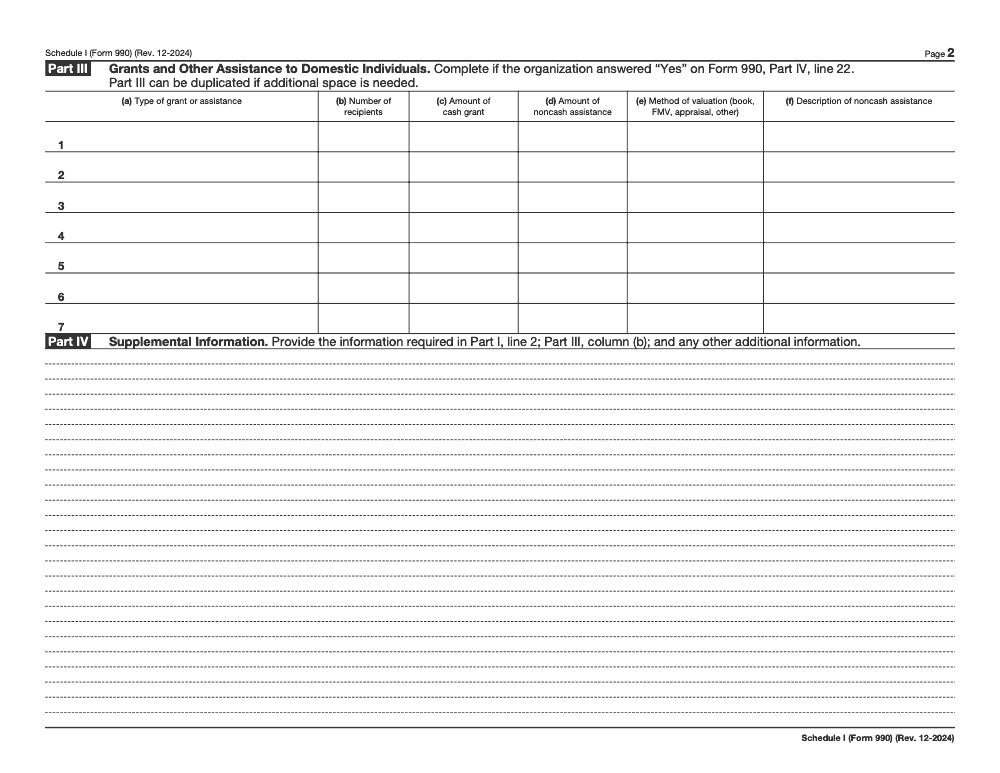
- Part III aggregates assistance to domestic individuals by type, not by name, with the number of recipients, cash, noncash at FMV, valuation method, and descriptions. Totals must reconcile to Part IX, line 2.
- Part I confirms records for selection, eligibility, monitoring, and disbursements, and Part IV supplies the narrative details, including any recipient estimates and how you monitor use of funds.
- The IRS moved to “continuous‑use” instructions for Schedule I, updated in December 2024, and noted as reviewed on January 7, 2025, so treat these rules as current until the IRS issues a newer revision.
What Schedule I Actually Covers
Schedule I gives the IRS a clear window into your U.S. grantmaking, both to entities and to individuals. Think of it as the detail behind the summary lines on Part IX.
- It applies to grants and other assistance you made directly, as well as amounts you made through a disregarded entity or qualifying joint venture that flows through your activities.
- It includes cash awards, stipends, scholarships, fellowships, contributions, noncash property, and similar support.
- It does not include salaries, vendor invoices for services like audit or legal, or other payments where the primary purpose is to serve your organization’s direct operations.
A quick sanity check helps: if you are supporting another organization’s mission or a person’s needs, and it is not a fee for your operations, you likely belong on Schedule I.
Why This Matters, Beyond “Because IRS”
Accuracy on Schedule I protects trust. Donors and watchdogs look at who you funded, how you selected recipients, whether amounts tie to your financials, and how you verified use. The IRS, for its part, reviews whether your grantmaking matches your exempt purpose and whether controls exist to prevent diversion of funds. Clean, specific reporting prevents slowdowns, avoids needless questions, and reduces audit risk.
What Changed for 2025 Filings
- The IRS converted Schedule I to a continuous‑use instruction set in December 2024. In practice, that means you use the current instructions for tax year 2024 and later, until a superseding version appears. Keep an eye on the “What’s New” and “Future Developments” sections each year.
- The fundamentals did not shift, the familiar $5,000 thresholds and the Part II and Part III structures remain. If you follow ASC 958, remember the present value rule for multi‑year grants, and then accrue increments in future years.
The Simple Framework, What, How, Wow
- What: Schedule I reports grants and assistance to U.S. organizations, governments, and individuals when your Part IV checklist is “Yes” on lines 21 or 22.
- How: You list each domestic organization or government over $5,000 in Part II, then aggregate assistance to individuals by type in Part III, and you document controls in Part I with narrative support in Part IV.
- Wow: You reduce review time and questions by standardizing workpapers, naming files consistently, and reconciling totals to Part IX with a one‑page tie‑out. I have seen this cut prep and review time by hours on busy closes, and it pays dividends during audit season.
A Quick Example To Ground This
- You gave Organization A, a 501(c)(3), a $35,000 program grant and donated surplus laptops with an FMV of $6,000. On Part II, you list the legal name, address, EIN, the cash and noncash amounts, your FMV valuation method, and a purpose like “STEM after‑school program expansion,” then you reconcile those totals to Part IX, line 1.
- You also issued $12,500 of emergency gift cards to 50 domestic individuals, which you track under “disaster relief” in Part III with a recipient count, cash amount, and brief description, supported by eligibility files.
Next, we will cover who must file, the exact triggers, and how to organize your records so reviews move faster and you stay safely within IRS expectations.
Who Must File Schedule I
If you checked “Yes” on Form 990, Part IV, line 21 or line 22, you are in Schedule I territory. That simple checkbox is the gate. Line 21 signals grants or assistance to domestic organizations or governments that show up on Part IX, line 1. Line 22 signals grants or assistance to domestic individuals that show up on Part IX, line 2. If either is “Yes,” complete Schedule I, then follow the thresholds below.
Filing Trigger Criteria
- Line 21 is “Yes,” and any single domestic organization or government received more than $5,000 in grants or assistance, list that recipient in Part II.
- Line 22 is “Yes,” and aggregate assistance to domestic individuals exceeds $5,000, complete Part III by assistance type.
- Always complete Part I when either line is “Yes,” then use Part IV for narratives that do not fit on the form.
| Trigger | Required Action |
| Yes on Part IV, line 21 | Complete Schedule I, then itemize recipients in Part II if a single domestic organization or government received more than $5,000 |
| Yes on Part IV, line 22 | Complete Schedule I, then aggregate assistance to individuals in Part III once totals exceed $5,000 |
| No recipient exceeds $5,000 | Do not itemize in Part II, still maintain complete records and answer Part I |
Organizations Required To File
- Applies to section 501(c) organizations, section 527 political organizations, and section 4947(a)(1) nonexempt charitable trusts that file Form 990.
- Private foundations typically use Form 990‑PF, not 990 with Schedule I, so they follow a different set of schedules.
- Voluntary filers of Form 990 should attach Schedule I if their answers trigger these requirements.
Key Components and Thresholds
Schedule I is straightforward once you break it into four parts with one goal, tie everything to Part IX and make it provable.
- Part I, confirm that your organization keeps records that substantiate disbursements, eligibility, selection, and monitoring.
- Part II, list each domestic organization or government that received more than $5,000, and disclose cash, noncash at fair market value, valuation method, and purpose.
- Part III, aggregate assistance to domestic individuals by type, show number of recipients and cash or noncash totals at fair market value with a valuation method.
- Part IV, explain procedures, estimation methods, and special cases that do not fit in the boxes.
Reporting Thresholds Overview
- Part II trigger, more than $5,000 to any single domestic organization or government.
- Part III trigger, more than $5,000 in aggregate assistance to domestic individuals.
- Totals must reconcile to Form 990, Part IX, line 1 for organizational grants and line 2 for individual assistance.
When in doubt, build a one page tie‑out that shows Part II total equals Part IX, line 1, and Part III total equals Part IX, line 2, then have a reviewer sign off before e‑file. This simple habit prevents the most common mismatch.
Part II, What To Include For Each Domestic Organization Or Government
Think of Part II as your recipient card for every organization over $5,000.
- Legal name, mailing address, and EIN, and if tax exempt, the recipient’s Code section.
- Cash grants, noncash assistance recorded at fair market value, and the valuation method used for noncash, for example FMV, book, appraisal, or other.
- A clear purpose statement that informs the reader how funds or property will be used, for example “Scholarships for first‑generation college students” or “Clinic renovation equipment.”
I encourage a naming convention in your workpapers that mirrors Schedule I fields. For example, “FY2025_ScheduleI_PartII_OrgName_EIN_Purpose.pdf.” Reviewers can find files quickly, your totals tie out faster, and you reduce repeat questions.
Part III, How To Aggregate Assistance To Domestic Individuals
Part III groups assistance by category, not by name. This protects privacy and keeps the focus on program types.
- For each type, show number of recipients, total cash amount, total noncash amount at fair market value, the valuation method, and a brief description of noncash property if applicable.
- Common categories include scholarships, stipends, emergency relief, patient assistance, rent relief, and gift cards.
- If you estimate the number of recipients, disclose the method in Part IV, for example sample size and extrapolation.
Example, Part III Line
- Assistance type, “Disaster relief gift cards.”
- Number of recipients, 50.
- Cash amount, $12,500.
- Noncash amount, 0.
- Valuation method, not applicable for cash.
- Notes, eligibility files retained, cards logged and reconciled to disbursement report.
Part I, Records And Monitoring At A Glance
Part I is short on the form, yet heavy in expectations. You confirm that you maintain records supporting recipient eligibility, selection criteria, amounts paid, and use of funds. You also confirm monitoring procedures, such as required reports or site visits, and who is responsible. Use Part IV to add detail that will answer the obvious reviewer questions.
A solid Part I response tells the story in one breath, what records you keep, how you decide who qualifies, how you monitor use, and who is accountable inside your organization.
Up next, we will step through a practical prep and review workflow, including templates, valuation choices for noncash assistance, and how to keep Part IV tight and convincing.
Part IV, Supplemental Information That Answers Reviewer Questions
Part IV is where you explain the story behind the numbers. Use it to document how you select recipients, how you monitor use of funds, and how you value noncash items. If you estimated recipient counts or amounts, explain the method in clear language that a reviewer can repeat.
What To Cover In Part IV, Practically
- Selection criteria, who qualifies, who approves, and what files you retain.
- Monitoring procedures, required reports, site visits, and follow up steps when something looks off.
- Valuation methods for noncash assistance, including why you chose fair market value, appraisal, book value, or other.
- Any estimates, sample sizes, and extrapolations used, with enough detail so another accountant can replicate the math.
- Corrections or restatements made after year end and how they affect the totals.
- A tie out note that confirms Part II totals match Part IX, line 1, and Part III totals match Part IX, line 2.
Keep Part IV concise and factual. Aim for short paragraphs that answer who, how, and why, then point to the specific workpapers by file name.
Monitoring That Actually Works
You do not need fancy language. You need predictable steps that people can follow when busy.
- Require interim or final reports from grantees, even for modest awards.
- For larger awards, schedule a short check‑in and document the outcome.
- For individuals, log eligibility decisions, disbursement dates, and any proof of use that your policy requires.
- Create thresholds for escalations, for example any delay over 30 days triggers an email and a calendar reminder.
- Document corrective actions, repayment requests, and decisions on future eligibility.
Noncash Valuation, How To Choose FMV, Appraisal, Or Book
- Fair market value fits most items such as gift cards, equipment, or supplies. Support the value using current price lists or comparable sales.
- Appraisal makes sense when items are unique, for example a vehicle or specialized equipment.
- Book value is rarely a good fit for Schedule I, because it may not reflect current market value that the form expects. If you use book, explain why, and attach support in your workpapers.
- When you donate services paid to third parties, for example a physician’s time that you purchased, treat it as assistance and disclose the amount. If volunteers donated time directly, that is not a grant or assistance payment.
Privacy And Redaction Boundaries
Schedule I lists organizational grantees with names and EINs, but individuals are aggregated by type. Maintain privacy by avoiding unnecessary personal detail in Part IV. Keep sensitive attachments out of the public file. In your internal records, store applications, approvals, and monitoring notes with access controls so auditors and reviewers can see what they need without exposing personal data.
A Prep And Review Workflow You Can Repeat Every Year
The biggest win is reducing rework. A simple, consistent workflow keeps teams calm and files clean.
- Plan the calendar Map deadlines for data collection, valuation, reconciliation, and review. Assign owners for Parts I through IV and Part IX tie outs.
- Collect and label Gather grant agreements, approval memos, reports, and noncash support. Use a consistent naming rule that mirrors the fields in Part II and Part III.
- Validate eligibility Confirm that every recipient met policy requirements. If you find exceptions, document the fix or the reason.
- Value noncash items Select the method, add the support, and write a one sentence explanation that ties to the method. Keep it with the schedules.
- Reconcile to Part IX Build a simple spreadsheet that shows how Part II and Part III totals land on the correct lines of Part IX.
- Manager review Use a checklist. Confirm EINs, addresses, purpose statements, and valuation methods. Check that Part IV explains anything unusual.
- Sign off and e‑file Export a reviewer‑ready PDF, run your e‑file validations, and retain the transmission receipt with your workpapers.
Simple Templates That Save Time
- A one page Part II card for each organizational recipient, with fields that mirror the form.
- A Part III roll‑up that lists assistance types, recipient counts, cash, noncash, and valuation method.
- A Part IV narrative template with headings for selection, monitoring, valuation, estimates, and corrections.
- A tie out sheet that bridges the totals to Part IX with references to the supporting files.
Example Disclosures You Can Adapt
- Selection criteria “Scholarship recipients must be residents of County X, demonstrate financial need based on the rubric in Policy FIN‑04, and maintain a 2.8 GPA or higher. Awards are approved by the Scholarship Committee and documented in meeting minutes.”
- Monitoring “Grantees over 25,000 submit a midpoint and final report. Finance reviews reports within 15 days and confirms use of funds against the budget. Exceptions are escalated to the Program Director.”
- Valuation “Noncash laptops were valued at fair market value using current retail prices for the same model. A price list dated June 30, 2025 is filed as Workpaper S‑I‑NC‑01.”
- Estimates “Recipient counts for rental assistance were estimated using a 20 percent sample of transactions and extrapolated to the full population. The sampling file and calculation are filed as S‑I‑EST‑02.”
Up next, you will see the most common errors we catch during review, plus a fast pre‑file checklist you can run before you transmit.
Common Reporting Pitfalls And How To Avoid Them
You can avoid most Schedule I headaches with a short checklist and a habit of writing things down the same way every time. Here are the errors we catch most often during reviews, plus practical fixes you can use this year.
Mismatch With Part IX
- Problem, totals in Schedule I do not tie to Form 990, Part IX, line 1 for organizational grants or line 2 for individual assistance.
- Fix, create a one page bridge that shows every Part II line and every Part III category rolling up to the exact Part IX lines. Have a reviewer sign and date the bridge before e‑file.
Missing EINs, Addresses, Or Purpose Statements
- Problem, a grantee appears without a full address, EIN, or a clear purpose.
- Fix, build a Part II intake sheet that cannot be saved without those fields. Purpose statements should say how the money or property will be used, not a vague label.
Noncash Valuation At Cost Instead Of FMV
- Problem, donated equipment or supplies reported at cost or book value when fair market value is required.
- Fix, use current price lists or comparable sales to support FMV. If you use book value for a specific reason, explain why in Part IV and keep documentation in your workpapers.
Aggregation Errors In Part III
- Problem, mixing assistance types, counting recipients twice, or leaving out noncash amounts.
- Fix, list each assistance type on its own line, add the number of recipients once per category, and include noncash totals with a stated valuation method.
Estimates With No Method Disclosed
- Problem, you estimated recipient counts but did not explain how.
- Fix, tell the story in one sentence in Part IV, sample size, extrapolation approach, cutoff date, and who approved it.
Gift Card Documentation Gaps
- Problem, gift cards are quick to distribute and easy to misplace, which creates missing counts or unclear eligibility.
- Fix, treat gift cards like cash. Maintain eligibility files, card numbers, amounts, dates, and recipient counts. Reconcile cards issued, used, and voided.
Fiscal Sponsorship And Pass‑Through Grants
- Problem, regrants through fiscal sponsors get underreported or misclassified.
- Fix, if funds are regranted, report them. Disclose the sponsored project or the sponsoring entity as appropriate, the amounts, the purpose, and any monitoring procedures you used.
Multi‑Entity And Multi‑State Complexity
- Problem, grants made by related entities do not flow to the correct filer, or state compliance facts are missing from your files.
- Fix, map each grant to the legal entity that made it, then document state filing impacts in your workpapers so reviewers can confirm the right schedules and attachments.
Monitoring Statements That Say A Lot But Prove Little
- Problem, polished language, no proof.
- Fix, name who monitors, what they collect, when they review it, and what happens if a report is late. Keep emails or forms that show it happened.
Pre‑File Checklist You Can Run In Thirty Minutes
Use this right before you transmit. It catches the small things that cause big headaches.
| Step | What To Check | Pass Test |
| Part II identifiers | Every organizational recipient has legal name, full address, and EIN | Yes or No |
| Purpose clarity | Each Part II line describes how funds or property will be used | Yes or No |
| Noncash valuation | Fair market value support exists and method is stated on the form | Yes or No |
| Part III categories | Assistance types are separated, totals and counts look reasonable | Yes or No |
| Estimates disclosed | Methods are explained in Part IV and supported in workpapers | Yes or No |
| Monitoring proof | Reports, check‑ins, or approvals on file for larger awards | Yes or No |
| Tie out complete | Part II equals Part IX, line 1, Part III equals Part IX, line 2 | Yes or No |
| PDF review | Final PDF exports cleanly, no cut off fields or missing pages | Yes or No |
| E‑file validation | Software validations run clean, errors are resolved | Yes or No |
Quick tip, print a single PDF that contains Schedule I, the tie out bridge, and your Part IV narrative. Review it as a story. If it reads clearly to someone new, you are ready.
Tools, Templates, And File Hygiene
- Build templates that mirror the form fields, one for Part II recipient cards and one for Part III categories.
- Use consistent file names that start with year, schedule, and the recipient or category, for example “2025_SI_PartII_CommunityClinic_EINxx‑xxxxxxx.pdf.”
- Lock down permissions so program staff, finance, and reviewers can see what they need, and sensitive attachments remain restricted.
- Keep an audit trail, who prepared, who reviewed, and on what date. This accelerates audits and amendments.
Where Accountably Helps Without Taking Over
If your team struggles with version control, tie outs, or inconsistent workpapers, a structured delivery model can help. Accountably integrates trained staff into your workflow, uses your templates, and builds a repeatable review layer that protects quality while keeping you in control. This is not outsourcing decisions, it is about clean execution that lets you file with confidence.
Resources, Filing Tools, And Tight Controls
Strong tools make clean Schedule I work feel routine. You do not need fancy tech, you need the right fields, the right checks, and a repeatable path from data to e‑file.
What Good Software Should Do For Schedule I
- Pull recipient data from your grant system, then map it to Part II and Part III fields.
- Force entry of legal name, full address, and EIN for organizational recipients before you can save.
- Require a valuation method for every noncash line, and a short description of the property.
- Auto-sum Part II and Part III and tie them to Part IX.
- Run validations that catch missing fields and obvious inconsistencies.
- Produce a clean PDF and machine-readable file for retention.
| Task | Helpful Feature | Why It Matters |
| Part II preparation | Mandatory EIN and address fields | Prevents IRS follow‑up for missing identifiers |
| Noncash entries | Drop‑down for FMV, book, appraisal, other | Standardizes valuation language |
| Part III roll‑up | Category templates and recipient counts | Stops double counting and mixing types |
| Tie out | Built‑in bridge to Part IX | Eliminates the most common mismatch |
| Review | Checklist and sign‑off fields | Documents oversight for auditors |
| Filing | E‑file validation and retransmit | Reduces rejection delays and resubmission stress |
Treat your tie out like a control, not a courtesy. If Part II does not equal Part IX, line 1, or Part III does not equal Part IX, line 2, you are not done.
File Hygiene That Speeds Reviews
- Keep one “Final” folder with your exported PDF, e‑file receipt, and the signed tie out.
- Keep one “Support” folder with workpapers for selection, eligibility, monitoring, and noncash valuation.
- Use short file names that carry year, schedule part, and the recipient or category.
- Limit edit rights. Track who prepared and who reviewed.
- Store correspondence that proves monitoring happened, for example a grantee’s report and your approval email.
When To Consider Outside Help
If deadlines pile up, or reviews always stretch into late nights, the gap is rarely the rules, it is capacity you can trust with your name on the return. Accountably places trained offshore preparers inside your workflow, ramped on your templates and systems, with multi-layer review protecting every tie-out. You start with one to three, prove the work on real returns, and scale as trust builds. Not a fit in the first 45 days? We replace them free. Don't trust us. Test us.
Conclusion And Next Steps
You keep Schedule I clean by doing three things well. First, know when you must file, if Part IV, line 21 or 22 is “Yes,” you are in. Second, record details the way the form expects, name, address, EIN, purpose, and fair market value with a stated method. Third, build a repeatable tie out that proves Parts II and III land exactly on Part IX.
If your challenge is not knowing the rules but getting the work out the door on time, fix delivery. Standardize templates, set review checkpoints, and assign clear owners. If you need extra hands who can slot into your system and protect review time without sacrificing control, Accountably can help with a disciplined, U.S. led offshore delivery model, trained on IRS workflows and your software stack.
Your goal is simple, accurate, timely, and provable. With consistent records, clear monitoring, and confident tie outs, Schedule I becomes one more clean page in your Form 990, not a late night scramble.
Ready to tune your Schedule I workflow, or need help building SOPs and review layers that scale with busy season, reach out. We can walk your team through a practical checklist, tighten your templates, and, if helpful, add trained capacity that works inside your systems and protects quality.
Common Mistakes We See Every Season
From my side of the desk, the Schedule I errors that cost the most rework are predictable. Each one below is easy to catch once it lives on your review checklist, so here are the ones my team flags most often with the fix you can copy into your SOP.
Reusable Checklists
These checklists are copy-paste ready for a firm SOP or a nonprofit close file. Run them in order, and Schedule I tends to tie out on the first pass.
Recipient Intake and Data Capture
- Confirm each recipient is domestic, and route foreign grantees to Schedule F.
- Capture the legal name, mailing address, and EIN for every organization or government.
- Record the recipient IRC section when the grantee is tax exempt.
- Split cash grants from noncash assistance, and value noncash at fair market value.
- Write a specific purpose statement that names how the funds or property are used.
- Flag any single recipient over $5,000 for itemized Part II disclosure.
Part IX Tie-Out
- Total Part II cash and noncash, and confirm it equals Form 990, Part IX, line 1.
- Total Part III cash and noncash, and confirm it equals Part IX, line 2.
- Confirm grants under $5,000 are excluded from itemization but included in the Part IX totals.
- Build a one-page bridge mapping each Part II line and Part III category to its Part IX line.
- Have a reviewer sign and date the bridge before e-file.
- Retain the bridge and the e-file validation receipt with the workpapers.
Noncash Valuation and Monitoring File
- Select a valuation method per item: FMV, appraisal, or book value with a stated reason.
- Attach the price lists, comparable sales, or appraisals that support each value.
- Aggregate assistance to individuals by type, with recipient counts reconciled to the disbursement log.
- Treat gift cards as cash assistance, and reconcile cards issued, used, and voided.
- Document selection criteria, monitoring steps, and the responsible owner in Part IV.
- Disclose any estimation method, including sample size and extrapolation.
Keep 990-SI Season From Stalling
Schedule I rarely stalls because the form is hard. It stalls because the data arrives late. For calendar-year organizations, Form 990 and its schedules are due May 15, and that deadline lands while month-end and audit prep already compete for the same hours. Every grantee needs an EIN, an address, a purpose, and a noncash value, and those details sit in agreements, disbursement logs, and program files that are not always close-ready (per the Schedule I (Form 990) instructions).
The fix is not more hours in May. It is moving the data work upstream and standardizing how each recipient is captured, so reconciliation to Part IX becomes a check rather than a rebuild.
- Open a Part II recipient card the moment a grant is approved, not at year-end, with EIN, address, IRC section, and purpose locked in.
- Tag noncash assistance with a valuation method and supporting price list or appraisal at disbursement, so fair market value is settled early.
- Keep a running Part III roll-up by assistance type, with recipient counts reconciled to the disbursement log each month.
- Maintain a live bridge from Part II and Part III totals to Form 990, Part IX, lines 1 and 2, so the tie-out is current before close.
- Route any foreign grantee to Schedule F at intake, so cross-border activity never contaminates the Schedule I totals.
When the prep is structured this way, Schedule I stops being a May fire drill and becomes a quiet sign-off. That is the kind of repeatable, reviewed execution our tax services are built to deliver, so the schedules tie out and the deadline holds without the late nights.
FAQs
Schedule I shows limited details. Organizations and governments are listed by name and EIN in Part II. Individuals are aggregated by assistance type in Part III. Balance transparency with privacy by keeping sensitive documents out of the public file, using redaction where appropriate, and limiting internal access to eligibility and monitoring records.
Yes. If you regrant funds through a fiscal sponsor or similar arrangement, report the amounts on Schedule I. Disclose the sponsoring entity or project as appropriate, the purpose, and your monitoring steps. Keep agreements and subrecipient files with your workpapers.
File an amended return. Update the schedules, refresh the tie outs to Part IX, and include an explanation of the change. Obtain any required board approvals, rerun your software validations, and keep a clear audit trail that shows what changed and why.
Yes, they can still affect totals. Individual organizational grants under $5,000 are not listed in Part II, but they still roll into Part IX, line 1. Small awards to individuals also roll into Part IX, line 2. Track them in your ledger, keep eligibility and monitoring files, and include them in your Part III categories if your aggregate assistance to individuals exceeds $5,000.
Use Schedule F for foreign activities and grants to foreign recipients. Keep your totals consistent across both schedules and your financials. If a grant involves a U.S. intermediary that regrants abroad, document which schedule captures the reportable activity and why, then keep the currency conversion and due diligence files with your support.
Treat gift cards like cash. Keep eligibility documentation, card numbers, amounts, and reconciliation records that show cards issued, used, and voided. Report them as cash assistance under the relevant category, and keep your counts tight so your Part III line shows an accurate number of recipients.
Other forms this guide names
- Form 990: Nonprofit Tax Return Filing Guide 2025
Summarize this article with AI
About this guide
Accountably helps US CPA, EA, and accounting firms hire trained accountants and tax preparers in India.
About us Reviewed byJugal Thacker, CPAFounder and CEO at Accountably
A Washington-licensed CPA with 7+ years inside US firms – PwC, a real-estate tax practice, then a full-service firm, rising from reviewer to manager to advisory. This article was reviewed against current IRS guidance for the 2025 tax year and updated for filers preparing late returns, amendments, and 2026 estimates.
View profile →How we research, review, and update this guide
Every Accountably guide is researched against primary IRS sources, reviewed by a U.S. CPA, and refreshed as guidance evolves. Read our Editorial Guidelines to see how we source, fact-check, and update our content.