Summarize this article with AI
In Brief
Schedule K attaches to Form 990 when a 501(c)(3) has a tax-exempt bond issue with outstanding principal of more than $100,000 on the last day of the tax year, issued after December 31, 2002 (per Schedule K Form 990 instructions, Rev. December 2024). The full Form 990 with Schedule K is due the 15th day of the 5th month after the tax year ends – May 15, 2026 for calendar-year 2025 filers – with a 6-month Form 8868 extension available to November 16, 2026.
Schedule K trips people on the calendar, not the concept. A 501(c)(3) carries an old bond issue, assumes it is too small to matter, then finds the outstanding principal still sits above $100,000 on the last day of the tax year, which is exactly the test that pulls the schedule onto the return. Add the post-December 31, 2002 issuance cutoff and you have two conditions that have to be checked issue by issue, not from memory.
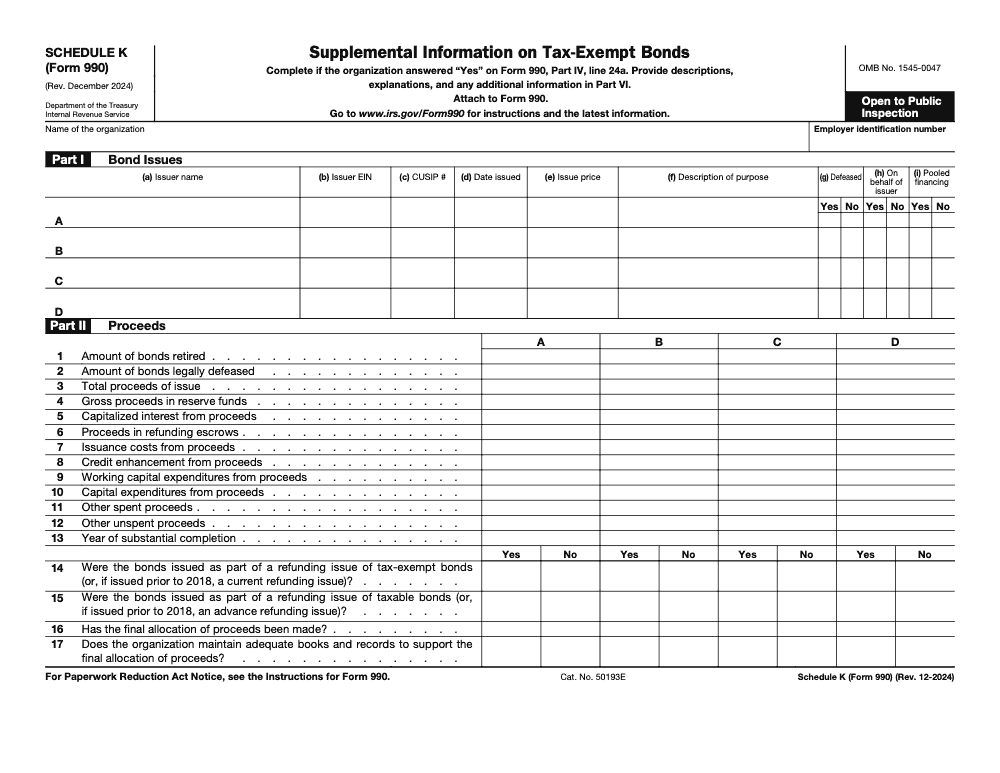
The schedule reports up to four bond issues across six areas, from bond basics through arbitrage and the Part VI narrative, and it has to tie to Form 8038, the trustee statements, and the bond transcript. For a calendar-year 2025 filer the full Form 990 with Schedule K is due May 15, 2026, with a Form 8868 extension available to November 16, 2026.
Key Takeaways
- Schedule K is issue level reporting for your outstanding tax‑exempt bonds. It must tie to Form 8038, trustee statements, and your bond transcript. Accurate cross ties lower exam risk.
- You file Schedule K with Form 990 when, at year end, your organization has one or more tax‑exempt bond issues with outstanding principal over $100,000 and the issue was first issued after December 31, 2002. Up to four issues per schedule.
- Due dates align with Form 990, the 15th day of the fifth month after your year end. File Form 8868 for a six month extension.
- The form covers six areas, bond basics, proceeds, private business use, arbitrage and investments, corrective procedures, and supplemental details. Treat Part VI as your narrative control.
- Consistency across years matters. The IRS builds a multi year picture from your first accurate filing. Mismatches and omissions invite questions.
What Schedule K is, and why it exists
Schedule K, Form 990 is where you show ongoing compliance for your tax‑exempt bonds, often qualified 501(c)(3) bonds. You report at the issue level. You identify the issuer, the CUSIP, the original amount, and the use of proceeds. You disclose private business use and arbitrage status. Think of it as your annual bond compliance snapshot that lives alongside your Form 990.
Schedule K connects your CUSIPs, proceeds, private use, and arbitrage testing into one annual record the IRS can follow year to year.
Schedule K expects your answers to agree with the issuer’s Form 8038, the bond transcript, and trustee reports. If you are reporting for a related group, only one entity should report the liability. Use Part VI to explain who is reporting and why.
Who must file Schedule K
You must attach Schedule K to Form 990 if you answered Yes to Part IV, line 24a. In plain terms, that means at the end of your tax year you had an outstanding tax‑exempt bond issue with principal over $100,000, and the issue was first issued after December 31, 2002. If you have more than four issues, file additional copies.
Practical eligibility checks
- Confirm the year end outstanding principal for each issue that benefits your organization. If any issue exceeds 100,000, you are in scope.
- Confirm the original issue date. Post December 31, 2002 issues are generally reportable. There are special rules for refundings of pre 2003 issues, see notes below.
- Coordinate with related organizations so only one entity reports each liability, and amounts align with internal allocations. Use Part VI to explain the approach.
A note on refundings and pre‑2003 issues
Refunding matters. If you current or advance refunded older bonds, you will typically list the refunding issue in Part I each year the outstanding principal exceeds $100,000 (note: TCJA eliminated tax-exempt advance refunding for bonds issued after December 31, 2017, so only current refundings, generally within 90 days of redemption, remain available for newer issues). If you refunded a pre‑2003 issue, you usually complete Parts I, II, and IV, but not Part III for that refunding issue. If you refunded a post‑2002 issue, complete Parts I through IV. If any prior bonds remain outstanding and not legally defeased, they may also need to be listed.
Filing dates and extensions
Schedule K rides with your Form 990. The due date is the 15th day of the fifth month after your fiscal year end. For a June 30 year end, your due date is typically November 15. Need time to close proceeds schedules or compute private business use, file Form 8868 for an automatic six month extension. The IRS page for exempt organization due dates was last reviewed on May 30, 2025.
File the extension before your original due date, then use the time to reconcile, not to guess. Accuracy lowers risk far more than speed.
Up next, we will go line by line through each part, starting with Part I. You will get checklists, a records map, and tips that shorten review time without cutting corners.
Part I, bond issue basics
Part I sets your foundation. You will list one row per issue. Enter the issuer name and EIN, the CUSIP on the longest maturity, the issue date, original amount, final maturity, and bond type. Use the same row letter for the issue across Parts I through IV so your responses link cleanly.
Data you should pre collect for Part I
- Issuer name and EIN as shown on Form 8038 (this is the governmental or conduit issuer's identity, not the 501(c)(3) borrower's name and EIN, which appear only in the Form 990 header).
- CUSIP for the longest maturity. If no public CUSIP exists, enter "None."
- Issue date and original principal.
- Final maturity date and purpose.
- Year end outstanding principal, consistent with trustee and your general ledger.
Keep your first year entry precise. The IRS expects the Form 8038 identifiers and your Schedule K identifiers to match. If your reporting period uses an alternate 12 month period for bond compliance, apply it consistently and note assumptions in Part VI.
Frequent Part I mistakes
- Using the wrong CUSIP, for example a short maturity rather than the longest.
- Listing a legally defeased issue that is no longer your liability.
- Omitting a refunding issue while prior bonds remain outstanding.
- Reporting outstanding principal that does not agree to trustee statements.
Part II, use of proceeds and allocations
Part II turns proceeds into a clean ledger. You will map total proceeds to capital projects, working capital, costs of issuance, reserves, refunding escrows, and any unspent balance at year end. The figures should reconcile to trustee statements, project draws, and bank activity.
Tie every dollar to purpose, then tie that purpose to records you can produce in an exam. Your narrative in Part VI should point to the same totals the trustee would provide.
Records to have at hand
- Trustee statements for the life of the issue, including reserve and escrow accounts.
- Internal disbursement logs by project and date, with invoices.
- Proof of costs of issuance and how you paid them.
- Documentation for any working capital use, including policy and timing tests.
Working capital and reserve reminders
Working capital draws carry stricter timing rules than capital projects. Make sure the amounts qualify and are reported in the right category. Reserves and sinking funds should be identified clearly so you do not double count them as unspent proceeds. If you used a refunding escrow, label it as such, not as unallocated proceeds.
Quick preparation table for Part II
| Category | What to include | Source records |
| Capital projects | Draws for construction, equipment, capitalizable costs | Invoices, draw schedules, capitalization policy |
| Working capital | Qualifying operating costs within allowed timing | Policies, approvals, cash disbursements |
| Costs of issuance | Underwriter, counsel, trustee, rating, printing | Closing statements, invoices |
| Reserves and sinking | Deposits held per indenture, not spent | Trustee statements, indenture |
| Refunding escrows | Amounts placed to defease prior debt | Escrow agreement, trustee confirmations |
| Unspent proceeds | Balance at year end by account | Bank and trustee balances |
Accuracy in Part II helps you in two downstream places. It frames the asset base you will test for private business use in Part III. It also aligns investment balances for arbitrage questions in Part IV.
Common pitfalls that slow reviews
- Workpapers that do not show how trustee balances tie to your GL.
- Descriptions that mix capital and working capital.
- Missing substantial completion dates for projects.
- Unexplained swings in unspent proceeds year over year.
If you partner with an outside team for seasonal capacity, keep the control in your process. Clear SOPs, structured naming, and version control prevent long review loops. On Accountably’s teams, we use a simple file logic by issue letter, then Part, then line number, so your reviewer can scan, not search. Mentioning this here only because structure reduces stress when deadlines press.
Part III, private business use, get the percentages right
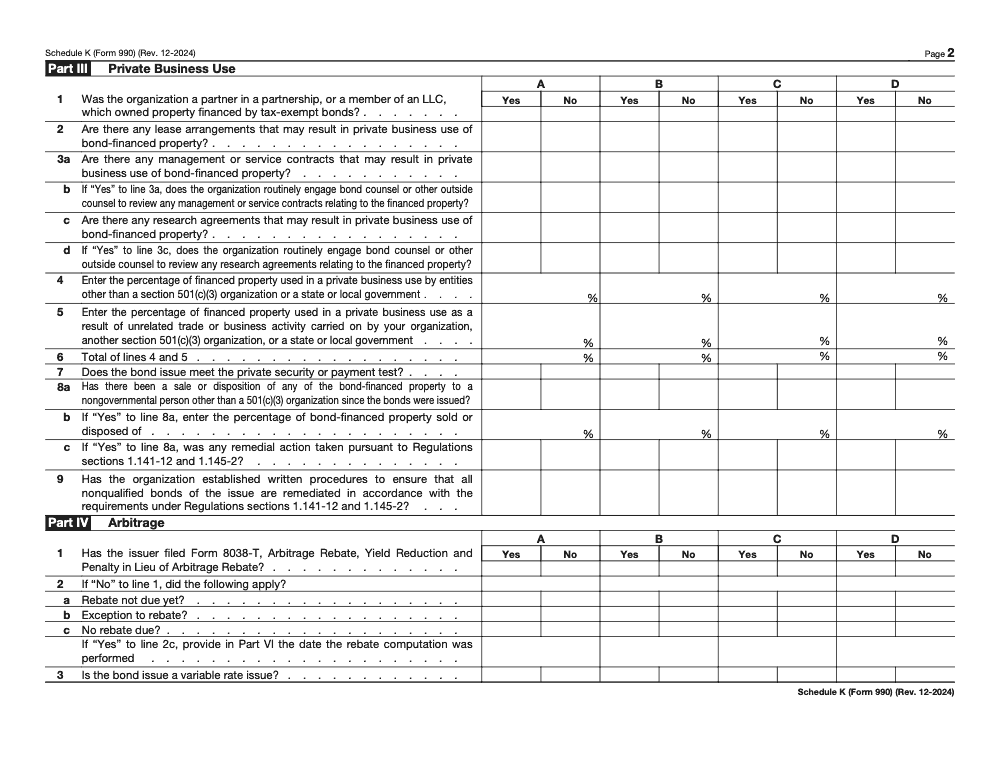
Part III asks whether nongovernmental parties, or unrelated trade or business activities, used bond financed property. You will identify leases, output sales, management or service contracts, research agreements, and transfers. Then you will calculate percentages by category and in total. If you are near limits, talk to bond counsel early (qualified 501(c)(3) bonds tolerate no more than 5 percent private business use under IRC section 145, stricter than the 10 percent rule that applies to governmental bonds).
What counts as private business use
- Use by a nongovernmental person other than a section 501(c)(3) organization.
- Use by your organization, or another 501(c)(3), in an unrelated trade or business under section 513.
- Certain leases, management contracts, and research agreements can create private use unless they fit a safe harbor.
Safe harbor frameworks exist for management contracts and research agreements. See Rev. Proc. 2017 13 for management and service contracts, and Rev. Proc. 2007 47 for research. Even when a contract meets a safe harbor, you still disclose the existence of such contracts on Schedule K, then exclude them from the percentage if they truly qualify.
How to compute the percentage
- Build a facility map that ties square footage or time use to bond financed property.
- Calculate average private business use during the year, then divide by total use.
- Exclude costs of issuance from the numerator, include them in total use for the denominator as the instructions direct. Report to the nearest tenth of a percent.
Payment and security tests
Schedule K also asks if the issue met the private security or payment test. For qualified 501(c)(3) bonds, the test generally turns on whether more than 5 percent of debt service is paid or secured by private payments or private property. Keep a simple schedule that shows sources of payment and security for debt service, with percentages.
Transfers and remedial actions
If any financed property was sold or transferred during the year, you will disclose the percentage and whether you took a remedial action under the regulations (remedial action under Regs sections 1.141-12 and 1.145-2 generally must be taken within 90 days of the deliberate action, otherwise the bonds may lose tax-exempt status retroactively). If you did, describe it in Part VI and attach the supporting counsel opinion in your records file. If self remediation is not available, issuers may seek a closing agreement under the IRS Voluntary Closing Agreement Program, often called VCAP.
Part IV, arbitrage, rebate, and yield restriction
Part IV confirms your compliance with section 148. You will indicate whether Form 8038 T was filed when due, whether you used hedges, whether you hold a GIC, and whether any proceeds were invested beyond temporary periods or above limits. This section links to your investment history, not just your project history.
Rebate installment payments are generally due within 60 days after each fifth anniversary of the issue date and within 60 days after retirement. Schedule K asks if the issuer filed the most recent Form 8038 T that would have been required. If 8038 T was not filed, simply leaving the question blank is not compliance: you must affirmatively check one of three exceptions on Part IV line 2 (rebate not yet due, an exception to rebate applies, or no rebate due after computation), and report the rebate computation date in Part VI when line 2c applies.
What to document for Part IV
- The latest rebate computation date and result.
- If rebate was due, proof of Form 8038 T filing and payment.
- If no rebate was due, a copy of the computation report supporting that conclusion.
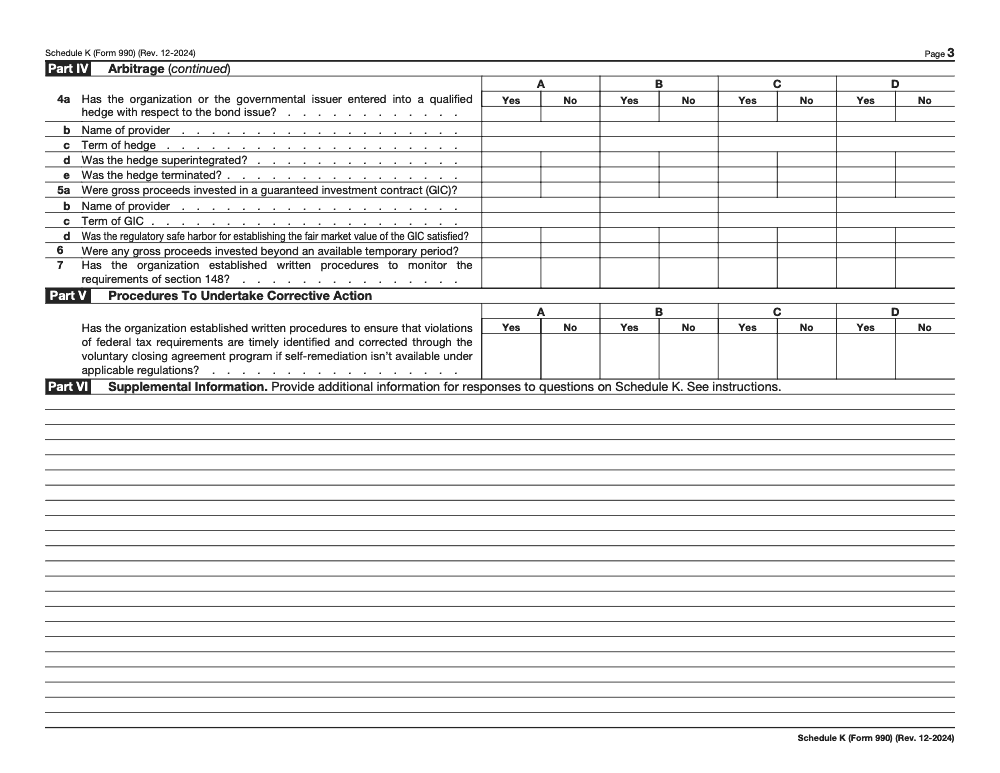
- Any hedges, including provider name, term, and whether superintegration applies.
- Any GICs, including provider, term, and whether you satisfied the fair market safe harbor.
If you need to make a rebate or yield reduction payment, the issuer uses Form 8038 T. The instructions to that form outline the timing rules, exceptions, and penalty alternatives. Keep those references in your file so your Part IV answers rest on current guidance.
Temporary periods and reserves
Schedule K asks if gross proceeds were invested beyond a temporary period, for example three years for capital projects under Treas. Reg. 1.148-2(e)(2) or thirteen months for qualified working capital, or invested in a reserve beyond allowed limits. Working-capital temporary periods follow facts-and-circumstances rules under Treas. Reg. 1.148-2, so confirm the applicable period against current regulations before relying on a specific number. Answer based on your records, then explain any special facts in Part VI.
Part V, written procedures and corrective action
Part V is simple to answer and powerful in practice. Do you have written procedures to spot violations and fix them on time, including through VCAP when self remediation is not available, and do those procedures actually apply to the bond issues you report this year. A Yes tells the IRS that you are not improvising (informal staff practices or ad hoc bond counsel relationships do not qualify; the IRS expects a documented, board- or management-approved policy on file).
What good procedures include
- A calendar for rebate testing, yield restriction checks, and private use monitoring.
- Roles, who reviews leases, service contracts, research agreements, and when counsel is involved.
- A trigger list, events that force a review, such as a space lease, a change in payment sources, or a sale of financed property.
- A remediation playbook, which actions you will evaluate and how you will document them.
Part VI, use the narrative to lower audit risk
Part VI is where you connect the dots. Identify the bond issue, reference the exact line you are explaining, and write concise facts. Use it to explain related organization reporting, assumptions, refunds, transfers, or why an 8038 T was not required because the last computation showed no rebate due.
What to memorialize in Part VI
- The 12 month period you used if it differs from your Form 990 year and the reason.
- How related organizations split the liability and who reports it.
- Substantial completion dates for projects and how you treat draws after completion.
- The date and result of the most recent rebate calculation and whether a payment was made.
- Any remedial action taken, with dates and percentages.
A fast prep workflow your reviewers will love
- Start with a one page issue summary that lists CUSIP, issue date, original amount, purpose, and year end outstanding principal.
- Build a proceeds roll forward that ties to trustee statements and highlights reserves, escrows, and unspent balances.
- Prepare a private business use schedule by facility, then map to the percentages the form requests.
- Gather the latest arbitrage report and, if needed, the 8038 T and proof of payment.
- Draft Part VI notes that answer questions before a reviewer asks them.
Quality control checklist before you file
- CUSIP matches Form 8038 and longest maturity.
- Outstanding principal agrees to trustee and GL.
- Part II totals reconcile, no double counting reserves as unspent proceeds.
- Part III percentages computed as instructed, safe harbors documented.
- Part IV answers backed by the latest computation and 8038 T if applicable.
- Part VI narratives identify issue, lines, and assumptions.
One disciplined pass now prevents three review cycles later. Structure is your time saver, not speed typing.
Final thoughts and a light CTA
You have a complete roadmap now. Confirm that Schedule K applies, build clean proceeds and private use schedules, validate arbitrage status, and use Part VI to tell your story. If your team wants help standardizing workpapers or handling seasonal spikes without losing review control, Accountably can support your process inside your systems and templates, not outside them. The goal is simple, accurate filings, fewer review loops, and calm nights before the deadline.
Compliance is not about fear. It is about clear records, consistent math, and a short list of documents you can pull in five minutes.
Sources and note on currency
- IRS, Instructions for Schedule K, Form 990, page last reviewed January 16, 2025. Used for who must file, part by part requirements, private business use, arbitrage questions, and Part VI guidance.
- IRS, Annual exempt organization return due date page, last reviewed May 30, 2025. Used for due date and extension details.
- IRS, Instructions for Form 8038 T, used for rebate timing and payment context.
Common Mistakes We See Every Season
The Schedule K mistakes I see year after year aren't technical edge cases. They're workpaper-discipline failures that show up the same way across very different organizations.
Reusable Checklists
These checklists are written to copy directly into firm SOPs or the engagement file. Each step ties to a specific Schedule K Part, line, or IRC reference so a senior can confirm coverage during review.
Schedule K trigger check
- Pull every tax-exempt bond issue where the borrower is named in the official statement, regardless of payment status.
- Confirm the outstanding principal on the last day of the tax year is strictly over $100,000 per issue. An issue at exactly $100,000 outstanding is not triggered.
- Confirm the issue date is after December 31, 2002. Pre-2003 issues are not Schedule K reportable, no matter the outstanding balance.
- If both conditions are met for any issue, answer "Yes" to Form 990 Part IV line 24a.
- Complete Form 990 Part IV lines 24b through 24d for each triggered issue (temporary period invested, escrow account, on behalf of issuer).
- If the borrower files Form 990-EZ or 990-N, confirm Schedule K does not apply. Schedule K attaches only to the full Form 990.
- Count triggered issues. If more than four, set up additional Schedule K attachments (four columns per copy).
- Schedule the filing date: the 15th day of the 5th month after year-end (May 15, 2026 for calendar-year 2025), and the extended date (November 16, 2026 with Form 8868 for calendar-year 2025, since November 15 falls on a Sunday).
Part III private business use audit
- For each bond-financed property, pull the current lease schedule, management contracts, service contracts, and research agreements.
- Test each management or service contract against the applicable IRS safe harbor for management contracts. Flag contracts outside the safe harbor for Part III lines 3a and 3b review.
- Test each research agreement against the applicable IRS safe harbor for research agreements. Flag exceptions for lines 3c and 3d.
- Compute the percentage of bond-financed property used by non-501(c)(3) and non-governmental users for Part III line 4.
- Compute the unrelated trade or business use percentage for Part III line 5.
- Sum lines 4 and 5 into line 6. Compare against the 5% qualified 501(c)(3) ceiling under IRC section 145.
- If line 6 exceeds 5%, prepare a remediation memo under Treasury Regulations 1.141-12 and 1.145-2 (redemption, defeasance, or alternative use) and confirm the action was taken within 90 days of the deliberate action.
- Confirm written procedures for remediation of nonqualified bonds (line 9) are on file before answering "Yes."
Part IV arbitrage and Form 8038-T review
- Confirm whether Form 8038-T was filed for the most recent installment computation date (line 1).
- If "No" on line 1, select exactly one exception on lines 2a (not yet due), 2b (exception to rebate applies), or 2c (no rebate due).
- If 2c is selected, document the rebate computation date and post it to the Part VI narrative.
- For variable rate issues (line 3), document the rate index and the calculation method in the workpaper file.
- For each qualified hedge (line 4a "Yes"), record the hedge provider name, term, superintegrated status, and any termination details on lines 4b through 4e.
- For each guaranteed investment contract (line 5a "Yes"), confirm the regulatory safe harbor on line 5d was met: bona fide solicitation of at least three bids from independent providers with a written record retained.
- Confirm written procedures to monitor IRC section 148 arbitrage requirements are on file before answering "Yes" on line 7.
- Schedule the next rebate installment date: every 5 years from the issue date under Treas. Reg. 1.148-3(g), with payment due within 60 days of the installment computation date.
Keep Form 990 Schedule K Season From Stalling
Schedule K is the part of Form 990 nobody wants on a tight November close. Mandatory electronic filing under the Taxpayer First Act of 2019 means a single missing CUSIP or a blank Part VI narrative blocks the whole 990 from acceptance, and for calendar-year 2025 filers the extended due date lands on November 16, 2026 (per IRS Form 8868 instructions). Penalties under Rev. Proc. 2024-40 reach $125 a day for organizations above $1,208,500 in gross receipts, capped at $63,500 per return.
Most of the late-cycle pain isn't the technical answers. It's missing source data and unrouted reviewer questions, especially on Part II proceeds and Part III private business use. Building a Schedule K packet that survives review starts with the workpapers, not the form itself.
- Track each bond issue separately by Part I column (A through D). If the borrower has more than four reportable issues, attach an additional Schedule K, never combine columns.
- Lock the Part III private business use math against the 5% qualified 501(c)(3) limit under IRC section 145 before the reviewer sees it. Lines 4 and 5 sum into line 6, and anything above 5% needs a remediation memo under Treas. Reg. 1.141-12.
- Confirm Form 8038-T status before answering Part IV line 1. If rebate was not due, document which exception applies (lines 2a, 2b, or 2c) and stage the rebate computation date for the Part VI narrative.
- Maintain written procedures (not informal practice) for both Part III line 9 (remediation of nonqualified bonds) and Part IV line 7 (section 148 arbitrage monitoring). The IRS reads "Yes" as a documented standing policy.
- Verify column (a) issuer name is the governmental conduit issuer, not the 501(c)(3) borrower. Borrower EIN belongs at the top of the form, issuer EIN goes in column (b).
Accountably's tax outsourcing teams run this Part-by-Part build inside your review system: documented workpapers, written-procedure tracking for the Yes/No questions, and Part VI narrative drafts staged for senior review. The 990 still closes on time, and Schedule K stops being the section that drags the engagement.
FAQs
If, on the last day of your tax year, you have an outstanding tax‑exempt bond issue with principal over $100,000 and the issue was first issued after December 31, 2002, you must attach Schedule K. Answer Yes to Form 990 Part IV, line 24a, then complete Schedule K for up to four issues per copy.
Use by a nongovernmental party, or unrelated trade or business use by a 501(c)(3), can be private business use. Certain leases, management or service contracts, and research agreements may count unless they meet a safe harbor, for example Rev. Proc. 2017 13 for management or Rev. Proc. 2007 47 for research.
No. If the bonds are legally defeased in whole and no longer your liability, do not list them in Part I. Keep evidence of defeasance with your records and continue to monitor any compliance obligations that remain.
Form 8038 T is used by issuers to make arbitrage rebate, yield reduction, or related payments under section 148. Rebate installments are generally due within 60 days after each fifth anniversary of the issue date and within 60 days after final maturity. Your Schedule K answer confirms whether the most recent filing, if required, was made.
Schedule K is due with your Form 990, the 15th day of the fifth month after your fiscal year end. Use Form 8868 to request an automatic six month extension. The IRS confirms these rules for exempt organization returns.
Use Part VI to explain line level items by issue. Reference the issue letter and line number, note any assumptions, and describe any remedial actions, rebate computations, or related organization reporting decisions. Clear narratives reduce follow up.
Other forms this guide names
- Form 990: Nonprofit Tax Return Filing Guide 2025
- Form 8868: Extension for Exempt Organization Returns
- Form 8038‑T: Complete Filing Checklist for Rebate and Penalties
Summarize this article with AI
About this guide
Accountably helps US CPA, EA, and accounting firms hire trained accountants and tax preparers in India.
About us Reviewed byJugal Thacker, CPAFounder and CEO at Accountably
A Washington-licensed CPA with 7+ years inside US firms – PwC, a real-estate tax practice, then a full-service firm, rising from reviewer to manager to advisory. This article was reviewed against current IRS guidance for the 2025 tax year and updated for filers preparing late returns, amendments, and 2026 estimates.
View profile →How we research, review, and update this guide
Every Accountably guide is researched against primary IRS sources, reviewed by a U.S. CPA, and refreshed as guidance evolves. Read our Editorial Guidelines to see how we source, fact-check, and update our content.