Summarize this article with AI
In Brief
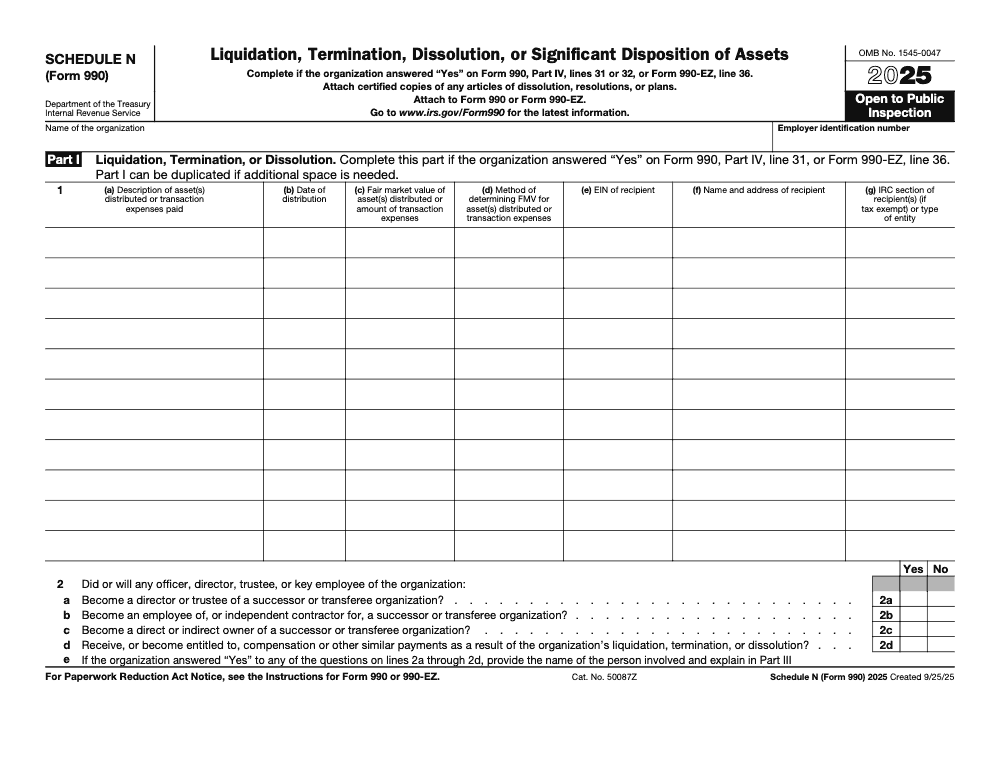
Schedule N (Form 990) reports a liquidation, termination, dissolution, or a significant disposition of more than 25% of net assets. You attach it after answering ‘Yes’ to Form 990, Part IV, line 31 or line 32, or to Form 990-EZ, line 36, and the 25% test runs against the fair market value of net assets at the beginning of the tax year (according to the Instructions for Schedule N). Related transaction expenses of $10,000 or more are listed separately in column (a). See our tax preparation services for help with a wind-down.
A board approves the sale of a building, and the organization is not winding down. If the transactions add up to more than 25% of the fair market value of beginning-of-year net assets, that is a significant disposition, a Yes on Form 990, Part IV, line 32, and Schedule N is required even though nothing is being liquidated.
Schedule N also covers a liquidation, termination, or dissolution, attaches to Form 990 or 990-EZ, and is open to public inspection. Each related transaction expense of $10,000 or more is listed separately in column (a), and for calendar-year 2025 filers the return is due May 15, 2026, with Form 8868 granting a six-month extension to file.

Key Takeaways
- Schedule N (Form 990) reports a liquidation, termination, dissolution, or significant disposition of assets. It attaches to Form 990 or 990-EZ; it is not a stand-alone return.
- A “significant disposition of net assets” means transactions adding up to more than 25% of the fair market value of beginning-of-year net assets.
- The triggers are Form 990, Part IV, line 31 (liquidation/termination/dissolution) and line 32 (significant disposition), or Form 990-EZ, line 36. A “Yes” requires Schedule N.
- List each related transaction expense of $10,000 or more separately in column (a); smaller amounts may be aggregated.
- The return, with Schedule N, is due the 15th day of the 5th month after year end (May 15, 2026 for calendar-year 2025 filers). Form 8868 grants a six-month extension to file.
- Schedule N has three Parts and is Open to Public Inspection. Missing Form 990 filings for three consecutive years triggers automatic revocation of exempt status.
What Schedule N is and when it applies
Schedule N is the attachment to Form 990 or 990‑EZ that reports either a full wind down, or a disposition that crosses the 25 percent threshold of your beginning of year net assets. This includes sales, exchanges, or other transfers, whether or not you received full consideration. The trigger is simple to spot on the core return, Form 990 Part IV lines 31 and 32, or Form 990‑EZ Part V line 36, and the details live on Schedule N.
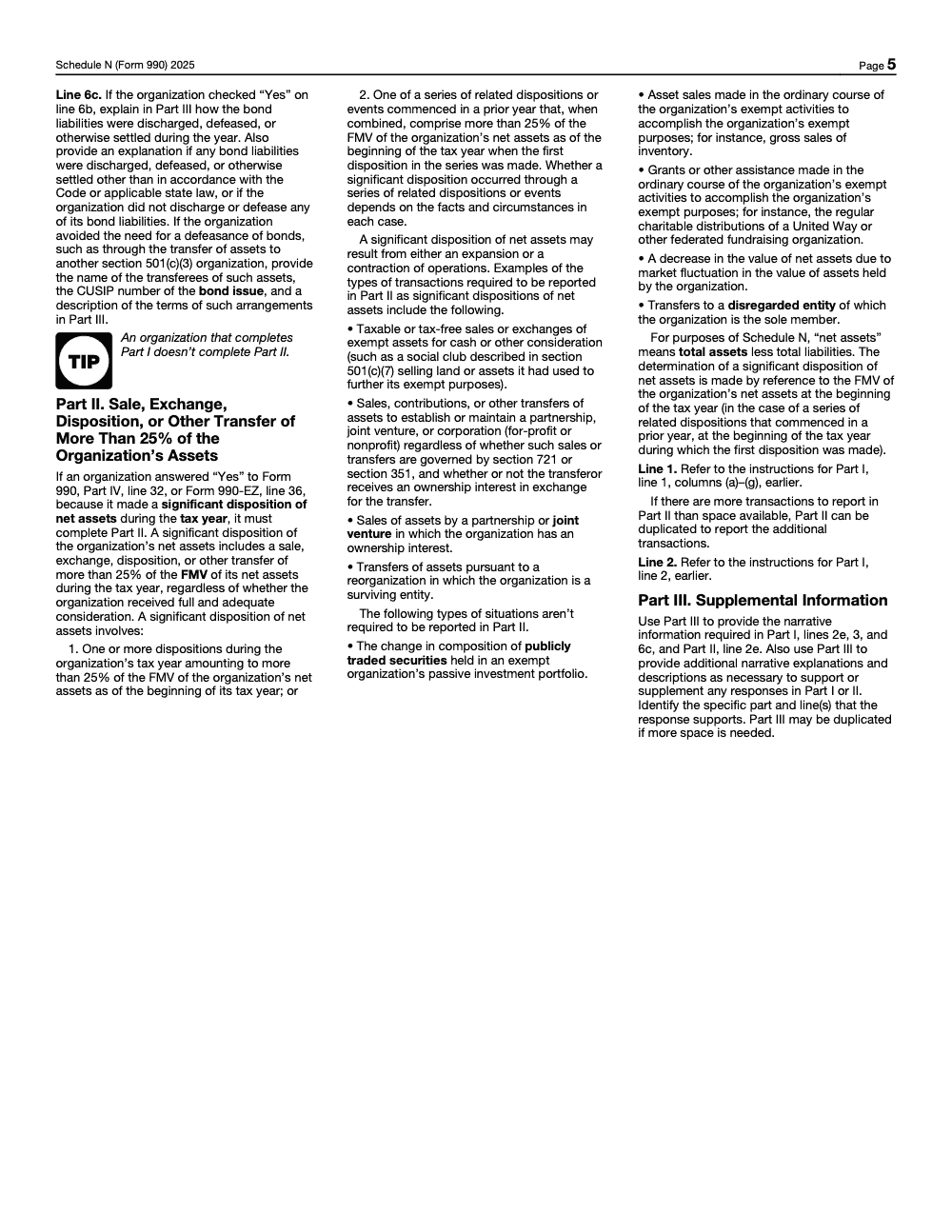
A “significant disposition of net assets” means one or more transactions adding up to more than 25 percent of the fair market value of net assets, and it can arise in an expansion or a contraction. Think about large asset sales, transfers into a joint venture, or reorganizations. Routine grantmaking or routine inventory sales are not significant dispositions for this purpose.
How the 25 percent test actually works
- Start with net assets at the beginning of the year, measured at fair market value (net assets here means total assets less total liabilities, not gross assets).
- Add up the fair market value of all qualifying sales, exchanges, or transfers during the year.
- If the total passes 25 percent, you have a significant disposition to report on Schedule N Part II. Even a series of related transactions across years can push you over the line.
Here is a quick example. Your nonprofit starts the year with 4,000,000 in net assets. You sell a building for 1,200,000, less 40,000 in transaction costs. The 1,200,000 is 30 percent of beginning net assets, so Part II is required, and you will itemize the sale, valuation method, recipient or counterparty, and related expenses.
Triggers on the return you cannot ignore
On Form 990, check Part IV, line 31 for liquidation, termination, or dissolution (a merger into a successor organization counts as a termination here), and line 32 for significant dispositions. A “Yes” means you must complete Schedule N and, for liquidations, also attach certified articles or board resolutions that support the action (the IRS requires a certified copy of the articles of dissolution or merger; board resolutions or liquidation plans are acceptable only if certified articles are not available). On Form 990‑EZ, the analogous trigger sits on Part V, line 36, and again a “Yes” calls for Schedule N.
If your organization is fully terminating, the IRS also expects you to mark the final return box and include required attachments, for example dissolution articles and lists of recipients. This is one of the most common misses I see in reviews, and it is avoidable with a simple close checklist.
Filing deadlines, extensions, and one important exception
Your Form 990 or 990‑EZ, with Schedule N, is due the 15th day of the fifth month after the close of your tax year. Calendar year returns are due May 15 of the following year. Most organizations can request a six month extension with Form 8868, which is filed by the original due date. Keep in mind, this is an extension of time to file, not an extension of time to pay any tax due, which matters for 990‑T filers.
There is one exception that trips people up. The Form 990‑N e‑Postcard due date cannot be extended, although there is no penalty for a late e‑Postcard. However, missing the filing three years in a row triggers automatic revocation of exemption, which is far more painful than any penalty.
How to complete Schedule N without rework
Schedule N is short, but it rewards precision. Use the right part, complete every field, and tie your explanations in Part III to the line items you reported in Parts I and II.
Part I, liquidation, termination, or dissolution
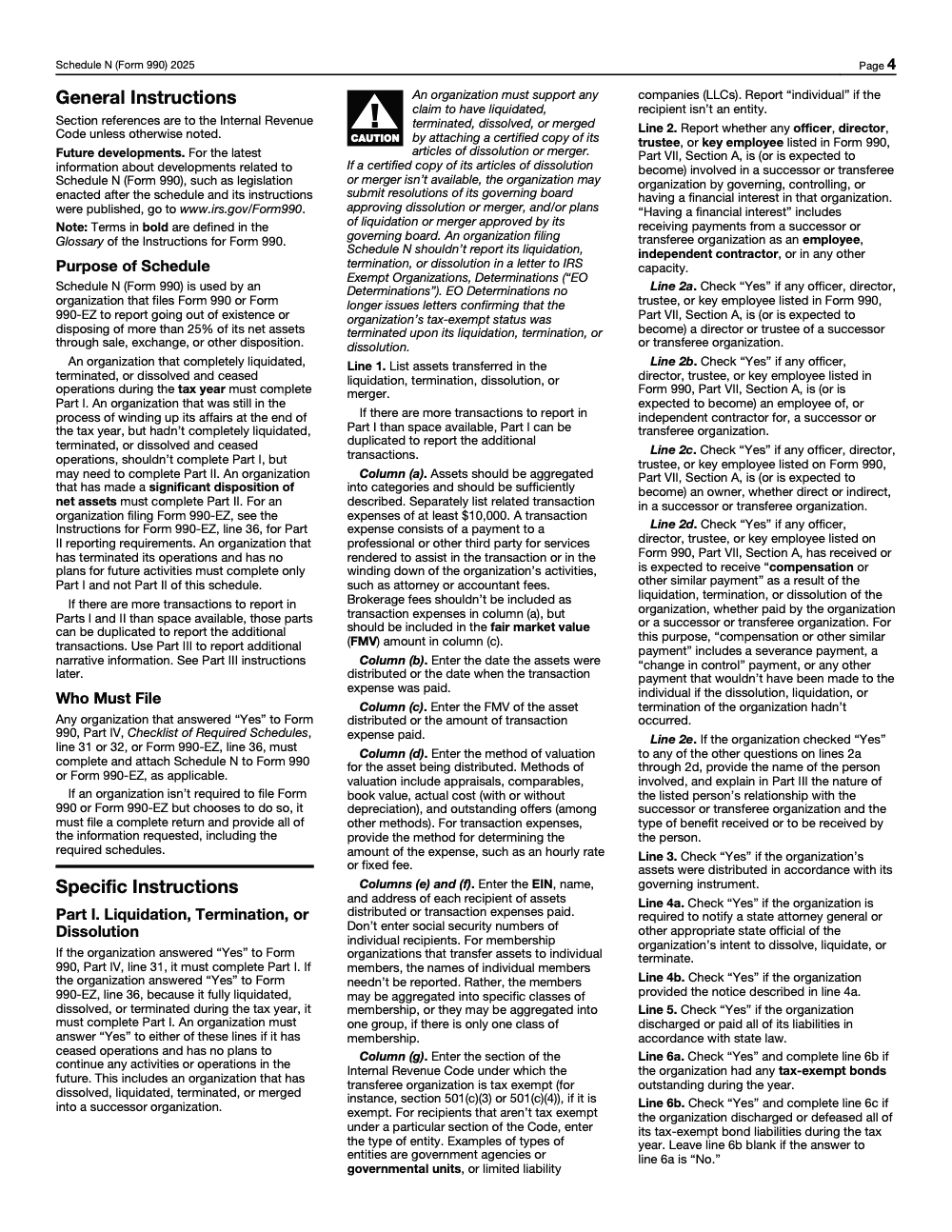
You will list each distribution made as part of winding down. Report the date, a description of the assets distributed, the fair market value with the valuation method, the recipient’s legal name, address, and EIN, the recipient’s entity type or IRC section, and any transaction expenses (separately list each related transaction expense of $10,000 or more; smaller amounts may be aggregated). If multiple distributions occurred, repeat the rows and, if needed, attach a duplicate Part I page. When the organization fully terminates, include the certified articles of dissolution or merger resolutions with the return.
Add a short narrative in Part III if a line directs you to explain, for example why a particular valuation method was selected or how you handled a restricted fund. This keeps the reviewer from guessing and speeds acceptance.
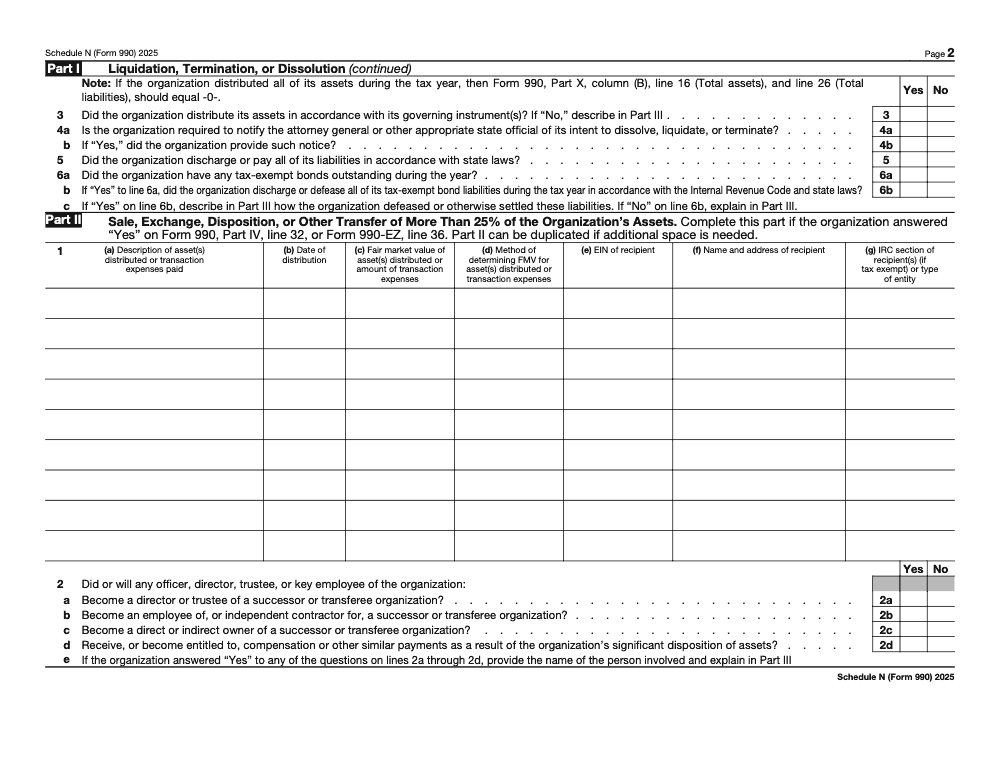
Part II, sale, exchange, or other disposition over 25 percent
Part II captures sales, exchanges, transfers, or other dispositions that cross the 25 percent threshold, including tax-free contributions to a partnership or corporation under section 721 or section 351, because the tax treatment of the transfer does not exempt it from reporting. For each transaction, enter the date, the fair market value or amount realized, the valuation method, itemized transaction expenses, and the recipient or counterparty’s details. If one event involves multiple recipients, list each recipient separately. Use Part III to explain anything unusual, for example a series of related transfers.
Part III, the explanation that ties it all together
Part III is your cross‑reference map. Identify the specific part and line, name the asset, restate the date, show the fair market value and the valuation method, and match each recipient’s name and EIN to the numbers you reported. If your organization is terminating, confirm that you attached the required board resolutions or certified articles.
Quick reference table
| Field you enter | Where it appears | Why it matters |
| Date of distribution or sale | Part I or Part II | Establishes the timeline for the event |
| FMV or amount realized and method | Part I or Part II | Shows valuation basis for the IRS reviewer |
| Recipient legal name, address, EIN, and type | Part I or Part II | Confirms where assets went and under what authority |
| Itemized transaction expenses | Part I or Part II | Clarifies net vs gross amounts and reasonableness |
| Explanations and cross‑references | Part III | Links numbers to narrative and attachments |
Documentation that prevents questions
Strong workpapers save time. Keep source documents, for example closing statements, board minutes, independent appraisals if used, and calculation sheets for the 25 percent test at the front of your binder. If you rely on a market comp approach, summarize the data you considered and the date you applied it. If you use an appraisal, retain the report and note the effective date.
For dissolutions or mergers, include certified articles or resolutions and a schedule that lists the recipients, their addresses and EINs, the nature of the assets they received, and the fair market value on the transfer date. The IRS explicitly looks for these in final returns, so do not leave them out.
Valuation tips that speed review
- Use a consistent valuation date for all items in an event.
- For marketable securities, a clear pricing source and date usually suffice.
- For real property, an appraisal or a well supported broker opinion is helpful, especially if the sale occurs months after the valuation date.
- Always tie fair market value and transaction expenses to the amounts you entered in Parts I or II, and call out differences between fair market value and amount realized when they exist.
Filing mechanics, deadlines, and extensions
- File Schedule N for the tax year in which the liquidation, dissolution, or disposition occurred.
- The due date is the 15th day of the fifth month after year end, and most organizations can request an automatic six month extension using Form 8868, filed by the original due date.
- Note that Form 990‑N has no extension, although there is no penalty for a late e‑Postcard, and three consecutive misses lead to automatic revocation.
If you e‑file, run a validation pass in your software to catch missing EINs, address formats, or skipped valuation methods. Small errors slow acknowledgments more than anything else in this schedule. Many packages include prompts tied to 990 Part IV and 990‑EZ Part V, so use them to make sure a “Yes” on the core return has a completed Schedule N attached.
Examples you can model
Example 1, full dissolution
You cease operations on June 30, approve a formal plan, and distribute all assets to a related 501(c)(3). You check “Final return,” answer “Yes” on Form 990, Part IV line 31, complete Schedule N Part I, list each distribution with fair market value and method, identify the recipient with name, address, EIN, and section, and include certified articles or resolutions. In Part III, you reference the line items and confirm the dates and valuations.
Example 2, asset sale over 25 percent
Beginning net assets are 4,000,000. In September, you sell a parcel of land for 1,200,000. You answer “Yes” on Form 990, Part IV line 32, complete Schedule N Part II, report the sale date, fair market value or amount realized, valuation method, transaction expenses, and list the buyer information as the counterparty. You use Part III to explain the method used to determine fair market value at the time of sale.
Example 3, related transactions across years
You transfer 12 percent of your net assets into a joint venture in March and another 15 percent in November. Together they exceed 25 percent, so you complete Part II and explain the series in Part III. Your calculation workpaper should show how you determined the 25 percent threshold and why the two events are related. The IRS instructions recognize a series of related dispositions as a trigger.
Quality control checklists your reviewer will love
- Confirm whether the event is a Part I wind down or a Part II significant disposition.
- Recompute the 25 percent test from beginning of year net assets, at fair market value.
- Tie every number in Parts I and II to support in the workpapers.
- In Part III, name the line, restate the figure, and explain the valuation method.
- Attach certified dissolution or merger documents when applicable.
- Scan for missing EINs, addresses, or recipient types.
- Make sure your answers on Form 990 Part IV lines 31 and 32, or 990‑EZ Part V line 36, match the schedule you attached.
Where disciplined workflow helps
If you run a firm, you know the real risk is not the form, it is delivery breakdowns. Schedule N heightens that risk because it touches valuations, legal documents, counterparties, and deadlines. A simple, documented workflow prevents late nights and rework.
- Use SOPs for dissolutions and large dispositions, with role clarity for preparer, senior, and reviewer.
- Keep a standard naming convention for workpapers, for example “SN‑P1‑Dist‑001‑FMVcalc.pdf.”
- Apply a multi layer review, preparer to senior to quality, so valuation methods and recipient data are checked before partner review.
- Track open items in your practice management tool with dates and owners.
Accountably partners with CPA and EA firms that want that structure without adding hiring risk. Our teams work inside your templates and systems, keep workpapers standardized, and protect reviewer time with layer checks and clear escalation paths. Mentioning us here is not about promotion, it is simply to say, if you need disciplined offshore execution for complex returns, including 990s with Schedule N, we can help you keep quality and deadlines steady.
E‑filing confidence steps
- Run software diagnostics and correct any warnings related to Schedule N.
- Confirm you have included certified articles or board resolutions when required for dissolutions or mergers.
- Make sure recipient EINs are correct, and addresses follow USPS format.
- If you filed Form 8868, keep the IRS acknowledgment with your return package, and remember that the 990‑N e‑Postcard does not have an extension option.
A final tip, when your disposition crosses into unrelated business income territory, evaluate 990‑T needs and dates, since the 8868 process also touches 990‑T filers, and payment timing still matters.
Recap and next steps
If you are facing a wind down or a big asset move, pause and run the 25 percent test. Choose the right part of Schedule N, complete every field, and tie your story together in Part III with clear valuation methods and recipient data. Attach certified articles or resolutions where required, and file by your deadline or request a timely extension.
If you want a second set of hands to keep workpapers tight and reviews quick, our team at Accountably can integrate with your workflow and help you process complex returns at scale while protecting quality and security. We place trained offshore preparers inside your firm, ramped on your software and SOPs, with multi-layer review standing between their work and your signature. Don't trust us. Test us.
Sources and notes
- IRS, Instructions for Form 990, lines 31 and 32, significant disposition definition, examples, and exclusions.
- IRS, Annual exempt organization return due date and extension options for Form 990 series.
- IRS, Instructions for Form 8868, extension rules and reminders.
- IRS, Termination of an exempt organization, final return checklist and required attachments.
- IRS, 990‑N e‑Postcard due date, no extension, and three year revocation rule.
Disclosure
This article was produced by our editorial team with assistance from trusted automation to check citations and dates, reviewed by a senior preparer in November 2025. The purpose is to help practitioners file accurate returns. Always confirm facts with the latest IRS instructions for your specific year.
Common Mistakes We See Every Season
The same handful of errors surface on almost every Schedule N we review. Each one is avoidable with a quick check against the Instructions for Schedule N (Form 990).
Reusable Checklists
These checklists are copy-paste ready for your firm SOPs. Drop them into the engagement workflow so nothing on the final return slips.
Schedule N trigger test
- Confirm whether the organization fully liquidated, terminated, dissolved, or merged during the year (Part I) or made a disposition while continuing operations (Part II).
- Pull total assets and total liabilities at the beginning of the tax year and compute net assets.
- Test each disposition, and any series of related dispositions, against 25% of beginning-of-year net assets by fair market value.
- Exclude portfolio rebalancing, ordinary-course sales and grants, market-value declines, and transfers to a wholly-owned disregarded entity.
- Confirm the matching trigger: Form 990, Part IV, line 31 (Part I) or line 32 (Part II), or Form 990-EZ, line 36.
Part I and II completion packet
- Aggregate distributed assets into sufficiently described categories in column (a).
- List each related transaction expense of $10,000 or more separately, and net brokerage fees inside the column (c) fair market value.
- Record the FMV date in column (b), the valuation method in column (d), and the recipient EIN, name, and address in columns (e) and (f) with no SSNs.
- Answer lines 2a through 2d on officer or key-person ties to the successor, and explain any ‘Yes’ in Part III via line 2e.
- If all assets were distributed, confirm Form 990, Part X, column (B), line 16 and line 26 both equal zero.
Attachment and disclosure support
- Attach a certified copy of the articles of dissolution or merger; if unavailable, attach governing-board resolutions or the approved plan of liquidation or merger.
- Check line 3 (assets distributed per the governing instrument) and explain any ‘No’ in Part III.
- Check line 4a on whether state attorney general notice was required, and line 5 on discharge of liabilities under state law.
- For tax-exempt bonds, complete line 6a, leave line 6b blank if 6a is ‘No’, and explain any discharge or defeasance in Part III at line 6c, including the CUSIP number where defeasance was avoided by transfer.
- Do not send a separate dissolution letter to IRS Exempt Organizations, Determinations; report it only on Schedule N.
Keep Schedule N Season From Stalling
Schedule N lands on the final return, usually right when a board is winding down operations and the people who held the institutional knowledge are already moving on. The schedule runs three parts, but the work behind it is dense: the Instructions for Schedule N (Form 990) require a 25% net-assets test measured at the beginning of the year, separate listing of every transaction expense of $10,000 or more, and narrative support in Part III for specific lines. Miss one and the whole termination filing stalls.
The fix is not heroics during the close. It is a repeatable workflow that captures the disposition facts as they happen, not three months later when the return is due. When the trigger test, the valuation trail, and the attachments are documented in order, the preparer fills the schedule once and the reviewer signs off without a second pass.
- Lock the beginning-of-year net-assets figure first, then test every disposition and related series against the 25% threshold for the line 32 significant-disposition trigger, separate from the line 31 liquidation, termination, or dissolution trigger.
- Keep a valuation log per asset category for column (d): appraisal, comparable, book value, cost, or outstanding offer.
- Break out professional wind-down fees at or above $10,000 in column (a), and keep brokerage costs inside the column (c) FMV.
- Pre-stage the certified articles of dissolution or merger and the Part III narratives for lines 2e, 3, and 6c before the return is assembled.
This is the kind of structured, documented execution our teams run every close. If a termination or significant-disposition return is heading your way, our tax preparation services keep the workpapers, valuations, and attachments in order so the final Form 990 files clean and on time.
FAQs
It is the schedule you attach when your organization liquidates, terminates, dissolves, or disposes of more than 25 percent of its net assets during the year. You report dates, fair market value, valuation methods, recipient details, and any related expenses, and you include explanations in Part III where lines direct you to do so.
Yes, if that sale, together with related transactions, exceeds 25 percent of beginning of year net assets by fair market value. Routine inventory sales or routine grantmaking do not count as significant dispositions for this purpose.
Include certified articles of dissolution or merger, or board resolutions approving the liquidation, plus a list of recipients with addresses, EINs, the nature of assets transferred, and fair market value on the transfer date. Note that board resolutions or a plan of liquidation or merger are acceptable only if a certified copy of the articles of dissolution or merger is not available.
It is due with your Form 990 or 990‑EZ on the 15th day of the fifth month after year end. Most filers can request a 6 month extension with Form 8868, filed by the original due date. This extends time to file, not time to pay any tax due.
No. 990‑N is an electronic notice for small organizations with gross receipts normally at or below the IRS threshold. It is not tax exempt status, and it cannot be extended. Three consecutive years of missed filings lead to automatic revocation.
Yes, include your share of dispositions made by a joint venture in which you hold an interest when you evaluate the 25 percent threshold and whether Part II is required.
Other forms this guide names
- Form 990: Nonprofit Tax Return Filing Guide 2025
- Form 990‑EZ: Eligibility, Deadlines, E‑File, Schedules
- Form 8868: Extension for Exempt Organization Returns
- Form 990‑T: UBTI Filing Guide, Schedule A, Deadlines, E‑file
Summarize this article with AI
About this guide
Accountably helps US CPA, EA, and accounting firms hire trained accountants and tax preparers in India.
About us Reviewed byJugal Thacker, CPAFounder and CEO at Accountably
A Washington-licensed CPA with 7+ years inside US firms – PwC, a real-estate tax practice, then a full-service firm, rising from reviewer to manager to advisory. This article was reviewed against current IRS guidance for the 2025 tax year and updated for filers preparing late returns, amendments, and 2026 estimates.
View profile →How we research, review, and update this guide
Every Accountably guide is researched against primary IRS sources, reviewed by a U.S. CPA, and refreshed as guidance evolves. Read our Editorial Guidelines to see how we source, fact-check, and update our content.