Summarize this article with AI
In Brief
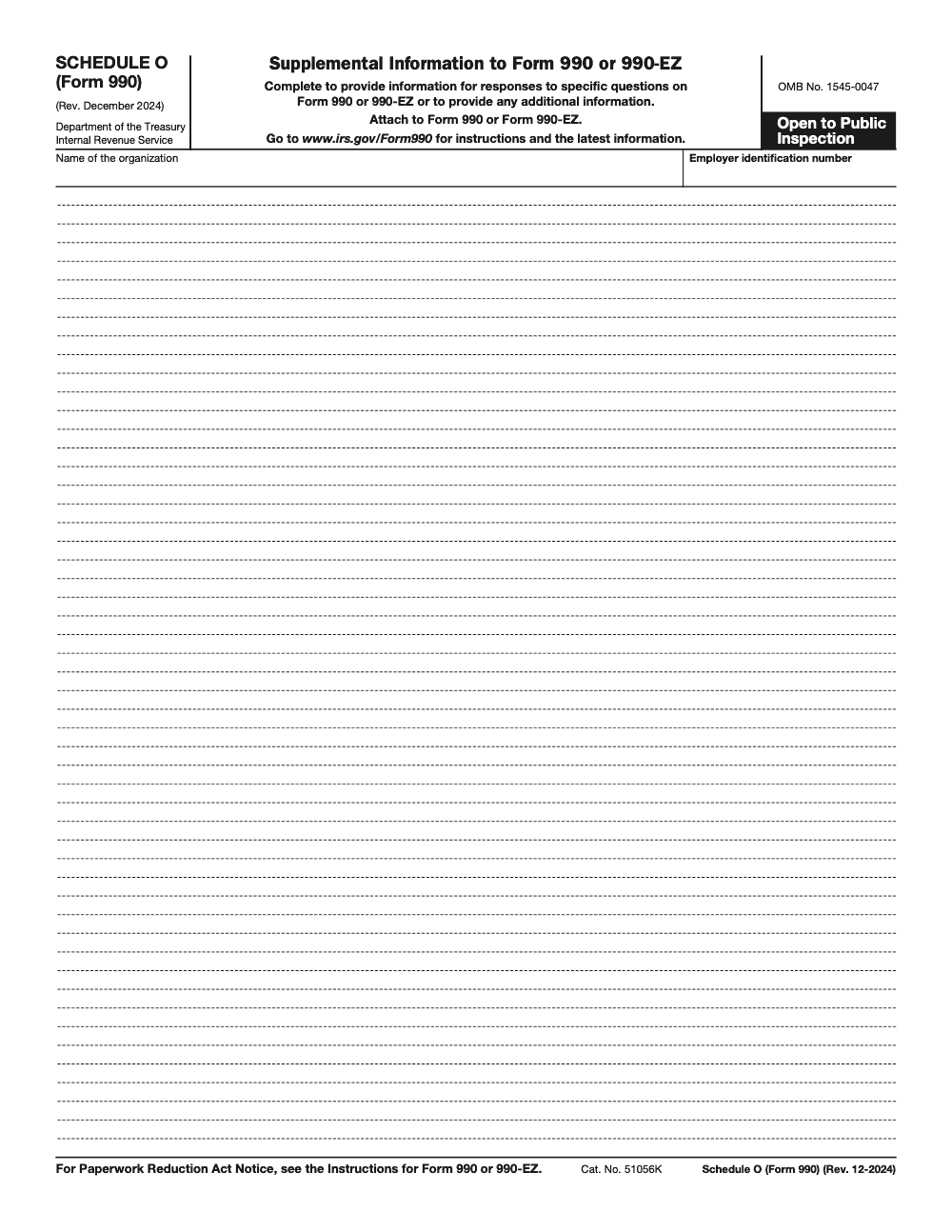
Schedule O (Form 990) is the narrative attachment for Form 990 and Form 990-EZ, where filers explain the answers the core return cannot fully hold. Every Form 990 filer must complete it, at minimum for Part VI line 11b (the process used to review the 990) and line 19 (public availability of governing documents), according to the IRS Form 990 instructions. For calendar-year 2025 filers it is due May 15, 2026 with the parent return, and Form 8868 extends that to November 16, 2026. When narrative volume outpaces your review bandwidth, our tax preparation team can carry the load.
Schedule O is where a reviewer's questions either stop or multiply. It is the narrative attachment for Form 990 and 990-EZ, the place to explain answers the core return cannot hold on its own, and every Form 990 filer has to use it at minimum for Part VI, line 11b, the process used to review the 990, and line 19, public availability of governing documents.
The discipline is small and specific: each paragraph cites the exact part and line, quantifies amounts, and stays factual enough to match the return. Because the 990 is public, no SSNs or sensitive personal data belong here. For calendar-year 2025 filers it is due May 15, 2026 with the parent return, and Form 8868 extends that to November 16, 2026.
Key Takeaways
- Schedule O is the narrative attachment for Form 990 and 990‑EZ, used to centralize explanations the core form requests, especially governance and program details.
- Every Form 990 filer must use Schedule O, at minimum for Part VI, lines 11b and 19, and many 990‑EZ filers must use it when lines ask for explanations.
- Due date matches the main return, generally the 15th day of the fifth month after year‑end, for example May 15 for calendar‑year filers, and electronic filing is required.
- Each paragraph should cite the exact part and line, quantify amounts, and stick to short, factual statements that match the return.
- Because the 990 is public, do not include SSNs or sensitive personal data in Schedule O.
What is Schedule O?
Think of Schedule O as your line‑by‑line comment box. You use it to add narrative context where the form says “explain,” with the biggest emphasis on governance, program changes, compensation nuances, and financial reconciliations. For Form 990 filers, you must use Schedule O to describe the review process for the 990, Part VI, line 11b, and how governing documents and policies are made public, Part VI, line 19. The IRS wants each narrative labeled with the exact part and line so agents and state regulators can trace your explanation without hunting.
A quick sanity check:
- You complete the core form first, then write Schedule O entries in the same sequence, and you add as many continuation sheets as needed, repeating the organization name and EIN at the top of every page so the IRS matches each continuation sheet to the right return.
- Keep paragraphs short, precise, and tied directly to the return.
Who must file Schedule O?
Form 990 filers
If you file Form 990, you will file Schedule O. At minimum, you explain how the board or management reviewed the 990 and how you provide public access to governing documents and policies, both in Part VI. If you answer “Yes” or “No” to governance items and the response needs context, you use Schedule O to spell out the facts, such as who reviewed drafts, when, and what changed before approval. Remember that Part VI, Section A also triggers a Schedule O narrative for each “Yes” on lines 2 through 7b and for each “No” on lines 8a, 8b, or 10b, so do not assume only “Yes” answers need explaining.
Tip, answer the governance questions directly on Part VI, then use Schedule O to document the process in real words, names, dates, and outcomes.
Certain 990‑EZ filers
Form 990‑EZ is shorter, but it leans on Schedule O for details. You will use it to list grantees over 5,000, to break out other revenue and other expenses, to describe other assets and total liabilities, and to describe program services that do not fit on the face of the form. The 990‑EZ instructions specifically direct you to provide these details on Schedule O.
Filing requirements and deadlines
- The deadline for Form 990, 990‑EZ, and 990‑PF is the 15th day of the fifth month after your accounting period ends, for example May 15 if you run on a calendar year. You can request a 6‑month extension with Form 8868.
- The IRS requires electronic filing for 2024 and later Form 990 series returns, so your Schedule O will be transmitted with the main return.
Missed or incomplete narratives can trigger IRS questions or processing delays, so treat Schedule O as a core part of the return, not an afterthought.
How Schedule O complements the core 990
The form gives you boxes, totals, and Y/N answers. Schedule O gives you context. You use it to:
- Tie a governance answer to what actually happened, including who reviewed drafts, the approval date, and what changed.
- Describe new, changed, or ceased programs with dates, outputs, and who benefited.
- Explain material swings in net assets, accounting method updates, or audit status changes, and remember that even small reconciling items belong on Schedule O once they appear on Part XI, line 9.
- Itemize “other” categories so reviewers can see the makeup without guessing.
Write for a busy reviewer. One paragraph per line, a specific citation at the start, numbers that tie to the return, and a clear outcome or status at the end.
Step‑by‑step, completing Schedule O for Form 990
You will move faster if you prep in three short passes, gather, map, and write.
Gather the right information
- Identify all items that require narrative explanation across the return, especially Part III program changes, Part VI governance, Part VII compensation details, Part XI reconciling items, and Part XII accounting methods or audits.
- Pull evidence that quantifies each narrative, dates, amounts, headcounts, and decisions, and make sure totals match the core form and statements.
- Note reviewers by name and title for the Part VI review process, and keep minutes on hand in case a regulator asks.
Map lines to explanations
Every paragraph begins with a citation, for example, “Form 990, Part VI, line 11b.” Keep the order aligned with the return so your e‑file prints in a logical sequence. For 990 filers, your common targets include:
- Part VI, lines 11b and 19, review process and public‑disclosure practices.
- Part III, lines 2 to 4d, program changes or significant activities.
- Part VII, related organization compensation or missing data notes.
- Part XI and XII, reconciling changes in net assets and accounting method updates.
Write clear, traceable narratives
Keep paragraphs short, concrete, and verifiable.
- Start with the citation.
- State the action plainly, who, what, when, and why.
- Quantify impact, dollars, counts, dates.
- Close with status, approved date, corrective steps, or where the policy is posted.
Example format “Form 990, Part VI, line 11b. The Finance Committee reviewed the draft Form 990 on April 18, 2025, and recommended approval after revising Part VII to add related organization W‑2 wages. The Board approved the final return on April 25, 2025.”
A quick mapping guide you can copy
| Form part and line | What to include | Numbers to quantify | Common pitfalls |
| Part VI, line 11b | Who reviewed the 990, dates, what changed, approval outcome | Meeting dates, names, counts of edits | Vague “The board reviewed it” with no dates or roles |
| Part VI, line 19 | How governing documents, conflict policy, and financials are made public | URL, office location, date posted | Saying “available upon request” with no process |
| Part III, lines 2–4d | New, changed, or ceased programs with outcomes | Beneficiaries served, units delivered, spend | Mission language with no measurable outputs |
| Part VII, compensation notes | Related org pay, missing figures, outreach steps | Amounts by source, dates requested | Skipping related pay disclosures |
| Part XI or XII | Net assets swings, method changes, audit status | Dollar impact, effective dates | “Changed methods” with no technical detail |
| 990‑EZ Part I, line 8, 10, 16, 20 | Other revenue, grants over 5,000, other expenses, other changes in net assets | Itemized amounts | Lump sums with no breakdown |
| 990‑EZ Part II, lines 24, 26 | Other assets, total liabilities composition | Categories and amounts | No balance sheet detail when requested |
| Sources, IRS Schedule O and 990 instructions. |
Governance, what the IRS expects to see
The IRS ties governance quality to tax compliance, which is why Part VI exists. You should do two things on Schedule O:
- Explain the review process for the 990. Name the people or committee, list dates, and say whether independent members participated. If no review occurred, the instructions allow a “Yes” in limited circumstances when the final was provided to voting members, but you should still describe the facts on Schedule O.
- Clarify policy coverage and public disclosure. If your organization is governed by a parent’s policies, answer the Part VI questions based on your own adoption, then use Schedule O to explain the relationship and practical effect.
Keep it factual and simple, your narratives should read like meeting minutes, not marketing copy.
Step‑by‑step, completing Schedule O for Form 990‑EZ
Treat 990‑EZ like a checklist. Scan for every place the form asks you to explain something, then write one concise paragraph per trigger.
- Part I, disclose unidentified revenue, list grantees over 5,000, and break out other expenses.
- Part II, describe other assets and total liabilities when requested.
- Part III, summarize other program services and significant activities.
- Part V, answer follow‑up questions with facts and corrective steps where needed.
Pro move, draft the 990‑EZ face first, then fill Schedule O in that same order so your e‑file prints cleanly.
Key line items that usually need narratives
Governance disclosures, Part VI
For 990, Part VI, confirm what happened, not what should happen.
- Line 11b, who reviewed the return, when, and what changed before approval.
- Line 19, how governing documents, the conflict policy, and financials are made publicly available, include a URL or physical location and a date.
Program and finance details
Use Schedule O to describe new or changed programs with dates, goals, outputs, and whom you served. For finance, itemize “other expenses” when thresholds or prompts apply, and document material changes in net assets, grants, or releases from restriction. If you changed accounting methods or had audit status changes, say so and include the effective period.
990‑EZ, the common triggers
- Part I, line 8, other revenue description.
- Part I, line 10, list of grants and similar amounts paid over 5,000, include required details.
- Part I, line 16, other expenses itemization.
- Part I, line 20, other changes in net assets.
- Part II, line 24, other assets, and line 26, total liabilities breakdown.
Formatting and organization best practices
- Lead with the citation, “Form 990, Part VI, line 11b.”
- Write one short paragraph per line, stick to plain language.
- Quantify, numbers settle questions faster than adjectives.
- Keep the sequence aligned to the form so the e‑file prints in the right order.
- Do not include SSNs or other sensitive personal data, Schedule O is public.
Common errors and how to avoid them
- Skipping Schedule O entirely, especially for governance, expect an IRS follow up.
- Writing narratives with no citation, reviewers cannot match your text to a line.
- Listing lump sums for “other” categories with no breakdown, which hides the story.
- Using generalities for board review, always include who, when, and what changed.
Quick check before you file, do totals reconcile, are names spelled correctly, are dates consistent across the 990 and Schedule O?
Due dates, extensions, and what happens if you miss them
- Due date is the 15th day of the fifth month after the close of your year. You can request a 6‑month extension on Form 8868, which extends Schedule O along with the parent return, since Schedule O has no separate due date or extension of its own.
- Failure to file for three consecutive years leads to automatic revocation of tax‑exempt status, effective on the original due date of the third missed return. The IRS posts revocations monthly.
If you were revoked and later reinstated, penalty treatment and required back filings vary by path. Review the current revocation guidance before you act.
E‑filing cleanly and avoiding rejections
Electronic filing is required for current Form 990 series returns, so your Schedule O must be complete and sequenced correctly at transmission. Good platforms validate missing narratives and print Schedule O in order, but you still own the quality of the text. If a return is rejected for missing or incomplete Schedule O entries, correct the narratives, keep the order aligned with the form, and retransmit the entire return.
Save your draft, rejection code, corrected text, and the date you retransmit. That paper trail prevents repeat work.
Resources and helpful tools
- IRS instructions for Schedule O and Form 990 are your primary source. Start there for what to include, who must file, and how to format.
- The IRS page on 990 schedules lists current schedules and instruction links in one place.
- If you file 990‑EZ, the grantee list and other narrative prompts are spelled out in the 990‑EZ instructions. Keep that guide open while drafting.
Where disciplined delivery helps, without slowing you down
If you prepare many 990s across busy season, your bottleneck is usually not content, it is delivery. The firms that scale this work build a controlled process for narratives, SOPs for mapping parts and lines, standardized workpapers, a multi‑layer review, and SLAs for turnaround. That is our wheelhouse at Accountably. We integrate trained offshore teams into your workflow, in your software, with structured workpapers and a layered review that protects partner time and prevents deadline slips. This approach keeps Schedule O clean, consistent, and on time, even when volume spikes. Mention us if you need the capacity, otherwise use the same structure in your own team.
A simple Schedule O template you can adapt
Copy this pattern, then swap in your dates, names, and amounts.
Form 990, Part VI, line 11b. The Finance Committee reviewed the draft Form 990 on April 18, 2025. The Committee requested revisions to Part VII to include related‑organization W‑2 wages of 48,250. The Board approved the final on April 25, 2025. Form 990, Part VI, line 19. The organization posts its conflict‑of‑interest policy and audited financial statements at example.org/transparency, updated on March 5, 2025, and makes governing documents available at its office during business hours.
Remember, Schedule O is public, do not include SSNs or sensitive personal details.
Conclusion and next step
Schedule O turns your Form 990 into a clear story the IRS and the public can follow. Build short, factual paragraphs, one per line, that match the return and explain what changed, why it changed, and who approved it. If volume or timing makes this hard to sustain, we can help you shore up the delivery side so your team can focus on the work that needs judgment. Either way, use the structure you have here, and your next 990 will file cleanly, read clearly, and hold up under review.
Small disclosure, this article was prepared with editorial assistance and human review, and it cites current IRS pages for 2024‑2025 guidance to ensure accuracy.
Common Mistakes We See Every Season
Schedule O mistakes rarely come from bad intent, they come from rushing the narrative pass at the end of a 990 engagement. These are the patterns my team flags most often when we review nonprofit returns through our tax preparation work.
Reusable Checklists
These checklists are copy-paste ready for your firm SOPs. Drop them into your 990 workpaper template and work top to bottom, citing the IRS Form 990 and Schedule O instructions as your source.
Schedule O mapping pass
- Confirm a Part VI line 11b narrative describing the process used to review the Form 990, or stating none was used.
- Confirm a Part VI line 19 narrative on how governing documents, the conflict-of-interest policy, and financials are made public.
- Flag every Part VI “Yes” on lines 2 through 7b for a narrative.
- Flag every Part VI “No” on lines 8a, 8b, and 10b for a narrative.
- Describe Part III new, changed, or ceased program services (lines 2, 3, and 4d).
- Explain Part XI line 9 other changes in net assets, including small reconciling items.
- Explain any Part XII accounting-method change (line 1) or audit oversight change (line 2c).
- Add a Part V line 3b explanation if UBI was $1,000 or more and no Form 990-T was filed.
Governance narrative packet
- Name the committee or individuals who reviewed the draft 990, with dates.
- State whether independent voting members participated in the review.
- Record what changed between draft and final approval, and the approval date.
- Describe the conflict-of-interest monitoring process if Part VI line 12c is “Yes.”
- Describe the compensation-setting process for Part VI lines 15a and 15b, including comparability data and contemporaneous substantiation.
- Give the URL or physical location where governing documents and financials are available, with a date.
- List the name and address of any officer, director, or key employee who cannot be reached at the organization mailing address (Part VI line 9).
Pre-transmission review
- Start every entry with its Form, Part, and line citation, for example Form 990, Part VI, line 11b.
- Check the “Schedule O contains a response or note” box on each Part that has a narrative.
- Confirm the organization name and EIN appear at the top of every Schedule O page.
- Reconcile every amount in a narrative to the core return and financial statements.
- Scrub for SSNs and sensitive personal data, since Schedule O is open to public inspection under IRC section 6104.
- Keep Schedule O entries sequenced in the same order as the return so the e-file prints cleanly.
- Confirm the parent return is set to transmit by May 15, 2026, or that Form 8868 was filed for the extension to November 16, 2026.
Keep Schedule O Season From Stalling
Schedule O is where Form 990 season quietly stalls. The core return is mostly boxes and totals, but the narrative pass demands judgment, and it lands right at the May 15 deadline for calendar-year filers, per the IRS Form 990 instructions. When governance, program, and reconciliation explanations all need writing at once, the narrative becomes the bottleneck, not the numbers.
The firms that hold their deadlines treat Schedule O as a structured production step, not a free-text afterthought. They standardize how each part and line maps to a narrative, then run those narratives through the same review discipline as the rest of the return.
- Map the mandatory Part VI line 11b and line 19 narratives into a reusable template so they are never rebuilt from scratch.
- Build a trigger checklist for the “Yes” responses on Part VI lines 2 through 7b and the “No” responses on lines 8a, 8b, and 10b.
- Standardize Part III program-change language and Part XI line 9 reconciliations so amounts always tie to the return.
- Lock a header rule that repeats the organization name and EIN on every continuation page before transmission.
This is exactly the kind of structured, review-protected work our tax preparation services were built to carry. We integrate trained offshore teams into your workflow, with documented SOPs and a multi-layer review, so Schedule O stays clean and on time even when 990 volume spikes.
FAQs
If you file Form 990, you must file Schedule O. If you file Form 990‑EZ, you must attach Schedule O whenever the form asks for explanations, for example grantees over 5,000, other revenue or expenses, and program descriptions. 990‑N filers do not use Schedule O.
Vague or missing governance narratives, no breakdowns for “other” categories, and narratives that do not match the return. Fix this by citing the part and line, quantifying amounts, and keeping the order aligned with the form.
Churches and certain church‑related organizations, some governmental units, and private foundations file 990‑PF instead. Small organizations eligible for 990‑N follow different rules. Always confirm your status before skipping a 990.
If you fail to file for three consecutive years, your exemption is automatically revoked as of the original due date of the third return. Reinstatement is possible, but it takes time and documentation.
Other forms this guide names
- Form 990: Nonprofit Tax Return Filing Guide 2025
- Form 990‑EZ: Eligibility, Deadlines, E‑File, Schedules
- Form 990‑T: UBTI Filing Guide, Schedule A, Deadlines, E‑file
- Form 8868: Extension for Exempt Organization Returns
- Form W‑2: Deadlines, E‑File Rules, Boxes, and W‑2c Corrections
- Form 990‑PF: Filing Guide, Payout, E‑File
Summarize this article with AI
About this guide
Accountably helps US CPA, EA, and accounting firms hire trained accountants and tax preparers in India.
About us Reviewed byJugal Thacker, CPAFounder and CEO at Accountably
A Washington-licensed CPA with 7+ years inside US firms – PwC, a real-estate tax practice, then a full-service firm, rising from reviewer to manager to advisory. This article was reviewed against current IRS guidance for the 2025 tax year and updated for filers preparing late returns, amendments, and 2026 estimates.
View profile →How we research, review, and update this guide
Every Accountably guide is researched against primary IRS sources, reviewed by a U.S. CPA, and refreshed as guidance evolves. Read our Editorial Guidelines to see how we source, fact-check, and update our content.