Summarize this article with AI
In Brief
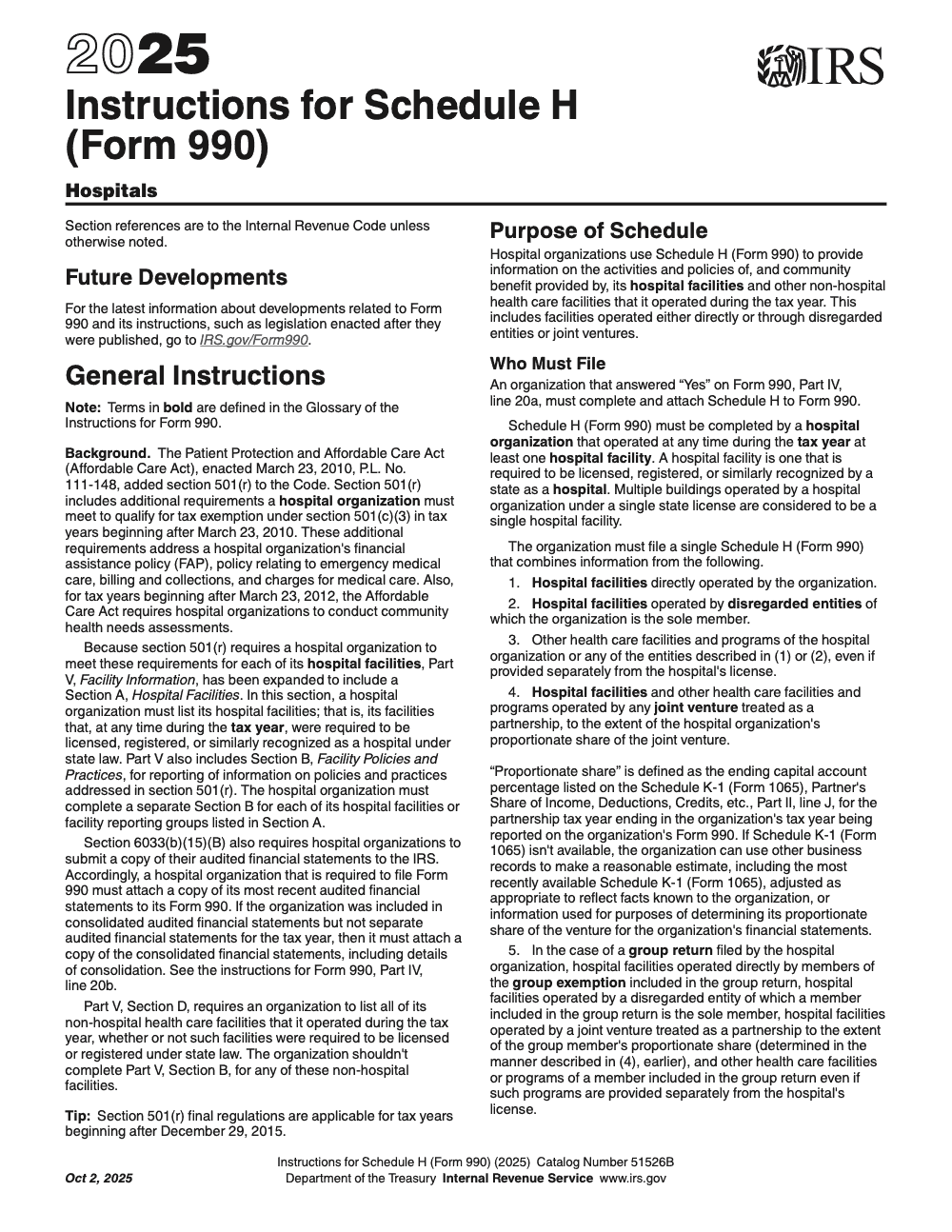
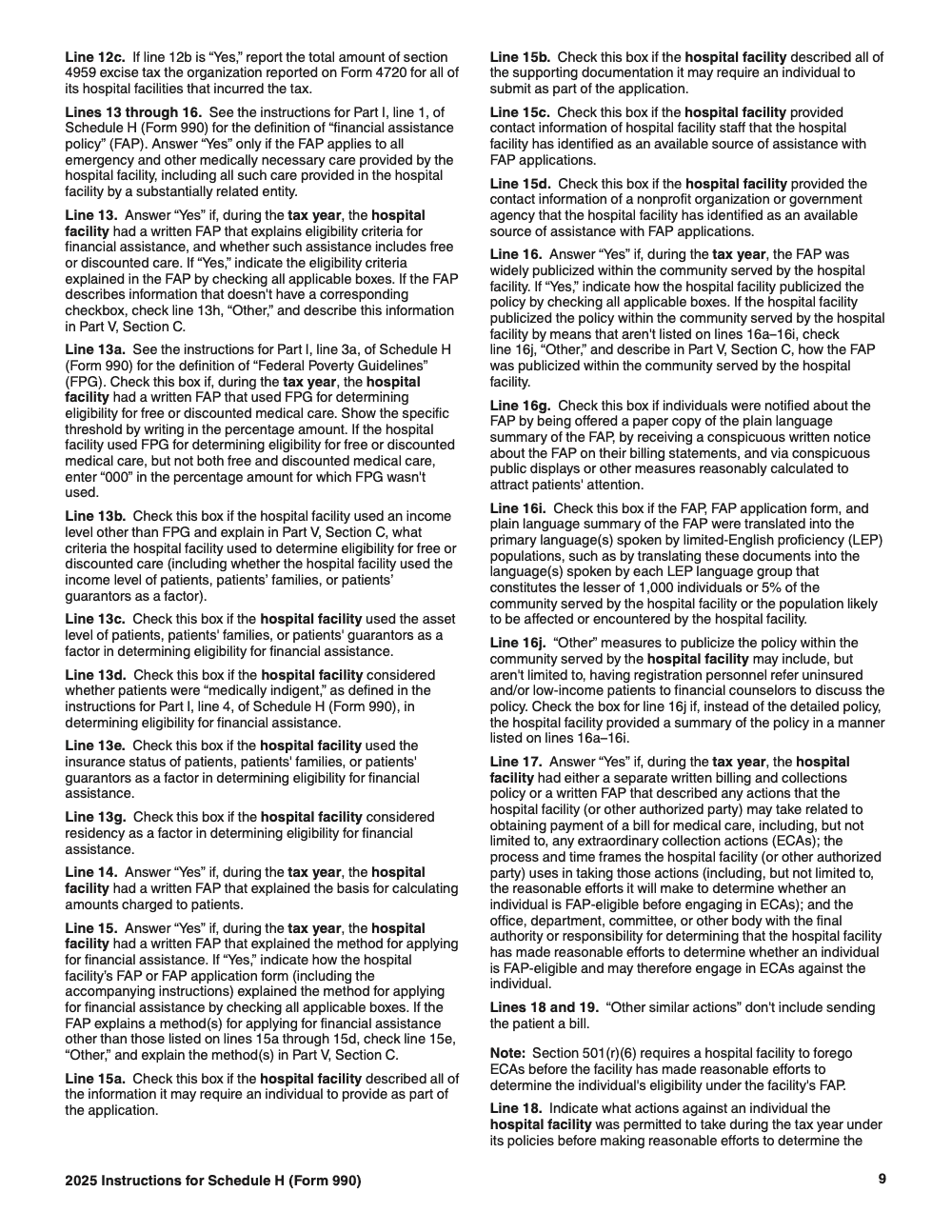
Form 990 Schedule H is filed by 501(c)(3) hospital organizations that operated at least one state-licensed hospital facility during the tax year, triggered by a Yes answer on Form 990, Part IV, line 20a (per the 2025 Instructions for Schedule H, IRS Catalog Number 51526B, revised October 2, 2025). Each facility must conduct a Community Health Needs Assessment at least once every 3 years and adopt a written implementation strategy, or face a $50,000 section 4959 excise tax per facility reported on Form 4720.
For each hospital facility, Schedule H treats the written implementation strategy as a requirement separate from the Community Health Needs Assessment, and completing the CHNA without adopting a strategy can trigger the same $50,000 section 4959 excise tax per facility per tax year as missing the CHNA itself.
Form 990 Schedule H is filed by 501(c)(3) hospital organizations that operated at least one state-licensed hospital facility during the tax year, triggered by a Yes answer on Form 990, Part IV, line 20a. Each facility must conduct a CHNA at least once every 3 years, and section 501(r) also requires a written financial assistance policy, a written emergency medical care policy, a limitation on charges, and compliant billing and collections.
Key Takeaways
- You must file Form 990 Schedule H if your exempt organization operated at least one state licensed hospital facility during the tax year. That includes facilities you run directly, through disregarded entities, and your proportionate share of hospital joint ventures taxed as partnerships.
- Section 501(r) requirements apply at the facility level. You need a written FAP, a written emergency medical care policy, a limitation on charges method, and compliant billing and collections, and you must complete a CHNA on the required cycle and adopt a written implementation strategy for each facility (the CHNA alone does not satisfy section 501(r)(3); the implementation strategy is a separate requirement).
- Schedule H contains six parts that cover community benefit costs, community building, bad debt and Medicare, related entities, facility level 501(r) compliance, and narrative explanations in Part VI. Use consistent, auditable costing methods and describe them clearly.
- Missing a CHNA, or completing the CHNA without adopting an implementation strategy, can trigger a $50,000 excise tax per facility per tax year (both steps are independently required under section 501(r)(3), and failing either one triggers the same tax), so track by facility, not just system wide.
- Charity care in Part I is free or discounted care under your FAP. It excludes bad debt, self pay discounts, contractual adjustments, and payer shortfalls.
What Schedule H Is, And Why It Matters
Schedule H is how tax exempt hospital organizations explain, with numbers and plain language, how they serve their communities and how each hospital facility meets section 501(r). It asks you to quantify financial assistance and other community benefit at cost, separate community building, report bad debt and Medicare, and answer facility level questions about CHNA, FAP, emergency care, limitation on charges, and billing and collections. You use Part VI to add the narrative that ties methods and exceptions together.
The law expects hospitals to operate for community benefit. To be treated as a 501(c)(3) hospital organization, each facility needs a written Financial Assistance Policy and emergency medical care policy, must limit charges for FAP eligible patients, must follow compliant billing and collections, and must complete a Community Health Needs Assessment on a set cadence with an implementation strategy.
Who Must File, And What To Include
If you checked Yes on Form 990, Part IV, line 20a because you operated at least one hospital facility, you must attach Schedule H. A hospital facility is any site the state requires to be licensed, registered, or similarly recognized as a hospital. Include facilities you operate directly, facilities operated by a disregarded entity you solely own, and your proportionate share of hospital joint ventures treated as partnerships. For partnerships, use the ending capital account percentage listed on Schedule K-1 (Form 1065), Part II, line J.
Group return filers combine all member hospital facilities on a single Schedule H and identify subordinate operators and EINs as required. Exclude hospitals outside the United States from Parts I through III and Part V, and use Part IV or Part VI if a foreign joint venture needs context. List non hospital health care sites in Part V, Section D (do not complete Section B for these sites; Section B applies only to state licensed hospital facilities).
Why The Facility Lens Matters
Section 501(r) is enforced facility by facility. A strong system policy does not excuse a single facility that misses CHNA timing or fails to post its FAP properly. A CHNA failure, or a failure to adopt an implementation strategy after the CHNA, can trigger a $50,000 excise tax per facility per tax year, even when other facilities are compliant. Track adoption dates, website links, and implementation strategies by facility, then keep screenshots and board minutes with your workpapers.
The Six Parts Of Schedule H, At A Glance
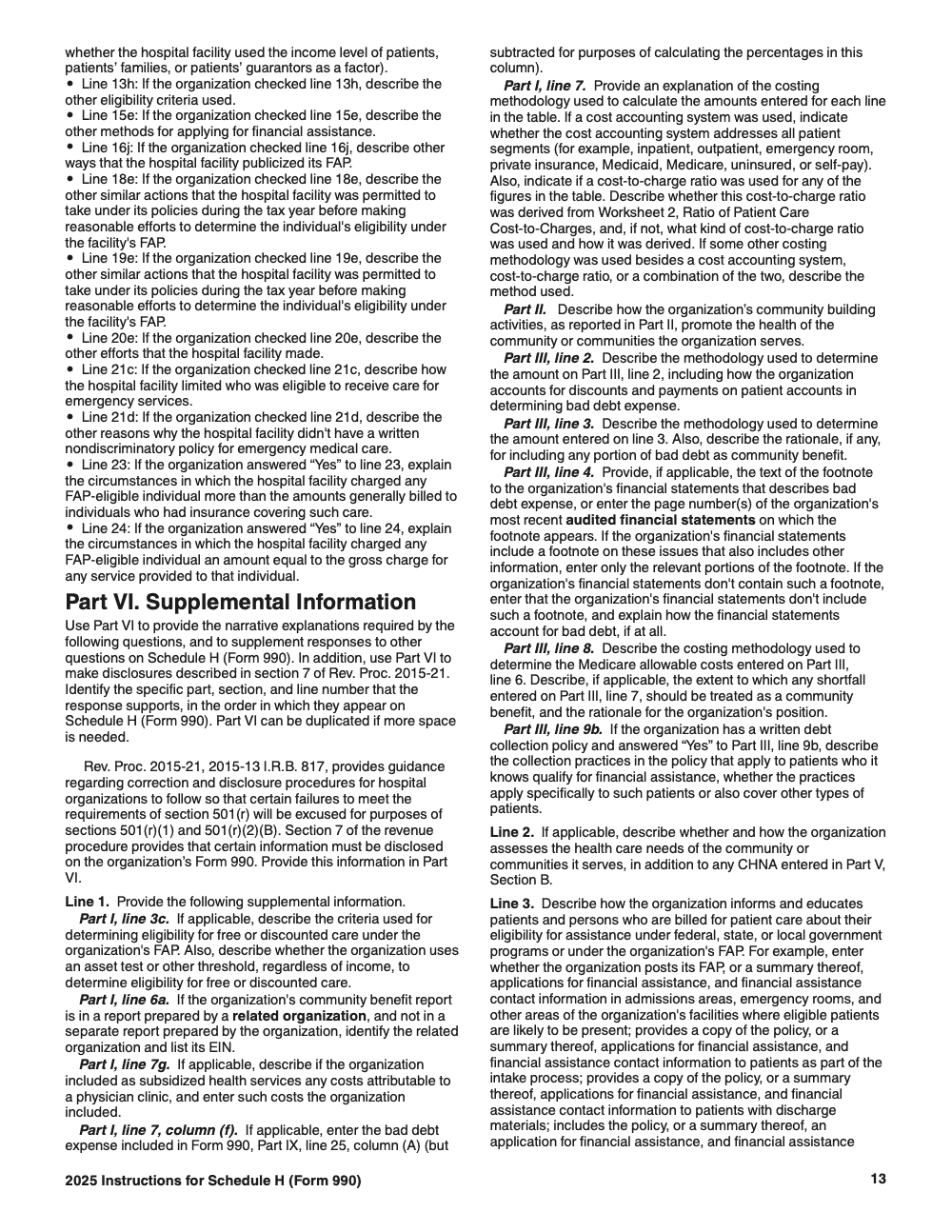
- Part I, Financial Assistance and Certain Other Community Benefits at Cost, confirm your FAP status, then report persons served, total expense, offsets, net expense, and percent of total. Use a consistent costing method and keep the worksheets that back it up.
- Part II, Community Building Activities, report non patient care efforts that improve community health, such as housing or environmental work, without double counting them as community benefit.
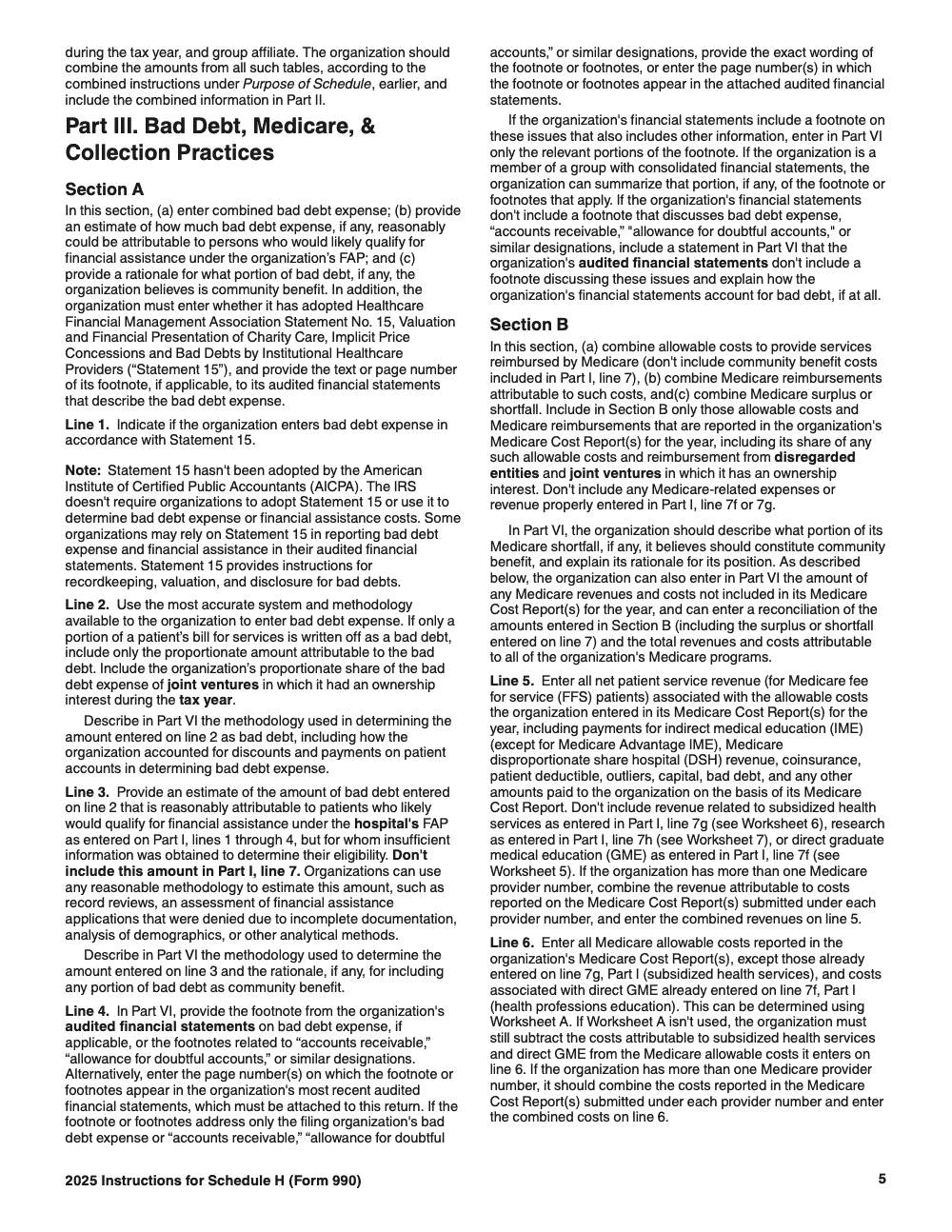
- Part III, Bad Debt, Medicare, and Collection Practices, report total bad debt expense, estimate the portion likely FAP eligible, disclose Medicare revenue and allowable costs, and confirm a written collections policy. Explain your methods in Part VI.
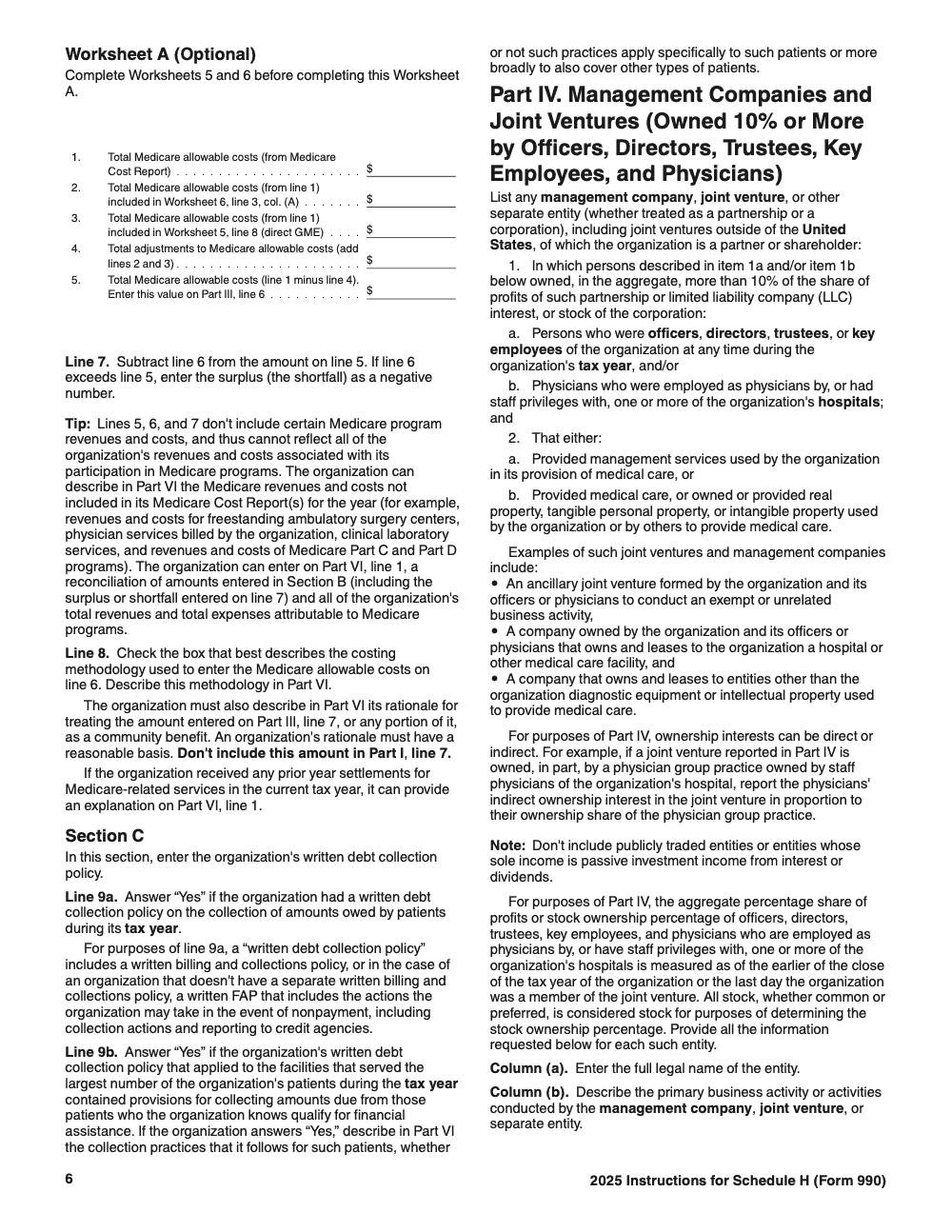
- Part IV, Management Companies and Joint Ventures, list entities where covered persons hold at least 10 percent, including indirect tiers, and state activity and ownership.
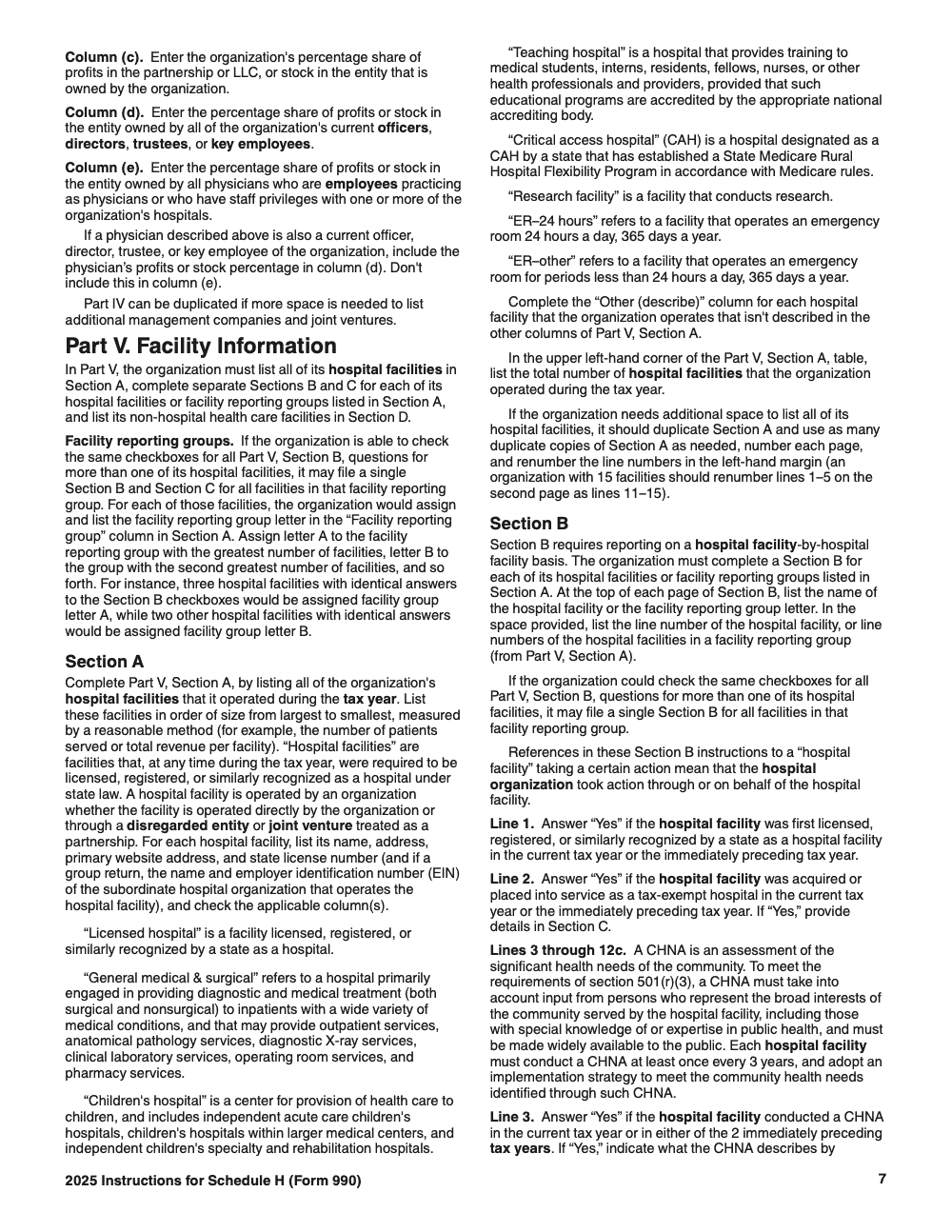
- Part V, Facility Information, list each hospital facility and answer yes or no on CHNA, FAP, emergency care, limitation on charges, and billing and collections, then add facility specific explanations.
- Part VI, Supplemental Information, spell out your costing method, your bad debt estimation method, policy applications, exceptions, and related party clarity.
Think of Part VI as your control room. A reviewer should be able to trace every key number back to a method you describe here.
Part I, Financial Assistance And Community Benefit At Cost
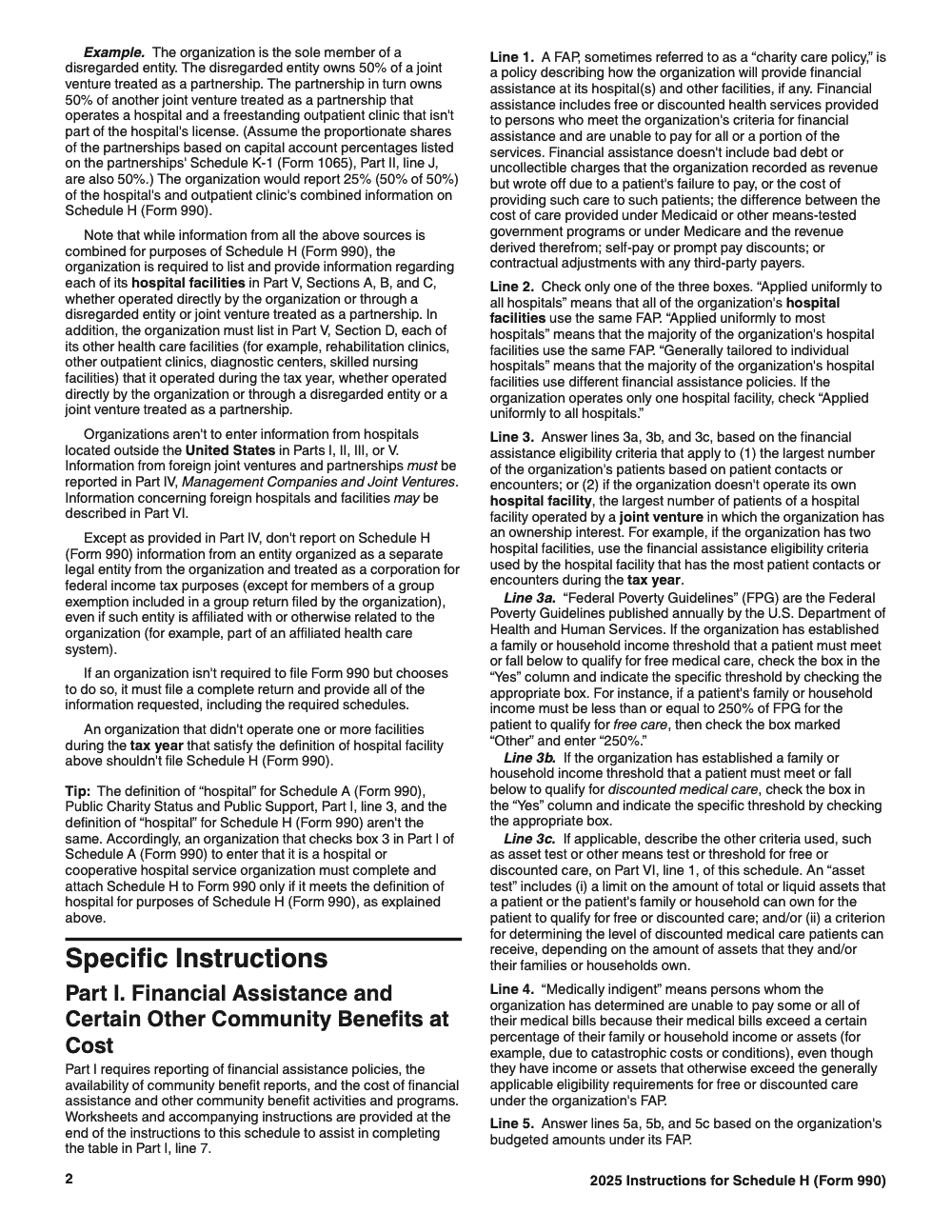
Start with your Financial Assistance Policy. Confirm it is board approved, identify the policy that covers the largest number of patients, and state whether the policy is uniform across all facilities or varies by facility. Financial assistance, often called charity care, means free or discounted services provided under your FAP. It does not include bad debt, payer shortfalls, self pay discounts, or contractual adjustments. Those belong elsewhere on the form.
FAP Eligibility And Thresholds
Disclose eligibility thresholds tied to the Federal Poverty Guidelines, and show whether free or discounted care applies at specific percentages, for example 200 percent or 250 percent of FPG. If you apply asset tests or medically indigent criteria, describe them in Part VI. Make sure the numbers in Part I match what your posted policy says, and what your staff actually applies.
Keep Charity Care Clean
Do not mix charity care with items the IRS excludes. Bad debt you write off after recording charges stays out of Part I. The gap between cost and reimbursement from Medicaid or Medicare stays out of charity care. Self pay or prompt pay discounts and contractual adjustments also stay out. Keep the definition tight so your totals are credible.
Costing Methods That Pass Review
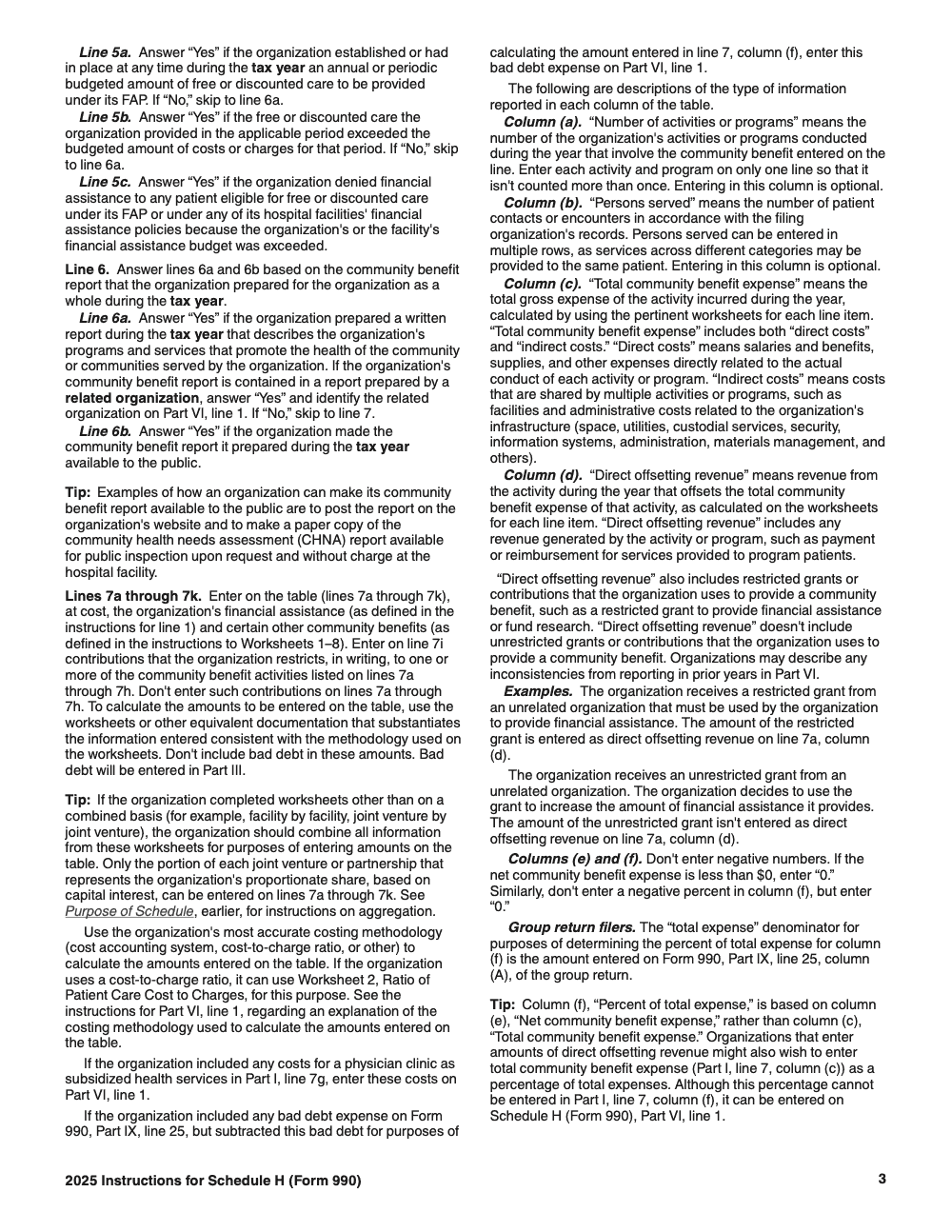
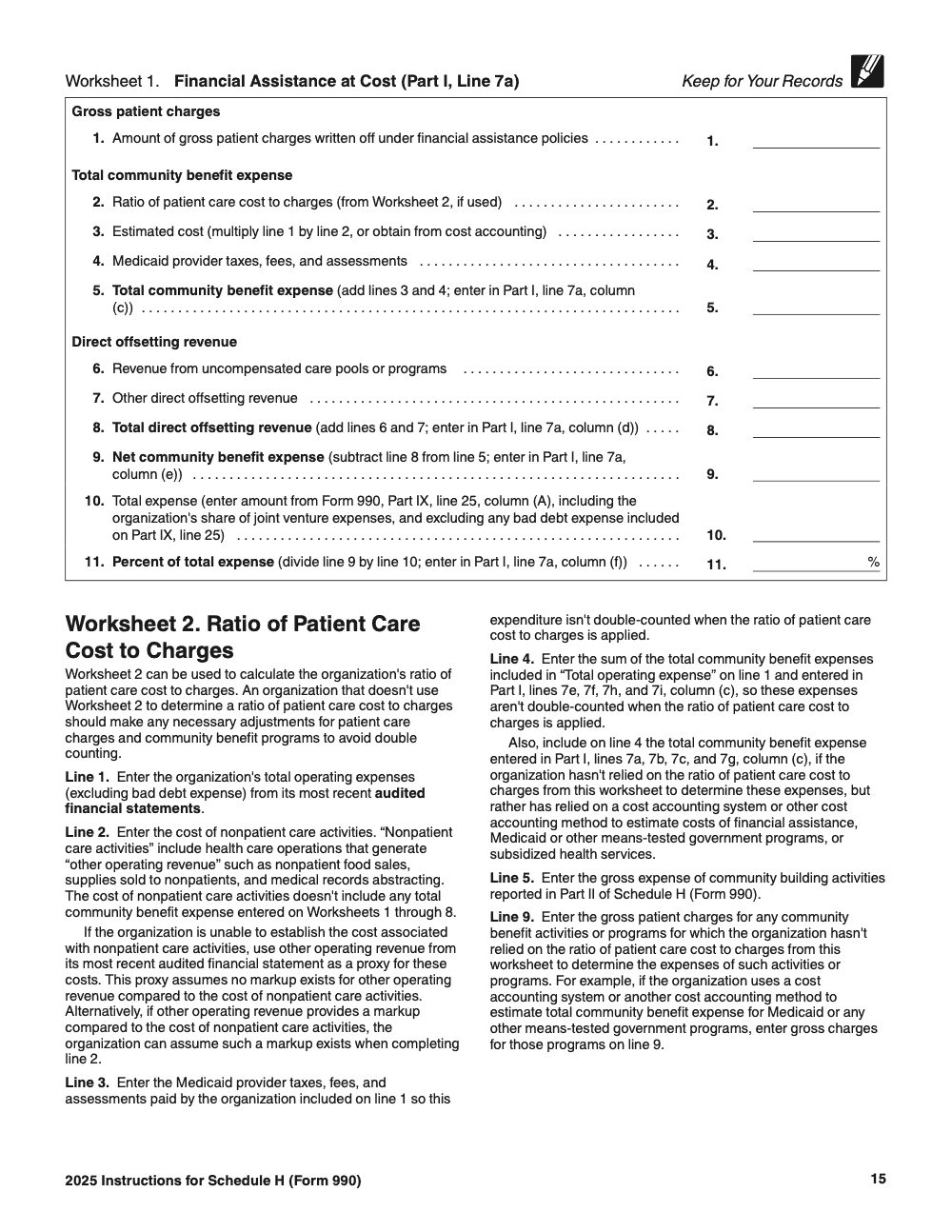
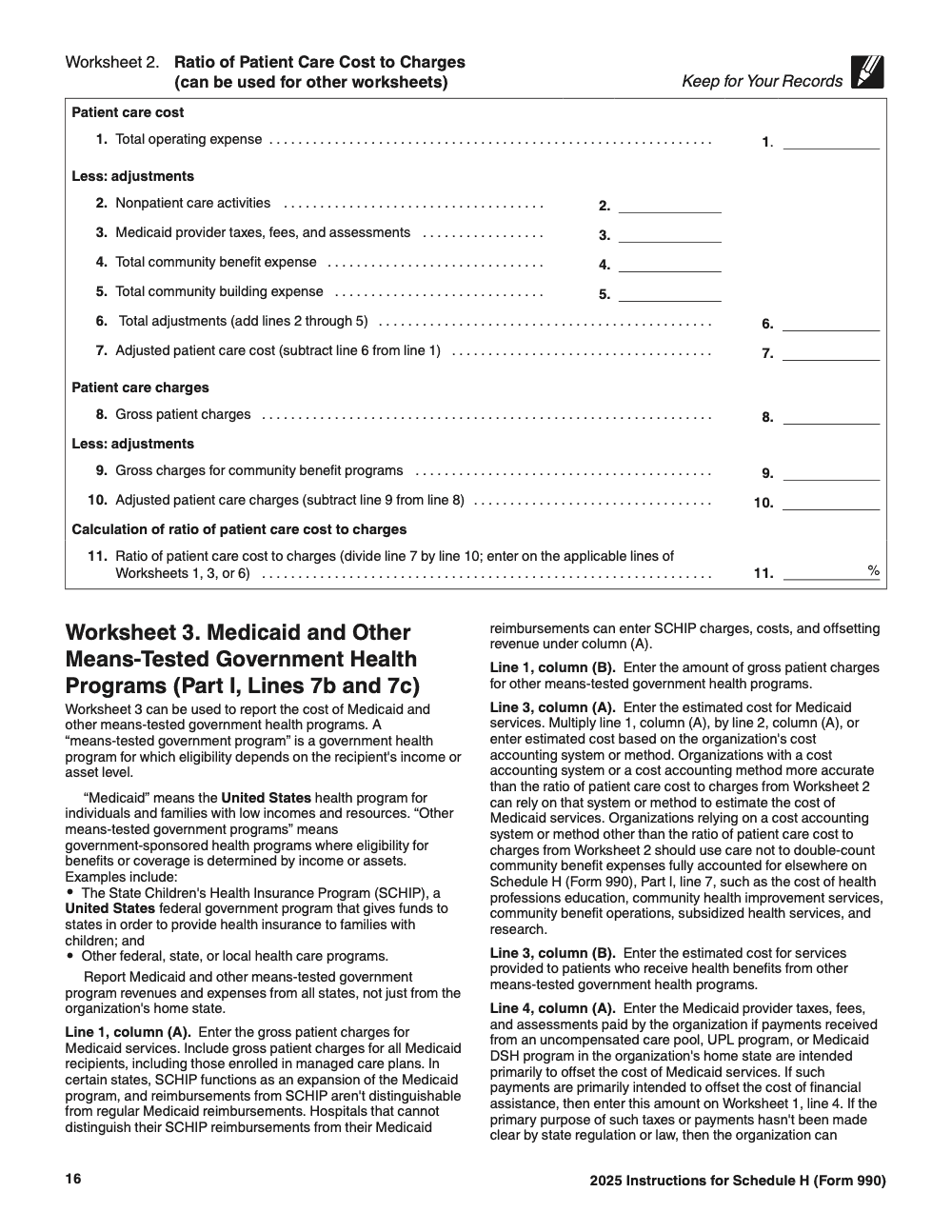
Report at cost, not at charges. Acceptable methods include a cost accounting system, a cost to charge ratio, a blend of both, or another reasonable method applied consistently. Capture both direct expenses and allocable indirect costs, retain the worksheets, and combine facility or joint venture tabs properly for the filed totals using proportionate shares.
H4: A Simple Way To Organize Line 7
| Step | What You Do | Evidence To Keep |
| 1 | Pick a costing method and lock it for the year | Policy memo, rationale, sample calc |
| 2 | Map programs to accounts and time | Ledgers, time studies, program logs |
| 3 | Allocate shared costs on a rational driver | Allocation bases, calculations |
| 4 | Reconcile to GL totals and policy limits | Crosswalks, board approvals |
Explain any significant estimates and subsidized service allocations in Part VI so a reviewer can follow your judgment calls.
Community Benefit Reporting Tips
- Align your internal definitions to the IRS definitions in the Line 7 worksheets.
- Reconcile charity care back to FAP logs and approval lists, and keep copies that match your website policy.
- Validate persons served counts with a documented method rather than loose estimates.
Part II, Community Building Activities
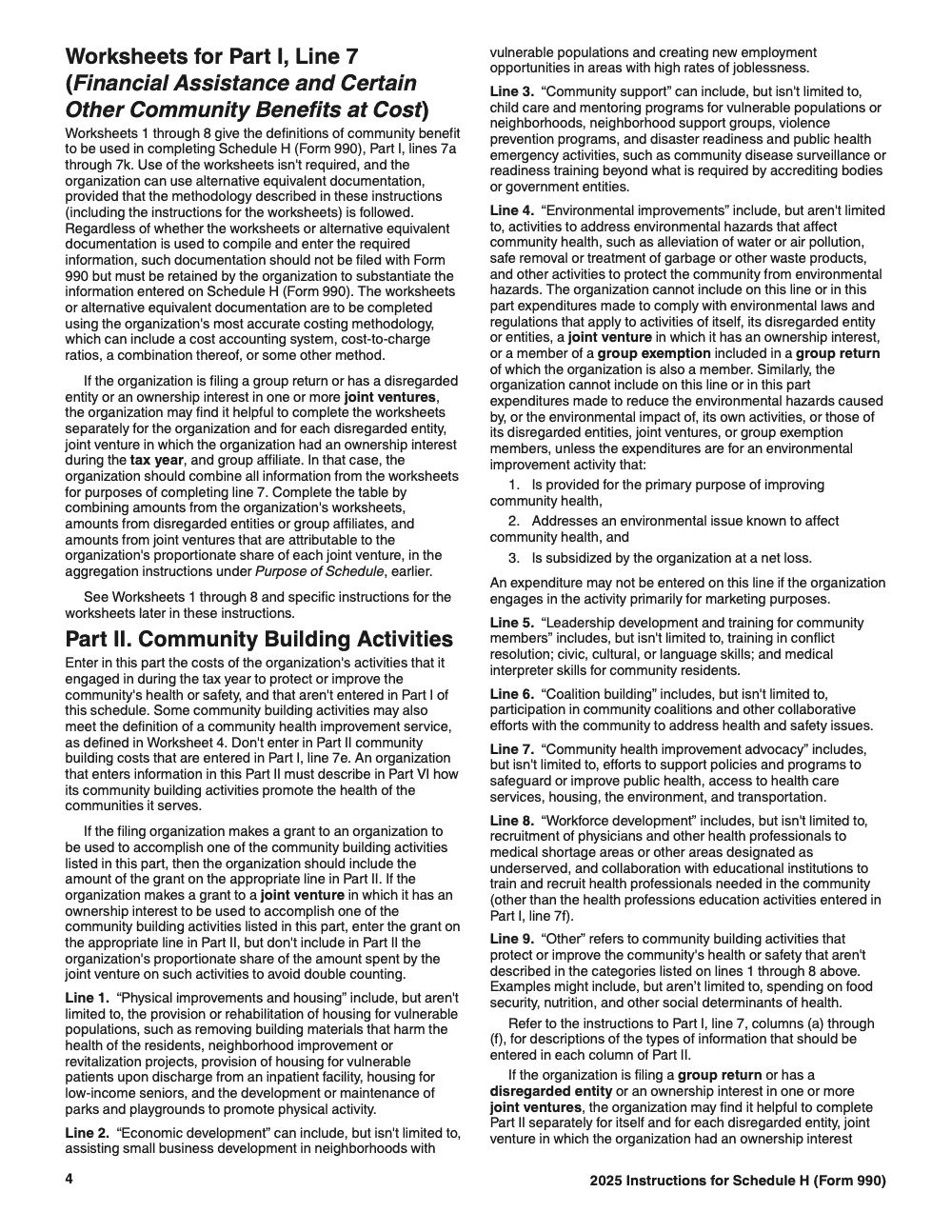
Part II captures community building work that improves community health without being direct patient care. Examples include housing initiatives, economic development partnerships, environmental improvements, and advocacy tied to your CHNA findings. Report the number of programs, optional persons served, total expense, offsetting revenue, and net expense. Keep documentation that ties each activity back to identified community needs, usually through your CHNA, and use Part VI to explain why the activity qualifies.
Community building matters, but do not double count it as community benefit in Part I. Keep the categories clean and the support tight.
Part III, Bad Debt, Medicare, And Collection Practices
In Section A, report total bad debt expense using the most accurate system and methodology available to the organization, then estimate the portion reasonably attributable to patients who likely would have qualified under your FAP. Describe your estimation method in Part VI, for example account reviews or documented presumptive charity models, so a reviewer can understand your logic.
In Section B, report Medicare patient revenue, allowable costs, and the resulting surplus or shortfall, and tie amounts to allowable costs, not gross charges. In Section C, confirm the existence of a written billing and collections policy, including how you use agencies, credit reporting, or legal actions, and align this with Part V answers at the facility level.
Align data and methods across facilities, then cross reference Part VI so anyone can follow each number to its source.
Part IV, Management Companies And Joint Ventures
Part IV shines a light on entities tied to your hospital operations where insiders hold meaningful interests. You will disclose any management company, joint venture, or similar entity in which an officer, director, trustee, key employee, or physician owns 10 percent or more, including indirect interests through tiers. For each entity, you will list the name, the primary activity, and the exact ownership or profit share. For partnerships, use the ending capital account percentage listed on Schedule K‑1 (Form 1065), Part II, line J.
This section protects your organization and your board by making relationships clear. It also gives a reviewer the context to see how those relationships affect your exempt purpose, community benefit programs, and operations. If ownership tiers make the math messy, aggregate interests carefully and explain your calculation in Part VI so your logic is easy to follow.
A Practical Checklist For Part IV
- Build a current inventory of management companies, JVs, and similar entities that touch hospital operations.
- Ask insiders to disclose direct and indirect ownership, then validate with source documents.
- Capture the activity description in clear language, avoid jargon.
- Tie partnership percentages to K‑1s, archive them with your workpapers, and note any estimates you used.
- Flag foreign joint ventures for a short explanation in Part VI, even if the facility itself is not in the United States.
When in doubt about whether an interest is reportable, document your analysis in Part VI. A short, factual note beats an unanswered question later.
Part V, Facility Information And 501(r) Compliance
Part V is your facility by facility compliance map. In Section A, list each hospital facility with the address, license details, and website. In Section B, answer yes or no for each facility on your Community Health Needs Assessment, Financial Assistance Policy, limitation on charges, billing and collections, and emergency medical care policy. Use Section C to give targeted explanations tied to those responses. In Section D, list your non hospital health care sites.
The most common pitfall here is assuming a strong system policy covers every hospital. It only counts if each facility can show its own CHNA cycle, its own policy postings, its own limitation on charges method, and its own billing and collections compliance. Keep your proof in a place anyone on the team can find quickly.
Facility Posting And Policy Checklist
| Item | What To Confirm | Where It Lives |
| CHNA and implementation strategy | Completed on cycle, adopted by the board, posted and easy to find | Public website, board minutes, policy library |
| Financial Assistance Policy | Eligibility thresholds, application process, AGB method, list of providers covered, translations | Website, admissions materials, patient financial services |
| Emergency medical care policy | Applies to emergency conditions, available publicly | Website, ED protocols |
| Limitation on charges | AGB method documented, rates applied to FAP eligible accounts | Policy memo, billing system settings |
| Billing and collections | Extraordinary actions defined, agency use governed, timelines followed | Written policy, vendor contracts |
| Facility mapping | Each hospital facility tied to the legal operator and EIN | Part V, Section A working list |
Tip, test every policy link from an outside network, and take dated screenshots for your workpapers. That way, if a link changes during the year, you still have proof of posting at the time of filing.
Part VI, Supplemental Information That De‑Risks Your Filing
Part VI is your narrative control room. Tie each explanation to a specific line reference so reviewers can follow your trail. At a minimum, include:
- Your costing methodology for Part I, and how you allocate shared costs.
- Your bad debt estimation method for Part III, including data sources and steps.
- Any policy applications that vary by facility, for example different FAP thresholds.
- Clarifications for joint venture proportional reporting and ownership calculations.
- Rationale for community building classifications and any unusual items.
Keep each narrative short, factual, and anchored to documents you can produce on request. Your goal is to remove ambiguity, reduce back‑and‑forth, and make your numbers easy to trust.
Common Mistakes, And How To Prevent Them
The checklists below are copy-paste ready for your Schedule H SOP. They mirror the sequence our reviewers follow before a hospital Form 990 is cleared for sign-off.
CHNA cycle and implementation strategy review
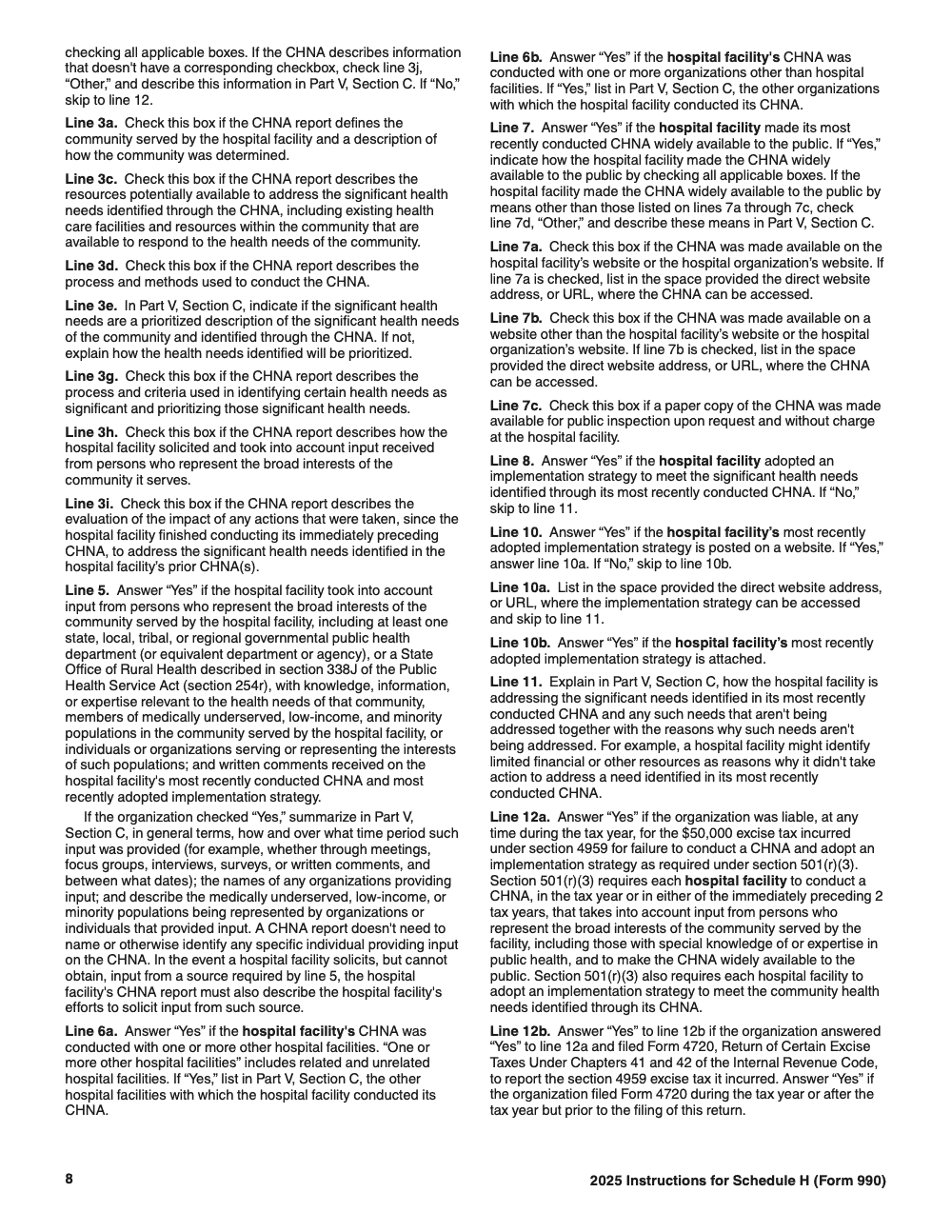
- Confirm each hospital facility conducted a CHNA in the current tax year or one of the 2 immediately preceding tax years (Part V, Section B, Line 3).
- Confirm a written implementation strategy was adopted (Section B, Line 8) and posted to a public website (Line 10) for every facility.
- Document input solicited from a governmental public health department, a State Office of Rural Health (Public Health Service Act sections 338J and 254r), and medically underserved, low-income, and minority populations.
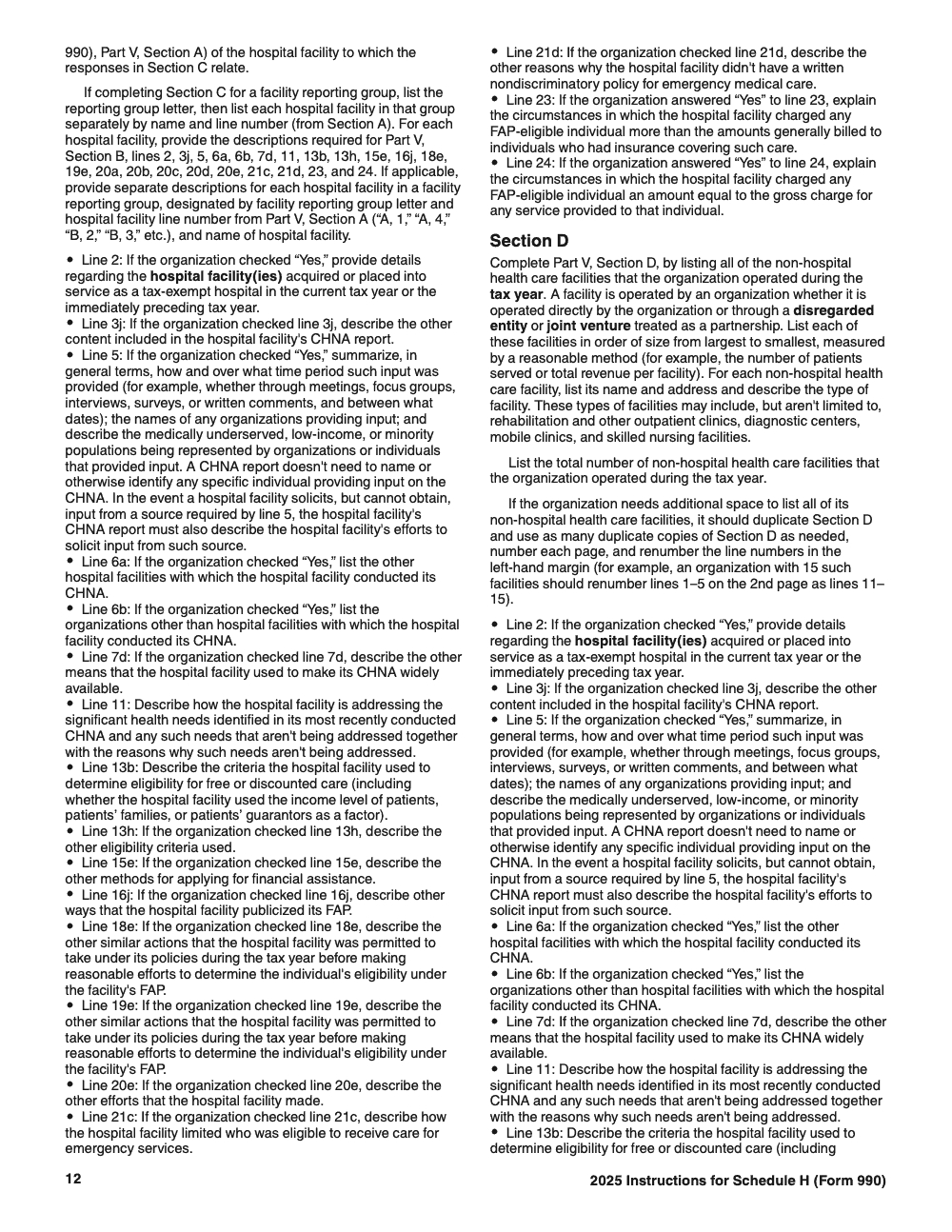
- If input could not be obtained from a required source, capture the facility's solicitation efforts in the CHNA report for the Section C narrative on Line 5.
- Verify no $50,000 section 4959 excise tax is owed on Line 12a; if owed, confirm Form 4720 was filed (Line 12b) and the amount appears on Line 12c.
- File the CHNA report, board approval minutes, and website screenshots in the workpapers, organized by facility and reporting group letter.
FAP and 501(r) policy verification
- Confirm the written FAP explains eligibility criteria (Line 13), the basis for amounts charged (Line 14), the application method (Line 15), and is widely publicized in the community (Line 16).
- Verify the FAP applies to all emergency and other medically necessary care provided in the facility, including care by substantially related entities.
- For Line 16i translation, confirm FAP documents are translated for any Limited English Proficiency group meeting the lesser of 1,000 individuals or 5 percent of the community served.
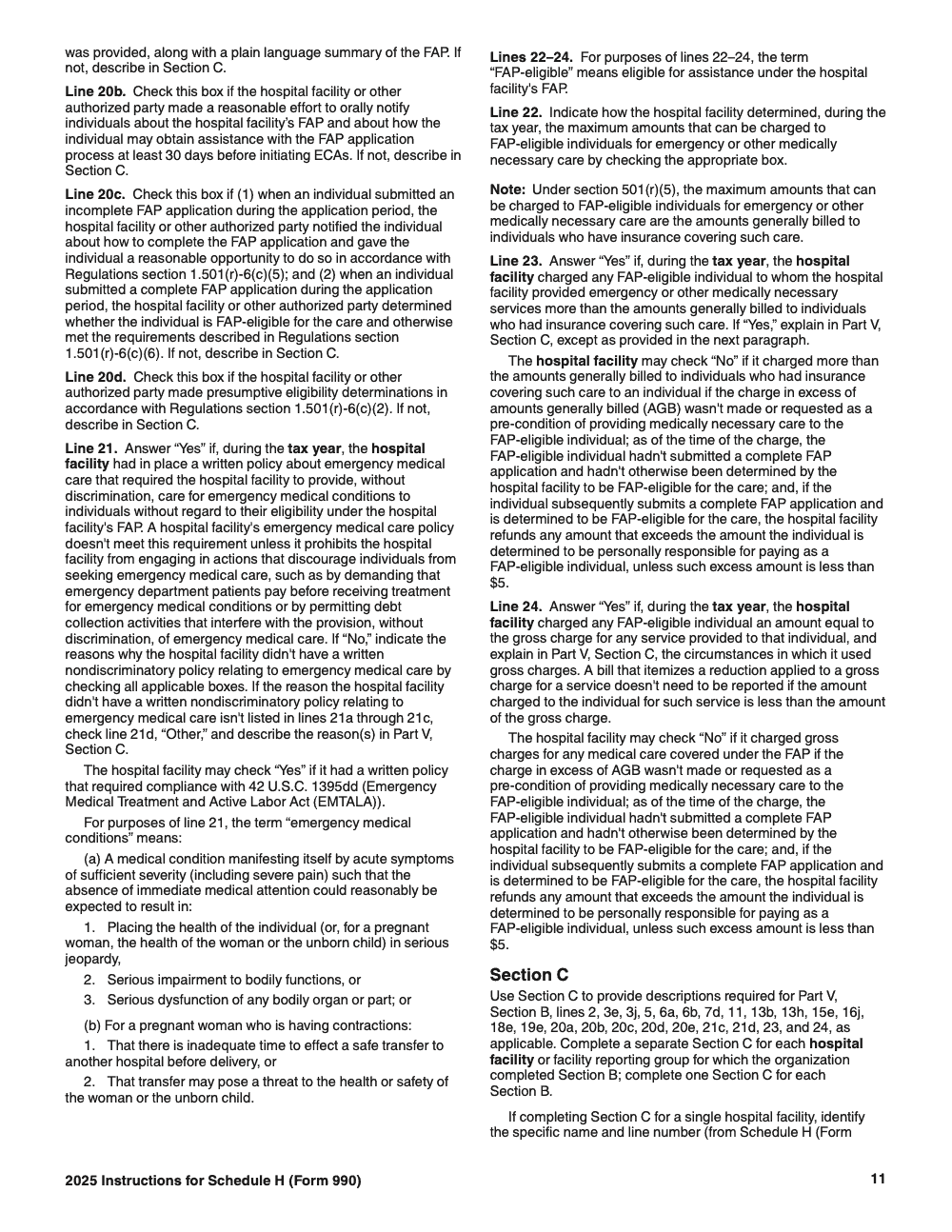
- Document the AGB method on Line 22, reconcile that FAP-eligible individuals were not charged more than AGB (Line 23) or gross charges (Line 24), and refund any excess above $5.
- Confirm the written emergency medical care policy on Line 21 prohibits actions that discourage emergency care; a policy requiring 42 U.S.C. 1395dd (EMTALA) compliance satisfies the requirement.
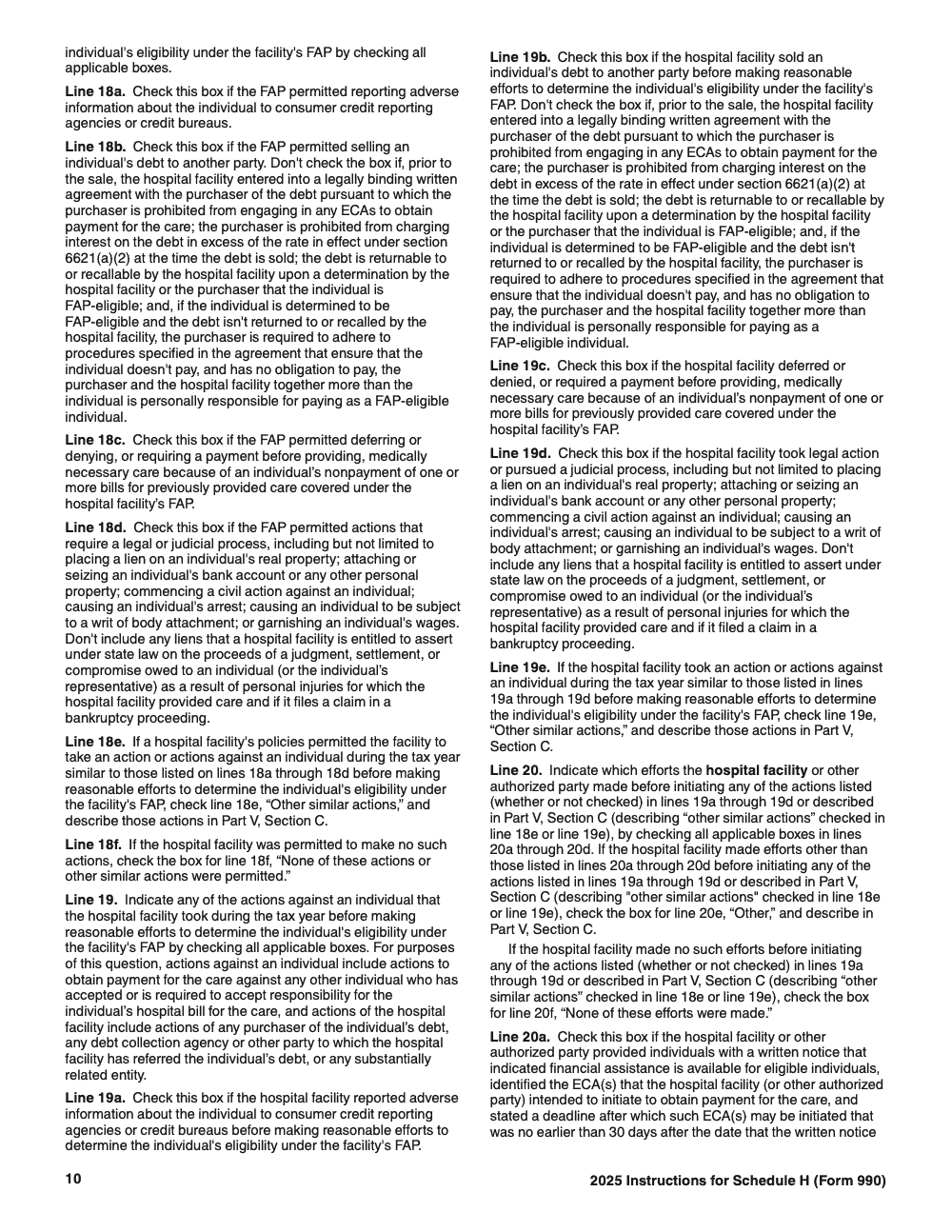
- For every Extraordinary Collection Action taken under Line 19, confirm written FAP-availability notice was provided at least 30 days before initiation, plus an oral notification effort within the same window.
Part I community benefit costing tie-out
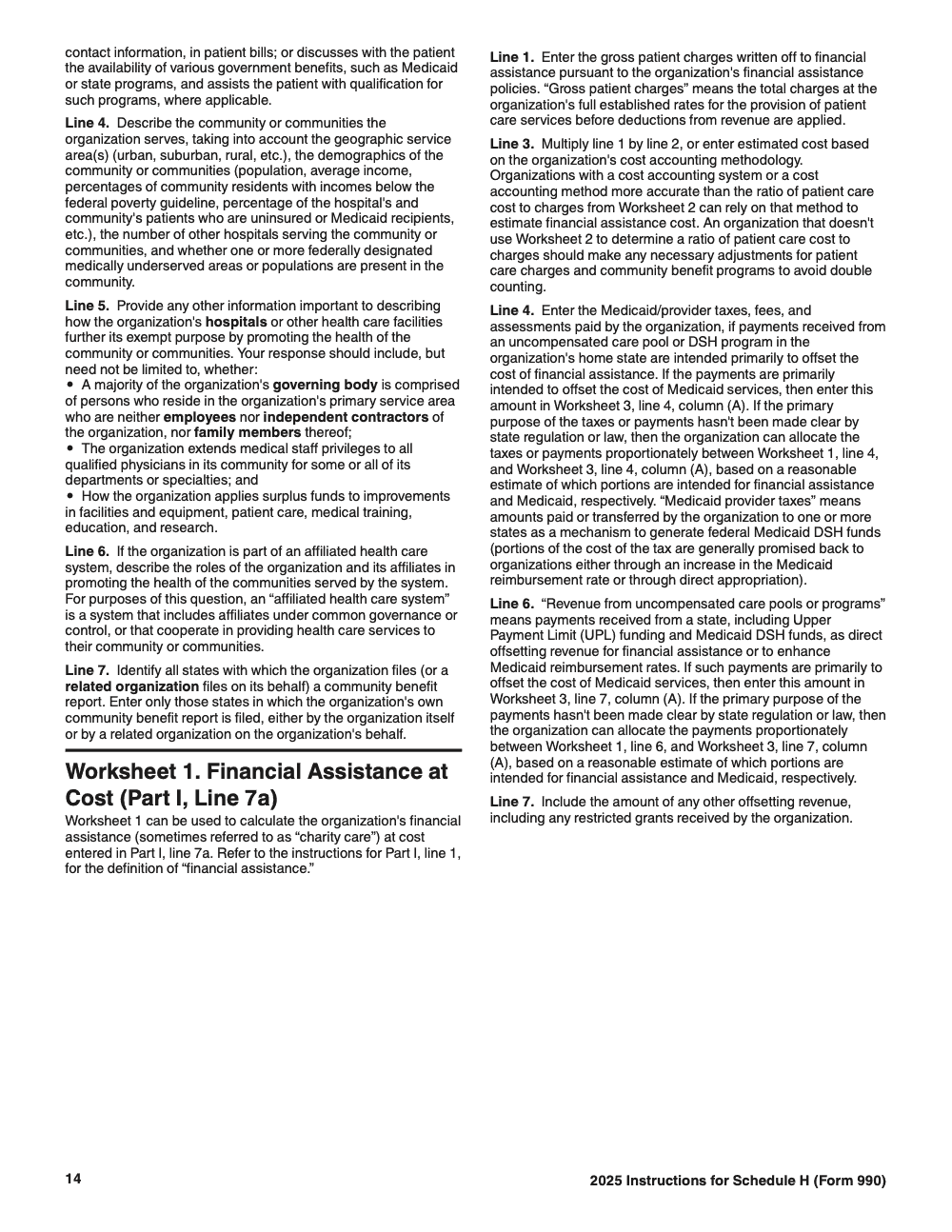
- Confirm Line 7a financial assistance at cost uses Worksheet 1 and excludes bad debt, Medicaid shortfall, self-pay discounts, and contractual adjustments (those belong in Part III or Lines 7b and 7c).
- Reconcile Lines 7b (Medicaid) and 7c (other means-tested programs such as SCHIP) using Worksheet 3, not the Part I charity care line.
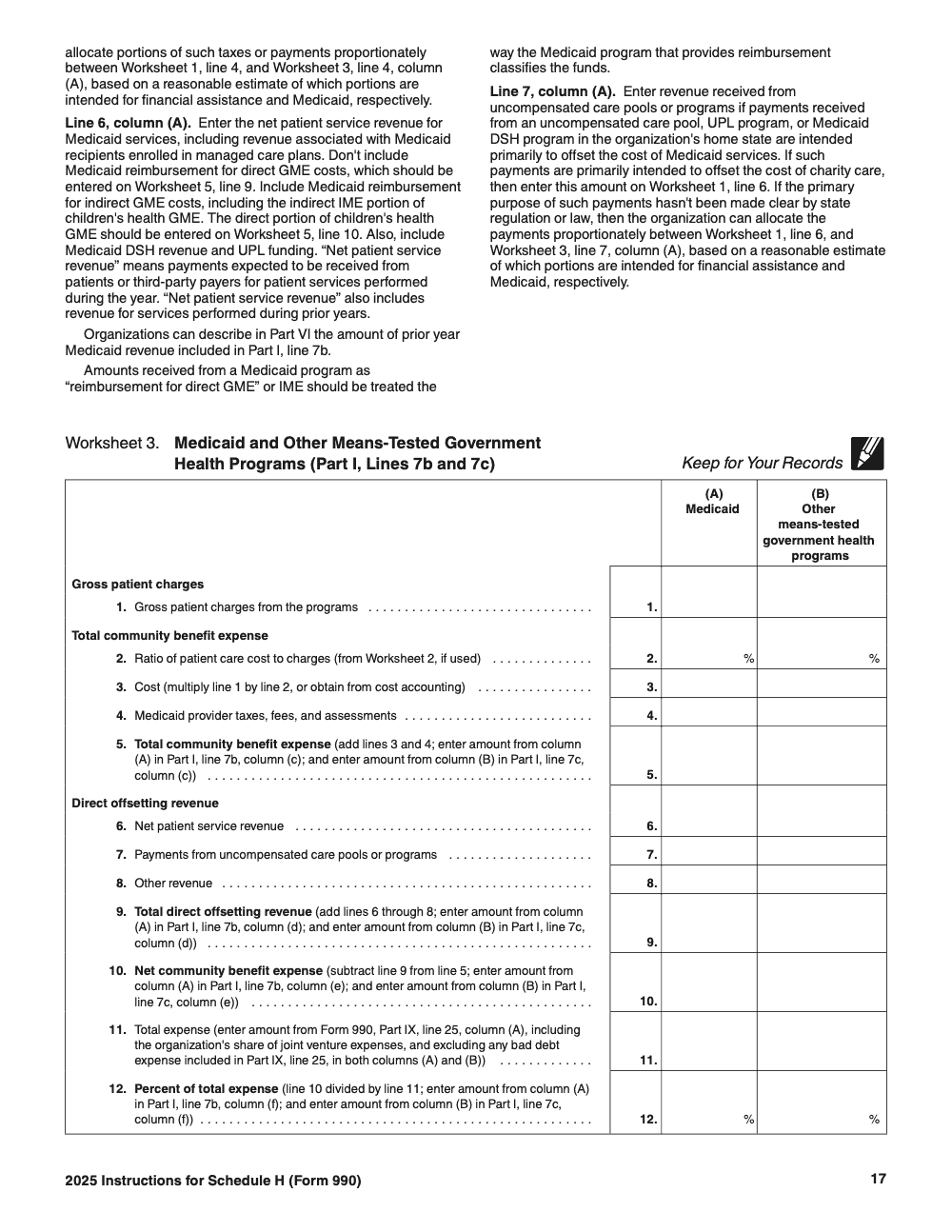
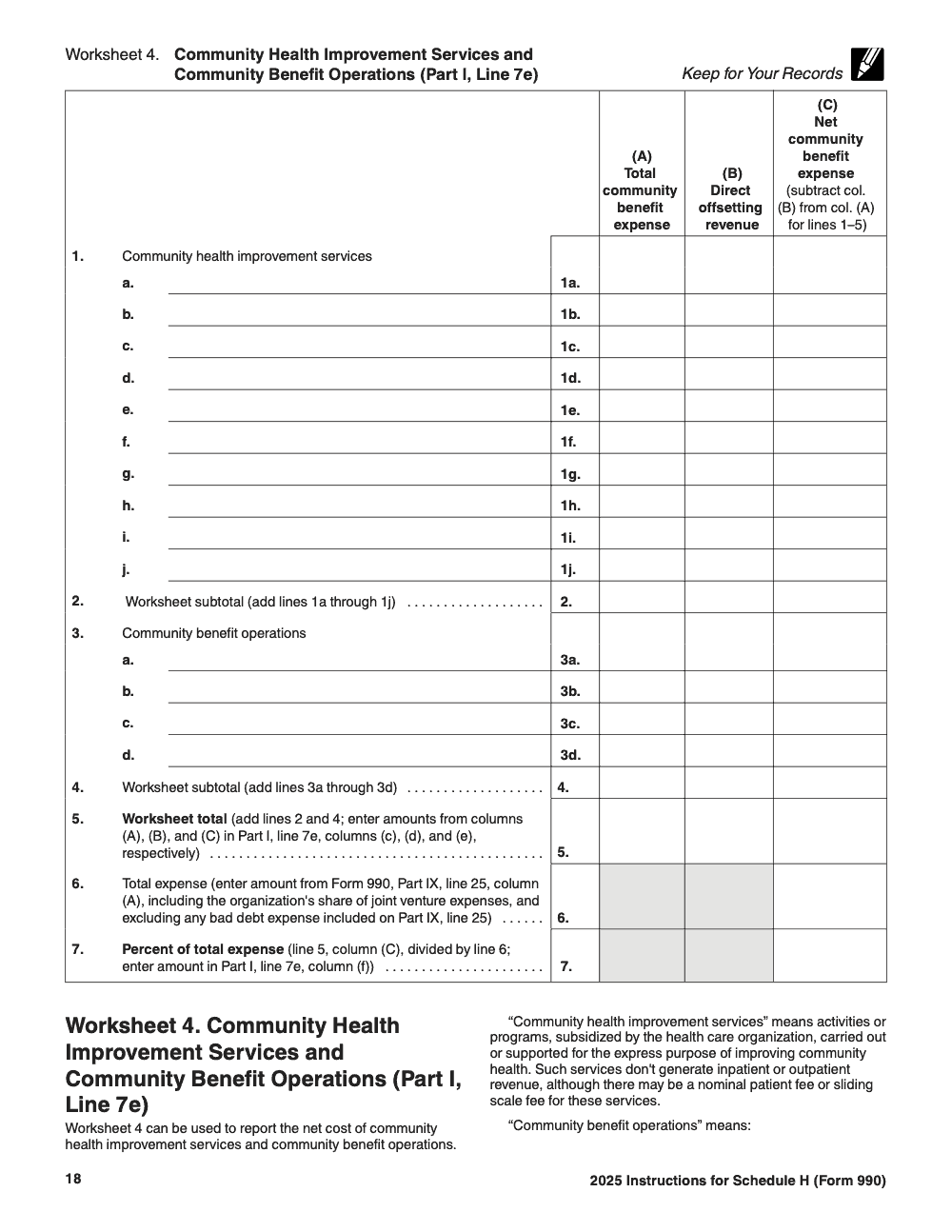
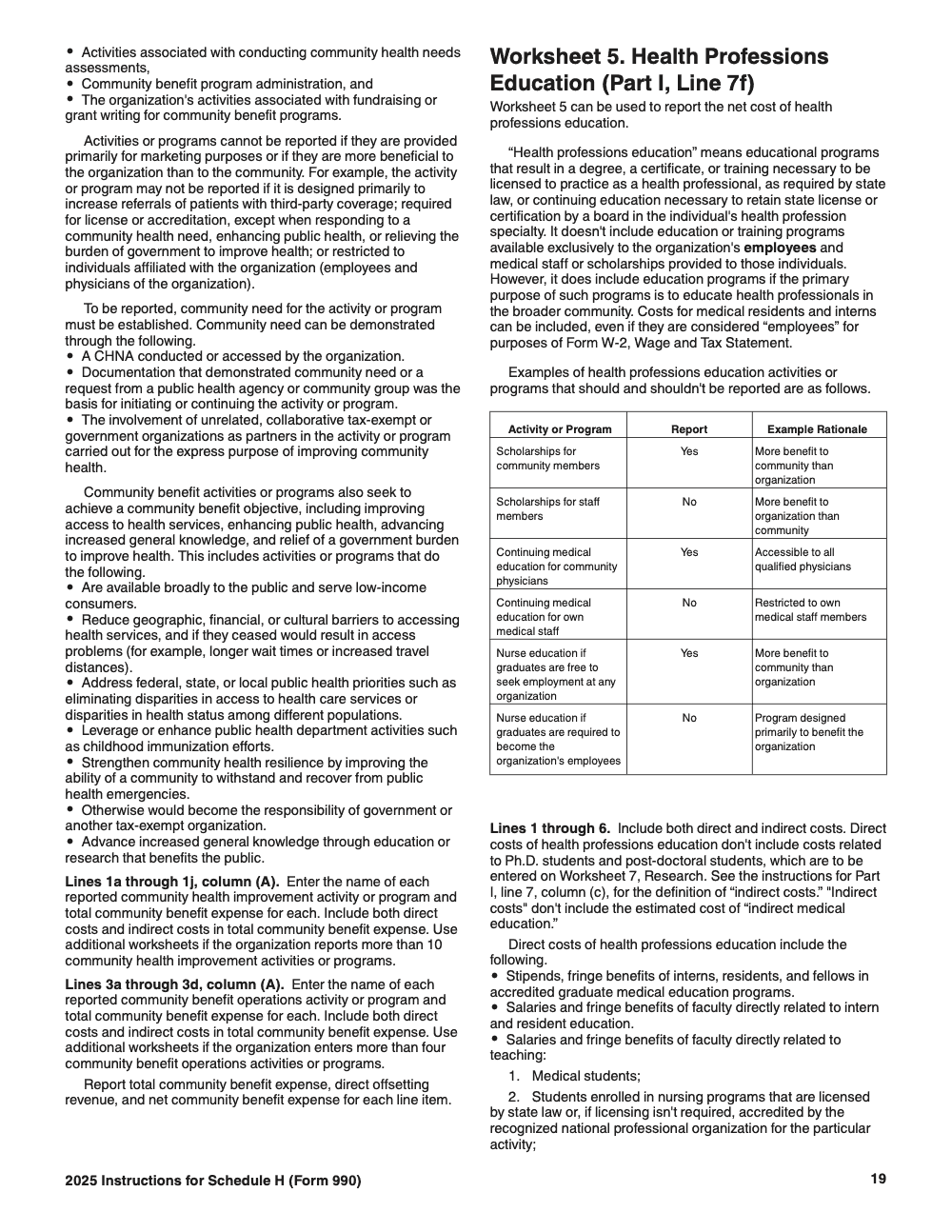
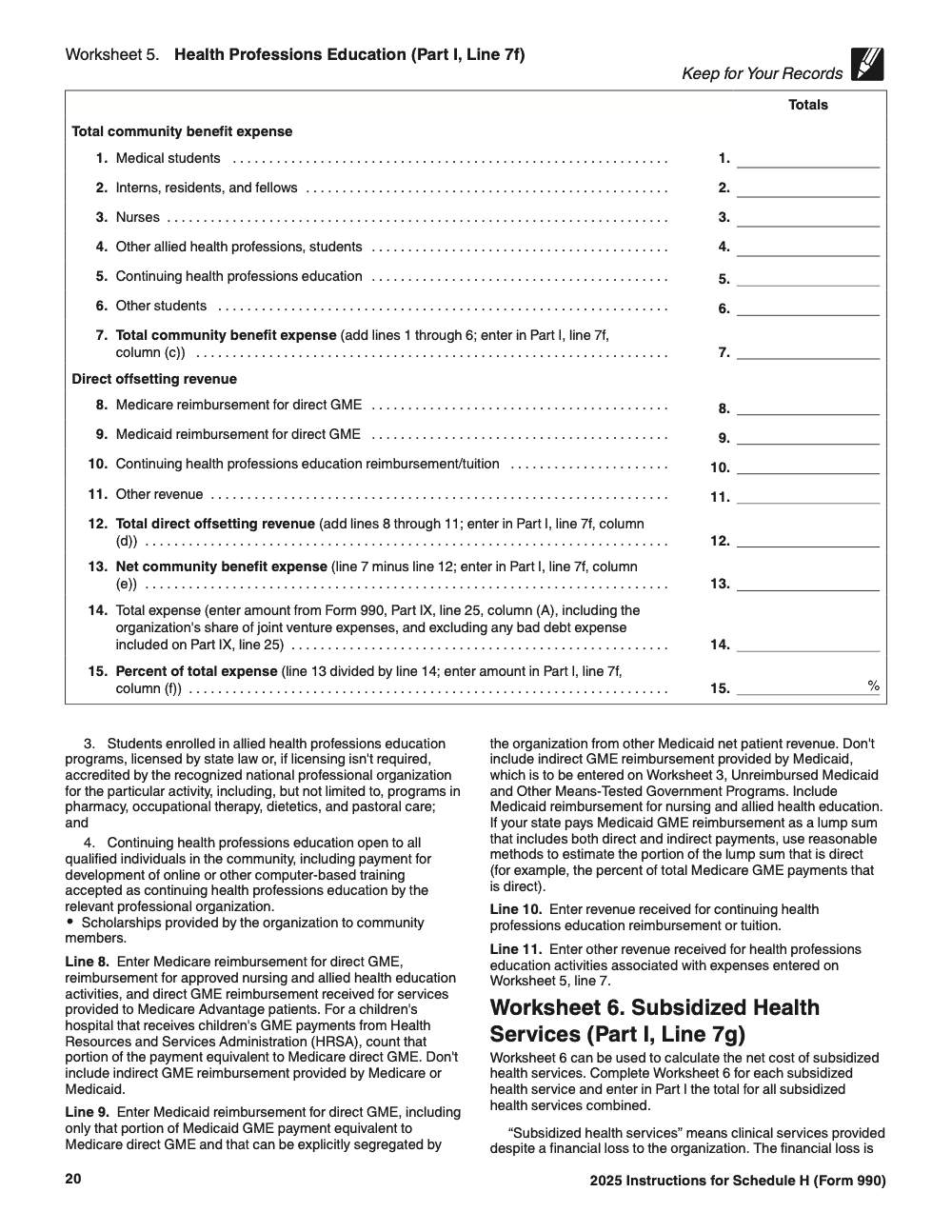
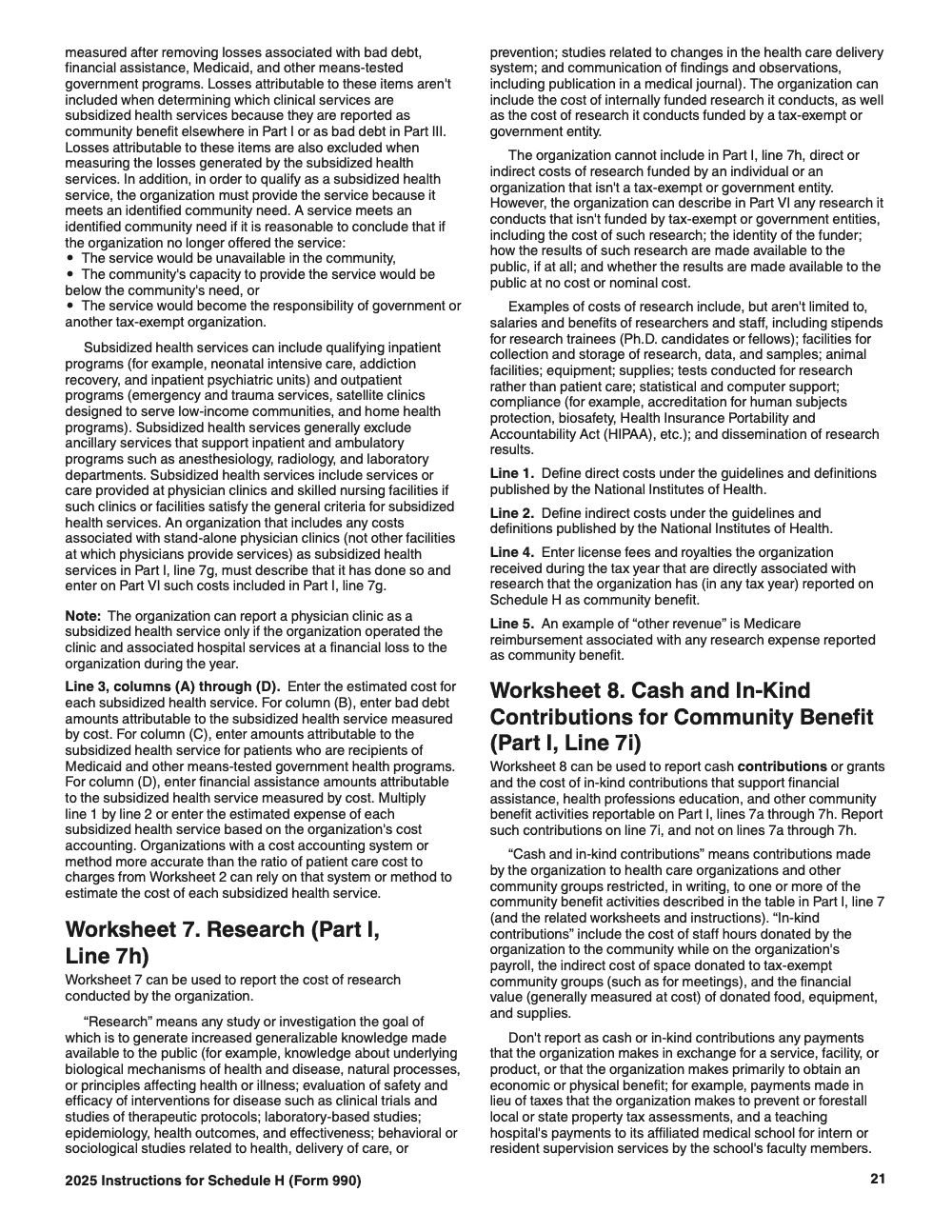
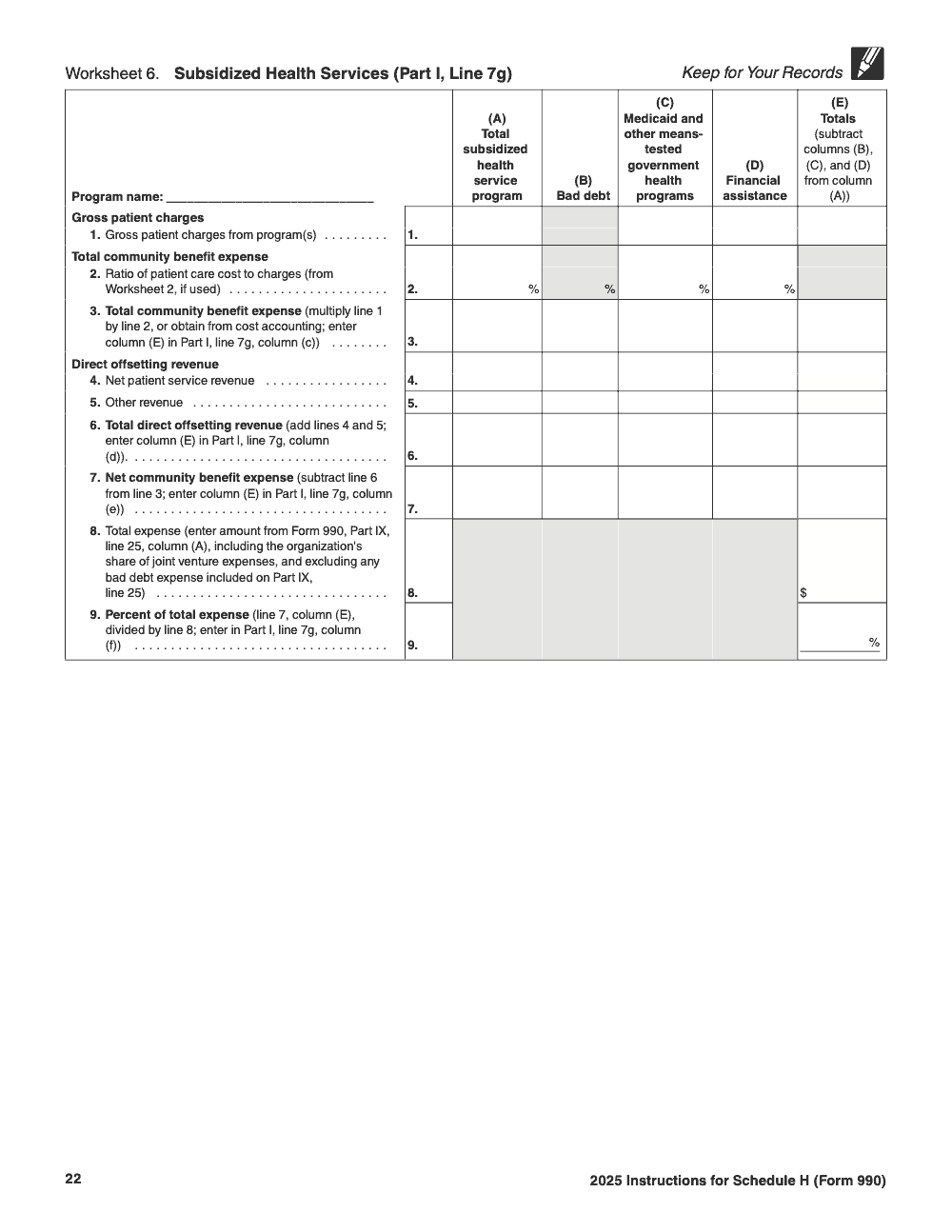
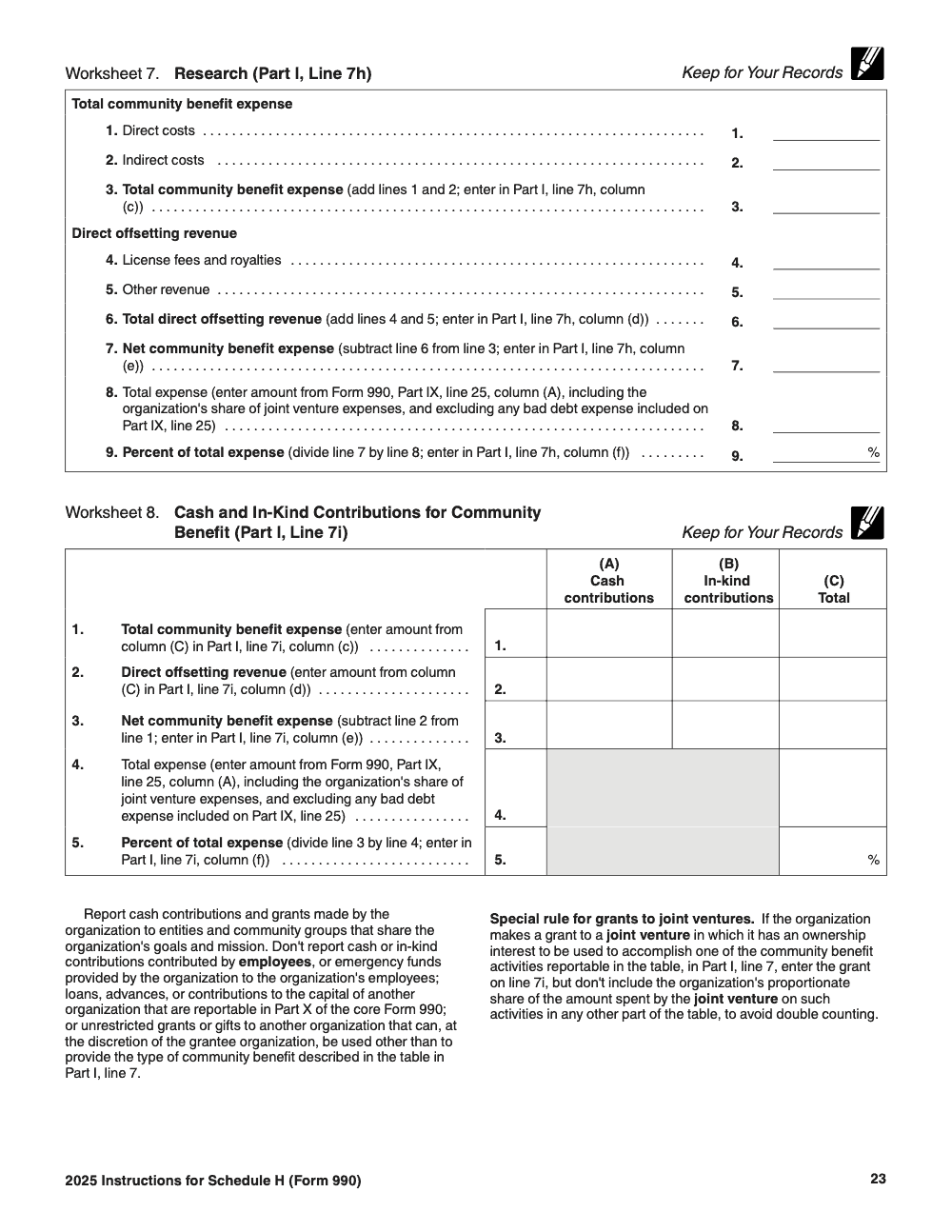
- Verify Worksheets 4 through 8 were prepared for Lines 7e through 7i and tie to the cost-to-charge ratio or cost accounting system in use.
- Calculate Column (f) percent of total expense using Column (e) net community benefit expense divided by Form 990, Part IX, line 25; never use Column (c) total community benefit expense.
- Confirm Columns (e) and (f) contain no negative values; enter zero when the math would otherwise be negative.
- For Line 7i cash and in-kind contributions, verify each grant is restricted in writing to one or more activities reportable in Lines 7a through 7h.
- If a grant was made to a joint venture in which the organization holds an interest, confirm the organization's proportionate share of that venture's spending is excluded elsewhere in Line 7 to prevent double counting.
E‑Filing And Documentation Practices That Reduce Risk
You will attach Schedule H to Form 990 and e‑file through an IRS authorized provider. Choose a platform that supports Schedule H end to end, validates required fields, and flags omissions before submission. Keep your CHNA, FAP, costing worksheets, Medicare support, and ownership lists outside the e‑file, organized in a single source of truth. Use multi‑user access with roles, and turn on activity logs. These simple controls save hours when you need to answer questions later.
A Quarterly Rhythm That Works
- Quarter 1, lock the costing method, refresh Federal Poverty Guidelines in the FAP, and confirm public posting for FAP and CHNA at each facility.
- Quarter 2, update community benefit program logs, reconcile persons served counts to source systems, and document allocation drivers.
- Quarter 3, pull Medicare allowable costs and revenue, preview Part III, and test your bad debt estimation method on a sample.
- Quarter 4, finish reconciliations, draft Part VI narratives with line references, and run a facility level policy check with dated screenshots.
Internal Controls You Can Implement In A Week
- A short policy memo that locks your costing approach for the year.
- A shared index that maps each Part and line to its supporting documents.
- A facility policy checklist that includes URLs, last reviewed dates, and file owners.
- A one page playbook for staff who post or update public facing policies.
2025 Context, What Boards And Reviewers Watch
Media and policymakers continue to compare community benefit totals and percentages across hospitals. Analysts look at financial assistance, unreimbursed costs of means‑tested programs, and other community benefit categories, then compare your results to peers. The absolute numbers matter, but your narrative matters just as much. Use Part VI to connect your spending to the needs you identified in your CHNA and to explain your methods. Clear methods and clean posting reduce noise and keep the focus on real outcomes.
Your best defense is clarity, consistent methods, and a short narrative that makes it obvious why your numbers look the way they do.
Where Accountably Helps, Briefly
This article is educational first. If your team needs capacity to produce accurate, on‑time Schedule H filings without burnout, Accountably can slot trained offshore accountants into your workflow, inside your systems. We work with SOP driven workpapers, structured naming, version control, and multi‑layer reviews, so your CFO time is spent on strategy, not clean‑up. Use us to add capacity without chaos, or to build a repeatable delivery system your team owns long term.
- SOP driven execution for Part I and II logs and costing.
- Structured workpapers, standardized naming, and version control for review speed.
- Turnaround SLAs and escalation paths that protect deadlines.
We keep mentions light because your compliance comes first.
Do This, Not That
| Topic | Do This | Not That |
| Charity care, Part I | Report FAP qualified free or discounted care at cost | Mix in bad debt, self pay discounts, or payer shortfalls |
| Community building, Part II | Tie activities to CHNA needs and keep separate from Part I | Double count expenses as both community benefit and building |
| Bad debt, Part III | Estimate FAP eligible share with a documented, consistent method | Change methods mid year or leave them unexplained |
| Medicare, Part III | Use allowable costs and reconcile to support | Report charges or rules of thumb |
| Part V policies | Post FAP, CHNA, emergency care, charges, and billing policies clearly for each facility | Assume system wide policies cover every facility without checking |
| Part VI narratives | Cite line numbers, keep explanations factual and brief | Leave out methods and hope the numbers speak for themselves |
Conclusion, Confidence Comes From Clarity
You now have a complete playbook for Schedule H, who must file, which facilities to include, how to complete Parts I through VI, and where to explain your methods. Keep charity care clean, keep policies current and posted for each facility, and make Part VI your control room. If you want a simple test, open any line on your form and ask, can I get from this number to a policy, to a worksheet, to a ledger entry in under five minutes If yes, you are in good shape. If not, your process needs a touch more discipline.
Your community work is real. Your reporting should make it unmistakable.
Brief Transparency Note
Our editorial team drafted this guide with help from trusted automation for consistency checks. Human experts reviewed and approved the content against current IRS instructions and section 501(r) requirements, current as of November 26, 2025.
Reusable Checklists
Schedule H is the most facility-intensive schedule attached to Form 990, and the work does not concentrate into a single quarter the way a 941 or 1040 does. The pressure point sits upstream: CHNA cycles, implementation strategy board approvals, FAP updates, translation logs, and AGB recalculations have to be tracked through the entire tax year so the schedule itself becomes a tie-out rather than a scramble. According to the 2025 Instructions for Schedule H (IRS Catalog Number 51526B, revised October 2, 2025), a single hospital organization files one Schedule H that aggregates every hospital facility it operates directly, through wholly-owned disregarded entities, and through its proportionate share of joint ventures treated as partnerships, which means a ten-facility system can produce up to ten Section B reporting groups before a single narrative is written, although facilities with identical Section B checkbox answers may be collapsed into a single facility reporting group lettered A, B, or C (letter A is the largest group).
The fix is to push policy maintenance, costing worksheets, and facility-level evidence into a standing workflow instead of a year-end project. When the Form 990 close cycle starts, the team should be reconciling and reviewing, not reconstructing.
- Maintain a per-facility CHNA tracker covering Section B Lines 3 through 12c: assessment date, implementation strategy adoption date, website posting URL, and the next deadline that protects the 3-year cycle.
- Lock the AGB methodology used on Line 22 once per year and log refunds over $5 issued under the Line 23 no-excess test, so each Yes or No answer has audit support sitting behind it.
- Keep Worksheets 1 through 8 in a shared workpaper folder organized by facility, with cost-to-charge ratios and the Form 990 Part IX line 25 total expense updated as the trial balance closes.
- Track every Extraordinary Collection Action taken under Line 19 with the date of written FAP notice, the 30-day deadline, and the oral notification log; Section B Line 20 narratives depend on that evidence trail.
- Pre-stage Section C narratives for the lines that require them (including Lines 11, 13b, 13h, 16j, 18e, 19e, 20a through 20e, 21c, 21d, 23, and 24), so reviewers are editing copy rather than drafting from a blank page.
Accountably builds and runs that standing workflow inside our tax outsourcing and offshoring delivery, with documented SOPs, structured workpapers, and a multi-layer review that protects senior reviewer time through the Form 990 close.
Keep I990SH Season From Stalling
Schedule H reaches across six Parts, eight optional worksheets, facility-level Section B questions, and Section C narratives the reviewer cannot draft from a blank page the day the return is due (per the 2025 Instructions for Schedule H, IRS Catalog Number 51526B, revised October 2, 2025). Layer in the audited financial statements attachment under Section 6033(b)(15)(B) and the per-facility CHNA evidence trail, and senior review hours stack up fast in the final week of the Form 990 close.
The fix is to treat the schedule as a year-round evidence trail, not a return-season build. Every facility-level answer on Section B should have a workpaper, a date, and a named owner before the engagement team opens the return.
- Map each state-licensed hospital facility to one Section B answer set, then collapse facilities with identical policy answers into letter-coded reporting groups A, B, C (largest group first) so the team completes one Section B per group rather than one per facility.
- Run a CHNA tracker by facility that pairs the 3-year assessment cadence with the written implementation strategy adoption date, since failing either step triggers the $50,000 section 4959 excise tax per facility per year, reported on Form 4720.
- Standardize on Worksheets 1 through 8 for the Part I, Line 7a-7i community benefit build so column (e) net community benefit expense and the column (f) percent of total expense always reconcile back to Form 990, Part IX, line 25 without double counting joint-venture activity already entered on Line 7i.
- Quarantine bad debt to Part III, Section A and Medicare allowable cost and shortfall to Part III, Section B so neither leaks into the Part I, Line 7 table, and route Medicaid and other means-tested government program shortfalls to Lines 7b and 7c respectively.
- Capture each joint venture's ending capital account percentage from Schedule K-1 (Form 1065), Part II, line J at the time the workpaper is built, so Part IV ownership reporting and proportionate-share allocations across Parts I through III hold up under review.
That cadence is exactly what a structured offshore delivery layer is built for. Accountably integrates trained preparers and reviewers into your Form 990 workflow under documented SOPs and a multi-layer review, so Schedule H sections close on schedule and senior time stays focused on Part VI judgment calls. Our structured engagement models wrap the workpaper, narrative, and review cadence around the standard the 2025 instructions demand.
FAQs
Schedule H is the part of Form 990 used by tax‑exempt hospital organizations. It reports community benefit at cost, separates community building, captures bad debt and Medicare information, and documents, at the facility level, your 501(r) compliance for CHNA, FAP, emergency care, limitation on charges, and billing and collections. Part VI is where you explain methods and exceptions.
Any 501(c)(3) organization that operated at least one state‑licensed hospital facility during the tax year must attach Schedule H. Include facilities operated directly, through disregarded entities you solely own, and your proportionate share of hospital joint ventures treated as partnerships. Group return filers include all member hospital facilities on one Schedule H.
No. Charity care is free or discounted care provided under your FAP. Bad debt write‑offs, payer shortfalls, self pay discounts, and contractual adjustments are excluded from Part I charity care. Bad debt is reported in Part III, along with your method for estimating accounts likely eligible under your FAP.
You must complete a CHNA on the defined cycle and adopt an implementation strategy for each hospital facility. A missed CHNA can result in a $50,000 excise tax per facility per tax year. Track dates, approvals, and website posting by facility, and keep that proof with your workpapers.
Report your proportionate share of joint ventures treated as partnerships, generally using the ending capital account percentage from the K‑1. Disclose reportable ownership interests in Part IV when covered persons hold 10 percent or more, including indirect interests through tiers.
No. Do not include hospitals located outside the United States in Parts I through III or Part V. If you have foreign joint ventures or related activity, describe them as required in Part IV and Part VI.
You can use a cost accounting system, a cost‑to‑charge ratio, a blend of both, or another reasonable method. Apply it consistently across programs and facilities, capture direct and indirect costs, and retain worksheets that reconcile to your ledgers.
Report Medicare revenue, allowable costs, and any surplus or shortfall in Part III, Section B. Do not include those amounts in Part I charity care.
Other forms this guide names
Summarize this article with AI
About this guide
Accountably helps US CPA, EA, and accounting firms hire trained accountants and tax preparers in India.
About us Reviewed byJugal Thacker, CPAFounder and CEO at Accountably
A Washington-licensed CPA with 7+ years inside US firms – PwC, a real-estate tax practice, then a full-service firm, rising from reviewer to manager to advisory. This article was reviewed against current IRS guidance for the 2025 tax year and updated for filers preparing late returns, amendments, and 2026 estimates.
View profile →How we research, review, and update this guide
Every Accountably guide is researched against primary IRS sources, reviewed by a U.S. CPA, and refreshed as guidance evolves. Read our Editorial Guidelines to see how we source, fact-check, and update our content.