Summarize this article with AI
In Brief
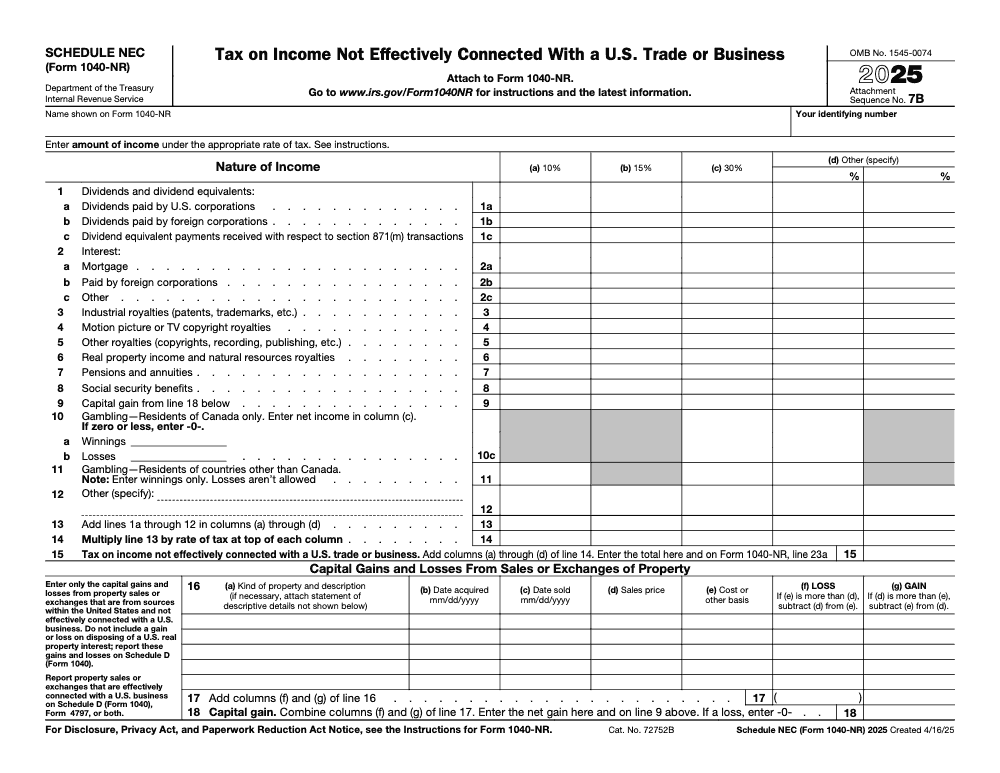
Schedule NEC (Form 1040-NR) reports a nonresident alien's U.S.-source income that is not effectively connected with a U.S. trade or business, taxed at the 30% statutory rate or a lower treaty rate elected in columns (a), (b), or (d). For tax year 2025 the schedule carries Catalog Number 72752B and Attachment Sequence 7B (per the Schedule NEC instructions on IRS.gov); the line 15 total flows to Form 1040-NR line 23a, where it joins other taxes on line 24. For offshore execution support, see our U.S. tax preparation and review service.
A nonresident client hands you a 1042-S and a couple of 1099s. The easy move is to default every line to the 30 percent statutory rate in column (c) and be done. The catch is the treaty position sitting on the W-8BEN, because the same dividend or royalty might belong in a 10 percent, 15 percent, or Other column where a treaty gives a lower rate, sometimes zero. Miss it and you file for a refund a year later.
Schedule NEC reports U.S.-source FDAP income that is not effectively connected with a U.S. trade or business, and each item lands on a specific line in a specific rate column. The line 15 total moves straight to Form 1040-NR line 23a, so the mapping has to be exact.
Key Takeaways
- Schedule NEC reports U.S.‑source FDAP income that is not effectively connected with a U.S. trade or business, for example dividends, interest, rents, royalties, annuities, certain gambling winnings, and in limited cases capital gains.
- Each item goes on a specific line and into a tax‑rate column, 10 percent, 15 percent, 30 percent, or “Other” when a treaty gives you a different rate, including 0 percent.
- The total tax from Schedule NEC moves straight to Form 1040‑NR, Line 23a, so your mapping must be exact.
- Deadlines match Form 1040‑NR. For 2025 calendar‑year returns, the due date is April 15, 2026 if you had wages subject to U.S. withholding, or June 15, 2026 if you did not. Extensions give more time to file, not more time to pay. Always verify the current year on IRS.gov.
What Schedule NEC is, and why it matters
“NEC” means not effectively connected. The IRS taxes two buckets differently. Effectively Connected Income, ECI, is taxed after deductions at graduated rates, and it lives on page 1 of Form 1040‑NR. Non‑ECI, which is U.S.‑source FDAP income, is generally taxed on the gross amount at a flat 30 percent, or a lower treaty rate if you qualify, and it belongs on Schedule NEC. Keeping this split clean avoids wrong tax and IRS notices.
Think of Schedule NEC as the “flat rate” page, your place to list passive U.S. income, pick the correct rate, and tie it to actual withholding.
Who must include Schedule NEC with Form 1040‑NR
You add Schedule NEC when you are a nonresident and you received U.S.‑source income that is not effectively connected with a U.S. trade or business. That includes most dividends, some interest, royalties, rents, annuities, and some gambling winnings. Capital gains usually are not taxed to nonresidents, however they become taxable if you were in the United States for 183 days or more during the year, and those taxable gains are reported on Schedule NEC, not Schedule D.
A couple of quick guardrails help:
- If the income is effectively connected, report it on the 1040‑NR ECI lines, not on Schedule NEC.
- U.S. real property gains follow FIRPTA rules, which are separate, so do not push those onto Schedule NEC.
Deadlines and extensions in plain English
Schedule NEC is due when your 1040‑NR is due. For 2025 calendar‑year returns, individuals with wages subject to U.S. withholding file by April 15, 2026. If you did not have such wages, the due date is June 15, 2026. If you need more time to file, request an extension, then pay your estimated tax by the original due date to limit penalties and interest. Check the current year’s calendar on IRS.gov, since weekends or holidays can shift exact dates.
How Schedule NEC ties to Form 1040‑NR
Schedule NEC is the worksheet that summarizes your non‑ECI by category and rate. After you pick the right columns and compute the tax, you carry the result to Form 1040‑NR, Line 23a, “Tax on income not effectively connected with a U.S. trade or business.” That line is a direct pull from Schedule NEC, Line 15. Keep your Forms 1042‑S and 1099 close, since withholding credits are entered on the 1040‑NR.
For firms and reviewers
If you prepare returns at scale, a standard folder and review checklist is gold. At Accountably, we place copies of 1042‑S forms next to each Column d treaty entry, and we keep a simple map that shows which items feed 1040‑NR Lines 9, 10a through 10c, 11, and 23a. It turns a ten‑minute review into a two‑minute confirmation, without changing your standards.
The What‑How‑Wow framework for Schedule NEC
- What, the form for passive U.S.‑source income that is not effectively connected, taxed at a flat rate unless a treaty applies.
- How, list each item on the correct line, choose the correct rate column, then reconcile actual withholding to your 1042‑S or 1099.
- Wow, use treaty rates in the matching column – column (a) for 10%, column (b) for 15%, column (d) for any other rate including 0 percent on certain gambling winnings – and fix overwithholding directly on your return.
Line by line, what goes where
The IRS instructions group Schedule NEC into income lines for dividends, interest, royalties, rents, pensions and annuities, gambling, other FDAP, and then a capital gains section. Lines 13 through 15 complete the tax. Lines 16 through 18 handle non‑ECI capital gains and losses that feed back into the totals.
Quick reference table
| Item type | Schedule NEC lines | Typical rule |
| Dividends, dividend equivalents | 1a–1c | 30 percent default; treaty may lower the rate (column (a) 10%, column (b) 15%, or column (d) for any other rate including 0%) |
| Interest, not ECI | 2 | Bank deposit and portfolio interest can be exempt, check exceptions |
| Royalties and rents | 3–6 | 30 percent default, rate may change with treaty |
| Pensions and annuities | 7 | FDAP rules apply, treaty can alter rate |
| Gambling winnings | 10–11 | Special Canada rules and treaty‑exempt entries |
| Non‑ECI capital gains | 16–18 | Taxable when present in the U.S. 183 days or more, flat rate applies |
Dividends and dividend equivalents, Line 1
- Line 1a, U.S. corporation dividends
- Line 1b, U.S.‑source dividends paid by foreign corporations
- Line 1c, dividend equivalents under section 871(m), including substitute dividends
Apply the 30 percent rate unless a treaty gives you a lower number. When a treaty applies, put the income in the matching rate column – column (a) for a 10% treaty rate, column (b) for 15%, column (c) for 30%, or column (d) for any other rate – and write the exact treaty rate. Tie every amount to a 1042‑S or 1099 and keep residency proof that supports the treaty claim. The 1040‑NR instructions show how Line 23a pulls from Schedule NEC after you make these entries.
Interest, Line 2, where exemptions are common
Report U.S.‑source interest that is not effectively connected. Many bank deposit items are not taxable to nonresidents, and portfolio interest can be exempt when requirements are met. If a treaty sets the rate at 0 percent and the payer still withheld at 30 percent, you may enter the item in Column d with the treaty rate and claim the refund through the return. Match every figure to a payer statement.
Royalties, rents, and structured entries
- Line 3, industrial royalties, patents, trademarks
- Line 4, motion picture and TV royalties
- Line 5, other copyrights and recordings
- Line 6, rents and natural resource royalties unless you properly elected ECI treatment
Pick the right column, then tie to 1042‑S withholding. If the income is effectively connected, do not use Schedule NEC. Move it to the ECI section on Form 1040‑NR.
A real‑world prep flow you can copy
- Sort income by category first, for example dividends, interest, royalties, rents, pensions, gambling.
- Decide ECI vs non‑ECI. Only non‑ECI goes to Schedule NEC.
- Pick the column matching the rate – column (a) 10%, column (b) 15%, column (c) 30%, or column (d) for any other treaty rate.
- Reconcile withholding, use 1042‑S for FDAP, use 1099 for other items, and map totals back to 1040‑NR.
For firms that file at volume, Accountably standardizes this with SOPs and a two‑step review that checks treaty citations and 1042‑S tie‑outs before partner review, which reduces revision time during peak season while keeping your own templates and controls. Use or adapt that idea inside your firm even if you do not outsource.
Gambling and capital gains, the parts many filers miss
Gambling has its own lines and rules. If you are a resident of Canada and not in the trade or business of gambling, enter all U.S. winnings on Line 10a, U.S. gambling losses up to U.S. winnings on Line 10b, then the net on Line 10c. If your losses are larger than winnings, enter zero on 10c.
If you are a resident of a country other than Canada and a treaty exempts gambling winnings, report them on Line 11 and use Column d with a 0 percent rate. If no treaty exemption applies, report gross winnings on Line 11 at 30 percent; gambling losses are not allowed as an offset for residents of countries other than Canada. Keep residency evidence and the treaty citation on Schedule OI in case the withholding agent applied 30 percent.
Capital gains that really do belong on Schedule NEC
Nonresident capital gains are usually not taxed by the United States. A key exception applies when you were present in the United States for 183 days or more during the year. In that case, your U.S.‑source capital gains are taxed at a flat rate, often 30 percent unless a treaty lowers it, and the gains go on Schedule NEC, not Schedule D (the one exception is a U.S. real property interest sale, which always follows FIRPTA under IRC §897 and goes on Schedule D, never Schedule NEC). The IRS points out that this 183‑day rule is different from the substantial presence test.
Lines 16 through 18, how to enter gains and losses
- Line 16, list each property with description, dates, sales price, and basis, then compute the gain or loss
- Line 17, total gains and losses
- Line 18, carry the net figure to Schedule NEC Line 9 (within the same schedule, for capital gain reporting)
No capital loss carryovers apply on Schedule NEC. If your total is zero or negative, you cannot create or increase a loss here.
A quick example
You received U.S. dividends all year. Some were withheld at 30 percent, yet your treaty rate is 15 percent. You also sold stock while you were present in the United States more than 183 days. Put dividend amounts on the dividend lines, use Column b (the pre-printed 15% column) where the treaty applies, then keep the 1042‑S that shows the incorrect 30 percent to support your refund. For the stock sale, list it on Line 16, total on Line 17, and move the net to Line 18, which flows to Schedule NEC Line 9.
Documentation to gather before you start
- Forms 1042‑S and 1099 for every FDAP payment and any tax withheld
- A valid W‑8BEN or W‑8BEN‑E you gave the payer, which supports any treaty claim
- Treaty citations for each Column d entry and a Schedule OI note
- Brokerage statements, trade confirms, and days‑in‑U.S. proof for the 183‑day rule
- Your ITIN or SSN and any currency conversion records
The 1040‑NR instructions expect you to put the gross amount in the proper column and then reconcile the withholding on the 1040‑NR. A clean packet makes matching faster and reduces refund delays.
Quality checklist you can reuse
- Are dividends, interest, royalties, and rents sitting on the correct lines and columns
- Did you place each treaty rate in the matching column – columns (a) and (b) for 10% and 15% treaty rates, column (d) for any other rate (including 0 percent for treaty‑exempt gambling on Line 11)
- Does Schedule NEC Line 15 match Form 1040‑NR Line 23a
- Do the withholding totals on the 1040‑NR match your 1042‑S and 1099 statements
When your review loop is this tidy, questions drop off and refund timing improves. This is where a little structure pays for itself during deadlines.
Withholding and treaty rates, how to claim the right number
Default FDAP tax for nonresidents is 30 percent on the gross amount, no deductions. When a treaty applies, you can use the lower treaty rate for that income category. If a payer withheld at 30 percent even though you qualify for a lower rate, claim the correct rate on your return and request the refund.
Treaty eligibility, the essentials
Confirm that you are a tax resident of the treaty country for the tax year, that the income type is covered, and that you meet any limitation on benefits or holding‑period rules. Provide a valid Form W‑8BEN or W‑8BEN‑E to the payer so the correct rate can be applied at source. Even if the payer did not apply the treaty rate, you still report the correct rate in Column d and support it with your treaty disclosure on Schedule OI.
Reporting in Column d, zero or custom rates
Use Column d for any rate that is not 10, 15, or 30 percent, including 0 percent when a treaty fully exempts the item, such as certain gambling winnings. Enter only the income covered by the treaty in Column d, write the exact rate, and keep residency evidence. The instructions give specific examples for gambling entries on Lines 10 and 11 that use Column d.
Avoiding common mistakes, and how to fix them
I see the same six mistakes every season on Schedule NEC, and most of them trace back to skipping the treaty step or mixing ECI with NEC income. Here is what to watch.
What to keep after you file
Hold your 1040‑NR, Schedule NEC, all 1042‑S and 1099 forms, and treaty evidence for at least three years. If the IRS questions a Column d rate or a withholding credit, these papers close the loop fast. The 1040‑NR instructions spell out how Schedule NEC connects to the main form and the lines you use for withholding credits.
Plain‑English note, this guide is for general information. For personal tax advice, speak with a qualified professional who can review your facts and treaty position.
Software how‑to, entering Schedule NEC in TaxAct
In TaxAct, add Schedule NEC, then enter each non‑ECI item on the matching line and rate column. For non‑ECI capital gains, use Lines 16 through 18, include property details, and compute the gain or loss. Enter U.S. tax withheld from 1042‑S or 1099 forms, then confirm that Schedule NEC Line 15 flows to Form 1040‑NR Line 23a, and that Schedule NEC Line 9 reflects the capital gains total from Line 18. Use the IRS instructions for precise line mapping.
Final checks before you file
If you take one thing from this guide, make it this. Put every non‑ECI item on the right line, pick the right rate column, and back it with clean 1042‑S and treaty documentation. That is how you keep your refund, reduce notices, and keep review time under control. If you are a firm that needs disciplined help at scale, Accountably’s teams can work inside your software and checklists without changing your standards.
Reusable Checklists
These checklists are written so you can paste them into a firm SOP without rewriting. Each block is a separate workflow step on a Schedule NEC return.
Pre-prep evidence packet
- Collect all Forms 1042-S showing U.S.-source FDAP income paid to the filer.
- Collect Forms 1099-DIV, 1099-INT, and 1099-MISC for any U.S.-source items not on a 1042-S.
- Pull Form 8288-A for any U.S. real property dispositions (USRPI gain goes on Schedule D, not Schedule NEC).
- Confirm the filer's country of tax residence and pull the W-8BEN or W-8BEN-E on file with each payer.
- Identify the applicable U.S. income tax treaty and locate the article covering each FDAP income type.
- Note the filer's days of physical presence in the U.S. (the 183-day rule for capital gains is separate from the substantial presence test).
- Match the filer's name and ITIN or SSN to what will appear on Form 1040-NR.
Rate column selection walkthrough
- Place each item of FDAP income under the rate column matching the treaty position: column (a) 10%, column (b) 15%, column (c) 30%, or column (d) Other (specify).
- For column (d), write the exact treaty rate (for example 5%, 7.5%, or 0% for a full treaty exemption).
- Dividends from U.S. corporations on line 1a; foreign-corporation dividends on line 1b; section 871(m) dividend equivalents on line 1c.
- Mortgage interest on line 2a; interest from foreign corporations on line 2b; other U.S.-source interest on line 2c.
- Royalties split across lines 3 through 5 by type (industrial; motion picture or TV; other copyrights).
- Real property income on line 6 (unless the §871(d) election to treat as ECI is in effect).
- Pensions and annuities on line 7; 85% of U.S. Social Security on line 8 at 30% (or treaty rate).
- Multiply column 13 subtotals by the rate at the top of each column to produce line 14; sum across columns to line 15.
Pre-file review
- Confirm Schedule NEC line 15 ties to Form 1040-NR line 23a.
- Confirm line 18 (net capital gain) ties to Schedule NEC line 9 and that any net loss is entered as -0-.
- Confirm all 1042-S withholding credits are listed on Form 1040-NR line 25g, not 25a.
- Disclose the treaty position on Schedule OI for every item entered in column (a), (b), or (d).
- Confirm the digital asset question on Form 1040-NR is answered Yes or No (never blank).
- Confirm filing status is Single, MFS, QSS, Estate, or Trust (MFJ and HoH are not available on Form 1040-NR).
- Stack attachments in sequence; Schedule NEC carries Attachment Sequence 7B.
- Retain 1042-S, 1099, W-8BEN, and treaty residency evidence for at least three years.
Keep 1040-NR Schedule NEC Season From Stalling
Nonresident returns run on a different clock from a typical 1040 season. Most 1042-S statements arrive only after the underlying payers complete year-end withholding reconciliation, treaty positions take time to confirm against the filer's country of residence, and a single wrong column choice on Schedule NEC can stall the refund for a full cycle. The Schedule NEC instructions on IRS.gov are explicit that NEC tax is computed in parallel to the ECI tax and joined only at total tax on Form 1040-NR line 24, which is where most NEC errors surface in review.
The fix is not more hours during peak weeks; it is a tighter front-end packet and a fixed review walk that catches the same six mistakes every time. Build the workflow around the form's actual reconciliation points and the noise drops on its own.
- Build a per-filer treaty card before data entry: country of residence, treaty article, applicable rates by FDAP category, and W-8BEN status with each payer.
- Reconcile every 1042-S amount and withholding figure to the rate column on Schedule NEC lines 1a through 8 before computing line 13.
- Triage USRPI activity to Schedule D, not Schedule NEC, and route 8288-A withholding to Form 1040-NR line 25f at the same time.
- Walk the line 15 to 23a to 23d to 24 path on every return so the parallel NEC and ECI computations net correctly on total tax.
- Lock the Schedule OI treaty disclosure to the column (a), (b), or (d) entries on Schedule NEC so the position survives a desk audit.
That is the structure our offshore preparation teams run inside firm software, with documented SOPs and review SLAs you can audit. If your bench is thin and 1040-NR volume is climbing, our U.S. tax preparation service can absorb the production work without changing your review standards.
FAQs
It is the page where nonresidents report U.S.‑source FDAP income that is not effectively connected with a U.S. trade or business. You pick the correct rate column, claim a treaty rate in the matching column (column (a) for 10%, column (b) for 15%, column (d) for any other rate), and carry the tax to Form 1040‑NR Line 23a.
No. Contractor income is usually ECI and belongs on the ECI part of the return, often on Schedule C feeding into the 1040‑NR. Schedule NEC is for passive U.S.‑source FDAP that is not effectively connected.
Canadian residents use Lines 10a through 10c and can offset U.S. losses up to U.S. winnings. Residents of certain other treaty countries may use Line 11 with 0 percent in Column d when the treaty exempts the winnings. For everyone else, gross winnings go on Line 11 and losses are not allowed as an offset.
When you are a nonresident and you were present in the United States 183 days or more during the year, U.S.‑source capital gains are taxed at a flat rate and belong on Schedule NEC (with one exception: gains from selling a U.S. real property interest follow FIRPTA and go on Schedule D, never Schedule NEC). The IRS notes this 183‑day rule is different from the substantial presence test.
Other forms this guide names
- Form 1040‑NR: Filing 2025, Nonresident Taxes Made Simple
- Form W-8BEN: Foreign Status Certificate Guide 2025
- Form 8288-A: FIRPTA and 1446(f) Withholding Credit
- Form W-8BEN-E: Treaty Benefits and Withholding Basics
- Form 1040: Filing Guide for 2025 Returns (AGI, Deductions, Deadlines)
- Form 1099-NEC: Rules, Who Gets One, How to File
Summarize this article with AI
About this guide
Accountably helps US CPA, EA, and accounting firms hire trained accountants and tax preparers in India.
About us Reviewed byJugal Thacker, CPAFounder and CEO at Accountably
A Washington-licensed CPA with 7+ years inside US firms – PwC, a real-estate tax practice, then a full-service firm, rising from reviewer to manager to advisory. This article was reviewed against current IRS guidance for the 2025 tax year and updated for filers preparing late returns, amendments, and 2026 estimates.
View profile →How we research, review, and update this guide
Every Accountably guide is researched against primary IRS sources, reviewed by a U.S. CPA, and refreshed as guidance evolves. Read our Editorial Guidelines to see how we source, fact-check, and update our content.