Summarize this article with AI
In Brief
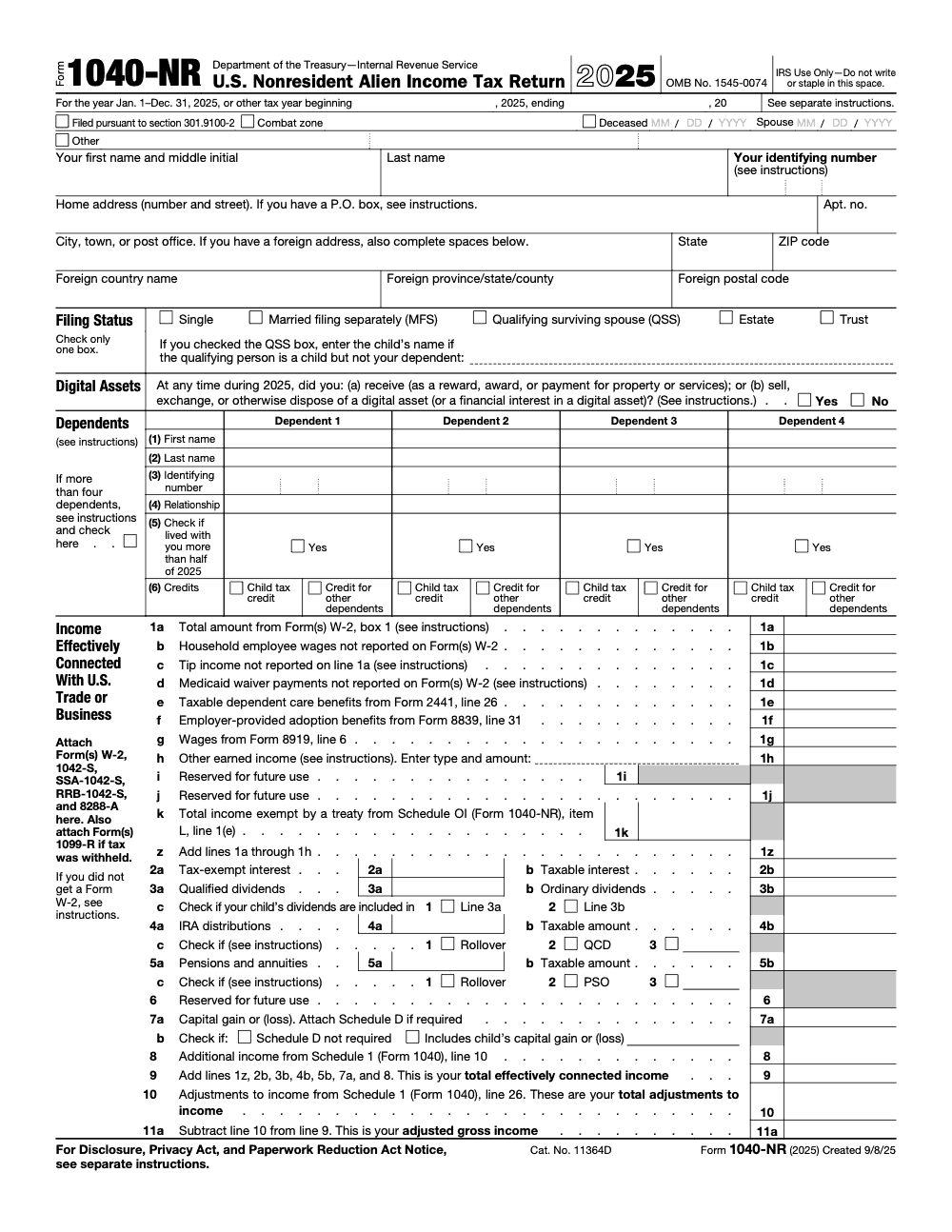
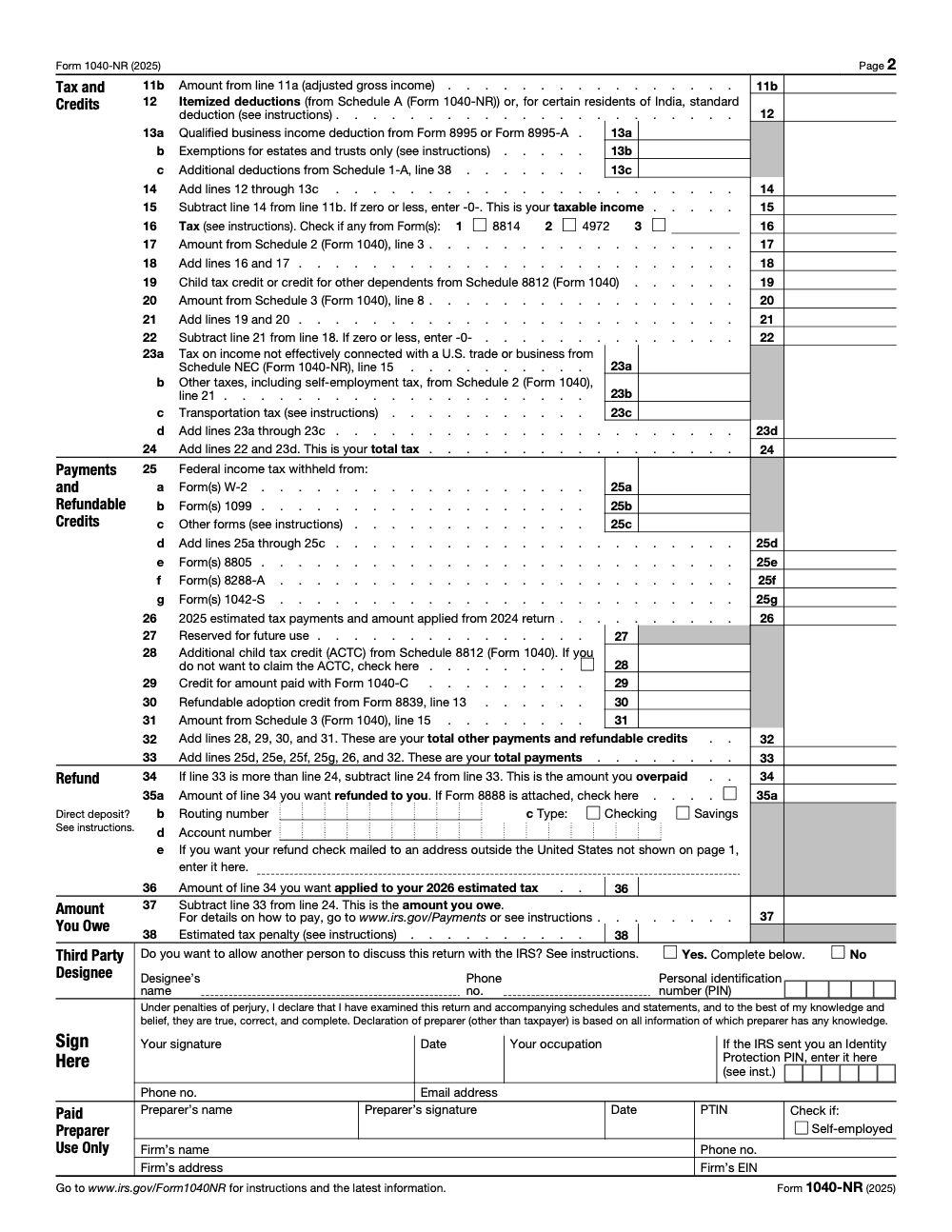
Form 1040-NR is the U.S. nonresident alien income tax return – nonresidents engaged in a U.S. trade or business, or with U.S.-source income not fully satisfied by withholding, must file (per the Instructions for Form 1040-NR, 2025). AGI sits on line 11a; total tax on line 24. Tax year 2025 returns are due April 15, 2026 if U.S. wages were withheld and June 15, 2026 otherwise; Form 4868 extends the filing deadline to October 15, 2026 (or December 15, 2026 for June 15 filers).
The 1040-NR returns that stall in our shop are rarely the complicated ones. They are the F-1 student who paid tax on a stipend without claiming the standard deduction allowed to students and business apprentices from India under treaty Article 21(2), and the filer who never completed Schedule OI. In both cases the numbers were workable; the framing was off, and the cleanup ran longer than the original prep would have.
The fix is almost always the same two things. Effectively connected income belongs on page 1 at graduated rates, while U.S.-source income that is not effectively connected goes on Schedule NEC at a flat 30 percent. And the filing deadline is April 15, 2026 if wages were subject to U.S. withholding, or June 15, 2026 if they were not.
Key Takeaways
- You file Form 1040‑NR if you are a nonresident alien with U.S. trade or business income, or with other U.S.‑source income that was not fully withheld. Table A in the official instructions lists the triggers.
- The 2025 tax year return is due Wednesday, April 15, 2026 if you received wages subject to U.S. withholding. If you had no such wages, your due date is Monday, June 15, 2026. File Form 4868 by the regular due date if you need more time to file, not more time to pay.
- Report effectively connected income on page 1 of Form 1040‑NR. Report U.S.‑source income that is not effectively connected on Schedule NEC, usually taxed at 30 percent unless a treaty reduces the rate.
- Always complete Schedule OI. Use it to disclose residency facts and treaty positions. Attach Form 8233 for wage treaty exemptions or Form 8833 when a treaty‑based return position requires disclosure.
- Most nonresidents cannot claim the standard deduction. A narrow exception exists for students and business apprentices from India under Article 21(2). Everyone else itemizes only certain U.S.‑connected deductions on Schedule A.
Who must file Form 1040‑NR
If you engaged in a U.S. trade or business at any time in 2025, you must file Form 1040‑NR, even if you had no income, had only treaty‑exempt income, or had no U.S.‑source income. If you were not engaged in a U.S. trade or business, you still file if you had U.S.‑source income, for example dividends or royalties, and withholding did not fully cover the tax. The IRS instructions spell these tests out in Table A.
Special cases also trigger filing. Examples include additional tax on retirement distributions, AMT, household employment taxes, and other taxes listed on Schedules 1 and 2 that flow to Form 1040‑NR. The instructions provide a schedule‑by‑schedule roadmap for when to include these forms.
Quick rule of thumb, if you worked in the United States, received U.S. investment income with incomplete or zero withholding, or want a refund of over‑withheld tax, check whether Form 1040‑NR is required, then file on time.
Determining nonresident status
First, decide whether you are a U.S. tax resident or a nonresident for the year. You are a resident if you held a green card at any point during the year, unless a treaty tie‑breaker treats you as a nonresident. Otherwise, apply the substantial presence test, which counts all U.S. days this year, one‑third of last year’s days, and one‑sixth of the days from two years ago. Some visa categories, like certain F, J, M, or Q students and teachers, can exclude days. Publication 519 explains the tests and the exceptions.
If your status changed during the year, you may be dual‑status. That means you are a resident for part of the year and a nonresident for the rest, with different reporting scopes for each period. The 1040‑NR instructions cover dual‑status limitations and where to report noneffectively connected income in these transitions.
2025 deadlines, extensions, and where to file
- Due dates for 2025 returns, April 15, 2026 if you had wages subject to U.S. withholding, June 15, 2026 if you did not. File Form 4868 by your regular due date if you need until October to file. Interest still accrues after April 15 on unpaid 2025 balances.
- You can e‑file Form 1040‑NR. If you mail a paper return in 2026 without a payment, send it to the Austin, TX address in the instructions.
- To preserve deductions and credits, the IRS can deny them if you file more than 16 months after the due date. File a true and accurate return timely to protect benefits.
1040‑NR vs 1040, what to file and when
The difference is residency and scope. Residents file Form 1040 and report worldwide income. Nonresidents file Form 1040‑NR and generally report only U.S.‑source income plus income effectively connected with a U.S. trade or business. FDAP items that are not effectively connected, for example many dividends and royalties, go on Schedule NEC at flat rates unless a treaty applies. The IRS pages on nonresident taxation and the 1040‑NR instructions align on this point.
What income to report on Form 1040‑NR
As a nonresident, you report only two buckets of income. First, income that is effectively connected with a U.S. trade or business, which goes on page 1 of Form 1040‑NR and is taxed at graduated rates. Second, fixed, determinable, annual, or periodical income that is not effectively connected, which goes on Schedule NEC and is usually taxed at 30 percent unless a treaty gives you a lower rate. NEC tax applies to gross income with no deductions or losses netted against it, except gambling losses for residents of Canada. This split is the backbone of the return.
Quick map, where does it go?
| Income type | Where you report it | Typical tax treatment | Notes |
| Wages earned while physically working in the U.S. | Page 1, Form 1040‑NR | Graduated rates after allowable deductions | Use your W‑2, include state withholding if any. |
| Business or contractor income from U.S. activities | Schedule C to 1040‑NR | Graduated rates on net profit | See self‑employment tax rules later in this guide. |
| Interest that is U.S. bank deposit or qualifying portfolio interest, not ECI | Not reported as income, list only in Schedule OI L if asked | Generally exempt from U.S. tax | Check portfolio interest rules and exceptions. |
| U.S. dividends not ECI | Schedule NEC | 30 percent or treaty rate | Attach 1099‑DIV or 1042‑S to support rate and withholding. |
| Capital gains not ECI, for example many stock sales | Schedule NEC | Often 0 percent for non‑ECI stock gains unless present in the U.S. for 183 days, special rules apply | Real property is different, see FIRPTA below. |
| U.S. real property gain | Page 1 if you elect ECI treatment or as required, and reconcile FIRPTA credit | Graduated rates, credit FIRPTA withholding with Form 8288‑A | Attach stamped 8288‑A, see section below. |
If it is effectively connected, put it on the main form. If it is U.S.‑source but not effectively connected, it belongs on Schedule NEC. That simple routing avoids most 1040‑NR math errors.
Wages, salaries, tips, and scholarships
Report pay for services you performed while physically in the United States. Use Form W‑2 for wages, plus any 1099 for contractor pay tied to U.S. work. If you received U.S. wages but a payer reported them on Form 1042‑S as not effectively connected, those amounts generally go to Schedule NEC and you match the withholding shown. If a treaty reduces or exempts wages, disclose the article on Schedule OI and use Form 8233 with the payer during the year.
Students and trainees sometimes have treaty wage exemptions or scholarship relief. The right way to reflect those benefits is to cite the treaty article on Schedule OI and, when required, attach Form 8833. Your withholding agent should have an 8233 on file for wage exemptions claimed during the year.
Interest and dividends
- Bank deposit interest and many kinds of portfolio interest paid to nonresidents are not taxable if they are not effectively connected, so you do not include them in income. The IRS asks you to list certain exempt interest in Schedule OI item L rather than as income lines. Keep the 1099‑INT or bank statements as support.
- Dividends from U.S. corporations are usually U.S.‑source FDAP, so they go on Schedule NEC and are taxed at 30 percent unless a treaty lowers the rate. If your broker issued a 1042‑S with treaty withholding at a reduced rate, you reflect that rate on Schedule NEC and take the credit for the tax withheld.
Publication 519 gives the definition of portfolio interest and the carve‑outs, for example contingent interest, certain bearer obligations, and related‑party exceptions. When in doubt, check the instrument type and the issue date before assuming the exemption applies.
Capital gains, stock sales, and real estate
- Stock sales by nonresidents are often not taxed if the gain is not effectively connected, but there are exceptions, for example a 183‑day presence rule for some non‑ECI gains. If non‑ECI, report the gain on Schedule NEC, apply the correct rate, and attach 1099‑B or broker statements as support.
- Real estate is different. Sales of U.S. real property interests are subject to FIRPTA withholding, often 15 percent of the amount realized, collected and sent in with Forms 8288 and 8288‑A. To claim the credit on your 1040‑NR, you usually attach a stamped Copy B of Form 8288‑A. If you do not have the stamped copy yet, the IRS allows substantial evidence of withholding to be attached with the return in some cases.
- The filing year must include the correct sale date. Even if a withholding certificate denial letter changes the date that appears on 8288‑A, you still report the sale in the year it actually happened.
Electing to treat real property income as effectively connected
You can elect to treat all income from U.S. real property held for the production of income as effectively connected, which allows deductions such as property taxes or expenses before tax. The 1040‑NR instructions explain how to make or continue that section 871(d) election and where to reflect it on Schedule OI.
Key schedules you will probably use
- Schedule A, itemized deductions. You can only deduct amounts connected to effectively connected income, with narrow exceptions such as gifts to qualified U.S. charities and some casualty losses. Most nonresidents cannot claim the standard deduction. There is a special rule for students and business apprentices from India under Article 21(2), who can claim the standard deduction instead of itemizing, and you enter that amount on line 12 of Form 1040‑NR.
- Schedule NEC. Use this for U.S.‑source income that is not effectively connected, for example dividends, some interest that is taxable, rents, royalties, and certain capital gains. NEC tax then flows to page 2 of the 1040‑NR.
- Schedule OI. Complete every relevant item. This schedule documents visa type, tax home, days of presence, treaty articles, and whether you are making the real property ECI election. Missing OI answers slow refunds and can derail treaty claims.
What documents to gather before you start
- Identification, SSN or ITIN. If you do not have an SSN and you need to file, apply for an ITIN with Form W‑7 and include your tax return unless you meet an exception. Certified Acceptance Agents can verify identity documents in many cases.
- Income forms. W‑2 for wages, 1099‑NEC or 1099‑MISC for contractor pay, 1099‑DIV and 1099‑INT for investments, 1099‑B for sales, and 1042‑S when a payer withheld at treaty or statutory rates on FDAP items. Keep pay stubs and statements.
- Real estate. Stamped Form 8288‑A Copy B if available, or substantial evidence of withholding such as a closing statement if the stamped copy has not arrived. Match the sale to the correct tax year.
Deductions, credits, and treaty benefits that actually move the needle
Nonresidents have a tighter toolbox, so every deduction or credit must tie back to the correct source rules. You do not get to mix worldwide income with U.S.‑source amounts. Keep it clean, one source at a time, or the math will not match the schedules.
Think “source by source.” If a deduction does not connect to effectively connected income, it probably does not belong on your 1040‑NR.
Schedule A, what you can usually claim
Most nonresidents cannot take the standard deduction, so you itemize only certain U.S.‑connected expenses on Schedule A. Common items include:
- State and local income taxes that relate to your U.S. wages or business income.
- Gifts to qualified U.S. charities, with receipts that match the donor’s name on your return.
- Casualty and theft losses tied to U.S. property, subject to the usual limits.
- Some treaty‑specific items when the treaty grants equivalent resident treatment, which you disclose on Schedule OI.
Keep the proof. For state taxes, hold the W‑2 and state return copy. For charitable gifts, keep the written acknowledgment, the date, and the amount.
The India student rule, a narrow but powerful exception
There is a well known exception for students and business apprentices from India under Article 21(2) of the U.S.‑India treaty. If you qualify, you can claim the standard deduction on Form 1040‑NR instead of itemizing. That single line can swing the result from small balance due to refund, especially when wages are modest. You still complete Schedule OI to cite the treaty article, show your visa type, and list days of presence.
Practical tip, if your school or employer withheld as if you had no standard deduction, your refund will often reflect the difference once the treaty benefit shows up correctly.
Credits you can realistically use
Nonresidents do not get the broad credit menu that residents enjoy. Focus on the items that actually apply:
- Foreign tax credit, only for taxes that relate to income reported on your 1040‑NR.
- Business credits connected to effectively connected income, for example general business credits tied to your U.S. activity.
- Withholding credits, from W‑2, 1099, or 1042‑S. For real estate sales, claim FIRPTA withholding with Form 8288‑A.
- Education and child‑related credits are usually off the table for nonresidents, unless a treaty or status change makes you eligible. The Earned Income Tax Credit is never available on Form 1040‑NR unless you elected full‑year resident treatment under section 6013(g) and file Form 1040 instead.
If a credit depends on residency, assume it does not apply unless you can point to specific authority. When you do claim a credit, map it to a schedule and line number, then keep the support with your records.
Treaty benefits, when to attach 8233 or 8833
Use Schedule OI to disclose treaty positions. If you claimed a wage exemption at the payroll level, there should be a Form 8233 on file with your payer. If you take a treaty‑based return position that requires disclosure under section 6114 or 7701(b), attach Form 8833. Keep your residency certificate, the treaty article citation, and proof of withholding with your return file. Missing disclosures are the number one reason treaty refunds stall.
Self‑employment, contractors, and Social Security rules
If you performed services as an independent contractor while physically in the United States, your net profit generally belongs on Schedule C and flows to your 1040‑NR as effectively connected income. Most nonresident aliens do not owe U.S. self‑employment tax on those earnings under section 1402(b). There are important exceptions, for example if you became a resident under the substantial presence test for part of the year, or if another rule specifically brings you into the Social Security system. When in doubt, check your visa, day count, and any applicable totalization agreement before you assume zero Social Security and Medicare.
Two practical habits help here:
- Put a day‑by‑day log in your workpapers that shows where you physically worked.
- Keep your invoices, contracts, and proof of expense payments. Reviews go faster when the numbers tie out the first time.
Schedule OI, finish it like a pro
Schedule OI is more than a formality. It is the IRS’s short interview about who you are, where you live, why you are a nonresident, and what treaty rule you used. Fill every relevant box:
- Visa type, for example F‑1, J‑1, H‑1B.
- Country of tax residence, and your tax home.
- Date of entry and total days present in the United States for the current and prior two years.
- Treaty article number, if you claimed a reduced rate or an exemption.
- The real property election if you are treating rental income as effectively connected.
If you ever waited months for a treaty refund, there is a good chance Schedule OI was incomplete or inconsistent with the income lines. Tighten it, and you shorten the wait.
Two quick examples to lock it in
- Example 1, graduate student. You worked on campus from January through May, took the summer abroad, and returned in September. You have a W‑2 with federal and state withholding, a 1042‑S for a small treaty scholarship, and interest from a U.S. bank account. You file 1040‑NR, claim the India standard deduction if eligible, list the scholarship with the treaty article on Schedule OI, leave bank interest off the income lines if it is exempt portfolio interest, and attach W‑2 plus 1042‑S.
- Example 2, contractor plus dividends. You spent 90 days in the United States doing freelance design work, then left. You received 1099‑NEC for the U.S. work and 1042‑S for dividends paid by a U.S. company at a reduced treaty rate. You file 1040‑NR, put net profit from Schedule C on page 1, do not include self‑employment tax if you remain a nonresident all year, and put the dividends on Schedule NEC at the treaty rate with the 1042‑S as proof.
IDs, documents, and a clean filing workflow
If you set yourself up right at the start, the rest of the return feels routine. Here is the prep I walk clients through before they touch the form.
Identification numbers that actually work on 1040‑NR
- SSN if you are eligible for Social Security.
- ITIN if you are not eligible for an SSN. You request it on Form W‑7 and include the tax return unless you qualify for a listed exception. Many people use a Certifying Acceptance Agent so they do not have to mail a passport.
- EIN for estates, trusts, or entities that must file alongside the 1040‑NR.
Practical tip, match your name exactly to the ID document. Hyphens, spaces, and middle names cause more refund delays than you would expect.
Documents to assemble
- Income forms, W‑2, 1099‑NEC, 1099‑MISC, 1099‑DIV, 1099‑INT, 1099‑B, 1042‑S, and any Schedule K‑1.
- Real estate sale support, a stamped Form 8288‑A Copy B when available, closing statement, and proof of withholding.
- Deduction proof, state tax paid, charitable acknowledgments, property tax receipts, mortgage interest, and any business expense receipts tied to U.S. activity.
- Treaty support, a residency certificate if you have one, the article you relied on, Form 8233 if wages were exempt at payroll, and Form 8833 if a disclosure is required.
A straight‑line filing checklist
Follow this order and you will rarely backtrack.
- Confirm residency status with the green card and substantial presence tests. If you will be dual‑status, note the dates.
- Decide what is effectively connected versus not effectively connected. Keep a one‑page summary with totals for each bucket.
- Enter wages and business income on the main form. Enter dividends, taxable interest, rents, royalties, and non‑ECI capital gains on Schedule NEC.
- Add deductions. Either take the India student standard deduction if you qualify, or itemize only allowed U.S.‑connected items on Schedule A.
- Claim credits you can actually use, for example withholding credits, FIRPTA credit, and any business or foreign tax credit that ties to income on this return.
- Finish Schedule OI carefully. Fill your visa type, days in the United States for the current and prior two years, treaty article, and any real property ECI election.
- Reconcile tax and payments, then decide how you will file and pay.
- Keep a PDF set of everything, including the e‑file acceptance or certified‑mail receipt.
Extensions, payments, e‑file vs paper
- Extension basics, use Form 4868 to extend your time to file. It does not extend time to pay. If you owe, make an estimated payment with the extension to reduce interest and the 0.5 percent per month failure-to-pay penalty, both of which accrue from the original due date regardless of the extension.
- E‑file or paper, e‑file is faster and avoids address mistakes. If you mail, use the exact address in the year’s instructions and send by a trackable method.
- Refund timing, complete Schedule OI and attach the right forms. Missing OI entries and missing 1042‑S or 8288‑A copies are the most common causes of long processing times on nonresident returns.
ITIN timing, what to expect
If you need an ITIN, do not wait until the week before April 15. Application review takes time, and you cannot e‑file without a valid number. If you are claiming a refund but lack an ITIN, file the paper return with Form W‑7 and approved ID. You will receive the ITIN assignment first, then the return will process.
Two small wins that save weeks:
- Use a Certifying Acceptance Agent so you keep your passport.
- Check the W‑7 box that matches your reason, for example nonresident filing a U.S. tax return. Wrong boxes lead to rejection letters.
State returns and other add‑ons
Federal is only part of the picture. Many states require returns from nonresidents if you worked there or sold property there. Watch for:
- State wage thresholds that create filing duties even if your federal return is simple.
- Residency rules that count days differently from the federal test.
- States that do not follow treaties the same way the IRS does. Enter the federal return first, then confirm the state’s separate rules.
Common errors and fast fixes
Here are the mistakes I see most, plus the cleanest way to correct them.
- Filing the wrong form. If you mistakenly filed a resident Form 1040, amend with Form 1040‑X and attach a correct 1040‑NR set.
- Reporting worldwide income. Amend and include only U.S.‑source and effectively connected items.
- Skipping Schedule NEC. If you had U.S.‑source dividends, royalties, or non‑ECI capital gains, add Schedule NEC and recompute tax.
- Missing treaty disclosures. Amend and complete Schedule OI. Attach the treaty article reference and the required statement.
- Forgetting FIRPTA credit. Amend and include the 8288‑A stamped copy.
- Invalid ID number. Fix the SSN or ITIN, or file an ITIN application with the corrected return.
Pro tip, when you amend for a treaty claim or a FIRPTA credit, include a short cover note that lists the forms attached. It helps the reviewer see the complete package on the first pass.
Quick comparisons and examples you can copy
1040 vs 1040‑NR at a glance
| Topic | 1040, resident return | 1040‑NR, nonresident return |
| Scope of income | Worldwide income | U.S.‑source income and effectively connected income |
| Standard deduction | Usually allowed | Not allowed, except India student or apprentice rule |
| Credits | Broad menu | Limited, mostly withholding and business credits tied to ECI |
| Interest and dividends | Taxed by normal rules | Often taxed at flat rates on Schedule NEC, or exempt if portfolio interest and not ECI |
| Reporting schedules | Schedules 1 to 3 as needed | Schedule NEC, Schedule OI, Schedule A for itemized deductions |
Substantial presence day count, a simple walk‑through
- Add all days you were physically in the United States in the current year.
- Add one‑third of your days from the prior year.
- Add one‑sixth of your days from the year before that.
- You need at least 31 days this year and 183 weighted days total to be a resident under this test.
- If you are an exempt individual, for example certain F, J, M, or Q students and teachers, you may exclude days, so keep a day‑by‑day record.
If you meet neither the green card test nor the substantial presence test, you are a nonresident for the year unless a treaty says otherwise.
FIRPTA playbook for real estate sellers
- Expect withholding. Most sales of U.S. real property by nonresidents have withholding at closing, often 15 percent of the amount realized.
- Get your forms. You will need the stamped Form 8288‑A to claim the credit on Form 1040‑NR. If the stamped copy is delayed, keep your closing statement and escrow paperwork as backup.
- Elect ECI treatment for rentals. If you held property for rental income, consider the section 871(d) election so you can deduct expenses and be taxed on net income, not gross.
- File the right year. Report the sale in the year it happened, then reconcile withholding and actual tax due on that return.
When to get help, and a light note for firms
If you have a dual‑status year, a treaty claim you have never used before, a FIRPTA credit to reconcile, or a mix of W‑2, 1042‑S, and 1099 documents, bring in an expert. For firms that prepare many nonresident returns, delivery is where work stalls, not sales. If your team is buried in production every March, consider a disciplined offshore delivery approach that fits your templates, your review steps, and your deadlines. Accountably can integrate trained offshore teams into your systems with structured workpapers, review protection, and clear turnaround windows, so partners get time back for advisory while quality stays high.
Wrap up
You now know how to decide residency, split income between ECI and NEC, use Schedule A and Schedule OI correctly, claim treaty and withholding credits, and file on time with the right IDs attached. Keep a tight day log, collect your forms early, and use the checklist in this guide. If something does not fit the standard patterns, pause and get advice before you file. Clean filings move faster, refunds arrive sooner, and you avoid the back‑and‑forth that slows nonresident returns every year.
Common Mistakes We See Every Season
From years of cleanup work, the same 1040-NR errors repeat across firms and DIY filers alike. Catching them at intake saves the amended-return cycle later.
Reusable Checklists
These checklists are copy-paste ready for firm SOPs. Strip the form-specific phrasing if you adapt them to a different cluster.
1040-NR intake packet
- Passport, visa class, and U.S. entry/exit history for the substantial presence count.
- SSN or ITIN on file. If neither, queue Form W-7 to file alongside the return.
- All Forms W-2, 1042-S, 1099, 8288-A, SSA-1042-S, RRB-1042-S, and 1099-R for the year.
- Country of citizenship and tax residency on filing date.
- Prior-year Schedule OI item L treaty positions and any open §6013(g) elections.
- Days present in the U.S. for current year and prior two years (for the 31-day and 183-day weighted formula).
- List of U.S. real property dispositions during the year (for FIRPTA reconciliation on line 25f).
ECI vs FDAP income sort
- Wages, tips, taxable scholarships – page 1, lines 1a through 1h, summed on line 1z.
- Treaty-exempt income – Schedule OI item L, flows to line 1k.
- Interest, dividends, and royalties NOT connected to a U.S. trade or business – Schedule NEC.
- Capital gains from U.S. real property dispositions (FIRPTA) – ECI via Schedule D, line 7a.
- Other capital gains for filers present 183+ days in the U.S. – Schedule NEC line 9.
- U.S.-source transportation income (IRC §887) – line 23c at 4% gross, not page 1.
- Social security benefits paid to NRA – Schedule NEC line 8 at 30% on 85% of benefits unless a treaty (Canada, U.K., Germany, etc.) reduces or eliminates.
- Total ECI – line 9; total tax – line 24.
Pre-file review
- Schedule OI attached and complete on every return, treaty or not.
- Digital asset question answered Yes or No – skipping causes rejection.
- IP PIN entered if the IRS issued one.
- Treaty positions disclosing more than $10,000 of reduction attached on Form 8833.
- FIRPTA withholding from Form 8288-A reconciled to line 25f.
- EITC not claimed – not available on Form 1040-NR under any facts.
- Standard deduction claimed only if filer qualifies under U.S.-India treaty Article 21(2); otherwise itemize on Schedule A.
- Total tax (line 24) cross-checked against Schedule NEC line 15 and Schedule 2 amounts.
- Estimated tax safe harbor verified (90% current year, 100% prior year, 110% if prior-year AGI exceeded $150,000).
Keep 1040-NR Season From Stalling
Form 1040-NR returns concentrate in a tight window between mid-March, when most Forms 1042-S land, and the April 15 wage-filer deadline, then again before the June 15 non-wage deadline. The IRS processes roughly 161 million individual returns each year (according to IRS Publication 1304, SOI TY2022), and the nonresident slice carries a disproportionate share of the complexity – Schedule OI on every filer, ECI/FDAP sorting, treaty disclosure on Schedule OI item L, ITIN timing on Form W-7, and FIRPTA reconciliation on line 25f. The work is rarely hard. The risk is volume against a calendar that does not slip.
The fix is process, not heroics. The 1040-NR returns that ship clean are the ones where the intake packet was complete on day one, the income character was decided before any line was populated, and the review caught the four or five errors that repeat every season.
- Standardize an ECI vs FDAP sort at intake, before any number lands on line 1a or Schedule NEC.
- Default Schedule OI into every workpaper template so it is never skipped on a no-treaty return.
- Reconcile Form 8288-A FIRPTA withholding to line 25f at the same step as W-2 withholding on line 25a.
- Tag returns by wage-withholding status at intake to lock the correct deadline (April 15 vs June 15, 2026) and the matching extension date (October 15 vs December 15, 2026) on Form 4868.
- Build a treaty-disclosure subroutine that flags Form 8833 whenever a treaty position reduces tax by more than $10,000, and confirm the total treaty-exempt income lands on line 1k.
Accountably runs this exact discipline inside our tax outsourcing services – trained U.S.-led offshore teams, SOC 2 controls, documented SOPs, and multi-layer review on every nonresident return.
FAQs
You file if you are a nonresident with U.S. trade or business income, if you have U.S.‑source income that was not fully withheld, if you are claiming treaty benefits, if you owe special taxes, or if you act for an estate or trust that must file.
Most F‑1 students file 1040‑NR during their first five calendar years because they are exempt from counting days for substantial presence. After you start counting days and meet the test, you switch to Form 1040. You still file Form 8843 when required.
Generally no. A narrow exception exists for students and business apprentices from India, who can claim the standard deduction under the treaty instead of itemizing.
Usually no, most nonresident aliens do not owe U.S. self‑employment tax on earnings from services, as long as you remain a nonresident all year and no special rule brings you into coverage. Confirm your visa, day count, and any totalization agreement.
Enter the dividends on Schedule NEC at the treaty rate shown and take credit for the tax withheld. Keep the 1042‑S with your records.
File Form 1040‑X to amend, attach a correct 1040‑NR package, and include any missing schedules or treaty disclosures.
Form 1040‑NR family
- Form 1040-NR Schedule A: Itemized Deductions for Nonresident Aliens
- Form 1040‑NR Schedule NEC: nonresident FDAP income guide
- Form 1040‑NR Schedule P: US Trade and Real Property Transfer
Other forms this guide names
- Form 8288-A: FIRPTA and 1446(f) Withholding Credit
- Form W‑2: Deadlines, E‑File Rules, Boxes, and W‑2c Corrections
- Form 1040: Filing Guide for 2025 Returns (AGI, Deductions, Deadlines)
- Form 8833: Filing Requirements, Exceptions, and Penalties
- Form W-7: ITIN Application Guide, Requirements & Documents
- Form 8233: How to Reduce 30% U.S. Withholding With a Tax Treaty
Summarize this article with AI
About this guide
Accountably helps US CPA, EA, and accounting firms hire trained accountants and tax preparers in India.
About us Reviewed byJugal Thacker, CPAFounder and CEO at Accountably
A Washington-licensed CPA with 7+ years inside US firms – PwC, a real-estate tax practice, then a full-service firm, rising from reviewer to manager to advisory. This article was reviewed against current IRS guidance for the 2025 tax year and updated for filers preparing late returns, amendments, and 2026 estimates.
View profile →How we research, review, and update this guide
Every Accountably guide is researched against primary IRS sources, reviewed by a U.S. CPA, and refreshed as guidance evolves. Read our Editorial Guidelines to see how we source, fact-check, and update our content.