Key dates
Summarize this article with AI
In Brief
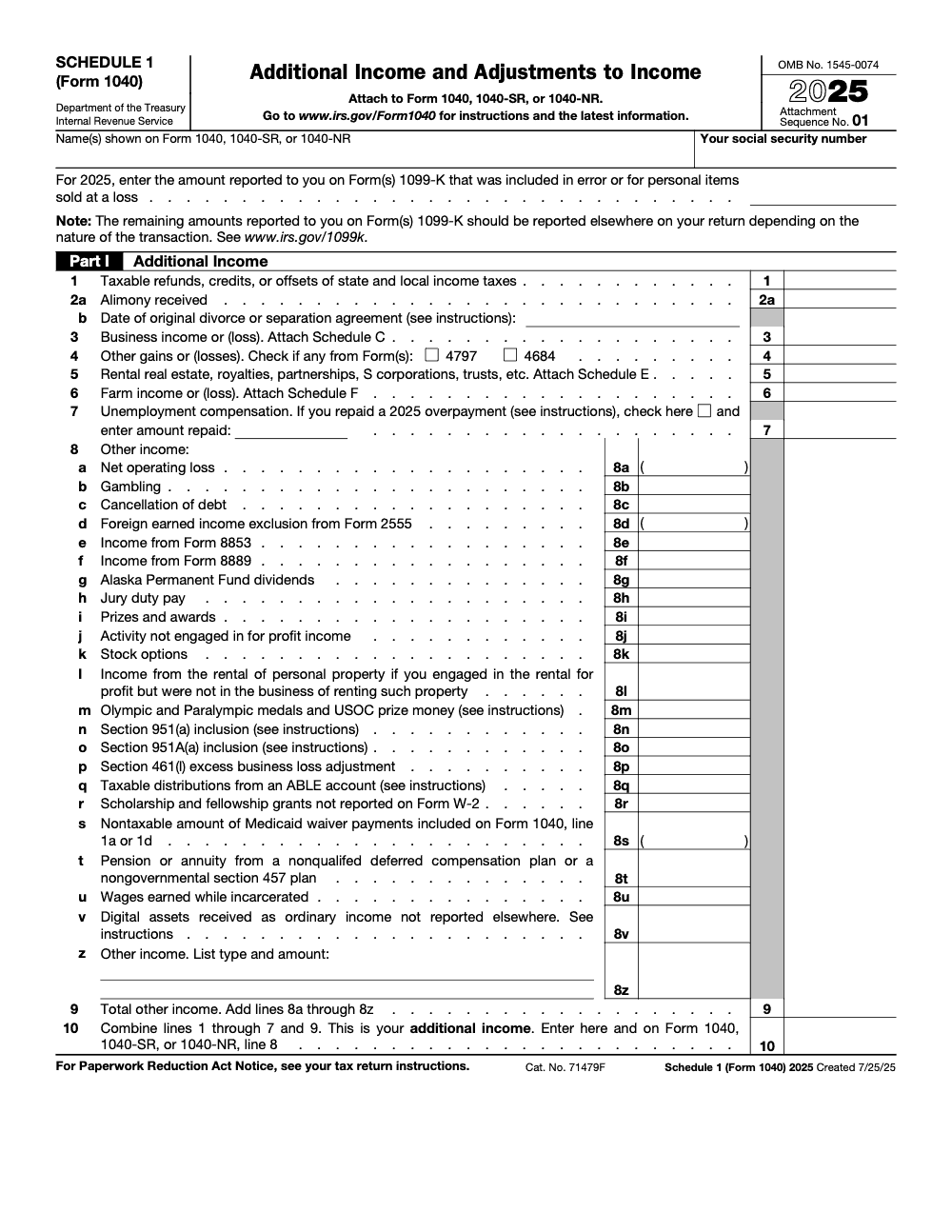
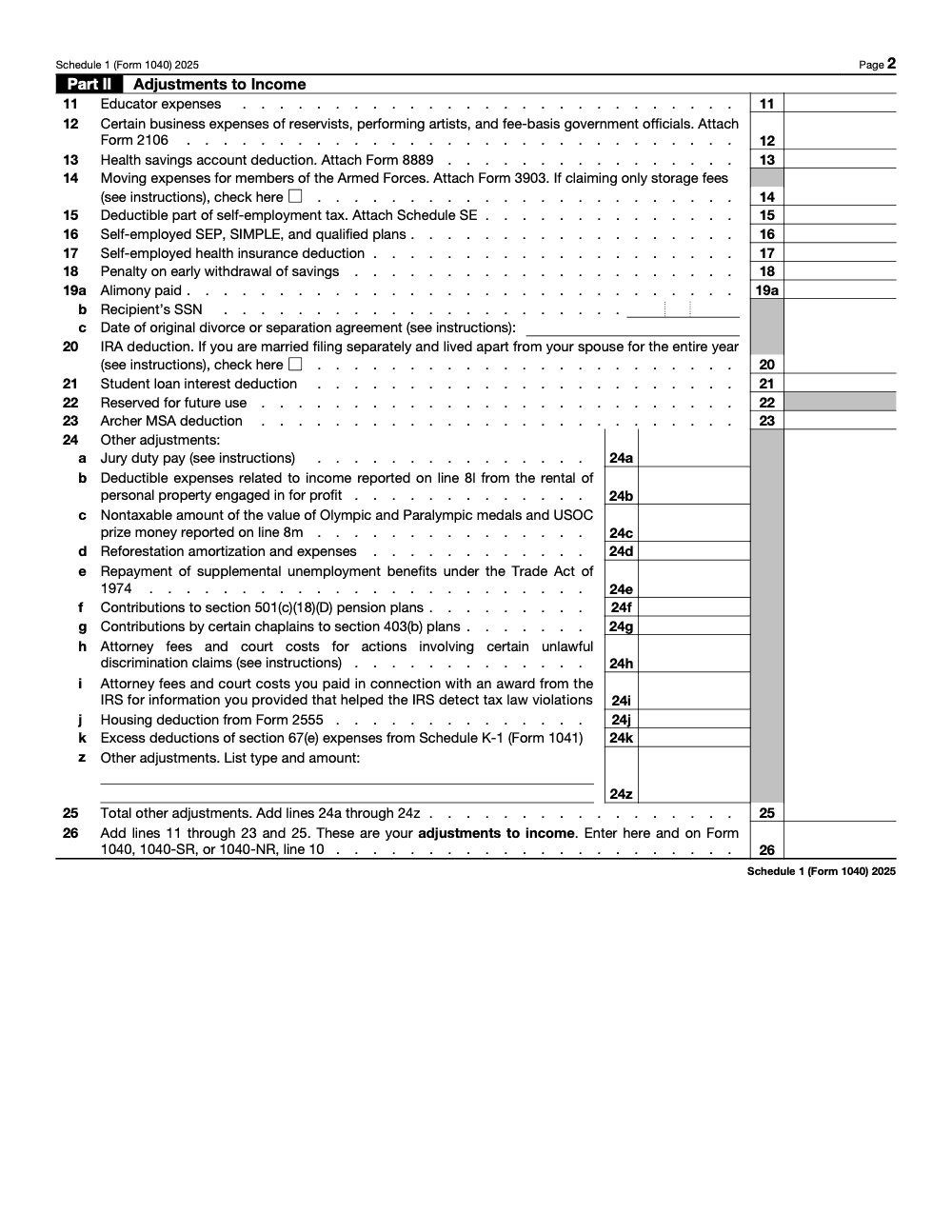
Schedule 1 attaches to Form 1040, Form 1040-SR, or Form 1040-NR to report additional income (Part I, line 10 flows to Form 1040 line 8) and above-the-line adjustments (Part II, line 26 flows to Form 1040 line 10). For tax year 2025, the form was revised 7/25/25 (per the IRS Schedule 1 (Form 1040) 2025 instructions); returns are due April 15, 2026, or October 15, 2026 with Form 4868.
Schedule 1 is where two specific entries decide a lot: Part I collects additional income and its line 10 total flows to Form 1040 line 8, and Part II collects above-the-line adjustments with its line 26 total flowing to Form 1040 line 10. Both move AGI, which then ripples into credits, deductions, and the state return.
For 2025 there are two items worth flagging before you start. Line 8v now carries digital-asset ordinary income not reported elsewhere, such as staking or certain fork income, and there is an entry space at the top to record Form 1099-K amounts issued in error or for personal-item sales at a loss.
Key Takeaways
- Schedule 1 has two jobs, collect “additional income” in Part I and “adjustments to income” in Part II. Part I totals go to Form 1040 line 8, Part II totals go to Form 1040 line 10, both impact AGI.
- Use Schedule 1 for unemployment, state tax refunds, pre‑2019 alimony received, business, rental, farm results, gambling winnings, and many “other income” items, plus educator expenses, student loan interest, HSA and IRA deductions, self‑employed tax and health insurance, and more.
- For 2025, line 8v carries digital‑asset ordinary income not reported elsewhere, for example staking or certain fork income.
- For 2025, there is an entry space at the top of Schedule 1 to record Form 1099‑K amounts issued in error or for personal‑item sales at a loss, see examples in the 1040 instructions.
- The IRS issues post‑release corrections to the 1040, Schedule 1, and the instructions throughout the season, so pull the latest 2025 PDFs and review the IRS post‑release changes page before you file.
What Schedule 1 Is And When You Need It
Think of Schedule 1 as the detail page for income and deductions that do not live on the face of Form 1040. You will file it when you have additional income like unemployment compensation, taxable state refunds, pre‑2019 alimony received, net results from a sole proprietorship on Schedule C, rental or K‑1 items via Schedule E, farm results via Schedule F, other gains via Form 4797, along with prizes, awards, and gambling winnings listed under “Other income.” Those entries roll up to Schedule 1 line 10, then to Form 1040 line 8.
Part II is just as important. This is where you lower AGI with above‑the‑line deductions, educator expenses, HSA and IRA deductions, the deductible half of self‑employment tax, SEP or SIMPLE contributions, student loan interest, self‑employed health insurance, and a handful of specific write‑ins. These sum to Schedule 1 line 26, which you then carry to Form 1040 line 10.
If a Schedule 1 item applies to you, you must include the schedule. If none apply, you typically do not attach Schedule 1.
Quick Map Of Common Items
| Item you have | Where you report it | Also attach | Where it lands on Form 1040 |
| Unemployment compensation | Schedule 1, line 7 | 1099‑G | Line 8, through Schedule 1 line 10 |
| Net profit or loss from a sole proprietorship | Schedule 1, line 3 | Schedule C | Line 8, through Schedule 1 line 10 |
| Rents, royalties, partnerships, S corps, trusts | Schedule 1, line 5 | Schedule E | Line 8, through Schedule 1 line 10 |
| Farm income or loss | Schedule 1, line 6 | Schedule F | Line 8, through Schedule 1 line 10 |
| Other gains, business property | Schedule 1, line 4 | Form 4797 | Line 8, through Schedule 1 line 10 |
| Gambling winnings, prizes, awards | Schedule 1, line 8b or 8i | W‑2G if issued | Line 8, through Schedule 1 line 10 |
| Educator expenses | Schedule 1, line 11 | Keep receipts | Line 10, through Schedule 1 line 26 |
| Student loan interest | Schedule 1, line 21 | Form 1098‑E if ≥ 600 paid | Line 10, through Schedule 1 line 26 |
| Self‑employed health insurance | Schedule 1, line 17 | Policy statements | Line 10, through Schedule 1 line 26 |
All line references above are for the 2025 Schedule 1 and Form 1040. Always pull the latest PDFs from IRS.gov before you file.
A Simple Example
Say you earned wages, plus 4,000 from a side gig, and you paid 1,800 for your own health insurance as a sole proprietor. You would report the net business result on Schedule 1 line 3, which increases Form 1040 line 8 after Schedule 1 line 10 totals up. Then you would deduct the self‑employed health insurance on Schedule 1 line 17, which reduces Form 1040 line 10 through Schedule 1 line 26. Net effect, AGI changes twice, once up for income, then down for the deduction.
Additional Income You Report On Schedule 1
The Usual Suspects, With Quick Pointers
- State or local income tax refunds, Schedule 1 line 1, include only the taxable portion under the tax benefit rule (if you took the standard deduction in the prior year, the refund is not taxable at all). See the 1040 instructions for how to test refund taxability.
- Alimony received under pre‑2019 agreements, line 2a, include the original agreement date (for divorce or separation instruments executed after December 31, 2018, alimony is neither taxable to the recipient nor deductible by the payer, so nothing goes on lines 2a or 19a).
- Business income, line 3, attach Schedule C. Rentals, partnerships, S corps, trusts, line 5, attach Schedule E. Farms, line 6, attach Schedule F. Other business property gains or losses, line 4, attach Form 4797. These roll into Schedule 1 line 10, then Form 1040 line 8.
- Unemployment compensation, line 7, report from Form 1099‑G.
- “Other income,” lines 8a through 8z, for items like gambling, canceled debt, Alaska Permanent Fund dividends, jury duty pay, stock options, and more, see the line‑by‑line notes in the instructions.
Digital Assets, The New Line 8v, And The Check‑Box Question
If you received ordinary income tied to digital assets that is not reported elsewhere, for example staking rewards or certain hard fork income, you now use Schedule 1 line 8v. Capital transactions for digital assets, for example selling or exchanging a coin you held as an investment, still belong on Form 8949 and Schedule D. Regardless, you must answer the digital assets question on your return, Yes or No, and then report the income in the right place.
A quick way to think about it, wages paid in crypto go where wages go, Schedule C income in crypto goes on Schedule C, capital sales of crypto go to Form 8949, and only other ordinary income that is not already reported elsewhere goes to Schedule 1 line 8v.
The New 1099‑K Entry Space At The Top Of Schedule 1
For 2025, if a platform sent you a 1099‑K that included non‑taxable personal transfers or a sale of a personal item at a loss, the IRS provides an entry space at the top of Schedule 1 for those amounts. The instructions include several examples, for an incorrect 1099‑K, for a personal item sold at a loss, and for multiple incorrect forms. Use the entry space only for amounts included in error or for personal‑item losses, report the rest of 1099‑K activity where it belongs.
Also note the evolving 1099‑K threshold path. For tax year 2025, third‑party settlement organizations must report payments exceeding 2,500 on Form 1099‑K, and the threshold is scheduled to drop to 600 for 2026 and later years under current law. Watch the instructions each season for updates.
Adjustments To Income That Can Lower Your AGI
Educator Expense Deduction
If you are an eligible K–12 educator who worked at least 900 hours during the school year, you can deduct up to 300 of unreimbursed classroom expenses on Schedule 1 line 11. Married filing jointly, and both spouses qualify, you can claim up to 600 total, but no more than 300 for each educator. Keep receipts and a simple log of hours and purchases.
Student Loan Interest
You can deduct up to 2,500 of qualified student loan interest on Schedule 1 line 21, even if you take the standard deduction. For 2025 returns, the phaseout uses modified AGI, starting at 85,000 and ending at 100,000 for single filers, and starting at 170,000 and ending at 200,000 for married filing jointly (married filing separately filers cannot claim this deduction at all, regardless of income, and a taxpayer who could be claimed as a dependent on another person's return is also ineligible). If you paid at least 600 in interest, your servicer should send Form 1098‑E, if you paid less, you can still deduct the actual interest you paid.
Self‑Employed Health Insurance
If you are self‑employed, you can deduct health, dental, and qualified long‑term care premiums you paid for yourself, your spouse, and dependents on Schedule 1 line 17. The deduction cannot exceed your net self‑employment income from the relevant business, and it does not create or increase a loss. Coordinate carefully with any employer coverage, HRA, or pre‑tax arrangement, do not double count. Keep policy statements and proof of payment with your records.
Tip, several Schedule 1 adjustments flow into AGI first, then feed phaseouts for credits. Re‑run any AGI‑based worksheets if you change Schedule 1 mid‑way through your prep.
2025 Updates And IRS Corrections You Should Not Miss
- The IRS issues post‑release corrections to forms and instructions throughout the season. Before you file, review the IRS post‑release changes page for the current 2025 Form 1040, Schedule 1, and the 1040 instructions, then re‑check any computations done from an early copy.
- If you prepared a draft using an early version of Schedule 1 or Schedule 2, confirm your line entries against the final 2025 forms once they are released.
- Corrections to math figures and worksheet references do happen after a form is first posted, so always pull the latest PDF rather than relying on a copy downloaded earlier in the season.
How Schedule 1 Connects To Form 1040
- Part I total, Schedule 1 line 10, carries to Form 1040 line 8. This is the additional income that increases your total income.
- Part II total, Schedule 1 line 26, carries to Form 1040 line 10. These adjustments reduce AGI and can unlock credits or avoid phaseouts.
Mini Case
You have 5,000 in Schedule C profit and 2,000 of self‑employed health insurance. Schedule 1 line 3 adds 5,000 to Part I. Schedule 1 line 17 subtracts 2,000 in Part II. On Form 1040, income rises by 5,000 on line 8 through Schedule 1 line 10, then AGI falls by 2,000 on line 10 through Schedule 1 line 26. The order matters, so finish Part I and Part II before you compute AGI‑based items.
Filing Tips, Forms, And Where To Get The Latest Versions
Download the current‑year Schedule 1 and 1040 instructions each time you prepare a return, even mid‑season. Updates are real, and they do change outcomes.
- Pull the latest PDFs for Form 1040, Schedule 1, and the 1040 instructions from IRS.gov, then check the “Post‑release changes” page for corrections.
- If you do not have additional income or any adjustments, do not attach Schedule 1. If you do, attach the supporting schedules, for example Schedule C, E, F, and Form 4797.
- For digital assets, answer the Yes or No question and then report the item in the correct place, capital transactions on Form 8949, ordinary digital asset income not reported elsewhere on Schedule 1 line 8v.
- For incorrect 1099‑K or personal‑item losses, use the entry space at the top of Schedule 1 per the examples.
For CPA, EA, And Firm Owners
If you oversee busy season, you already know the return itself rarely breaks the schedule. Delivery does. Many firms stall when extra Schedules 1, 2, and 3 pile up, reviews slow down, and AGI‑sensitive recalculations ripple through the file. If you are building capacity responsibly, an offshore team only works when it follows your SOPs, your templates, and a layered review model. That is exactly how our team at Accountably integrates with firms, trained on U.S. workflows, working inside your systems, and measured against turnaround SLAs and quality control, so your reviewers spend less time in loops and more time on client strategy. Use offshore capacity with structure, not as a resume drop.
Wrap Up And Trust Signals
Schedule 1 is where you make the 1040 complete. Start with the latest PDFs, report additional income cleanly, claim the adjustments you earned, and double‑check 2025 updates, especially digital assets and the 1099‑K entry space. We prepared and fact‑checked this guide against the current IRS forms and instructions, and we reviewed it on November 26, 2025. If your situation is complex or involves multi‑state, business, or digital asset activity, consider a professional review before you file.
Disclosure, this article was created by our tax team and reviewed with the help of research tools to ensure citations and dates are current.
Common Mistakes We See Every Season
Schedule 1 is small enough to look routine and large enough to push a return back through review when one of these patterns slips through. Five repeat every season.
Reusable Checklists
These are written to be copied straight into a firm SOP for the Schedule 1 pass on every Form 1040, 1040-SR, and 1040-NR file.
Part I additional income scan
- Split every 1099-K bucket into business, hobby, and personal-loss before any income line is entered.
- Verify state refund on line 1 traces back to prior-year itemized deduction and a tax-benefit calculation.
- Run alimony entries through the December 31, 2018 instrument-date test before line 2a touches the return.
- Confirm Schedule C is attached for line 3, Schedule E for line 5, and Schedule F for line 6.
- Flag every line 8a NOL, line 8d FEIE, and line 8s Medicaid waiver entry as a negative number.
- Confirm digital asset ordinary income (mining, staking, airdrops, payment for services) lands on line 8v at fair market value at receipt and is not double-counted on Schedule D.
- Verify line 8u wages earned while incarcerated are excluded from EITC and Additional Child Tax Credit earned-income computations.
- Reconcile line 10 total to Form 1040 line 8.
Part II adjustment eligibility
- Cap line 11 educator expenses at $300 per qualifying K-12 educator ($600 combined on MFJ where both spouses qualify).
- Confirm line 12 Form 2106 filer is an Armed Forces reservist, qualified performing artist, fee-basis state or local government official, or has impairment-related work expenses.
- Confirm Form 8889 is attached for any line 13 HSA deduction.
- Confirm line 14 moving expense filer is active-duty Armed Forces on PCS orders.
- Confirm line 15 deductible self-employment tax equals 50% of the Schedule SE liability, not the full amount.
- Apply line 20 IRA deduction phaseouts ($79,000 to $89,000 single active participant, $126,000 to $146,000 MFJ active participant, $236,000 to $246,000 spousal) and check the lived-apart-entire-year box for MFS filers when accurate.
- Apply line 21 student loan interest cap of $2,500, single phaseout $85,000 to $100,000, MFJ phaseout $170,000 to $200,000, and the MFS disqualification.
- Confirm line 22 is left blank (reserved for future use).
- Reconcile line 26 total to Form 1040 line 10.
AGI-driver review
- Confirm AGI on Form 1040 line 11 ties to gross income (line 9) less Schedule 1 line 26 adjustments.
- Re-run any AGI-sensitive item (IRA deduction phaseout, Roth contribution limit, education credits, Premium Tax Credit, EITC) after Schedule 1 totals are final.
- Recheck 1099-K threshold posture for the return ($2,500 for 2025) before the digital assets question on Form 1040 is answered.
- Document Form 982 review for any 1099-C item before it lands on line 8c, including bankruptcy and insolvency exclusion analysis.
- Document Form 461 computation for any line 8p excess business loss adjustment ($313,000 single, $626,000 MFJ thresholds for 2025).
- Lock the Schedule 1 PDF revision date 7/25/25 in the workpaper.
Keep Schedule 1 (Form 1040) Season From Stalling
Schedule 1 is small but punches above its weight. Every line that lands on Part I or Part II shifts AGI, and AGI feeds into IRA deduction phaseouts, student loan interest phaseouts, and the credits, deductions, and exemptions that follow. The March and April spike makes that ripple expensive: Part I line 10 flows to Form 1040 line 8, Part II line 26 flows to Form 1040 line 10, and a single overlooked above-the-line adjustment can pull a return back through review (per the 2025 Schedule 1 (Form 1040) instructions).
The fix is upstream of the return. Standardize how Schedule 1 lines get sourced, screened, and signed off before any AGI-sensitive credit is computed. Teams that stall most often are doing the credit math first and the Schedule 1 audit second.
- Add a 1099-K screen step that routes in-error and personal-loss amounts to the adjustment line at the top of Schedule 1 before any income hits line 8j or Schedule C.
- Build a Part II eligibility gate that flags MFS status (line 21 student loan interest disallowed), civilian filers on line 14 (Armed Forces only), and W-2 employees on line 12 (reservists, qualified performing artists, fee-basis officials, or impairment-related expenses only).
- Mark every line 8a NOL, line 8d FEIE, and line 8s Medicaid waiver as a negative-only field in the prep software so review does not have to catch sign flips on the final pass.
- Require Form 982 review before any 1099-C amount lands on line 8c, and document the bankruptcy or insolvency analysis in the file even when it does not change the inclusion.
- Enforce the $300 line 11 educator cap and the $2,500 line 21 student loan interest cap at data-entry, not at review.
This is the layer where structured offshore capacity earns its keep. Our team at Accountably's tax outsourcing works inside your prep software, follows your SOPs on AGI-driver lines, and routes Schedule 1 review through a documented preparer-to-reviewer path so the AGI cascade does not break twice in one return.
FAQs
It is an attachment to Form 1040 for reporting additional income and adjustments to income. Part I totals go to Form 1040 line 8, Part II totals go to Form 1040 line 10, both feed AGI and can change credits and deductions.
File it if you have income streams not shown on the face of Form 1040, for example unemployment, business, rental, farm, prizes, gambling, pre‑2019 alimony received (alimony under post-2018 instruments is neither taxable nor deductible), or if you take any above‑the‑line deductions like educator expenses, HSA or IRA deductions, student loan interest, or self‑employed health insurance.
If these are ordinary income and not reported elsewhere, use Schedule 1 line 8v. If you sell or exchange a digital asset held as a capital asset, use Form 8949 and Schedule D, and still answer the digital assets question on your return.
For 2025 returns, the deduction phases out with MAGI from $85,000 to $100,000 for single filers, and from $170,000 to $200,000 for married filing jointly. The maximum deduction is $2,500, subject to those limits.
Up to 300 per eligible educator, 600 if both spouses are eligible educators filing jointly, but not more than 300 each. You must work at least 900 hours during the school year in a K–12 setting.
Other forms this guide names
- Form 1040: Filing Guide for 2025 Returns (AGI, Deductions, Deadlines)
- Form 1099-K: Rules, Thresholds, and State Triggers
- Form 4797: Depreciation Recapture and Section 1231
- Form 8949: How to Report Capital Gains & Losses
- Form 1098‑E: Student Loan Interest Deduction Guide
- Form 1099-C: Taxable Income, Exclusions, and How to Report
Summarize this article with AI
About this guide
Accountably helps US CPA, EA, and accounting firms hire trained accountants and tax preparers in India.
About us Reviewed byJugal Thacker, CPAFounder and CEO at Accountably
A Washington-licensed CPA with 7+ years inside US firms – PwC, a real-estate tax practice, then a full-service firm, rising from reviewer to manager to advisory. This article was reviewed against current IRS guidance for the 2025 tax year and updated for filers preparing late returns, amendments, and 2026 estimates.
View profile →How we research, review, and update this guide
Every Accountably guide is researched against primary IRS sources, reviewed by a U.S. CPA, and refreshed as guidance evolves. Read our Editorial Guidelines to see how we source, fact-check, and update our content.