Summarize this article with AI
In Brief
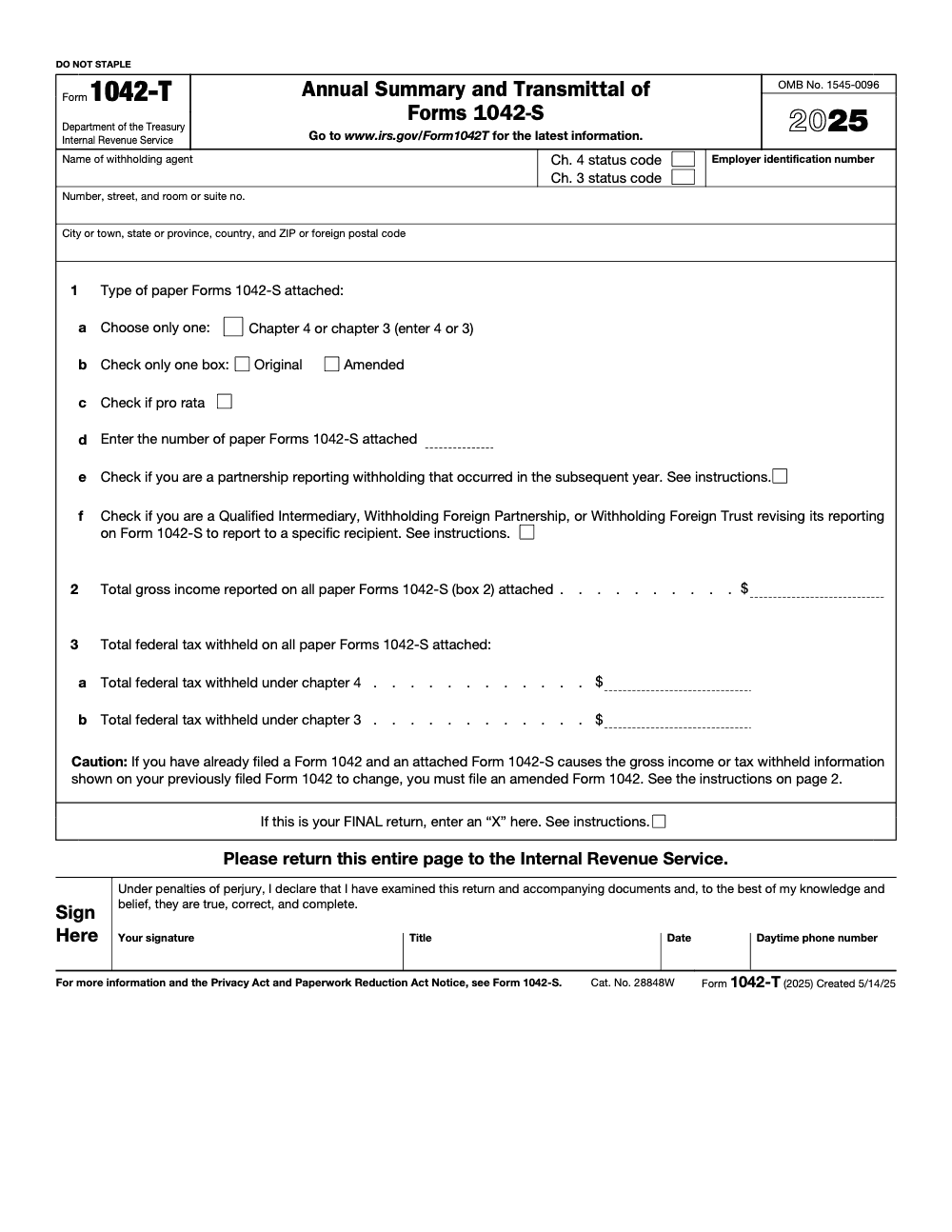
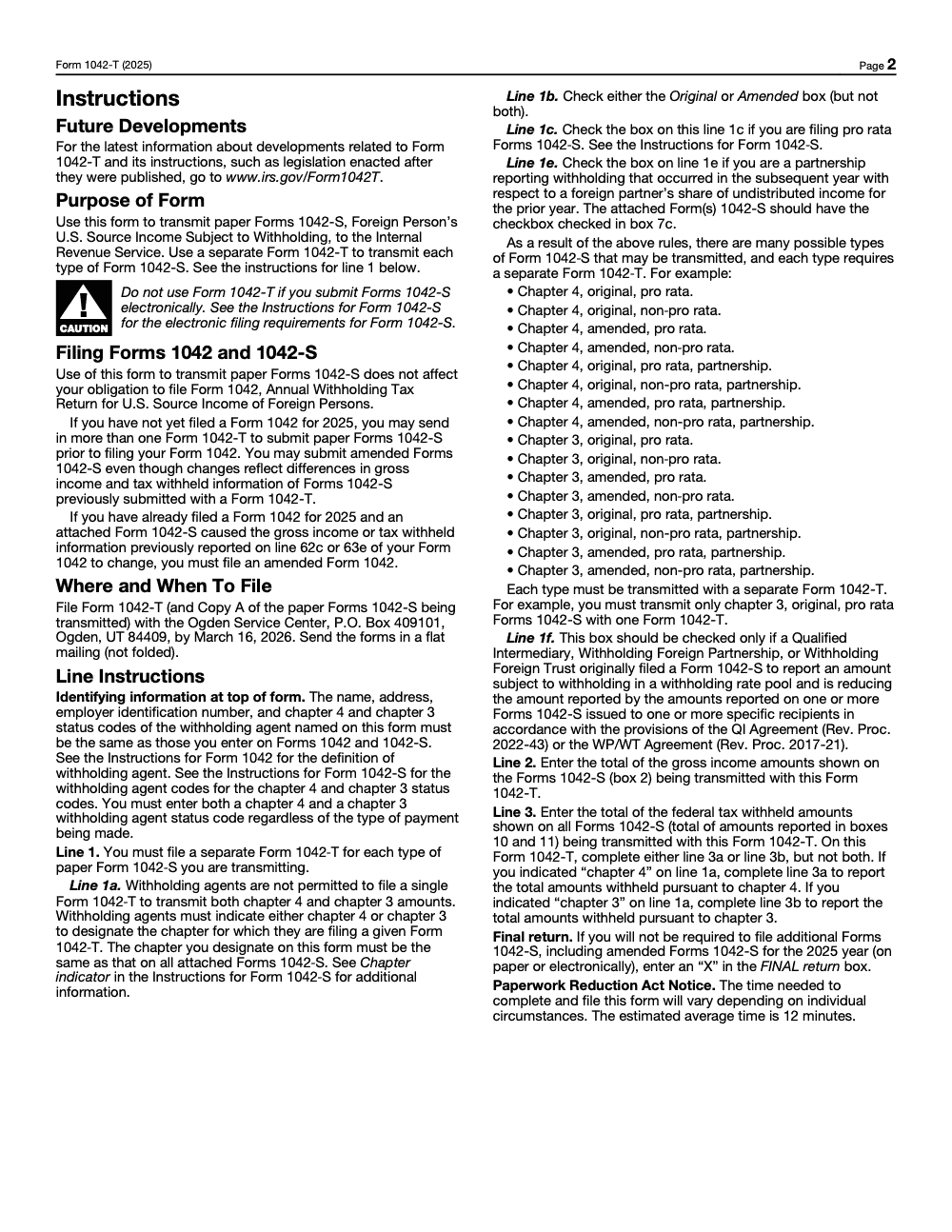
Form 1042-T is the one-page paper transmittal that summarizes Copy A of Forms 1042-S mailed to the IRS Ogden Service Center, and it does not replace Form 1042, the annual withholding return (per the Instructions for Form 1042-T). Line 2 carries the total gross income from box 2 of the attached forms, line 3a or line 3b carries the federal tax withheld depending on the chapter you transmit, and for tax year 2025 the transmittal is due March 16, 2026. File Forms 1042-S electronically and you do not use Form 1042-T at all. If paper batches are piling up, see our tax preparation services.
The pattern on a 1042-T call is almost always the same. A controller mails one transmittal covering both original and amended Forms 1042-S, mixes chapter 3 and chapter 4 totals on a single cover sheet, and weeks later a mismatch notice arrives from Ogden. The IRS treats this as a quick one-page form, yet that kind of cleanup can swallow an afternoon.
Form 1042-T is paper only, and only if you are not e-filing the 1042-S forms; meet the 10-return threshold and it disappears from your process entirely. When it does apply, line 2 carries the total gross income from box 2 of the attached forms, line 3a or 3b carries the withholding by chapter, and the stack goes to the Ogden Service Center, P.O. Box 409101, Ogden, UT 84409, due March 16, 2026 for tax year 2025.
Key Takeaways
- Form 1042‑T is only for paper filing and only to the IRS. If you file Forms 1042‑S electronically, you do not use 1042‑T.
- The due date tracks Form 1042‑S, generally March 15, with the next business day rule when that date falls on a weekend or holiday.
- Most filers must now e‑file if they meet the 10‑return threshold, so many organizations will not use 1042‑T anymore. Financial institutions must e‑file regardless of count. Partnerships with more than 100 partners must also e‑file.
- If you are mailing paper 1042‑S, send them to the Ogden Service Center, P.O. Box 409101, Ogden, UT 84409, with 1042‑T on top, and use traceable delivery.
- Need more time to file 1042‑S and the 1042‑T transmittal, request Form 8809 for a 30‑day extension. A second 30‑day extension may be available.
What Form 1042‑T Is, and Why It Trips Teams
Think of Form 1042‑T as the IRS cover page for a paper stack of Forms 1042‑S. It summarizes how many forms are enclosed and the totals for U.S.‑source income and tax withheld so the IRS can reconcile your submission. You prepare a separate 1042‑T for each type of 1042‑S you are mailing, then place the 1042‑T on top of those paper forms in the envelope to Ogden. If you e‑file 1042‑S, you do not prepare a 1042‑T at all.
The IRS’ own Form 1042‑T page labels the form as the current revision without a dated change log, which is why many teams rely on the on‑page form instructions and the latest 1042‑S instructions for the operational details. We do the same in our shop and keep a PDF copy of the exact form used in our working papers.
Quick gut check, if you are e‑filing 1042‑S, stop. You do not need 1042‑T. If you are mailing paper 1042‑S, 1042‑T is required and belongs on top.
The 10‑Return E‑File Rule Changed the 1042‑T Decision
For years, teams repeated the old 250‑return threshold. That is outdated for today’s filings. Under the final e‑file regulations, most filers that must file 10 or more information returns in the year are required to e‑file, and that rule covers Forms 1042‑S. Financial institutions must e‑file regardless of count, and partnerships with more than 100 partners must also e‑file. If you fall into these categories, you will not use 1042‑T because you will not mail paper 1042‑S.
If you are below the e‑file threshold and you choose to mail paper Copy A of Form 1042‑S, then you must include Form 1042‑T as the transmittal, and you must use a separate 1042‑T for each 1042‑S type. Attach only Copy A to the 1042‑T. Recipient copies go to payees, not with the IRS mailing.
Who This Guide Helps
- CPA and EA firms that still mail small batches of 1042‑S
- Universities, research institutions, and healthcare systems that pay scholarships or stipends to foreign recipients
- Funds, broker‑dealers, and platforms that issue a mix of Chapter 3 and Chapter 4 1042‑S but sometimes have small paper remnants
- Controllers and tax managers cleaning up late corrections who need to paper file a small set with a precise transmittal
We write this from the operator’s seat. Our team has shipped countless compliant sets, and the pattern is consistent. When grouping is clean, control totals tie the first time, and the address is current, review is fast and calm. When grouping is loose or a team mixes forms under one transmittal, review bogs down and corrections multiply.
Current Revision, Still “Current”
As of December 2, 2025, the IRS shows About Form 1042‑T with “Current revision” and no explicit effective date. No separate “Recent developments” are listed for the form page. That means you should validate against the latest 1042‑S Instructions and keep a copy of the exact 1042‑T PDF you used. We document the lack of a stated effective date in our file notes, then archive the PDF for audit support.
Where 1042‑T Fits With 1042 and 1042‑S
- Form 1042‑S reports the income paid to foreign recipients and the withholding applied. It is due to the IRS and to recipients by March 15.
- Form 1042‑T is the paper‑only transmittal that summarizes paper 1042‑S packages mailed to the IRS. Do not send it to recipients, and using it does not replace your obligation to file Form 1042, the annual withholding tax return, separately.
- Form 1042 is the annual withholding tax return that reconciles Chapters 3 and 4 withholding with deposits and 1042‑S reporting. Its e‑file requirement and mailing address differ, so check the current instructions each year.
A simple way to remember it, the 1042‑S tells the story per payee, the 1042‑T bundles paper 1042‑S for the IRS, and the 1042 ties the whole year together in one return.
Who Must File Form 1042‑T
If you are a withholding agent who is paper filing any Forms 1042‑S with the IRS, you must include Form 1042‑T as the transmittal. Withholding agent is a broad term, it includes U.S. or foreign persons, individuals, corporations, partnerships, brokers, custodians, estates, trusts, and exempt organizations that control or pay U.S.‑source income to foreign persons.
The Practical Test
- If you must e‑file 1042‑S because you meet the 10‑return rule, because you are a financial institution, or because you are a partnership with more than 100 partners, you do not use 1042‑T.
- If you are allowed to paper file and choose to do so, you must send Copy A of each 1042‑S with a Form 1042‑T on top, and you must use a separate 1042‑T for each 1042‑S type you include.
Withholding Agents, Defined Simply
If you control, receive, or pay U.S.‑source income to a foreign person, and withholding rules apply under Chapter 3 or Chapter 4, you are in scope. That includes common items like dividends, interest, royalties, compensation, and scholarships. Your 1042‑S reporting tells the IRS and the recipient what happened, and your 1042‑T helps the IRS process a paper batch.
Paper Filing Scenarios You Might Still See
- You issue a small number of 1042‑S and are under the 10‑return e‑file threshold.
- A late correction must be mailed for timing reasons.
- Your organization obtained an approved waiver from e‑filing by filing Form 8508.
When any of the above apply, you will prepare Form 1042‑T, organize the paper 1042‑S by type, and mail to Ogden by the deadline. Use certified mail or a tracked carrier so you have timestamped proof that you filed on time.
Separate Transmittals Are Not Optional
Every distinct 1042‑S type gets its own 1042‑T. Do not mix income types, chapter indicators, or batches under one transmittal. The IRS’ processing guidance and training materials reinforce that 1042‑T is filed and processed separately from the Form 1042 and that multiple 1042‑S types exist, including chapter and pro rata distinctions. Keeping these groupings clean cuts review time and avoids mismatch notices.
Relationship To 1042 and 1042‑S, At a Glance
| Item | Purpose | Who sees it | When it is due |
| Form 1042‑S | Per‑recipient reporting of U.S.‑source income to foreign persons and any withholding | IRS and recipient | March 15, next business day rule applies |
| Form 1042‑T | One‑page transmittal for any paper 1042‑S mailed to the IRS | IRS only | Same as 1042‑S due date |
| Form 1042 | Annual return that reconciles withholding, deposits, and 1042‑S totals | IRS only | Per current year instructions |
Sources for due dates, use, and submission method are the IRS discussion page and the 1042‑S instructions, which expressly require a 1042‑T for any paper 1042‑S and forbid using it when you e‑file 1042‑S.
Why Quality Control Around 1042‑T Matters
Errors around 1042‑T trigger real costs. Penalties for incorrect or late 1042‑S filings are assessed per form and rise with lateness. The IRS penalty page provides yearly figures and points to the inflation‑adjusted schedules in the IRM. In 2024, for example, the maximum per‑form penalty for filing after August 1 or not filing was up to 310. Intentional disregard jumps to 630 or 10 percent of items required to be reported. Amounts adjust over time, so always reference the most current year.
When you keep 1042‑T groupings clean and totals reconcile to the attached 1042‑S, reviewer time drops, rework plummets, and you protect trust with recipients. That is the real win.
Deadlines, Extensions, and the Correct Mailing Address
Your 1042‑T clock is tied to 1042‑S. The IRS due date is March 15 of the year following the calendar year of payment. If March 15 lands on a weekend or legal holiday in D.C. or where you file, use the next business day. This applies to both the IRS filing and furnishing recipient copies.
Extension Options
If you need extra time to file 1042‑S with the IRS, request Form 8809 by the original due date. The first request provides an automatic 30‑day extension. A second 30‑day extension is possible if you file another 8809 before the first extension ends, although the second is not automatic and is subject to IRS approval. Remember, Form 7004 extends Form 1042, not the 1042‑S or the 1042‑T transmittal.
Tip, file Form 8809 online through the FIRE system to get immediate acknowledgment when time is tight.
Where to Mail Paper Sets
For paper submissions, assemble the package with Form 1042‑T on top, then all Copy A 1042‑S forms, and mail to: Ogden Service Center, P.O. Box 409101, Ogden, UT 84409. Use a tracked delivery method so you can prove timely filing if questioned later. The IRS’ where‑to‑file page confirms this address for 1042, 1042‑S, and 1042‑T.
Quick Deadline Table
| Moment | Risk if missed | Action to stay compliant |
| March 15 due date | Late filing penalties | File 1042‑S with 1042‑T if paper |
| Weekend or holiday | Confusion on cutoff | Use next business day |
| Need more time | Penalties begin to accrue | File Form 8809 for 30 days |
| Still not ready | Second lapse risk | File second 8809 before the first expires |
| Wrong extension form | No protection | Do not use Form 7004 for 1042‑S or 1042‑T |
How to Complete Form 1042‑T, Step by Step
The form is short, the discipline around it is what matters.
- Confirm you truly need 1042‑T. If you meet the 10‑return e‑file rule, e‑file 1042‑S and skip 1042‑T. If you are mailing paper Copy A forms, continue.
- Group your paper Forms 1042‑S by type. Prepare a separate 1042‑T for each distinct type. Keep originals together, and if you are mailing a corrected batch later, that corrected set gets its own 1042‑T. If you have already filed Form 1042 for the year and a corrected 1042‑S changes the gross income or tax withheld previously reported on Form 1042 line 62c or 63e, you must also file an amended Form 1042, not just the amended 1042‑S.
- Complete 1042‑T with the withholding agent’s legal name, EIN, address, contact name, phone, the count of attached forms, total U.S.‑source income, and total tax withheld. Sign where required.
- Place 1042‑T on top of the grouped paper 1042‑S, and do not staple the 1042‑T or the attached 1042‑S forms together. Do not include recipient copies in the IRS package.
- Mail to the Ogden address in a flat mailing, never folded, and keep proof of mailing with your year‑end workpapers.
Pre‑Mail Checklist We Use In Practice
- Counts on 1042‑T match the number of enclosed 1042‑S, with a second person recount.
- Totals on 1042‑T equal the sum of attached 1042‑S for gross income and withholding.
- Groupings are clean by 1042‑S type, no mixing.
- Address is current and verified against the IRS where‑to‑file page.
- Tracked shipping label printed and placed in the binder, along with a PDF of the exact 1042‑T used.
- Calendar shows the next check‑in date to confirm delivery scan and processing status.
If you take these steps, your reviewer will spend minutes, not hours, and your audit file will stand up later.
Electronic Filing vs Paper Filing, Make the Call Quickly
The fastest way to decide if Form 1042‑T belongs in your process is a two step check.
- Count your total information returns for the year. If you are required to e‑file your Forms 1042‑S under current rules, you do not use 1042‑T.
- If you are allowed to mail paper Copy A sets, then 1042‑T is required and must sit on top of each properly grouped paper batch.
Simple Decision Tree
- You must e‑file 1042‑S, you will not prepare 1042‑T.
- You are permitted to paper file and choose to do so, you must prepare 1042‑T.
- You obtained an approved waiver to paper file, you must prepare 1042‑T.
- You are sending corrected forms by paper, that corrected set gets its own 1042‑T.
Why many teams still use 1042‑T at least once
Even strong e‑file programs see paper corner cases. A late discovery, a system cutoff that misses a recipient, or a corrected batch that must go out quickly. In these cases, a clean 1042‑T plus precise grouping keeps the cleanup small and avoids penalty letters.
If you are holding a paper stack of Copy A forms in your hands, a 1042‑T should already be printed and sitting on top.
Penalties and Common Filing Errors
The IRS assesses penalties per form, and mistakes that start small can multiply. The best defense is a tidy transmittal and a clean tie out to the attached 1042‑S.
Frequent mistakes and fast fixes
| Error you might make | What the IRS sees | Fast fix you can apply |
| Mixed 1042‑S types under a single 1042‑T | Totals that do not reconcile to system logic | Split by type, reprint 1042‑T for each group, and re‑mail |
| Count on 1042‑T does not match attached forms | Mismatch notice or processing delay | Recount with a second person and update totals before mailing |
| Recipient copies mailed to the IRS with Copy A | Extra pages and privacy risk | Remove recipient copies, attach only Copy A behind 1042‑T |
| Used Form 7004 to extend 1042‑S filing | No protection for 1042‑S deadlines | File Form 8809 for 1042‑S and 1042‑T, keep the acknowledgment |
| Address out of date or no tracking | Mail arrives late or cannot be proven timely | Verify Ogden address, use a tracked carrier, keep the receipt |
| E‑file threshold met, but paper mailed | Incorrect filing method and higher penalty exposure | E‑file 1042‑S, retire 1042‑T for those batches |
Penalty posture that keeps you safe
- File on time or file Form 8809 by the original due date.
- Keep proof of timely mailing or an electronic acknowledgment in your binder.
- Correct errors quickly, and document what you changed and why.
- Train reviewers to check groupings and totals first, since those drive most notices.
Controls That Keep 1042‑T Boring
Your goal is a boring review. No surprises, no rework.
Batching rules we teach new staff
- Group by 1042‑S type, not by customer, business unit, or who completed the work.
- Create a unique 1042‑T for each group, even if a group has only a few forms.
- Use consistent file naming so anyone can find the transmittal weeks later.
Documentation rules that save you later
- Archive a PDF of the exact 1042‑T you used, plus a scan of the signed one.
- Store the carrier receipt or certified mail number in the same folder.
- Note the absence of a stated effective date on the 1042‑T web page in your workpapers and cite the instruction set you followed.
Reviewer checklist we rely on
- Counts tie and totals tie, both checked by two sets of eyes.
- The signature line is complete and legible.
- The address is confirmed for the current year.
- If this is a correction set, the word corrected is properly indicated on each 1042‑S.
- The e‑file decision was documented, so no one asks later why paper was used.
Withholding and Reporting References That Matter
Keep these references handy in your binder or knowledge base.
- Instructions for Forms 1042‑S and 1042‑T, these explain transmittal use, grouping rules, codes, and deadlines.
- Instructions for Form 1042, this is the reconciliation that must agree with the year’s 1042‑S.
- Publication 515 for withholding rates and treaty references.
- Form 8809, for extensions of time to file information returns, including 1042‑S and the paper 1042‑T transmittal.
- FIRE and e‑file pages for how to transmit and how to confirm acceptance.
When you work from these sources and keep your internal controls tight, the 1042‑T becomes a short, repeatable step instead of a stress point.
Extra Tools, Templates, and a Simple Process Map
Batch control sheet template
Add a one page batch control sheet to every paper packet.
- Withholding agent legal name and EIN
- Tax year and contact name with phone and email
- 1042‑S type this packet contains
- Count of enclosed forms
- Total U.S.‑source income, total tax withheld
- Date prepared, date mailed, carrier and tracking number
- Reviewer initials and a second person recount confirmation
Tape the control sheet to the inside flap of the envelope so anyone can see the core details without opening files.
Seven step process map we use with clients
- Decide e‑file or paper up front, document the decision.
- If paper, create groups by 1042‑S type.
- Run a totals report by group that will match the 1042‑T fields.
- Prepare the 1042‑T for each group and sign it.
- Assemble packet, 1042‑T on top, Copy A behind it, no recipient copies.
- Mail to Ogden with tracking and file the receipt.
- Update your log with the mailed date and who performed each step.
Final Checklist You Can Copy
- I confirmed whether e‑file is required for my 1042‑S.
- If paper filing, I grouped by 1042‑S type, not by client or team.
- Each group has its own signed 1042‑T.
- Counts and totals tie to a report and to the attached 1042‑S.
- Address verified, tracking number recorded, mailed on time.
- Extension filed on Form 8809 if needed, acknowledgment saved.
- My binder includes the exact 1042‑T PDF and the shipping receipt.
One clean checklist can save you hours of rework and a string of penalty notices. Make it part of your routine.
A Note on Operations and Scale
If 1042‑S season pushes your in‑house team past capacity, the issue is usually delivery design, not demand. At Accountably, we integrate trained offshore teams into your workflow with clear SOPs, standardized workpapers, and multi layer review so partner time stays in strategy, not in last mile paper checks. We work inside your systems and templates, and we keep control with turnaround SLAs and visible work tracking. If you want production stability for busy season without giving up quality or security, our team can help.
Conclusion
You now have a clear, practical playbook for Form 1042‑T. Decide e‑file or paper early, keep your 1042‑S groups clean, place a signed 1042‑T on top, and mail to Ogden with tracking by the due date. Use Form 8809 if you need time, and keep a tight audit file with proof of mailing and the exact form you used. Treat this as a short, disciplined step in your 1042‑S workflow. Do that, and the transmittal becomes a quiet non event while you keep your focus on quality withholding and accurate recipient reporting.
Common Mistakes We See Every Season
The same handful of 1042-T errors drive most of the notices we see, and almost all of them trace back to the top of the form or to a line that does not match the attached batch (per the Instructions for Form 1042-T).
Reusable Checklists
These checklists are written to drop straight into a firm SOP or a controller's workpaper file. Copy them, adapt the labels to your systems, and run them in order each season.
Sort paper Forms 1042-S into type-batches
- Confirm these Forms 1042-S are being paper filed, since electronic 1042-S need no 1042-T.
- Separate the forms by the chapter shown on line 1a, chapter 4 or chapter 3, and never mix the two under one transmittal.
- Within each chapter, separate original from amended forms (line 1b).
- Separate pro rata from non-pro rata forms (line 1c).
- Pull partnership subsequent-year forms (line 1e, with box 7c checked on the 1042-S) into their own batch.
- Confirm each distinct type will get its own Form 1042-T, up to the sixteen possible filing-type combinations.
Tie out each 1042-T before signing
- Enter the count of attached paper Forms 1042-S on line 1d and recount with a second person.
- Total box 2 across the batch and enter it on line 2.
- Total boxes 10 and 11 across the batch and enter it on line 3a (chapter 4) or line 3b (chapter 3), never both.
- Confirm the chapter on line 1a matches the chapter on every attached 1042-S.
- Confirm name, address, EIN, and both status codes match Forms 1042 and 1042-S.
- Complete the Sign Here block: signature, title, date, and daytime phone number.
- Mark the FINAL return box only if no further 1042-S will be filed for 2025.
Assemble the Ogden mailing packet
- Place the signed Form 1042-T on top of Copy A of the matching 1042-S batch.
- Attach only Copy A, with no recipient copies in the IRS envelope.
- Do not staple the packet, and mail it flat rather than folded.
- Address it to the Ogden Service Center, P.O. Box 409101, Ogden, UT 84409.
- Use a tracked carrier and file the receipt with your workpapers.
- Archive a PDF of the exact 1042-T used (Catalog Number 28848W) for audit support.
Keep 1042-T Season From Stalling
Form 1042-T does not get a busy season of its own. It rides on the March deadline for Forms 1042-S, and for tax year 2025 the transmittal is due to the Ogden Service Center by March 16, 2026. The pressure shows up in the sorting: the Instructions for Form 1042-T describe sixteen distinct filing-type combinations, since each mix of chapter, original or amended status, pro rata status, and partnership status needs its own transmittal. A team that leaves that sort to the last week mails mixed batches and earns mismatch notices.
The fix is to treat 1042-T as a short, repeatable production step rather than a March scramble. When the type-batching, the control totals, and the Ogden mailing are standardized, the transmittal becomes a quiet checkbox at the end of your 1042-S workflow.
- Lock the line 1a chapter and the line 1b original or amended status for each batch before anyone prints a transmittal.
- Tie line 2 to box 2 and line 3a or 3b to boxes 10 and 11 on a totals report, checked by a second reviewer.
- Keep both the chapter 4 and chapter 3 status codes aligned with Forms 1042 and 1042-S.
- Flag any line 62c or 63e movement so an amended Form 1042 is queued before the corrected batch mails.
- Standardize the Ogden packet: signed 1042-T on top, Copy A only, flat and unstapled.
This is the kind of low-drama, high-discipline work our teams run every season. If your 1042-S volume outgrows the bandwidth to sort, tie out, and mail it cleanly, Accountably's tax preparation services add structured offshore execution and multi-layer review so the deadline gets met without pulling senior reviewers into paper checks.
FAQs
It is the one page cover sheet that summarizes any paper Forms 1042‑S you mail to the IRS. It lists how many forms are enclosed and the totals for U.S.‑source income and tax withheld. You never send 1042‑T to recipients.
No. If you e‑file 1042‑S, there is no paper transmittal. The electronic system handles the transmittal and acceptance flow.
It is due the same day as Form 1042‑S, generally March 15, with the next business day rule when the date falls on a weekend or legal holiday.
Yes, if you are mailing corrected paper Copy A forms, make a new group for those corrected returns and prepare a new 1042‑T with corrected totals.
No. Keep 1042‑S types separate. Each distinct type gets its own 1042‑T, even if one group has only a handful of forms.
Mail to the IRS Ogden Service Center at the current year address. Use a tracked method and keep the receipt with your workpapers.
File Form 8809 for an extension if you are before the deadline. If you are already late, file as soon as possible and document your steps. Penalties are assessed per form and increase with time.
Other forms this guide names
Summarize this article with AI
About this guide
Accountably helps US CPA, EA, and accounting firms hire trained accountants and tax preparers in India.
About us Reviewed byJugal Thacker, CPAFounder and CEO at Accountably
A US-licensed CPA with 7+ years inside US firms – PwC, a real-estate tax practice, then a full-service firm, rising from reviewer to manager to advisory. This article was reviewed against current IRS guidance for the 2025 tax year and updated for filers preparing late returns, amendments, and 2026 estimates.
View profile →How we research, review, and update this guide
Every Accountably guide is researched against primary IRS sources, reviewed by a U.S. CPA, and refreshed as guidance evolves. Read our Editorial Guidelines to see how we source, fact-check, and update our content.