Summarize this article with AI
In Brief
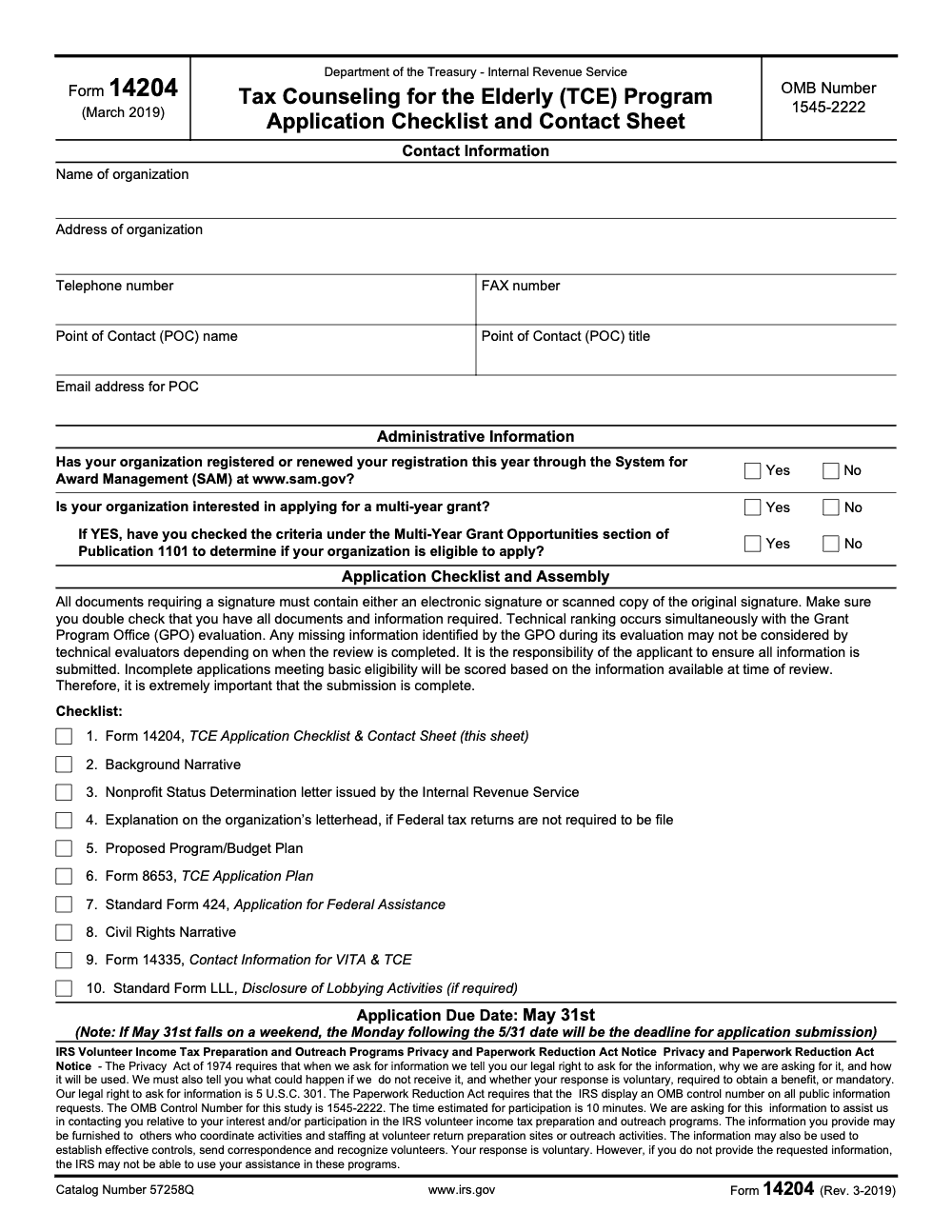
Form 14204 is the IRS TCE Program Application Checklist and Contact Sheet (Rev. March 2019, OMB 1545-2222) – the cover sheet your organization submits with the nine other required attachments to apply for a Tax Counseling for the Elderly grant per IRS Publication 1101. The full application package is due May 31 each year, shifting to the following Monday only when May 31 falls on a Saturday or Sunday.
The Tax Counseling for the Elderly grant cycle gets tense in mid-May because a clean Form 14204 hides every other moving piece behind it. One season a grant director emailed the night before the deadline asking why Grants.gov kept rejecting the package; the SAM record had lapsed and the UEI on the cover sheet no longer matched the SF-424.
Form 14204 is the TCE Application Checklist and Contact Sheet, the cover that anchors the nine other required attachments. The package is due May 31 each year, and it has to pass Grants.gov validation by then, not just upload. Keep UEI and SAM details aligned across the form, the SF-424, and every attachment, and treat Publication 1101 as your master instruction set.
Key Takeaways
- Form 14204 is the required TCE Application Checklist and Contact Sheet, it anchors your attachments and confirms the correct contacts for notifications. The IRS lists it among the required items for every TCE application.
- The 2025 application window ran from May 1 to May 31, with notifications scheduled for early October. This cadence is standard for TCE, so plan for the same timing in the upcoming cycle. Always verify the current year on IRS.gov.
- Publication 1101 is your master instruction set. Use it to confirm eligibility, narrative contents, and form requirements, then mirror those details on Form 14204. The 2025 revision is posted by the IRS.
- Your package must pass Grants.gov validation by the deadline, not just be uploaded. Keep UEI and SAM details consistent across Form 14204, SF‑424, and every attachment.
- Build light internal controls, think SOPs, naming conventions, and layered review, so you do not lose days to rework or mismatched files. That is how you remove delivery friction when the clock is ticking.
What Is Form 14204?
Form 14204 is the Tax Counseling for the Elderly Program Application Checklist and Contact Sheet. In plain terms, it is the front‑door verifier for your TCE package. You use it to confirm required attachments are present, to provide accurate organizational contacts, and to keep identifiers consistent across the bundle. The IRS points to Form 14204, along with Form 8653, Form 14335, SF‑424, and other elements, as standard requirements for every applicant.
Why it matters: the Grant Program Office relies on the contacts on this form to send acceptance or non‑selection emails in early October. If the name, email, or UEI does not align with SAM, you can meet the deadline and still miss validation. Keep this form current and precise, then lock it before submission.
Quick purpose check Use Form 14204 as your control sheet to match UEI, SAM legal name, contacts, and attachments across the entire TCE package. It is the easiest way to prevent avoidable rejections.
Getting Started, Eligibility, UEI, SAM, and Grants.gov
Here is your starting block, in order:
- Confirm eligibility in Publication 1101, then gather the items listed on the IRS “Applying for a TCE grant” page. This ensures your plan, narratives, and forms match the current year’s instructions.
- Secure your Unique Entity Identifier and verify your SAM registration is active, renewed for the current year, and matches your legal name (Form 14204 specifically asks whether your organization has registered or renewed this year, so a prior-year SAM record alone will not satisfy the question). Expired or mismatched records are a top cause of last‑minute problems.
- Set up Grants.gov Workspace with roles that allow you to create, upload, and submit. Schedule an internal validation dry run one to two weeks before the deadline to catch errors early.
- If your state participates in Executive Order 12372, reach out to the State Single Point of Contact now, not the week of the deadline.
A note on timing, so you can plan your calendar. The IRS announced the 2025 application window for May 1 through May 31, with notifications in early October. The TCE timeline page shows the same structure for application, review, and notification. Expect similar dates next cycle, then confirm when the new notice posts.
Build Your TCE Package With Confidence
Form 14204 sits in the middle of your package, and it references everything else. Assemble these items side by side, then fill 14204 so names and details match exactly:
- Background Narrative, your qualifications and program approach.
- Proposed Program and Budget Plan, including Form 8653 for budget info.
- Civil Rights Narrative and any required SF‑LLL.
- SF‑424 and Form 14335 for grant contacts.
Required Documents, Quick Checklist
| Item | What to check | Why it matters |
| Form 14204 | UEI, SAM legal name, contact emails, phone numbers | Drives notifications, must match SAM and SF‑424 |
| Background Narrative | Organization capacity, training, quality, coverage | Supports technical scoring in review |
| Proposed Program/Budget Plan + Form 8653 | Line‑item budget, cost principles, program scope | Aligns spending with TCE allowability rules |
| Civil Rights Narrative | Policies, EO 12372 if applicable | Required content for compliance |
| SF‑424 | Federal assistance application | Core identifier record in the package |
| Form 14335 | All key contacts, accurate and current | Avoids missed notices and delays |
The IRS “Applying for a TCE grant” page lists these items explicitly. Use that list and Publication 1101 as your single sources of truth.
Timeline and Deadlines You Should Build Around
Here is the typical TCE rhythm, which the IRS reaffirmed for the 2025 cycle. Use it to structure your work, reviews, and internal approvals.
| Phase | Typical dates | What to do |
| Application period | May 1 to May 31 | Finalize all documents, run validation, and submit early |
| Review and ranking | June 1 to Sept 30 | Respond quickly to any clarification requests |
| Notification | Around Oct 1 | Watch the inbox on your Form 14204 contacts |
| Period of performance | Oct 1 to Sept 30 | Execute, report, and prepare for next cycle |
Always verify the current year’s dates on IRS.gov and Grants.gov. In 2025, the IRS published the May 1 to May 31 application window in a news release and on its TCE timeline (note: when May 31 falls on a Saturday or Sunday, Form 14204 shifts the cutoff to the following Monday; the form does not address federal holiday shifts, so do not assume a holiday extension).
Why “Validation by the Deadline” Matters
Grants.gov deadlines are about acceptance and validation, not just clicking Submit. If your package fails validation on May 31, it does not count. Plan to clear validation at least 48 hours before the cutoff. The IRS guidance stresses passing validation in Grants.gov by May 31, so build that date into your internal plan.
How to Complete Form 14204, Step by Step
Use this simple sequence. Keep your SF‑424, SAM record, and internal contact roster open while you fill the form.
- Organization identifiers Enter the legal name exactly as it appears in SAM and on SF‑424. Enter your UEI precisely, confirm the mailing address, and include the correct federal identifiers. This alignment is the fastest way to avoid preventable holds.
- Primary contacts List the program lead and grants administrator who will actually monitor the inbox. If you need more space for contacts, include Form 14335 and mirror the same names and emails.
- Checklist confirmation Tick each required attachment that you are submitting this cycle, including Background Narrative, Proposed Program and Budget Plan with Form 8653, Civil Rights Narrative, and SF‑424. Confirm you have attached SF‑LLL if lobbying disclosure applies.
- Sign and date Apply an authorized signature, then export a clean, legible PDF. Keep fonts embedded and avoid scans of scans. If you need to collect multiple signatures, route the fillable version first, then export.
- File name hygiene Use short, descriptive names that align with Grants.gov Workspace expectations, for example, OrgName_Form14204_2026.pdf. Avoid special characters. Consistent file names help reviewers and reduce the chance of upload or indexing issues.
- Internal archive Store the fillable source, the signed PDF, and a checksum or version tag in your controlled folder. If you have a document control SOP, record the approver and date so you can answer questions later.
Sign and Export, Accessibility First
Keep your form accessible. Use fillable fields, readable fonts, tagged PDFs, and OCR for any scanned attachments. The IRS expects accessible files and Grants.gov can reject unreadable uploads. Before you export, run a quick screen reader test and keyboard‑only navigation to confirm field order and labels. Then export the signed version, and keep the fillable source for next year’s update.
Passing Grants.gov Validation Without Drama
Here is a straightforward checklist your team can use the week before the deadline:
- Confirm SAM is active through the end of May, and the legal name matches exactly.
- Verify UEI on Form 14204, SF‑424, and narratives.
- Cross‑check contacts on Form 14204 against Form 14335 and the SF‑424.
- Validate PDFs, test opening on multiple machines, and ensure no password prompts block reviewers.
- Check that each attachment corresponds to what Publication 1101 requires for the current year. Use the IRS list to confirm Form 14204, Form 8653, SF‑424, Civil Rights Narrative, and SF‑LLL if applicable.
- Submit early, then wait for the Grants.gov validation email. If you get an error, correct and resubmit immediately, because technical ranking runs in parallel with the Grant Program Office completeness check and a late fix may not reach evaluators in time to count.
A Simple Internal Review Flow That Works
- Preparer fills Form 14204 using source data from SAM, SF‑424, and your narrative set.
- Senior reviewer checks identifiers and contacts, then signs off.
- Quality reviewer compares the checklist items to the attachments in the Workspace.
- Grants lead submits, monitors validation, and documents the receipt.
This layered review, preparer to senior to quality, is the same structure we use to protect partners’ time and prevent rework during peak cycles. It is simple, and it works.
Publication 1101, What to Pull Into Your Form 14204
Publication 1101 explains what to include in your narratives and forms. Use it to populate the checklist parts of Form 14204 and to shape your budget assumptions in Form 8653. The 2025 revision is posted by the IRS, so you can cite the exact sections in your internal SOPs.
What to Mirror From Publication 1101
- Eligibility requirements and the types of organizations that qualify.
- Required narratives and the purpose of each attachment.
- Budget rules and allowability, which drive lines in Form 8653.
Budget Plan, Form 8653, Practical Tips
- Keep administrative costs within the limits you see in program guidance, and document your assumptions.
- Tag each cost to an activity or output, for example, training, quality review, site operations.
- Double check math, and ensure totals in 8653 match your narrative budget. The IRS hosts the budget plan details and fields you will complete.
Timeline Planning, The 6‑Week Workback Schedule
Even when the official window is only one month, your prep can start earlier. Here is a proven schedule that keeps your team out of crunch time.
- Week 6 and 5, confirm roles, gather last year’s materials, refresh SAM, and verify UEI.
- Week 4, draft Background Narrative and Civil Rights Narrative, update Form 14335 contacts.
- Week 3, build the budget, complete Form 8653, align scope with allowability.
- Week 2, complete Form 14204, align checkboxes with attachments, route for signatures.
- Week 1, run validation in Grants.gov Workspace on a full draft, fix errors, then submit final early in the window.
- Deadline week, hold the calendar open to respond to any validation notices the same day.
Accessibility and Usability That Reviewers Appreciate
Accessibility is not just a compliance box, it is a practical way to make sure reviewers can read and process your files fast.
- Use tagged PDFs and keep text selectable on every page.
- Run OCR on any scanned material and remove artifacts.
- Test with a screen reader and keyboard navigation before you export, then save the signed version and the fillable source.
- Use consistent headings and short, descriptive file names. These habits make your application easier to handle across systems and devices.
Common Pitfalls And How You Avoid Them
- Mismatched names and identifiers, solved by copying legal name and UEI from SAM directly into Form 14204 and SF‑424, then locking those fields.
- Missing Form 14335 when you have additional contacts, solved by attaching it every time your team or structure changes.
- Submitting on deadline day with no time for validation, solved by an internal cut‑off two days earlier. The IRS calls out the need to pass validation by May 31, so do not risk it.
- Unreadable PDFs or password‑blocked files, solved by a preflight check on multiple machines and user accounts.
- Budget totals that do not match across Form 8653 and your narrative, solved by a final single‑source spreadsheet that feeds both.
Pro tip Keep a one‑page control sheet in your workspace that lists UEI, SAM legal name, primary contacts, and the exact filenames for each attachment. That sheet becomes your north star during reviews and resubmissions.
Light Ops Help, Only If You Need It
If you are short on review capacity or you want a tighter delivery model, you can borrow the same structure we use in offshore production work. Build SOPs around Form 14204 and its companion forms, standardize workpaper naming, assign a quality reviewer who is different from the preparer, and track turnaround via a simple SLA. The point is not to add bureaucracy, it is to protect your time and make grant season predictable again. If you choose to work with a partner, insist on workflow discipline, documentation checks, and layered review that actually reduces rework, not just more resumes.
Sample One‑Page Control Sheet You Can Copy
| Field | Entry example |
| UEI | ABC123DEF456 |
| SAM legal name | RiverTown Senior Services Inc. |
| Primary contact | Jordan Lee, Grants Lead, |
| Secondary contact | Pat Gomez, Program Director, |
| Core files | RiverTown_SF424_2026.pdf, RiverTown_Form14204_2026.pdf, RiverTown_Form8653_2026.pdf, RiverTown_BackgroundNarrative_2026.pdf, RiverTown_CivilRightsNarrative_2026.pdf, RiverTown_Form14335_2026.pdf |
| Submission plan | Validation dry run May 20, final submit May 24, monitor receipts same day |
Keep this at the top of your Workspace folder so reviewers and backups can find the right file in seconds.
Closing Thoughts, And A Calm Path To Yes
You have everything you need to complete Form 14204 with confidence. Focus on consistency across UEI, SAM, SF‑424, and Form 14204, confirm each required attachment against Publication 1101, and submit early enough to clear validation without stress. If your team is stretched thin, borrow the layered review flow above to protect time and avoid rework. For next year, save the fillable sources and your control sheet, then you can refresh and resubmit in hours, not weeks.
Common Mistakes We See Every Season
The same five or six mistakes show up on TCE applications every spring. None of them are exotic, and all of them are easy to catch with a twenty-minute review the week before submission.
Reusable Checklists
The three checklists below are written so a coordinator can copy them into a firm SOP, Asana board, or Notion runbook without rewriting a line. They map directly to Form 14204's ten checklist items and the Publication 1101 attachments that ride with them.
Pre-validation packet (T-14 days)
- Confirm SAM registration is active and the expiration date is past May 31 of the application year.
- Verify the legal name, address, and UEI on SAM match Form 14204, SF-424, and Form 14335 exactly.
- Locate the IRS Nonprofit Status Determination letter and confirm the organization's current 501(c) status.
- Draft the Background Narrative, Proposed Program/Budget Plan, and Civil Rights Narrative.
- Complete Form 8653 with totals that reconcile to the narrative budget.
- Complete Form 14335 with current point-of-contact name, title, telephone, fax, and email.
- Decide whether SF-LLL applies based on the prior year's reportable lobbying activity.
- If no Federal return is required, draft the letterhead explanation for checklist item 4.
May 31 submission-day runbook
- Pull the master attachment index and verify every checklist item 1 through 10 has a named file.
- Log into Grants.gov no later than 10 a.m. local time.
- Upload the package and run validation; do not assume upload alone meets the deadline.
- Resolve any Grants.gov validation errors before 3 p.m.; SAM and UEI mismatches are the most common.
- Capture the Grants.gov tracking number and confirmation email; file both with the master packet.
- Email the Point of Contact with the tracking number and a one-line submission summary.
- If May 31 falls on a Saturday or Sunday, repeat the runbook on the following Monday per Form 14204.
Multi-year grant eligibility check
- Read the Multi-Year Grant Opportunities section of Publication 1101 in full before electing multi-year on Form 14204.
- Confirm the organization meets every eligibility criterion listed; multi-year is not open to all TCE applicants.
- Document the eligibility analysis in the workpapers so reviewers and auditors can see the basis for the election.
- Answer the Form 14204 administrative questions honestly: interest, eligibility check, and SAM status.
- If eligibility is uncertain, default to a single-year election rather than risk disqualification.
Keep 14204 Season From Stalling
Form 14204 looks like a single-page cover sheet until you trace what stands behind it. Every May the same compression hits TCE applicants: SAM renewals, UEI verification, the nine Publication 1101 attachments, and Grants.gov validation all converge into the last ten days before May 31, and a missed step at any layer can push the entire package past the deadline.
The pattern that protects against late submissions is not extra effort, it is earlier sequencing. Most rework on TCE applications comes from items that could have been confirmed weeks earlier but were left to the final review, and that is where a workback schedule changes the math.
- Lock the SAM renewal window at T-60 days and re-verify the registration at T-14 days; lapsed SAM is the single most common Grants.gov validation failure on TCE submissions.
- Build the attachment index from checklist items 1 through 10 in Form 14204 itself, not from a free-form list, so reviewers can see at a glance which items are present and which are still pending.
- Treat Form 8653 and the Proposed Program/Budget Plan as a paired review; budget totals must reconcile to the narrative or reviewers will flag the inconsistency.
- Confirm Form 14335 point-of-contact details against the SAM record and the Form 14204 contact fields so all three documents present the same legal name and UEI.
- Run a final SF-LLL decision (item 10) the week of submission, since reportable lobbying activity in the prior year drives the answer per the Form 14204 instructions.
For organizations that need execution support without losing program ownership, Accountably's tax and compliance teams handle the documentation discipline behind the cover sheet: standardized workpapers, layered review, and SOC 2 aligned controls so the TCE package clears Grants.gov validation on the first attempt rather than the third.
FAQs
Yes. The IRS lists Form 14204 on its TCE application page as part of the standard package for all applicants, alongside SF‑424, Form 8653, Form 14335, and required narratives.
Plan for an application window from May 1 to May 31 and notifications around October 1, then confirm the specific year’s dates when the IRS posts the notice. That was the 2025 cadence and it aligns with the program timeline on IRS.gov.
You must pass Grants.gov validation by the deadline. Submitting on May 31 without validation can still miss the cutoff. The IRS calls this out on the TCE application page.
Use Publication 1101 for current instructions and requirements, and check the IRS TCE grants page for updates and links. The IRS posted the 2025 revision in its accessible publications list.
Renew it before you submit, and ensure your legal name and UEI in SAM match what you enter on Form 14204 and SF‑424. Mismatches lead to validation issues and delayed notices.
Use Form 8653 for the budget plan. It should reflect allowability and totals that match your narrative and the checklist confirmations you mark on Form 14204.
The IRS schedules notifications for early October. In 2025 the formal timeline and IRS updates reference October 1 as the notification date.
You do not need to. Your application should focus on your organization’s plan and capacity. If you partner with outside teams for production capacity, describe your workflow discipline, review layers, and quality controls rather than vendor names.
Other forms this guide names
- Form 8653: What It Is, How to Complete It, and Deadlines
- Form 14335: IRS VITA and TCE Grant Contact Guide 2025
About this guide
Accountably helps US CPA, EA, and accounting firms hire trained accountants and tax preparers in India.
About us Reviewed byJugal Thacker, CPAFounder and CEO at Accountably
A Washington-licensed CPA with 7+ years inside US firms – PwC, a real-estate tax practice, then a full-service firm, rising from reviewer to manager to advisory. This article was reviewed against current IRS guidance for the 2025 tax year and updated for filers preparing late returns, amendments, and 2026 estimates.
View profile →How we research, review, and update this guide
Every Accountably guide is researched against primary IRS sources, reviewed by a U.S. CPA, and refreshed as guidance evolves. Read our Editorial Guidelines to see how we source, fact-check, and update our content.