Summarize this article with AI
In Brief
Form 2106 is the IRS Employee Business Expenses form used by four narrow categories of filers in 2025: Armed Forces reservists, qualified performing artists, fee-basis state or local government officials, and employees with impairment-related work expenses (per IRS Form 2106 (2025) instructions). The 2025 business standard mileage rate is 70 cents per mile (line 22), the form attaches to Form 1040 by April 15, 2026, and the total flows to Schedule 1 line 12 as an above-the-line adjustment to income.
Most employees lost the ability to deduct job expenses after 2017, which is why Form 2106 now belongs to only four groups: Armed Forces reservists, qualified performing artists, fee-basis state or local government officials, and employees with impairment-related work expenses. If a W-2 client outside those four asks about writing off mileage or supplies, the answer is no, and this form is not the workaround.
For the filers who do qualify, the vehicle math is the part to get right. The 2025 business standard mileage rate is 70 cents a mile on line 22, up from 67 cents in 2024, and you choose that rate or actual costs for a given car, never both in the same year, and commuting never counts. The total flows to Schedule 1, line 12 as an above-the-line adjustment, and the form attaches to your 1040 by April 15, 2026.
Key Takeaways
- Form 2106 is for certain employees to claim ordinary and necessary unreimbursed job expenses. It is not for most W‑2 workers after 2017.
- In 2025, eligibility is mainly Armed Forces reservists, qualified performing artists, fee‑basis state or local government officials, and employees with impairment‑related work expenses.
- The 2025 business standard mileage rate is 70¢ per mile, up from 67¢ in 2024. You can use that rate or actual vehicle costs, not both for the same car in the same year.
- Commuting is not deductible. Trips between work sites, or qualified travel away from home, can be, with receipts and logs.
- Use official IRS instructions and Publication 463 for recordkeeping rules, the 50% meals limit, and how to attach Form 2106.
What Is IRS Form 2106
Form 2106 is the IRS form employees use to report unreimbursed employee business expenses that are ordinary and necessary for the job. Think mileage to a temporary work location, airfare and lodging for required travel, or certain meals while away from home, all backed by documentation.
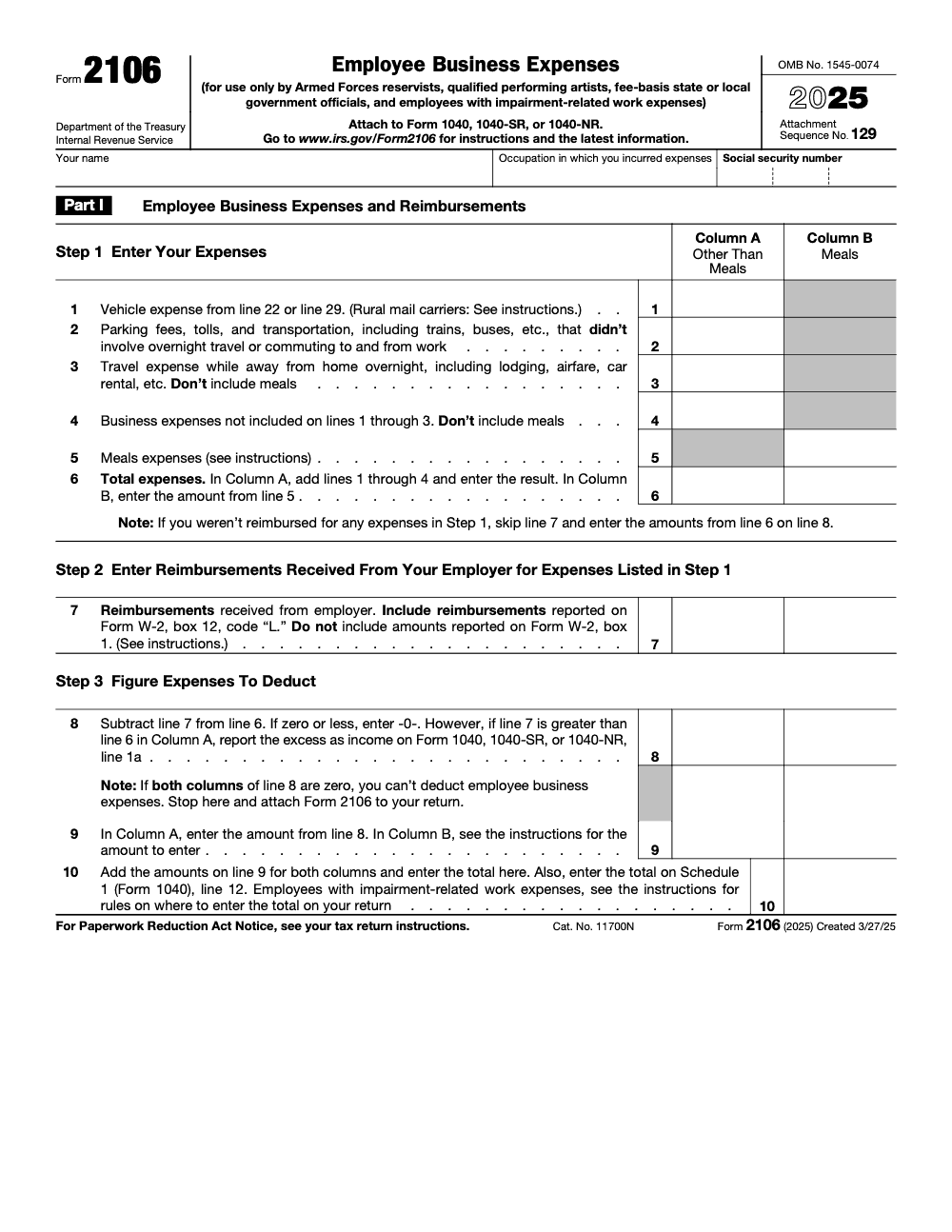
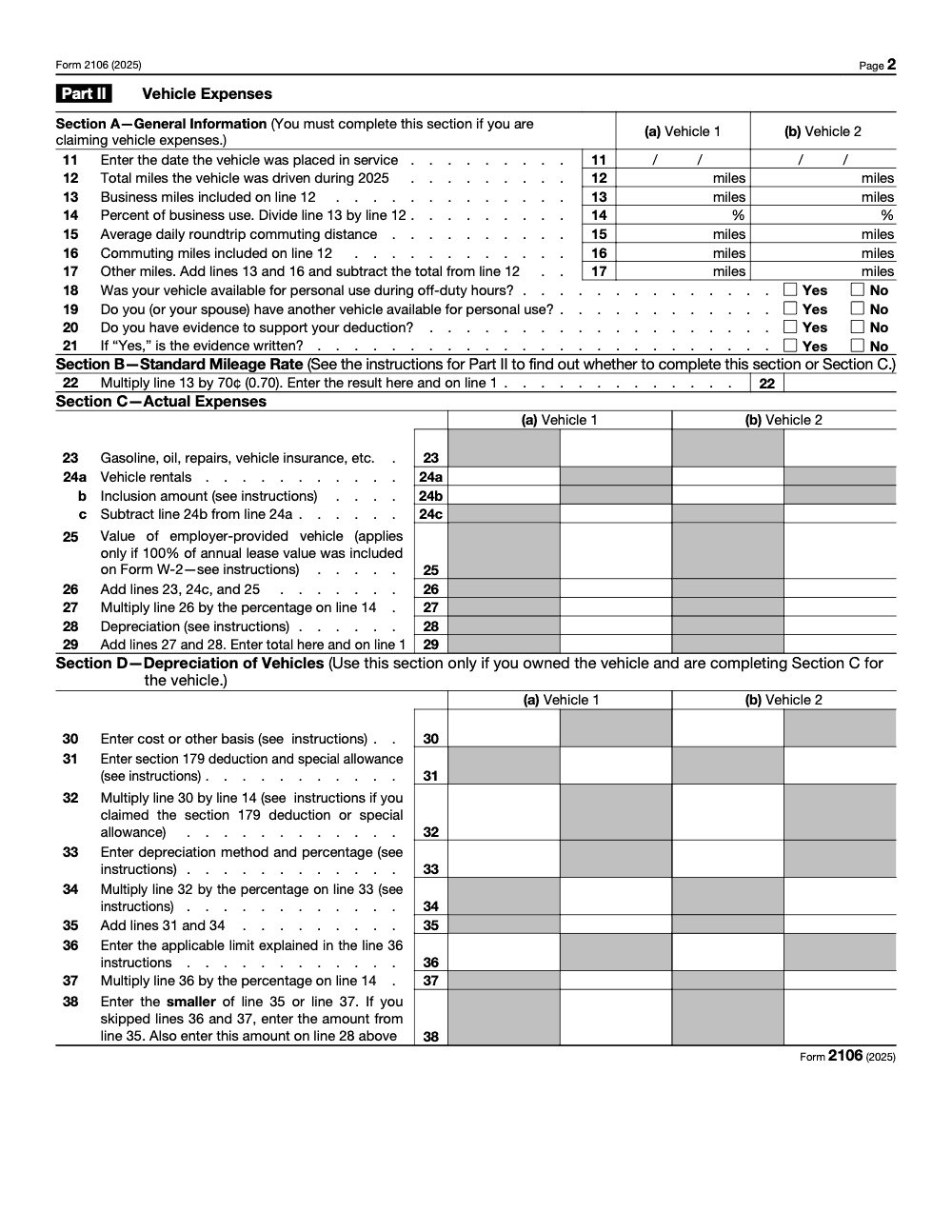
The form has two working sections. Part I totals expenses and subtracts any reimbursements that were not included in your W‑2 wages. Part II is the vehicle section, where you choose between the standard mileage rate and actual expenses, then add parking and tolls if applicable.
Quick rule of thumb, pick one method for your car for the year, standard mileage or actual costs, and keep tight records either way.
Who Can Still Use Form 2106 in 2025
Most employees cannot deduct unreimbursed job expenses under current federal law. The Tax Cuts and Jobs Act eliminated the old miscellaneous itemized deduction for these costs for years beginning after 2017. Only a narrow set of employees still use Form 2106.
The four eligible groups
- Armed Forces reservists who travel for reserve duties. Certain travel over 100 miles can be deducted and, in some cases, taken as an adjustment to income, not just an itemized deduction.
- Qualified performing artists who meet all tests, including wages from at least two employers, more than 10% of gross performing income spent on allowable expenses, and adjusted gross income of $16,000 or less before those expenses.
- Fee‑basis state or local government officials, paid all or in part by fees.
- Employees with impairment‑related work expenses, which enable the employee to work at the workplace.
If you are outside those groups, Form 2106 usually does not apply at the federal level, though your state might still allow some employee expense deductions. Always check your state’s site before you assume you cannot claim anything locally.
What You Can Deduct, Big Picture
You can claim job‑related vehicle costs using either the standard mileage rate, 70¢ per business mile in 2025, or the actual expense method with depreciation. Add business parking and tolls either way. For overnight travel, airfare, hotels, taxis or rideshare, internet fees for work use, laundry, and tips can qualify when ordinary, necessary, and not reimbursed. Meals tied to overnight travel are generally 50% deductible, and entertainment is not (and meals belong only on line 5 in Column B – never lump them into the overnight travel line 3 or the other-business-expenses line 4, both of which explicitly say "Don't include meals").
Two lines that trip people up every year, commuting is never deductible, and if you could have been reimbursed under your employer’s accountable plan but did not submit, you generally do not get a deduction.
Deductible vs Non‑Deductible At A Glance
Here is a quick reference you can use while organizing receipts.
| Item | Generally deductible on 2106? | Notes |
| Business miles between job sites | Yes | Use 70¢ per mile for 2025, or actual expenses. Add parking and tolls. |
| Commuting to your regular workplace | No | Commuting stays personal, even if you take calls or carry tools. |
| Airfare, hotel, taxis for overnight business travel | Yes | Must be ordinary, necessary, and unreimbursed. Keep itemized receipts. |
| Business meals on overnight trips | 50% | Subject to the 50% limit. Keep itemized receipts. |
| Entertainment | No | Entertainment is not deductible. |
| Work uniforms not suitable for daily wear | Possibly | If required and not adaptable to everyday use. See Pub 463. |
| Home office for W‑2 employees | Rarely | Usually not deductible for employees under current federal rules. Check state law. |
How Vehicle Deductions Work
You choose one method per vehicle for the year.
- Standard mileage method, multiply your business miles by the IRS rate, 70¢ in 2025, then add parking and tolls. Keep a contemporaneous log with dates, starting and ending odometer readings, and business purpose.
- Actual expense method, total gas, oil, repairs, insurance, lease or depreciation, then multiply by your business use percentage (depreciation on passenger vehicles is capped by the §280F luxury-auto limit – on line 38 you enter the smaller of computed depreciation on line 35 or the cap-adjusted amount on line 37, not the full MACRS figure). Keep all receipts and a mileage log to support the business‑use percentage.
One more guardrail, if you own the car, you must have used standard mileage the first year the vehicle was available for business to keep using it later. If you lease, you must stay with standard mileage for the entire lease term (and a leased vehicle cannot use Part II Section D depreciation – any rental cost runs through line 24a with the lease inclusion amount subtracted on line 24b).
Commuting vs business miles
The IRS draws a bright line. Daily trips from home to your regular workplace are commuting and not deductible. Trips between job sites, or from a qualifying home office to a client site, are business miles. Travel to a temporary work location outside your metropolitan area can also qualify.
What Counts As “Away From Home”
For travel deductions, you must be away from your tax home long enough to need sleep or rest. Your tax home is generally your main place of work, not necessarily where you live. Expenses must be ordinary, necessary, and not lavish. Meals are typically limited to 50%, and you must document the time, place, and business purpose.
Special Cases You Should Know
- Armed Forces reservists who travel more than 100 miles for reserve service can deduct eligible travel, and certain amounts are taken as an adjustment to income on Schedule 1. Start with Form 2106, then carry the allowed amount over.
- Qualified performing artists must meet all four tests, including the $16,000 AGI cap before performing‑arts expenses. If married, a joint return is generally required unless you lived apart all year.
- Fee‑basis officials can claim their employee business expenses on Form 2106 when unreimbursed.
- Impairment‑related work expenses are allowed for employees with disabilities when they enable the employee to work at their workplace.
For most other employees, the old miscellaneous itemized deduction for unreimbursed job expenses remains eliminated for years beginning after 2017. Check the current Form 2106 instructions each season for any changes.
If your employer offers an accountable plan for reimbursements, use it. Declining reimbursement usually means you also decline any deduction.
Step‑By‑Step, How To Complete Form 2106
- Confirm eligibility Make sure you are in one of the four categories that still use Form 2106 in 2025. If you are not, do not file the form for federal purposes, though you can still check state rules.
- Gather documentation Pull mileage logs, travel itineraries, receipts for lodging and transportation, and itemized meal receipts. Keep records for any expense of 75 or more, and keep all lodging receipts, regardless of amount.
- Choose your vehicle method Decide between standard mileage and actual expenses, then stick with that method for the year for that vehicle. If you owned the car and did not choose standard mileage in the first year, you cannot switch to it later. If you leased and choose standard mileage, you must use it for the entire lease.
- Complete Part I Enter unreimbursed expenses by category, then subtract any reimbursements your employer did not include in your W‑2 wages (line 7 picks up only W‑2 box 12 code L amounts – do not re-enter reimbursements already reported in box 1 wages, since those are inside your taxed wages already and re-entering them double-counts and understates the deduction). If you received excess reimbursements under a nonaccountable plan, those belong in wages, not on Form 2106 as expenses. And if line 7 reimbursements end up greater than line 6 total expenses in Column A, the excess must be reported as income on Form 1040, 1040-SR, or 1040-NR line 1a – not netted against your other deductions.
- Complete Part II for vehicles Enter either total business miles and compute using 70¢ per mile for 2025, or complete the actual expense lines. Add parking and tolls. Carry the allowed figure to Part I as instructed.
- Move the result to your tax return Depending on your category, Form 2106 amounts may flow to Schedule 1, line 12, or to Schedule A for certain impairment‑related expenses. Follow the line instructions carefully.
Recordkeeping that survives review
- Keep a contemporaneous mileage log with dates, start and end odometer, destination, and business purpose.
- Keep receipts for lodging, and for any expense of 75 or more.
- Track reimbursements and note whether they were included in box 1 of your W‑2.
- Save orders and calendars for reserve duty, contracts and pay stubs for performing artists, and engagement letters or fee schedules for fee‑basis officials.
A Simple Example
Say you are a qualified performing artist. You worked for three employers, each paid you more than 200, and your performing‑arts expenses were 12% of your performing income. Your AGI before those expenses was 15,500, so you meet the 16,000 cap. You logged 1,000 business miles visiting rehearsal spaces and studios, no commuting included. Using the standard mileage rate for 2025, your vehicle deduction is 700, plus 50% of eligible meals on overnight trips and any unreimbursed travel. You would complete Form 2106, then carry the allowed performing‑arts total to Schedule 1, line 12.
Helpful IRS Resources
- About Form 2106, for the latest links to the form and printable instructions.
- 2025 standard mileage announcement, to confirm the current cents‑per‑mile rate.
- Publication 463, for the 50% meals limit, away‑from‑home rules, commuting versus business travel, and documentation.
For Accounting Firms Reading This
If your team handles 1040 seasons with tight review windows, build a repeatable process for 2106 cases, a named workpaper checklist, vehicle logs checked before data entry, and a reviewer summary that flags the chosen mileage method and any state differences. This is the kind of workflow discipline Accountably brings to firms during peak load, with standardized workpapers and multi‑layer review so partners are not trapped in last‑minute cleanups. Use it lightly for 2106, use it heavily across your return stack when the calendar compresses.
When your process is clear, Form 2106 becomes routine instead of risky.
Common Mistakes That Cost Deductions
The same six mistakes drive most of the rejected Form 2106 deductions during 1040 review. Each one ties back to a specific line, column, or eligibility test in the IRS Form 2106 (2025) instructions, and each has a guardrail that fits cleanly into a workpaper template.
Final Word And Next Steps
If you are eligible to use Form 2106, you can absolutely turn careful records into real tax savings. Start with eligibility, choose the right vehicle method, separate commuting from business miles, and match every travel line to a receipt. When in doubt, check the official Form 2106 instructions and Publication 463, then complete the line‑by‑line steps with your logs in hand.
Light disclaimer, this guide is educational, not personal tax advice. Tax rules change, and your facts matter. Always verify the current year’s instructions before you file.
If you run a firm, standardize your 2106 workflow so reviewers get what they need on the first pass. If you are an individual filer, organize your mileage and travel receipts now, not on April 14. Either way, a steady process beats last‑minute guesswork.
Reusable Checklists
Use these three checklists as drop-in SOP fragments for Form 2106 engagements. Each step ties to a specific line, column, or routing rule in the IRS Form 2106 (2025) instructions, and each is written so it can be pasted straight into a firm template or in-house tax SOP.
Pre-file eligibility gate
- Confirm the filer fits one of the four eligible categories per the IRS Form 2106 (2025) instructions: Armed Forces reservist, qualified performing artist, fee-basis state or local government official, or employee with impairment-related work expenses.
- For reservists, verify travel exceeded 100 miles from home and pull orders or the duty calendar onto the workpaper.
- For qualified performing artists, run the eligibility tests in the IRS Form 2106 (2025) instructions, including the $16,000 AGI cap before performing-arts expenses.
- For fee-basis officials, document the fee-based pay arrangement and reference the engagement on the workpaper face.
- For impairment-related expenses, tag the file for Schedule A routing instead of the default Schedule 1 (Form 1040), line 12.
- If the filer does not fit any category, stop and document on the workpaper why Form 2106 is not attached.
Vehicle workpaper review
- Pull the contemporaneous mileage log and confirm dates, business purpose, and odometer entries for each trip.
- Split miles into three columns: business (line 13), commuting (line 16), and other (line 17). Reconcile to total miles on line 12.
- Compute line 14 business-use percentage as line 13 divided by line 12.
- Lock the 2025 standard mileage rate at 70 cents per mile on line 22 and flag any template still using the 67-cent 2024 rate.
- If actual expenses are claimed, total gas, oil, repairs, insurance, and rentals on line 26 and multiply by line 14 to compute line 27.
- For a leased vehicle, route rentals through line 24a with the inclusion amount on line 24b and do not complete Section D.
- For an owned vehicle on actual expenses, run the section 280F luxury-auto cap on lines 36 to 38 and enter the smaller of line 35 or line 37 on line 38.
- Answer lines 18 through 21 (personal availability, other vehicle, evidence, written evidence) before file release.
Reimbursement and routing review
- Confirm line 7 includes only W-2 box 12 code L amounts. Exclude any amounts already in W-2 box 1 wages.
- If line 7 exceeds line 6 in Column A, report the excess on Form 1040, 1040-SR, or 1040-NR line 1a as income. Do not net it against deductions.
- Verify Column A on line 6 sums lines 1 through 4 and that line 5 meals remain in Column B for the line 9 meals limitation.
- If both columns of line 8 net to zero or less, still attach Form 2106 to the return per the IRS Form 2106 (2025) instructions.
- For reservists, performing artists, and fee-basis officials, carry the line 10 total to Schedule 1 (Form 1040), line 12.
- For impairment-related work expenses, route the line 10 total to Schedule A per the special instructions, not to Schedule 1.
- Confirm attachment sequence 129 places Form 2106 in the correct order behind Form 1040, 1040-SR, or 1040-NR before the return is e-filed.
Keep 2106 Season From Stalling
Form 2106 sits in an awkward production zone for firms and in-house tax teams. Volume is low because the Tax Cuts and Jobs Act narrowed eligibility to four categories through 2025, but the returns that do come in carry edge cases that absorb reviewer time: the Armed Forces reservist 100-mile travel test, the qualified performing artist eligibility check, the impairment-related routing to Schedule A rather than Schedule 1, and the section 280F luxury-auto cap on actual-expense vehicle deductions (per IRS Form 2106 (2025) instructions). Add the 2025 standard-mileage-rate change to 70 cents per mile (up from 67 cents in 2024) and stale templates start producing wrong line 22 totals before review even begins.
The fix is not more hours during peak season, it is a tight 2106 sub-routine inside the 1040 workpaper set. Pull the eligibility test, the mileage rate, and the schedule-routing rule out of the preparer's head and into a one-page checklist that travels with the engagement.
- Confirm the filer fits one of the four eligible categories before any data entry begins, and document the category on the workpaper face so reviewers do not retrace it.
- Lock the 2025 standard mileage rate at 70 cents per mile (line 22) in the template, and require the preparer to acknowledge the change from the 2024 rate of 67 cents before the file moves to review.
- Separate business miles (line 13), commuting miles (line 16), and other miles (line 17) into three labeled columns in the vehicle workpaper so the line 14 business-use percentage reconciles at a glance.
- For employees with impairment-related work expenses, route the line 10 total to Schedule A per the IRS Form 2106 (2025) instructions, not the default Schedule 1 line 12 path the rest of the form points to.
- When actual expenses are claimed, build the section 280F luxury-auto cap into the depreciation tab so line 38 automatically picks the smaller of line 35 or line 37.
Once the routine is in place, Form 2106 stops absorbing senior-review time it never deserved. Accountably builds these per-form sub-routines into a firm's U.S. tax delivery stack so peak-season hours go to advisory work, not to relearning a narrow form each year.
FAQs
It is used by a limited group of employees to report unreimbursed job expenses, including business mileage, travel, lodging, and certain meals, then to carry allowed amounts to the correct place on your Form 1040. Most W‑2 employees will not file it under current federal rules.
Four groups, Armed Forces reservists, qualified performing artists, fee‑basis state or local government officials, and employees with impairment‑related work expenses. Each group has specific definitions and, for performing artists, a $16,000 AGI cap.
If you choose the standard mileage method, use 70¢ per business mile for 2025, 67¢ for 2024. If you use actual expenses, calculate business use percentage and apply it to your costs. Do not mix methods for the same car in the same year.
No. Commuting to your regular workplace is personal. Travel between job sites, or from a qualifying home office to a client site, can qualify. Document the purpose and route.
Many of these costs were once miscellaneous itemized deductions. Today, only specific categories can deduct them at the federal level, and the placement on the return depends on your category. The 2106 instructions tell you where the total goes on your 1040.
Mileage logs, dated receipts, and proof of business purpose. Keep all lodging receipts. Keep receipts for any other expense of 75 or more. Retain orders, contracts, or pay stubs that prove status if you are a reservist, performing artist, or fee‑basis official.
Other forms this guide names
- Form W‑2: Deadlines, E‑File Rules, Boxes, and W‑2c Corrections
- Form 1040: Filing Guide for 2025 Returns (AGI, Deductions, Deadlines)
- Form 1040‑NR: Filing 2025, Nonresident Taxes Made Simple
- Form 1040-SR: Standard Deduction, Schedules, E-file Tips
Summarize this article with AI
About this guide
Accountably helps US CPA, EA, and accounting firms hire trained accountants and tax preparers in India.
About us Reviewed byJugal Thacker, CPAFounder and CEO at Accountably
A Washington-licensed CPA with 7+ years inside US firms – PwC, a real-estate tax practice, then a full-service firm, rising from reviewer to manager to advisory. This article was reviewed against current IRS guidance for the 2025 tax year and updated for filers preparing late returns, amendments, and 2026 estimates.
View profile →How we research, review, and update this guide
Every Accountably guide is researched against primary IRS sources, reviewed by a U.S. CPA, and refreshed as guidance evolves. Read our Editorial Guidelines to see how we source, fact-check, and update our content.