Key dates
Summarize this article with AI
In Brief
Form 2441 is where you claim the Child and Dependent Care Credit and reconcile employer dependent care benefits, filed as an attachment to Form 1040, 1040-SR, or 1040-NR. The credit covers up to $3,000 of work-related care expenses for one qualifying person or $6,000 for two or more, at a rate that phases from 35% down to a 20% floor once AGI exceeds $43,000 (per IRS Publication 503 and the Form 2441 instructions). Tax year 2025 returns are due April 15, 2026.
A client hands over a clean stack of daycare invoices, then mentions almost in passing that her employer ran benefits through a dependent care FSA. Without reconciling that W-2 box 10 amount in Part III, her expenses would have generated a credit she was not entitled to. That one coordination step is where most Form 2441 returns slip in review.
Form 2441 is where you claim the Child and Dependent Care Credit and reconcile employer dependent care benefits. The credit covers eligible expenses up to $3,000 for one qualifying person or $6,000 for two or more, at a rate that runs from 35% down to a 20% floor. The credit is nonrefundable, and if W-2 box 10 shows any amount, the form is still required even when no credit remains.
Key Takeaways
- You attach Form 2441 to Form 1040 to report work‑related child and dependent care expenses and to compute the nonrefundable Child and Dependent Care Credit.
- The credit rate runs from 35% down to 20%, applied to eligible expenses capped at $3,000 for one qualifying person or $6,000 for two or more. Most higher income filers land at 20%.
- Employer dependent care benefits, often shown in W‑2 box 10, must be reconciled in Part III. Up to $5,000 can be excluded from income, $2,500 if married filing separately.
- You must list care providers with name, address, and SSN or EIN, or show due diligence if a provider will not furnish an ID. Payments to your spouse, the parent of your under‑13 child, or your dependent do not qualify.
- The credit is nonrefundable, so it cannot exceed your tax. If W‑2 box 10 shows any amount, Form 2441 is still required even if no credit remains.
What Is Form 2441?
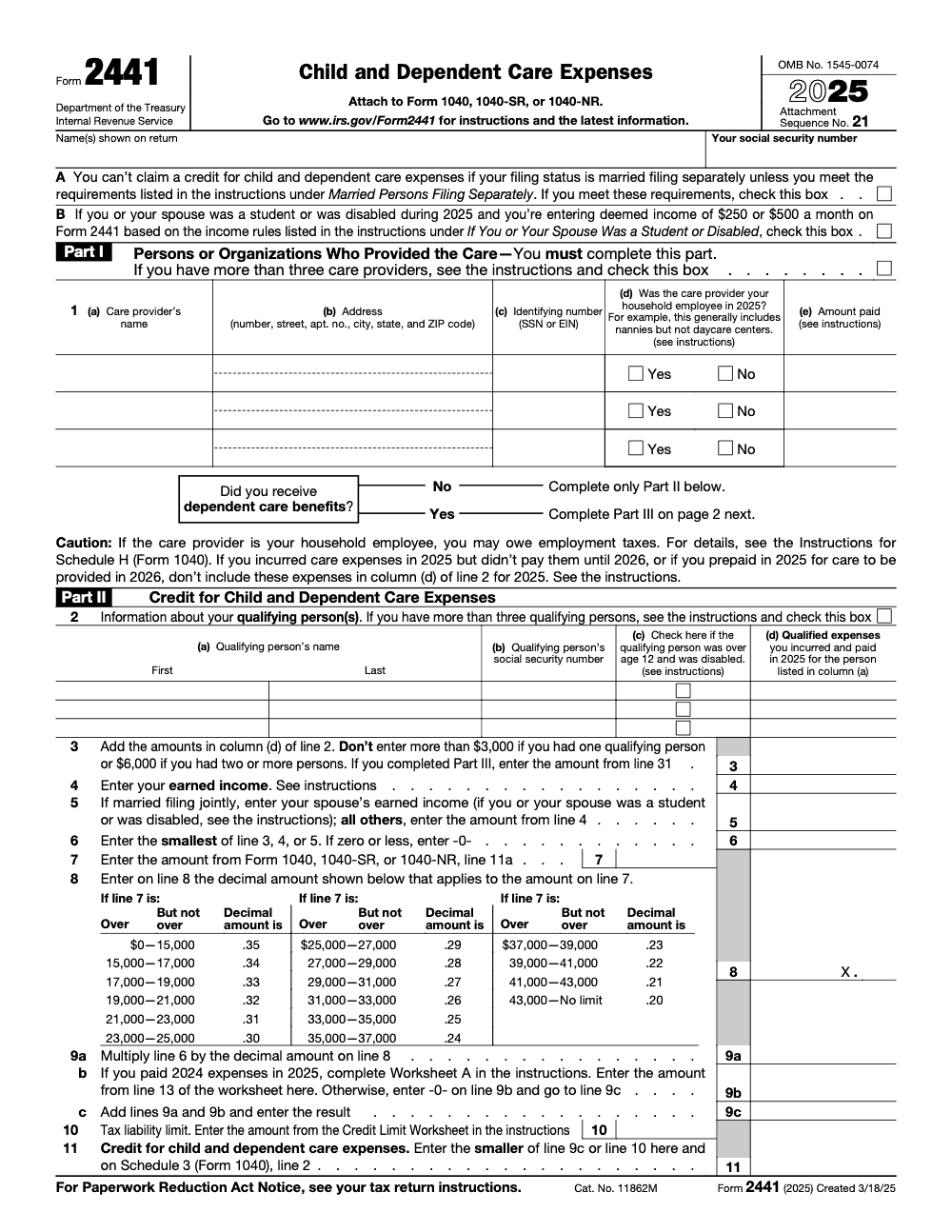
Form 2441, Child and Dependent Care Expenses, is where you report qualifying care costs, identify each provider, reconcile any employer benefits, and calculate the Child and Dependent Care Credit. You file it with your Form 1040. If your employer reports dependent care benefits on your W‑2 in box 10, you must complete this form even when the benefits absorb all your costs.
In Part I, you enter provider details, including SSN or EIN, and the total you paid to each provider. In Part II, you list each qualifying person and the related expenses and you apply the earned income and percentage limits. In Part III, you reconcile employer‑provided dependent care benefits and apply the $5,000 or $2,500 exclusion limit.
2024 vs 2025, Which Year Are We Talking About?
Most readers are filing 2024 returns during 2025. The federal limits for the credit remain $3,000 and $6,000 for qualifying expenses, and the rate table still phases down from 35% to 20%. The dependent care benefit exclusion limit remains $5,000 for most, $2,500 if married filing separately. Always confirm current instructions if you are preparing a later year return.
Who Qualifies For The Child And Dependent Care Credit
You need both a qualifying person and work‑related expenses. A qualifying person is typically your child under age 13 who lived with you more than half the year (the cutoff is strictly under 13, so a child who turns 13 mid-year qualifies only for the part of the year they were under 13), your spouse who is physically or mentally unable to care for themselves, or another dependent who is unable to self‑care and lived with you more than half the year.
You must have paid for care so you could work or look for work. If you are married and file jointly, both of you generally need earned income for the period you claim. If your spouse was a full‑time student or unable to care for themselves, the IRS treats them as having deemed earned income of $250 per month for one qualifying person or $500 per month for two or more, which can keep your claim alive during those months.
What Counts As Care, And What Does Not
Care must be for the person’s well‑being and protection. Preschool or nursery school for a child below kindergarten level counts. Day camp can count. Overnight camp does not. Tutoring and school tuition above kindergarten do not. Household services can count when part of the service is for the care of the qualifying person.
Quick gut check, if the expense is mainly for education, entertainment, or overnight lodging, it probably does not qualify.
Provider Rules You Cannot Ignore
You cannot claim amounts you paid to your spouse, the parent of your qualifying child under 13, or anyone you can claim as a dependent. If a child provided the care, they must be at least age 19 by year end and not your dependent. Keep provider IDs. If a provider refuses to give an SSN or EIN, document your due diligence, then attach an explanation and fill in what you can.
Why This Matters If You Use A Dependent Care FSA
Many employers offer dependent care FSAs. Money you set aside is not taxed, up to the annual exclusion. These benefits appear in W‑2 box 10 and must be reconciled in Part III. FSA dollars reduce the expense base you can use for the credit, which avoids double dipping. Done right, you can combine the exclusion with the credit on any remaining eligible expenses.
Pro move, max the FSA first if your marginal tax rate is high, then use the credit on any leftover expenses within the $3,000 or $6,000 cap after subtracting the FSA.
Note: Federal guidance cited is current as of September 30, 2025 for the W‑2 box 10 FAQ and December 4, 2024 for the Form 2441 page. Always use the latest IRS instructions for the year you are filing.
How The Credit Is Calculated
Here is the flow you will follow on Form 2441.
- Start with your total qualifying expenses for the year.
- Apply the annual cap, $3,000 for one qualifying person or $6,000 for two or more. This is a per-family cap, not per-child, so it stays at $6,000 no matter how many additional qualifying persons you have.
- Subtract any employer dependent care benefits that were excluded from income.
- Apply the earned income limit, the smaller of your earned income or your spouse’s earned income for the period.
- Find your percentage from the IRS table based on AGI, then multiply.
The result is a nonrefundable credit that can reduce your tax but not below zero.
The Percentage Table, In Plain English
- The rate starts at 35% for lower AGI.
- It steps down by 1 percentage point for each 2,000 of AGI over 15,000.
- Once AGI reaches 43,000 and above, the rate is 20%.
That rate applies to your allowable expenses after the earned income and benefit adjustments. Maximum credit at 35% is 1,050 for one qualifying person and 2,100 for two or more. At 20%, it is 600 and 1,200.
Two Quick Examples
Example A, lower AGI, one child.
- Qualifying expenses, 3,400
- Cap applies, allowable expenses, 3,000
- No FSA, no benefits
- AGI places you at 31%
- Credit, 3,000 × 31% equals 930 Result, you reduce your tax by 930, subject to your overall tax liability.
Example B, higher AGI, two kids with an FSA.
- Total expenses, 9,200
- Employer FSA excluded, 5,000, appears in W‑2 box 10
- The 5,000 FSA exclusion reduces the 6,000 cap, leaving 1,000 of creditable expenses
- AGI places you at 20%
- Credit, 1,000 × 20% equals 200 You got a tax free 5,000 through the FSA and a 200 credit on the rest. That is a solid combined result.
The credit is nonrefundable, so if your tax is smaller than the computed credit, you will only see the credit up to your tax. Check the credit limit worksheet tied to Form 1040 line 18 to confirm.
Step‑By‑Step, Completing Part I, Care Providers
Accuracy here prevents letters later.
- Enter each provider’s legal name and complete address.
- Enter the SSN or EIN. For a tax‑exempt organization, write “Tax‑Exempt.”
- Indicate if the provider was your household employee. If so, you may owe Schedule H household-employment taxes (the nanny tax), which is a separate obligation from this credit.
- Show total paid in the year to each provider, do not net reimbursements.
- Used more than three providers, check the box and attach a statement listing the extras. List the three highest paid providers on the form itself.
- If the provider will not give an SSN or EIN, keep Form W‑10 or other proof of your attempt and attach an explanation.
Disallowed payees include your spouse, the parent of your under‑13 qualifying child, and anyone you can claim as your dependent. If your child provided care, they must be age 19 or older by year end and not your dependent.
Real‑Life Tip From Reviews
When we review returns, most provider issues come from incomplete addresses or missing EINs for centers. Grab the year‑end statement from the daycare portal and cross check it to your Form 2441 before you e‑file.
Step‑By‑Step, Completing Part II, Qualifying Persons And Expenses
- List each qualifying person with full name and SSN.
- Check the box if the person was age 13 or older and disabled.
- Assign that person’s qualifying expenses in the right column.
- Add line 2 amounts and carry to line 3.
- Enter your earned income and your spouse’s earned income on lines 4 and 5. If your spouse was a full‑time student or unable to care for themselves, use deemed income of $250 or $500 per month as allowed and check box B.
- Apply the earned income limitation, then use AGI to select your percentage and compute the credit through line 11.
What Counts For Work‑Related
Expenses must be so you can work or look for work. Part‑time work counts. Looking for a job can count, but if you have no earned income for the year, you cannot take the credit. Day camp may count. Overnight camp does not. Preschool below kindergarten counts. Before and after school care for older kids can count.
Step‑By‑Step, Completing Part III, Dependent Care Benefits
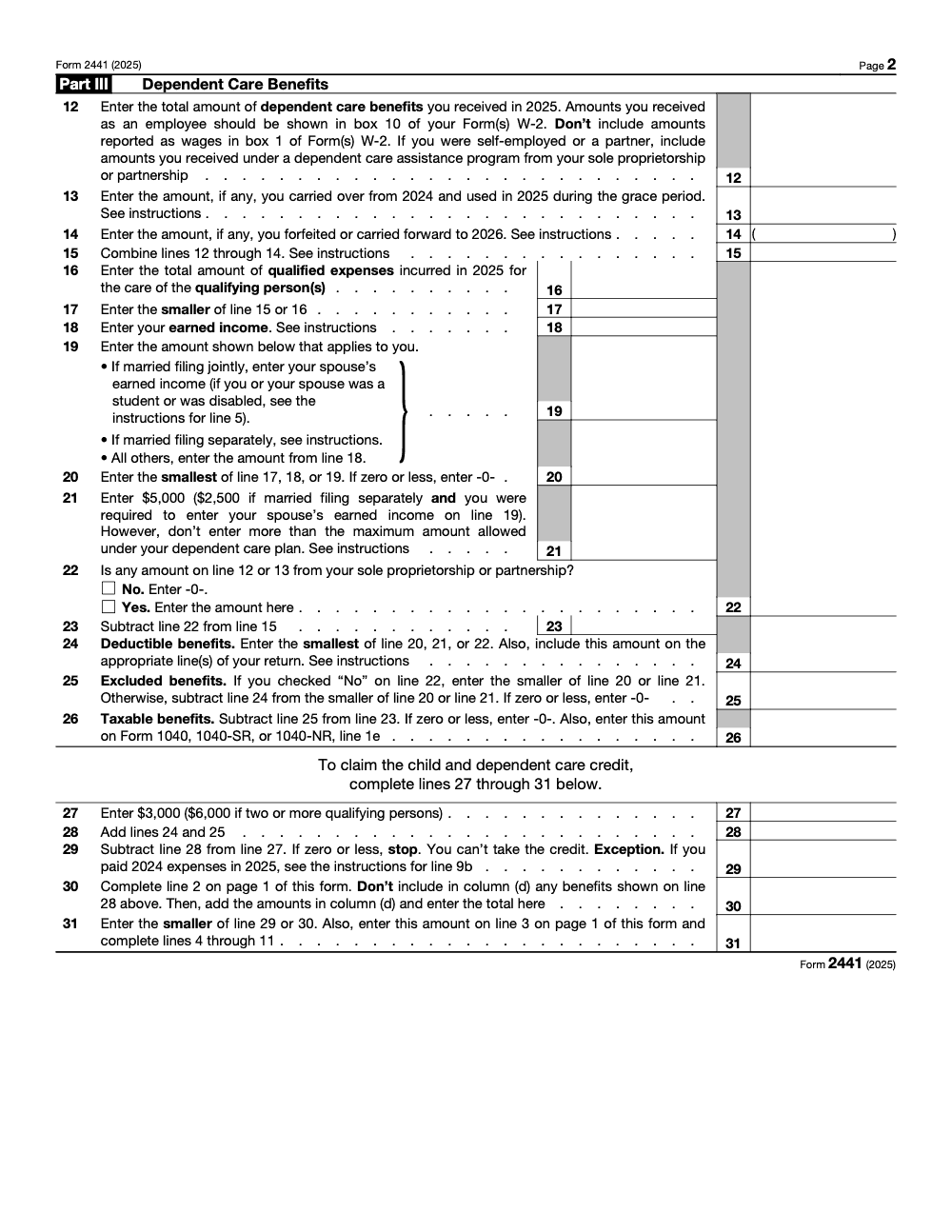
Part III is where you reconcile any dependent care benefits you received from an employer and figure out how much of those benefits are excludable from income and how much of your remaining expenses can still generate a credit.
Lines 12–15, Gather Your Benefits
- Line 12, enter all dependent care benefits you received for the year. This usually matches W‑2 box 10. Include benefits from partnerships or S‑corps shown on your K‑1 if applicable. Do not include any portion already reported as wages in box 1 of your W‑2, or you will count that income twice.
- Line 13, add any amount you carried over from 2024 and used in 2025 during the grace period.
- Line 14, subtract any amounts you forfeited or carried forward to 2026.
- Line 15, the result is your net benefits for the year.
Tip, if you participated in a dependent care FSA, pull the year‑end statement from your benefits portal so line 13 reflects any forfeitures accurately.
Lines 16–19, Earned Income Limits
You and your spouse, if filing jointly, must each have earned income for the months you claim. In Part III you will:
- Enter your earned income and your spouse’s earned income.
- If your spouse was a full‑time student or unable to care for themselves, use deemed income of $250 per month for one qualifying person or $500 per month for two or more for the relevant months.
- The exclusion for benefits cannot exceed the smaller of your earned income or your spouse’s earned income for the period.
Keep a simple month‑by‑month note showing when a spouse was a student or unable to care for themselves. It makes the deemed income step painless.
Lines 20–27, Figure The Excludable Amount
- Apply the annual employer benefit exclusion cap of $5,000, or $2,500 if married filing separately, but never more than the maximum your employer’s dependent care plan actually allows, whichever is lower.
- Compare your net benefits to the cap and to your earned income limits, then compute the excludable amount.
- Any benefits above the allowed exclusion become taxable wages and will reduce the expenses you can use for the credit.
If the plan withheld more than you can exclude, the excess will flow to taxable income and will not generate a credit, so check this section carefully.
Lines 28–33, Coordinate With The Credit
- Line 31 carries the portion of your expenses that remain available for the credit after accounting for employer benefits.
- You will take that amount back to Part II, line 3 to finish the credit.
- This coordination prevents double benefits, you cannot use the same dollar twice.
First, exclude up to $5,000 from income through your employer plan. Second, take a credit on any remaining qualifying expenses within the $3,000 or $6,000 cap, subject to your percentage and your earned income limits.
FSA vs Credit, How They Work Together
Here is a fast comparison you can skim before you decide how to set up next year’s benefits.
Side‑By‑Side Comparison
| Feature | Dependent Care FSA | Child and Dependent Care Credit |
| Where it appears | W‑2 box 10 and Part III | Form 2441 Part II |
| Annual ceiling | 5,000 per household, 2,500 if MFS | Expenses up to 3,000 for one, 6,000 for two or more |
| Income effect | Excluded from income, lowers taxable wages | Nonrefundable credit against tax |
| Who benefits most | Higher marginal tax rate households | Those without FSAs or with costs beyond FSA limit |
| Interaction | FSA dollars reduce expenses available for the credit | You can still claim a credit on leftover expenses |
| Documentation | Benefits statements, pay stubs, provider info | Provider info, receipts, proof of work‑related care |
Rule of thumb, if your employer offers an FSA, fill that first, then use the credit on the remaining eligible costs. If your expenses are below 5,000, the FSA alone can often give the best result.
Married Filing Separately, Special Caution
If you are married filing separately, the rules are stricter.
- The FSA exclusion cap is 2,500.
- The credit rules generally require that you lived apart for the last 6 months of the year or meet specific exceptions.
- Run the math carefully. In many cases, filing jointly gives a better combined outcome for this credit.
Education, Camps, And Household Services, What Counts
- Preschool and nursery school for a child not yet in kindergarten count as care.
- Day camps count, as long as the primary purpose is care.
- Overnight camps do not count.
- Household services can count when part of the job is caring for the qualifying person, for example a nanny who also does light housekeeping.
- School tuition for kindergarten and above does not count, however before and after school programs can count.
When in doubt, ask yourself, was the main purpose the person’s care so I could work. If yes, keep the receipt and provider details, you will likely include it.
Real‑Life Scenarios You Can Mirror
Numbers are easier when you see them with context. Here are clean examples you can adapt.
One Child, Moderate AGI, No FSA
- Care costs, 4,200
- Cap applies for one qualifying person, 3,000
- Earned income limit is not an issue
- AGI puts you at 29% on the table
- Credit, 3,000 × 29% equals 870
Result, you reduce your tax by 870. If your final tax is smaller than 870, your credit will be limited because it is nonrefundable.
Two Children, High AGI, With FSA
- Total costs, 10,000
- Employer FSA excluded, 5,000
- The 5,000 FSA exclusion reduces the 6,000 cap, leaving 1,000 of creditable expenses
- Table percentage, 20%
- Credit, 1,000 × 20% equals 200
Combined benefit, tax free 5,000 plus a 200 credit on the rest.
Spouse Is A Full‑Time Student, One Child
- Care costs, 3,600
- AGI places you at 31%
- Spouse is a full‑time student for 6 months, deemed income, 250 per month for one qualifying person
- Deemed income total, 1,500
- Earned income limit = the smaller of your income or your spouse’s 1,500, so allowable expenses are 1,500
- Credit, 1,500 × 31% equals 465
Even if the spouse had no wages for those months, the deemed income keeps part of the credit.
Split Custody, Who Claims The Credit
Only the custodial parent, the one the child lived with for more than half the year, can claim the credit, even if the noncustodial parent claims the child as a dependent under a release for other tax items. If you are the custodial parent and you paid for care so you could work, the expenses are generally yours to claim. Keep a simple calendar or school record showing nights spent in your home.
Documentation Checklist You Will Actually Use
- Provider details, name, address, SSN or EIN, or note of due diligence if refused.
- Receipts or annual statements that show dates, amounts, and the person cared for.
- Proof the care was so you could work or look for work, think work schedules, job search notes, or pay stubs.
- W‑2 showing box 10 if you had an FSA or other employer benefits.
- For spouse deemed income, student transcripts or a letter from the school, or doctor’s note for inability to self‑care.
- A quick worksheet showing your cap, FSA amount, earned income limit, and percentage. It will make next year faster.
If a provider refuses to share an SSN or EIN, document the request and keep a copy of Form W‑10 or your written request. You can still file if you exercised due diligence.
Errors To Avoid
- Mixing tuition with care, kindergarten and up tuition is not care.
- Forgetting to subtract FSA amounts before you compute the credit.
- Paying a provider who is an ineligible person, like your spouse, then trying to count it.
- Leaving provider SSNs or EINs blank without a due diligence note.
- Claiming more than 3,000 or 6,000 for expenses before the percentage step.
- Ignoring the earned income limit when a spouse had no income and does not qualify for deemed income.
Timing, Extensions, And Amended Returns
- Most people file 2024 returns in 2025. If you discover missed expenses after filing, you can amend with Form 1040‑X and an updated Form 2441.
- If you extend your return, keep your provider statements and a year‑end FSA report handy so you do not guess in October.
- Changes to custody or employment during the year, document the months carefully. Part‑year rules still follow the month‑by‑month work and deemed income logic.
Step‑By‑Step Checklist, From Receipts To Filed
- Confirm you have a qualifying person for each month you plan to claim.
- Verify the care was so you could work or look for work.
- Gather provider details, name, address, SSN or EIN, and the total you paid.
- Pull your W‑2 and, if applicable, your FSA year‑end summary.
- Total your eligible expenses for the year, separate by provider and by person if that helps.
- Apply the 3,000 or 6,000 cap.
- Subtract any employer benefits before computing the credit.
- Check earned income limits, including deemed income for a student or unable spouse.
- Find your AGI percentage and compute the credit.
- Complete Part I, Part II, and Part III in that order, then review.
- Keep your documents for at least 3 years after filing.
Quick Planner For Next Year
- If your employer offers a dependent care FSA, enroll and choose a contribution that matches your predictable costs up to 5,000.
- If your costs will exceed 5,000, plan to claim the credit on the remainder within the 3,000 or 6,000 cap.
- Track summer day camps by week in a simple spreadsheet, it pays off at tax time.
When Firm‑Level Process Matters, Especially For CPA And EA Teams
If you run a firm, Form 2441 work can pile up in peak season. Returns stall when care expenses are documented loosely and provider IDs are missing. This is where a disciplined delivery model helps:
- Standardized workpapers for Part I provider details and due diligence notes.
- Clear review checklists that catch FSA coordination errors in Part III.
- Consistent naming and storage so your reviewers find line 31 reconciliations fast.
- Turnaround SLAs so amended returns and late FSA corrections do not derail deadlines.
How Accountably Can Help, Brief And Practical
Accountably integrates trained offshore teams into firm workflows so your staff is not trapped in rework. Our teams follow your templates, keep provider documentation tight, and protect review time with layered quality checks. You stay in control of the process while gaining predictable capacity. If you are scaling compliance work and want cleaner 2441 files, structured workpapers, and fewer review loops, a brief consult can show you what disciplined offshore delivery looks like.
Mini Reference, What Counts As Earned Income
- Wages, salaries, tips, and net self‑employment income count.
- Nontaxable combat pay counts if you choose to include it for this credit.
- Unemployment does not count.
- Child support does not count.
- Pension or social security benefits do not count as earned income for this purpose.
Keeping this list handy prevents last‑minute surprises when you apply the earned income limit.
Coordinating With State Credits
Many states offer their own child and dependent care credits that piggyback on your federal Form 2441 numbers. Check your state’s cap, rate, and whether it is refundable. Save a copy of your federal worksheet because several state programs ask for your federal‑level expenses and federal percentage.
Final Thoughts And A Clean Next Step
You now have a simple playbook. Confirm your qualifying person, gather provider IDs and receipts, coordinate any FSA dollars, apply the 3,000 or 6,000 cap, then use your AGI percentage to compute the credit. Keep those records, especially if a provider declined to share an ID and you had to document due diligence.
If you lead a firm and want steadier throughput on returns that include Form 2441, our team at Accountably can help you standardize workpapers and reduce review time without giving up control. If you are an individual filer, keep this checklist nearby and you will file with confidence.
File what you can prove, compute what the form allows, and you will turn necessary care costs into a clear, compliant tax benefit.
Common Mistakes We See Every Season
The same handful of Form 2441 errors come back every season, and almost all of them surface in Part III reconciliation or in the provider details on Part I. Here are the ones worth a second look before you file.
Reusable Checklists
These checklists are copy-paste ready for a firm SOP or a personal filing folder. Each step maps to a specific line or part on Form 2441 so nothing gets reconciled out of order.
Provider and Qualifying Person Intake (Parts I and II)
- Confirm each qualifying person was under age 13 when care was provided, or is a spouse or dependent unable to self-care.
- Collect each provider's name, address, and SSN or EIN for Part I.
- Send Form W-10 to any provider who has not furnished an ID, and save the response.
- Note whether any provider is your household employee, which may trigger Schedule H.
- Flag returns with more than three providers or three qualifying persons for the required attached statement.
- Gather dated invoices showing the child's name and that the care was custodial, not overnight camp or tuition.
Dependent Care Benefit Reconciliation (Part III)
- Pull the W-2 box 10 amount and enter it on line 12, excluding anything already taxed in box 1.
- Add any 2024 FSA carryover used in the 2025 grace period on line 13.
- Subtract amounts forfeited or carried to 2026 on line 14.
- Apply the $5,000 exclusion cap, or $2,500 if married filing separately, on line 21, limited to your plan's maximum.
- Carry any taxable benefits from line 26 to Form 1040 line 1e.
- Compute the remaining expense room on lines 27 through 31 before touching the credit.
Credit Computation Review (Parts I and II)
- Enter total qualifying expenses, capped at $3,000 for one person or $6,000 for two or more, on line 3.
- Enter your earned income on line 4 and your spouse's on line 5, then take the smallest of lines 3, 4, and 5 on line 6.
- Bring AGI from Form 1040 line 11a to line 7.
- Select the decimal percentage from the AGI table on line 8, from 35% down to the 20% floor above $43,000.
- Multiply line 6 by line 8 for the tentative credit on line 9a.
- Apply the tax liability limit on line 10, then carry the final credit from line 11 to Schedule 3, line 2.
Keep 2441 Season From Stalling
Form 2441 does not carry its own deadline; it rides the Form 1040 cycle, so every return with a dependent care FSA or a W-2 box 10 amount lands in the same March and April crush before the April 15, 2026 due date. The reconciliation in Part III, lines 12 through 26, and the provider detail in Part I look small on their own, but they quietly stretch review time when a single missing SSN or an unreconciled box 10 figure holds up an otherwise finished return (per the Form 2441 instructions and IRS Publication 503).
The fix is not more hours in the seat, it is a standard intake and a documented Part III reconciliation that runs before the credit math, so nothing waits on a missing identifier or a benefit figure entered twice.
- Capture each provider's name, address, and SSN or EIN before the return opens, with a Form W-10 fallback for refusals.
- Reconcile W-2 box 10 against lines 12 through 26 first, so the $5,000 ($2,500 if married filing separately) exclusion and the remaining expense room on lines 27 through 31 are settled before line 3.
- Confirm the per-family cap on line 3, then pull AGI to line 7 so the line 8 percentage is locked once.
- Route more-than-three-provider returns to the required attachment and household-employee cases to Schedule H.
At Accountably, our trained teams run that intake and Part III reconciliation as a documented step inside our tax preparation services, so dependent care returns clear review on schedule without pulling extra senior time.
FAQs
You use Form 2441 to report work‑related child and dependent care expenses, reconcile any employer benefits, and calculate the nonrefundable Child and Dependent Care Credit that reduces your tax.
Your child under 13 who lived with you more than half the year, or your spouse or another dependent who cannot self‑care and lived with you more than half the year. If custody is shared, only the custodial parent can claim the credit.
You cannot count payments to your spouse, the parent of your under‑13 qualifying child, or anyone you claim as a dependent. Payments to an older child can count only if they were age 19 or older by year end and were not your dependent.
If your employer offers a dependent care FSA, it often saves more first, especially at higher tax brackets. You can still use the credit on remaining expenses after subtracting the FSA, within the $3,000 or $6,000 cap.
Day camps generally count because they provide care so you can work. Overnight camps do not. Keep invoices that show dates and the child’s name.
Yes, but only for the months you were actually looking for work and you had earned income for the year. If you had no earned income all year, you cannot claim the credit.
No, the federal Child and Dependent Care Credit is nonrefundable. It can reduce your tax to zero but cannot produce a refund by itself.
Other forms this guide names
Summarize this article with AI
About this guide
Accountably helps US CPA, EA, and accounting firms hire trained accountants and tax preparers in India.
About us Reviewed byJugal Thacker, CPAFounder and CEO at Accountably
A Washington-licensed CPA with 7+ years inside US firms – PwC, a real-estate tax practice, then a full-service firm, rising from reviewer to manager to advisory. This article was reviewed against current IRS guidance for the 2025 tax year and updated for filers preparing late returns, amendments, and 2026 estimates.
View profile →How we research, review, and update this guide
Every Accountably guide is researched against primary IRS sources, reviewed by a U.S. CPA, and refreshed as guidance evolves. Read our Editorial Guidelines to see how we source, fact-check, and update our content.