Summarize this article with AI
In Brief
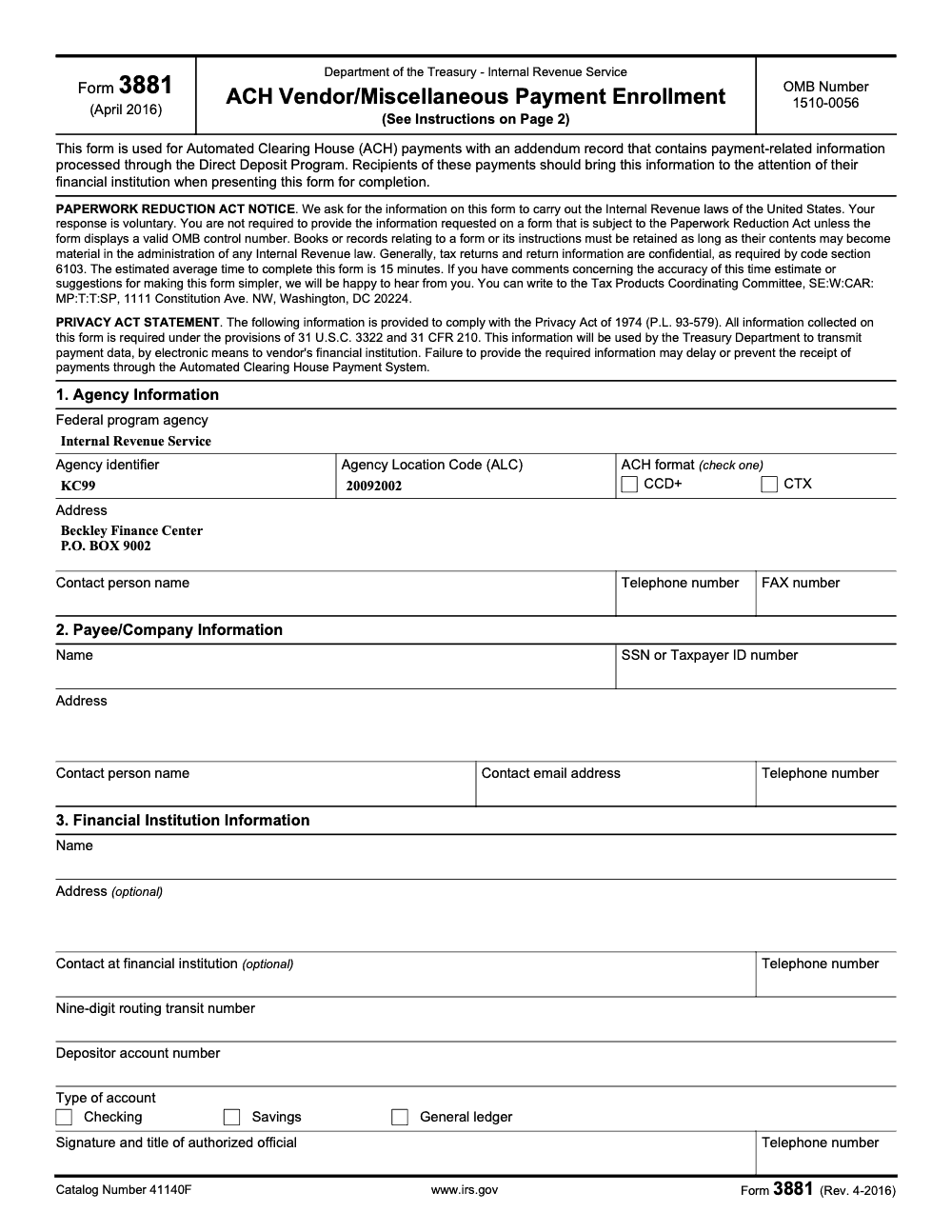
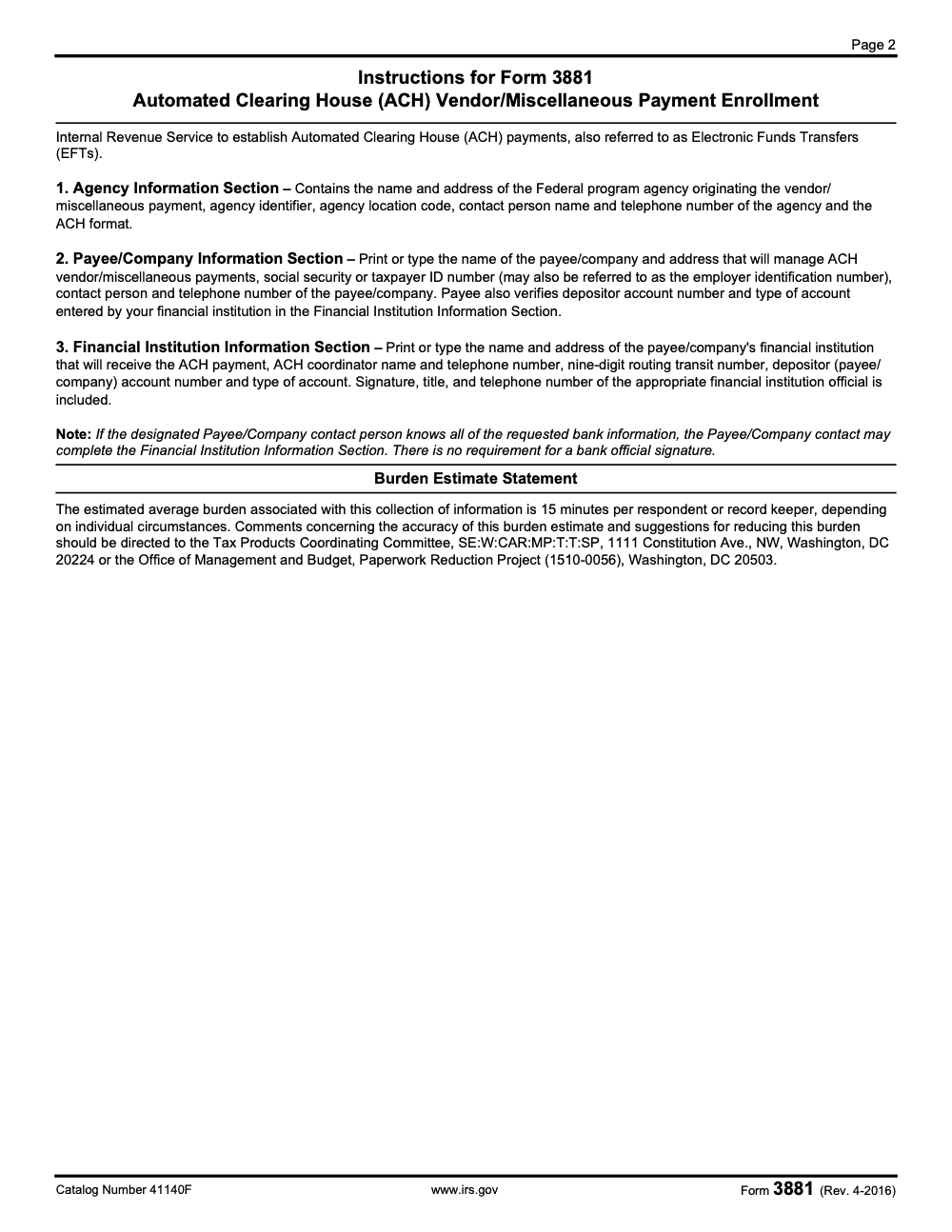
Form 3881 (Rev. April 2016) enrolls vendors and miscellaneous payees to receive ACH payments from a federal program agency. It is not for tax-refund direct deposit – taxpayers use the routing fields on Form 1040 or Form 8888 for that. The form has three sections (Agency, Payee/Company, Financial Institution), uses a 9-digit routing transit number, and carries OMB control number 1510-0056 under the Treasury Bureau of the Fiscal Service (per the Form 3881 (Rev. April 2016) instructions).
The whole appeal of Form 3881 is getting paid by ACH instead of waiting on a check that can wander in the mail. The catch is in the banking fields: an incorrect routing or account number sends the payment back or into the wrong account, and now you are running a resolution process instead of a deposit.
Form 3881 enrolls vendors and miscellaneous payees to receive federal ACH payments, with three sections covering the agency, the payee, and the financial institution, plus a 9-digit routing transit number. It is not for tax-refund direct deposit, and once you are enrolled, any banking change means submitting a fresh form.
Key Takeaways
- Form 3881 is an ACH enrollment form used by vendors and miscellaneous payment recipients to provide banking information to the IRS so they can receive payments via Automated Clearing House (ACH) direct deposit instead of paper check.
- The form is used for non-tax-refund IRS payments such as payments to vendors, contractors, and other miscellaneous payees – taxpayer tax refunds use a different direct deposit process through the annual return.
- Accurate banking information is the critical requirement – an incorrect routing number or account number on Form 3881 will cause the payment to be returned or deposited in the wrong account, creating a resolution process that can take weeks.
- Form 3881-A is the HCTC variant, titled "ACH Vendor/Miscellaneous Payment Enrollment - HCTC." It is scoped to the Health Coverage Tax Credit program and carries fields the general Form 3881 lacks, including a Health Plan Administrator (HPA) reference, a Health Plan Provider field, and a New or Annual renewal enrollment type. It is not interchangeable with Form 3881.
- Quick rule you can copy into your SOP: always verify routing and account numbers directly with the bank before submitting Form 3881 – do not rely on old checks or memory; get current verified information from the financial institution.
- Once enrolled, changes to banking information require a new Form 3881 submission – there is no phone-based update process for most ACH enrollment contexts; a new form with updated information must be submitted.
What Form 3881 Is and When to Use It
Form 3881 – ACH Vendor/Miscellaneous Payment Enrollment – is a banking enrollment form used to establish Automated Clearing House (ACH) direct deposit for IRS payments to vendors, service providers, and other miscellaneous payees. The ACH network is the electronic funds transfer system used for direct deposit of wages, business-to-business payments, and government payments throughout the United States. Form 3881 is the IRS’s standardized instrument for capturing the banking information needed to initiate these transfers.
The form is distinct from the direct deposit instructions that appear on individual or corporate income tax returns. Those tax return instructions enroll the taxpayer for receipt of their own tax refund via ACH. Form 3881 serves a different population: vendors who provide goods or services to the IRS or Treasury Department, contractors who receive miscellaneous payments from federal programs, and other payees who receive non-refund IRS or Treasury payments and want to receive them electronically rather than by check.
For accounting firms and their clients, Form 3881 is most commonly encountered in contexts where a client is a vendor to or contractor with a federal agency, or where the IRS is making a miscellaneous payment such as a refund of a non-income-tax payment or a payment from a specific IRS program. Understanding when this form is required versus when standard tax return direct deposit instructions apply is important for routing clients to the correct enrollment process.
The ACH Network and IRS Payments
The ACH network is operated by the National Automated Clearing House Association (NACHA) and handles the electronic transfer of funds between financial institutions. Government ACH payments are processed through the Federal Reserve’s ACH system. When the IRS or Treasury makes a payment via ACH using Form 3881 enrollment information, the payment typically takes one to three business days to appear in the recipient’s account after the IRS initiates the transfer. This is faster and more reliable than paper check delivery.
Contexts Where Form 3881 Applies
Specific programs and contexts where Form 3881 enrollment is relevant include: IRS vendor and contractor payments, certain Treasury program payments to state and local governments, payments to exempt organizations receiving IRS grants or reimbursements, and some specialized refund situations where the standard return-based direct deposit instruction does not apply. If you are unsure whether Form 3881 or a return-based direct deposit instruction is appropriate for a specific payment, contact the IRS program office making the payment for clarification.
How to Complete Form 3881
Form 3881 is relatively brief but banking accuracy is everything. A single digit error in the ABA routing number or account number can send a payment to the wrong financial institution or into a non-existent account, triggering a return and delay that can take weeks to resolve.
| Field / Section | What to Provide | Practitioner Tip |
|---|---|---|
| Payee/Company Name | Legal name of the payee exactly as it appears in IRS records | Must match the name on file with the IRS to prevent processing mismatches |
| Taxpayer Identification Number (TIN) | SSN or EIN of the payee | Cross-check against the most recent tax filing for this payee; TIN mismatches cause enrollment failures |
| Address | Current mailing address for correspondence | Use the same address on file with the IRS to avoid identity verification delays |
| Financial Institution Name | Full legal name of the bank or credit union | Use the official name, not a colloquial abbreviation – “First National Bank” not “First National” |
| ABA Routing Number | 9-digit ABA routing transit number for the receiving financial institution | Verify directly with the bank – do not copy from an old check unless recently confirmed; routing numbers can change after mergers |
| Account Number | The specific account number at the receiving financial institution | Verify the complete account number with the bank; confirm whether it is a checking or savings account |
| Account Type | Checking, savings, or general ledger | Form 3881 actually offers three options – Checking, Savings, and General ledger (the general ledger option supports payments to business or government internal accounts). Most vendors and businesses use checking accounts for ACH enrollment; savings accounts work but confirm with the bank that ACH credits are accepted |
| Authorized Signature | Signature of an authorized representative of the payee organization | Must be someone with authority to bind the organization to the banking enrollment; a check approver or CFO is appropriate (no separate bank official signature is required if the Payee/Company contact already has the routing and account information and completes the Financial Institution section directly) |
Verifying Banking Information Before Submission
The single most important step in completing Form 3881 accurately is independent verification of the banking information. My standard procedure is to obtain the ABA routing number and account number directly from the financial institution – by calling the bank’s customer service or pulling a current bank statement – rather than copying from any document that might be outdated. This takes five minutes and prevents weeks of payment delay. Small errors create big cleanup.
Submission Requirements and Timing
Form 3881 does not have a specific statutory filing deadline – it is a one-time enrollment, not an annual filing tied to April 15, and is submitted when the payee wants to establish or update ACH enrollment for IRS payments (resubmit only when banking or payee details change). However, the form should be submitted well in advance of any expected payment to allow the IRS time to process the enrollment before the payment is issued.
| Situation | When to Submit | Processing Notes |
|---|---|---|
| New vendor or payee enrollment | As soon as vendor relationship is established | Allow 2–4 weeks for processing before first payment is expected |
| Banking information change | Immediately upon account change; before any expected payment | Old enrollment remains active until new enrollment is processed; time the submission carefully to avoid a payment going to a closed account |
| Prior to an expected IRS payment | At least 4–6 weeks before the payment date | Processing times vary; contact the IRS program office to confirm timeline for your specific payment type |
Where to Submit Form 3881
Form 3881 is submitted to the specific IRS office or program that is making or will make payments to the payee. There is no single centralized submission address – the appropriate destination depends on the type of payment and the IRS program involved. Confirm the submission address and instructions with the IRS program office or contracting officer before submitting. Sending the form to the wrong address can result in it being lost or delayed without any notification to the payee.
ACH Payment Security and Fraud Prevention
ACH direct deposit enrollment is a high-value target for fraud – a fraudster who can intercept and alter a Form 3881 submission can redirect IRS payments to their own account. Understanding and implementing proper security controls around Form 3881 submissions is an important part of any payee’s compliance and financial controls framework.
Protecting the Submission Process
Best practices for Form 3881 security include: submitting the form via secure, trackable mail or hand delivery rather than regular mail; requiring dual authorization before any banking information change is submitted; maintaining an internal log of all ACH enrollment changes with dates and authorizing individuals; and confirming receipt with the IRS office after submission. Organizations that handle multiple vendor ACH enrollments should implement a change management process that includes independent verification of changed banking information by a second employee.
What to Do if a Payment Goes to the Wrong Account
If an IRS payment is sent via ACH to an incorrect account due to an error on Form 3881, notify the IRS program office immediately. The ACH return process can be initiated if the payment was sent to a non-existent account or a closed account – these are typically returned automatically by the receiving bank. If the payment went to a wrong but valid account, recovery may require coordination between the IRS, the financial institutions involved, and potentially NACHA dispute resolution processes. Recovery of misdirected ACH payments can be time-consuming; prevention through accurate initial enrollment is far preferable.
Form 3881 vs. Other IRS Payment Methods
Understanding how Form 3881 fits within the broader landscape of IRS payment methods helps practitioners direct clients to the right process for their specific situation.
| Payment Method | When Used | Enrollment Process |
|---|---|---|
| Tax refund direct deposit (individual) | Income tax refund on Form 1040 | Banking information entered directly on the tax return; Form 3881 not used |
| Tax refund direct deposit (business) | Corporate or partnership refund | Banking information entered on Form 1120 or 1065; Form 3881 not used |
| Vendor/miscellaneous IRS payment | Non-refund IRS payments to vendors, contractors, other payees | Form 3881 (or Form 3881-A) submitted to the relevant IRS program office |
| EFTPS (Electronic Federal Tax Payment System) | Payment of federal taxes by businesses and individuals | Separate EFTPS enrollment; not related to Form 3881 |
Form 3881-A – The HCTC Variant
Form 3881-A is a separate, related form, titled "ACH Vendor/Miscellaneous Payment Enrollment - HCTC." It is scoped to the Health Coverage Tax Credit (HCTC) program, not a reformatted copy of the general Form 3881. While it shares the same three-section structure (Agency, Payee/Company, and Financial Institution Information), Form 3881-A adds HCTC-specific elements the general form does not have, such as a Health Plan Administrator (HPA) reference, a Health Plan Provider field, and a New or Annual renewal enrollment type. Use Form 3881-A only for HCTC-related ACH enrollments; for general vendor or miscellaneous payment enrollment, use Form 3881. The two are not interchangeable.
Common Mistakes That Slow Things Down
Most Form 3881 rejections and payment delays trace back to a small set of recurring errors – almost all preventable with a five-minute verification step before submission.
Practical Checklists You Can Reuse
Three reusable checklists for the Form 3881 enrollment workflow – copy them into the firm SOP, vendor onboarding deck, or controller's review file.
Pre-submission banking verification
- Confirm the payee's legal name matches the name on file with the IRS for this TIN.
- Pull the 9-digit routing transit number directly from the financial institution (phone confirmation or current online-banking source).
- Pull the depositor account number directly from the financial institution, not from an old check.
- Verify the account type (Checking, Savings, or General ledger) with the payee's treasury or AP contact.
- Confirm the receiving bank accepts ACH credits to the selected account.
- Document the verification source and date in the working file for reviewer traceability.
Section-by-section completion review
- Section 1 (Agency Information): federal program agency name, agency identifier, ALC, address, contact person, telephone, and ACH format (CCD+ or CTX) selected by the agency.
- Section 2 (Payee/Company Information): name, SSN or Taxpayer ID, address, contact person, email, and telephone.
- Section 3 (Financial Institution Information): bank name, 9-digit routing transit number, depositor account number, and account type.
- Confirm whether the Payee/Company contact is completing Section 3 directly (no bank signature required) or whether a bank official signature is needed.
- Apply the payee's verification duty under the Form 3881 (Rev. April 2016) instructions: independently check the account number and type entered in Section 3.
- Have an authorized payee representative (CFO, controller, or AP approver) sign the form.
Post-submission tracking
- Send the form via tracked or secure delivery to the IRS program office making the payment; there is no single centralized submission address.
- Log the submission date, delivery confirmation, and the IRS contact who received it.
- Allow 2 to 4 weeks for processing before the first expected payment; 4 to 6 weeks for time-sensitive payments.
- Confirm enrollment activation directly with the IRS program office before the first scheduled disbursement.
- Add the active enrollment to an annual review tickler so banking details are reverified on each renewal cycle.
- File the executed Form 3881 and supporting verification notes in the vendor or payee master record.
Keep 3881 Season From Stalling
Form 3881 does not run on a tax-season calendar – there is no April 15 deadline and no quarterly cycle. The pressure shows up in vendor-onboarding cycles and bank-change events, when a single missing or stale ACH enrollment can hold up federal disbursements for weeks. The form itself is short (the Form 3881 (Rev. April 2016) instructions estimate 15 minutes of completion time per record), yet the failure modes – wrong routing digit, missed bank-merger update, ACH format mismatch – consistently trace back to AP and treasury teams handling enrollment as a one-off rather than a controlled workflow.
The fix is to treat Form 3881 enrollment as a standing AP control, not a clerical errand. Bake the verification steps into the vendor-onboarding SOP, log every active enrollment in a single register, and rebuild the touchpoints between AP, treasury, and the federal program contact.
- Standardize the Section 1 intake from the federal agency: capture the agency identifier, ALC, and selected ACH format (CCD+ or CTX) before any payee fields are filled.
- Verify the 9-digit routing transit number and depositor account number with the bank on every new enrollment and on every bank-change event, with the verification source noted in the file.
- Confirm which Section 3 path applies (payee-contact completion versus financial-institution signature) at the start of the enrollment, not at the end.
- Maintain a single live register of active Form 3881 enrollments by payee, agency, and last-verified date, and tickle it for annual revalidation.
- Reconcile each expected ACH receipt against the IRS program office's payment schedule, and escalate any return or misdirect immediately under the documented payee-verification duty.
Accountably's tax and payment-execution teams run this enrollment register and the verification cadence end-to-end, so federal ACH receipts land where they are meant to and stale banking details do not hold up next quarter's payments.
FAQs
Form 3881 is used for ACH enrollment for non-tax-refund IRS and Treasury payments to vendors, contractors, and miscellaneous payees. This includes payments for goods or services provided to the IRS or Treasury, certain program payments, and other miscellaneous disbursements. Individual income tax refunds and business tax refunds use direct deposit instructions entered on the tax return itself – not Form 3881.
Processing times vary by IRS program office and the volume of submissions being processed at the time. As a general guideline, allow at least two to four weeks from submission to activation before an expected payment. For payments with a firm deadline, submit Form 3881 at least four to six weeks in advance and confirm processing status with the relevant IRS program office.
If the receiving bank returns an ACH payment due to an incorrect routing or account number, the payment typically reverts to the IRS, which will then issue a paper check or contact the payee for corrected banking information. The resolution process can take several weeks. Submit a corrected Form 3881 with verified banking information immediately, and contact the IRS program office to explain the error and expedite re-issuance of the payment.
No. EFTPS (Electronic Federal Tax Payment System) is the system used by taxpayers to pay their federal tax obligations (estimated taxes, payroll taxes, etc.) electronically. Form 3881 is used to receive ACH payments from the IRS – the direction of funds is opposite. EFTPS has its own separate enrollment process at EFTPS.gov. They are entirely distinct systems serving different payment flows.
Other forms this guide names
- Form 3881-A: ACH Vendor/Miscellaneous Payment Enrollment (HCTC)
- Form 1040: Filing Guide for 2025 Returns (AGI, Deductions, Deadlines)
- Form 1065: Guide, Deadlines, K‑1, K‑2/K‑3, E‑File
- Form 1065: Schedule K-2 and K-3 Guide 2025, one month date rules
- Form 1120: Corporation Tax Return Guide
About this guide
Accountably helps US CPA, EA, and accounting firms hire trained accountants and tax preparers in India.
About us Reviewed byJugal Thacker, CPAFounder and CEO at Accountably
A Washington-licensed CPA with 7+ years inside US firms – PwC, a real-estate tax practice, then a full-service firm, rising from reviewer to manager to advisory. This article was reviewed against current IRS guidance for the 2025 tax year and updated for filers preparing late returns, amendments, and 2026 estimates.
View profile →How we research, review, and update this guide
Every Accountably guide is researched against primary IRS sources, reviewed by a U.S. CPA, and refreshed as guidance evolves. Read our Editorial Guidelines to see how we source, fact-check, and update our content.