Summarize this article with AI
In Brief
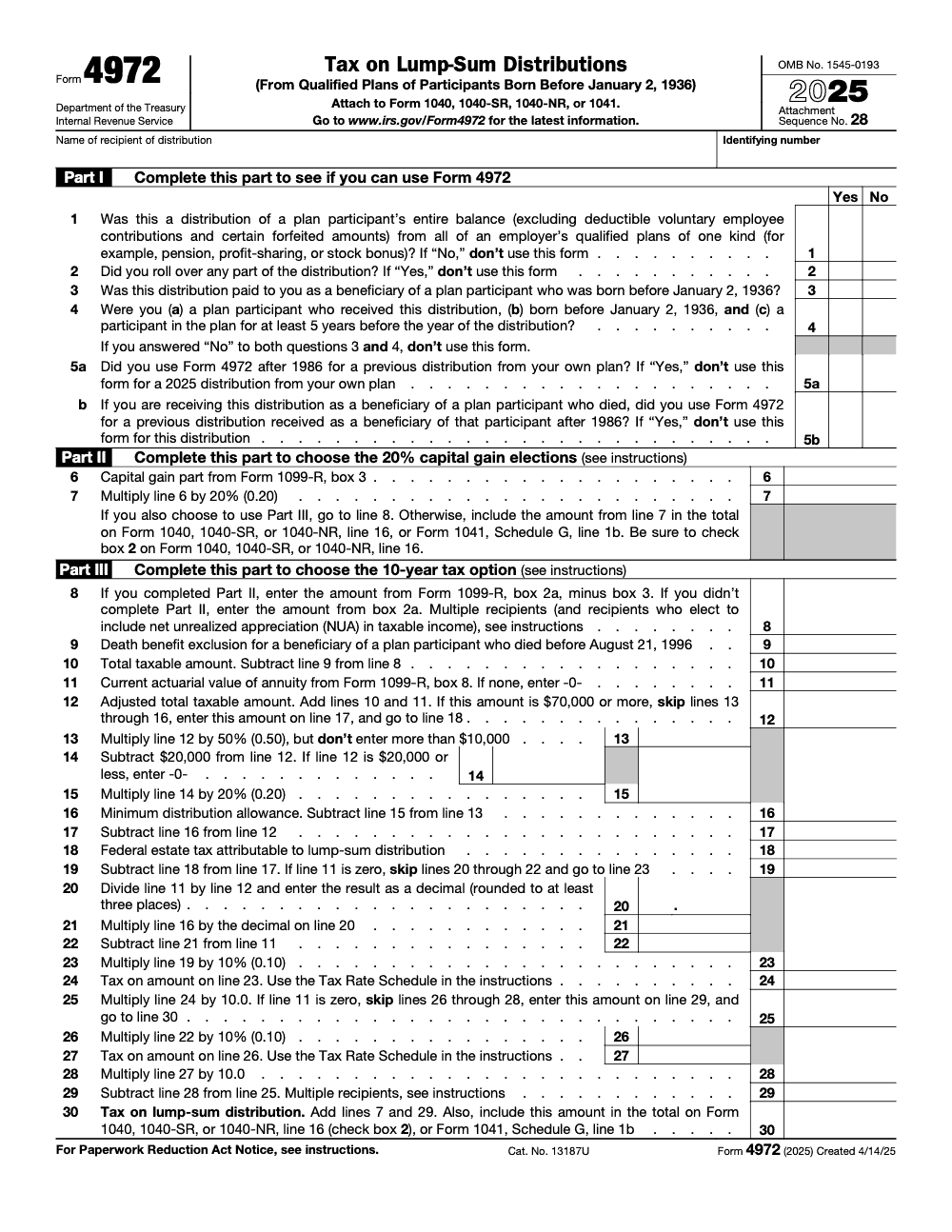
Form 4972 figures the tax on a qualified lump-sum distribution from an employer pension, profit-sharing, or stock bonus plan – available only when the plan participant was born before January 2, 1936 (per the IRS instructions for Form 4972, 2025 revision). Eligible filers can elect the 20% capital gain rate in Part II for pre-1974 participation and the 10-year tax option in Part III; the resulting tax flows to Form 1040 line 16 with box 2 checked.
A retiree takes the whole balance of an old employer plan in a single year and wonders whether there is a gentler way to be taxed on it than stacking it all onto ordinary income. Form 4972 offers two, but the door is narrow: the form is generally available only when the plan participant was born before January 2, 1936.
It figures the tax on a qualified lump-sum distribution from an employer pension, profit-sharing, or stock bonus plan, never from an IRA. Eligible filers can elect the 20% capital gain rate in Part II for pre-1974 participation and the 10-year tax option in Part III, using one or both if they qualify, with the result flowing to Form 1040 line 16. The catch that ends the conversation fast: roll over any portion and you are out. Even a partial rollover makes the whole distribution ineligible for Form 4972.
Key Takeaways
- Form 4972 applies to a qualified lump‑sum distribution paid from a qualified employer plan, received in one tax year, and generally tied to a participant born before January 2, 1936, or a beneficiary of such a participant.
- You cannot roll over any portion and still use Form 4972. Partial rollovers make the distribution ineligible.
- The form offers two choices, the 10 year tax option for the ordinary income part and a 20 percent capital gain method for the small capital gain part shown on 1099‑R box 3 if applicable. You can use one or both if you qualify.
- Employer stock has net unrealized appreciation, NUA, which is usually excluded from income at distribution and taxed later when you sell, often at capital gains rates. You can elect to include NUA in taxable income for averaging, but that is optional and situational.
- If the plan pays you directly, most eligible rollover distributions have 20 percent mandatory federal withholding. Direct rollovers avoid the withholding, but any rollover makes you ineligible for Form 4972.
What Is IRS Form 4972
Form 4972, Tax on Lump‑Sum Distributions, computes a separate tax on an eligible one time payout from a qualified plan. You use information from Form 1099‑R, including the taxable amount, any capital gain part in box 3, the current actuarial value of an annuity in box 8, and, if employer stock is involved, box 6 for NUA. The tax figured on Form 4972 is added to your regular tax on Form 1040 for that year.
- What it does, it can reduce total tax compared with treating the entire payout as current ordinary income, but only if you are eligible.
- How it works, you choose the 10 year tax option for the ordinary income portion, the 20 percent capital gain method for the capital gain portion if you have one, or both, then attach the form to your return.
- Wow factor, these elections are one time for a participant after 1986, so choosing well matters. If you make the optional election, you generally cannot use it again for that participant on a later distribution.
When Form 4972 Is Even On The Table
To even consider Form 4972, the payout must be a qualified lump‑sum distribution. Think of this as your entire balance from all plans of one kind with that employer, for example all pension or all profit sharing plans, paid out in one tax year. There are participation and birth‑date rules, and several disqualifiers. The form itself walks you through a quick checklist before you compute anything.
A Note On IRAs And Rollovers
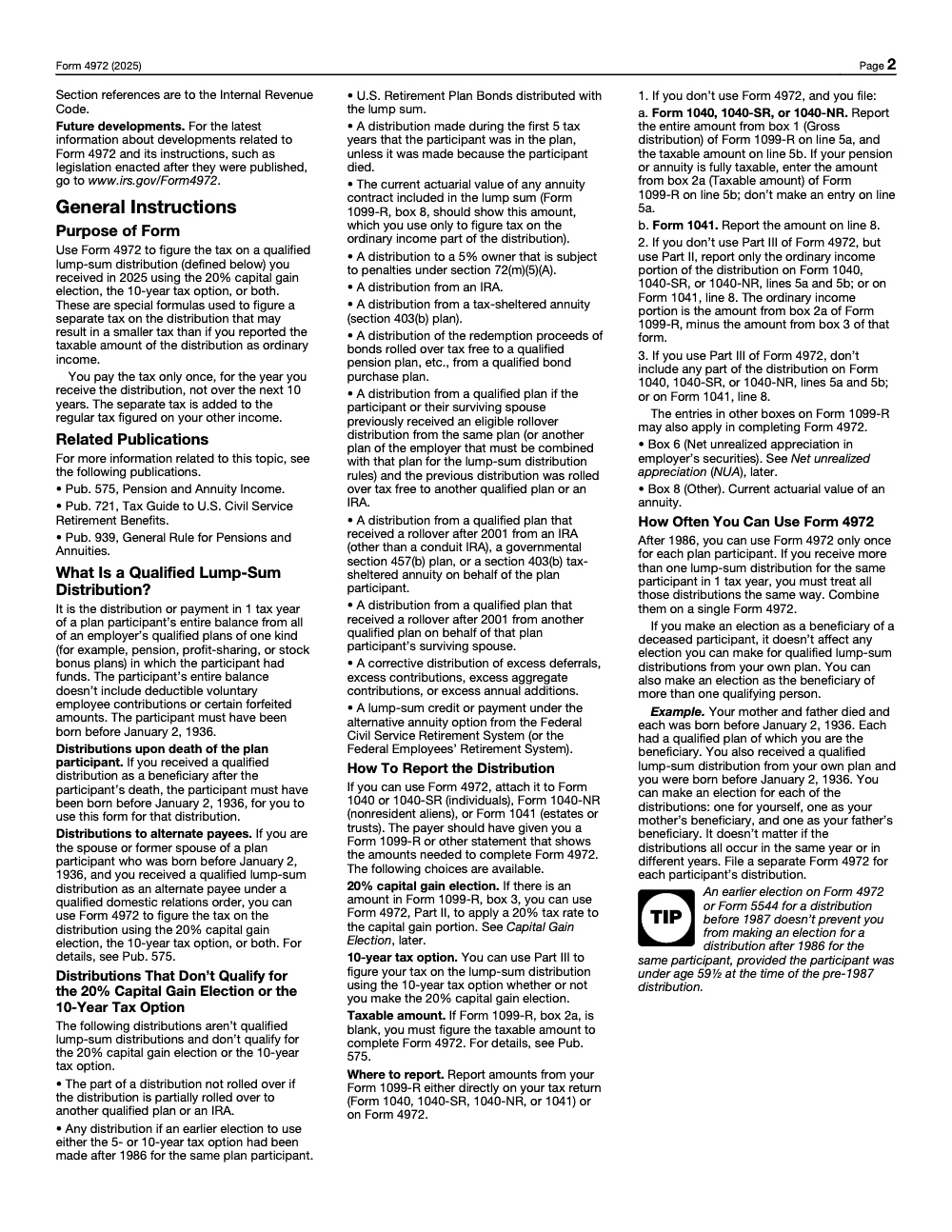
Form 4972 does not apply to IRA distributions, tax sheltered annuities under section 403(b), or distributions that were rolled over. If you do any rollover, even a partial one, the distribution is not eligible for the 10 year tax option or the 20 percent capital gain method. In contrast, if you are aiming for NUA treatment on employer stock, that usually relies on a lump‑sum distribution without rolling the stock to an IRA. Strategy first, moves second.
Why older plans, the 1936 date
The special methods on Form 4972 were grandfathered and now apply mainly to participants born before January 2, 1936, including certain beneficiaries and alternate payees. That is why most modern distributions do not qualify, while some longtime employees and their heirs still do.
Eligibility Requirements And Key Terms
Form 4972 starts with Part I, a yes or no gate. If you miss on any key item, you stop and report your distribution under the usual rules on Form 1040. Here is what the IRS looks for.
Who Can Use Form 4972
- You received the entire balance from all of your employer’s qualified plans of one kind in one tax year.
- You did not roll over any portion of the distribution.
- You were born before January 2, 1936, and you participated in the plan for at least 5 years before the year of distribution, or you are a beneficiary of someone who meets the birth‑date rule.
- You have not previously used the 5 year or 10 year option for this participant after 1986 (a pre-1987 election on Form 4972 or Form 5544 does not count against this limit if the participant was under age 59½ at the time of that earlier distribution).
Additional notes the IRS calls out, distributions from IRAs, 403(b) annuities, and certain other situations are excluded. Some items, like the current actuarial value of an annuity shown in 1099‑R box 8, are handled specially inside the 4972 math.
Qualified Lump‑Sum Distribution, Plain English
A qualified lump‑sum distribution is a one year, all balance payout from all plans of one kind held with that employer. If you receive pieces in different years, or you roll over any part, you do not have a qualified lump‑sum for Form 4972. Beneficiaries can qualify if the participant met the birth‑date rule. The form’s instructions define these terms and the exact items you include or exclude.
Distributions That Do Not Qualify
These common blockers remove 4972 from consideration.
- Any distribution where any portion was rolled over.
- Any distribution if you already used the 5 year or 10 year option after 1986 for this participant.
- Distributions from IRAs or 403(b) annuities.
- Payouts within the first 5 tax years of plan participation unless paid after death (no hardship, financial, or administrative waiver applies; the death exception is the only one).
- Certain payments to 5 percent owners, annuity value in box 8, corrective distributions and a short list of specialized cases in the instructions.
NUA And Employer Stock
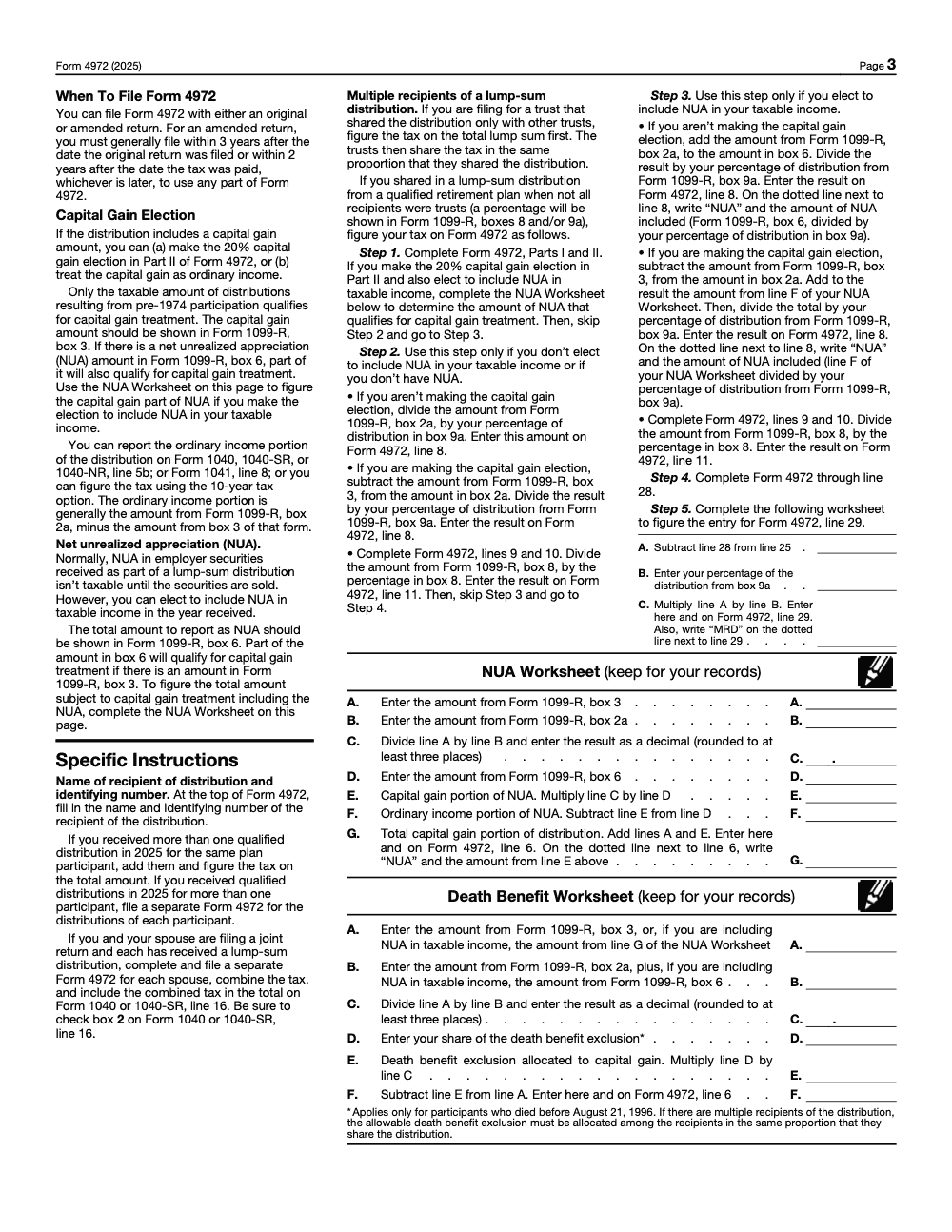
If the distribution includes employer securities, understand net unrealized appreciation. Generally, the cost basis is taxed as ordinary income in the year of distribution, while the NUA portion is deferred and taxed when you sell the shares, often as long term capital gains. You can, if you choose, include NUA in taxable income for the 10 year option, which can be attractive in a narrow set of scenarios. Run the numbers before you elect.
Eligibility Quick Check
| Situation | Eligible for 4972? | Why |
| Entire balance from company pension paid in 2025, participant born in 1935, no rollover | Yes | Meets one year, all balance, birth‑date, and no rollover rules. |
| Same facts, participant rolls 10 percent to an IRA | No | Any rollover disqualifies the optional methods. |
| Distribution from a traditional IRA | No | IRAs are not eligible for 4972. |
| Beneficiary of a participant born in 1934 receives all plan assets in one year | Yes, if other tests met | Beneficiaries can qualify if the participant met the birth‑date rule. |
| Employer stock included, you want NUA treatment later | Maybe | NUA can be excluded now and taxed at sale, or you may elect to include it for averaging. Evaluate before filing. |
Tip, do not assume software defaults are right. Confirm that all 1099‑R forms for the same employer and plan type are combined in your computation if more than one payment was issued in the same year.
Tax Calculation Methods You Can Elect
When you are inside the 4972 gate, you decide how to compute tax. Use the 20 percent capital gain method for the small capital gain portion shown on 1099‑R box 3 if you have one, use the 10 year tax option for the ordinary income portion, or use both. The form and instructions provide the exact lines, and the tax from Form 4972 is then added to your total tax on Form 1040.
The 10 Year Tax Option
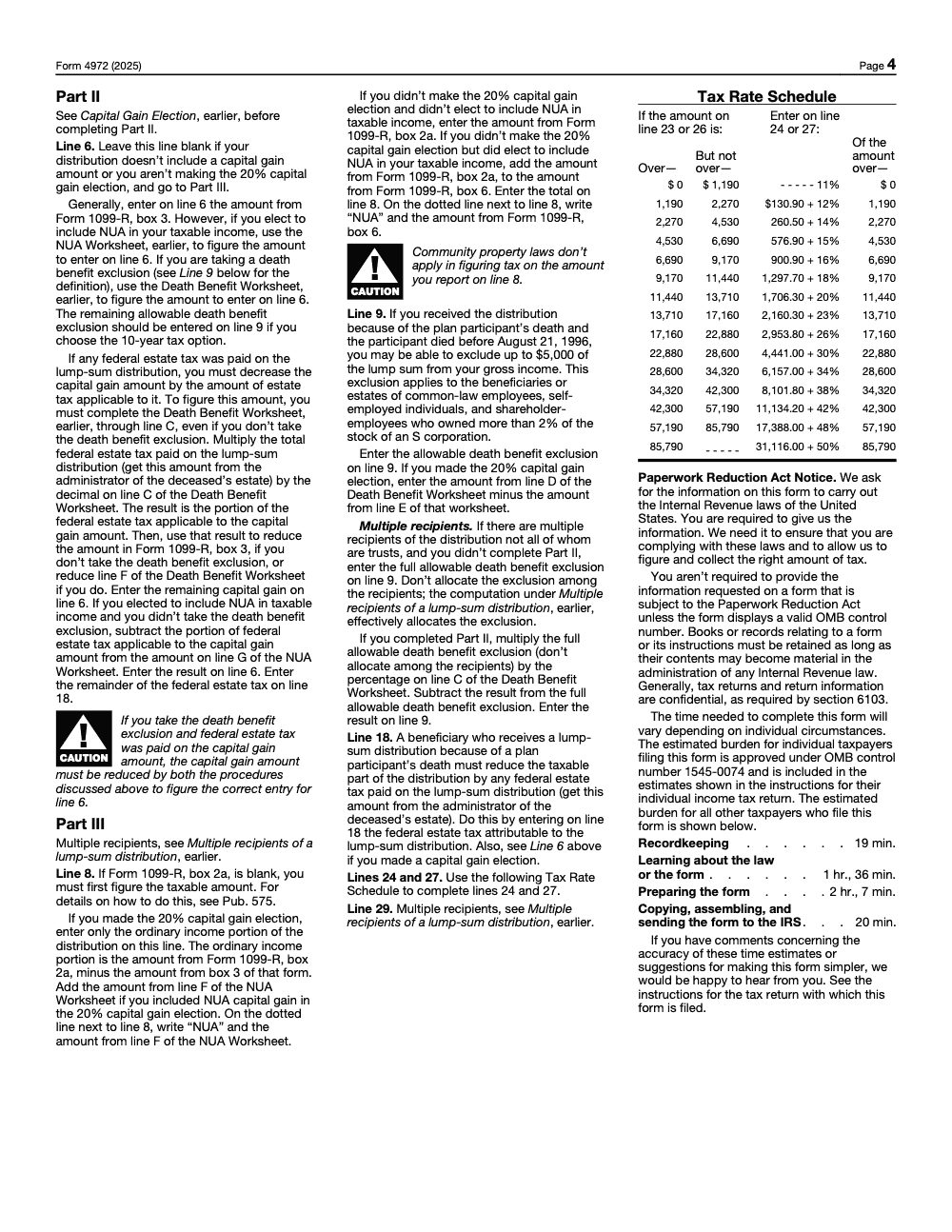
- You enter the taxable amount in Part III, then follow the worksheet. The method taxes one tenth of the adjusted taxable amount using the rate schedule in the instructions (a frozen 1986-era schedule with 15 brackets and rates from 11% to 50%, not the current ordinary income brackets), then multiplies that result by ten. The math also considers a minimum distribution allowance and, if present, the actuarial value of an annuity in box 8.
- The tax computed on 4972 is a separate tax added to your return for that year. You do not actually pay tax over ten years.
The 20 Percent Capital Gain Method
- If your 1099‑R has a capital gain amount in box 3, you can tax that slice at 20 percent in Part II. This applies only to the portion of the distribution attributable to plan participation before 1974 (which the payer determines and reports in box 3) and is uncommon today, but it still exists for some participants and beneficiaries.
- If you also use the 10 year option, you will compute both parts and add them.
Employer Stock And NUA, How It Fits
- If employer securities are distributed, the basis is ordinary income in the distribution year. The NUA portion can be deferred and taxed when the stock is sold, often at long term capital gains rates. You can instead choose to include NUA in taxable income for the 10 year option, which can help if your averaged rate beats your expected future capital gains rate. This is a modeling exercise, not a rule of thumb.
Worked Example, Round Numbers
Assume you qualify for Form 4972. You receive a 2025 lump‑sum of 600,000 from a qualified plan, paid in cash. Your 1099‑R shows taxable amount 600,000 and no capital gain part.
- Ordinary income, 600,000 goes to Part III.
- The 10 year option requires you to compute adjustments such as the minimum distribution allowance, then to tax one tenth using the schedule in the instructions, then multiply by ten. The form guides each step and produces a single number that you add to your regular tax on Form 1040.
Now assume instead the payout includes employer stock, basis 120,000, NUA 180,000, and cash 300,000.
- Basis 120,000 is ordinary income in the year of distribution.
- NUA 180,000 is deferred and taxed at capital gains rates when you sell the stock, unless you elect to include it now for averaging.
- Cash 300,000 is ordinary income.
- You can run two paths, include the NUA in Part III and average it, or exclude NUA now and plan for capital gains at sale. Compare the total lifetime tax across both paths.
Bottom line, once you elect 4972 optional methods for a participant after 1986, you generally cannot use them again. Be deliberate.
Withholding, Rollovers, And Reporting Mechanics
If the plan pays you directly, most eligible rollover distributions have 20 percent mandatory federal withholding. That amount is sent to the IRS and shows on 1099‑R box 4. You reconcile it on your return. Choose a direct rollover to another eligible plan or IRA to avoid withholding, however any rollover makes the distribution ineligible for Form 4972.
If you take a payment and plan to roll it within 60 days, you must replace the withheld 20 percent from other funds to achieve a full tax‑deferred rollover. If you do not replace it, that withheld slice is treated as distributed cash and taxed, and if you are under 59½, it may face a 10 percent additional tax unless an exception applies.
- The 60 day rollover clock and waivers are explained by the IRS, including a self certification process for certain late rollovers.
- The 20 percent withholding comes from section 3405 and the related regulations, direct rollovers are not subject to that withholding.
How To Complete Form 4972, Step By Step
- Confirm eligibility in Part I, all balance, one tax year, no rollovers, birth‑date rule, participation, and no prior post‑1986 election.
- Gather all 1099‑R forms tied to the same employer and plan type, combine amounts when the instructions say to combine.
- If you have a capital gain amount in box 3, enter it in Part II and multiply by 20 percent.
- Complete Part III for the 10 year option, follow the lines for minimum distribution allowance, annuity value from box 8 if present, and the tax rate schedule. Multiply the tax on one tenth by ten.
- Add Part II and Part III results if you used both, then transfer the total tax to Form 1040 line 16, checking the box for 4972. Attach Form 4972 to your return.
Deadlines And Extensions
You file Form 4972 with your Form 1040 for the year you received the lump‑sum. For distributions made in 2025, the regular due date is April 15, 2026, with a valid extension to October 15, 2026. State deadlines can differ. The IRS page for Form 4972 confirms you attach the form to your return.
Planning Considerations And Alternatives
- If cash needs are modest, a direct rollover preserves tax deferral and avoids 20 percent withholding. Remember, that choice removes Form 4972 from play.
- If you qualify for 4972 and expect very high ordinary income rates this year, the 10 year option may reduce tax compared with reporting the entire sum as ordinary income now. Run the computation before filing.
- With employer stock, weigh NUA capital gains at sale against averaging now. Consider your bracket today, your likely bracket later, state tax, holding period, and diversification needs.
- If you are under 59½, map out exceptions to the 10 percent additional tax and your estimated tax needs for the year.
Practical move, model at least three paths before you commit the return, all ordinary income now with no elections, 10 year option only, 10 year option plus capital gain method and, if stock is present, with and without including NUA.
Resources And Tools For Filing Form 4972
- IRS, About Form 4972 and the current year Form 4972 PDF, for the latest instructions and the rate schedule.
- IRS Publication 575, for detail on lump‑sum distributions, optional methods, and NUA mechanics.
- IRS Topics 412 and 413, for lump‑sum distributions, withholding and rollovers, including the 20 percent rules.
- Your tax software, for example UltraTax, ProConnect, or CCH Axcess, to run scenarios and attach the form properly. Most systems prompt you to combine multiple 1099‑R entries tied to the same plan.
A Quick Callout For Accounting Teams
If you run a CPA or EA firm, you know peak season piles on complex fact patterns, multiple 1099‑R forms, and clients who need careful modeling. When your internal team is at capacity, Accountably can slot trained offshore professionals into your workflow, maintain documentation standards, and protect review time. Use this when you need clean workpapers, predictable turnaround, and steady quality during spikes, not as a short term band aid.
Final Checklist Before You File
- Confirm eligibility with Part I on the form.
- Combine all related 1099‑R amounts for the same plan type and employer.
- Model three or more scenarios, including NUA choices if employer stock is present.
- Verify withholding, 60 day timelines, and any 10 percent additional tax exposure.
- Attach Form 4972 to Form 1040 and retain all schedules and notes.
Common Mistakes We See Every Season
Form 4972 is one of the narrowest elective tax computations on the books, which means even seasoned preparers misread the eligibility gates or the reporting flow. Below are the recurring traps we catch when reviewers pull these returns for a second look.
Reusable Checklists
These checklists are copy-paste ready for firm SOPs. Drop them into the engagement file the first time a Form 4972 candidate walks in, and review during the second-look pass.
Pre-Election Eligibility Scan
- Confirm the plan participant's date of birth is before January 2, 1936.
- Verify the participant had at least 5 full years of plan participation before the year of distribution (death exception applies).
- Confirm the distribution is the entire balance from all qualified plans of one kind (pension, profit-sharing, or stock bonus) in a single tax year.
- Confirm no portion of the distribution was rolled over to another qualified plan or IRA.
- Pull prior-year workpapers to check for any post-1986 Form 4972 election tied to this participant.
- Confirm the plan is not a 403(b), IRA, or governmental 457(b) plan and was not the recipient of a post-2001 rollover from one of those vehicles.
- Flag if the participant was a 5% owner subject to Section 72(m)(5)(A) penalty – the distribution is disqualified.
- For beneficiary filings, document the participant's date of death and confirm pre-August 21, 1996 status if the $5,000 death benefit exclusion is in play.
Election Method Comparison
- Pull Form 1099-R box 3 to identify any pre-1974 capital gain portion eligible for the 20% election in Part II.
- Pull Form 1099-R box 6 to identify NUA in employer securities and decide whether to elect inclusion on line 8 or defer until sale.
- Model scenario A: ordinary income treatment, no Form 4972.
- Model scenario B: 10-year tax option in Part III only.
- Model scenario C: 20% capital gain election in Part II combined with the 10-year option in Part III on the ordinary income portion.
- Model scenario D: NUA inclusion layered on the chosen Part II and Part III combination, with the NUA Worksheet completed.
- Apply the Form 4972 Tax Rate Schedule (15 brackets, 11% to 50%) for the Part III tax math on lines 24 and 27, not the current 2025 ordinary income brackets.
- Document the chosen path and the comparison numbers in the workpaper for reviewer sign-off.
Filing and Reporting Handoff
- If Part III is used, blank out Form 1040 lines 5a and 5b; the distribution does not appear there.
- If only Part II is used, report the ordinary income portion (1099-R box 2a minus box 3) on lines 5a and 5b.
- Confirm Form 4972 line 30 tax is added to Form 1040 line 16 with box 2 checked.
- For estates and trusts, route the tax to Form 1041 Schedule G, line 1b instead.
- If multiple recipients are involved, follow the five-step procedure and write "MRD" on the dotted line next to line 29.
- If NUA is included on line 8, write "NUA" on the dotted line next to line 8 with the amount.
- Attach Form 4972 with Attachment Sequence Number 28.
- For amended returns, confirm the filing falls within 3 years after the original return was filed or 2 years after the tax was paid, whichever is later.
Keep 4972 Season From Stalling
Form 4972 is a narrow elective. The plan participant must have been born before January 2, 1936, which means most eligible filers today are estates, beneficiaries, or QDRO alternate payees handling distributions for participants now in their late 80s and 90s. Volume is low across most firms, but the per-return dollar value is high and the post-1986 one-time-per-participant rule means a missed election cannot be revisited later. Per the IRS instructions for Form 4972, the form spans three parts and 30 numbered lines, and the underlying Tax Rate Schedule still uses the frozen 1986-era brackets (11% to 50%) rather than current ordinary income rates.
The trap is treating these returns as routine. A preparer who has not touched Form 4972 in 18 months will reach for current ordinary income brackets instead of the special Tax Rate Schedule, miss the $70,000 line 12 trigger that zeros out the minimum distribution allowance, or skip the NUA Worksheet on an employer stock distribution. The fix is rare-form discipline: a documented intake gate, a second reviewer who knows the form, and workpapers that cite the line numbers explicitly.
- Build a one-page intake gate that captures the participant's date of birth, plan type, Form 1099-R boxes 1, 2a, 3, 6, 8, and 9a, and any prior Form 4972 history before drafting begins.
- Run scenario modeling for every viable election path – Part II only, Part III only, Part II combined with Part III, and each variant with NUA included versus deferred – and price each path before the client commits.
- Wire the $70,000 line 12 skip and the line 11 zero rule (which forces a skip of lines 20 through 22 and, on line 25, lines 26 through 28) into a single workpaper template so the preparer cannot accidentally fill lines the instructions require to be skipped.
- Require a senior reviewer to validate the participant's birth date documentation and the one-time-per-participant log entry before sign-off; the post-1986 election is permanent.
- For multi-recipient distributions, follow the five-step procedure and label line 29 with "MRD" so the allocation is auditable on review.
Rare-form discipline is exactly what structured offshore delivery is built for: documented SOPs that survive the years between filings, a second reviewer who has seen the form recently, and a workflow that catches the 1986-era rate schedule before it gets misapplied. See how our team handles low-volume specialty filings at Accountably tax services.
FAQs
Form 4972 computes a separate tax on a qualified lump‑sum distribution using the 10 year option, the 20 percent capital gain method, or both. It can reduce tax compared with reporting everything as ordinary income, but it applies mainly to participants born before January 2, 1936, and certain beneficiaries.
No. Any rollover, even a partial one, makes the distribution ineligible for the 10 year option or the 20 percent capital gain method. Consider this before you move funds.
If the plan pays you directly, most eligible rollover distributions have 20 percent mandatory withholding. If you later roll over within 60 days and want a full tax‑free rollover, you must replace the withheld amount from other funds. Direct rollovers avoid withholding.
No. IRAs and 403(b) annuities are not eligible. Form 4972 is for qualified employer plan lump‑sum distributions that meet the specific rules.
Any portion not rolled over may be subject to a 10 percent early distribution tax unless an exception applies. Review the IRS exceptions for qualified plans and consider estimated taxes.
You file it with your Form 1040 for the year of distribution. For distributions received in 2025, the regular due date is April 15, 2026, with extension to October 15, 2026.
Other forms this guide names
- Form 1099‑R: Box 7 Codes, Rollovers, 2025 Filing Guide
- Form 1040: Filing Guide for 2025 Returns (AGI, Deductions, Deadlines)
Summarize this article with AI
About this guide
Accountably helps US CPA, EA, and accounting firms hire trained accountants and tax preparers in India.
About us Reviewed byJugal Thacker, CPAFounder and CEO at Accountably
A Washington-licensed CPA with 7+ years inside US firms – PwC, a real-estate tax practice, then a full-service firm, rising from reviewer to manager to advisory. This article was reviewed against current IRS guidance for the 2025 tax year and updated for filers preparing late returns, amendments, and 2026 estimates.
View profile →How we research, review, and update this guide
Every Accountably guide is researched against primary IRS sources, reviewed by a U.S. CPA, and refreshed as guidance evolves. Read our Editorial Guidelines to see how we source, fact-check, and update our content.