Summarize this article with AI
In Brief
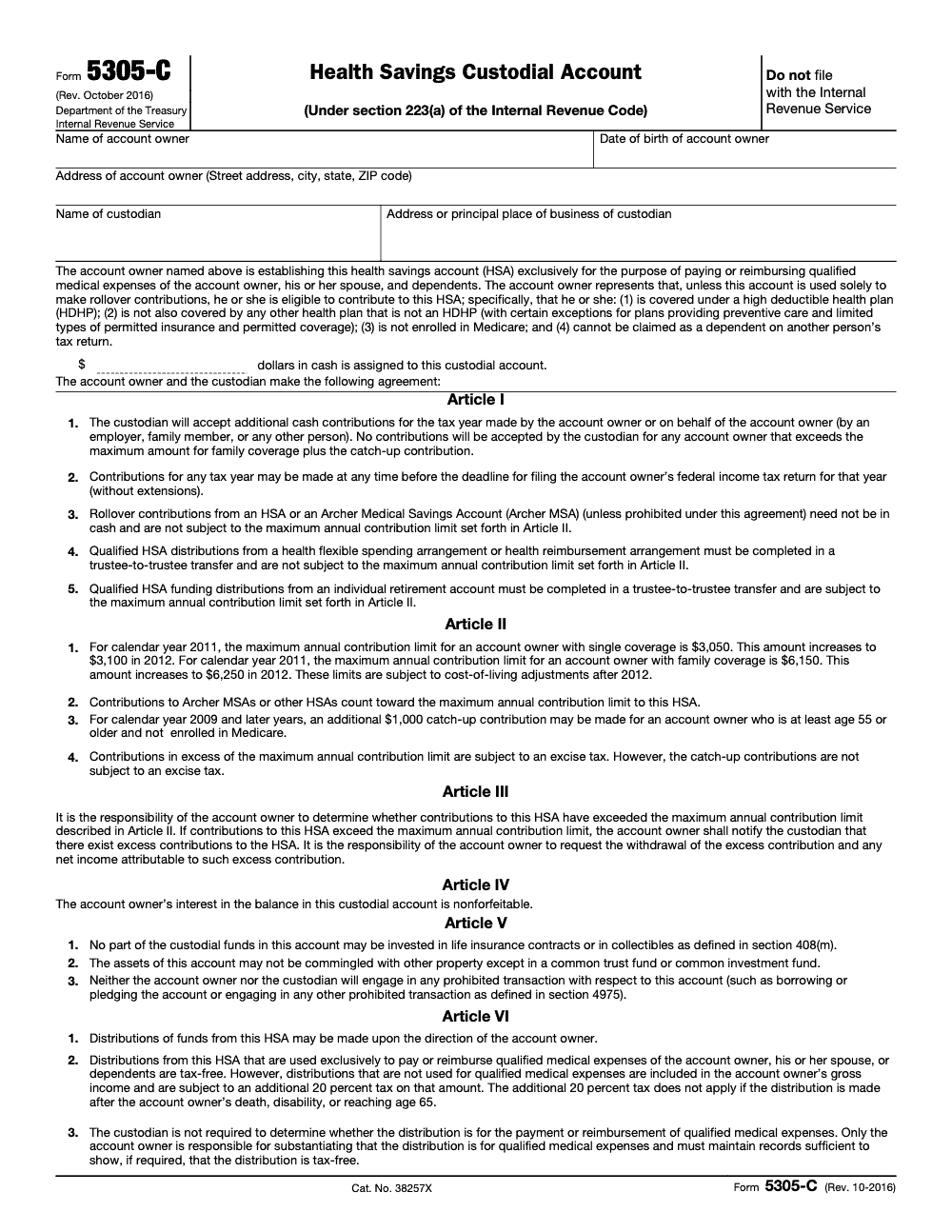
Form 5305-C is the IRS model custodial agreement for a Health Savings Account under IRC §223(a) – the account owner and HSA custodian execute it and retain it in their records, never filing it with the IRS (per IRS Form 5305-C, Rev. October 2016). For tax year 2025, the HSA contribution limit is $4,300 self-only and $8,550 family with a $1,000 catch-up at age 55+; HDHP minimum deductibles are $1,650 and $3,300 (per Rev. Proc. 2024-25). See our taxation services for HSA setup and review support.
A client wants to set up an HSA for one employee, the broker sends a stack of paperwork, and buried in it sits a half-completed model agreement with the wrong form number on top. By the time the question lands on a desk, contributions are already flowing and the custodian record is shaky.
Form 5305-C is the IRS model custodial agreement for a Health Savings Account under IRC §223(a), revised October 2016. The account owner and HSA custodian execute it and keep it in their records, never filing it with the IRS. The numbers that size contributions are easy to get right once you have them in front of you: for 2025 the HSA limit is $4,300 self-only and $8,550 family, with a $1,000 catch-up at age 55 or older, and the HDHP minimum deductibles are $1,650 and $3,300. Nonqualified withdrawals before age 65 carry a 20% additional tax.
Key Takeaways
- Form 5305‑C is the IRS model document to set up an HSA custodial account with a bank or similar institution. It is not filed with the IRS. Check the footer for the latest revision, currently Rev. October 2016.
- SIMPLE IRA model forms are 5304‑SIMPLE and 5305‑SIMPLE. The SEP model form is 5305‑SEP. If your goal is a SIMPLE or SEP, use those instead.
- HSA contribution limits for 2025 are 4,300 self‑only and 8,550 family, with a 1,000 catch‑up at age 55+. For 2026, limits rise to 4,400 and 8,750.
- HSAs require HDHP coverage. For 2026, the minimum deductible is 1,700 self‑only and 3,400 family, with out‑of‑pocket maximums of 8,500 and 17,000.
- Nonqualified HSA withdrawals are taxable and face a 20% additional tax before age 65, with exceptions for disability and death. After age 65 only the 20% additional tax is waived – non-medical distributions remain includible in gross income as ordinary income. You report HSA activity on Form 8889.
- Always download the current PDF from IRS.gov and open it in Adobe Acrobat Reader to preserve fields and signature blocks. Save executed copies and keep an audit trail.
What Form 5305‑C Actually Is
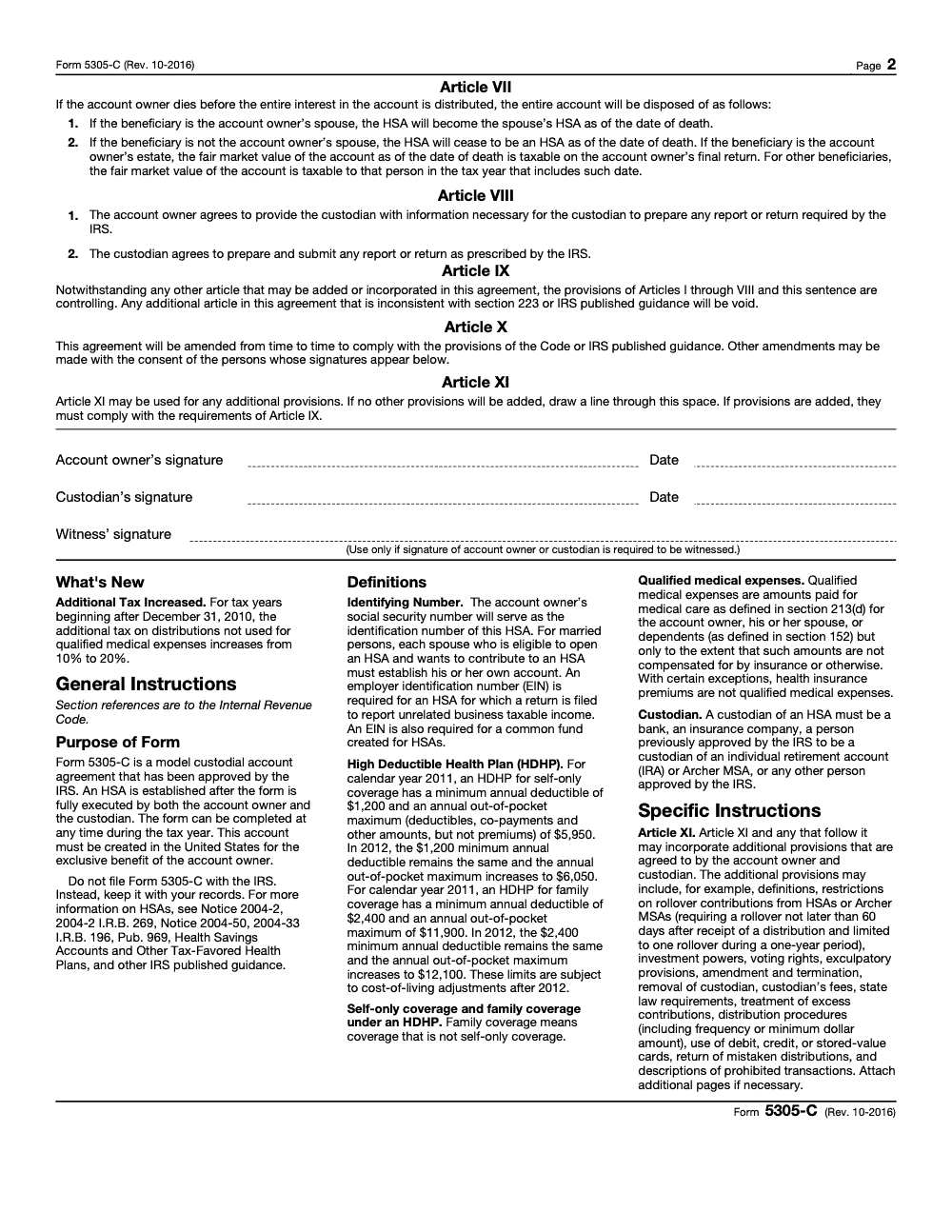
Form 5305‑C is the IRS’s model custodial agreement that financial institutions use to open and maintain Health Savings Accounts. It spells out the duties of the HSA custodian, the rights of the account owner, and the rules the account must follow under section 223. You do not file this form with the IRS, you adopt it with the custodian, and you retain it as part of your records. The latest posted file on IRS.gov shows “Rev. October 2016.”
Who Uses It
- Banks, credit unions, and trust companies acting as HSA custodians
- Employers that facilitate HSAs and want a standard custodial agreement on file
- Individuals opening an HSA directly with a custodian
If you manage benefits for clients, you will touch 5305‑C during account setup, document retention, and year‑end quality checks. Publication 969 and the Form 8889 instructions provide the operating rules you will rely on during tax time.
What Form 5305‑C Is Not, With Correct Forms To Use
A lot of confusion starts here. If your objective is a SIMPLE or SEP, you need a different model form. Use this table to sanity‑check your next step.
| Purpose | Correct IRS Model Form | Notes |
| Open an HSA custodial account | 5305‑C | Adopt with the custodian. Not filed with IRS. Rev. October 2016. |
| Adopt a SIMPLE IRA with any financial institution | 5304‑SIMPLE | Used when employees choose the financial institution. Check revision date notes on IRS site. |
| Adopt a SIMPLE IRA with one designated institution | 5305‑SIMPLE | Used when employer names the financial institution. |
| Adopt a SEP IRA plan | 5305‑SEP | Model SEP adoption agreement. Do not file with IRS. |
If you came here expecting a SIMPLE IRA setup, pivot to 5304‑SIMPLE or 5305‑SIMPLE. If you are setting up a SEP, move to 5305‑SEP. The IRS retirement plan pages confirm these mappings and remind you to verify the revision date printed on the form.
Why This Matters Right Now
Two reasons. First, using the wrong model document can cause messy re‑papering and client confusion. Second, HSA and retirement plan limits update annually. As of January 30, 2026, the current HSA limits for 2026 are set, and the SIMPLE IRA limits for 2026, 2025, and 2024 are posted on the IRS site. If you advise clients or prepare returns, keep both sets of numbers handy.
Bottom line, if the task is HSA account setup, Form 5305‑C is your model agreement. If the task is a SIMPLE or a SEP, switch forms immediately and save yourself a redo.
HSA Limits and HDHP Rules You Need for 2025 and 2026
Here are the numbers you will reference in conversations, enrollment packets, and tax prep.
Contribution Limits
- 2025 HSA limits
- Self‑only: 4,300
- Family: 8,550
- Catch‑up at age 55+: 1,000 The IRS confirms these in the Internal Revenue Manual and annual guidance.
- 2026 HSA limits
- Self‑only: 4,400
- Family: 8,750
- Catch‑up at age 55+: 1,000 Published in the Internal Revenue Bulletin with the inflation adjustments for section 223.
Remember, catch‑up contributions start in the year the account holder turns 55, and once someone enrolls in Medicare, new HSA contributions stop. Mere Medicare eligibility (for example, turning 65 without enrolling) does not by itself disqualify HSA contributions – actual enrollment in Part A, B, C, or D is the trigger. Publication 969 covers these mechanics in plain language.
HDHP Minimums and Out‑of‑Pocket Maximums for 2026
- Minimum annual deductible
- Self‑only: 1,700
- Family: 3,400
- Maximum out‑of‑pocket (not including premiums)
- Self‑only: 8,500
- Family: 17,000 These are the 2026 thresholds the plan must meet for the HSA to be valid.
Tax Treatment and Penalties, In One View
- Qualified medical expense distributions are tax‑free.
- Nonqualified distributions are taxable and subject to an extra 20% if taken before age 65, unless the account holder is disabled or deceased. After age 65 the 20% additional tax is waived but the distribution remains taxable as ordinary income unless used for qualified medical expenses.
- You report HSA contributions and distributions on Form 8889 with the individual return.
Pro move, especially for firm admins: keep a one‑page reference of HSA limits next to your SIMPLE and SEP limit sheet. It avoids last‑minute mixups when clients ask “what’s my max this year.”
How To Complete Form 5305‑C Correctly
You will typically adopt this form as part of the HSA account opening workflow with the custodian. Here is a clean, repeatable sequence your team can run.
- Confirm you are in the right form Check the title and footer. You should see “Form 5305‑C” and “Rev. October 2016” on the IRS PDF. If the goal is a SIMPLE or SEP plan, stop and move to the correct model form.
- Open with Adobe Acrobat Reader Open the official PDF in current Adobe Reader to preserve fillable fields and signature blocks. Browser previews can drop fields or flatten signatures. Save a clean, read‑only copy once executed.
- Complete identifying details Enter the account owner’s information, the custodian’s legal name, and any required contact details exactly as they appear on the custodian’s account records. Publication 969 and the Form 8889 instructions are your companions for eligibility and tax reporting questions that come up during onboarding.
- Capture beneficiary elections Encourage the account owner to designate a beneficiary. This matters for downstream tax treatment if the owner dies.
- Execute signatures and retain copies Obtain the account owner’s signature and the custodian’s signature if required by the institution. Store the executed PDF and any institution addenda in your client’s permanent file. Keep an audit trail noting the source URL, the “Rev.” date, the adoption date, and who approved the document.
Quick Field Map
| Section | What to confirm | Who signs or approves |
| Account owner info | Legal name, SSN, address, DOB | Account owner |
| Custodian | Legal entity name, contact, address | Custodian representative if required |
| Beneficiary | Primary and contingent designations | Account owner |
| Adoption | Execution date, retention location | Account owner, custodian, firm file owner |
Keep your entries consistent with how the custodian titles accounts, or you will spend time fixing 1099‑SA and 5498‑SA mismatches in April.
Custodian and Employer Responsibilities Under 5305‑C
Form 5305‑C frames the roles, but the day‑to‑day work happens in operations. Here is how the responsibilities break down so you can document them cleanly.
What the Custodian Must Do
- Maintain a separate HSA for each participant and keep accurate records
- Post contributions and process distributions correctly
- Provide required statements and tax forms to the account owner and the IRS (5498‑SA for contributions, 1099‑SA for distributions)
- Apply the HSA rules in Publication 969 and the Form 8889 instructions when handling corrections, rollovers, or death claims
What Employers Should Do
- Confirm employee HSA eligibility under an HDHP, then route contributions via payroll or vendor files
- Stop HSA contributions when an employee enrolls in Medicare
- Provide clear communications about annual limits, deadlines, and catch‑ups
- Coordinate with the custodian on account openings, corrections, and year‑end reporting
Compliance Traps We See Most Often
- Using the wrong model form for the job, for example, adopting 5305‑C when you meant to adopt a SIMPLE IRA. Mitigate with a pre‑adoption checklist that maps the objective to the form number.
- Opening the IRS PDF in a browser preview, which can break fields or signatures. Always use current Adobe Reader and save a locked copy after execution.
- Missing the Medicare enrollment rule and allowing post‑enrollment contributions, which creates excesses that must be corrected. Publication 969 covers the fix.
- Misclassifying distributions and missing the 20% additional tax on nonqualified spending before age 65. Form 8889 instructions walk through the calculation.
A Simple, Repeatable SOP Your Team Can Adopt
I have used this 7‑step checklist with firm teams and employer admins to cut rework.
- Confirm the objective Is this HSA setup, SIMPLE adoption, or SEP adoption? Pick the correct model form before you touch a PDF.
- Pull the current PDF from IRS.gov Note the “Rev.” date in your log. Store the source link and the date you downloaded it.
- Open in Adobe Acrobat Reader Validate fillable fields and signature blocks. Use the print dialog from Reader if you need a hard copy.
- Complete required fields Mirror the custodian’s account naming and collect the beneficiary designation.
- Execute and retain Save a signed PDF, then file to your standardized location with version‑controlled naming.
- Confirm plan eligibility and limits If HSA, verify HDHP status and current limits for the calendar year. If SIMPLE or SEP, check the IRS limits page your team maintains.
- Close with a two‑minute QC Another team member checks names, dates, and signatures before you mark complete.
Tip for firm owners: if you standardize this flow once, you can delegate confidently during busy season and reduce last‑minute partner reviews.
Where Accountably Fits
If your internal team wrestles with document sprawl or inconsistent workpapers, a controlled offshore workflow can help without sacrificing quality or security. Accountably integrates trained staff into your tools and templates, runs SOPs, and protects review time with layered QC, so plan paperwork like 5305‑C, 5304‑SIMPLE, 5305‑SIMPLE, and 5305‑SEP is handled the same way, every time. Keep the brand mention light, keep the results strong.
- Capacity with predictable turnaround
- SOP‑driven execution and standardized file naming
- Multi‑layer review to cut partner time in review
If that discipline would help your firm, we can plug in without forcing new software.
Helpful Resources
- SIMPLE IRA plan overview and limits, IRS. Good for matching and nonelective rules and annual limit tables.
- COLA page for retirement plan limits, IRS. Bookmark for annual updates.
- HSA rules in Publication 969 and Form 8889 instructions. The go‑to sources for contributions, distributions, and corrections.
- 2026 HSA limits and HDHP thresholds, IRS IRB. Use these figures for plan year discussions.
Final Thoughts and Next Step
If you are opening HSAs, Form 5305‑C is the right model custodial agreement. If you are adopting a SIMPLE or SEP, change course to the correct model form before you collect any signatures. Download the official PDFs from IRS.gov, open them in Adobe Reader, execute, and retain clean copies with a short audit trail. That simple discipline keeps you fast, accurate, and ready for review.
Common Mistakes We See Every Season
The same handful of issues surface every year on Form 5305-C reviews. None of them are exotic – they come from custodians or filers treating a model agreement like form-fill paperwork instead of a controlling contract.
Reusable Checklists
These three checklists are copy-paste ready for your firm SOPs. Each one targets a different stage of Form 5305-C work: account setup, annual contribution review, and year-end reconciliation.
HSA setup with Form 5305-C
- Confirm the account owner is HDHP-covered, not enrolled in Medicare, and not claimed as a dependent on another person's return.
- Verify the custodian is a bank, an insurance company, or an IRS-approved non-bank custodian.
- Download the current Rev. October 2016 PDF and confirm catalog number 38257X.
- Complete the account owner identification block; the SSN serves as the HSA identification number.
- Decide whether Article XI will carry any additional provisions; if not, draw a line through the space.
- Obtain account owner, custodian, and (if required by state law) witness signatures.
- Retain the fully-executed agreement in both parties' permanent records.
- Do NOT mail the form to the IRS.
Annual HSA contribution review (tax year 2025)
- Confirm HDHP coverage tier each month: self-only ($1,650 minimum deductible) or family ($3,300 minimum deductible) per Rev. Proc. 2024-25.
- Confirm HDHP out-of-pocket maximum is at or below $8,300 self-only or $16,600 family for 2025.
- Cap regular contributions at $4,300 self-only or $8,550 family across ALL of the account owner's HSAs and Archer MSAs (aggregate limit).
- Add the $1,000 catch-up only if the account owner is 55+ and not enrolled in Medicare.
- Treat any IRA-to-HSA qualified funding distribution as counting AGAINST the annual limit.
- Treat any HSA-to-HSA or Archer-MSA-to-HSA rollover as NOT counting against the limit.
- Flag any excess for withdrawal with net income attributable before the April 15, 2026 contribution deadline.
Year-end HSA reconciliation packet
- Collect Form 5498-SA from each HSA custodian (Boxes 2, 3, 4).
- Collect Form 1099-SA for any distributions taken during the year.
- Separate cafeteria-plan payroll deductions from post-tax deposits when matching contributions.
- Reconcile distributions against substantiation receipts the account owner provides (the custodian does not police this).
- Calculate any 20% additional tax on non-qualified distributions on Form 8889 Part II.
- Note any 6% excise tax exposure under IRC §4973 if contributions exceed the cap and were not timely withdrawn.
- Confirm the beneficiary designation is current; a spouse beneficiary continues the HSA, a non-spouse triggers full FMV inclusion in the year of death.
Keep 5305-C Season From Stalling
HSA work is rarely a single transaction. A January cafeteria-plan election triggers a payroll cycle that drives 12 months of 5498-SA reporting, an April 15 contribution deadline for the prior year, and a separate substantiation trail for every distribution. The IRS still posts Form 5305-C as Rev. October 2016 (per IRS Form 5305-C) and the annual contribution and HDHP figures move every year (per Rev. Proc. 2024-25 for tax year 2025), which means an HSA file is never quite finished.
The teams that move fastest on HSAs treat the model agreement as the start of a workflow, not a piece of paper. They standardize how Form 5305-C is stored, how Form 8889 line entries are reconciled, and how the 2025 cap of $4,300 self-only or $8,550 family is tracked across multiple custodians for a single account owner.
- Store the executed Form 5305-C, the custodian's 5498-SA Box 1 through 6 detail, and any 1099-SA distributions in a single client folder keyed by SSN.
- Reconcile Form 8889 Line 2 (current-year contributions) against payroll deductions and Line 4 (rollovers) against custodian transfer records every quarter, not just at year-end.
- Maintain a running per-account-owner contribution ledger across ALL HSAs the client holds, since the $4,300 / $8,550 / $1,000 catch-up limits are aggregate, not per-account.
- Flag IRA-to-HSA qualified funding distributions on the contribution ledger – they count against the annual HSA limit, unlike HSA-to-HSA rollovers.
- Build a year-end substantiation review where the account owner confirms every distribution against medical-expense receipts before the return is filed.
That is the kind of structured execution Accountably layers onto an HSA-heavy practice. Our delivery teams take the contribution-tracking, 5498-SA reconciliation, and Form 8889 prep load off senior reviewers so the firm stays focused on planning. See our taxation services for how we plug into existing HSA workflows.
FAQs
No. You adopt Form 5305‑C with the HSA custodian. Keep it with your records. The IRS hosts the PDF on its site, and the latest shows Rev. October 2016.
Check the “Rev.” date in the footer of the IRS PDF. Log the source URL and date you downloaded it, then retain the executed copy in your permanent file.
For 2025, 4,300 self‑only and 8,550 family, plus 1,000 catch‑up at age 55+. For 2026, 4,400 and 8,750, catch‑up still 1,000.
Use the same general definition as Schedule A medical expenses (medical care under IRC §213(d) for the account owner, spouse, or dependents). Note one important difference from Schedule A: with narrow exceptions (long-term-care insurance within an annual cap, COBRA continuation coverage, coverage while receiving unemployment, and for account owners age 65+ Medicare premiums but not Medigap), general health insurance premiums are NOT qualified medical expenses for HSA reimbursement. See the Form 8889 instructions and Publication 969 for details and examples.
That amount is taxable and usually subject to an extra 20% if the account owner is under age 65, unless an exception applies. After age 65 (or upon death or disability) only the 20% additional tax is waived – the distribution is still includible in gross income as ordinary income unless used for qualified medical expenses. You calculate this on Form 8889.
Use 5304‑SIMPLE if employees choose the financial institution or 5305‑SIMPLE if the employer designates one. For SEPs, use 5305‑SEP. Verify revision notes on the IRS site.
Other forms this guide names
- Form 8889: HSA Instructions, Limits & Filing Guide
- Form 5498-SA: HSA & Archer MSA Contribution Reporting
- Form 5305‑SEP: Limits, Eligibility, Setup & Deadlines
- Form 1099-SA: HSA Distributions, Codes, Penalties & Filing
About this guide
Accountably helps US CPA, EA, and accounting firms hire trained accountants and tax preparers in India.
About us Reviewed byJugal Thacker, CPAFounder and CEO at Accountably
A Washington-licensed CPA with 7+ years inside US firms – PwC, a real-estate tax practice, then a full-service firm, rising from reviewer to manager to advisory. This article was reviewed against current IRS guidance for the 2025 tax year and updated for filers preparing late returns, amendments, and 2026 estimates.
View profile →How we research, review, and update this guide
Every Accountably guide is researched against primary IRS sources, reviewed by a U.S. CPA, and refreshed as guidance evolves. Read our Editorial Guidelines to see how we source, fact-check, and update our content.