Summarize this article with AI
In Brief
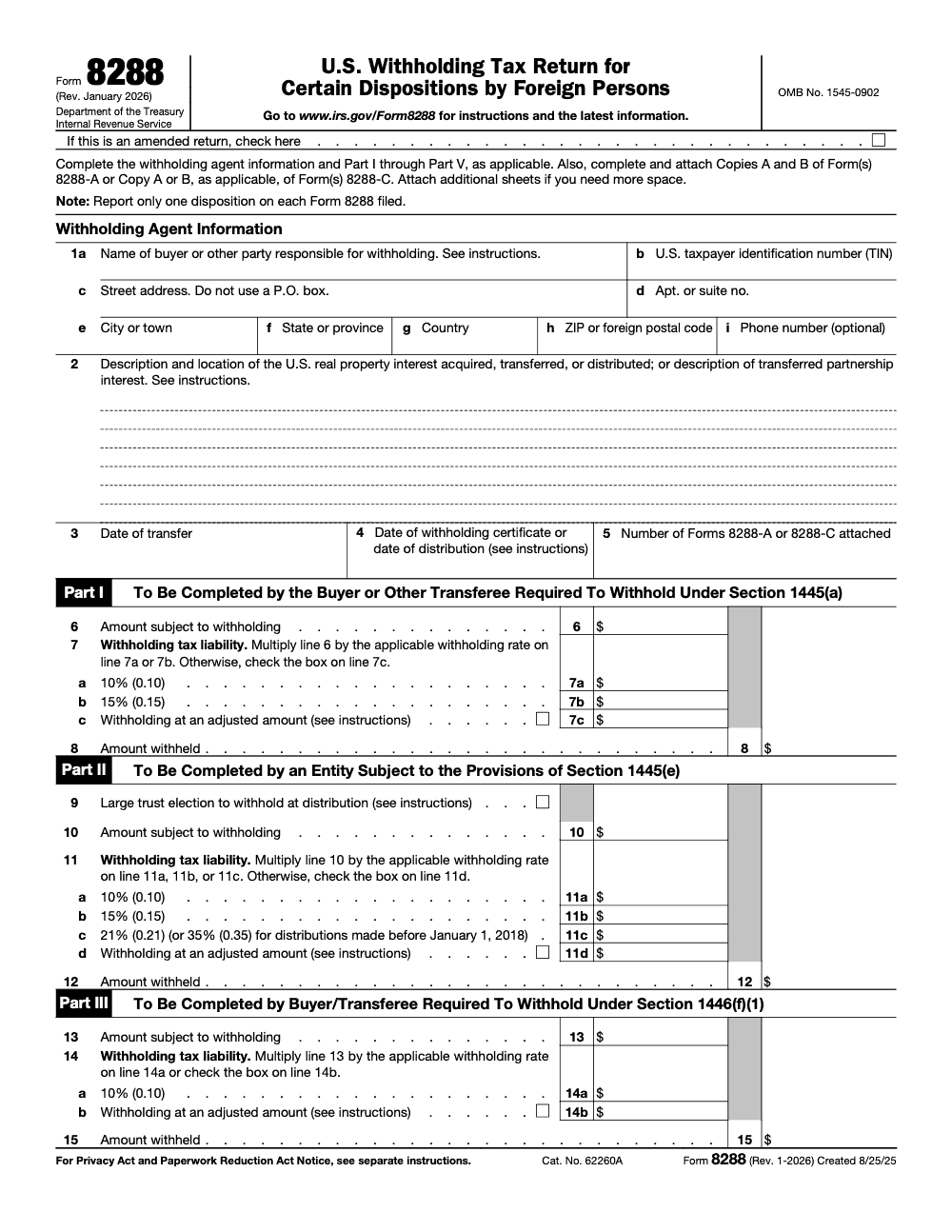
Form 8288 is the withholding agent's return for FIRPTA dispositions of U.S. real property interests under §1445 and for transfers of partnership interests by foreign persons under §1446(f) (per Treas. Reg. §1.1445-1 and §1.1446(f)-1). The default FIRPTA rate is 15% on line 7b; the reduced 10% rate on line 7a applies only when the amount realized falls between $300,001 and $1,000,000 AND the buyer intends to use the property as a residence, and the return is due within 20 days of the transfer date with Form 8288-A or 8288-C attached.
Picture a closing where the buyer is foreign property changing hands, the wire has cleared, and everyone wants to move on. The catch is the withholding return that has to follow, and the clock on it is short.
Form 8288 is the withholding agent's return for two situations: FIRPTA dispositions of U.S. real property under section 1445, and transfers of partnership interests by foreign persons under section 1446(f). It is due within 20 days of the transfer, the default FIRPTA rate is 15% of the amount realized, and partnership-interest withholding under 1446(f)(1) generally runs 10%. Filings and payment route to the IRS Ogden Service Center at P.O. Box 409101, and a late or missing return becomes personal liability for the agent.
Key Takeaways
- Form 8288 is the withholding agent’s return for two buckets of deals, FIRPTA under §1445 for U.S. real property interests, and §1446(f) for transfers of non‑publicly traded partnership interests. You file it, and you transmit the tax.
- The clock is fast. You must file and pay within 20 days of the transfer, or for §1446(f)(4) when a partnership withholds because a transferee failed to do so.
- Withholding rates differ by regime. FIRPTA is generally 15% of the amount realized, while §1446(f)(1) is generally 10% of the amount realized on partnership interest transfers.
- Use the right attachments. Form 8288‑A supports FIRPTA remittances. Form 8288‑C supports §1446(f) transactions. Form 8288‑B is the application for a withholding certificate that can reduce or eliminate FIRPTA withholding.
- Mail filings and payments to the IRS Ogden Service Center, P.O. Box 409101, Ogden, UT 84409, or pay electronically via EFTPS if available for your situation. Late or missing filings create personal liability for the withholding agent (in real estate closings the buyer is the withholding agent, not the seller, and the IRS pursues the buyer personally for the full amount that should have been withheld plus interest and penalties).
What Form 8288 Covers, In Plain English
Form 8288 is the return you, the withholding agent, file when a foreign person disposes of a U.S. real property interest, or when there is a qualifying transfer of a non‑publicly traded partnership interest and any portion of the gain would be effectively connected with a U.S. trade or business. It is the IRS’s way of making sure the required tax is withheld and paid on time. The same core form covers both regimes, then you attach the statement that fits the transaction.
- For FIRPTA under §1445, you generally withhold 15% of the amount realized and attach Forms 8288‑A. This applies to sales, exchanges, and many other dispositions of a U.S. real property interest by a foreign seller.
- For §1446(f)(1), you generally withhold 10% of the amount realized when a foreign person transfers a non‑PTP partnership interest that has ECI exposure. If a transferee fails to withhold, the partnership must withhold under §1446(f)(4) and file using Form 8288 with Form 8288‑C.
The 20‑Day Rule, Do Not Miss It
The deadline is tight. A transferee must file Form 8288 and transmit the tax by the 20th day after the date of transfer. If a withholding certificate application is pending, you still withhold on the transfer date, but you may delay filing and remitting until the 20th day after the IRS mails the approval or denial. If the certificate only reduces, rather than eliminates, withholding, you still must file and pay by that extended 20‑day rule.
Tip: Use a single calendar tracker that starts on the transfer date, collects IDs and amounts for every foreign transferor, and locks the mail‑by date. This one discipline prevents most penalties.
For §1446(f)(4) backup withholding by a partnership, you apply the same 20‑day timing from the triggering distribution to the transferee who failed to withhold.
Amount Realized, What Goes In and What Stays Out
Your withholding base is the “amount realized.” Add the cash paid, the fair market value of any property transferred, and any liabilities you assume or that the property is subject to at transfer. Exclude purchaser‑side financing that is not assumed and liabilities that do not move with the property. Allocate among multiple sellers based on capital contributions so you only withhold on the foreign portion.
Two common pitfalls I see:
- Forgetting to include liabilities attached to the property, which undercuts the withholding and creates exposure.
- Splitting a deal among several sellers, then failing to allocate the amount realized correctly between U.S. and foreign transferors. The IRS instructions outline how to credit among foreign transferors if they do not agree by the 10th day.
Rates and Special Cases You Should Know
- Standard FIRPTA rate, 15% of amount realized, applies to most property dispositions.
- Residence exception, no withholding if the buyer is an individual, intends to use the property as a residence for at least 50% of the days the property is used during each of the first two 12-month periods after closing, and the amount realized is not more than $300,000. A middle band often applies a 10% rate for qualifying residences when the amount realized is more than $300,000 but not over $1,000,000. Amounts above $1,000,000 generally revert to 15%. Check current IRS guidance and your facts.
- Corporate distributions can trigger different rules, including 21% withholding on recognized gain by a foreign corporation.
- §1446(f)(1) partnership transfers generally use a 10% rate on the amount realized, and §1446(f)(4) shifts liability to the partnership if the transferee fails to withhold.
I will show you how each form fits these situations next, with a simple table you can reuse in your closing checklist.
Which Form When, A Quick Map You Can Trust
| Form | Used for | Who attaches it to Form 8288 | When it matters |
| 8288 | The return that transmits withholding to IRS for §1445 and §1446(f) transactions | Withholding agent, usually the buyer or transferee, or the partnership under §1446(f)(4) | Always, unless an approved certificate fully excuses withholding |
| 8288‑A | Statement for FIRPTA withholding on U.S. real property interests | Attach Copies A and B with Form 8288 for each foreign person subject to withholding | IRS later stamps Copy B and sends it to the transferor to claim credit or refund |
| 8288‑B | Application for FIRPTA withholding certificate to reduce or eliminate withholding | Filed by transferor or transferee before or around closing, not attached to 8288, it is a separate application | Can defer 8288 filing until 20 days after IRS mails determination, but you still withhold at transfer unless excused |
| 8288‑C | Statement for §1446(f) withholding on transfers of non‑PTP partnership interests or partnership backup withholding | Attach Copy A of 8288‑C to 8288 for §1446(f), partnership sends Copy B to transferee | Documents 10% withholding on amount realized or partnership backup withholding timing |
Citations: IRS, About Form 8288, About Form 8288‑A, About Form 8288‑B, About Form 8288‑C, and the 01/2026 Instructions.
How to Calculate Withholding, Step by Step
For FIRPTA, §1445
- Confirm foreign status for each transferor, collect TINs or proceed without if unavailable, you still must file.
- Compute the amount realized, cash, plus fair market value of other property, plus liabilities assumed.
- Check residence exceptions. If buyer is an individual and intends to use the property as a residence for at least 50% of the days used during each of the first two 12-month periods after closing, and amount realized is not more than $300,000, no withholding. If more than $300,000 and not over $1,000,000, consider the 10% rate band if facts fit. Otherwise use 15%. Document the residency test in the file.
- If tax due would be less than statutory withholding, consider a withholding certificate via Form 8288‑B. The IRS typically acts within about 90 days after a complete application, and special timing rules apply to when you must send in Form 8288.
- Prepare Form 8288 and Forms 8288‑A for each foreign seller, attach Copies A and B, and file with payment within 20 days of the transfer, unless an approved certificate fully excuses withholding.
For §1446(f) Partnership Interest Transfers
- Confirm it is a non‑PTP interest and whether any gain would be ECI under §864(c)(8).
- Compute the amount realized and withhold 10%, unless an exception applies under the §1446(f)(1) rules and instructions.
- File Form 8288 with Form 8288‑C within 20 days of the transfer. If the transferee failed to withhold, the partnership withholds from distributions to that transferee under §1446(f)(4) and files 8288 with 8288‑C on the same 20‑day clock from the backup withholding distribution.
Where to File and How to Pay
Mail Form 8288, required 8288‑A or 8288‑C attachments, and payment to: Internal Revenue Service, Ogden Service Center, P.O. Box 409101, Ogden, UT 84409. This is the current IRS FIRPTA processing address, and it applies across the Form 8288 series.
The IRS also highlights using the Electronic Federal Tax Payment System for certain payments. If EFTPS suits your controls, plan your authorization and payment scheduling so funds clear by the 20th day deadline. Keep proof of payment with the file.
Pro move: add a same‑day “mail checklist” in your workflow, confirming the correct P.O. Box, the check or EFTPS confirmation, Copies A and B of 8288‑A, or Copy A of 8288‑C, and a copy set for your records.
Real‑World Gotchas We See Often
- Mixing up forms. Form 8288‑B is the withholding certificate application, not a transaction statement, and Form 8288‑C is the §1446(f) statement, not a certificate. Treat them very differently.
- Waiting on a certificate and assuming you do not need to withhold at closing. You must still withhold on the transfer date unless the certificate fully excuses withholding. Filing and payment timing can shift, the withholding requirement does not.
- Missing the residence exception documentation. If the buyer plans to live there and the price is at or under $300,000, you may have no FIRPTA withholding, but you need clear, signed statements to support it.
- Understating amount realized by missing liabilities attached to the property. Reconcile payoffs and liens before you compute withholding.
A quick note on process. If you run a multi‑entity firm with seasonal spikes, your biggest risk is not knowing which desk owns each deadline. A lightweight tracker, even a shared sheet tied to your practice system, saves deals and sleep.
Filing Timeline, Attachments, Corrections, and Refunds
Timeline You Can Count On
- Day 0, the transfer closes. Withhold required amounts.
- By Day 20, file Form 8288 with the correct attachments and pay the tax. Use the Ogden address or EFTPS where appropriate.
- If a withholding certificate was filed, and the IRS later approves or denies it, you generally have until the 20th day after the IRS mails that determination to file and remit. If the application’s main purpose was delay, interest and penalties can still apply.
What to Attach
- FIRPTA deals, attach Form 8288‑A Copies A and B for each foreign transferor. The IRS will stamp Copy B and mail it to the transferor, who uses it to claim credit or a refund (only the IRS-stamped Copy B supports the credit on the seller's U.S. return; closing documents or unstamped copies will not be accepted). Keep Copy C for your records.
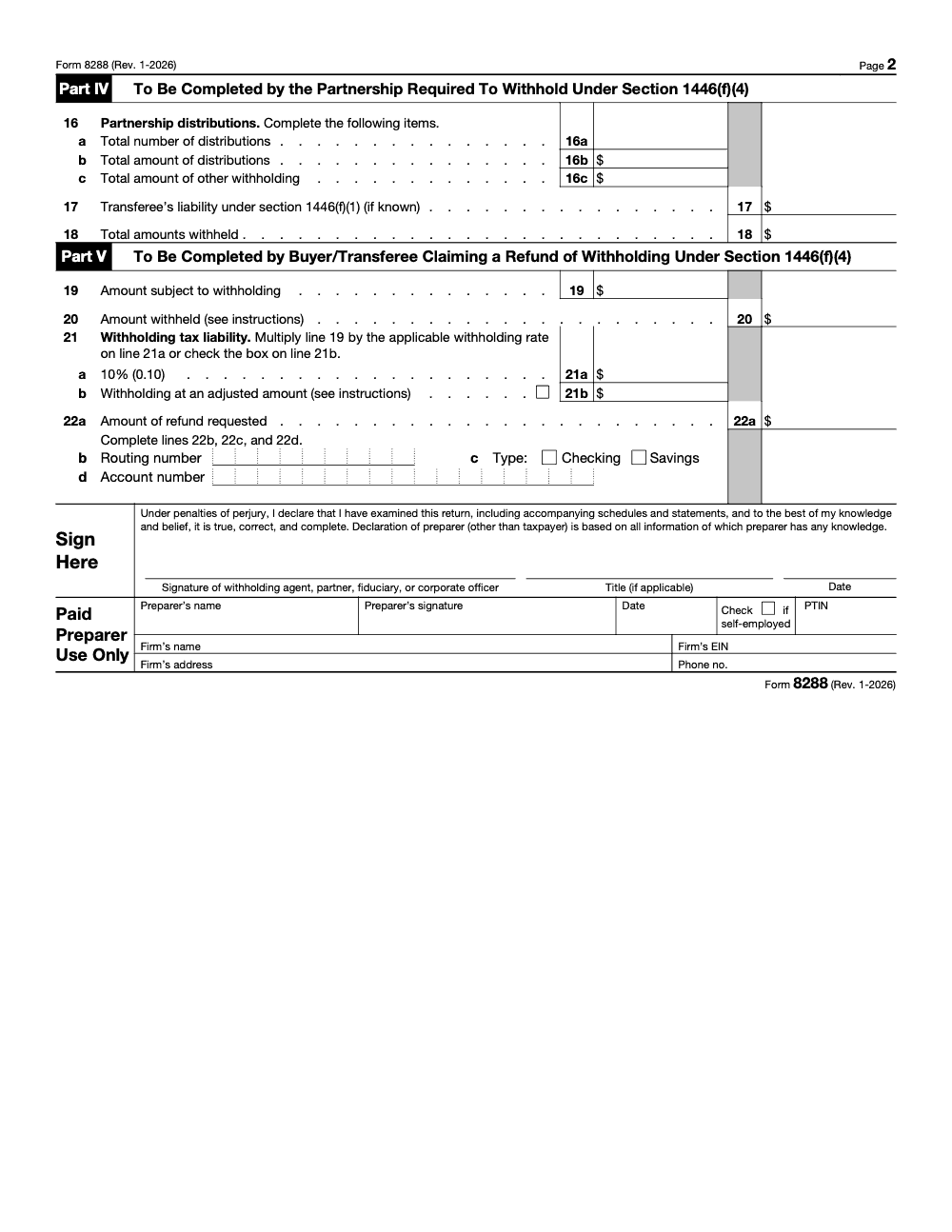
- §1446(f) deals, attach Form 8288‑C Copy A, and send Copy B to the transferee. Partnerships filing backup withholding under §1446(f)(4) complete Part IV with one 8288‑C per distribution per transferee.
Correcting Errors
If you discover an error, file an amended, or “corrected,” Form 8288 as soon as possible and attach corrected statements (check the amended-return box at the top of the form, there is no separate Form 8288-X). The instructions explain amendments and include relief provisions for certain late certifications or notices under Rev. Proc. 2008‑27, when you can show reasonable cause. Send those to Ogden with the proper header statement.
If withholding exceeded the tax, the foreign transferor can claim a refund on a U.S. return, often using the stamped 8288‑A Copy B as supporting credit. For §1446(f) situations, review the refund lines in the current instructions for where a transferee may request excess amounts back.
Withholding Certificates, When They Help and How to Request One
A withholding certificate can reduce or eliminate FIRPTA withholding when the statutory percentage would exceed the seller’s maximum U.S. tax. Either party can apply, often the closing agent or buyer when they want to simplify remittance. Applications use Form 8288‑B, and the IRS generally acts within about 90 days after receiving a complete package. Timing rules for filing and payment change when a certificate is pending, but do not assume that means no withholding at closing.
Practical tips from the field:
- Do not wait for an ITIN to get started. If the seller lacks an SSN and needs an ITIN to file the 8288‑B, the IRS allows attaching Form W‑7 with 8288‑B and sending both to the Austin ITIN Operation. This is common in real estate closings.
- Use Box 5 on 8288‑B to direct IRS correspondence to escrow when the seller is overseas, so the approval or denial gets to the table fast.
Compliance Guardrails You Should Not Skip
- Keep your workflow visible. Use a tracker that shows who owns TIN collection, who computes amount realized, who prepares 8288, who signs, who mails, and when funds clear.
- Standardize naming for files and workpapers. You want to see property address, transfer date, parties, and amounts in the first screen.
- Calendar the 20‑day clock, plus a back‑up task five days earlier to confirm signatures, attachments, and payments.
- For corporate or trust distributions, confirm whether specialized 21% or other rates apply, and whether Chapter 3 withholding also applies. Cross‑check the current IRS instructions or Publication 515 before you finalize.
Reminder: This is a tax compliance topic. Use official IRS sources for rates, addresses, and timing. The citations in this guide point to pages reviewed or updated in late 2025, which is why you can rely on them for filings you handle now.
Where Accountably Fits, Briefly
If you run a CPA or EA firm and your team is buried in production, the weakest link is usually review, not sales. In our experience building disciplined offshore delivery for firms, the only way to hit the 20‑day clock every time is to standardize workpapers, enforce checklists, and give partners a clean, layered review pack so they can sign off quickly. That is the delivery structure Accountably helps implement, with teams trained on U.S. FIRPTA, 8288‑A credit flows, and §1446(f) statements, all inside your systems. Use us only if you want capacity without chaos.
Note, this section is for firms that asked how to operationalize. If you only needed the filing rules, you are good to go with the steps above.
Practical Checklist You Can Copy
- Confirm foreign status and collect TINs, or note that you will file without if unavailable.
- Compute amount realized, include liabilities assumed, and allocate among sellers.
- Apply the correct rate, 15% for most FIRPTA, residence exceptions at 0% or 10% when facts fit, 21% for certain corporate distributions, and 10% for §1446(f)(1).
- Decide on a withholding certificate via 8288‑B when statutory withholding exceeds expected tax. Track the “20 days after IRS mails decision” rule.
- File Form 8288 with the right attachments and pay by Day 20. Use the Ogden address, P.O. Box 409101, Ogden, UT 84409, or EFTPS where applicable.
- If you find an error, file an amended return quickly and include corrected statements. Consider reasonable cause relief where allowed.
Final Word and Compliance Note
You now have a complete, practical path to file Form 8288 with confidence, hit the 20‑day deadline, and avoid painful penalties. If your team is stretched thin during peak season, tighten your process with a one‑page checklist, standard file names, and a shared tracker. If you want a disciplined offshore unit that works inside your systems and cuts review time, our team at Accountably can help with trained support for FIRPTA and §1446(f) packages. Keep your focus on the client, and let the workflow do the heavy lifting.
Common Mistakes We See Every Season
The recurring Form 8288 errors are not arithmetic, they are framing errors. Buyers, escrow agents, and seasoned preparers carry stale assumptions from the pre-2016 FIRPTA era and from Form 1042 withholding logic that do not apply on a §1445 or §1446(f) return.
Reusable Checklists
These checklists are copy-paste ready for firm SOPs. Drop each block into your engagement file or workflow tool, work the items in order, and you have an auditable trail per disposition.
Pre-Closing FIRPTA Packet (Buyer-Side)
- Confirm the seller's status: foreign person Y/N, documented by passport, visa, or a non-foreign affidavit signed under penalties of perjury with a U.S. TIN.
- If the buyer is foreign, file Form W-7 (ITIN) or Form SS-4 (EIN) before the closing date to satisfy the line 1b TIN requirement.
- Determine the applicable rate: 15% default on line 7b, 10% on line 7a only if amount realized is between $300,001 and $1,000,000 AND a documented residence-use intent exists.
- Decide whether to apply for a Form 8288-B withholding certificate before the transfer date; if yes, instruct the buyer to still hold gross 15% in escrow until the IRS acts.
- Build the amount-realized worksheet: cash plus fair market value of any non-cash consideration plus all liabilities the buyer assumes or to which the property remains subject.
- Identify the withholding agent's signer (buyer, partner, fiduciary, or corporate officer) authorized to sign under penalties of perjury.
- Confirm a physical street address on line 1c; P.O. boxes are not allowed on Form 8288.
Amount Realized and Withholding Calculation
- Enter cash and cash equivalents paid by the buyer at closing.
- Add the fair market value of any property the buyer transferred as part of the deal.
- Add all liabilities the buyer assumes and all liabilities to which the property remains subject; do not net the assumed mortgage out of the sale price.
- Total the three components; this is the amount realized for line 6.
- Apply the correct rate on line 7: 15% on 7b as default, 10% on 7a for qualifying personal-residence sales between $300,001 and $1,000,000, or the IRS-adjusted amount on 7c if a withholding certificate has been issued.
- Cross-check the line 7 result against the funds actually withheld at closing on line 8; investigate any variance before filing.
- For §1446(f)(1) partnership-interest transfers, repeat on lines 13 to 15 at the 10% rate and attach Form 8288-C instead of Form 8288-A.
20-Day Filing and Remittance Handoff
- Pull the date of transfer from line 3 and calculate the 20-day deadline; mark it on the closing file and in the firm's deadline tracker.
- Attach Forms 8288-A Copies A and B for FIRPTA dispositions, or Form 8288-C Copy A or B for §1446(f) transfers.
- File one Form 8288 per disposition; never bundle multiple closings on a single return.
- Sign the return under penalties of perjury; paid preparers include a PTIN in the preparer block.
- Remit the withheld tax with the return by check, money order, or EFTPS; no separate semi-weekly or monthly deposit cycle applies to FIRPTA withholding.
- Mail to the IRS service center at P.O. Box 409101, Ogden, UT 84409 per the current Form 8288 instructions; verify the address against the latest revision before sending.
- Log the stamping cycle for Form 8288-A Copy B; the foreign transferor needs the IRS-stamped copy to claim credit on Form 1040-NR or 1120-F.
- If amending, file a new Form 8288 with the amended-return box checked at the top; there is no separate Form 8288-X.
Keep 8288 Season From Stalling
Form 8288 is transaction-driven, not seasonal. The 20-day clock starts the moment a foreign person closes on a U.S. real property interest under IRC §1445(a) or transfers a partnership interest under §1446(f)(1). The Foreign Investment in Real Property Tax Act of 1980 (per Public Law 96-499) makes the buyer the withholding agent and personally liable if the 15% is not captured at closing, which is why title companies and escrow agents bake FIRPTA certifications into every closing involving a foreign seller.
What stalls 8288 season is not the math, it is the workflow chaos around the math. Bundling closings on a single Form 8288 is barred by the one-per-disposition rule, the failure-to-file minimum is $510 for returns due in calendar year 2025 (per Rev. Proc. 2024-40) before the 5%-per-month addition under IRC §6651(a)(1) kicks in, and the buyer often has to obtain a U.S. TIN before the form can even be drafted. When closings cluster, the firm ends up firefighting TIN logistics, amount-realized review, and 8288-A stamping all at once.
- Treat every foreign-seller closing as a controlled file with its own 20-day clock; the deadline does not move because a buyer obtained their ITIN late.
- Compute amount realized on line 6 using the full economics (cash plus fair market value of non-cash consideration plus all assumed and remaining liabilities) and apply 15% on line 7b by default, with the 10% rate on line 7a only when the residence-use and $300,001 to $1,000,000 conditions are both documented.
- Run the Form 8288-B path only when the application is filed on or before the transfer date; the certificate defers remittance, but the buyer still has to withhold the 15% and hold it in escrow until the IRS acts (generally within 90 days per Treas. Reg. §1.1445-3).
- For §1446(f)(1) transfers, use Form 8288-C and watch the partnership backstop under §1446(f)(4) when the transferee misses the 10% withholding on the amount realized.
- Track the 8288-A stamping cycle from filing through return; the foreign seller cannot claim credit on Form 1040-NR or Form 1120-F without the IRS-stamped Copy B in hand.
Accountably's U.S.-led tax delivery handles each Form 8288 as a controlled file with documented amount-realized worksheets, TIN-readiness checks before closing, and a 20-day clock that sits inside the workflow rather than someone's inbox.
FAQs
Form 8288 is the withholding agent’s return that reports and remits tax for FIRPTA dispositions of U.S. real property interests and for certain §1446(f) transfers of non‑PTP partnership interests. You attach 8288‑A for FIRPTA or 8288‑C for §1446(f), and you file within 20 days of the transfer.
Yes, the IRS highlights using EFTPS to submit payments. Coordinate enrollment, payment scheduling, and confirmation so funds are credited by the 20th day. Keep proof with your file.
Form 8300 is separate. Any person in a trade or business that receives more than $10,000 in cash in one or related transactions must file Form 8300, generally within 15 days. Starting January 1, 2024, many businesses must e‑file it if they meet the 10‑return threshold for information returns. This is unrelated to Form 8288 filings.
Non‑U.S. persons provide W‑8s to the payer or withholding agent, not the IRS, to document foreign status and, if applicable, treaty benefits. Individuals use W‑8BEN. Entities use W‑8BEN‑E. These forms are common in cross‑border payments but are not substitutes for FIRPTA or §1446(f) documentation.
If the transferee does not withhold, the partnership must withhold from future distributions to that transferee under §1446(f)(4) and file Form 8288 with 8288‑C within 20 days of the backup withholding distribution.
Other forms this guide names
- Form 8288-A: FIRPTA and 1446(f) Withholding Credit
- Form 8288-C: Partnership Backstop Withholding Guide
- Form 8288‑B: Reduce FIRPTA Withholding
- Form 1040‑NR: Filing 2025, Nonresident Taxes Made Simple
- Form 1120‑F: Guide, Filing, Deadlines, Protective Return
- Form 1120-F: Schedule Q, QDD Filing Guide
Summarize this article with AI
About this guide
Accountably helps US CPA, EA, and accounting firms hire trained accountants and tax preparers in India.
About us Reviewed byJugal Thacker, CPAFounder and CEO at Accountably
A Washington-licensed CPA with 7+ years inside US firms – PwC, a real-estate tax practice, then a full-service firm, rising from reviewer to manager to advisory. This article was reviewed against current IRS guidance for the 2025 tax year and updated for filers preparing late returns, amendments, and 2026 estimates.
View profile →How we research, review, and update this guide
Every Accountably guide is researched against primary IRS sources, reviewed by a U.S. CPA, and refreshed as guidance evolves. Read our Editorial Guidelines to see how we source, fact-check, and update our content.