Summarize this article with AI
In Brief
Form 8828 reports the federal mortgage subsidy recapture tax owed when a taxpayer sells a home financed by tax-exempt bond proceeds or a Mortgage Credit Certificate within 9 years of closing (per IRC §143(m) and the Form 8828 instructions, Rev. November 2024). The tax caps at the smaller of 50% of the gain (line 14) or the line 22 computed amount, and the final number carries to Schedule 2 (Form 1040), line 17b.
A homeowner sells a few years after closing, never thinking about the bond-financed loan or the Mortgage Credit Certificate that made the purchase possible, and a recapture tax surfaces that nobody saw coming. Form 8828 is what calculates it whenever a federally subsidized home is sold within 9 years of closing.
Two limits keep the number in check. The tax caps at the smaller of 50% of the gain on line 14 or the line 22 computed amount, and mortgages originated on or before December 31, 1990 are not subject to recapture at all. Even when the result is zero, you still attach the form, and any tax carries to Schedule 2 (Form 1040), line 17b. The current instructions are Rev. November 2024.
Key Takeaways
- Use Form 8828 when you sell or dispose of a home financed with a federally subsidized mortgage, such as a tax‑exempt bond loan or an MCC, within nine years of the original closing.
- The form tells you if you owe recapture and caps the tax at 50% of your gain. If you have no gain or your income is below the threshold, your recapture can be zero, but you still attach the form.
- The form’s tax, if any, is reported on Schedule 2 (Form 1040), line 17b for the year of the sale.
- Mortgages originated on or before December 31, 1990 are not subject to recapture. The form itself highlights this cutoff date.
- Keep the written notice from your lender or bond issuer, it includes the subsidy amount, qualifying income, and other data you need to complete the calculation.
What Form 8828 Is and When It Applies
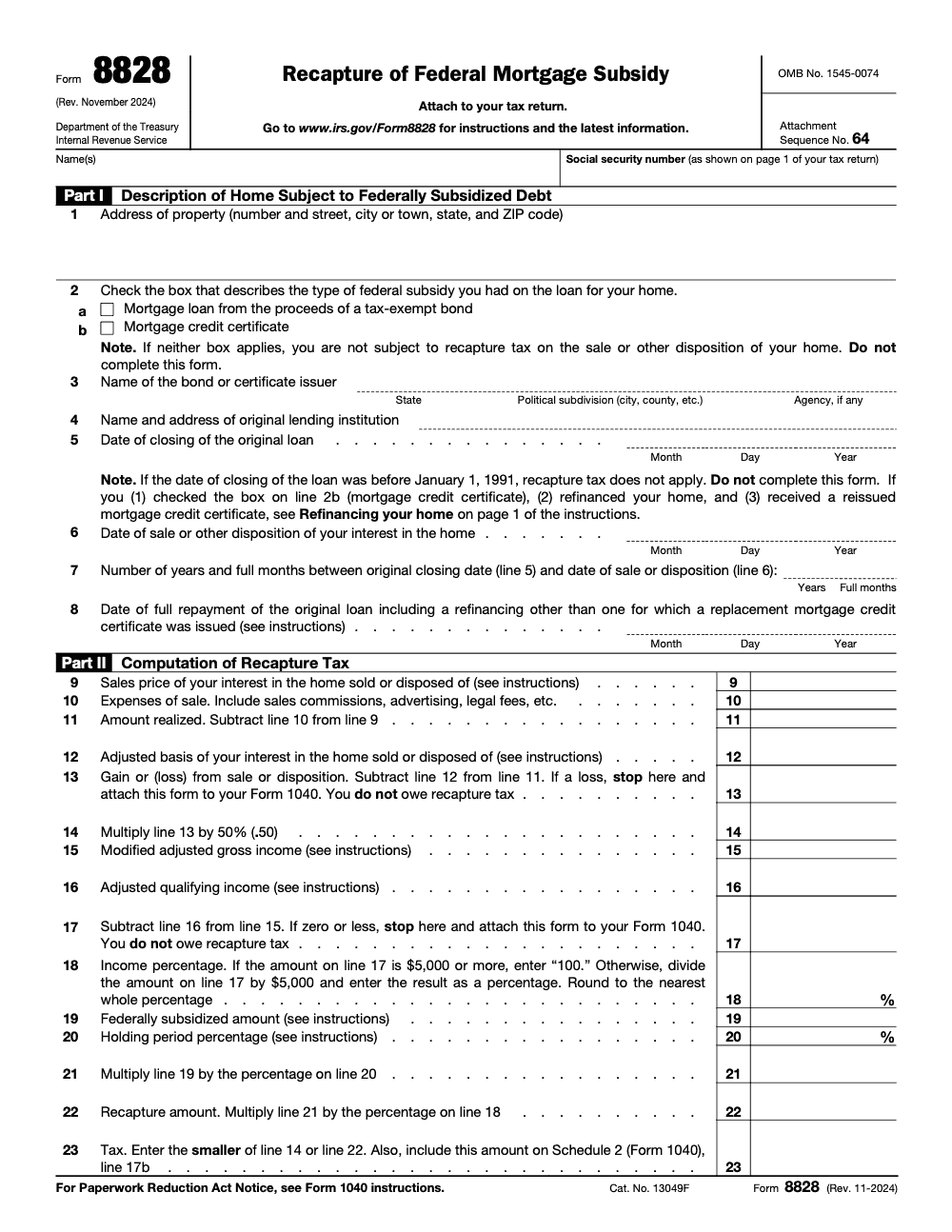
Form 8828 is the IRS form for calculating and reporting the recapture of a federal mortgage subsidy. You use it if your home was financed through either a qualified mortgage bond program with a below‑market rate or you held an MCC, and you sell or otherwise dispose of that home within nine years of the original closing date. The instructions confirm this trigger and explain that a refinancing by itself does not always cause recapture, but a later sale within the nine‑year window might, and for MCC holders a refinance without a reissued MCC is treated as a deemed disposition reported on line 8 that can trigger the recapture computation immediately.
Two common situations put you in Form 8828 territory (plain FHA, VA, or USDA loans do not count as a federal subsidy for these purposes, only tax‑exempt bond financing under IRC §143 or an MCC under IRC §25 does):
- You received a mortgage funded by tax‑exempt qualified mortgage bonds that lowered your interest rate.
- You received a Mortgage Credit Certificate with your mortgage that gave you a mortgage interest credit during the years you lived there.
You attach the completed Form 8828 to your individual return for the year you sold or disposed of the home. If the calculation results in tax, the amount on line 23 carries to Schedule 2, line 17b. The IRS’ current form shows those exact line references.
The Nine‑Year Window, In Plain English
Think of the nine‑year period as your recapture clock. If you sell or transfer the home during that window, you must run the calculation. If you sell after year nine, you are outside the recapture period and no Form 8828 is required. The instructions publish special rules if your home was destroyed and replaced, if you transferred the home in a divorce, or if multiple owners held title.
The 1990 Cutoff
The form notes that if your original loan closed before January 1, 1991, recapture does not apply. That is why older bond‑financed loans avoid Form 8828. The form’s Part I includes a clear note next to the closing date line to help you confirm this quickly.
Why This Matters To You
Missing Form 8828 when you sell a subsidized home can trigger an IRS notice and interest. Completing it correctly protects you, even when the outcome is zero. In our work with homeowners and firm partners, the most common issues are lost issuer notices, confusion about which income the form uses, and uncertainty about whether a refinancing changes the hold period. The IRS instruction booklet speaks to each of these, including a Holding Period Percentage Worksheet for people who repaid or refinanced early.
If you still hold an MCC while planning a sale, remember that MCC credits themselves are computed on a different form, Form 8396, during years you own the home. The recapture conversation begins only when you sell or dispose of the property within nine years. The IRS publishes both resources and ties them together.
Who Must File and The Main Exceptions
You must file Form 8828 if all three statements are true for the year you sold or otherwise disposed of the home.
- You sold or otherwise disposed of the home, whether or not you had a gain.
- Your original mortgage was provided after December 31, 1990.
- You received a federal mortgage subsidy through a bond‑funded loan or an MCC.
If all three fit your facts, attach Form 8828 to your tax return. The instructions plainly say to attach the form to your Form 1040, 1040‑SR, or 1040‑NR for that tax year. If your calculation shows a loss or your income is below the threshold, your recapture can be zero, and the form stops you from computing further tax, but you still attach it.
Common Exceptions Where No Form Is Required
- Your original loan closed on or before 12‑31‑1990.
- The home is sold after the nine‑year period ends.
- A transfer to a spouse or certain divorce transfers that create no recognized gain.
- The home was destroyed and you timely replaced it as your main home on the original site, subject to the disaster rules in the instructions.
Keep your issuer or lender’s written notice. The IRS instructions say you should have received a notice when your mortgage was provided, and that notice includes the data you need, such as the federally subsidized amount and the income figure used to set your threshold.
Step‑By‑Step, How To Complete Form 8828
Follow the form top to bottom. Here is a plain‑English walkthrough aligned to the current revision.
Part I, Description of Home
- Enter the property address that was subject to the subsidized debt, not your current mailing address if different.
- Check whether your subsidy came from a tax‑exempt bond loan or an MCC. If neither applies, the note on the form says you are not subject to recapture tax.
- Enter the issuer and the original lender.
- Enter the original closing date and the date you sold or otherwise disposed of the home. The form also captures years and months between those dates, which feeds the holding period percentage later.
Part II, Computation of Recapture Tax
- Lines 9 to 13 compute your gain or loss. If line 13 is a loss, stop, you do not owe recapture tax, but attach the form to your return.
- Line 14 multiplies your gain by 50%, which sets the hard cap on recapture.
- Lines 15 to 18 determine your income percentage. If your modified AGI does not exceed the adjusted qualifying income, your income percentage is zero, and there is no recapture; if MAGI exceeds the qualifying income by less than $5,000, the percentage phases in linearly between 0 and 100 rather than jumping straight to 100, so only part of the otherwise-computed recapture applies.
- Lines 19 to 21 multiply your federally subsidized amount by the holding period percentage.
- Line 22 applies your income percentage to that result.
- Line 23 takes the smaller of line 14 or line 22. If it is positive, that is your recapture tax and it goes to Schedule 2, line 17b.
A Simple Example
Say you have a 6‑year sale with a 30,000 gain. Line 14 caps potential recapture at 15,000. Your modified AGI is just 2,500 above the adjusted qualifying income, so your income percentage on line 18 is 50%. Your federally subsidized amount is 10,000, and your holding period percentage at year six is, for illustration, 60% using the worksheet in the instructions. Lines 19 to 21 give 6,000. Line 22 applies the 50% income percentage, giving 3,000. Line 23 is the smaller of 15,000 and 3,000, so your recapture is 3,000 and you report it on Schedule 2, line 17b. Use the actual holding period percentage from the IRS worksheet for your year and month.
Tip, if you refinanced within the first four years, the instructions tell you to adjust the holding period percentage as if the loan was fully repaid on the refinance date. That adjustment can materially change the result.
Filing Deadlines, Reporting, and Payment
You file Form 8828 with your individual return for the calendar year you sold or otherwise disposed of the home. File by your tax return due date, including extensions. The current form explicitly instructs you to include any recapture tax on Schedule 2, line 17b. If you extend, attach Form 8828 with your extended filing. If you cannot pay, still file on time and arrange a payment plan with the IRS to minimize additional charges.
Quick Reporting Map
| Action | When it happens | Where it appears |
| Determine if recapture applies | When you sell or otherwise dispose within 9 years | Form 8828 Part I |
| Compute gain, income and percentages | During tax prep for that year | Form 8828 Part II |
| Carry tax to the 1040 | With the return for that year | Schedule 2, line 17b |
| Keep records | Through at least the normal statute period | Issuer notice, worksheets, closing docs |
Source references, IRS Form 8828 and the 1040 Schedule 2 instructions.
Records You Should Keep
- The written notice from your lender or bond issuer that shows the federally subsidized amount and qualifying income.
- Your closing disclosure or settlement statement and proof of selling expenses.
- Basis records, including improvements.
- Any refinance closing statements, especially if a refinance occurred within the first four years. The instructions explain how this affects the holding period percentage.
Special Situations You Should Know
- Divorce transfers. Transfers between spouses or incident to divorce that do not create recognized gain do not trigger recapture. In those cases, you do not file Form 8828 for the transfer itself.
- Destruction by casualty. If your home is destroyed and you replace it as your main home on the original site within the time allowed, there is generally no recapture. Disaster area rules can extend the replacement period.
- Multiple owners. Each co‑owner generally computes any recapture separately based on their ownership share. The instructions give an example.
- Qualified rehabilitation loan and home improvement loan rules. Qualified rehabilitation loans can be subject to recapture, but qualified home improvement loans funded by bonds are not. The instruction booklet defines both.
Common Mistakes We See
- Skipping the form because there is no gain. The form itself tells you to stop the tax calculation if there is a loss, but you still attach the form to your return to document the result.
- Losing the issuer notice. That paper drives the adjusted qualifying income and the federally subsidized amount used on the form.
- Putting the tax on the wrong line. The form points you to Schedule 2, line 17b, under Other Taxes. The 1040 instructions confirm the line reference in 2024 and 2025 materials.
For CPA and EA Firms During Peak Season
If you have ever tried to push dozens of Form 8828 cases through in March and April, you know the bottlenecks, missing notices, and review churn. A disciplined delivery model helps. Standardize the workpaper naming for 8828, centralize issuer notices, pre‑compute holding period percentages with a shared worksheet, and add a review checklist that ties lines 14, 18, 21, and 23 together, so reviewers can scan accuracy in minutes.
Accountably works with firms that want structured, accountable offshore delivery without losing control of review. For forms like 8828, predictable turnaround and standardized workpapers reduce partner review time and deadline stress. If you need seasonal lift or a durable model, keep your brand and workflow, then add capacity that follows your SOPs. We keep mentions light here, but if you want help operationalizing this, our team can step in with a clean, documented process that fits your stack.
Practical Checklist You Can Use
- Confirm your original closing date and check whether it is after 12‑31‑1990.
- Confirm your subsidy type, bond‑funded loan or MCC.
- Gather the issuer notice and your sale documents.
- Compute gain or loss, then follow the lines on the form.
- Use the holding period worksheet from the instructions to get the right percentage for your year and month.
- Complete lines 14 through 23 carefully, then attach the form.
- If line 23 is positive, place that amount on Schedule 2, line 17b.
Common Mistakes We See Every Season
Form 8828 trips practitioners up because the rules are narrow but the assumptions around them are broad. The same five errors recur every season, almost always because the preparer treated a general home-sale rule as if it applied to a federally subsidized mortgage under IRC §143(m).
Reusable Checklists
These checklists are copy-paste ready for firm SOPs – drop them into your engagement template so the line-item logic runs the same way on every Form 8828.
Pre-Form 8828 Eligibility Scan
- Confirm the original mortgage closed on or after January 1, 1991 (line 5).
- Verify the loan was funded by tax-exempt bond proceeds (line 2a) or backed by a Mortgage Credit Certificate (line 2b); FHA, VA, and USDA loans do not qualify.
- Capture the bond or certificate issuer name on line 3 from the original closing package (state, political subdivision, or agency).
- Calculate years and full months between closing (line 5) and disposition (line 6); a period over 9 years removes the form from scope.
- If the client refinanced, ask whether a reissued MCC was attached to the refinance and document the answer at line 8.
- Pull the date of sale or disposition on line 6 from the closing disclosure or HUD-1.
- Confirm the SSN on the form matches page 1 of Form 1040.
Recapture Computation Walk-Through
- Enter sales price on line 9 from the closing statement.
- Enter expenses of sale on line 10 (commissions, advertising, legal fees).
- Compute amount realized on line 11 (line 9 minus line 10).
- Pull adjusted basis on line 12 from the basis worksheet, including capital improvements.
- Compute gain on line 13 (line 11 minus line 12); if a loss, stop and attach the form.
- Multiply gain by 0.50 on line 14 to set the statutory cap.
- Enter modified adjusted gross income on line 15 and adjusted qualifying income on line 16.
- Compute the excess on line 17 (line 15 minus line 16); if zero or less, stop and attach the form.
- Compute the line 18 income percentage: 100 if line 17 is $5,000 or more, otherwise divide line 17 by $5,000 and round to the nearest whole percent.
- Compute line 21 (line 19 federally subsidized amount times line 20 holding-period percentage), then line 22 (line 21 times the line 18 percentage).
- Tax on line 23 equals the smaller of line 14 or line 22.
Schedule 2 Carry-Forward Review
- Confirm line 23 of Form 8828 carries to Schedule 2 (Form 1040), line 17b – not Form 1040 line 16, not the Schedule 2 other-tax catch-all.
- Cross-check the recapture amount against tax software output before the return is signed.
- Attach Form 8828 to Form 1040 even when the result is $0 (loss on line 13 or zero on line 17).
- Retain bond issuer documentation, the MCC certificate, the basis worksheet, and the closing statement in the engagement file for IRC §143(m) audit support.
- Run the tax-year 2025 Schedule 2 totals through e-file validation before transmission.
Keep 8828 Season From Stalling
Form 8828 does not dominate any single filing month, yet every spring brings a small queue of clients selling a home that was originally financed through a state housing finance agency or a Mortgage Credit Certificate program. The math itself is short – a single page of line items – but the eligibility checks underneath it are narrow enough that a generic home-sale workpaper misses the trigger entirely.
Per the Form 8828 instructions (Rev. November 2024), the form applies only to tax-exempt bond financing or an MCC, only to closings on or after January 1, 1991, and only to dispositions inside the 9-year window. Three filters decide everything downstream. The fix is not more hours on each return; it is a documented intake step that surfaces the trigger before staff opens the form.
- Add a single intake question to your home-sale workpapers: was the original mortgage funded through a state housing finance agency, or did the client receive a Mortgage Credit Certificate?
- Pull the original HUD-1 or closing disclosure into the engagement file before staff begins line 1; the issuer name on line 3 lives there.
- Build the line 14 ceiling (50% of gain) and the line 22 computed amount as parallel calculations in the workpaper so reviewers see both caps without re-deriving them.
- Document the line 7 holding period in years and full months at intake; over 9 years closes the file with no further work.
- Keep a $5,000 phase-in note next to line 18 so preparers do not default to 0% or 100% when excess MAGI falls inside the band.
We run the Form 8828 path inside structured tax delivery with documented intake, a multi-layer review, and turnaround SLAs, so a one-off recapture return never stalls behind a stack of 1040s in late March.
FAQs
Yes, you still attach the form for the year of sale. The form’s Part II stops the calculation if line 13 shows a loss, which means no recapture tax, but you attach the completed form to your return to show why the tax is zero.
If your calculation on line 23 is positive, you enter that amount on Schedule 2, line 17b, then it rolls into your total tax for the year. The current form and the 1040 instructions both show this line.
A refinancing by itself does not always trigger recapture, but it can. If you later sell within nine years of the original closing, you may owe recapture, and if the refinance happened within the first four years, you must adjust your holding period percentage per the instructions. If you hold an MCC and refinance without a reissued MCC, the date you repay the original loan goes on line 8 and is treated as a deemed disposition for recapture purposes, while a reissued MCC carries the recapture exposure forward through the original nine‑year window.
Transfers to a spouse or certain transfers incident to divorce that do not recognize gain do not result in recapture and do not require filing Form 8828 for that transfer. Review Publication 504 if your transfer recognized gain or loss, since that changes the analysis.
If your home was destroyed and you replaced it as your main home on the original site within the allowed time, recapture generally does not apply. Disaster declarations can extend the replacement period.
Loans that closed on or before December 31, 1990 are outside the recapture rules. Also, qualifying home improvement loans funded by bonds are not subject to recapture.
Keep the lender or issuer’s written notice from origination, your settlement statements, basis records, and any refinance papers. The instructions specifically mention the notice and advise you to retain it.
During ownership years, you may claim the mortgage interest credit on Form 8396 if you have an MCC. Recapture becomes relevant only when you sell within the nine‑year window, at which point you use Form 8828.
Other forms this guide names
- Form 1040: Filing Guide for 2025 Returns (AGI, Deductions, Deadlines)
Summarize this article with AI
About this guide
Accountably helps US CPA, EA, and accounting firms hire trained accountants and tax preparers in India.
About us Reviewed byJugal Thacker, CPAFounder and CEO at Accountably
A Washington-licensed CPA with 7+ years inside US firms – PwC, a real-estate tax practice, then a full-service firm, rising from reviewer to manager to advisory. This article was reviewed against current IRS guidance for the 2025 tax year and updated for filers preparing late returns, amendments, and 2026 estimates.
View profile →How we research, review, and update this guide
Every Accountably guide is researched against primary IRS sources, reviewed by a U.S. CPA, and refreshed as guidance evolves. Read our Editorial Guidelines to see how we source, fact-check, and update our content.