Summarize this article with AI
In Brief
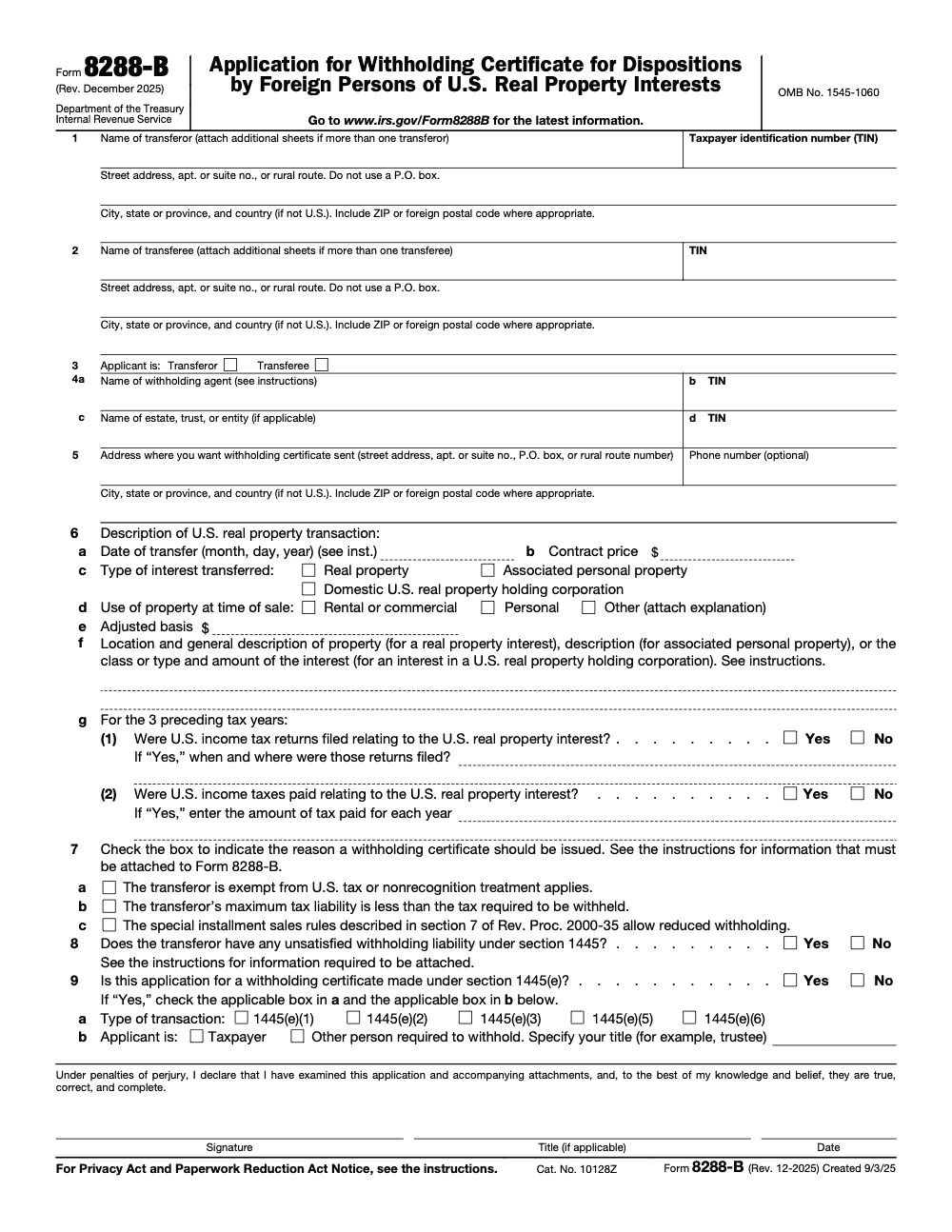
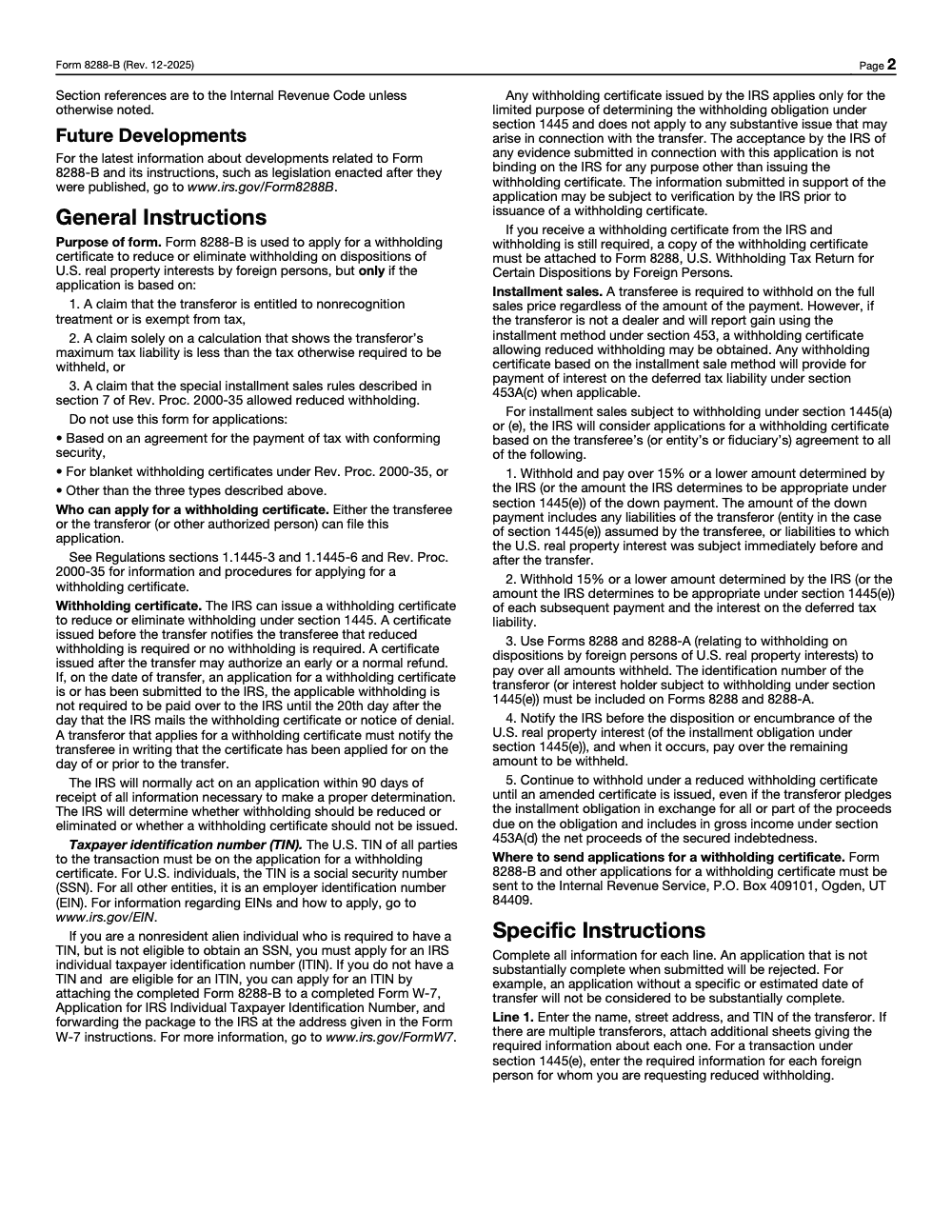
Form 8288-B is the IRS application for a FIRPTA withholding certificate – it lets a buyer or foreign seller cut the standard 15% holdback on a U.S. real property disposition under section 1445(a), per the Instructions for Form 8288-B (Rev. December 2025). The IRS normally acts within 90 days of a substantially complete packet, the buyer keeps the full 15% in escrow until 20 days after the IRS mails the certificate or notice of denial, and applications mail to Internal Revenue Service, P.O. Box 409101, Ogden, UT 84409 – attach a copy to Form 8288 when residual withholding is still due.
The standard FIRPTA holdback is a flat percentage of the sale price, not the actual tax on the gain, so a foreign seller with a thin profit can watch far too much cash sit in escrow. The line that fixes this is an application asking the IRS to right-size the number before anyone has to chase a refund.
Form 8288-B is that application for a withholding certificate, and it can cut the default 15 percent down to an amount that matches the seller's expected U.S. tax under section 1445(a). The IRS normally acts within about 90 days of a complete packet, so it pays to submit early and ask escrow to hold funds while the decision is pending. Mail the package to the FIRPTA unit at P.O. Box 409101 in Ogden, and if the seller has no TIN, attach Form W-7 so an ITIN can be assigned during processing.
Key Takeaways
- Form 8288-B is the application for a FIRPTA withholding certificate that can cut the default 15 percent withholding to a lower amount that better matches the seller’s expected U.S. tax.
- The IRS says it will normally act within about 90 days after receiving a complete application, so submit early and ask escrow to hold funds while you wait.
- The buyer is usually the withholding agent, and can be liable if the correct amount is not withheld or remitted on time.
- Mail Form 8288-B packages to the IRS FIRPTA unit at P.O. Box 409101, Ogden, UT 84409. Use tracked mail and keep copies.
- If the certificate is pending, the buyer withholds at closing, then waits to file Form 8288 and pay until the 20th day after the IRS mails the decision.
- If you do not have a U.S. TIN, you can attach Form W‑7 to your 8288-B package so the IRS can assign an ITIN during processing – mail the combined Form 8288-B + Form W‑7 packet to the address in the Form W‑7 instructions, not to the Ogden FIRPTA P.O. box.
What Form 8288-B Is, In Simple Terms
Form 8288-B is your formal request for a FIRPTA withholding certificate (the form covers only three permitted bases: nonrecognition or exemption, a maximum-tax calculation that comes in below the required withholding, or the special installment sales rules in section 7 of Rev. Proc. 2000-35; payment-agreement requests with conforming security and blanket withholding certificates use a separate letter procedure under Rev. Proc. 2000-35). When a foreign person sells a U.S. real property interest, the buyer must usually withhold 15 percent of the amount realized. That figure is often higher than the seller’s actual U.S. tax on the gain. A withholding certificate lets the IRS approve a lower, liability-based amount so cash is not over-withheld at closing.
When you apply, you include the purchase agreement, the property details, each party’s name and address, TINs or W‑7s, and a support packet that proves the expected U.S. tax is less than the default withholding. The IRS will normally act within about 90 days of receiving a complete application.
Think of Form 8288-B as a “right-size my withholding” request, grounded in math, documentation, and timing.
When To Use It
Use Form 8288-B when the default FIRPTA withholding overstates the seller’s likely U.S. tax. Common triggers include low gain or a loss, large basis from improvements, installment sale structures (where, absent an approved certificate, the buyer must still withhold 15 percent of the full contract price at closing rather than 15 percent of each installment payment as received), certain nonrecognition rules, or entity distributions where the calculated tax is lower than the default amount.
FIRPTA, The 90‑Second Primer
Here is the rule that drives everything. When a foreign person disposes of a U.S. real property interest, the buyer, also called the transferee, must withhold 15 percent of the amount realized. This requirement is statutory, and buyer liability is real if withholding is wrong or late.
- What is withheld: usually 15 percent of the gross amount realized, not the gain.
- Who withholds: typically the buyer, who files Form 8288 with 8288‑A and pays the withheld amount.
- Timing rule during a pending certificate: withhold at closing, then wait to file and pay until the 20th day after the IRS mails its decision.
- Address for filings and certificates: IRS, P.O. Box 409101, Ogden, UT 84409.
If you only remember one thing, remember this, you can reduce withholding before closing with a complete 8288-B package, you cannot skip withholding without IRS approval.
Do You Qualify For A Reduced Withholding Certificate
If the default withholding exceeds the seller’s expected U.S. tax, you likely qualify. The IRS looks for a credible gain calculation, support for basis and selling costs, and clear identification of the property and parties. Attach Form W‑7 if a seller needs an ITIN so the IRS can assign one during processing – when an ITIN is needed, mail the combined Form 8288-B + Form W‑7 package to the address in the Form W‑7 instructions, not to the Ogden FIRPTA P.O. box.
Quick Eligibility Scan
- Run a draft computation: sale price minus adjusted basis and selling costs, then apply the appropriate rates, for example capital gains for individuals, corporate rates for entities.
- Compare that tax to the default 15 percent withholding. If your tax is lower, you have a viable case.
- Check for special cases, for example Section 1445(e) distributions by entities, where withholding rules differ, and a certificate can still help align withholding with actual tax.
Fast Visual, What‑How‑Wow
- What: Form 8288‑B is the IRS application that can approve a lower FIRPTA withholding amount.
- How: File early with a full packet, ask escrow to hold the default amount, and wait for the IRS letter before remitting.
- Wow: Clean documentation often saves six figures of unnecessary cash drag on large deals, and it avoids refund waits that can stretch through the next filing season.
Note On Brand And Help
Accountably places trained offshore accountants and tax preparers inside CPA, EA, and accounting firms, ramped on the firm’s software and SOPs. If your firm juggles multiple 8288‑B files each peak season, those U.S.‑led teams can help standardize workpapers, manage SLAs, and keep escrow and filing dates on one visible track, without overusing staff hours. Mentioning this once here is enough, the rest of this guide stays focused on how you can execute.
Key Compliance Note
This guide is general information, not tax or legal advice. FIRPTA rules and IRS addresses here are current on January 27, 2026, always confirm before mailing.
Eligibility And The Documentation You Need
You qualify for a reduced withholding certificate when the default 15 percent holdback is higher than the seller’s expected U.S. tax on the gain. The IRS is looking for clean math and clean paperwork. If your numbers are credible and your packet is complete, your odds improve.
The fastest way to lose time is a thin packet. A tight packet with proof of basis, selling costs, and identity almost always moves quicker.
Eligibility Checklist You Can Run In Ten Minutes
- Estimate taxable gain, then estimate the U.S. tax. Compare that number to 15 percent of the contract price.
- Confirm each transferor’s status and identification, TIN or a ready-to-file Form W‑7.
- Check for special fact patterns, for example installment sales, entity distributions under Section 1445(e), or treaty positions that change the expected tax.
- Make sure escrow is willing to hold the statutory amount while the certificate is pending. Put that in writing in escrow instructions.
Required Supporting Documentation, What The IRS Expects To See
Build a packet that proves the expected tax is lower than default withholding. Include:
- Signed Form 8288‑B, legible and complete.
- Fully executed purchase agreement and all amendments.
- Property details, address, and a short description of the interest being transferred.
- Parties’ names, addresses, and TINs. If no TIN, attach Form W‑7 and ID evidence.
- Detailed tax computation, show adjusted basis, improvements, depreciation, and selling costs.
- Draft closing statement or settlement estimate that ties to your math.
- Form 2848 if a representative signs or communicates for the seller.
- Any special support, for example depreciation schedules, prior year returns, escrow letters, or legal opinions that explain a nonrecognition or treaty position.
- Note: blanket withholding certificate requests and payment-of-tax-with-conforming-security applications are NOT filed on Form 8288-B – per the Instructions for Form 8288-B, they follow a separate letter procedure under Rev. Proc. 2000-35. If you are pursuing one of those routes, prepare the security agreement and instrument (for example, an irrevocable letter of credit or surety bond covering maximum potential tax) for that separate filing, not for the Form 8288-B packet.
Pro tip, add a one‑page cover memo that walks the IRS reviewer through your packet, what you are asking for, and where each piece of evidence sits. It saves back‑and‑forth.
Documents To Include In Your 8288‑B Packet
Think like an auditor. Every claim should connect to a document. Keep it organized so a stranger could follow your story in five minutes.
- Form 8288‑B, complete, signed, and dated.
- Purchase agreement with amendments, showing price and target closing date.
- Identification, names and addresses for transferor and transferee, TINs or W‑7s, and a Form 2848 if an agent signs.
- Detailed computations, basis, improvements, depreciation, selling costs, and the resulting estimated tax.
- Escrow and closing agent details, as listed in Box 5, so the IRS knows where to direct the decision.
- If applicable, the security instrument for blanket requests, plus a short schedule listing covered transactions within the 12‑month window.
Organization Tips That Cut Review Time
- Use a simple index, label exhibits in the top-right corner, for example A, B, C.
- Put the computation on one page, then add backup pages.
- Reconcile numbers to the draft settlement statement so totals match.
- Sign everything that requires a signature, and date it.
- Include proof of mailing in your retained copy, not in the packet.
How To Complete Form 8288‑B, Step By Step
Here is a practical sequence you can follow. It mirrors how our team builds these packets during busy season.
- Gather required identifiers, names, addresses, TINs, or W‑7s for each transferor.
- Confirm the property description and interest being transferred, for example fee simple, membership interest in a U.S. real property holding corporation, or other U.S. real property interest.
- Enter the contract price, contract date, and target closing date.
- Complete Line 5 with the address where the IRS should send the withholding certificate, plus an optional phone number (Line 5 is the only address line where a P.O. box is allowed).
- Attach the purchase agreement, draft closing statement, and your one‑page tax computation with schedules behind it.
- Add Form 2848 if an authorized representative will talk to the IRS.
- Do not attempt to file blanket withholding certificate requests or payment-of-tax-with-conforming-security applications on Form 8288-B – per the Instructions for Form 8288-B, those follow a separate letter procedure under Rev. Proc. 2000-35.
- Review the entire packet for names, dates, math, and signatures.
- Make a full copy, then mail the original to the IRS FIRPTA unit using tracked mail.
Required Information Checklist
- Parties identified, transferor and transferee, with addresses and TINs or W‑7s.
- Property identified, address and a short description of the interest.
- Contract details, price and dates match your attachments.
- Estimated tax computation, clearly showing basis, improvements, depreciation, selling expenses, and rates applied.
- Escrow and closing agent information for correspondence.
- Signatures, Form 2848 if needed, and any prior filings you reference.
Submission Timing That Works In Real Life
Timing can make or break cash flow. File as soon as the contract is signed, ideally at least 90 days before closing. That window usually covers IRS review and gives escrow confidence to hold funds until a decision. If closing is sooner, you can still file and ask escrow to hold the default amount, then follow the IRS decision once it arrives.
- Populate every required field to avoid delays.
- Check that names and tax IDs match source documents.
- Use tracked mail and keep the receipt with your copy set.
- Confirm the current IRS address in the latest instructions before mailing, addresses can change.
- If the certificate is not issued by closing, keep the full statutory amount in escrow until the decision, then disburse per the letter.
Fast is good, complete is better. The IRS clock starts when a complete application lands on a reviewer’s desk.
Where To File And When To Send It
You will mail Form 8288‑B and all supporting documents to the IRS FIRPTA unit. As of January 27, 2026, the centralized address commonly used is in Ogden, Utah. Always double‑check the current mailing address in the latest IRS instructions before sending your packet, then use tracked mail. Keep a clean copy of everything you send, plus the mailing receipt, in your files.
- Send as soon as the property is under contract, the earlier the better, with a target of 90 days before closing.
- If you lack a TIN, include Form W‑7 and ID evidence with the same packet so processing can continue – when an ITIN is needed, mail the combined Form 8288-B + Form W‑7 package to the address in the Form W‑7 instructions, not to the Ogden FIRPTA unit.
- If a representative files on your behalf, attach Form 2848.
- If the certificate cannot be issued before closing, the buyer or escrow should hold the statutory amount until the decision letter arrives.
How Buyers And Escrow Fit In
The buyer is usually the withholding agent, so errors can create buyer liability. Coordinate early with the closing team. Give them a simple memo that explains you have filed Form 8288‑B, shows the escrow hold instruction, and tells them how to apply the final IRS decision. This helps everyone avoid last‑minute confusion.
Processing Times, Tracking, And Escrow Best Practices
In most seasons, a clean packet takes about 90 days to process. Incomplete applications, amendments, or blanket requests may take longer. Plan your escrow instructions around that timeline and make sure everyone on the deal knows the plan.
| Item | Action |
| Timing | Plan for about 90 days from receipt of a complete packet. Add time for amendments or blanket requests. |
| Escrow | Hold the default FIRPTA amount until a decision letter arrives. Do not release funds based on expectations. |
| Tracking | Keep full copies of everything you sent, mailing receipts, and all IRS correspondence. |
| Communication | Give the buyer and escrow a one‑page status update, including the date mailed and the expected window. |
Title and escrow teams appreciate clarity. A short, respectful status note every few weeks keeps money safe and nerves calm.
How To Calculate Tax For A Defensible Reduction
Your math has to stand up to a cold review. Build it from the ground up and tie it to documents.
- Start with the contract price.
- Subtract selling costs, for example commissions and transfer taxes.
- Determine adjusted basis, original purchase price plus capital improvements, minus depreciation if it was a rental.
- Compute taxable gain and apply the right rates. For individuals, consider long‑term capital gain rates and unrecaptured Section 1250 up to 25 percent for depreciation. For corporations, apply the corporate rate and consider whether the branch profits tax could apply.
- Reconcile your result to the draft closing statement and attach proof, for example improvement invoices and depreciation schedules.
- Show the comparison, the estimated tax versus 15 percent of the contract price, and state the reduced amount you are requesting.
A Simple Example
- Contract price 1,200,000.
- Selling costs 72,000.
- Adjusted basis 1,050,000 after accounting for improvements and prior depreciation.
- Gain 78,000.
- Estimated tax for an individual at long‑term capital rates, for example 15 percent on part and 20 percent on part depending on income, plus up to 25 percent on unrecaptured depreciation, results in an estimated tax around 13,000 to 18,000 in many common scenarios.
- Compare to default withholding 180,000.
- Request a certificate that sets withholding to the estimated tax with a small buffer, then explain the math and attach support.
Keep the example simple and the backup strong. A reviewer should be able to replicate your number with a calculator and your exhibits.
Quality Control, The Pre‑Mailing Scrub
Do one final pass before you mail.
- Names and addresses match on every form and attachment.
- TINs or W‑7s are included, and identification pages are legible.
- Signatures and dates are present where required.
- Numbers reconcile to the draft settlement statement.
- Exhibits are labeled and referenced in your cover memo.
- Proof of mailing materials are prepared, envelope, label, and tracking.
One clean packet beats three rushed supplements. Aim for quiet completeness, not speed alone.
If The Certificate Is Not Ready By Closing
Sometimes the calendar wins. If the IRS has not issued a decision by closing, treat the default withholding as due and protect everyone with clear escrow controls.
Escrow Withholding Procedures That Keep You Compliant
- Put the withholding on the closing statement and in escrow instructions. Spell out that funds stay put until the IRS decision arrives or the statutory timeline controls release.
- Keep a copy set in the escrow file, the mailed Form 8288‑B packet, the tracking receipt, and a short cover memo that explains why funds are held.
- If a reduced certificate later arrives, release only the excess to the seller. The buyer or escrow remits the certified amount right away.
- Use written indemnities or holdbacks to allocate the risk of extra withholding, penalties, and interest among buyer, seller, and escrow. Keep signatures on file.
Do not release based on hopes, promises, or emails. Release only on a signed IRS letter or a rule that clearly tells you what to do.
Post‑Closing IRS Responses And What To Do Next
- Approval at a lower amount. Disburse the difference to the seller and remit the approved amount within the timeframe shown. Keep the letter in the file.
- Request for more information. Respond quickly, usually within the window listed, and attach the requested exhibits in a clean, indexed packet.
- Denial. The buyer remits the default amount. The seller can still claim a refund on the U.S. return for the year of sale.
- No response within the expected window. Confirm the IRS received the package using your tracking, then call or write with your proof of mailing. Keep the funds in escrow until you have direction.
Real‑World Escrow Playbook
Title company teams and attorneys do better with instructions they can paste into their file. Use a plain memo with the following sections.
- Summary. We filed Form 8288‑B on [date]. Funds equal to 15 percent of the contract price are held in escrow pending the IRS decision.
- Contacts. List the transferor’s representative and the escrow officer with phone and email.
- Evidence. Attach the filing proof and certificate of mailing.
- Action on approval. Release excess funds to the seller and remit the approved amount to the IRS within the stated window.
- Action on denial or silence. Remit the default amount by the statutory deadline.
Keep the memo short and calm. Your goal is confidence, not drama.
Section 1445(e) For Entities And Distributions
FIRPTA does not stop at direct sales. Certain distributions by corporations, partnerships, trusts, and estates are treated as deemed dispositions of U.S. real property interests. That can put the withholding duty on the entity or on the distributee.
What To Check
- Party status. Collect W‑9s or W‑8s for owners and distributees so you know who is foreign.
- Withholding base. Compute the deemed gain that flows to the foreign distributee.
- Certificate option. If the calculated tax is lower than the default withholding, file Form 8288‑B to request a reduced amount.
- When unsure. Withhold to avoid entity‑level penalties and interest. Then use the return to reconcile.
Applying Without A U.S. TIN
A missing TIN does not have to delay your withholding certificate. Attach a completed Form W‑7 for each foreign seller with required identification so the IRS can assign an ITIN during 8288‑B processing.
W‑7 Package At A Glance
| Item | What It Proves | What To Include |
| Form W‑7 | Identity and foreign status | Complete and sign for each transferor |
| ID evidence | Identity | Passport or certified copy per W‑7 rules |
| Tie to tax purpose | Need for ITIN | Cover note that W‑7 is included to allow 8288‑B processing |
| Representation | Authority | Form 2848 if an agent submits |
Tips that save time
- Make sure names on W‑7, passport, and 8288‑B match exactly.
- Use certified copies where required, not scans.
- Include W‑7s in the same outer envelope as the 8288‑B packet so the reviewer sees the full picture – and route the combined package to the address in the Form W‑7 instructions, not to the Ogden FIRPTA P.O. box.
Blanket FIRPTA Certificates And Security Agreements
When multiple transfers will occur within a 12‑month window, a blanket withholding certificate can save cash and repetition. You estimate each transfer, then provide security that protects the government up to the maximum tax.
How To Build A Clean Blanket Packet
- Define scope. List covered properties or interests, timing window, and parties.
- Do the math. Provide an aggregate tax estimate with a schedule for each expected transfer.
- Provide security. File the security agreement and the instrument, for example an irrevocable letter of credit or a surety bond, enforceable in favor of the United States – note that blanket certificate and payment-of-tax-with-security requests are filed as a separate letter request under Rev. Proc. 2000-35, not on Form 8288-B itself.
- Operate the letter. Track draws, expirations, and conditions so no one misses a date.
- Keep the return filing. The seller still files a U.S. tax return to true‑up the final tax.
A Quick Word On Operations
If your firm handles many of these each season, standardize the packet. Use SOPs, named workpapers, and a two‑step review so numbers reconcile and signatures are never missed. A little discipline turns a stressful scramble into a steady routine.
After You Receive The Withholding Certificate
The letter is here, now put it to work. Close the loop with the buyer, escrow, and your files.
Immediate Next Steps
- Send a copy to the buyer or withholding agent and the closing team the same day. Confirm the exact amount or percentage shown.
- If the deal already closed with funds in escrow, disburse the excess to the seller and remit the approved amount to the IRS on the schedule in the letter.
- If the deal has not closed, instruct escrow to apply the certificate at closing and collect only the approved amount.
- File and tag the letter, your 8288‑B packet, and all mailing proofs in permanent records.
Match the remittance to the certificate exactly. Do not round or improvise. If the letter says a dollar amount, pay that dollar amount.
Keep Your Paper Trail Tight
Audits and refund claims move faster with clean records. Keep the following together.
- The IRS certificate and any follow‑up correspondence.
- The original 8288‑B packet and index.
- Proof of mailing and delivery.
- The final settlement statement and remittance proof.
- For blanket cases, the security agreement, instrument, draw records, and expiration diary.
Practical Examples You Can Model
Low Gain, High Basis Condo
- Facts. Nonresident sells for 750,000. Basis after improvements is 690,000. Selling costs are 45,000.
- Gain. 15,000.
- Default withholding. 112,500.
- Action. Apply for a certificate at the estimated tax on 15,000, attach improvement invoices, depreciation schedules if any, and the draft closing statement.
- Result. If approved, buyer remits the lower amount, cash stays in the deal at closing.
Corporate Seller, Potential Branch Profits Tax
- Facts. Foreign corporation sells a warehouse.
- Action. Compute corporate tax at corporate rates, evaluate whether branch profits tax could apply, and explain the calculation in a short memo.
- Result. Request a certificate that matches the higher of the corporate tax alone or corporate tax plus any branch profits exposure based on facts. Attach evidence and a clear schedule.
Blanket Certificate For A Portfolio Disposition
- Facts. Seller plans six sales over nine months.
- Action. File one 8288‑B with a security instrument covering the maximum potential liability, plus a schedule for each sale.
- Result. On approval, each buyer applies the blanket letter, and escrow holds only as needed.
Common Mistakes And Easy Fixes
Most 8288-B rejections cluster around the same handful of process slips. Spot them in your review checklist before mailing and the IRS rarely has a reason to stall the file.
Light Touch On Operations
One page of SOPs prevents most mistakes. Use a named folder set, a single computation template, a document index, and a two‑level review before mailing. That is often all you need.
Conclusion And Next Steps
You now have a practical, field‑tested path to reduce FIRPTA withholding with Form 8288‑B. Start early, compute the tax honestly, document every claim, and mail a complete packet. Keep escrow steady, communicate with buyers and title teams, and move funds only when the IRS tells you to.
If you lead an accounting or tax team and want a production system that handles dozens of these without late nights, standardize the workflow. Clear SOPs, structured workpapers, and scheduled reviews protect timelines and client cash flow. If you need outside capacity, a U.S.‑led offshore delivery partner like Accountably can plug into your tools, keep SLAs visible, and protect review time, but this guide gives you everything you need to execute in house.
Reusable Checklists
Drop these into your firm's SOP folder. Each list maps to a phase of the 8288-B workflow so the preparer, the reviewer, and the closing contact see the same milestones.
FIRPTA seller intake
- Confirm the seller's foreign-person status under section 1445.
- Capture the seller's U.S. TIN (SSN, ITIN, or EIN); queue a Form W-7 packet if no ITIN exists.
- Capture the buyer's U.S. TIN and Line 4 withholding agent details.
- Confirm contract price, date of transfer (an estimated date is acceptable), adjusted basis, and use of property for Line 6d.
- Identify which of the three Line 7 bases (7a exemption, 7b maximum tax, 7c Rev. Proc. 2000-35 installment) the application rests on.
- Pull prior-acquisition records to support Line 8 (prior Form 8288, nonforeign certificate, signed residence-use statement, or pre-1985 acquisition).
- Verify street addresses, not P.O. boxes, for the transferor and transferee.
- Run the section 1445(e) test if the seller is a partnership, REIT, foreign corporation, or fiduciary.
Packet assembly and review
- Complete every line on Form 8288-B, including a four-digit year on Line 6a.
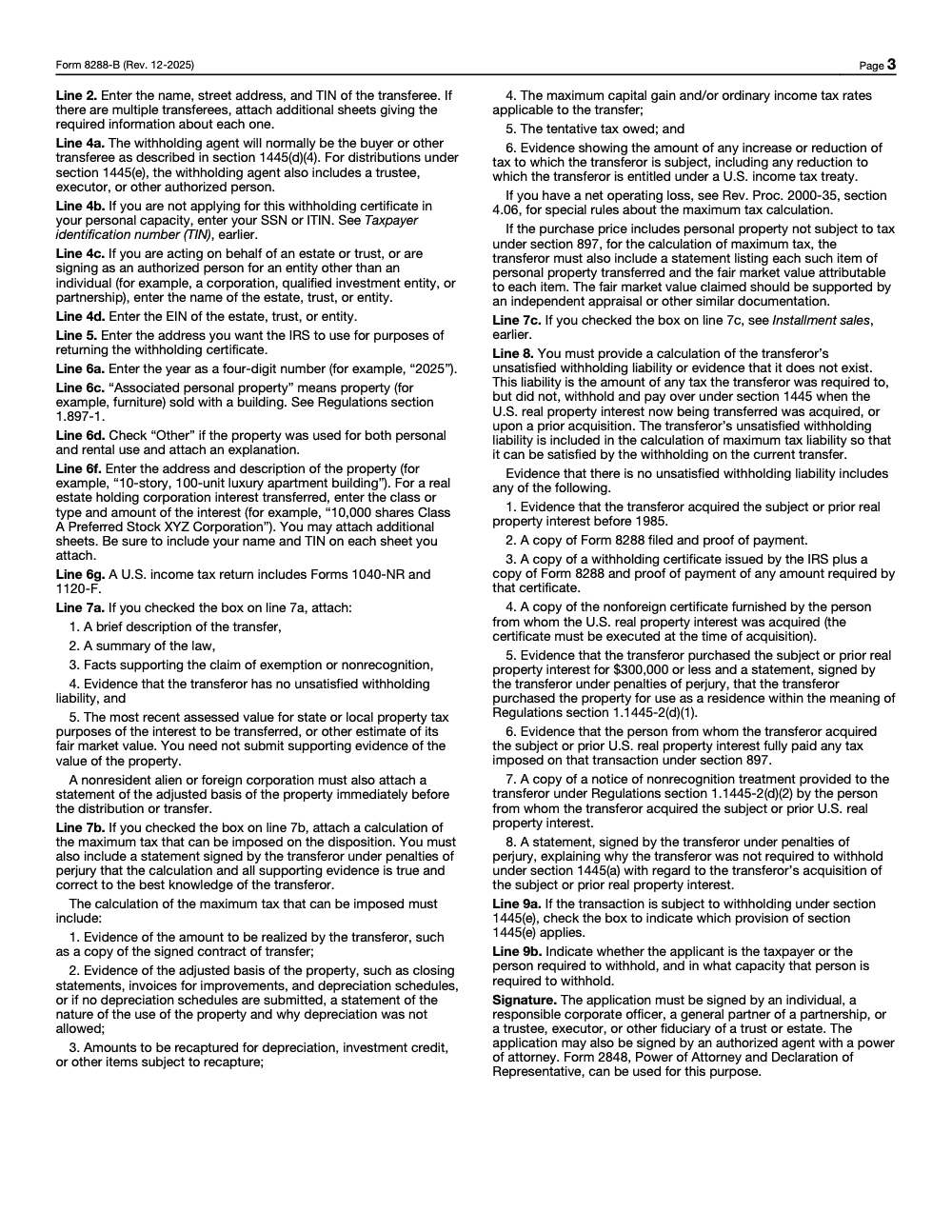
- For Line 7a: attach the brief description of transfer, summary of law, supporting facts, evidence of no unsatisfied withholding liability, and the most recent assessed FMV.
- For Line 7b: attach the six-item maximum-tax calculation (amount realized evidence, adjusted basis evidence, recapture, rates, tentative tax, treaty reductions) and the penalty-of-perjury statement.
- For Line 7c: attach the signed agreement to all five installment-sale conditions plus the proposed withholding schedule.
- Label the Line 8 evidence type clearly and staple it behind the form.
- Attach Form W-7 if the seller still needs an ITIN.
- Attach Form 2848 if an authorized agent is signing.
- Run a two-level (preparer plus senior) review sign-off on the workpaper before mailing.
Post-mail tracking and escrow release
- Mail the application to Internal Revenue Service, P.O. Box 409101, Ogden, UT 84409.
- Calendar the 90-day target from IRS receipt, not from the postmark date.
- Deliver the seller's written notice of application to the buyer on or before the transfer date.
- Confirm 15% of the contract price is parked in escrow at closing.
- Calendar the 20-day remittance window from the date the IRS mails the certificate or notice of denial.
- If the certificate is issued and residual withholding is still due, attach a copy of the certificate to Form 8288.
- File Form 8288 and Form 8288-A with the reduced withholding inside the 20-day window.
- Schedule the seller's year-of-sale U.S. return (Form 1040-NR or Form 1120-F) so the gain is reported and any over-withholding is recovered on the return.
Keep 8288-B Season From Stalling
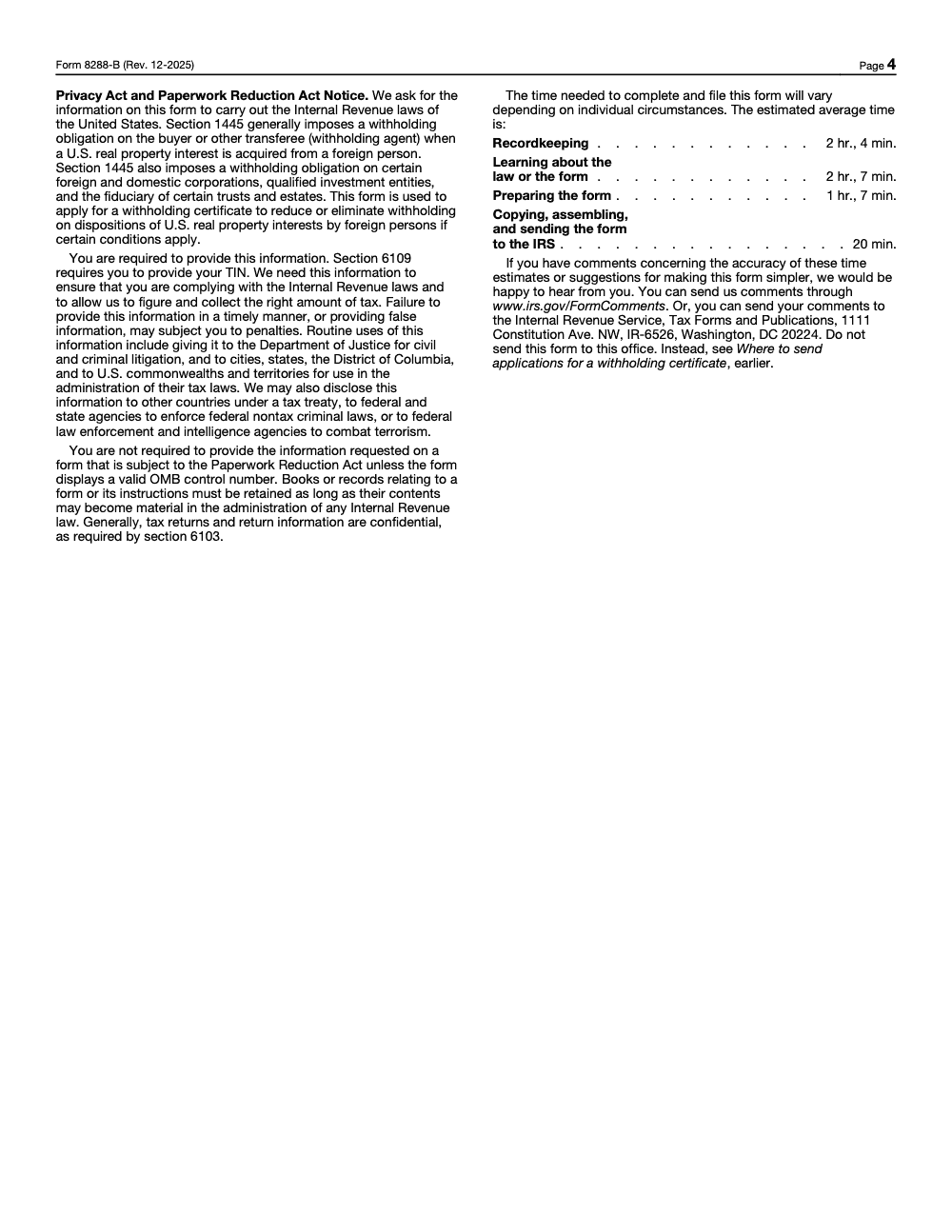
FIRPTA timing is the recurring source of trouble on 8288-B work. A complete application takes about 5 hours and 38 minutes per filer to assemble (per the IRS burden estimate in the December 2025 Instructions for Form 8288-B), and the IRS only starts its 90-day processing clock once a substantially complete packet arrives. Most rejections trace back to a single missing attachment, a P.O. box on Line 1, or a maximum-tax calculation that quietly omits depreciation recapture, and every one of them resets the clock with a closing date already on the calendar.
The fix is to treat every 8288-B as a workpaper deliverable, not a one-page form. Build the packet around the line numbers, lock the evidence file before mailing, and run a two-stage review so the closing team and the IRS are reading the same numbers on the same date.
- Lock the Line 7 basis early. Decide whether the application rests on Line 7a (exemption or nonrecognition), Line 7b (maximum tax less than required withholding), or Line 7c (Rev. Proc. 2000-35 installment rules) before drafting, because each basis carries a different attachment set – five items for 7a and a six-item maximum-tax computation for 7b, per the Form 8288-B instructions.
- Pre-stage Line 8 evidence. Pick from the eight permitted Line 8 evidence types named in the IRS instructions, such as a pre-1985 acquisition, a copy of the prior Form 8288 with payment proof, a contemporaneous nonforeign certificate from the prior seller, or a signed residence-use perjury statement when the prior acquisition was at or under $300,000.
- Use street addresses on Lines 1 and 2. P.O. boxes are banned on the transferor and transferee address lines (Line 5 is the only line where a P.O. box is allowed, and only for the return-mail address), and the IRS rejects packets that miss this rule as not substantially complete.
- Calendar the 20-day remittance window. The buyer holds the full 15% withholding until 20 days after the IRS mails the certificate or denial, so the closing team needs the same trigger date on its remittance reminder that the tax preparer keeps on the workpaper.
- Mail to Ogden, not Washington. Form 8288-B applications go to Internal Revenue Service, P.O. Box 409101, Ogden, UT 84409; the IR-6526 Washington, DC address printed in the Privacy Act notice is for burden comments only and packets routed there sit in re-routing limbo.
When application volume spikes around closing season, the same workpaper discipline that protects a single filing also protects review hours across the team. Our U.S. tax preparation production model wraps these steps in documented SOPs, structured workpapers, and a preparer-to-reviewer cadence so the IRS sees the same complete packet on the first attempt.
FAQs
It is the IRS application for a FIRPTA withholding certificate. You use it to cut the default 15 percent withholding to an amount that better matches the foreign seller’s expected U.S. tax. You still file a U.S. tax return for the year of sale.
Yes, buyers are usually the withholding agents. They file Form 8288 with Form 8288‑A and remit the withheld amount. If a certificate is pending, they hold funds and then file and pay after the decision window.
Plan for about 90 days from the date a complete packet reaches the IRS. Incomplete submissions, amendments, or blanket requests can take longer. File early and keep escrow in the loop.
Yes. The seller files a U.S. return to report the disposition, reconcile the final tax, and claim any refund if the withholding exceeded the actual liability.
Yes. Attach a completed Form W‑7 and required identification to your 8288‑B packet so the IRS can assign an ITIN during processing. When an ITIN is needed, mail the combined Form 8288-B + Form W‑7 package to the address in the Form W‑7 instructions, not to the Ogden FIRPTA P.O. box.
In many cases, yes. Section 1445(e) treats certain distributions as deemed dispositions of U.S. real property interests and can require withholding. If the calculated tax is lower than the default, you can request a reduced amount with Form 8288‑B.
Other forms this guide names
- Form W-7: ITIN Application Guide, Requirements & Documents
- Form 8288: FIRPTA, 1446(f), 20-Day Filing Guide
- Form 2848: Guide to Line 3, Filing, and Rules
- Form 8288-A: FIRPTA and 1446(f) Withholding Credit
Summarize this article with AI
About this guide
Accountably helps US CPA, EA, and accounting firms hire trained accountants and tax preparers in India.
About us Reviewed byJugal Thacker, CPAFounder and CEO at Accountably
A Washington-licensed CPA with 7+ years inside US firms – PwC, a real-estate tax practice, then a full-service firm, rising from reviewer to manager to advisory. This article was reviewed against current IRS guidance for the 2025 tax year and updated for filers preparing late returns, amendments, and 2026 estimates.
View profile →How we research, review, and update this guide
Every Accountably guide is researched against primary IRS sources, reviewed by a U.S. CPA, and refreshed as guidance evolves. Read our Editorial Guidelines to see how we source, fact-check, and update our content.